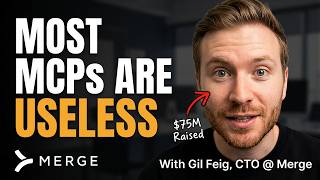
In this interview, Gil Feig, CTO of Merge, and two interlocutors explore the dangers of desktop AI agents like OpenClaw, emphasizing the severe security and permission risks when such agents have unfettered access to a user's machine. They describe how Merge mitigates these risks by double‑syncing permission data and recommending sandboxed or isolated hardware for running agents. The conversation shifts to the shortcomings of publicly available MCP (Machine‑Control‑Protocol) servers—poor tooling, unreliable APIs, and weak authentication—prompting Merge to rebuild integrations from scratch for robustness. Feig explains the concept of a context graph, a dynamic, graph‑structured knowledge base that supplies agents with just‑right information without overloading them, drawing parallels to GraphRAG and knowledge graphs. The discussion then broadens to the impact of AI on software engineering jobs, with Feig acknowledging a potential decline in demand as AI coders improve. Finally, they touch on futurist ideas from Ray Kurzweil’s "The Singularity is Near," debating timelines (2029 for AI surpassing human intelligence, 2045 for human‑machine merger) and the societal, economic, and governmental challenges such a future may bring.
Chapters
How much time software engineers have?
AI is a better coder than most engineers I know. It does make some mistakes here and there. It's not perfect at everything, but at this point I've seen such an inflection point in the growth of sort of intelligence of these agents that I'm not here to say it's not going to happen anymore. So I think the answer is like the gap is closing because you won't need software engineers.
Is that your doomsday prediction for software engineers?
Yes, absolutely.
Imagine you had the smartest possible person on the planet, right? And you go up to them and you say, which of my customers were upset last year? Right? The question is like, does doesn't matter how smart they are, it's also a sense of knowledge. It's also, do they have the data to go through to actually decide? With OpenClaw, the equivalent would be you go, you open your laptop, you put in your password, you go up to someone random on the street and you're like, here you go, take this and feel free to do what you want. They can always go rogue. And going rogue, when someone has unlocked access to your computer, that could mean going to a browser, going to a website that you have your password saved on, logging in. Permissions are really difficult when you sync the full dataset a third party, you need to make sure that employee A, who just joined the company as a new grad, is not able to see the board deck from your last board meeting, right? So what we do is we rebuild the permission sync twice. So we sync all of it in one engine. We have another engine that was built by someone who did not see the original codebase and also syncs those permissions. I always think of— not to bring this up, but I always think of that ship that hit that bridge in Baltimore and how for 10 minutes you could see it was going to hit the bridge. Everyone knows like this is going to hit, but but there is nothing you can do. This thing is just going, going, going. So I, we had to immediately talk to our whole company about why you can't be using things like, like, um, like OpenClaw. And there's a lot of reasons, but notably it's a computer use agent.
So this is different from a lot of like enterprise agents that run in the cloud.
You're basically— Would be you go, you open your laptop, you put in your password, you go up to someone random on the street and you're like, here you go, take this and feel free to do what you want. It's not quite as bad. Maybe you're passing it to someone who's semi-trusted on the street.
Why?
Because there are some controls in place, but it can always go rogue. And going rogue, when someone has unlocked access to your computer, that could mean going to a browser, going to a website that you have your password saved on, logging in. What if you have iMessage on your computer and you have two-factor auth with your bank? Like, Boom, it goes, just logs right into your bank.
So the risks are so immensely high right now of what you're inherently just giving this thing access to.
Even if you try to lock it down, a lot of people just don't know enough to be able to do this. So our advice to our team has been, unless you are sure of what you're doing, just don't bother with OpenCall right now. Everyone, if you are going to use it, you should be using it on like a sandbox.
So that would be either like, I'm guessing most people here don't have this, like a virtual machine set up, something of that sort, something containerized, privatized. Or the other option is on some brand new side computer that you just want to mess around with. But you should assume that any services or anything you log into on that machine, you're giving an agent full access to do whatever it wants with.
Yeah, I heard that computer, new computer prices has gone up.
Oh yeah. And that, that all of the, what is it? The Mac Minis are selling out.
The Mac, yeah, Mac Minis.
What's funny too is at Merge, we have, we have the old company devices that we recycle, but we give our employees a chance to buy them at a very low cost if they want them before we send them to get recycled.
And it used to be like not a lot of takers, a lot of them did end up getting recycled, but now like they're all getting purchased. As soon as we get one decommissioned, people buy it.
Speaking of MCP, a lot of people has been talking about MCP since last year. Um, and I remember you said something like most public MCP servers aren't enterprise grade.
Mm-hmm.
And why is that?
I think there's a mix of things. So I think it started with marketing.
Everyone just wanted to have something out there to, to kind of be first to market, speed for an MCP and all of that.
And I think the problem was they didn't expose a lot of tools. They didn't make things super reliable.
They didn't test really deeply.
And so ultimately you end up with all these tools out there that people tested once and were like, this doesn't work super well.
I'm not going to use this.
Also, auth is not super easy with MCP. And so actually getting connected and making it all work is just difficult.
And yeah, that's why at Merge we decided like one of the most important things here is tool reliability. And how we've done that is, is we build out all of the integrations from scratch. We don't use any official MCP servers. We rebuild all of them.
We cover all tools. So we basically cover anything that's needed for common use cases, because again, we've become experts in this space over 6 years.
And then lastly, we train over all of the ticketing data that we have from customers who have ever reported bugs or edge cases. And so just off the bat, these integrations are just built to be extremely robust and handle broad use cases. I think unfortunately a lot of the APIs at these big companies haven't been touched in years. And so you have people trying to tack on MCP servers with no real connection to the problem.
And that's why you see that. And actually you have seen some platforms release much better MCP servers.
They've gotten better over time, but it's still a huge problem. The vast majority are unusable.
Can you explain what is MCP in a very simple language for just in case people don't know what it is?
Yeah, I think the easiest way to think about MCP is it's like an API built for agents.
It's not, that's not like 100% exactly how someone like deeply technical would describe it.
But if you want to think of it that way, it's basically just a way to expose access to a third party directly to an agent. So the context graph is this notion of, it's kind of what I described, right? You have so much context you potentially want to pass to your agent, right? So that could be, let's just use an example here. Let's say that We have built some sort of enterprise knowledge search for our company because I've used that example a couple of times here. So we want to go, we want to ask, who is Gil's manager? There's a lot of ways to get this information, but what we also know is that in the context we pass to the agent to answer this question, we don't want to answer when was Gil's last vacation, right? But that is data that's valuable to have and potentially pass to an agent. So a context graph is essentially a sort of structured It's a data structure, we call it. It's a graph. And what that means is you have pieces of information. Gil, I am likely connected on this graph to another person who is my manager and maybe my reports.
So you can think of that almost as a tree, which is like a graph.
And so then when, you know, a certain question is asked, you can go into this graph and you can follow between all the links. You just go to all the nearby data that seems similar, and that helps you gather the relevant information. So that you don't pass too much context to your agent, but you pass just the right amount to answer the questions that are being passed in. So context graphs are sort of an underlying infrastructure feature that most people probably use in their day-to-day when using AI and don't even realize it. And it's used for local context. So what are things that I've asked before?
What are corrections I've given the agent in the past so that it knows not to do?
You know, there's a lot of that, but then it's also third-party data about my company.
It's all of my knowledge base information. It's all of my HR information, my ticketing information.
All the tools that my company's using, accounting, ERP.
That sounds very similar to a knowledge graph. So the GraphRAG approach for getting the right context.
Yes, it is very similar to a knowledge graph.
There are some key differences. There's, it's more living.
The data's changing constantly.
It's optimized for different relationships and all of that. But yeah, in a lot of ways it's very similar to a knowledge graph. I think everyone needs to get smart on AI. It's like it's the second industrial revolution, or it's the largest probably industrial revolution. And that means reading about AI. And there's a book that I read a long time ago that has held up to be like true, which is why I'm about to read the next one called The Singularity is Near. And it's basically about how we are approaching the moment. And I think that like it was written in early 2000s or something. And they quote 2029 as the year that like the singularity being the year that So I think 2029 was like what they predicted. I could be wrong about this, but what they predicted is like when AI reaches or surpasses human intelligence. And then 2045 or something is the year of the singularity, which is when humans and machine technology merge. And it's so weird because you're seeing things popping up that are like this. Like you have Neuralink, which is the chip in your brain that can help. And AI is getting good enough and Neuralink can run AI. And so we're getting to this point where it's like, Things are starting to come true from there. There are some wild outlandish claims in there, and it's a cool book for that reason.
I like that.
It's like a thought experiment and a lot of it is not true and a lot of it is true. But I think this claim around the singularity is really interesting and I love reading about these things because it helps you realize what the art of the possible is with AI and where things are gonna go, whether or not you believe every single claim or guess in that book.
That's a really good book. It seems like you are seeing firsthand it's happening now, right? Yeah. Yeah. Do you think that the time is about right? 2029, 2030?
It's weird. It's weird.
Yeah.
Are you prepared for this?
What can one do to be prepared? I, the things I've read are like, make all your money now because you'll never have a chance to make money again. Oh yeah. Just so scary. I don't, I think a lot of this is a little bit crazy. I think wherever you are on the political spectrum, you're gonna see that there's jobs are gonna be hit.
And so there, there's gonna need to be a government intervention in some way here. I, no one knows exactly, but I think everyone is pretty fearful of a post-AGI world.
Not even creativity? Do you, you don't think we can beat AI with creativity?