How Close Personal AI Employees Actually Are | Ali Parandeh, O'Reilly Author
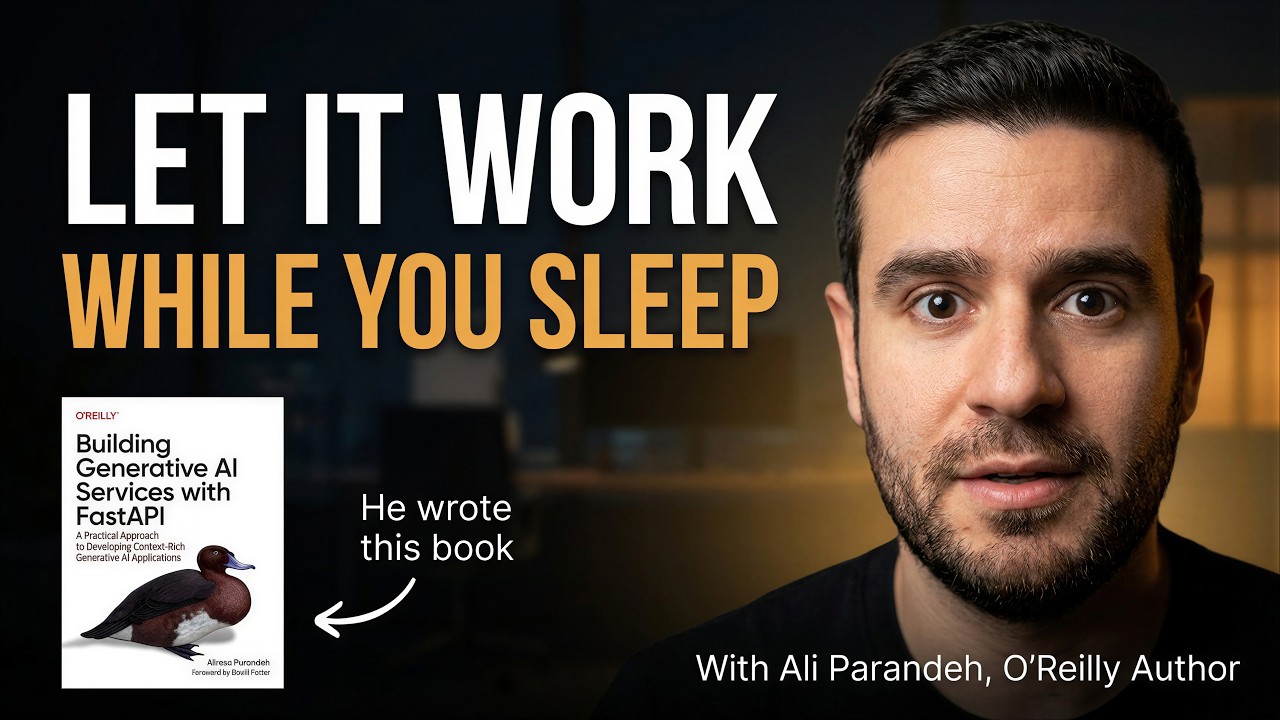
In this YouTube interview, host Angelina Yang talks with former O'Reilly author and solo founder Ali Parandeh about the current state and future of personal AI agents, often called "AI employees." They discuss the rapid rise of open‑source frameworks like OpenCLaw, the excitement around democratizing AI agents that can run on a simple Mac mini and handle personal tasks such as fitness coaching, food ordering, and finance management. Parandeh warns about practical risks: runaway loops that can generate hundreds of dollars in API token costs, exposure of private data, prompt‑injection attacks, and the lack of robust guardrails. Both agree that the technology is still in an alpha/beta phase, with early‑adopter meet‑ups and experimental use‑cases (e.g., automated investment decisions) but not yet production‑grade for businesses. The conversation then shifts to how solopreneurs can build an automation stack. Parandeh outlines a minimal set of cornerstone tools – a general LLM assistant (Claude or ChatGPT), a knowledge‑base like Notion, transcription services, and workflow automation platforms (n8n, Make.com). He describes his own workflow: using Notion for knowledge management and document generation, Claude for AI‑driven copy, Copilot 365 for expense handling, Figma + Figma Make for UI design, Relume.ai for rapid web‑page generation, JetBrains AI for code animation, and occasional use of Lovable, Motion AI, and custom Claude‑generated code. He emphasizes the human‑in‑the‑loop approach: AI produces drafts, the user quality‑controls and signs off, preventing over‑reliance. Parandeh also reflects on broader societal impacts: AI can erode critical‑thinking and calculation skills, similar to calculators, and may lead to dependence in education, hiring, and high‑stakes domains like rail safety. He advocates for AI‑assisted safety layers rather than full replacement, and stresses the need for standards, guardrails, and training to avoid complacency. The interview ends with thoughts on future marketplaces for AI employees, the evolution of frameworks (LangChain → Pydantic AI → OpenCLaw), and the importance of balanced, responsible AI adoption.
Chapters
People are letting AI run overnight, building products while they sleep. That's my dream too. What do you think?
Anyone can have your own AI agent sitting in your house doing work for you automatically. My friends who set this up as a fitness trainer, it even orders him delivery food. I'm not using it myself. If it goes off tangent, it can cost you hundreds of thousands of dollars. In APR tokens, someone racked up $800 of costs because the agent ran into a loop and couldn't decide to stop.
We have Ali Parandi today. He was on the show before and we were talking about live coding and building production AI systems. Since then, he's left his job and started his own company. Ali, welcome back.
Thank you very much for having me.
OpenCLaw. We know it exploded, right? 250K GitHub stars, employees are installing it on their work machines and connecting to corporate systems. People are letting AI run overnight. Building products while they sleep. That's my dream too. What do you think?
I mean, it is extremely exciting times. Um, a lot of people are feeling becoming like builders right now. They are building their own AI agents. It's becoming more democratized, like anyone can do it these days. You can have, you can have your own AI agent sitting in your house doing work for you automatically. And all you need is buy yourself a Mac mini or a mini, mini computer that can run these AI agents and People have found they can unlock a lot of free time for themselves on doing their admin for them, doing their finances, doing all sorts of various tasks, like setting up their own personal assistants where it's connected to all their internal systems and they can essentially just talk to them on WhatsApp. And I have one of my friends who set this up for himself and he, for instance, use it as a fitness trainer. So he just sends him a message and says, oh, I've got this in my fridge. How can I, what do I, how do I make for today? Or I'm going to the gym. What should I have for workout plan? And it's very personalized to him because of the way he sets it up. He even orders him deliverable food and things like that from, from these delivery apps. Yeah. So it's, it's, it's crazy times we live in.
Are you using it yourself?
I'm not using it myself. No, because I, I, I have my own set of apps that I use and I don't use it myself is because I don't trust it. Doesn't have any safety guardrails. And also if it goes off tangents and also if it starts going off around, it can end up costing you thousands of hundreds of thousands of dollars or pounds in API costs and tokens because these agents are not scaffolded enough that they could get into a loop and it can cost you a lot of API tokens. And at the moment, I didn't find a need in terms of how to use them to justify the need to purchase a Mac mini and set all of those things up. Whereas I normally automate my workflows with existing tools that I have access to. I'm quite happy And also I do want the privacy and the safety around that. So that's why I didn't set those open Claude myself.
Do you feel your friends are happy with it?
They're happy with it. If you're using it for personal, let's say if you're not running it for a business or anything like that, and you're setting it for personal and you're happy with the risks, then you can set it up for your personal agent. Also, sometimes people may not necessarily want to pay subscriptions. That's one of the main reasons they pay per, they set up OpenCLow because they pay per token instead of paying a subscription. So you still need to connect it to some form of API. Most of the time people are using connecting into Claude API or OpenAI API, but it's still, you're still paying by tokens. Um, if you're a heavy user and you're paying for pro subscriptions with these tools, it might actually be more cost effective to not have a subscription. And use OpenCLaw instead, especially because it has tool use and most of the time it does a good enough job.
Even with using a Mac Mini, it doesn't, for any, even for personal use cases, you're still going to expose your information and your privacy stuff to it, right? In order to make use of it, like, you know, let it access my Gmail, then I'm exposing all my Gmail to To the tool, right?
Yeah, especially if you're going to be putting it on the internet so you can use it through WhatsApp. These days, there is normally this, there is a kind of double authentication in place where you need to double authenticate with that agent to use it, but it's not going to be in a vacuum. There might, there are attack vectors available to them. Most people try to put guardrails around it by putting some system instructions to follow those, it's called like very light alignment guardrails, essentially, where you're providing system instructions to not hallucinate, do not do X, Y, Z, and maybe even more descriptive than that. But it's still prompt guardrails are not as strong as actual guardrails that you put in as input and output guardrails that you may build in an enterprise agent alongside real authentication authorization guardrails around your MCP servers. Or a model context protocol servers where the agent can communicate with to interact with tools.
It's still, I don't know what stage we should call it. It's alpha beta stage that is still developing. Right.
I think, I think at the moment there is a hype around it. Right. There's still some time before it becomes more adopted. Big, big players are starting to adopt the standard and start using it. There are massive meetups happening around it. There's a lot of Early adopters starting using it. Like for instance, there was a meetup I read about that people in that meetup have used it to automate certain investment decisions, like especially for stock markets and a lot of personal use. So for people who are a bit more adventurous and are actually like, you know, installing it on their systems and playing around with it, they have found really interesting use cases. Whereas before, for instance, people would sit down and create automations in n8n or in make.com. In these kinds of platforms, create like multi-agent orchestrations, whereas now they're doing it in, for instance, OpenCLAW, because it's more like an open source framework for these things. And it provides more integrations and abilities to perform various different tasks.
Do you think this indicates the up and coming truly autonomous AI employees?
Potentially. It depends. I think for it to obtain better adoption, they need to solve— standardize the security layer and the safety layer much more significantly. The problem with some of these agents is they can end up exposing API tokens. They can end up exposing your system inadvertently, or they can be manipulated using social prompting or prompt injection, various different attack vectors that could cause problems. And especially with people giving access to their agents to social platforms like Multibook, which is more like a Reddit for AI agents, and they just let these agents go wild on that system. There could be all sorts of vulnerabilities, and there have been significant CVEs raised for OpenCLaw as well in the past, like confirming these vulnerabilities at really critical stages. It has been one of the main reasons I've not been using it because even for my personal laptops, I have a lot of personal information on there and I don't want to install any system that has access to personal data or various different reasons, especially when I'm working with clients or anything like that, working on work laptops and work computers, definitely it's a no-go for these systems. And you can't really suggest it to any clients because unless they're going to run it in some kind of vacuum isolated network, it's going to cause problems for them. And there's also a maintenance overhead. Not even talking about the code token costs. You know, I shared you a link where there was someone racked up $800 or $300 of costs because their OpenAI agent, sorry, their OpenCLAW agent ran into some kind of loop and couldn't decide to stop. Get out. Yeah. That's crazy. And you don't want to open your billing account and be surprised with a $300 bill. You might as well just pay $200 every month to Claude or to OpenAI and just like go crazy on the usage if you want. It's good enough to give you Things that you need, and you can also build agents on top of that if you want.
When do you think we'll actually be able to hire a reliable AI employee?
Hire? You mean like from a marketplace? I think there might be, there might be some entrepreneurs creating marketplaces for AI employees where you go in and start using someone else's AI.
Yeah.
There might be these ecosystems coming in, so I can see that happening. And I think it would be useful. It's like similar to the GPT store in OpenAI and ChatGPT. or the skills hub for Claude where you can like get skills. Uh, you know, like for instance, in Notion, you can go to the template or Figma or Notion. They have community stores where you can download templates or things like that. It would just be like that. Someone else builds an agent, connects it to certain services, and you can start using it. I've seen that Notion as well is going down that route where you can now install and configure custom AI agents in Notion. And it already comes with preconfigured integrations where you can integrate it to major systems like your like your Google Docs, your Google Workspace, your MS 365, Microsoft 365, and even add your own MCP on top and customize that engine with a system prompt. And I honestly, I found these third-party tools like really interesting and really useful because like, and software like Notion, for instance, if you build custom agents in it, it's got all the security infrastructure in place. They've got ISO 27001, 9001, they've got SOC 2. Um, like I'm more confident putting more, uh, putting sensitive data in Notion because it's got all the standards and security infrastructure and I can back that up, back that data up and I can use their API to integrate things compared to, um, an open source where I need to build the entire infrastructure myself and, uh, basically spend more time doing that than actually running a business.
Yeah. It will only become more powerful though.
Absolutely. It used to be like, for instance, before to build agents, you had to use LangChain, LangChain framework. Then Pydantic AI came in, like learning lessons from LangChain and creating a framework for building AI agents in Python. And now we have OpenCLAW. So it's like the next revolution. But as I, as you said, OpenCLAW sits somewhere between alpha and beta stage at the moment, from my opinion. So it's not something you want to use production grade in your business.
But it's coming.
It is coming. If you're a small business, you're an adopter, you're sort of a nerd, definitely something to look to play with to actually start using it. Maybe I should start using it, but play around with it and figure out like which workflows may not necessarily be super sensitive that I can start putting in it. But honestly, I didn't need to, I didn't find the need to like everything, every day-to-day workflow, like with emails, with tools, there is third-party tools I can subscribe to that doesn't cost a lot of money. Um, that does the job way better, or there is a custom agent I can build in Notion for myself.
Tell me about it, right? Last time we talked about how AI can turn a 10x engineer into a 100x engineer, and now you are a solo founder now, and you, you don't have a team, I assume, yet. But so you must be like building your own automation stack, right? Can you share like what you're using and how does, how does it fit into your day?
Yeah, absolutely. So the first things that like normally solopreneurs or people coming into the AI space will face is there's a lot of AI tools out there. And for someone who's new to AI, it is absolutely overwhelming. There are AI cheat sheets. So I have created my own cheat sheet that I can share with you. Essentially, you don't need hundreds of tools. You need a few cornerstone tools. For instance, you do need one AI general assistant, like for instance Claude or ChatGPT, like pick your pick that you subscribe to for day-to-day conversations. That's something you can easily bring up on your phone and talk to. You do need a way to talk to all your notes and documents. So note-taking is very important for solopreneurs. Like you're going to be creating a lot of documents. You're going to create your own SOPs. You're going to, you need some kind of transcriber that transcribes your meetings so you have, you can come back into them and do actions. So Every day notes, you need accounting software, but essentially there is a handful of AI tools that you need for day-to-day work and you don't need more than that. Everything else is more like on a need basis if you want to. For instance, if you're working in a creative industry, you may need a lot of like Canva AI or like these other tools that allow you to generate images. But for most business owners and even engineers, like you just need a general assistant that you pick and that could do a lot of your workflows for you to some extent. More advanced use cases, you may go down the workflow automation tools like n8n or make.com. Make.com might be much easier to learn and then go from there. And some businesses that don't want to use a lot of third-party tools, Microsoft 365, for instance, or Google Gemini, they provide enough automations in there that allows you to build most of the— automate most of the workflows that you have to help you go forward. So I myself, I use Copilot 365 for certain, like I've created my own custom Copilots for certain scenarios. For instance, whenever I need to expense, create invoices or put expenses to clients, I use Copilot to convert my receipts into a spreadsheet that is approved by the client in a format that they like. And I can upload sensitive information into it because the data stays within my 365. But for general day-to-day workflows, I use Notion as my transcriber, as well as my knowledge management system. So all documents live in Notion. It's more like my SharePoint, and I can essentially— it has all the models available like Gemini, GPT, Claude, and I can basically talk to the entire document set. And I've structured my Notion in databases. So I have a database of documents, I have a database of customers, I have a database of leads, database of XYZ. And these databases essentially link to each other and it allows me to essentially create new records as I like and talk to all of them. And as I'm working on a document, I can talk to my AI assistant. It can also help me write the document up. So most of the time when you're working in Claude, for instance, when you produce an artifact, it just sits in a conversation, can't do much with it. Whereas in Notion, I can get Notion to like produce 50 documents for me while I'm talking to the Notion AI.
So, so for Notion, are you chatting with Claude and then generating the artifact into Notion? Is that how you're connecting it?
So Notion AI chat essentially has Claude model. It communicates using Claude. For instance, you can select the model, but essentially if you, if you ask it to create your documents, let's say you have a long conversation, for instance, for a business strategy, you can then ask Notion to create you the SOP or the Claude and just creates you a page. And you can edit the page, you can edit that artifacts, and it's very similar to the experience you get with ChatGPT Canvas mode where you really open a document and you can edit the document by talking to the chatbot.
Is it just connecting your Claude API to Notion? Is that how it works?
So Notion has their own service agreements with Claude, Gemini, these models, so the data Essentially goes through their own API. So you don't, you don't need to provide your own API tokens or anything.
Do you feel that— go ahead.
You pay a subscription fee for Notion AI.
Okay.
And it is not cheap. It's quite expensive, but essentially I think I pay like £250 a year or something like that, but I get good amounts of usage I can use it for. So you can use it to create your databases. You can use it for creating artifacts, editing documents. Reviewing across various different pages, take transcriptions of meetings, and you can, you can create your own CRMs in there. It's very, very useful. And I can, I even connect my website to Notion through their API. So whenever new leads come in, it just creates a new record in my Notion database.
Do you feel, do you feel the chat experience within Notion, even though you're using Claude within Notion, is similar to chatting within Claude?
So I have Claude as a subscription separately. And I have Notion. Notion is my main to-go-to because whenever a conversation creates an artifact, that artifact can then get generated in my Notion space in a correct database, and I can come back to it and I can search it. If I'm creating, let's say, a landing page, or if I'm creating a UI or a prototype, Claude and Claude Cowork are very useful because with Claude Cowork in the cowork mode, You can point it to a directory and it can just literally create on that directory documents on your file system. Whereas Claude itself can create you like prototypes and artifacts that loads in your browser. So if you're creating, let's say, utility tools, let's say you want to merge a bunch of CSVs and text files, and there is no, you don't want to download anything and you don't want to upload stuff to an online website to do that utility. You can easily create yourself a utility tool using Claude. And it should, it can just give you an HTML file that sits on your computer. You open it up in a browser and it allows you to easily upload files and the files don't go anywhere. It's just on your browser and it allows you to like merge those files together if you just want a really quick, simple utility tool or some kind of dashboard or anything like that.
Yeah, good point. It's just my experience is like, you know, the third-party tools are integrating with Claude or OpenAI. They're, they're, they're somehow behind the scenes calling the API.
Oh yeah.
The issue with the, you know, calling API versus the chat experience is the chat experience within Claude or ChatGPT. I noticed they have a lot more optimization within the chat that doesn't just come with the API calling. So I stayed within the Claude space ecosystem for that reason.
Yeah.
Yeah.
The Claude desktop app itself will have ability for you to add your own custom MCPs or anything like that. But I would say some of the other third-party tools are getting way better. They allow you to switch between models. So for instance, Gemini might be really good at image understanding. Claude is really good at copywriting. ChatGPT might be really good at strategy planning or anything like that. So different models might have slightly different strengths. So you may want to switch between them. Having a third-party tool that allows you to switch between APIs is normally useful for this type of tasks. Especially with Notion, like dropping new features like meeting transcriptions, I don't know, like ability to generate images inside your documents, ability to create databases, summarize things, all of those things inside one tool is normally good because you don't want to keep switching tasks and contexts. And for people who work in Google Workspaces, they have Gemini, they, and Gemini and Google Notebook LM, and that allows them to essentially have the Notion experience but in Google Workspaces. Microsoft is trying to do the same with Copilot, but I would say Microsoft is still a little bit behind because they have a lot of legacy infrastructure and they're trying to comply with enterprise-grade guardrails, and that's gonna slow them behind. At the moment, Copilot is not producing the same level of quality and output that third-party tools does. That's just where Microsoft is. They have a lot of legacy infrastructure like Microsoft Graph API to integrate with, so you can't really talk to your documents in SharePoint as well, but they do provide you tools like Copilot Agent Studio that allows you to build custom agents and connect them to the web, connect them to create deep research agents, things like that.
What else do you use other than Notion, Claude?
So I use Figma and Figma Make. So because I do design user interfaces, I do presentations, all of my training slides, for instance, I do them in Figma. The reason being is that Figma allows me to adjust the tone of the content on the fly, allows me to generate presentation notes, allows me to generate images for slides. And it comes with really good templates that easily can make really super nice looking templates in Notion and Figma. It has a FigJam product that allows you to do whiteboarding. So for instance, when I run workshops, people create, especially when they're online workshops, people, I can give them access without a login to that Right. Whiteboard. They can drop sticky notes, do brainstorming, and then they can highlight all of those sticky notes and arrange them by topic or arrange them by, sort them in any way you like. And I all use AI to do that. And it's very useful for like quickly extracting value and extracting patterns from those sticky notes.
You're not using Gamma for slides or the—
At the moment, no, but I may look into Gamma as well. I have been essentially recommending Gamma to a few clients to use because they were looking into presentations. However, I think it depends. It depends on the use case. Like if you're new to slides completely, like making them look good, yes, use an AI tool like Gamma. I feel mostly confident with making good slides manually or semi-manually. So I've been sticking with Figma. I didn't want to rack up a lot of subscription costs. But one thing I really like about Figma is the Figma Make, which allows me to produce really good looking user interfaces for prototypes. When I'm trying to show to a client, for instance, a vision that I have for an app that I could build for them. Or even when I'm iterating over product ideas with users, with potential users, I just send them, I just go have a bit of back and forth, like 50, 60 turn conversations with Figma Make, which under the hood uses Claude again. But it's Figma because it's a UI tool. It has a really good understanding of UI principles and it can make really nice looking UIs. Compared to other vibe coding platforms.
And Lovable. What about Lovable?
Lovable allows you to build full apps, but the problem with Lovable that I've been telling people about, so I had a, I had one of the past clients approaching me. They wanted me to help one of their friends. This friend was a teacher. She had built a whole app in Lovable connected to Supabase database and fully working. They wanted to start selling the app to schools. And the school wanted enterprise grade. And she, she had no idea how to code. She was mostly vibe coding the tool. The school wanted her to deploy the app into Google Cloud or Microsoft Azure. And she had no idea how to do it. And Lovable doesn't let you do that. Like you need to switch the database to Google Cloud SQL. You need to deploy it into containers. None of those things she can do because it's completely different. Like Lovable doesn't let you do that. Lovable just creates you Supabase because it's super easy to create databases. with it, then it provides an easy API to work with.
If, if you're a developer, can you move, uh, Lovable to, you know, the, the stuff that you build from Lovable to, uh, a proper tech stack?
Yeah, if you can export the codebase, you will need to rewrite all the connectors for database. So the database connector to Supabase will need to be rewritten. All the ORM logic, object relational mapper, all of that will need to be rewritten to work with Google Cloud SQL, and you need to containerize the app itself into Docker containers where you can deploy them into Cloud Run or App Engine. Also to learn the cloud bits, like understand what Google Cloud is, understand how to deploy there. But the main benefit of vibe coding, like for instance, this UI tool that I, UI prototype that I did when I'm validating my product idea, it's all done with Figma Make. It uses React code, but I can download all that code and reuse them. I mainly need to just adjust them and connect them together in exactly the architectural patterns I like to make it more maintainable, but it's really good code. Like even my website, I used AI tools to create it. Even my own website that I reskinned and recreated, I used AI to write the copy and help me iterate over the copy. So I spent 2 or 3 days with Motion AI to create the copy for my website, make sure it's tight and neat and it's really good and it follows a 21-step, uh, Then I used Relume.ai, so R-E-L-U-M-E.ai, to essentially iterate over various different designs at scale on different sections. So I have like 100 hero section designs and it generates the entire copy for you. So you can easily see like how it looks like.
It's crazy.
It then generates the design system. All of that is AI generated. And then once I'm happy with that, I then export the React code for each bit. I then string them together in my professional IDE, integrated development environment, like VS Code or PyCharm.
Right.
And then in PyCharm, I use JetBrains AI to help me, for instance, to animate those sections. So I get JetBrains and I tell it, use, for instance, Frame Emotion to fade in the hero section, the hero title, add like a typewriter effect into it. Like when I load the page, like have delays around animations, like this animation is to come in first from this side, then that one is to come to insert when you scroll down. animations need to pop up. So I don't sit down and do the animations, which is mostly CSS work by hand. Let's get AI to do all the CSS work.
You have to be in the middle, right? You are the human in a loop from one step to another. You're, you're in between Figma Make, Relume, JetBrains.
If you have experience, you know how to string them together in like a pipeline. It's like a, like a manufacturing pipeline. Like you design the pipeline and then you get the tools to do the actual grunt work. But you are quality controlling the outputs between each stage. If you just get the AI to do the entire pipeline for you, you're not gonna get 100%. You're gonna get 70%, 80%, maybe if it's very optimized. Most of the time you're not gonna get something you like. It's just gonna, not gonna have your signature on it.
Mm-hmm.
Whereas if you are quality controlling the pipeline, then you can use different tools or you can use the same tool. You can get the quality you want. And the main thing is you don't wanna delegate your entire thinking and your entire craft to AI tools because first of all, you lose your communication skills, you forget what you've done, and also your critical thinking skills, you're going to start losing it. Look at people doing multiplications right now. If you go and sit in a restaurant and you need to split the bill, can you do it in your head? These days you can't.
That's a really good question.
Calculators have made all of us really bad at mathematics now in our heads. We have to rely on calculators and ChatGPT is like that for language. It's still worth spending time actually learning a craft manually. So doing things that don't scale in the beginning. So like, for instance, the other day I had to learn video editing with CapCut because I started doing more videos for social media and it was my first time video editing and CapCut provides a lot of AI features, for instance, with eye adjustment, with cutting, ums and ahs, filler words from the video and all of those things is AI driven now. And I was sitting down and literally learning it and I spent like 3 hours doing a 10-minute video, but I knew that that 3 hours that I spent learning video editing by hand will then allow me to speed up much faster down the line with editing for future videos and understanding how, what AI does and quality controlling that.
I've been doing video editing for 2 years, no video editing experience. I still spend 3 hours on 10 minutes. I can tell you.
I know it's such a pain. Like I've been, I've been following like the market as well to see like new video editing coming tool. There was a guy that I follow, his name is Daniel Priestley. This guy has launched many SaaS apps. One of them is called Scorecard where you basically—
I want to use it. I'm very tempted. Yeah, I want to use it.
I didn't go with that. I created my own scorecard. It's not a SaaS app. It's basically for my website. I said, okay, I want something like a scorecard, but I don't want to pay Scorecard. What do I do? So I just created this quiz with HTML, CSS, and Claude did all of that for me with my design system that I give it. So I just copy pasted the entire CSS of my website into Claude and I said, okay, go build me a design, go build me a quiz with reporting. And the questions need to be like using this framework that Daniel Priestley teach, which is 10 questions on best practices, 10 questions on our current reality, 10 questions on ideal reality. And it gives you a report. I learned that framework and then I used AI to generate the questions and I then go and edit the questions and create a quiz and lead magnet essentially using that and on this, make sure that the reporting and all the questions actually make sense in the context.
This is the most valuable thing, right? Is the frameworks and the way you think. It's actually not the coding part, right?
The coding part and the generation of the copies and stuff, you don't need to become a copywriter anymore. You can use Claude, which is the best copywriters to help you with copy, and you can still own the copy. You still have to sit down and learn copywriting to some extent to make sure that it's not hallucinated or anything because these models hallucinate all the time. So you can't really just trust them out of the box and you want to put your own voice and tone to it, but, and your own domain expertise. But these days as a solopreneur, you don't need to hire an entire team. You can literally do all your marketing, all your sales with using AI tools. You could have AI employees essentially. And there are companies like Coursera that have scaled to millions of users and millions of pounds in revenue per month, sorry, per year, just by using, just with only a few employees because the rest AI does some of the job. And solopreneurs are also building million-pound businesses just using AI tools.
I'm looking forward to reaching that.
Yeah, me too. So yeah, I'm using a lot of AI tools for various, like whenever I have grant work to do, I ask myself, can I use AI? And then the other thing I ask myself is, is it better to use AI or is it better I do it manually in the early stage?
For instance, right? You actually ask that question?
Yeah.
You actually ask that question?
Yeah. I mean, it's not like I sit down and go through a checklist. It's like in my head, I sit down and for instance, I need to write a mission statement. Should I use AI? And I like that kind of stuff. You need to sit down and think. You don't want to delegate that to AI. So I have a go at the thinking process and when I hit a roadblock and then I get help from the AI to ask me questions and do back and forth to finalize it. That's my workflow. So I always try to put down my own head, then use AI to enhance it. Not the other way around. Only when I'm clueless and I use AI, like for instance, if I'm writing a copy, I'm not a marketer.
Mm-hmm.
So copywriting is new to me and I need to sit down and spend Probably 3 years in studying copywriting to become really good. So in those areas, like for instance, I put, I have an attempt and then I use AI to help me enhance the approach. But essentially you need, you do need to obsess over the quality by spending manual effort on the output, on the artifact. And once you figure that system out, then use AI to scale it a bit or enhance it and find the gaps. This is more like AI is a thinking partner.
Absolutely. Yeah. I was interviewing Jay Alec, who's a LinkedIn coach yesterday, and we were talking about people, people throw everything to AI first and that AI-first thinking is slowing our own thinking down, just as you said, like, you know, we can't do calculation, we can't talk anymore. I don't know how to talk.
I mean, there was the MIT study that was done on the productivity. So if you remember, they They broke people into 3 groups. One group could use AI and ChatGPT to write an essay. Another group could only do web searches on Google to write the essay. And another group had to use their brain. They had nothing else other than pen and paper. And they measured their brain activity and their scan of the activity of the brain group was showing a lot of red lines, which shows very high activity in critical thinking and in memory and communication. The people who were using web search had less of those red lines, and the people who were using ChatGPT and LLMs, they had like only maybe one red line or 2 red lines. Most of their brain was kind of deactivated. And this is also why they concluded that it will damage your critical thinking skills, your communication skills. And you also don't forget that you've done, you've produced an artifact. Let's say you write an email, an important email on sales calls or anything like that. You forget that you sent it. You forget what you said like weeks ago or months ago because you just used AI to reply or generate things up.
Yeah.
So it's very important to own any output that AI generates. Like you need to sign it essentially. I mean, when I teach engineers AI and they are very risk averse, they don't really trust it. Essentially, I say that AI will not do 100% of the job. It will do 80%. You don't want to overuse it. You want to use it to save you time on repetitive work, on manual work, on work you want to avoid, on work that can be automated, all of those things, right? Any work that's time-consuming, but also you don't want to go off the other side where you don't use it or go to the other side where you use it a lot and use your skills. So you want to be a bit of a mix. And in engineering, normally every artifact that gets produced, like a report, it will need to go through a reviewer process, a checking process, authorization process, and people sign their names on it.
Right.
And you want to do the same thing with AI. You want to produce artifacts with AI to help you save time, especially if you're only a single-person company or you're by yourself, but you do want to make sure that you own it. So you need to read everything that it generates and edit it and think of it as someone cooking something in the kitchen and making a mess. You go and clean the kitchen up first before you ask them to go and create another dish. You don't want to get them to keep plating dishes for you and literally explode the whole kitchen with a mess.
What about the next generation and the next, next generation? They grew up, you know, getting used to ChatGPT. You and me, we were trained pre-ChatGPT. We didn't have this. So you have to learn everything. You remember Stack Overflow? There's this website called Stack Overflow in the past, and you look everywhere trying to find answers.
But you had to like find out this in a different programming language and then try to back Yeah.
How much research we have to do to figure something out. It's not the same.
Go through all those blog posts and click on the cookie banners to get rid of them, walk past through all the ads to just get some piece of sentence after 200 lines of introduction to answer a question you might have.
Right.
I remember those days. Yeah.
What are you going to tell your kids?
I think, I think it's the same problem with social media. Social media reduces people's attention span. You actually have to actively like make yourself not bored and do practices to help you not have attention deficit, you know, like read books, write stuff down on paper by hand, like try to give yourself digital detox. It's the same thing with ChatGPT. You need to basically decide on certain activities that you're going to do it with your own brain and with your own intuition and not rely on language models because one of the main problems that it does, it makes you reliant on them on every Any small and big decision, like you want to go grocery shopping, use ChatGPT to make sure that you've done the right grocery list. You want to make big life decisions, whether to go with job A or job B, or should I marry this person? Yeah, any email you send to clients, to customers, to partners, to anyone, like any email you say, you always want to double check with ChatGPT because, because you become super reliant on these tools and you don't want that to happen. You want to cut yourself enough. Anytime you feel like you're becoming too reliant, you need to have a digital detox of language models where you rely on your own brain. Like if you're writing emails, don't use Copilot and email writers, just write it by hand, even though it wastes a bit more time, but actually you end up not losing your skills. You're not losing your intuition. Intuition is more important. Intuition is basically your subconscious mind processing millions of data points that you don't consider. Getting inputted into your brain, but your brain is processing when you're solving complex problems. And you don't want to lose that intuition because the more you rely on AI, the more you lose the intuition.
I think it's against human nature though.
It is like, it's a, it's a path of least resistance going and using AI because you just delegate your thinking to it. The only, the only valid time you want to use it a lot is if you're running against deadlines and you're pushed against deadlines and you're super stressed and you just want to get tick things off your to-do list. These incidents, these instances normally happen when like project organization not being exactly correct or where, you know, like you're firefighting. In those cases, yes, you gotta use AI to speed things up to be able to meet your deadlines, or if you're overloaded with stuff, it's better to use AI at that point to get you over those lines, but you don't want to, you don't want that to become a repeating pattern. Because then over time, it's like eating junk food.
It is.
It is. Yeah. It's like, it's like if you eat junk food a lot of times, it's going to degrade your body. But if you eat it once or twice, a couple of times, it's fine. It's nothing that's going to happen to your weight. But if you eat it a lot of times, that's when your weight starts gaining and you start losing your health. And there is a mental health as well. Then there is a brain health, which is related to, you need to start, you need to use your brain to write things down. You need to use your brain to create things because you get satisfaction from craft, especially if you obsess over quality. And if you write things down, because that process of writing will help you crystallize your vision and it will help you crystallize your thoughts. Without the process of writing, you don't get there. Like you will have a foggy vision of what you want or what the idea is. But unless you sit down and write things down, which a lot of business owners do these days, they sit down and write a business plan, even though no one else will read that other than themselves. That whole process of writing those things down, it helps them crystallize their market, where, which their approach is, what their vision is, what their mission is, that kind of stuff.
Do you have a doomsday prediction in the, in the era of AI?
So I'm, I'm thinking essentially it's not the singularity that's going to be much of a problem in terms of like AI writing its own code and like, you know, getting robots to kill humanity, that kind of stuff that you see in science sci-fi. It's not necessarily those. When institutes like Alan Turing Institute or these big, big institutions and NGOs look at AI safety, it's more about a random business coming in and starting using AI in safety-critical applications that can harm humans, that can put people at jeopardy in terms of their social life. For instance, if companies start using AI to score employees for performance and then start demoting or promoting them or making them redundant based on an AI score. Which essentially what the AI Act is trying to prevent. So the regulation in EU is trying to prevent companies misusing AI in certain scenarios. In my best opinion, the best way to use AI, not necessarily to replace humans, is to assist humans. So AI-assisted programs and software is the best use of AI, especially in safety-critical applications where AI can essentially reduce a layer of Human error. So humans can make mistakes all the time, especially when you get tired, you make mistakes. For instance, there is an automation right now with TfL where there was a DLR trains in London where someone got run over by 4 different trains at night because the trains are all automated and the human operator, normally because nothing happens most of the time, your brain kind of goes into autopilot and you make those mistakes. And the Rail Accident Investigation Branch recommended TfL to use AI. computer vision to detect if someone is on the train. So as things get more automated, humans' brains go on autopilot and AI can actually use as an additional layer of safety or assisted layer to help you find gaps, find conflicts across a lot of data and information. Like in software, AI can read all of your logs of your software and give you anomalies and critical information that you need instead of sitting down and read through like millions of There's definitely— That's where AI is very useful.
Yeah, there's definitely higher stake ones, doomsday predictions other than just our brains is going backward, the critical thinking skills. But if you think about it, the theme is the same. I think the theme is potentially overly dependent on AI, right? The high stake business, the railways, right? If they even think about it, even If they had this AI-assisted watch or safeguard, what's going to happen is the human's going to be lax, right? The human's going to be like, you know, I have AI to cover my back. I'm not going to pay attention to it. So that's the— that still can happen.
Yeah. I mean, the more you integrate AI into systems, one of the things that can happen then, yes, the operators of those systems and the people relying on it will become more reliant. They will less use their actual craft skills.
Yeah.
That's why you need to also train them to make sure they don't become reliant on it. Like for instance, sometimes you may want to use a calculator. Sometimes you may want to do the calculation in your head. And I use the calculator examples because AI is like a calculator for human information, is for information calculation, is some form of calculation of knowledge workers. Numbers, you may normally use to do them by hand. When you would go through primary school and when there was not many calculators, but now calculators, everyone just used them on their phone. And over time you become reliant and then you can't, you lose the skill, but you need to be proactive and make sure that you keep practicing the craft. So it's more of a training than to prevent and help people understand that it's like cigarettes. You don't smoke too many because you get cancer. It has lots of health issues. You want to keep the balance and moderation.
Yeah. After talking with you on, in this session, I feel like I'm gonna, I'm not, I'm not gonna let my kids use, uh, use ChatGPT too much. Like, don't use it. Yes.
It's, um, it's, the thing is they will then become, ChatGPT becomes more like their therapist. Yeah. And you don't use ChatGPT as a therapist. My girlfriend is a therapist and she hates people who use ChatGPT to give themselves self-therapy because it's not a therapist. ChatGPT is trained to make you feel good about yourself. It will essentially try to say things that make you feel like, okay, I'm feeling understood and good and stuff like that. And it makes you also reliant on coming back to it all the time and take your point of view. I'm sure OpenAI is working around guardrails, has worked guardrails around that to make it more neutral. Or if you system prompt it well enough to not do that, you can get it fine-tuned towards doing that. But yeah, essentially you don't want kids to become reliant on AI To self-validate.
Yeah. Or use it to do homework.
Or use it to do homework. Yeah. Which I think a lot of teaching organizations and universities will have this problem with. They will need to rethink their entire examination system. So similar to with calculators, they now let calculators, students bring calculators into exams. You can still do exams without having to rely, without students having access to their phone or anything like that. But When you assignments, you need to make sure that the assignments, you assume that they're going to use AI. So you probably perhaps increase the level of expectation from the output.
Yeah.
When I was a head of engineering at the previous company, I, when we hire, we give people a task to, for instance, build a dashboard on an API that fetch data or build a data pipeline. We, I would, I would assume that they're going to use AI. So my expectation from them was, first of all, It needs to be more impressive what they produce in those few days. And number 2, they need to be able to understand the entire thing. So I will ask them questions on the architecture. I will ask them questions on decisions, the trade-off and the decisions and what would they do if they had more time. And these questions normally help me to make sure that they understand what they did rather than just delegating the entire thing to AI. That's how I know that they're the right fit.
They need to do it in classroom. In person, right? Don't take it home.
Exactly. Like, uh, at the, at the end, we wanted to speed up the pace of hiring. So what we did was to replace that take-home exercise with an in-person exercise instead.
I want to, I want to run by you of how I, I'm running my automation stack. I use 3 layers. So, so first I use Claude projects with skills I've written. And then second, I use Cowork for scheduled tasks. It has limited access to some third-party tools like Gmail maybe, and Calendar, things like that. The third layer I'm thinking of is using Claude Code to build integrations outside this Claude ecosystem. That's what I'm currently using. So I'm completely staying within the ecosystem Claude, partially also because I'm doing a lot more content creation than pure coding. So I don't need tools like WingServ or Cursor or Copilot. As much.
Yeah. I mean, those are for people who do vibe coding a bit more.
Yeah.
I think what you're describing there, normally the best way to figure out how to automate the entire workflow is to map it out on a block diagram. And the other thing is to play around with the existing tools you've got and understand their limitations and capabilities and integrations that you can do and understand the level of, level of autonomy. So what you're essentially describing is if you want the entire process to be automated, you're looking at workflow automation rather than an AI agent. So it could be multiple AI agents that hand off their work to another one. Now, workflow automation tools like n8n.com or make.com allow you to automate with a user graphical interface that doesn't require as much of technical expertise, or you're looking at a script. That Claude can, for instance, produce, where there needs to be a trigger, a workflow, and an output. So you can think of your entire workflow, your entire input to output as a series of chained input, workflow, output, input, workflow, output that are connected together. It could be in a sequence, it could be in parallel. Some bits could be sequenced, some bits could be parallel. And people essentially been creating these types of advanced automations in N8N or Make.com. where AI is sitting in the middles, in the workflow middles, there are AI agents sitting down, which are essentially API calls to model providers that sends the data and then the data comes back and a certain tool gets executed and so on.
Right.
I would say like on the video side, from my, what I've seen so far, yes, it's not as automated as most, most places. There are certain third-party tools that allows you to like repurpose content or Edit it, but nothing. Yeah, it's not fully automated because first of all, video content is very heavy. It's a heavy file. It's like hundreds of megabytes, gigabytes, and uploading them, downloading them, editing them with AI takes a lot of energy and water consumption and who wants that? Generational takes a lot of energy to produce. So most of that needs to run on your laptop and most of that needs to be still manually adjusted, but Editing tools are integrating AI features in to help with the process a bit. Like you can definitely get Cloud Code to build you some kind of web-based app where it can, for instance, run all the time and it can do the entire work. What I've seen most people do is they get, they build a workflow in n8n. They, the trigger for that would be listening to a folder in Google Drive. For instance. So you don't even need to start a chat. All you have to do is upload the file into Google Drive folder.
Good point. Yeah.
It gets triggered by event. So it's called an event-driven trigger. So you have different triggers. You have HTTP triggers where an application sends an HTTP request and triggers a workflow. You have file-based triggers, like a file gets created, updated, or deleted from a Google, Google folder. So event-driven triggers. So event-driven architectures or manual triggers where you click a button.
Right, right.
So these are the 3 different triggers that you can create. Uh, do you basically, you need to design that workflow first on a piece of paper, right? Figure out how to chain it together. Figure out the edge cases for each workflow. Like what happens if it fails? What do you do? Where would it fail? Like, what do you need to validate before running the workflow? All of those things you need to plan by using your brain basically, or using Claude to help you plan it. Once you have a workflow planned out. Then you sit down and integrate it together. Now tools like n8n really helps you with that because you don't, it's a graphical interface. You can easily connect them together. It's a bit technical, but you can still do it. Um, then if you want to do it, if you don't want to rely on those tools, then yes, you can use Claude to build it. So Claude basically writes Python code and React code to do it. We keep the React will be the user interface. The Python will be the backend. And it essentially does what n8n does, but in code. The UI will just essentially give you a button as a trigger or give, give, gives you an integration to Google Drive.
Yeah.
And you just need to put that tool somewhere or make sure that tool keeps running all the time and listening.
Yeah. Thanks for helping me out. I think this is very empowering for all levels of skillset in terms, in terms of coding.
Yeah, definitely. I think one tip I would give is if anyone wants to build these workflows, start a chat in Claude, just a normal chat. Describe your idea in a dictate, dictate your idea to Claude. So you don't even need to write it, dictate it for 5, 10 minutes. And at the end, ask Claude to ask a bunch of questions about what exactly the work, what, like to help you understand a bit more about the workflow. Once you get interviewed by Claude and you provide enough more context, ask Claude to generate you Mermaid diagrams, like block diagrams, sequence diagrams, and system breakdown diagrams. And data flow diagrams. So you can ask it to generate these diagrams and ask it to use Mermaid, Mermaid diagramming language. Because it's just text, it can generate that text for the diagram, but then they get visualized inside Claude. So you can see the entire visualizations. So you don't even have to sit down and create those visualizations yourself. And that code, you can paste it into future chats or into Claude Code, and Claude Code exactly knows how to create it.
More from Angelina





The MrBeast Rule That Quietly Decides Who Wins on YouTube | Rox Codes, CEO @ Flightcast




Ask Any C-Suite This One Question About Their AI Agents | Hector Hernandez, COO @ Speakeasy
