The Question Every AI Creator Should Be Asking | Angelina Yang, Founder@TwoSetAI
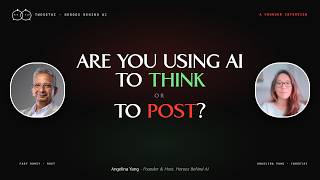
Angelina Yang, an AI researcher turned creator, argues that technical expertise means nothing without visibility. She uses Claude with custom "skill files" to automate her content workflow, but warns that AI amplifies your voice only if you have something genuine to say first.
Chapters
Let's start from language models.
Yeah, language model is simply a mathematical model to predict the next words based on so many data that the engine, the model, has seen how people talk.
Human genuine powerful storytelling. Can you see AI replacing, competing with that area in any means?
I interviewed a CTO at a company and he said the one doomsday prediction is a software engineer roles. The second one is I ask him, what about human creativity? And then who knows? I lived in China and lived in the US for almost equivalent amount of years in two countries, and my ability in language, in both language, is not optimal. And AI really helps me, including grammar mistakes, right? The way the awkward phrasing, I still do that.
One small actionable tip, what would that be?
From my perspective, the most valuable thing is you're doing something you enjoy, like building LinkedIn thought leadership or personal branding, but you stay still you. I think that's the one last observation I want to share with everyone.
And we are live again, ladies and gentlemen. Welcome to our weekly LinkedIn Live event, and today we have a very special guest and a very special, complicated, but we'll simplify that topic. Without further ado, today we have Angelina Yang, who is an AI researcher turned a podcaster and a YouTuber. So welcome, Angelina.
Hi, Fadi, nice to meet you and nice to see everyone here.
Thank you so much. First of all, ladies and gentlemen, please feel free to share in the comments where you are joining us from. We're curious to know our, our audience today. And throughout this conversation, feel free if you have any thoughts, any questions, anything, just put them here in the comments. Today's topic is very interesting because just before going live, we were discussing that everyone is using AI, yet mostly on a superficial level. This is what we will be challenging both ourselves in the conversation, but First of all, I like the intro, Angelina, like an AI researcher turned podcaster. Let's start from that. What did you do as an AI researcher? Give us a little bit of a backstory here.
I was a, a data scientist and machine learning engineer, and everybody is turning towards the AI engineer phase, right? It's like a rebranding. And what I did was mostly around algorithm research and statistical modeling. Back in the day, it's called statistical modeling, and then it's rebranded to be machine learning and then large language models. I've been working on natural language processing since maybe 2017 or 2018. So natural language processing is the precursor of language models and then to the large language models and the small language models and today's AI. So that's what I've been doing.
Let's stop here for a second. Can we simplify those terms for someone like non-technical? What does that mean? For example, let's start from language models, or can we just keep it in English?
Model is that, yeah, language model is simply a mathematical model to predict the next words based on so many data that the engine has, the model has seen how people talk, like apple juice. You're like apple connected with juice, when you see apple, it's gonna predict juice or something in that realm, or apple pie. You're not gonna say apple student or apple teacher, right? So there is a probability while you're predicting the next words. So that's how it works.
So that's a language model. What's a small one and what's a large one? Because we hear like large language models, we hear this every single day. What's that?
It's just the size. It's just the size of the model. And part of the reason that there are smaller ones is because of the compute use that's required for hosting like a bigger model versus small model. And the small models can be fine-tuned and trained on smaller and more domain niche set of data. So it's targeting a lot of time targeting smaller verticals like finance potentially.
So you said if we start like historically first, it was machine learning. What's that and what was next?
Oh yeah, machine learning. I consider them all statistical mathematical models. And in school, back in college, we probably all have learned a little bit about regression type of models, right? That's the foundation of all of these predicting the next token, predicting the next words. Or if you are given two pictures like cats and dogs and you're trying to figure out, is this a cat or is this a dog? So that's a classification model. What it does is really just trying to, based on the pixels in the pictures, and you're trying to distinguish, is this a dog or a cat? So the, all of these are probabilistic models. And so you, you are not confident. That's why LLMs are not deterministic. There's a probability attached to every decision language models makes. That's how, yeah, that's the— I was trained as a statistician, so I have to say that statisticians are not very good with, with branding themselves. Today it's branded as AI.
Okay. And then comes, which comes the more interesting part, turned into a podcaster and YouTube. So tell us about this transition. What happened?
Yeah, it was a, it's a side hustle actually. I started doing it because I realized how important, this is your realm, like personal branding, how much, how important is personal branding, right? Nobody knows about me and I'm doing like AI related products and building products in the AI space and So, how do I learn about how to build and how do I build in public and showcase my team's capabilities? So, that's when I started. And then gradually, I'm in Silicon Valley, so I have access. The first year, like when I started building on my own, I attended maybe 300 events in Silicon Valley in person, in person and online. So, it's crazy. And I met a lot of founders and founder-to-bees. And then I realized there are a lot of opportunities, a lot of learning actually organically happening in these conversations. So I decided like, why don't we just chat? Just this one, how we happen, how this conversation happened, right? We met in J-Alex's current community and we were like, why don't we chat and why don't we find ways to collaborate? So that's how it happens. But behind the scenes, I have to say the core of what I'm thinking I want to do is to tell the story that matters. As I said, I spent years in machine learning helping companies to build and sell these AI or machine learning solutions. And I'm seeing the same pattern, like the very smart technical founders, they, with genuinely innovative work, but it's hard for technical founders or technical people, engineers, to articulate what they've built. And why it matters. There's a lot of noise, right? There's always a gap between the brilliance and the visibility. So this is why TwoSet.ai exists to fix, and whatever products I'm building and what I'm working on trying to fix. So closing the gap between how smart you are and your visibility problem. So the podcast is one vehicle for solving that problem. So based on these Conversations I have with founders, engineers, builders, domain experts, I'm trying to help them articulate their thinking out loud, right? That act of articulation is very powerful. So, it forces clarity. It creates the narrative for them. And when it's recorded and shared, it becomes like a permanent record of their expertise and perspective. So, that's what I'm trying to do.
Yeah, actually, I love that and I just wrote it down because I totally agree 100%. I come from engineering background, so I totally can relate from a technical person versus like the idea of visibility, personal branding, online visibility, thought leadership. Sometimes all these terminologies are new to us if we are like a geek binary people, zeros and ones, all what we see is zeros and ones and code and so on. So you said like brilliance versus visibility. So let me challenge that. Sometimes we assume brilliance is enough. I'm a genius and this is my large language model that I built and that's the startup with evaluation like etc., etc. I don't need visibility. What do you say here?
I actually, I'm not against it. I think Depends, it really depends on your goal. Is your goal of building something and you have to go to market at a scale that you're looking for, or you're happy with what you are doing? I actually interviewed a founder who reminds me of that kind of thinking, and I have 100% respect to him. And I have to say, I feel the same way. I feel I'm the same type of person. I'm not looking for like IPO or a significant exit for doing what I'm doing. The founder is Steve Ruiz of TL Joe. So he's a designer, so fine art background, fine art designer turned engineer and then turned a founder. So he told me the story that he was building this open source library on, um, having— so when you're drawing, when people are drawing on an iPad and you have a digital ink, and then the way your pen, your digital pen is touching the iPad is not going to completely represent how a pencil or pen draw on a piece of paper, but that's what he's shooting for. So can you believe— how do you even think about to completely replicate that experience as an artist? And this matters. It doesn't matter for me, I'm not an artist, but it matters a lot for a true artist. And he's a craftsman, and I have to say that he put that craftsmanship into the product that he's building. So it's amazing how much effort, like the angle of the pen touching the pad and also your weight on your hand and the angle of the weight all dictate how the lines and the colors turns out. So this is an amazing story. He was building that and he was interviewing with Adobe and he basically told Adobe that, okay, let me finish this open source project and then I'll join you guys. And then turns out this open source project just exploded and it became a very popular application just because he put all these detailed real thinking into building this product because nobody on earth does this. I confirmed it with him on the call. Nobody does this. He's the only person who put a digital canvas just like a piece of paper for artists or any, anyone who wants to be an artist and who wants to draw on iPad. And the other side of the story was He, he was early on the vibe coding hype. He was the first one who created something that's very similar to a vibe coding tool. So what he does is on the canvas, he has one, a button called the Make Real. So whatever you draw on the canvas, he will make it real. So for instance, you are wireframing on your website, right? And he makes it, and you click on that button, Make Real, it becomes a webpage. So that's the early stage. This was maybe 2023 or I think 2023, 2024. So it's the early stage. He's the first one. He could have become a, I don't know, $100 million or a billion dollar evaluated founder for Vibe Coding at the time. He could have become a lovable, right? Bolt. But he didn't. He focused on the craftsmanship. I asked him on the call, do you regret that decision? And he's no. He's not, he's happy. He's a dad with a kid, like similar to my kid's age. He's totally fine with it. I have 100% respect on that.
I love that because you said it depends on what's your strategy, what's your goal, brilliance versus visibility. They can go together. And again, it depends on what do you want to achieve.
Yes.
I always believe that visibility is a tool. If that's the, as you said, that's the goal, then visibility can help you. Achieve more of exposure. But let's move to the, let's say, more interesting side, because currently with all, unfortunately, the noise, people consider AI is— if we say the title is AI for thought leadership, so we just open any tool like ChatGPT and we just create some LinkedIn posts, articles, and we just spread them all over, and then we assume that's thought leadership. What do you think about that?
I think that's the first step. I think action is louder than any thoughts, so it's the first step. If you're taking actions, I think it's a great first step. And we often, including myself, we often find a lot of reasons or excuses to not doing something, to reject ourselves. So disregard the whatever, whether we're using AI or not, or AI is causing us to think slower, whatever. I think doing is the first thing because we have many reasons for not doing and not living our lives. And that's what I'm trying to change for myself. And maybe hopefully I can inspire my community and your community too.
That's perfect. Yeah, I agree 100%. There are lots of the imposter syndrome that everyone is just enjoying and the comfort zone that we are always spending our days in. So if we want to do something or share something or post something, sometimes the first step is extremely difficult because if I post something, what would the world think about me? What would my boss or my subordinates think about me? So sometimes, yes, it, it needs a little bit of action, and action is the best way to, to start that type of journey towards thought leadership. How do you see AI Helping people to take that first step, like sharing something. How can we bridge this psychological gap of being online or being visible online? Can AI help us here?
Absolutely. And I think you're asking two questions here. So one is how AI is gonna help, should help, and the other one is how do you break the mentality of not doing it? I think, I think Jay Alex's LinkedIn community is very helpful and I think your community is also very helpful. Your coaching is also very helpful. The first thought that comes to your mind is actually, you know what, nobody really cares what you post, and probably not many people are looking at you anyway. So I, on this thread, I talked with a friend who's training for public speaking, and I can tell you, if I were to do public speaking in front of a room, I'm always nervous. Like, for working so many years, I'm still nervous. And he told me that one practice you can do is to go on the street and then just start talking and making a speech. I never did that. I think he's very brave, but I think the thinking is very similar. If you go to LinkedIn, and it's the same thing, and you can treat it as if you are just going on the street and start making your speech. And the fact is, some people might walk by and think that you're weird, and most people probably won't even stop. And if you are able to get some people stay there and watch you, and you know, it's not a bad thing, meaning that you're grabbing their attention. So it feels similar. It's safer on LinkedIn, actually. Think about it. If you're scared, then try think about there are things even worse, like you could have practice by going down to the real street and just shout out whatever you want to say over there. It's even harder. Yeah, really, nobody's looking. But I think Jay also— Jay and you also proved that until you get a lot of attention, a lot of impression, nobody's looking. So it's fine. And that the second thing is, what do you want to post? I feel like I, I spend a long time to I think we can think of your visibility as a product. So you probably will pivot over time, like your content is a product. So you should think about who is it for and what is your goal. And then you can, one way to use AI is brainstorming with AI about all of these things. What should be your goal? What is, you can, what you can do is you can pass your LinkedIn profile you can pass anything about yourself to AI and have AI to bounce ideas with you. Who, what should I, what should be my LinkedIn content strategy? And then I'm sure AI will ask you like, what is your goal? What is your goal? And who, and the second question, what is your audience? And then you can come and you can come up with the content strategy, like what you should post, right? So these are the things that you should figure out. And AI is a great echo board, soundboard for you to talk with. And I think the pivot happens when, if you really think of from a product perspective, there's a product term called PMF. So product market fit. So assuming when you have a lot of LinkedIn followers and you have a lot of traction on LinkedIn, people are commenting on your posts, that's when you get PMF. Then from zero to PMF, it's exactly the same as building a product. So you probably will pivot many times along the way. I do think it's a very hard journey and I'm not 100% focusing on LinkedIn, but I feel it's very analogous. The thinking is once you figure out who's your audience, what's your goal, and then you can start testing and then see if you get traction. And over time you can pivot to different content strategies. Are you— should you have a different mix of things that you should post towards your audience and your goals, and then you can change that until you, you find your PMM for your own personal branding. So that's how I'm thinking about it. And I think this is a very hard journey, to be honest, because if you're working at a company, your first thought is, who's my audience? Who should I talk to? What should be my goal? One of the hardest questions I got was, what is your goal for building your YouTube channel? I actually thought so. Adam Biddlecomb, who's the CEO and founder of Mindstream, asked me that question. He built his newsletter, not LinkedIn, but newsletter, in 3 years. I think he sold it in 17 months, 17 months to HubSpot exit. So I asked him, I interviewed him on my podcast. So if you're interested, I'll share the link once I— once it's released. But he shared his story. It's a fascinating story. He's a really smart person. He's not a technical person, but he's very smart. His newsletter is all about AI.
Wow. You made us all curious here.
Yeah. He asked me that question. What is your goal for doing your podcast? It's a really hard question. If you really stop and think and give yourself a little time, it's a hard question.
Yeah, I think that's one of the most, if not the most difficult question. What's your goal or what are you aiming at? What are you like the why? Why are you posting on LinkedIn? Why do you show up? I think that's, that's very challenging. And yes, sometimes back and forth with AI can give us some insights, some direction, some path that can help us proceed. If you agree to this.
Of course I can. I, there's so many things to share about AI. So it really depends on where you are. For me, I'm talking with a lot of technical founders and I don't consider myself as the most powerful. AI, one of the most powerful AI users out there. There are people who are running like multiple instances of Open Claw and doing things behind the scenes when they're sleeping. So there are different levels. If you, I do think Adam Biddlecomb's LinkedIn posts are good to read. He does share a lot of tips about how to use ChatGPT. So if you are just interested in learning the tips of how to use ChatGPT, or any other AIs, I think just following him would be a good idea. And then for me, actually, I'm not a ChatGPT user. I use Claude on a day-to-day basis. Claude has very— Claude has many tools. For instance, it has chat just like ChatGPT and has co-work. Co-work has access to your local system, so you can write, you can have it do something, and you can have it scheduled. And have all the information and files saved locally. So you have a record, help you build, help you distill information. And the third one, code is also very, it's the most powerful of everything. You can build, you can build your own automations through it. So there are so many ways of automating things. I can give an example. So for my, I'm going to use my YouTube as, as an example, I have I don't know if you heard something called skill. Have you ever heard of something called skill?
Can you explain to our audience?
Skill is like how you just— so remember when we are talking with ChatGPT, it's like a prompt. So it's like we're chatting with a person. It's a prompt, right? Skill is one level above that. It's not a prompt. It's like you can think of it as an accumulated judgment from dozens of iterations with a chat conversation. Imagine we often run into a situation that we chat a long thread and then it doesn't get what we want and we just keep chatting, keep chatting, and then we get so angry and we want to throw our computer out of the window. What— and then you tomorrow you start a new thread, it forgets everything, right? So you have to give the same instructions again and again. So you, for that, you can build your accumulated judgment into the skill document, which is a container of your instruction of how you want something to be done. So that's an important step, but I also wanna give another tip in the conversation threads. So this is what I learned from another founder. So when you are chatting through, if you are a HeavyChat user, right? So when you're chatting through the threads, The moment when it happens that the performance of the results are degrading over time, you should go back and then at one point of your conversation turn, just go edit that question or the comment and then don't keep talking. Don't give more information because I think what AI does is it's already stuck at a local optimal spot and it couldn't, it's stuck and it couldn't get out of it. What you do is you go backwards and then at some point of the conversation you feel like the results are still acceptable and just edit there. And then it will change everything. It will start a new branch and then it will change everything below. So try that first. And then the second one is accumulate your instructions into a skill document. Use projects are very useful as well. There are two things, skill and memory. So if you wanted to remember what you've asked the AI to do, One way is to have project-level memory, and Claude already doing this. You don't have to, I don't have to do anything. Claude already remembers. If you do every relevant chat thread into a project, everything is memorized there anyway. So it's a distilled version. So it's a summarization of what you are doing within a project, but it's useful. But the second one is more explicit what you want. The chat to react or perform. So that's your skill document. That's what I mean. And I have, for my YouTube channel, I probably started with a handful of skill files, and then now I have 26. So I have 26 skill files to orchestrate my output. For instance, this is for mostly for post-production. For post-production, I have, I build my trailer, I build my highlights, I build shorts, I create descriptions, thumbnail text, LinkedIn posts, blog posts. I create site posts on my site, so I'll share in the link. And then these are— so each skill file will include a different set of decisions. So that's my, that's one of the things that, that, that I do. And I strongly recommend if you feel like you're doing the same thing, the way to think about is if you are making the same decision twice, you should think of putting it, creating that into a skill file. So that's the way of thinking it. There is one more layer on top of this, but I don't know if you want to—
do you want to share?
Yeah, yeah. I have two systems for my skill files. The thinking behind the scene is this: if you use AI enough, you might recognize this pattern. Sometimes you give very clear instruction but it starts hallucinating. They give you the wrong answer. And if you really think about why it happens, it's from a human perspective, understanding perspective. If you imagine AI is a conscious being, a human, what happens is this. If you oftentimes we're lazy, we don't really know the answer, especially with AI. Maybe with a human intern, we'll have more patience. With AI, we have zero patience. So we just dump some information and maybe it's very rough. And what happens is in any rough thinking, AI, if AI process that information and if it cannot find enough information to support what you're assuming, like in your premise, in your assumptions, what happens is imagine we're cornering AI, like to think from a perspective, a very specific perspective. So we're cornering AI against the wall and they have no way getting out of that thinking and they want to abide by your rules. What happens is they will hallucinate because there's no way out. Like in order to get what you want and versus this is the reality, this is what you want. If they're mismatching, what you get is you get hallucination because AI is not organic, but also they really want to achieve achieve your goal, achieve whatever you, the task that you give to AI. So if you think about skills, the higher level, so you have prompts and you have skills, the certain level, if you think about it, how human beings think is we have something called principles, or in another word, fallback rules. So it's more judgment calls. If I give the same task to an intern, to a human, if the facts doesn't match my assumption, the task I give to them, they will think of what's really behind the scene, what do I really want. They either come back to me and ask a question, or they figure out, okay, based on my past experience working with Angelina Yang, this is actually what she wanted, right? And then they will go with that principle. So that's what, that's something that AI doesn't automatically give you because it's your judgment, right? So I separate my skills into two levels. So I have, I call them L2 and L3 skill files. L2 are the skills, which are the operational rules. So they're essentially do this and don't do that kind of instructions. So AI will execute directly. So it's very concrete, it's repeatable, no judgment requirement. So an example is when you write a LinkedIn post, must have the first 3 lines should have no niche language, no jargons. This is from Jia Alec. The first 3 lines, your hook and your rear hook, don't put any jargons in, right? So this L2 files will, skills will get me to the first draft to about 80%. And, and then I have the L3s. The L3s are my principles and it's my editorial judgment. What it does is, this is the Y document. It has multiple Y-axes that I use as a reflection layer after my first draft. So L3s doesn't generate anything, it just evaluates. So one example is, one example is that when I design my interview question list for my guests, I have some scaffolding parts in my question list that's also getting generated. For instance, I recently interviewed Trip Adler, who's the CEO, co-founder of a company called Created by Humans. Check this company out. I really like the name. Create— it's called Created by Humans. One thing I generate is called interview thesis. Interview thesis, for instance, Trip, I will generate something like, okay, Trip is the person who can teach my audience what happens when you build a marketplace for demand that doesn't exist yet because they're doing AI rights licensing. So, can AI, whatever you write, what kind of AI rights it should have? He talks about training rights, I think licensing rights, and transformative rights. So, I have these scaffoldings when I think about my interviews. And one of my L3 reflection points is that these scaffoldings are for writers, not for It's not for the actual interview. It's really just for me. So when I'm finalizing it, it's just removed. So things like that. This is just a simple example, but there are so many of those that I created. And I also create these from my past conversations with AI as well. So if you have conversations with AI, you can just pass the whole conversation in and ask how AI evaluates this conversation. Is there some underlying principle I'm sharing with AI? And then put that into a different file. So these are what I'm doing. So one file for operation, one file for evaluation. So you need both so that you're not cornering your AI to absolutely try to carry out a task. You have to have fallback rules. Yep.
I love that, like the operation and the values and driving it into a certain direction. Actually, this is a very interesting conversation that sparked some curiosity and some conversation going on here in the comments. So If you would like, let me stop for a couple of minutes. Let me read the comments for you quickly. Last comment from Chris Michelson saying, focusing on leadership, AI is one of the most powerful tools we have ever had for improving how we show up as leaders, but only if we use it intentionally with proper focus. At its best, AI acts as a force multiplier for self-awareness and decision-making. Let me stop here because it's a long comment, but first of all, yes, I agree 100%. AI can be a very good assistant for self-awareness and self-discovery, and then decision-making. You agree to this, Angelina?
Yeah, yeah, I do think AI is amplifier, as you said, amplifier.
Yeah, it is an amplifier. So he continues saying it can help leaders pressure test ideas, identify blind spots, and synthesize large amounts of information quickly and communicate with clarity. In many ways, it becomes a real time thought partner, and one of the challenges and assumptions is acceleration. Let me read the rest of—
yeah, I cannot really see the rest of the message. Do I need to?
It's a long one, but just to summarize it, so great leadership has been about judgment, empathy, and clarity in uncertainty. AI does not replace those. So yes, I think I agree with that. It's a companion, it's an assistant, it's an add-on, but does not It does not replace judgment, empathy, and clarity, especially in uncertainty.
I agree with that. Yeah.
Sometimes people mistakenly, they just let AI go behind the driving wheel and they just, they go with the flow, especially with like commercial models like ChatGPT. Whenever you ask it something, it ends up with a question to you. Would you like me to do this or that? Then I respond yes. And then yes. So somehow, can we slip into the AI leading a conversation or driving us into a certain direction? That happens as well, right?
Yeah, yeah, it does. Yeah.
Okay, that leads us also to the next question from Somer, saying, my ongoing research finds that generative AI plays a significant role as a collaborative partner in strategic decision-making among business leaders. Let us stop here. Strategic decision maker. How is AI of help here in your expertise, Angelina, with all the people that you have interviewed? How is AI a strategic decision-making companion and supporter?
I actually never asked that question. I think all— if I were to use one word to describe all the founders I, I talked with, I think they are They're all doers. Yeah, I think they all, they're all heavy users, but they are heavy on using probably coding assistant already to, into making things. Strategic decision-making, I'm sure they're talking with AI on those things. Yeah.
What about your own, like an AI scientist? How much do you use AI in, in the decision-making process? So you explained it clearly, like the workflow or your process for the YouTube channel, but what about decision-making? How do you personally use it if you do so in decision-making?
I chat with AI all the time. I feel like AI is better than an average expert in almost every domain. So I ask everything. Of course it does make mistakes, but a lot of times it's good enough for me to move forward. I think AI helped me significantly in this one single thing. Which is bias for action. Before, I don't know something, then how do you go about and learn those things or make a— help you make a decision? I talk with my parents, I talk with my friends and my teachers. I talk with people who I know who are in the space. I do Google search, look for Reddit and see if people are talking about something. I take a course, I read a book. All those are very— a lot of research. 'cause I'm a data-driven person, so I need to get permissions from either data or somebody who's, who I think, who I trust, right? Who I think is the expert or who I trust. Now AI accelerates it, 'cause I do, especially small decisions. How many decisions are we making every day? Do you know? I think there's some research on this.
Hundreds.
I forgot the number. But it could be thousands of, there's definitely research on this. Could be 1,000, let's say 1,000 decision points per day. If you just get stuck on every little step, then you're not moving. But now I'm just, I feel like I'm moving like crazy. And I can tell you that I don't feel I have enough time. Yesterday I built an application in one day. This is what I'm doing. So when I'm driving, I want to listen to a podcast, but it's too long for me, so I want to shorten it. and I also have really good articles I want to read. I don't have, I don't have, it's just an article. I'm, when I'm driving, I want to spend that time learning about it. So I'm turning all those podcasts and links and article links into summarized little podcast briefing on my phone. So this way I can, it's shortened, a 2-hour DOAC interview becomes 5 minutes. And then so I can at least get a feel what it is before I go spend 2 hours on it. And then the same with an article. Yeah, so I started doing that. I feel like that saves me time. So I build that. And the truth is anybody can build these things to automate your, or to make life easier for you. I wouldn't say it's automation, it's just making my life easier. And I have to say, I feel like I don't have enough time. And my prediction is once everybody get the hands of how to use AI, there is a, there's gonna be a blossoming of human created creativity. It's about to happen because only your imagination is going to be the ceiling. I built— I'm not a software engineer, by the way. I'm a machine learning engineer. I'm not a software. I'm more— I understand the models more. I don't know a lot of the software part, but I learned a lot of those things from using AI where I don't have to take a course. Rather, I start building already and then I ask these questions, right? So I think that's a very enjoyable experience for me. I feel everything goes faster and I can see the fruits of something I really want to build versus 5 years ago, I would have to hire an engineer to build this.
No way.
I'll share it with my audience as well.
Yeah, I think that that should be somehow like a mini product because when you just said that, like how many people would love to have that type of summary that can squeeze in something and save time? So yeah, and I think that also goes in the same direction with the comment here from our user Hamada. He says, he talks about the decision intelligence layer. And I agree with you that we have like per day it's hundreds of decision points. Most of them our brains are trained to take actions and respond, and while others, if our brains are not trained and we are just struggling with that, maybe some help with AI with the intelligence and research part, this can be like a support for us. But getting back to the idea of thought leadership. The one of the comments here from Leslie says leveraging AI to enhance original insights distinguishes leaders who create real value from those who simply add noise in a true measure of authentic expertise. So how do you see AI as a tool for enhancing my original insights? How can I use that?
I, the Like the application I just built, I feel like it's helpful for me to consume more insights. And maybe we can think of this way: we have our original thoughts, and our original thoughts are usually affected by our own experience and our own expertise, and then affected by a trigger of some outside source. Maybe read a news, and then you have— it sparks you to think about something, right? Your insight happens Sparks when some external events or news happen or some source happen and then combine it with your own knowledge, something like that. And then your next step is you try to articulate that insights of yourself, and depending on whether you want or not, you can share with the community. So that's how I think about these human thinking steps. I could be— let me know if I missed any, anything. And throughout this whole journey, AI can help. Consumption of relevant information or news that you care about, right? AI is really good at doing that. One founder that I interviewed was Yutori's CEO, Derya Parekh, and she's building an internet scout. The scout is looking for information that you care about. That is more complex than a Google search or AI search. It's real. It's— check it out. It's very interesting. I'm not affiliated with any of these and I'm just hugely inspired by them. And then they— that could be a piece of AI tool that you can use to beef up your information consumption. Something like what I built could also help you out, right? Because we only have 24/7. This is all the only asset that we have as human being. That's not coming back is time, right? This is the only valuable thing that we hold, isn't it? Maybe our health, family, relationship, but time is probably number one. And, and I think for us being human and having this original thought, the key thing that happens when these two things clash, which is in exogenous things or news or what events happening or information happening clashing with your own thoughts and your experience. That's when we are creating these original thoughts that AI has never seen before. AI is trained on existing knowledge, whatever happened it has seen, right? But it hasn't seen something that's a unique combination of you and something else. So that's when creation happens. That's you. And if you were to share that knowledge or insights, then AI can help with that articulation process as well. Like for me, like English is my second language. I have to say I lived in China for many years and lived in the US for many years, so I lived almost equivalent amount of years in two countries. And I have to say that I feel like I'm, my ability in language, in both language has, is not optimal. And AI really helps me, right? Including grammar mistakes, right? The way the awkward phrasing. I still do that, but AI is helpful on that, on those kind of things. It clears my thoughts. But one thing we have to pay attention to, I think what your guests maybe are alluding to is the AI tell problem. So when you feel that people can tell this something, this thing is written by AI, then it loses credibility instantly. And then you feel like there mustn't be any original thoughts. Which is probably not true, right? Even if somebody polishes with AI, it could be still very valuable information or a post that people are sharing. But to prevent this, it becomes like a human, human become an editor for AI to make it more acceptable in the human eye. Because once you get used to these AI tell, you can tell written by AI posts, then you just immediately screen them out. So you lose the chance to even give it a little attention. Even if there's gold in it, you're missing it. So yeah, so I think every— the whole journey you can use AI.
I love what you just said, and again, I wrote it down, which is AI is trained on existing knowledge. So if AI is the creator, then nothing new, nothing genuine is there. So you just keep polishing something that's not genuine, while the opposite is really valuable because we have the accumulated knowledge, the common sense, the empathy, everything. So if we are the creators and AI polishes those thoughts, adds insights, summarizes like knowledge as you said, and adds on, that makes lots of difference to the thought leadership. Yet what's more popular is option number 1. We just let AI do the job and we try to make the disguise for not create, humanize the AI content. Why do we tend to switch the rules?
To switch what?
Switch the rules that he is the creator and we polish what it produces, while it should be the opposite.
Oh yeah, yeah. I think either way works. I think you can write first and then ask AI to help you polish, or you can use AI to draft first and then you polish. And then maybe you pass through AI one more time. So it's really depend on how you like to build it. I know some people are— Jay's completely against passing first, letting AI to write your first draft. He told me on our podcast, he's, I'm against it. You can use, he's, you can use AI 50/50. So 50% you, 50% AI is fine, but the first draft has to be you.
And I agree 100%. The original source should be the human mind and empathy and values. That's, I think if it's not that, doesn't work.
I, so after I had the podcast with Jay, I started trying to write more of my first draft. I do notice that. And I do think he scared me. He said our thinking are slowing down and then we were, we're, we are just outsourcing the job, our thinking to AI, right? So we are becoming dummier. So it's scary.
That is, by the way, part of that is we're outsourcing our thinking. That's a little bit risky on the long term.
Yeah, it is. I agree with you. Yeah. But the reality, I can tell you a lot of the technical people are using AI as first draft, not just content, but writing code. I talked with a Meta engineer the other day. They told me that they're using the AI to write all their code. I asked them, do you review your code? No, they do. You have to do debug and everything. But in order to, I get it. There's a lot of pressure everywhere being, and again, this probably don't, I just talked with one person, so who knows, but I feel I did the same thing because you want to, when you want to ship fast, when you want to run fast, sometimes you do hugely rely on AI to help you to move forward. And then you want to spend your time on debugging. It's like the human editor, right? So you become the human editor and then you're looking at the end result. And I think there are judgment calls happening in between. So I'm sure when you know that, okay, this is boilerplate, I'm not going to describe this event I attended the other day again. I'll pass it on AI to help me describe. And the reflection part, I'll write it myself. So there's a mix of strategy when you write, whether it's coding, whether it's writing a post, writing an article. And so you have to be okay with the consequence. I don't know what the consequence— I use a mixed approach for sure.
I think we were on the same track. I totally agree when it comes to code or software or producing something like that. Yet I'm not sure if it's like producing human stories. Because again, one of the things I see a lot every single day, especially for the idea of thought leadership or online presence, especially for business leaders or thought leaders, part of the journey is our own human stories, which when we share, it's relevant and relatable to other humans. So humans relate to humans. AI cannot generate my own stories as Fadi. So if you start from the first draft, for content or thought leadership or your own presence online, if you start for the first draft from AI, it might work. That's fine. I'm not against it 100%, but I'm against it like 95%. So for the sake of humans relate to humans, especially again, like human genuine powerful storytelling, can you see AI replacing that or competing with that area in any means?
Yeah, I interviewed a CTO at a company in Silicon, in San Francisco, and he said it made two bold, at least one bold prediction, right? The one doomsday prediction is software engineer roles are the traditional, at least from the traditional perspective, right? The second one is I asked him, what about human creativity? And then he's, who knows? Who knows? Maybe AI is good enough at human creative things as well. And AI can beat us in every way. If your question is about what's our last moat as a human being, I honestly don't know. I think, I think this is the last moat, the organic, true conversation and relationship building, because AI doesn't need to build relationships. Do you care about the relation? Maybe one day that will happen, that robots roaming on the street and we have to establish relationship with them. But at that time, they are human beings. But before that happening, I think this is important. The organic conversations, the real connections you're building, relationships you're building with real people. This is what matters. Maybe this is our last note. I don't know about creativity.
I think that's very aligned and very true and goes aligned with what we are saying, because good leadership goes very well with building real human relationships. So thought leadership is not just creating content and sharing it online or having that type of vision and mindset. It's a whole package, and part— big part of the package is also building real human genuine relationships, empowering each other, impacting each other. That's thought leadership. And again, at least up till now, I see AI as a supporter and as we just mentioned amplifier for that, but it will not switch roles at least for now.
Yeah. At least for now. I'm, I am optimistic and I want to be optimistic about this. I think if human beings really care deeply about our human relationships, I think this is a chance for us to really think about 2 things. One is you can become more creative because whatever you think can be more easily realized now. The second one is maybe humans should really introspectively think about themselves, their lives, our lives, and our relationships with real humans around us. Because before AI, we work like crazy, right? After AI, we still work like crazy, and then we die.
I think that's a very interesting last point because yes, every time before AI, after AI, we work like crazy. But let me claim something and correct me if I'm wrong. As you just said, with the help of AI, we can work not crazy, but we can make better use of those 24 units that we have every sunrise. It's like everyone has that budget. With AI, we can better utilize even if still we're working like crazy, but like the productivity, the output within those units is much higher. If you agree to this.
I, I, I do agree with you. There, there's a, these are, there's something called a rebound effect that only when actually we do have these productivity gains, we actually do more, right? This probably is happening towards a lot of us. And so I think how we live is a fundamental philosophical question for all human, for the entire human race. Whether before AI, 1,000 years ago, or 1,000 years later, it's going to be the same. How do we live our lives? I think it has to be a choice. If you want to truly work on something you really enjoy and spend time with your family, that's a choice, and you have to be just committed to it. Otherwise, AI make you more productive. You will be more productive, and then you will do more.
Angelina Yang, I love that. I think approaching or to our end, I think that's one of the best, like, quotes that we can end it. It's a choice. Using AI is a choice because even before AI, we can keep ourselves busy 24/7. After AI, we can keep ourselves busy 24/7. So designing our lifestyle is a choice. Building our own narrative and our own online presence, thought leadership, is a choice. AI is a catalyst. It's an amplifier. So reaching to our end, if we finalize this with a very final cherry on top tip for AI for thought leadership, like just one, one small actionable tip, what would that be?
I don't know if this actionable tip, this is something I, I learned from, from interviewing maybe 50 to 100 founders. This is an observation I can share with everyone. So I feel the Sounders who sound the most polished are usually saying the least. I don't know, building a personal brand, the goal is to become polished or the goal to become— you're trying to put on a mask of being someone with that goal and audience in mind. And if that some persona is not you, then you will become, you will achieve that goal one day, but you're not you anymore. And from my perspective, the most valuable thing is you're doing something you enjoy, like building LinkedIn thought leadership or personal branding, but you stay still you. I think that's the one last observation I want to share with everyone.
I love that because I see every day people falling into that trap. We can polish our posts ourselves online. AI can help us a lot. It can amplify that polishing. So by the time I have those two personalities, one is the online/LinkedIn personality and the other one is myself, which is detached. But better usage is like amplifying my own genuine stories, values, thoughts. It can help me with the research, it can help me summarizing things, but it amplifies my own value as a human being. So I love that.
Yeah, thank you very much. I really enjoyed the conversation as well.
Thank you, Angelina Yang. Just one hour just flew away very quickly. So that was a very deeply insightful conversation. I enjoyed it a lot myself. So thank you so much for, for being with us here today.
Of course. Thank you, everyone. Thank you, Paddy.
Thank you, Angelina Yang. Thanks, everyone, and see you next week.
More from Angelina





The MrBeast Rule That Quietly Decides Who Wins on YouTube | Rox Codes, CEO @ Flightcast




Ask Any C-Suite This One Question About Their AI Agents | Hector Hernandez, COO @ Speakeasy
