What a Forward Deployed Engineer Is, and Why Every AI Firm Wants One | Ali Parandeh, O'Reilly Author
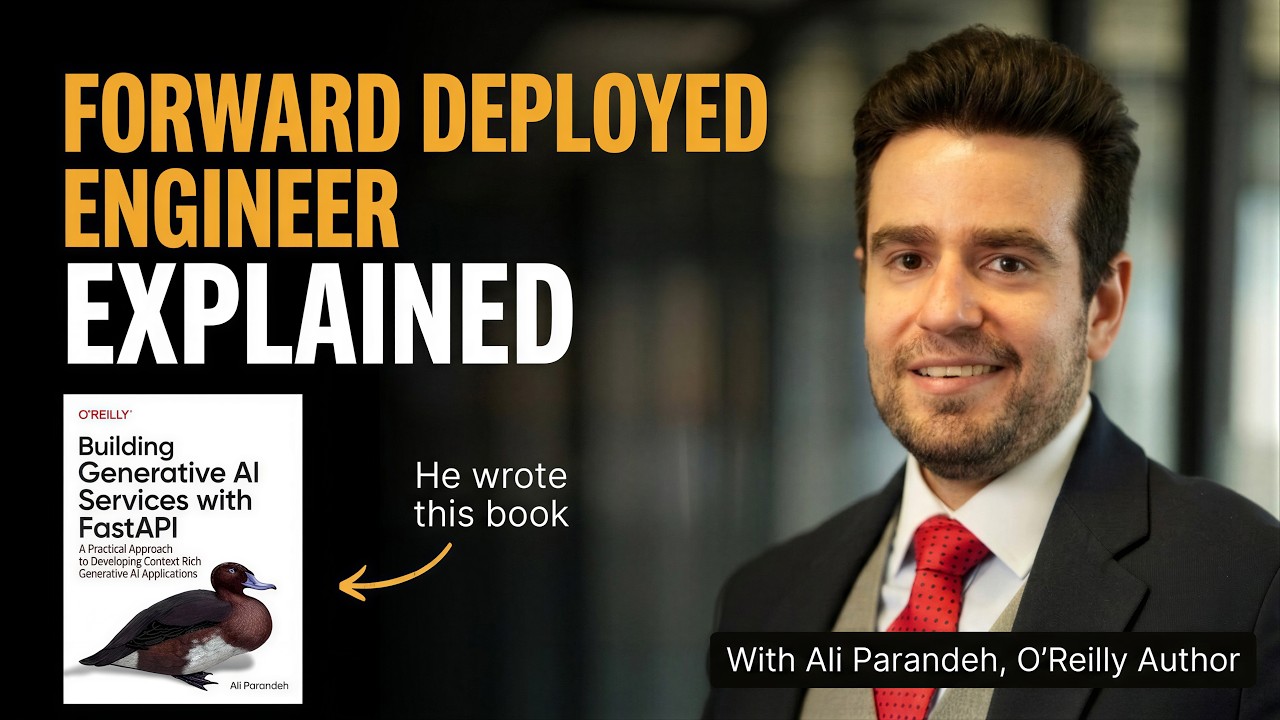
Ali Parandeh explains why construction, automotive, aerospace, and energy lag two to three years behind in AI adoption due to safety risks and bespoke data needs. His firm uses training, consulting, and custom AI tools for legacy engineering software. Predictive maintenance on unique sensor data is the strongest use case.
Chapters
Engineering sectors— construction, automotive, aerospace— 2 or 3 years behind AI adoption curve. If you make a mistake, it can have a lot of problems. They are very risk-averse and they want to do it properly. You are sitting on a lot of custom bespoke data that only you understand. You need the domain expertise to build on top. You're not going to find off-the-shelf tools that solve that problem for you. In the future, handcrafted artifacts will have more value than AI-produced. My websites on Netlify, right, or hand code. I always tell people, if you can do it without AI, do it without AI. Let's talk about what you're are working on right now.
So last time you were head of engineering, as you said. Now you're running Build Your UI, right? What changed?
So I'm running now buildyourai.com. So Build Your AI essentially is aimed at heavy industries, industrial organizations, construction, automotive, energy, aerospace, infrastructure. So those markets. The main reason I focus on this is because I'm a chartered mechanical, chartered software engineer myself. the Engineering Council in the UK. So these companies listen. They basically want someone to be enough AI expertise to guide them through the process. Most of these companies have this pressure to adopt AI. They know that their competitors are doing it. They know that other sectors have done it and there is good return on investment, but they are confused with— they're facing a lot of pressure in terms of clarity, like what is exactly AI? What can it do? What are the limitations? What happens if things fail? And how can we do it safely? Right? They are very risk-averse and they want to make sure that they do it properly. And at the moment, that's the main reasons they're like 2 or 3 years behind AI adoption curves with the rest of the markets, like IT, finance, retail, advertising, creative industries have adopted this much faster because they normally have the talent and normally it's not as, it doesn't require as much risk with, I mean, finance has regulations as well, which is good. Whereas with most of the engineering sectors, if you make a mistake, it can have a lot of problems. So I created Builder AI to essentially, first of all, help increase the awareness in the sector about the technologies and like how they work, their limitations and capabilities. And I do that through training through professional institutions that they trust, like Institutional Mechanical Engineers, Engineers Ireland. Those types of institutions. And the second one is to provide consulting services and advisory services so that they help them map out and discover use cases, build pilots and scale those pilots that are proving successful. So that's the, that's the kind of the current business model. At the same time, for certain areas where there is a lot of demand or where I think there is, there needs to be a really good product, like in engineering, we have a lot of software that have been around for years. They're not innovated. They have been developed by incompetence and it's not innovated yet in the AI age. And I think in these areas, I am placing bets on products where I think these can be very successful if you integrate AI correctly as an AI assistant layer. So one product I'm working on right now is an enterprise requirements management software going after large, mostly aimed at large construction and engineering projects to help them with analyzing their requirements, managing their requirements, preparing material pack for stage gates, and where you have to comply with certain regulatory requirements where you need to produce a lot of documentation to show you understand the requirements well, and you have verified and validated against them.
What is the, what would you say is the number one misconception these engineering executives Have about AI?
Yes, they want to adopt it. And I think that a lot of these engineering companies at the moment, some of them are quite good. They have tried going deeper into AI systems and building their own. Some of them, some of them are enrolling the AI very slowly to their employees. And their biggest misconception is that they cannot upload, they cannot use AI because their data is not safe. Or the data is not secure, or they don't know how the data will be used. Some of them only started adopting Copilot, and Copilot is the minimal amount of thing you can do to start using AI. It doesn't differentiate you from other companies, other companies, or even companies in the engineering sector. It's the minimum amount, like everyone is enrolling their employees into Copilot now. And Copilot is not even very good. It's not exactly the best AI tool you can use. Some companies even create their own private assistant, AI assistants that are integrated with more internal databases for better workflows and better context provided to the AI system. So that, that's where most, most companies are. They're just enrolling their employees to Copilot. And most of these employees have no idea how to use Copilot because they played around with it a bit and they found it like cool to generate some text, but it's not necessarily exactly the quality that they want. Whereas it's more about like understanding the right way to create, customize it, and to personalize it and to provide good, effective prompts to it to make it useful. And some, some people who are more pro-AI in the company, they may end up just using their own personal chatbots like ChatGPT or Claude, which normally most, most companies are not using those systems. Most engineering companies, or pretty much all of them, they are using Microsoft 365. As an enterprise platform, Copilot is the only approved chatbot that they can use.
Copilot is an easy, low-hanging fruit.
If you use it effectively, you can still get good outputs from it, especially if you build your own custom Copilots inside, which if each employee maps out where they spending most of the time, where it's time intensive, where it's repeatable, or things where they can avoid. tasks they can avoid, they can create very narrow customized Copilots for themselves for very specific workflows, and that can be a massive time saver for them, especially if they have to do weekly reporting, quarterly reporting, like they need to produce something every period of time. Those things can really help these employees save a lot of admin time. And I don't know, I think 20 to 30% of their time, engineers normally spend it on these type of admin work rather than actual value-add engineering.
So that's mostly employee productivity. That's the use case.
That's one part is employee productivity. The second part is integrating AI within, like adding more custom AI solutions and adding more, going deeper into AI systems and building systems internally that works on top of their internal databases, integrates with internal databases and systems and documentation, providing them with better intelligence or providing them providing their products with more value to their customers.
Which one of these use cases do you see executives are actually willing to pay?
It's mostly where they can unlock additional value by integrating with systems that are— integrating with systems that are just sitting there and not getting much value from. So one of the main areas where a lot of companies, engineering companies are looking into is predictive maintenance, for instance. So some of them have installed sensors on their production lines in manufacturing companies, but their equipment fail and they want to understand when they fail or even predict in advance when those fail. And they can use sensor data to use AI to make those predictions. The thing is, most of this data is very bespoke, which means it needs a bespoke model built on top of that.
Mm.
So you build a machine learning model on top of it. You can't just place the data into Copilot and get it to work. Copilot is not the right model for it, and there's a lot of data. And the other thing I tell engineers is that you guys are sitting on a lot of custom bespoke data that only you understand. You need the domain expertise to understand that data and to build custom AI models on top to extract additional value and insight from it. You're not going to find off-the-shelf tools and consumer-facing tools that solve that problem for you. You need to build your own bespoke. So that's where the leaders and the SLTs of these companies will probably will be allocating budget to discover what these use cases are and actually develop pilots and scale them. So a lot of manufacturing companies, like for instance, fiberglass company used computer vision to detect when their fiberglass production line would fail and predict seconds in advance when they need to stop and fix it. Automotive companies have used AI to predict in advance when their honing rings would fail when they're producing gearboxes. Um, and these kind of like scenarios, essentially, uh, predictive maintenance is very high adoption at the moment where companies are looking into, but their biggest challenges, I think O'Reilly found with these, with most companies is the use case identification, like explore, like what use cases would be good. Most of them will have problems around that. And normally that comes from education. Like you need to understand different types of AI limitations and capabilities to help you with ideation. Number 2 is lack of quality data. So either the data doesn't exist, they need to install sensors or the data is not in a good shape. And number 3 is talent. They don't have any capability. Most of them, most of them haven't looked into allocating budget to create data science teams. Or AI engineering teams, or even upskill existing engineers to become AI engineers to help them build those internal tools. Sometimes it makes sense to do it if you, especially if you want to be very serious and you want to do a lot of experiments. Sometimes you want to allocate, you want to basically subcontract it to specialist consultancies to build it for you, but you do want to invest in that area because it may help you save a lot of costs and maintenance downtime. Or helps you improve the quality, it helps you stay more competitive on the marketplace by increasing the value of your products by integrating AI into it.
Do they need to see some established use cases before they'll move forward with like investing in that?
So one of the things I help them with is normally when I'm establishing the awareness and understanding with their teams is these days I use AI Deep Research to basically research their entire market and their competitors and ideas for how they can start using AI for various different use cases. In the early stages of where AI was still being developed, there weren't many use cases. You will find a couple of companies here and there that started adopting it, but these days there are pretty much a lot of case studies that can be found online where engineers, engineering companies have started adopting AI across various different scenarios. Starting from Transport for London, all the way to Network Rail, all the way to manufacturing companies like Rolls-Royce, Boeing, all of them are starting to use AI. Even in defense, even in automotive or construction, like in construction, AI is being used to help you predict project runs and cost overruns and things like that.
Most AI prototypes never make it to production. How do you, do you have to convince a CFO to fund something? You know, when this is the common sentiment.
Sometimes you do need to experiment with novel ideas to innovate. Like what R&D does basically is sometimes R&D just comes up with ideas and experiments and you gotta invest in them. And some of that will not be fruitful, but you can't innovate without risk, taking a risk. There is always a risk involved where it may not be fruitful, but with more experience of doing these projects and from best learning best practices from other companies and other sectors, there are checklists and there are things you can follow to make sure that your projects has a higher chances of success. So for instance, yes, you can look for research papers and you can look for existing case studies that exactly has done what you're trying to do or in a similar area, but maybe a different market to give you more confidence. The other one is you can always limit the cost. You can always limit the scope and the experimentation. Until you're confident that it's good return on investment before you go forward. So one of the things I tell companies, for instance, is to use agile instead of waterfall when you're scoping AI projects. So instead of like sitting down and defining a scope and then allocating team and budgets to it, I would suggest to decide on a team and on a time and play around with the scope within that timeframe. So there's only 3 of us. You have one month, what can we do? Like, we can play around with the scope all the time. Like, as we learn new stuff, we may change the scope all the time. So the scope is kind of like all over the place, but at the end of every week or every sprint, we have to have some kind of finding. So any finding that maybe says, oh, this direction wasn't good, that direction wasn't good, those are still good findings. Those are still money well spent. You basically found out that like this approach doesn't work with this data. Or that approach isn't good. So we may not go down that route at all. And we saved a lot of money for ourselves trying out an idea that doesn't make any sense to any business case for it. Yeah, like that, basically there, there, there is an approach where you can just limit the cost whilst you're finding things out. Finding things out is still valuable because it tells you which direction to not go down. And which direction to spend more money on. The other thing as well is with all of these companies that have failed with their AI agents, normally the main problem is they haven't done this initial discovery properly. They rushed into trying to build an agent and productionize it. They didn't red team it enough. So they didn't spend a good amount of time during the pilot stage and prototyping stage, making sure that first of all, the edge cases and the bad cases are handled. And that there is good return on investment. And number 2, that actually the users will adopt it. So they didn't provide enough of a support and infrastructure to make sure that there is user adoption, because if you build the tool and you spend all this money and users don't use it, that's a waste of money. And that's normally where these agents fail. Either those agents don't have enough security layer, they don't have, they don't handle edge cases well, they don't, they're not reliable enough, they're not production grade. Or number 2, they don't have a— they don't have an AI adoption strategy. They don't have a strategy how to get people to start using it. Some companies just enforce the usage. That's one strategy. Some other companies like try to do webinars and training to encourage people to use it more often.
The product mindset is always needed everywhere, whether you're building a product facing external customers or internal customers. Is this something that you're helping with, like the strategy of Planning, how do you scope AI projects and how do you get the best ROI?
Yeah, exactly. So, um, um, like in May, for instance, I'm going to be helping a company, um, it's a manufacturing company. So I'm going to be helping them 10 days to meet with discovery sessions to figure out like for each of the ideas we came up with, what, how, what's the best way to approach them. So figure out what's the best project management approach and what's the best way to explore the datasets and like the next steps and plan it out a little bit more essentially. So it's most engineering companies, they're used to waterfall because most engineering projects you've done them in the past, like building a railway A to B is always the same.
Right.
Right? Like you build a railway from A to B, you need to do a certain amount of things. There are lots of standards to guide you and you just, as long as you're complying with the standards and you have a A couple of senior engineers with the experience on the project. Their risk is semi-limited. So you can essentially plan waterfall and manage the project in waterfall format, have stage gates where you do, you do business planning, requirements planning. Number 2, you do preliminary design, then detailed design, then construction, then validation, and then you commission and then maintain, then decommission. Essentially this step-by-step approach in terms of waterfall. But with AI, it's very iterative. Like with any of these R&D, with any R&D project, you don't know what you're doing. It's like you're in a dark room, not well lit. With normal engineering projects, sometimes the room is lit so you can plan ahead. With AI, it's mostly a dark room. No one's done it before in that context. So you have a lantern in your hand and you need to walk the room. Until you've walked the room, you have no idea where the walls are, where the table is, where the door is to exit the door, and you're looking for an exit. So you got to walk the room and you don't know how, you don't know how long it's going to take. You have an idea how big the room is, but you have no idea how to walk it. So you may have to hit a couple of walls before you enter each end of the room. That's basically the way to look at these AI projects. You need to allocate a certain time and try to keep iterating really fast until you get to the endpoint. And at the end of each iteration or sprint, you do need to have something deliverable to show the business. So to give them more confidence whether to invest in further sprints or not.
How many, how many days or hours are you engaging with this specific company for what you're doing?
Oh, basically the way you want to structure this is you start with low risk and gradually increase the risk. So you start with low effort, low commitments where, because most of this is a new area for most engineering companies. You start with training and awareness, but then gradually you shift into discovery and you want to just basically keep exploring and make sure that it's not a lot, it's cost-effective for them because they're just experimenting. But once they start seeing return on investment, they start seeing, having more clarity around the steps ahead. That's where the risk reduces because of that clarity.
Mm-hmm.
And that will also allow their senior leadership teams to essentially allocate more budget. Because they're, they're clarity.
So you're handholding the team. You're not developing for them, right?
In the early stages, it's more building with them. It's more experimenting and discovering with them. But in the later stages, it could be building for them. So you could do it for them. So it could be a 3-stage model, essentially.
Yeah.
It's where you build for them in the, and some And some of these don't need the first 2 stages. So if a company is completely new to it, they do need the first 2 stages. They do need the building awareness and understanding, and number 2, mapping out use cases, the discovery phase. But some companies are already done that stage, either through other trainings or through other approaches, or they are there, or the senior leadership team are more well-versed. With those teams, they do just want to get started building or piloting.
Mm-hmm.
So with those stages that you can just basically engage them and start building straight away pilots and then experiment and make sure those pilots are successful, identify if those successful, and then scale beyond that into actual production grade.
Yeah, this, this type of consulting is hard to scale though, right? You can take on how many clients per year for doing this?
So with any consulting model, essentially it's divided into multiple services depending on which client is at, at the Each stage of service, any consulting model normally scales either by providing software for that stage, for that service. So that could be one way to scale through software and technology or through a headcount, through hiring, hiring staff. And there is a, there is a new role called forward deployed engineers. So I've seen a couple of VC-backed firms, especially coming from like Andreessen Horowitz and a16z, though those Those startups, they also operate in these sectors. What they do is they hire a lot of FDEs or forward deployed engineers. These are essentially engineers who are good, well-versed with AI and they can build AI tools. These engineers get embedded in the teams of the client organizations and they essentially help them build pilots quite quickly, iterate and scale their successful pilots. That's how you scale with a business model like this.
Are you planning hiring?
I want to scale through software first. So ideally, I think where the market is at, especially in the UK, you do need to increase the market understanding and awareness of AI. I know all of them want AI. There is a demand there. Helping them understand and have clarity on the AI and then gradually move them towards the pilot stage. Once there is a lot of demand for the pilot stage and it's becoming a bottleneck, use software. to release capacity. So you provide them with software, which is these days easy to make, as long as you understand the requirements for the product, and then use forward deployed engineers.
If you could recommend a book to, let's say, yourself when you were a 20-year-old, just graduated from college, like what would it be?
So right now, a lot of the books that I got are more higher level books in terms of like Like, I don't remember the names of them, but books around understanding how to balance your life and how to set life vision, those kinds of books that are more high level, rather than just technical books related to business or technical books related to programming. It's more about like harder questions, like the stuff that you need to sit down and write vision statements or write down your values and figuring out like how Like what are the 5 different types of wealth you want to have, like time, money, social relationships, that kind of stuff. So things that make your life more balanced is basically the kind of things I'm reading now, like books on philosophy, those kind of bits. So high level. But when you're a bit younger, what I would recommend reading is things that would help you understand how to build a really good career. So for instance, Daniel Priestley's books are really good. So Entrepreneur Revolution, then Key Person of Influence, Oversubscribed, and 24 Assets. These 4 books will essentially help you understand how business works.
Did you read all of them?
No, but I understand, I've not fully read them back to back, but I know about all the models in them. So I know, for instance, the ascending transaction model when it comes to marketing or creating products, or I know Entrepreneur Revolution is about like Key Person of Influence model, KPI model, which is about how do you make yourself such an invaluable person in your industry that you don't have to worry about jobs anymore, or you don't have to worry about opportunities anymore. People come to you. You become that person that everyone knows about. Oh, like this guy is the AI guy in engineering.
Yeah.
People just come to you for that. And the importance of writing books. importance of like publishing like content and writing books. Like these people, like if people are new in their career and they start doing this, they create way more opportunities for themselves than they don't have to, they don't have to like apply for jobs. Jobs come to them. They don't have to worry about getting jobs or even like creating businesses themselves. Like they just decide to create their own job instead of create their dream job instead of like trying to find one and trying to accept any low-paying graduate position that comes around.
That's right.
And just build, build, learn, learn business by doing business. And that becomes their MBA essentially.
Yeah. Yeah.
That's, that's what I would recommend reading. And for people who are engineers, I would recommend essentially reading as many technical books as they can, especially these days, like on AI. So obviously read my book if you want to build with FastAPI and AI services, but read AI Engineering book by Chip Huyen, read the Machine Learning System book by Chip Huyen, those Those books are timeless. Read the, um, read the, um, machine learning, hands-on machine learning with PyTorch and scikit-learn. Like these are foundational tech books that really helps you become good AI engineers.
Do you think those are still needed? I mean, I'm going to challenge you on that foundation books versus just, how to use AI.
Yeah, absolutely. Yeah. AI makes mistakes. How do you make sure that it's not made a mistake? It's by knowing the expertise. Like, it's not going to replace expertise and craft. Like, for instance, if AI tomorrow can basically, um, good, really good paintings, do you still need to learn to paint?
I want to see a human paint, you know, I care less about like AI-generated painting these days.
With paintings, in the future, handcrafted artifacts will have more value than any factory-produced or AI-produced artifacts. So any skill is still going to be valuable because if you handcraft something, like one of the things I would do, like with my websites, underneath the website, I say handcrafted by, um, like under the website, I would say handcrafted or hand-painted.
Created by human.
Yeah, yeah, created by a human. Like even some businesses, like for instance, was it Ministry of Defense? I don't remember which website was it, or Royal Navy, RAF, Royal Air Force, or Royal Navy in the UK. You go to their website, they say you will talk to humans. Like they explicitly say there is no, we're not going to be using customer AI agents. And some businesses have adopted that strategy. Like even though a lot of businesses are doing customer service bots these days, People actually want to talk to humans. Even myself, when I go and I ended up having to talk to a customer bot, I always say, talk to agent or talk to human straight away, the first message, and it bypasses the entire agent process.
Man, it's almost a backlash on like the sentiment of like, it's about how good your chatbot is.
AI, the purpose of AI would be to bypass bits that you don't want to spend time on. Not necessarily to bypass the entire craft. The other thing is your mental health and your meaning of life will be based on the things you produce by hand yourself, or practicing a craft. Like, you went— the enjoyment of your career and your work comes from the craft. Like, I always— for me, the most energizing thing is coming up with models, business models, or coming up with actually writing code. that builds a software. Like, I don't need to build this software that I showed you right now. I don't need to build it. I could just sit down and just do consulting and training all day. That could just be my thing. And the consultant doesn't need to do coding. I could just do advisory and coaching and training. That could just be my business, but I love coding. Like, I make sure that even if I get a project, I'll do the coding. Or, you know, even if I hire, I would still be involved in coding. That was the case with my previous employer as well. founders were coding all the time. They were involved in the coding process, even though if they swipe coded bits of it, they would always swipe code. Sorry, they would always code themselves. They would always be involved in the engineering part of it because that's where you have the most fun. The designing, the developing part and building part. That's the craft. And even though these days AI can do stuff, I think AI, I don't like AI to do my paintings for me. I want to paint for myself. That's the enjoyment I get. No, the writing process and the, the writing process and the craft, the painting process, you get the enjoyment. When I wrote my book, I didn't use AI to write it.
Is it just joy or is it also pride?
It's identity as well. It's identity and joy. Like, you want to feel like it's yours. So you don't want to feel like a fraud. You want to feel like you did it. You want to be proud of it, right? You want to feel like you own it, and you want to feel like, yeah, you want to feel a satisfaction from the pain of doing it.
So it's joy, pride, and pain altogether that discrete this dopamine hit in our brain that truly satisfies.
Gives you the meaning. Without the pain, all the happiness would feel meaningless.
Ali, thank you so much for coming back this time. I mean, last time you gave us the playbook of building production AI systems. This time we went really deep and you showed us, you shared your stack, how you automate your work, how you train companies, how you build a product on the side. What's your last ending note?
My last ending note would be to the technology that the AI and everything that's coming, it's going to come here. It's going to stay where it is. We are at a new revolution. Previously it was industrial revolution. We now have AI information revolution. There is no reason to fight it, but essentially you need to accept that it's here to stay and it's going to change the entire workforce and the industries forever. The best thing to do is to essentially plan ahead and to adopt it, to start understanding the limitations, the capabilities, the benefits of using it, and create your own mind about how you want to use it. How you want to ride the wave with the wave that's coming. Like there is no point sitting and waiting for the wave to hit you and get ground. You wanna plan ahead and surf the wave, and that's how you get the most benefit for your careers and for your life from this and start like becoming more, essentially becoming a more capable human. Yeah. Because of that technology.
We have to be also balanced with using your own brain as well, right? Yeah.
Everything is about balance. Life is about balance. You wanna have a balance about even this. So I said about the bad stuff, even though I'm teaching AI and stuff, I'm promoting AI, I promote the limitations and the bad things about it more than the good things. I always tell like people, if you can do it without AI, do it without AI.
More from Angelina





The MrBeast Rule That Quietly Decides Who Wins on YouTube | Rox Codes, CEO @ Flightcast




Ask Any C-Suite This One Question About Their AI Agents | Hector Hernandez, COO @ Speakeasy
