Why Most AI Agents Still Can't Use a Browser Like You | Magnus Müller, CEO @Browser Use
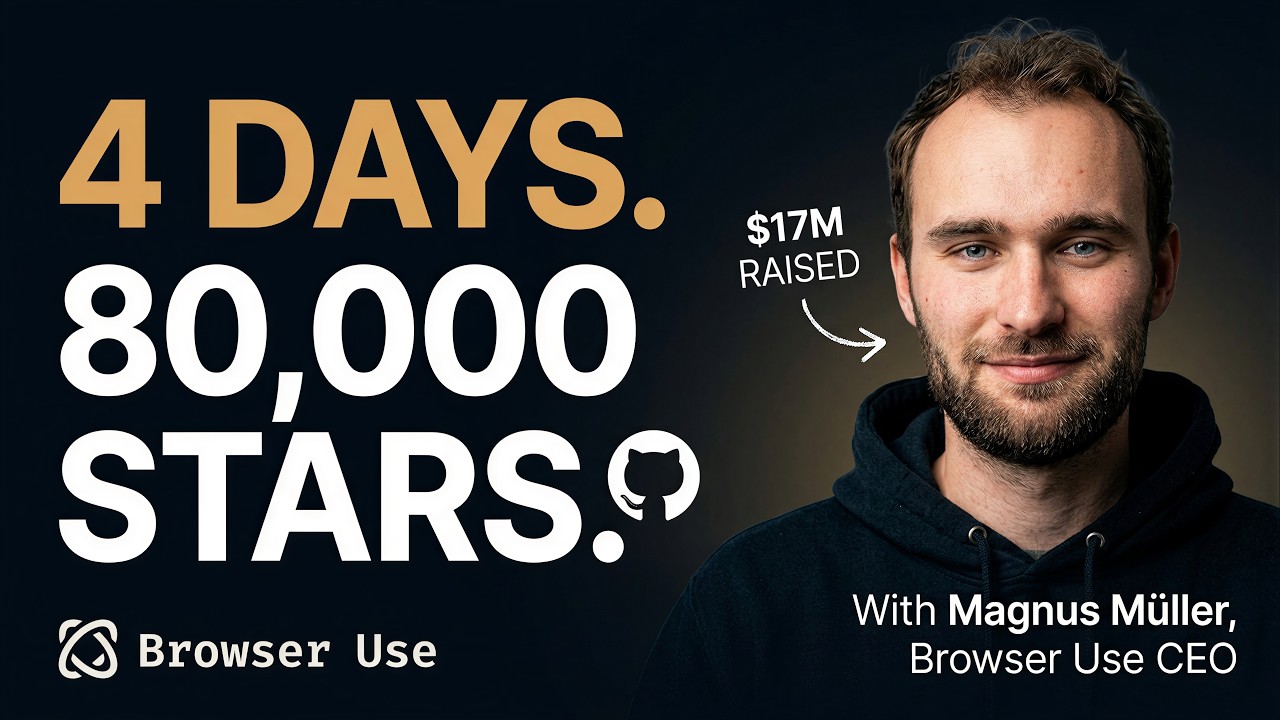
Magnus Müller, CEO of BrowserUse, built an open-source AI agent that controls browsers by feeding screenshots and DOM state to an LLM, which decides actions from a toolbox of 30 tools. The startup hit 80k GitHub stars and raised $17M, and now runs thousands of test tasks through an evaluation platform called Laminar to measure cost, latency, and success rate.
Chapters
When we were starting Brawzies, we were living in a coworking space. We were showering in a gym. I was washing my clothes in that place where homeless people wash their clothes. There was only a microwave to cook. For the eggs, you should have maximum like 50 seconds, otherwise the egg explodes and the entire microwave is full of the egg. How hard could it be to just do it ourselves? It took me like 20 recordings till I could have a recording of how the Blyze do a chop for me, but felt magical. We pushed this to Hacker News 4 days after we started. And people liked it.
Welcome back to Two Sided AI. Today I have Magnus Mueller, co-founder of BrowserUse. They're the open source tool that let AI agents actually use the web and not just search it, but use it. And he built it from a 4-day MVP to 80,000 GitHub stars and now $17 million in funding. Magnus, welcome. I just give everybody the LinkedIn headline version of who you are. Do you have a version that LinkedIn doesn't have to share with us?
Yes, for sure. So when we were starting Prozis, we were living in a coworking space. We were showering in a gym. I was washing my clothes in the place where homeless people wash their clothes because we were literally like, we were sleeping there on the couch. The night, there was not really a kitchen. There was only a microwave to cook. So we got the most creative ideas to get like hot water and put it into the microwave or make eggs in the microwave. One day we did raclette in Germany where we cooked like potatoes inside the microwave. During this time we were just sleeping day and night in this coworking space in Zurich in Switzerland, beautiful views on the mountains. Greg and I, we just both shut down our previous startup. Like in his case, the startup was doing very well, but he decided he wants to do something different. In my case, we didn't have any revenue, no funding. The co-founders, we fought with each other. Didn't go anywhere. And one day during lunch, we were sitting together and we were asking ourselves, how hard, how hard would it be to make this true? That you can tell your computer what it should do and it just does it. I always thought that would be so awesome if I can just tell my computer, if I don't need to type on the keyboard step by step what I want, but I can just tell it my goal and it does it. If you knew 100% OpenAI and Anthropic, they will for sure build something like this. We knew that computer use just came out from Anthropic, but we thought, okay, how hard could it be to just do it ourselves? And so we worked in this coworking space, did a small MVP, put together our knowledge from web scraping and from AI, small around GPT-4o back then. We give it the screenshot and the DOM state, then ask, okay, where should we click on? And said, click this button. And with a simple loop, we could get an MVP done. It took me like 20 recordings till I could have a recording of how it applies to a job for me. But it felt magical. It felt like something's happening on my computer. And so we pushed this to Hacker News 4 days after we started. And people liked it. People came to our repo, started, came to our Discord. Yeah, that was the start of the story.
Wow, that's amazing. How long was the cooking in microwave last?
For how long you should have potatoes in there? Yeah, yeah. For 10 minutes you need to keep them, but they will be very hard. For the eggs, you should have maximum like 50 seconds. Otherwise the egg explodes and the entire microwave is full of egg.
That's good to know. I mean, how long did you live like that?
Maybe like for 3 months. I really liked before to sleep in coworking spaces. It's very nice atmosphere. Like most often they have good coffee machines.
Is your life changing today? Like you moved to San Francisco, you're having a real startup, funded startup.
It feels very similar here. Just nicer location maybe in San Francisco, but the atmosphere is similar. There are many people who are addicted. We are also sleeping in a house. We have a hacker house. And we have a little bit better kitchen. We still use the microwave.
Okay. And the 50-second rule on the eggs didn't change. Let's dive into what you're building. I mean, you told us a little bit of the origin story, but can you explain what BrowserUse does at two levels? Let's say, let's try one elementary schooler and then one to maybe an engineer building AI agents.
Okay. For elementary, I think. Do they know nowadays ChatGPT already in elementary school?
Really?
Do you think so? Maybe not, right? Maybe they do.
Yeah, at home.
Maybe they know.
I have a second grader at home and I definitely tell him about AI and we have Google Assistant at home and yeah, they don't like it because it's not really working very smoothly. It's not a good experience. So they're aware of it.
Okay, so maybe they know Siri. Maybe they have like Siri at home or like Google Assistant at home. So I would say maybe, you know, you can talk to Siri and it can answer questions for you, but it cannot really do things for you, right? It cannot go and book you holidays or it cannot go and book you an apartment or it cannot buy you something on Amazon online. You have to do this yourself. And so we can solve this for you, that you can just tell to talk to Siri or Google Assistant, but then Google Assistant can actually buy it. We enable those assistants to interact with the web.
But what about engineers? How do you explain to them?
I will also start, we enable AI to control your browser. We built the biggest open source repository in the space. And how it works is basically we take the current website, the screenshot, the DOM state, we convert it into something which LLM can understand. And then the LLM can decide, oh, I want to click on this button. I want to scroll down. I want to upload here a file. So there are like 30 tools defined. And with this loop, it can complete end-to-end tasks online.
Which enabled your dream at the beginning of when you're building this, right?
Yeah, it was very simple tools. Like it's a click, a type, scroll, navigate, going back. Yeah. Very simple tools.
Amazon and, you know, Perplexity, they have been in this ongoing lawsuit and Amazon won a court order blocking Perplexity's AI shopping agent from its website. Like, does this lawsuit scare you?
Not really, but it, it really shows like the, what'd you say? Most end users, they love it and they want and they want to deploy 1,000 agents out there to do things for them. But many websites, like the entire business model is maybe built around ads, right? And they make money by showing you ads. Now, if your AI agent misses the ads, they maybe don't make any money from it. So many business models struggle a lot with this right now. It's not only browser agents, but it's just general AI, right? That people don't really go to websites. They see, they watch less ads. Maybe they only see like a chat box. Where they interact with, or maybe talk to. So it's, it, I would say it's just a sign of our time of the consumer versus current platforms, current existing businesses, how they fight with each other.
Yeah. Do you, do you think if even if Amazon wins this case at the end, do you think this stance will, will be sustainable? You know, will, will, will platforms eventually have to let agents in.
And the problem here is that we can make agents look exactly like a human, like from a browser side, from the interaction side. So at one point it just gets impossible to distinguish. You know, in the beginning when you write essays in school with AI, then it's very easy for the teacher to see if it's AI or not. But as AI gets better, it's very, very hard to distinguish the differences. And I would say it's similar here that just gets harder and harder to distinguish the differences. Like Amazon, for example, in this case, they could already have much, much better CAPTCHA. Okay, they show like sometimes they show a CAPTCHA in the beginning. They say, oh, you need to type. And from all CAPTCHAs which they could show, this is one of the easiest ones. Because the problem is if they make it too hard, they lose many users who then—
Yeah, I cannot figure out some of the CAPTCHA. I have no idea what I'm supposed to do there.
Yeah, and as they— they would just lose more and more users. So over time, I mean, I think we saw this in the past, over time, things move just more and more user-friendly, like what end users want. This is where things going. So I think it will get, in the end, it's easier for the end user, right? If they can just speak and then something gets bought somewhere. And over time, I think we get more and more into such an experience where just as easy as possible for the end user.
Yeah, yeah. And if I flip the case, if I think about if I'm a Shopify store, I actually would want agents to shop on my site because it's more visibility, it's new distribution channel, right? Even if the human didn't come to my site, a bot can make a purchase on behalf of a potential consumer. It's like, why not?
Yeah, I think there are many, many points in this equation. Like I could say, of course, Why does Amazon want to block them, right? Like, in theory, they bring in more revenue. But it seems like that there are forces behind, like, oh, Amazon doesn't have the control anymore, right? Or maybe they show you ads in the beginning, but they get ignored. Or maybe also the user experience, right? Imagine a store like Nike, okay? The only way how they can communicate, like, an experience to the end user is through their shop experience. And they can still tell a story with this. And if this is only like a chatbox in the end, which runs on ChatGPT, then the user doesn't have any connection anymore with Nike. And then the branding power between Nike and Adidas and other shoes is less and less and less because it's all just experience from a chatbox.
Right.
And so that's one, I think one key thought which they have is If they give this power away to just a chat interface on another service, then they lose this control over the user story in the website.
How do you think our everyday life will change if, you know, we truly have this autonomous agents running around doing stuff for us?
Honestly, I think one core question which I always get from people is they would love to use it, but they don't really know for what. The question is often, what should we prompt? And Google, Google said something similar in the past that the only problem with Google is you need to know before what you will search. You need to type, you need to search first because you need to know what you're looking for before you can type. And I think we will see this year a change where you will stop prompting AI, but AI will prompt more and more you. So you can imagine this a little bit like You have your high-level goals. You want to increase your reach of your podcast. You want to make more revenue. You want to make more people happy. You want to, if people hear your podcast, you want that they listen more than the first minute, right? And so those are your high-level goals. And right now to maybe achieve those goals, maybe you watch the recordings yourself. Maybe you try to send people a newsletter. Maybe You come up with like 10 different ideas and then to execute those ideas, you go and you go to different platforms, click by click to do the things. So when you want to optimize those high-level goals of you, like getting more people, you need to do them yourself. And right now you maybe prompt the AI, maybe you prompt ChatGPT, oh, how can I do a better newsletter? Or maybe you prompt, analyze those visitors, how can I maybe have more entertaining content for them? But I think over time during the year, this will move more and more that you will define your high-level goals to the AI. The AI will run 24/7 or in a schedule every once an hour and then kind of more work for you in the background. So it will go, for example, in my case, I want that if people come to my platform, I want higher retention. That's my high-level goal. Right now I'm prompting the agent what it should do. But I will, this year I will just prompt, I want higher retention. The agent will work 24/7. It will analyze my stats, it will analyze those users, it will come up with hypothesis, and then it will just ping me on Slack, hey, I found those 100 users which we might should email. Should I send them out this email? Or it will say, hey, I saw there's this big bug inside your onboarding, should I fix it for you? And it will go more and more into not you prompting it, the specific things, but it prompts you to specific things and you just confirm them based on your high-level goal. I think especially with the scheduling, I can give you some examples. For example, in the last year, I thought sometimes before I have a meeting like this, I would love to know before the meeting some context about the other person. I would love if I would take the time and research with whom I'm meeting every single meeting to know who this is, to maybe ask a better question. I thought it maybe 3 times, but I, of course, I don't do it like consistently. So now I basically prompted my agent and said, okay, every morning at 6 AM, check my calendar with whom in my meeting today, do web search about each of them, send me a Slack message with the context. And now every morning my agent pings me with context about each meeting. And you see, this is now transition, right? I prompted basically only once with my high-level goal. And now the agent prompts me every morning. And like you see how the kind of the distribution shifts, right? From me prompting all the time to, okay, the agent prompts me all the time. And then just you basically look into it whenever you're interested. Or I say, maybe last month I thought maybe once, oh, I would love if every day I would have an agent going to my docs of my tool and checking if there are any problems with my docs. If there are like any broken links or anything unclear. And I think, oh, I would love if like every day I would have somebody to check this for me. But of course I don't do it myself because it's just not the most important thing. But I still would love to have it. It's like, I would if I could, but I don't do any of them because there are so many of them. And then, yeah, basically I just want this agent, okay, every morning check my docs, see if there are broken links. Only if there are broken links, then ping me on Slack. And suddenly just, I had once this goal last month, I give it to the agent and now the agent just pings me if there's a problem. Examples like this, which is like medium important tasks. Some people told me, you know, last year in July their solar roof broke, okay? And then they lost like for 2 months their energy savings because there was like a in the pipeline, there was a broken thing. And he could immediately, he would have seen it in his dashboard if there's something broken, but he just never checked his dashboard. So he thought the solar roof is completely working, but it actually was not. And so in this case, he asked me how he would love to have just an agent, you know, where he can say every morning, check this dashboard. And only if there's something broken, and if we don't get the energy, then ping me in WhatsApp, on Slack, or wherever that something is broken. I feel we have more and more of those agents who do like medium important tasks, but who can be very impactful if it actually happens. Monitoring.
I'm curious, what tech stack are you using to build something like that?
I mean, you can just use Prozuse Cloud, but for us to use this, like the small components, the important things here are you have a smart LLM, then you have some tools, some interaction tools. It needs to have access, maybe persistent cookies so they can actually log in into your, let's say, Solar dashboard.
Mm-hmm.
Then you need some integrations, maybe to email, to Slack. For this, we just added Composeo because Composeo built out like 1,000 tools. So we just added Composeo. Now we have 1,000 integrations to all the services like Slack, email, just everything you can imagine. And then what's important here is, for example, this cron scheduling feature that you can tell the agent, okay, do this every day at 8 for me. And the agent just calls a tool that can then schedule something. And then it can basically run every morning so that it kind of can schedule itself. That's one part of the stack. Then one part, an important part is the file system. Also very simple component. But enables many more use cases. So you give this agent a persistent file system, and now you can tell something like, every day check the price of my competitor, save it to a file, check it tomorrow again, and if the price changes, then message me. And Sundee, by just giving the simple file system where it can save and read things, it can detect changes in the web. And everybody who wants to do data scraping out there What they actually want to do is they want to do change detection. They want to find interesting things out there, like a financial service who wants to detect prices of something. They're not actually interested in a price. They're just interested in the change of the price and something interesting happens out there.
I, I, if I want, I can use like BrowserUse as one of my tools behind the scenes so I don't have to build these scraping and all those kind of some of the components. In order to achieve that. And you have a lot of integration, you said, with Slack and Gmail calendars, those kind of things?
Yeah. Yes. So those examples, which I just mentioned with change detection, price change detection, solar roof authentication, we can solve all of them. It's basically to our— because we have this core browser agent who's very good at data extraction. But then we added like those 1,000 integrations. We added the file system, the scheduling feature. And with just like 4 or 5 such simple features, you can have suddenly a very, very strong general assistant.
I was thinking about if I were to build a browser automation agent from scratch. So I'm thinking of using the Playwright to control the browser and take a screenshot, feed that screenshot to an LLM and ask it to identify which button to click on the image. And then send maybe the coordinates of that image to Playwright again and repeat until the task is done. So that's my general thought process of building something like this from scratch without browser use.
I think it makes a ton of sense. Yeah. You have the BaseLM, screenshot, maybe some tools to interact. That's all you need.
That's all I need. Alternatively, I'm assuming I can just clone browser-use repository and Right? What more can I get other than what I did?
Like clone proxies. The thing is always the edge cases, right? Oh, suddenly there's a cross-origin iframe. Oh, there's a popup popping up which blocks. Oh, you want to upload a file. Oh, the site doesn't really load. Oh, you need to scroll inside this container on the screen. Or you need to sign suddenly a field. Or oh, you want to have it like a little bit faster. Or you want to block certain domains. So it's mainly for browser agents, all the edge cases where, and there are many of them, like every single task we see has some form of an edge case. Oh, you want to do two-factor authentication to log in. Those are like all the edge cases, which, yeah, you get when you use like more general framework, which just focuses on that. But like to have a pure loop of an LLM, you can post a screenshot to ChatGPT and ask ChatGPT, okay, where should I click on it? Then send this to Playwright and you will get a basic flow done.
How much do you think edge cases actually takes up the daily life use cases?
I think it's full of edge cases. Like it depends, of course, what you define as an edge case, right?
The edge case I'm thinking of is my simple workflow will not work, then it will be an edge case.
And let's say you want to buy something on Amazon. Okay. Oh, suddenly you need like a confirmation, a 2FA confirmation. Oh, you need to log in. Oh, you need to have persistent login. Oh, LinkedIn blocks you and they think you're a bot. Oh no, Amazon thinks you're a bot and they block you. And then, oh, when you do the checkout process, you want to add your credentials in a secure way without giving it to the LLM. And then Oh, it asks you for confirmation from your email. And for often checkout flows, you don't really interact with the actual site, but it's like a cross-origin iframe. So it streams another page, for example, from Stripe into Amazon, or from your bank, from Brax into Amazon. And then you actually interact with another site inside Amazon. As an end user, you don't really feel that. But because it looks like Amazon, because they want to make it look like Amazon, but it's actually like a different page which they embed inside Amazon. And like normal interaction with like clicks, it's super, super hard to interact with that because it's like actually inside another page. So you need to somehow first open the other page and then actually interact with the other page. And edge cases like this in a simple, let's say, checkout process in Amazon, there can be many popping up. You think? Yeah, I think over time those agents, they will get simpler and simpler. You will have the base LLM, which is very good at screenshot understanding. You have a simple tool to click on coordinates like a human and type like a human. Like in the end, if you just give a mouse and a keyboard, in theory, it should be able to do everything like a human can.
Right. Yeah. Yeah. What if the website changes? Like, you know, we see them changing all the time.
So our library, we just always get the most recent state of the website. We interact with it like a human. So if you refresh the website, we just get the real-time status. And so traditional frameworks like Playwright or Puppeteer, they often struggle with this a lot. Maybe you have a flow to do Amazon checkout, but then Amazon updates its website and your flow breaks. But maybe you have many users who rely on your flow. And then your engineers need to wake up in the middle of the night to fix those scripts. And this is definitely an advantage of browser agents who can just process the website in real time and see how the human would see it. And then they don't care if it just changed. But of course, then the problem is it's less reliable, right? Because every time an LLM processes the website. So people who traditionally do like scraping, they are very used to like a deterministic workflow. And now you can give them browser agents, which solve some problems of them. But suddenly browser agents have much more variance. They can, if you run them again, maybe they do something different. Maybe they choose a different approach to the solution. And so what we, for example, built out is that if you run your agent once, we can convert this agent into a deterministic flow. And then you can rerun the deterministic flow until it breaks. And then you can run the agent again. That's one problem with agents that by default LLMs are non-deterministic.. And so if you have like a long automation flow with 100 steps, if you have just a little bit of undeterministic things in there, it can happen that they kind of diverge and that they, like if I run my evals 3 times, sometimes tasks pass, sometimes not. There's a lot of variance in the agent or the design, the solution. But there's solutions to that.
But you're saying that, you're saying that you're turning the non-deterministic flow into deterministic flow after one use. How do you do that? And why do you do that?
Basically, in this one year, we're now building Prowseus. People are complaining about three things. People are complaining about consistency, which is exactly this determinism, that it works once, they run it again, and it does something different. Second thing is speed, and third thing is cost. That are just so much more expensive than traditional automation flows, which we don't pay any LLM, but suddenly you need to pay LLM all the time. Those are the 3 main complaints. And we realize often people just want to run this. They want to have an automation flow, but they don't want to create and maintain the automation flow. But actually they want to have an automation flow, just easier. And so they like agents because you can get very quickly, you see the result. It's much, much faster than writing the script. So what we ended up building is we tried to convert this agent, which does and does interaction, clicks, interacts with the website. We tried to record that and then convert that into a normal automation script so that when you then decide, oh, I want to rerun this over and over again. You can do it until the website changes. And when the website changes, you just come back and run the agent again. You get the new script, and then you can run the script again. And with this, you can solve this consistency, the speed, and the cost issue.
Very smart. And you are detecting the website change as well. Do you do that every time?
So basically what we do currently in our newest version, it's like the version 3, is that go even one step further. It's like one of the things which you built this month is you send an agent, for example, to go and get from your podcast page, get all the people which you ever spoke to and give me a list with all the people which you ever spoke to. Okay. Now I can send an agent and this agent needs to explore the website, needs to see how's it structured. And then after maybe 30 steps, it would find a way to extract all of them. And save them to a file. Okay. And now what we're doing is we use a different agent to analyze what went wrong and what went right in this run. We kind of save the learnings, the meta-learnings, like a teacher, you know, he says, there was right, there was not good. We save this to a file. And then the next time you send an agent to the same website, it sees the previous learnings. It knows, oh, previously I did this wrong and this right. And this snippet here worked, those actions worked to get all the founders from the website. And because it knows the solution already, it can directly execute the solution and it's 10 times faster, 10 times cheaper and much more consistent. Now to your question, if the website now would change and it would run this code, but it wouldn't give it any results, there's still an LLM in the process, which would think, oh, there are no results now. And then the LLM can go and explore it again. So we still use the LLM to detect if it actually worked, but it's much, much faster and much more consistent.
So basically, you know when it goes wrong, right? And when it's going to work, you use the deterministic way of doing the same thing over and over again.
Yeah, it's kind of— we tell the LLM the solution beforehand for the website. But if the solution doesn't work, The LLM will just try out something different.
Yeah. Who tells the LLM that, you know, who gives the feedback? Like, this is a good thing to do. This is the bad.
So let's say the first agent's done 30 steps. We just take all of this. We put it into an agent which analyzes what went wrong, whatnot. And this other agent knows, it knows the screenshot. It knows, oh, it tried to call this tool and it got this response. Then it called this Python snippet and there was no result. But then I called this Python snippet and there were suddenly 100 founders as a result. And then it can save in a skill for this website, you need to have this kind of snippet because the website structures like this. And then basically what you save is you save all the computation, the tokens which you spent in the beginning to explore the website. You compress all of them into this one Markdown file as a learning. And the next time the agent comes, you can skip this computation, what you compressed into this learning file. So in the end, you just save computation, like the computation compressed into, it's like very, very high-intent tokens, which you can then inject into the next agent and you save the entire computation what you did before.
Do you have fallbacks? You know, sometimes LLMs hallucinate, especially if we corner them, right? Like, you know, this is the constraint and you have to figure something out. And that's when I think they hallucinate. Hallucination happens a lot. Do you have like fallbacks for that?
Yeah, so this is a very big problem where it's different from LLM to LLM. And you can like, I can really experience how different LLMs behave. Some LLMs, when they like see CAPTCHA and they cannot solve it, they would just try forever. They would try until you run out of money. And others, they just say at first, This is a CAPTCHA. I'm not allowed to solve this. Okay, I need to stop here.
I give up.
You know, I give up directly. I break and then you get an error suddenly. So, and you definitely need to, like most weeks, of course, we do an assistant prompt, but then we detect, okay, what's like this? Did the LM try to call the same tool 3 times and nothing changed? Okay, maybe there's something wrong. Maybe we can tell the LM, okay, we think of something different., but it often goes into such loops where it kind of gets stuck.
How do you spot?
Yeah, our main question is what is the first principle? What is the root cause for the loop? Most often it happens, oh, try to click, but the click didn't work. Oh, then it's much better to fix the click action than to actually fix the loop. So it just never goes into a loop. I have some rules where I say, okay, if you try your approach 3 times, but nothing changes, try a different approach.
Yeah, that makes sense. It's almost an art, right?
Definitely. Yeah. And the system prompt engineering is like coding. One single line change can change your entire behavior of the system.
Yeah. And there's a lot of English language versus your deterministic programming language. And do you feel like it's much harder to control the English language?
Definitely a little bit harder to test because this is exactly the cause for the variance, right? Yeah. So you need to think a lot of variance and often it's very, very hard. Like we have an eval platform, okay, where we run every day thousands of evals.. But if you make a simple change in a system prompt, you won't see any increase in a score because the variance is so big. And so you need to do a lot of based on vibes and a lot of context where you know, oh, those other users had those problems, those users had those problems. You need to think, okay, will the solution, will this impact other users which we had before? But it's very, very hard to see from a single evaluation run. Like the score, if the score goes up 1%, often, most often it's just variance, you know, from the agent because there's like 4 or 5% variance.
Yeah. Yeah. The variance in detecting something really needs to be improved. It's hard to distinguish sometimes. Are you, since you're running evals so often, do you think you can show us like what it looks like?
Yeah, of course. Should I share my screen?
Yeah, please share your screen. I think how a real production company builds evaluation system is something I don't really ever get to see. I would love to see it. What does it look like?
Let me open. So now it's loading. Can you see my screen? It's loading.
Yeah, I can see it now.
So you see, basically those are the last 10 hours.
Okay.
And I did like 10 runs here. You can see here different developers. This is, for example, me. You see, for example, 40 minutes ago, I started my last run. And here you see, in here, we have, for example, now, like, almost 100 tasks in this one eval set. And we see, for example, the average time per task is like 4 minutes here. I can also zoom in. It's like 4 minutes on average per task. This is now like a harder benchmark, I would say. Yeah, you see, for example, the cost per task is like a new agent, which is a little bit more expensive. You see the average time per step, how many steps it took on average for each task is like high-level information. Okay. And now, I mean, I can go, for example, into some here. This, for example, also public benchmark. Here we evaluate different models. Those are all different branches, different experiments which we run. And in here, this, my colleague tried to fix some compaction hallucination. HPC evaluates in use branch if there are like any regressions. And so if I go in here, let's say I go into this task. So this task, for example, took 34 steps and was completed in the end, but it was not successful. Okay. The judge says it was failed. So here, the The task is find a comment under the Godzilla fandom page and follow a comment. Okay. It's like a very unspecific task. Find a comment. Okay.
And these tasks is from the users or these are your golden dataset or something?
This is now a public benchmark, which I show you, but we mainly do evals on real user tasks or tasks which people tell us which we should fix. Then we put them in evals and we optimize over them. For example, here the agent says, okay, it didn't have login credentials, but to complete the task, it would actually need login credentials, right? So this is now a task of high uncertainty because the user says, okay, go here and follow a comment. But to actually do this, it needs to have the authentication details. So what should the agent do? Should the agent now just create a new account? Should the agent tell the user, hey, I cannot log in? Should the agent tell I failed? Should the agent say, start to guess different user accounts to try to hack a different user account to log in to complete a task? Like it's just very, very high uncertainty. So if I run this task 3 times, maybe in one time the agent says, oh, please provide login credentials. Another task, maybe the agent goes and tries to create a new account, right? And now, now basically in here we could see like the task and everything. And like, yeah, we have like observability tools. For example, for this we use Laminar. It's like a tool. They just closed their funding this week. Basically in here I can see exactly what's our system prompt, what went into the LLM, how does the message history look like. You see, for example, here is now the first screenshot of the page. And I can see here, for example, the recording, how it changes over time. Over here, how the website changes. I can play this task. I see how the agent interacts with the page from a high level and where it struggles. Okay, now it sees the login page, right? And it kind of struggles here. And then I can see, oh, here are all the tool calls. It tried to click, it tried to scroll. But then this task is very quickly for me clear that I need to, yeah, that it's just, okay, how should we design the user interaction? You know, should we define like new roles in the system prompt that the agent should go and tell the user whenever it's super uncertain to provide more details? Or should it just say, cannot complete a task? Yeah, this would be fixed in our one task here. And of course, we try often to average this now over many, many tasks. Right over like hundreds of tasks so that the variance gets a little bit less. And what I then normally do is normally I don't go manually through those evals. Normally I don't look into every single task. But what I do instead is my flows, I can show you is I go inside, I use Superset. It's like here I have many different Claude code agents.
Okay.
You see every single of those tabs here on the left is basically like a different branch. And each of those has a different agent, a different coding agent running. And so for example, this agent here, you see it has like an MCP tool to interact with my eval platform. It can start new evals, it can inspect last evals. So for example, here it just started a new eval with cycle 10, it's called. And what I then tell to the system is, Wait 10 minutes, and in 10 minutes, inspect the results, see what are the biggest problems, fix those problems, start a new run, and 10 minutes later, inspect again and keep going. And you see, while we are having right now this interview, this agent is already in cycle 10. Like while we are right now talking, this agent is working for me. You see right now it's in a waiting phase. So you see here, okay, the runtime is like almost 100 hours. Of this agent. So I had this run over the entire last 3 days. And this agent basically right now waits for 10 minutes, then will inspect the newest results, and then inspects, did it actually work what it wanted to do or not? Does a new branch, submits a new experiment. And then like this keeps on going. And then I check in like every 10 hours to see what are the actual bugs we found out, whether they did stupid stuff, but most often it finds some really, really real bugs, which I can then just take over and put into main and say, okay, this was clearly a real bug. Great that we have fixed that.
Yeah, this debugging process feels very different from traditional software engineering.
Yeah, it's like I said earlier, I only define the high-level goals. Like I tell, I want to have my agent higher score. I want to have it faster and I want to have it cheaper. And I have some ideas, maybe better compaction, maybe better tools, maybe a little better system prompt. Please don't overengineer, like don't overfit on specific tasks. Do not put like specific tasks into a system prompt and then just say go and do like at least 20 cycles.
Yeah. And is this expensive to do? Like with all these tokens?
So basically for the coding model here, for all those, I just use Claude Code. I have like a monthly subscription and this is enough like for this entire loop to submit new experiments. And so yeah, it costs me $200 a month. So I would say it's much, much cheaper than having like a human doing all those experiments.
Right, right, right.
And then for the evals itself, it really depends on the model. So for example, one eval run here, for example, this eval run with 100 tasks cost me like $60. So $0.60 per task, 100 tasks, like $60. And there, if I do like many, many tasks, of course, easily it's like $1K, $2K per day, which is, I would say, a lot for like a solo dev. Like it's a lot, a lot. But compared, of course, to the labs like OpenAI or Anthropic, what they spend on evals, it's like very, very little. Yeah, it depends a bit on the model. If I use like a smaller model, it's definitely much, much cheaper. This run, for example, cost me $30, $60, $6.
Do you have strategy of operationalizing these experiments or maybe at this stage the cost is so low that it's okay, it's negligible?
Yeah, currently we pay around $100K to $200K per month on a LEMP cost for this stuff, which I mean, this is a good place where our funding can go, right? Where you can use those $17 million to just experience faster, experiment faster, like more agents running, more experiments to just find maybe faster bugs to explore different approaches faster.
And make the product better. Yeah. That's a good use of money. I'm curious, like, do you know the, how big is your team now?
We are now like 7, 8 people.
7, 8 people. Do you feel like having these LLMs agents running behind the scene and helping you out in all these things? Help you to keep the teams small?
Yes, definitely. Just building, especially when I want to build new things, it's just very, very fast. It's like very quickly you can see results. You can feel how things feel if they exist. Because often you have a lot of wishful thinking. Often you think, if we would have this feature, everything would change.
Yes.
And so you go like from one wishful thinking to the other and you think, oh, if we have this feature, feature my entire business change and we have product market fit and everything. And what those coding engines help you now with, because you can just have this feature very quickly, like maybe one day and you release it next day and you see, okay, your business is exactly the same. I think it kills a lot of this wishful thinking.
Which is really nice, isn't it? Are you gonna keep your team small?
I aim for that too.
You aim for that? I'm curious about this. So I think people might agree with, you might agree or disagree with me that, you know, AI is changing the gap between senior and junior engineers. And some people say it's widening and some people say it's actually shrinking. What are you seeing at Browder use?
Yeah, so my average team age is maybe 23, 24. So I hired some people who are like 19, and which I prefer much more over like all senior people, just because they're just so quick learner. They want to learn a lot. They want to take ownership. They, you know, like if you see a new AI tool on Twitter, or even me, I think like, oh, this looks cool, but I don't want to set it up. Like this for sure takes me long, right? But as young people, because they're so Young and don't know much. They're just so much faster, you know, all those new tools they know perfectly. And so they move very, very quickly and they find solutions to problems. And that's why I think they do great work. Like they do as great work as like senior people in their team. But then of course, I like some senior people who are not much more about infrastructure or browser infrastructure. It's just all the knowledge helps us a lot. But in general, I would say, like, if I see like correct 19-year-old people, I would definitely hire them. So I think they are like, I want to hire them from like their first semester in university. And so I feel if you have like, if you're a person with very, very high agency who wants to get stuff done and also shows, okay, you build like constantly projects because you want to have a lot of ownership. Like, I'm extremely happy to consider this over people who are like, 30, 40 who have a lot of experience, but yeah, who are maybe have it harder with like new things, I would say.
Do you, is university degree important to you?
Based on my past hiring decisions?
No.
Like I have like half of the team who don't have university degree. Who dropped out. Me myself, I dropped out of the master. But of course, you, like I studied in ETH in Zurich and there you meet like many correct people, right? You meet like many people who, like for me, my co-founder, right? Super great guy. You just meet them at those places where ambitious people come together.
So for younger people who are almost, we have to go as young as high school, like what's your suggestion to them? Like if they want to find a career in the AI you know, era, right?
I would actually encourage, think how hard would it be, what would you love to build, and then just try to build it, play around with it. Like if you build, like for example, if someone applies to me, like we had so many applicants, most often I just ignore it. But often if I go on X and I see, oh, this is a super cool thing, I want to talk to this person. I think, wow, this is super cool. I would love this guy, must be cracked. Send them, hey, do you want to come by our house? So I think if you build like super cool stuff and you want to work for a company, I think the easiest is to build super cool stuff and impress those companies with what you're building.
Yeah. So, so get your hands dirty is the most important thing.
Yeah. And then show it to people and think how hard would it be? Just try to think, okay, now OpenAI launched the Atlas. You think, okay, this is not great. You can for sure do it better and then just try it. How hard could it be?
Do you feel threatened by these bigger company research labs like OpenAI? They all have their browser agents.
We are growing strongly. So, but what I definitely see this year is that everything will converge more and more into one general assistant. And this one general assistant, this will be very competitive. Like I also think, should I have an integration, very good integration into Claude Code? But then I think if we are successful, it would be super easy for Claude Code to like replace us. So I think we almost need to compete on the like high agent level side with those general agents. Because I think in the end, there will be one super good general agent which can do everything. And this company will make a lot of money, maybe one or two companies. Maybe 3 or 4, but not hundreds. And so I think we need to compete on one level higher.
What is that level?
General agents, like directly to the user, like those tasks which I mentioned earlier. You come to me and say, okay, every morning check my calendar and send me Slack messages with the context about me, which is, by the way, possible in Browseuse, like in our cloud, you can do that. That's exactly why we're building this. But I think, yeah, we need to move more and more into very general agents as it converges more and more into one very clever intelligence.
Is that what you're building, like an end-user touching point?
Currently it's like our cloud is— currently we enable AI startups and AI automation teams to build AI agents for end users directly. So We enable them basically, but the dev goes more and more that you, like in theory, you can just come to our cloud and do everything what you can do in OpenClaw, just directly inside the cloud.
What's that missing link? Like let's say a non-technical person want to have a build powerful AI agents for the personal use. How can they make the switch instead of choosing cloud?
I think that's a good question. I think Because we also use Anthropic models under the hood, right, for our agents, I would say it's very similar already. So it's more like from our side, maybe we build cool stuff, but maybe more an education problem. Do we need to tell people what we are building? I think that's the biggest problem because it will get easier and easier to build those very, very strong general agents. But then the main question is, okay, how can you make that people know about you?
How do you make people know about you? Yeah.
And I don't know, for us, we do, we try to build a better product and hope that people will tell each other, like with the open source, that they share the open source, that they start, tell it to their friends. Sometimes demos on X, but I think it's for sure not our strength.
Do you still remember your first paying customer?
That's a very good question.
How did it happen?
We launched during Y Combinator with a $30 per month plan on the cloud. And I think we launched during Y Combinator and there, but honestly, I don't really remember who it is. I need to check.
Ow. Do you remember how did you get your first 100 paying customers?
I think it was mainly like from the launch because we had a lot of open source traction growing crazily. We launched a cloud-hosted version and so it all came through the open source.
Open source.
Public YC launches, Reddit launches, all that stuff.
I see. I mean, at your stage, are you seeing anything related to growth strategies that actually works?
Blog posts work surprisingly well recently. Like my team writes more and more blog posts, like also technical blog posts. And we post them on X and they get like 100,000, like some of them almost a million views. And people seem to like to read. I do many demos. Some months I get like 100,000 views per video, but it's not like it, not many people convert from there. And it's also not good for indexing. Like, for example, if you ask ChatGPT, what's the easiest way to automate the web? It doesn't see my X videos. It was very, very bad for X versus blog posts. They got much, much better for LLM index.
Is there one thing you can teach me to become a better founder or entrepreneur or my audience? One thing you learned from your days?
So before I was a founder, I was hitchhiking around the world with a hammock. I was hitchhiking through Central America and I was hitchhiking from Germany to Iran, to Middle East with a hammock and sleeping outside in the forest. Every night you, there's definitely some fear. Okay, and you, every day you have worries about who will pick me up, where will I sleep tonight, will I have enough food, will there be wild animals, will there something bad happen. And there's so many worries in your head, like thousands of them. Your brain screams with worries. But most often, next day you realize, okay, everything ended up well. And I feel it's similar in a startup that I have, like the natural state of a human mind would be hundreds of worries. We think, what about this? What about this hire? What about this competitor who just come up? What about this new partnership which my competitor announced? What about, oh, this person churned? Or what about this bug here? There are just hundreds of problems. And the natural state would be you're just flooded with worries. And I think one skill is definitely to get more and more of this basic trust that in the end, everything will be fine. It's in the end, if everything is fine, then it takes the worry and the pain a little bit from this current moment. It makes you a little bit more relaxed to deal with the stress. Because in the end, everything will be fine.
Thank you so much, Magnus. It's really profound. I feel like you're telling me, you know, just go do it and then don't overthink, right? Thank you so much. Awesome.
Yeah. Thank you.
More from Angelina





The MrBeast Rule That Quietly Decides Who Wins on YouTube | Rox Codes, CEO @ Flightcast




Ask Any C-Suite This One Question About Their AI Agents | Hector Hernandez, COO @ Speakeasy
