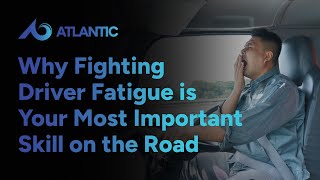
In this public‑safety presentation, Anthony LaFazia explains why drowsy driving is as dangerous as driving under the influence and outlines the severe human and economic consequences of driver fatigue. He describes how prolonged wakefulness (20+ hours) impairs reaction time and attention to the same degree as a blood‑alcohol level of 0.08%, and introduces microsleeps—brief 4‑5‑second lapses that can send a vehicle the length of a football field at highway speeds. The talk highlights the heightened risk for commercial motor vehicle (CMV) operators, whose large trucks require longer stopping distances and whose crashes often involve cargo loss and multiple fatalities. LaFazia cites CDC, NHTSA, and FMCSA data: 91,000 police‑reported fatigue‑related crashes in 2017 (≈50,000 injuries, ~800 deaths), a potential under‑count up to 350 % higher, and an annual economic cost of up to $109 billion. He details contributing factors—time of day (midnight‑6 am, late afternoon), lack of sleep, poor sleep quality, drowsiness‑inducing medications, monotonous interstate stretches, limited safe parking, and pressure to meet delivery deadlines. The segment ends by segueing into symptoms and prevention strategies for driver fatigue.
Chapters
Anthony LaFazia. In order to understand the importance of not driving when fatigued, we must first know why drowsy driving is so hazardous. The impact of drowsy driving is very similar to that of driving under the influence. It affects reaction time, ability to sustain attention, and awareness of hazards around you. In fact, driving after being awake for 20 or more hours is the same as driving with a blood alcohol level of 0.08%, the legal limit in the United States. Drowsy driving, however, is harder to recognize, and some drivers may experience episodes of microsleep, short periods of inattention lasting 4 or 5 seconds. This may not seem like a long time, but at highway speeds, a vehicle could travel the length of a football field in under 5 seconds. For commercial motor vehicle (CMV) drivers, these moments are even more critical. Large trucks and buses require much longer stopping distances and have a higher risk of severe crashes. A brief lapse in attention can result in catastrophic consequences for you, your cargo, and everyone sharing the road. It's hard to know exactly how many accidents each year can be attributed to drowsy driving, as unlike drugs and alcohol, there's no test for drowsy driving. However, the Centers for Disease Control lists drowsy driving as the leading contributing factor to car crashes, and the National Highway Traffic Safety Administration estimates that in 2017, 91,000 police-reported crashes involved fatigued drivers, with 50,000 injuries and almost 800 deaths. However, that number could be up to 350% higher due to lack of understanding and reporting of drowsy driving. There's also an economic toll, as drowsy driving crashes could cost up to $109 billion a year. According to the Federal Motor Carrier Safety Administration (FMCSA), fatigue is a major factor in many crashes involving CMVs. FMCSA studies show that long hours behind the wheel, irregular schedules, and poor sleep quality and sleeper berths all contribute to driver fatigue. So what leads to driver fatigue? While drowsy driving can occur at any time, there are some contributing factors that make it more likely. Accidents associated with driver fatigue are more likely to occur between midnight and 6 a.m. or late in the afternoon. They also often involve only one driver and no passengers running off the road at a high speed and frequently happen on back roads or highways. Other contributing factors include a lack of sleep, poor sleep quality, and using medications or other supplements that cause drowsiness. For CMV drivers, additional factors include long stretches of monotonous interstate driving, limited access to safe parking for rest breaks, and pressure to meet tight delivery deadlines. These challenges can make it even harder to get restorative sleep and maintain alertness while complying with FMCSA hours of service rules. Once you understand what causes drowsy driving and why it's so dangerous, it's time to learn the symptoms and how to prevent it.