5 Steps to Your First Million: Apryl Syed’s Proven E-Commerce Strategy with Harry Sardinas
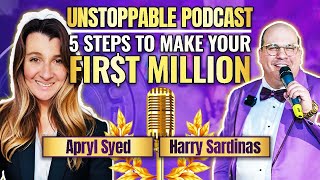
This is a YouTube video titled "5 Steps to Your First Million: Apryl Syed’s Proven E-Commerce Strategy with Harry Sardinas" published in September 2024. It features a detailed interview and conversation between Apryl Syed, a marketing and conversion optimization expert and founder of Conversion SG, and Harry Sardinas, the podcast host. They discuss strategies for building successful e-commerce and tech businesses, focusing on customer experience, marketing funnels, personalization, and overcoming challenges in tech entrepreneurship. The conversation also touches on women in tech, marketing during economic downturns, and practical advice for startups seeking growth and traction.
Welcome to Unstoppable podcast with Harry Sardines. Inspiring conversations with influential millionaires, investors, thought leaders, entrepreneurs who are making a massive difference with their innovative products and services and sharing the challenges and wisdom of how they sold their first million.
How would you like to make your first million? And today we have special guest joining us from San Francisco, United States. Her name is April and she's the founder of Conversion sg. So tell us, April, what are the five steps to make your first million?
Well, thank you, Harry. What I really like to focus on is making sure that you have like a really great funnel. And that starts with step one, which is really mapping out the customer journey. A lot of folks do this, maybe in hindsight back looking after they already have some sort of customer journey. But if you're starting out mapping out what you want that experience to look like from the very beginning is probably the best place that you can start. And that gives you kind of like the key touch points along the way where you want to create a customer experience. The key there that I like to tell folks is to focus on what emotion that you want your brand to really help make your customers feel. And if you can emulate that through that experience at every touch point all the way through, it kind of just gives you a lens to look through and say, does this touch point really give that emotion to our customer? So that would be great. Step one from a step two experience, we really say like make sure that you streamline your processes and optimize for a best user experience. So if you're an E commerce company, it might be how many clicks do they have to go through before they find your product, add it to cart and buy? I think that is something everyone can identify with. But if you're a tech company, it's also very similar. Like what steps does someone have to go through to learn about your product before they could either add to cart and buy, what does that experience look like and then it doesn't stop there. Once they do buy, what's that experience when they first jump into your product, what might that experience be? And is that creating a really positive experience so really optimizing for making it as simple as it possibly can in as few, as many steps as it can with also making sure that you're giving the customer that desired experience of step one. Then number three in my step process is really testing and refining. I think a lot of folks think, hey, I did my website, it's up and now I don't have to worry about that. And unfortunately everything in marketing needs to be tested, needs to have data that you are looking at back behind the scenes and needs to be refined. Most often things aren't going to work the very first time you do them, you know, and that doesn't mean that that strategy isn't working for you. So if you send out an email campaign and you hear crickets, you have to look at what actually was happening within that experience. So if you don't get the open rates, is it the subject line? If you're getting the open rates but you aren't getting the response rates, is it the offer? Is it how you've conveyed that offer, or is it the right prospect in the right list and is there a match of that? So there's all of these pieces of the puzzle that you'd say that kind of give you clues to whether you've got it right or not. And either way, you're finding out data and you're able to test and refine and work on that and keep tweaking it until you get something that works for your brand. Number four is really about trying to create some sort of personalization in the experience, and that is you can increase engagement both with your customers once they've purchased, but also beforehand trying to drive as much personalization as you possibly can. And that's different than categorization. A lot of us do categorization. And when you're first starting out, you have the ability of time to make that experience as personalized as you possibly can, because you could maybe personally be involved right with those customers and make that experience great so that they're giving you great customer stories, testimonials, and they're singing your praises, which is just going to make it a lot easier for your brand to expand. And then making sure that you have number five would be just analyze and measure your success. Know where your successes are, know where you are failing in terms of, of, you know, marketing and marketing spend. And don't be, you know, don't necessarily. It's not working one area for you, divert that attention to another area that is, and press the, you know, on button even more in that area. You know, as long as you have something going and marketing in one area that's working, you can, you can really grow.
That's fantastic, April. And I think that one word that you repeat a lot in, in this sequence of five steps is the word experience. And people, you know, with the consumers, people, we think that we selling a product and people just buy it and that's the end of it. But in the end of the day, it. The experience that, that, that this client have, what actually made them enjoy the product, made them to come back. So how you turn a simple product, that is you, you just buy and sell in an experience for the user so they can come back and again and again they become your fans and they can tell all their friends.
Yeah, that's a really great question. It is about them really understanding the story of the brand, and that's happening more prevalently than anything else. The other is that they're more likely to come back and buy again if they see that other people like them are buying again. We are creatures of habit and we are also creatures of the people that we aspire to be and who we spend our most time with. So if you can communicate with that buyer, you know, or that customer will say in a way that really helps them understand and see who is also buying. People like you also did this. People like you also were a part of our club creating those experiences that they purchase again in a community. Right. So that they can really find relationships there. I've heard an awful lot in the tech community, as I talk to a lot of leaders across various different organizations, that there is just as easy where people are buying quicker.
Right.
Because we're shortening that cycle. We're forgetting that there's middle stages of like, awareness, you know, top of the funnel, middle and bottom of the funnel, and we're driving faster and faster. There's pressure to go from top to bottom. And while we might be doing that effectively from a marketing standpoint, what's happening on the other side is that there's no brand affinity. And so people aren't getting that experience. They don't have a relationship with that, with that brand, and therefore it's easier for them to just quit that solution on the other side. And so we're seeing Churn driving up.
Or to switch to the competitors to the cheapest things and.
Yeah, that's right, because you've mostly been competing on likely at that point, price or an offer or a pressure from. For them to at least try it. No pressure, just go ahead and try it. So they do. And then Churn, you know, is able to increase when that experience, my step one, that user experience or customer journey doesn't really work out very well for them and they don't feel like loved by the brand and they don't get that big shiny hug at the end of it. So it makes it even more prevalent for us to either extend that cycle and properly let someone Go through those stages so that they get the feel for the brand and they really have a desire to want to be your customer or ensure that your customer journey really creates such a friendly onboarding experience that people really get and understand that they're now part of a community.
Yeah, I think that I talk about these a lot, right. Like, I mean the quality of your product, it doesn't really matter for you to sell one time, but if you want clients to come back and, and you want more, does your clients become into your fans and they bring the friends now completely different. It's completely different ball game. You have to have a good product, but that's not only that you have to beat the brand and experience about the whole process. So you have, like we said, you can turn your clients into funds and they can bring you client which will make your customer for acquisition for your client close to zero if they take their friends and they become your funds. But for, in order for that to happen, that cycle has to be complete. So there is no shortcut in marketing, correct, April?
There's no shortcut in marketing and there's no, there's no quick win either. I think it is, it is the, the rarity that you got something that goes from zero to thousands really quickly. You really have to do the work and the testing and knowing your audience and having the right product, having something valuable that they're going to love, testing that in a really smart way, understanding if you've got it right, being willing to be vulnerable and make tweaks and not feel like you have it 100% correct all of the time and really listening to your consumer and what they want more of.
So tell us how you decided to open this company.
Ah, this is a really strange way that I kind of got to hear.
Tell us, tell us. We're looking forward to hearing.
You know, I came, I came from working in technology companies. I, you know, grew up in my career at Sage, where I eventually ran three product lines there.
I want.
I know, a very large acquisitive company. So I really learned so much in that experience and got to work with not only some phenomenal leaders, but also say some phenomenal women leaders, which Sage had a great number of women leaders as part of, you know, their culture, which was not the norm during that time. And so then I went out into their channel. I worked for their largest reseller in the US I ran sales marketing, customer success, you know, helped launch some practices while I were there and ran a partner magazine as well that we launched and learned Just so much during that time about marketing and really got to get into content and SEO. I was one of the first users of HubSpot during that time. So I really kind of grew with HubSpot's Journey to Watch them into the wonderful company that they are today. And then I wanted to kind of like get out of the ERP space because I had spent so much of my career there. I wanted to learn about AI. So I kind of jumped over to bloomreach where I ran their advisory team working with some of the top brands in the world like Staples, Gap, Neiman Marcus, Albertsons, Williams, Sonoma, you name it. Those top brands were working with bloomreach and we worked on helping them from a conversion strategy perspective. 2020 came. You know, I was a little burnt out like I think a lot of people were and decided to kind of take a pause on my corporate career and go into coaching. So I got my coaching certification, I got certified in hypnosis neuro linguistics programming to really help entrepreneurs do that. And while I was coaching and working with a lot of founders and a lot of entrepreneurs, marketing came coming up as an issue for a lot of them and they just weren't having a lot of success in that area. And too many times I got asked, can't you just do this for us? And so I did. I kind of like went back to my roots and found some great people to bring onto my team so that we would really have the resources available to be able to offer those types of services. I started working in that kind of fractional CMO perspective and then we kind of last year launched into the conversion optimization space. So I have a great team of conversion optimization specialists that work with us. We do rapid testing for brands. We can turn around things in a 24 to 48 hour period where we can make changes and launch a new test for people so that they can maximize how many tests and how much data they can get in one year. So a weird journey, I would say, to where I got to where I am.
It sounds amazing. Very excited. Yeah. I think that one tech company that they are my friend, their partner with Sage actually.
Oh, great.
Yeah, yeah, yeah. And they are. They do operations. Operations and say she's the partner in United Kingdom. Yeah.
Yes.
It's a tech company actually founders on my friend. Anyway, so the. Here's the thing, right? We find a lot in tech companies that you have the normal scenario where you have a software developer or a team of software developer that they want to create the product and they put all the energy, time, money, effort and everything created that mvp. And then after they are exhausted with everything, they want to give 1% of the company or they want to, they only have 1% of the time of the resources to market the product, to get a market fit. So which advice do you have for these tech entrepreneurs which unfortunately they're failing and most of them, they don't repurpose very quickly what they're doing, they gonna go out of business. So with message do you have for these tech entrepreneurs that they know taking marketing and sales seriously?
Well, I think it is just, you know, it's kind of like you go and align yourself to what you know best and if that is your comfort space, it makes sense that they spend time and effort building that really great product. But just as we've kind of talked about earlier, just because you build it doesn't mean that the audience will come. And very rarely will somebody just stumble upon a product because there's a website and all of a sudden it will go into mass amount of success.
What are the chances to get the product right? The first time is the client who tell, who tell you.
That's right. Right, that's right. So I recommend always to try and have some design partners that work with you throughout the process of you developing. So reach out, do some, you know, interviews and it's really easy to just reach out to people on LinkedIn, tell them that you're building a product. I'd love your insights. You would be key. People really feel honored to give you that kind of feedback. So there's a great chance for you to do that kind of early on and those then might become your early customers. So I think that's first place and it's never too late to start that process, even if you have the product built already. Secondly, the cheapest and most effective campaigns that you can run and people are probably gonna, you know, hate this, but LinkedIn and LinkedIn campaigns, if your messaging is right, a good connection campaign, connecting with your ideal prospect, if you have something of value to offer them and you position that right, then they will want to have a conversation with you. Because if it's a pain point that they have and you are solving it, they'll want to talk to you about it, if that's top of mind. So that's the, that's the first step that is very low cost, right? It costs you in time to do that and maybe you have time if you don't have the customers right now to be servicing so that you know, you can Send I think up to 100 connection requests a week. You know, make a great list in Sales Navigator and go down that list. There's automations that do it if you want to use an automation tool. But sometimes they don't give that real human feel. And so be careful about the ones you choose. You don't want the one where someone accepts your request and then it slaps them with the message right away because it just feels disingenuous. Right. So be careful of those. Second is email. But in order to do email you got to set up some inboxes appropriately. There's some protocols there for cold email for testing. Make sure you warm up those inboxes, make sure that you have the right technology to then have all of those coming through a unified mailbox. I won't bore your folks with the details, but read about it or reach out to someone like myself. I'm happy to explain the process to someone and tell them the tool set that they need if they wanted to run that themselves. But you can get then more data quicker if you're able to send mass amounts of emails to people. You know, if you're only able to send like 30 a day through one inbox and it's going to take you six months before you even know if you have your messaging right. If you can send 3,000 in a month, well then you can get data in one month that's going to tell you if you should make some changes.
And then April, let's talk about women in tech. Because before you were working in search and you have been working in most of the technology companies. So how, how you manage to navigate the this environment that is usually male dominated and how you manage to succeed and to get your voice here heard in, in such a male dominant space and, and succeed. Any advice for any women in tech listening to this podcast?
Well, I think that, you know, I was very fortunate that you know, in my Sage days there were a lot of women leaders to look up to and aspire to be like. That's not necessarily the example, you know, that every company and every experience has. You know, when I went to Bloomreach there was only one other woman in a high level position at the organization. That was quite a shift from going working at Sage and then when I was at Blythe Co, the partner I worked for, we have over 55% of our workforce was women there. So it was quite a shift for me to kind of be in this like tech valley, very male dominated experience. So I get that. Oh you're surviving how did I survive? I think by bringing data and making I kind of have a three step process when presenting information where I try to bring people through like the steps that I use to decide the factors, the data that was involved and then the three things that I considered the three different directions we could take and I present it in that way. I learned that from one of my bosses that I previously worked with that I thought was really smart because in that three step process you make people feel like they can have input into that and they're a part of the decision. So it's not a yes or no, it's a how do we and then you get people you pro and con those three steps.
You get them involved, you can enroll them in your individual and anyway one of the three the three solutions that you're offering you are okay with either of the three?
That's right.
You're just presenting them and whatever you.
Might have your favorite within there and maybe you've written some pros and cons that might help gear people towards a certain direction but you also might find out information that you didn't consider and you might get some surprising data that helps everybody come with a better when you present three you have a such like a 70% higher greater chance for that solution to actually be more effective than if you're just doing an either or so.
Yeah, we the what we teach. One of the things that we teach is Poland speaking around the world we use this rule of three a lot to persuade the the audience is one of the one of the most effective way to to persuade to make people buy into your your idea.
So it's why pricing most pricing models are in three as well. And so it creates just more collaboration and as a woman in a male dominated environment it doesn't make it feel combative. Right Then it's more collaborative. And so it's not my idea versus someone else's idea. It's our idea and it's not this.
Woman is telling me what to do because this is what the whole program start and vice versa. So that's a great advice actually. I love it. Yeah. Then April, tell us why do you think that companies out there when things go tough like for example Covid and things like this everybody think that is a good idea to cut the budget for marketing and sales rather than do the totally opposite which is to put foot on the gas because if if people are no using mobile marketing I says your ads is going to be cheaper because you know nobody else is competing. So it Looks seems like a no brainer. So why every time that there is a covet, there is a nightquate, something happen, the people get panic and companies what they get panic. The founders, the first thing they do say oh, this is a brilliant idea, let's cut the budget, marketing and sales in half. So what message do you have with these founders?
Well, for those founders, I won't take it as my message. The CEO that I worked for at Blythe coast, even Blythe was a very avid, you know, although he was a developer, he had this marketer within him and it was the last apartment that he owned. He did always exactly what you said. He doubled down his spending in times where people were lightening up. And every single time his company, 35, 40 years that it's been in business now, he pushed the accelerator button and especially on keywords and buying, he diversified his spending and what happened is he was able to gain market share so that when he was coming out of a slow period, he actually accelerated way faster because everyone else was on their heels. And so it's, it's making sure that you have kind of like the coin saved away for that rainy day so that you can do that. There's also some folks, Brian Bulio out of the Boston or Connecticut area, they own a firm and what they do is they actually do market analysis of the predictors of when we're going to go into maybe a drier period. And they do that based on all of these various different factors like 98% as their accuracy rate. But what they do is you can actually align your business and take your financials and put it up against their model so they can tell you when it's actually going to impact your company because your company is going to have different types of customers and all of that sort of stuff. So you can look at the historical against their historical and then predict the future of how that you know, any downturn or prediction and either a downturn or upturn will impact your organization. That way you can be thinking of it very like mindfully and very forward thinking about how you want to save for that rainy day so that you can do a strategy like that and be really smart with your marketing.
So then April, so tell us a little bit more about your company because if I understood correctly, you have the, your company have the ability to become an extension of a CMO of any tech company or any commerce out there. You already have the team and the expert in this area. And I think this is a great solution because especially in the tech space, you have the software developer. So sometimes bringing a partner on board like, like, like you guys with, with the whole team that can create the whole 360 roadmap and experience and, and create that tranche for the, the company would be brilliant. So how, what are the challenges that you have encountered doing that and how you overcome these challenges.
In terms of, you know, working with those types of founders?
Yes.
Yeah, I think, well, what we offer usually first is some sort of analysis. So we can take a look at a landing page, we can take a look at a website and we'll tell you kind of like the tips and that we would do like our first step in the process. This would be our first stab at making things improve. But of course they don't have traffic coming to that website. Then that messaging is falling on deaf ears anyway. We've got to make sure that we get traffic to that site so that we can, so, you know, that's usually where we start and then kind of crafting out what does that ramp period look like. And if they're pre revenue, you know, how do we get those first customers? Some of the strategies like LinkedIn and email would be the first place that we would start really low and slow. But it's also, you know, our firm just doesn't believe in going out and spending money on ads if you haven't tested your messaging. And so we always like to run these, you know, let's start messaging people on LinkedIn and see if we have the right call to actions. Let's message people and see if they like the way that we're talking about the product. If we get it right there and we're starting to get good traction and we move into email. And then with email we're getting good traction again. That test and learn that now we feel confident, okay, let's go do some buying of keywords. Let's go and start spending money. Because we've already tested that we've got the right message and the right offer and we know who the audience is. You don't want to be figuring that out when you're buying keywords at the same time. And I find that like, if you work with a firm that does ads, they're going to sell you ads. If you work with a firm that does email acquisition, they're going to send you email. What we really look at is, you know, what's the budget, what do we have to accomplish from a business perspective? What's the pressure? Maybe you have investors involved, what's the.
Pressure what they strategy.
Exactly.
They can do with the resources that they have at the moment. Correct.
Exactly. And we, we fit in as a part of their team. Our clients feel like, hey, we'll sit in an executive meeting. I will be there personally in an executive meeting. We only work with a certain number of clients at a time. We don't over subscribe, especially on the startup side of things because we have a boutique feel. We want you to feel like you're getting an expert sitting at the table who can look at the business challenges that you're faced with and be a part of that decision making in a room. And also say, here's how we should message these things, here's how we would work around them together.
Absolutely. Then, April, why. What are the biggest. The advice that you have for those entrepreneurs that have the product right and they need more traction. Yeah. Or the organic thing that you describe about messaging. LinkedIn, that's really powerful. But one thing is to get attraction. Completely different ball game is to build a brand, to build this core message, to create all that experience. This is a 360 marketing solution that takes a lot of work, a lot of effort. So how can you describe your process? So for example, now you said, okay, person number one, you, you create some message in LinkedIn and then to see the written response that you go to email, then now we can buy keywords. Okay, at what point of the stage you guys focuses in and get the right story, the right message, the right brand. And to improve the customer experience, we.
Start right at the very beginning with that because. But it's a little bit, I think especially in startups, because the need is to get those customers is we're kind of driving the bus down the freeway and changing the tires at the same time. So it's a little bit of like test and learn and test this message, test this, test that and see if what we're finding that sticks. All of that comes back to yes, a brand identity and that brand emotion that I talked about in the very beginning. We've got to identify like what is it that we want people to feel. And then it allows us to write messaging that conveys that message very clearly and also articulates the product very quickly. People don't buy because of a feature or functionality, they buy because of an emotion. They feel like they're either going to be transformed, they feel like it's going to help them be a kind of different person, whether that's in business or not. People don't want to put their jobs on the line for making a decision about a certain software. Right. So they've got to feel secure, they've got to feel trust and high trust. How do you do that when you don't have customer testimonials yet? That's where those design partners really come into play. Or for instance with one brand. Right now we're considering just running a limited like first 10 people free so that we can get those in the board. You know, on the board of course that's our acquisition cost that we're paying to get that, you know, customer in. But that's of somebody who's, you know, maybe got enough LinkedIn following that. We have enough people that we could do that with. So it is also about not just your own brand from the company perspective, but how strong is your brand as the founder and could you even launch something like that to, you know, a community? It gives you options if you do. If not, then there's other, you know, tactics that we might have to take.
Okay, so then April, because you see your, your company has strategy group attached to it. So you guys work in a group and you design the strategy to, to, to improve the, the company. Now let's talk about the E commerce. You, you, you. I think that when it comes to ecommerce, if you can increase the conversion rate of, of a company by 2%, 3%, 5%, this could be massive. Especially if it's a huge, a big, big E Commerce. Yeah. And I think that there is a parameter that we look at it in our E commerce website that we have which is the abandonment rate. So basically how many people come and live without buying and how. Because I think that's on most of the time these people don't buy. But maybe they don't buy because they have a phone call, they got distracted or something happened. That doesn't mean that they're not gonna buy. That means that they can't. They're not. Then they don't buy when you're ready to sell. They buy when they are ready to buy. Becomes a lot of remarketing and, and a lot of strategies and have been a lot of change in policy with Apple and so on. So it's more difficult, difficult to remarketing now than what it was before. So how you your company is navigating these challenges and how you are coming out successful out of this?
Yeah, well the very first thing that I will say is for an E commerce brand and we've tested this over multiple brands and I can tell you that a landing page will convert Better than a product page all day long. So if you're taking a product page, we can automatically increase your conversion rate by just taking to a landing page.
Why?
Because a landing page we can lay out with enough information on that and tell the story of that particular product, which drives them down a conversion funnel. Then we can take them to the add to cart page. When they stick it in their cart and create that experience, that's still a flow that shortens.
And they only have one choice. They only have one choice.
Exactly. And a lot of what's missed is FAQs at the bottom of the page. Right? A lot of people miss FAQs. And if it's a heavily competitive product, why not create a competitive table which talks about where your product is priced or where your product is better. The other thing is that testimonials right up at the top and five star ratings are always going to convert better. So if you have those, bring those higher up on the page, that's why a landing page because you can include all of that information, not just what's in your shopify. You know, experience creates such a better way for people to buy. Now if you've gotten them all the way through, a lot of people use, you know, the first time they hit their website you're going to give them a coupon code and that's how you get their email address so that you can add retarget them. I do have a company that I work with, it's in my portfolio, so they're one of my clients. But they do this amazing personalization with sms and we're not talking about segmentation, we're talking about personalization which means they alter messaging, time of message, a personalized product page, a personal SMS with a picture of the product that they were looking at and leads them to a landing page with just that product on it. It's all done very simply for an SMB person. You know, if you're a small owner or one marketing team to be able to set that campaign up from the very beginning. So if you are grabbing those and you have abandoned cart, using a product like that is just going to get you edges above what anyone else does and gives you a better chance of grabbing that customer and getting them back into your cycle. Most of the time they're going to go out to check competitor pricing, they're going to go out to do more research which means you just didn't give them enough information on the page to convert.
And I think a lot of E commerce they leave a lot of money on the table because they're spending more and more and more money trying to bring strangers to a website and to people that already been there. They already landed that they found for any reason they haven't take the decision. They kind of forget about these people. And I think that these people are a big asset because they landed for a reason. The reason that they had this at that moment in time could be quite different. One of the reason could be that they're not interested in the product. But the other reason is are not they're thinking about they want to check the competition. They maybe the kids scream and they need to go and look after. We we don't know but as marketer we have to make sure that we continue the communication channel with that prospect until. Until we. We are right to absolutely decision. Now it has been difficult because of Apple change the policies and. And. And now it's more difficult for marketers to retarget those clients. Any new just think about.
I would just say you know just something as easy as adding a wish list where someone has to log into their wish list. Now you've got their information. You just have to be creative. There's no you know working against these. These privacy policies. There's still a lot of people that are giving you access to their information. You just need to offer something of value in order to get that.
I agree. You know, when you book in a flight you are happy to give your house address, your phone number, the name of your cat. You don't want to miss the flight. You know what I mean? Exactly. You don't want to miss the flight for anything in the world. So is. So if, if, if. If you manage to have a product that. I have another question for you. Yeah. If you want to have a pro that. That people are really really interesting. They want wanted. They. They are. No, they're gonna give you the information and they also gonna give you permission for marketing. Right. So what have you view your view in. In. In short forms again long forms. Yeah. By feeling in terms of conversion there is a big debate. I'm gonna tell you my opinion now. I'm gonna tell you after.
Well, I'm going to tell you it depends.
Okay.
Because it depends greatly on what the product is and it depends on the trust level that somebody has with the brand. So for instance we have a client in financial services. They're a financial services tech company. Tech plus service. And people will fill out a very long multi page form in order to book a meeting. Interesting, right. They've tested it we've tested it back and forth. Short form versus long form. Something about the long form increases trust in that capacity. There's a well known brand called Calm. I'm sure everyone's familiar with Calm. You go to Calm's homepage, Calm has a survey, there's a multi step survey that converts very, very well. They have tested this multiple times against multiple different, you know, varieties of things and time and time again that converted better than any other thing that they have done. But again what's the brand affinity and the trust level with a brand like Calm? It's a very well known brand, has very good longevity in the market. They have high trust. They have people like Oprah Winfrey, you know, on their, Matthew McConaughey, you know, and his voice. So there's a big affinity for that brand. Your trust is higher. You're more likely to go through a lengthy process. If you're a brand new brand and you don't have that high trust authority it's going to be pretty hard to get somebody to go through a multi step longer form process. So you better keep it as short and sweet as you possibly can until you have that authority and you can.
Command that long and then you, you can. Yeah, in our experience, yeah, long form convert better than shorter one because clearly the people that feed the wrong form, they are, they're very interesting what you offer. That's why they want to give you all the details of the same example. However, I agree 100 with you. If you're new in the market you're starting out, if you have a startup and, and you haven't made that credibility yet and it's better to, to keep it shorter so you can have some data which you will need in the future to get your pro, your traction, your pro market fit.
Yeah, that's right.
Okay, last question. If I'm a tech entrepreneur and I'm based in United States or and I need a partner that comes as a CMO partner in my business how they can find you guys, how the process work. Can you tell us a bit?
Sure. Well, easy enough to you know, connect with me on LinkedIn. Great. To either start the conversation there or April, my first name@conversionsg.com you can send me an email. So really easy to get a hold of us there. Our website is conversion sg.com so you can book an appointment straight onto my calendar. You will get me no one else even though I have a team behind me and I might bring some of my team members with me to that meeting. But Usually we'll ask you like, hey, give us a webpage to review or give us some of your marketing materials so that we can kind of take a look at that and we'll do an evaluation. So when we show up to that call, we're bringing you some information that whether you do business with us or not, you can take with you. And hopefully that's going to be really helpful. That's our gift. We are, you know, we are here to support entrepreneurs and to make sure you feel like they've got the information right that they need. We're super passionate about, you know, people being able to do that. My dad sits right there, was an entrepreneur. I grew up in an entrepreneurial household, so it is in my blood to make sure that they feel supported. So that's where we start in the process. The next place would be just determining what's really needed and what's the right approach. And once we understand that, then we present to you what that's going to cost. Usually our contracts are three to six months. You know, we're really easy to work with from that perspective. We don't want, you know, especially startup founders to feel like they're locked in too long. We like to prove ourselves. Like, you're gonna like us and you're gonna stay working with us if you're getting the results that you want and you're having a positive experience with us as a partner with you. So we're not like other companies that will say like, hey, sign on for a year or whatever that might be. We, by the way, people stay for years with us. It's just that we don't require that in our contracts. And, and if it feels right.
When this thing is working, it's a no brainer for the company because the, that's right. They increase in the sales so they have enough revenue to, to share with you guys and, and they keep making more money. So tell us, last thing I'm curious about, is your dad happy that now you're an entrepreneur or, or he' like I think, oh, my baby girl is taking so much risk.
Yeah. Unfortunately I made this move into entrepreneurial ism after my dad passed and he was actually a big reason why I made that shift in my career because I really wanted to feel maybe happier and really giving back in a way that felt just really more wholesome and maybe contributing for the time that I have left on this planet. And even though I want to extend that as far as I possibly can with all of the technology and things coming out in these days. So he was a big inspiration for me. I. I hope he's watching and he's proud.
Oh, it would be very proud of you. It would be so. Yay. Yeah. So I'm very happy for you, April. And I wish your best success and keep helping people keep. Keep inspiring women, especially in. In the tech space. And, and I think that one day, I believe that one day we're gonna live in a world that, you know, all women get an equal pay and all women have the same amount of participation in the tech space that, that men has, is improving, but unfortunately very little. We need to. To talk more about that, to bring more women like you into the conversation so more women get inspired and honest and move more the conversation. The other thing as well that we find shocking is that women, they get way less funding than men in tech. This is something that needs to be changed. I personally interviewed the minister of finance of Zimbabwe. I think, See, it was six months ago, seven months ago. And this is what he told me. He told me, Harry, listen, we have a policy in our government where we give loans to farmers and they take this money, they plant some tomatoes, some vegetables, they make some profit, they pay the loan back, we lend them more money and they grow a little bit more and they pay back. Long story short, he said. He said that the rate of people paying back their loans and asking for more money and paying back the loan is like 80 women and 30% men. So he told me that he's very happy to lend to women. You know, this is the minister of finance in Bawa. So why. I don't know why we have this blockage in. In. In that. In that space where women are actually more conscious about race than men and more responsible about. I mean, let's not say more responsible that we said that we're different. Right. We just know the same. You know, John Gray, we had the pleasure to meet him. Yeah. He wrote that book, Women are for Martian Men's. No, women. Yeah, for Martian. Women are for Venus. Yeah, I think that's. Then we have the pleasure to meet him here in London a few years ago. And he sat with us and with me and my girlfriend. He explained it. Guys, you are different. Did the expectation of that the boy have or how they work is completely different than women. And you know, you have to meet this expectation so you can have a solid relationship. So we were talking a lot about that. So women, we are definitely different than men. However, that doesn't mean that they are less. They have the same power. They have the same ability, definitely. They have the ability to become a great enterprise like you are. And, and I think that the more we talk about this, the more we can move forward in that direction. Okay.
I think the biggest thing, Harry, that I see see is that recently I've been working with a female entrepreneur that is in the startup community. I think she's going to be wildly successful while building her startup deck. You know, she kept coming back to, well, I don't have this in the product yet, so I can't put it in there. And I think women tend to want to be really accurate about what they're committing to. And I kept sharing with her what you're putting in your deck. You're selling the vision of what you're creating, not what you have today. This is different than what you put on your website for gaining for customers. That's what you have today. And maybe you say like, coming soon. Coming soon for features that are on coming soon, but when you're going to investors, you need to sell them the vision of what you're creating, which is absolutely what you have today.
Yeah. And I think that, well, little by little, we will get there. Yeah, it's the other hand, boys. Sometimes we always sell the thing, which is also not good. You know, this pro is gonna be way coincidentally better. Oh, God. It's not gonna do any of this, you know, so. So it's. It's about to find the balance. Right?
And it is about finding the balance and for us to support each other so that absolutely, you know, we're really creating value in the world.
Yeah. Like us, let us know we're not vc. So if those probably need funding, maybe we can make a few phone calls and help out somehow. And on that note, every. Thank you so much for the broadcast. Thank you so much for your time. We are very happy that you join us. And for all of you following this unstopp boss, how brave entrepreneurs like April, break that wall and achieve the first million. See you in our next episode. Bye for now.
Bye bye. Thank you so much, Harry. Follow us for more interviews with world's most influential audacious entrepreneurs that overcame challenges.
And adversity of brave entrepreneurs like April, break that wall and achieve the first million. See you in our next episode. Bye for now.
Bye bye. Thank you so much, Harry. Follow us for more interviews with world's most influential audacious entrepreneurs that overcame challenges and adversity, providing you with the blueprint of how they sold their first million. So you can grow your business exponentially, providing you with the blueprint of how they sold their first million so you can grow your business exponentially.
More from Apryl
Cracking Landing Page Conversion Codes in 2025 w/ Apryl Syed (Conversion Strategy Group)