Asif Osman speech | Training | Evaluation | Bahrain | Consultant |
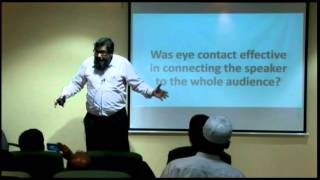
A recorded interactive workshop by Asif Osman (professional trainer/consultant) on evaluation skills for speeches, delivered to a Discover Islam audience in Bahrain. The session explains subjective vs objective evaluation, speaker objectives (educate, motivate, entertain, persuade), and practical criteria (opening, conclusion, enthusiasm, body language, eye contact, articulation). The speaker models interactive evaluation exercises with audience members giving brief evaluations and feedback.
Chapters
Dear brothers and sisters in Islam, on behalf of Discover Islam, I welcome all of you to the greetings of peace and salvation from paradise of Salam Alaikum Walaikum Salam. Today we have professional trainer amongst us and most of you know him better than me. Brother Asif Usman. I shall give you a small introduction about him. Asif Osman is a long time resident of Bahrain and UAE with experience in management across four industries, travel, loyalty, marketing, training and e commerce gateways, I.e. online payment processing. He is a consultant who has been presenting customized interactive workshops since 2002 to audiences in Bahrain, UAE, Khatar, Kuwait, Saudi Arabia, Oman and a few other Middle Eastern countries. His passion to solve problems has brought his clients less conflict, improved productivity and an increased effectiveness in the workplace. Brother Asif has 25 years of experience as a senior executive in the travel training, payment processing and loyalty marketing industries. He has traveled widely and managed multinational groups as a soft skill trainer. He has delivered various talks and courses for SMEs in the GCC, various business professional groups, conferences, unions and volunteer organizations. His expertise has also been exercised in customized personal training sessions for students, managers and leaders. His energetic, humorous and interactive presentation style provides his workshop with variety and pace which makes the atmosphere conducive to retention learning. Currently he is unemployed, therefore spends much time learning as he believes learning never stops. So with this I will hand over the floor to brother Asif Usman to present the subject today which is evaluation skills. Over to you brother.
Bismillahirrahmanirrahim Assalamualaikum. That was one clap. So I'm not really looking forward to claps. But you know, somebody told me. That I should start with the bang. Now I tried this at home and my wife said you'll never be able to burst that balloon. So I thought let me give it a shot in public. She said you'll embarrass yourself if you try to burst that that way. And I think have I embarrassed myself? All right, okay, welcome. Welcome to Discover Islam. You know I asked the guys how many people will be there. Somebody told me the room will be full. I do believe the room is full, but mostly by angels. You know we are followed by angels wherever we go. All right, so Jazakallah Khair, my brother for introducing me in such a nice way. It's exaggeration mostly. Only part of it is true. Alright, so don't believe everything just because Abdelamed says it. Okay? Now today we are here to talk about evaluation skills. Everybody knows the meaning of evaluation because you went through school and you were always being evaluated. Your mark sheets were being evaluated. But today we are going to talk about evaluation of speeches. I am giving a speech. You are evaluating me as I speak. Ok. Now, what is written on the screen over here is not that important. I would like you to look at it once in a while, but not that critical. I know it is not very clear as well, but it is a critical skill to be able to evaluate other speakers. Why? You will notice in my presentation, in my speeches, I do not like to just talk. I like to make people talk. So when I ask a question, I. It's not rhetoric. I would like an answer. So why is it a critical skill? Hello? Wake up. It's 8, 10.
It's actually so that you yourself also learn how to.
Exactly. Everybody got that? You evaluate speakers because you want to develop yourself. And you are evaluating because you understand what is good, what is bad, and what can I learn and what can he learn. So when you do an evaluation, you are trying to teach other people how to do a better speech, even though you may not be a good speaker, but you have observed something that could help him to be a better speaker. All right, does everybody know what's the meaning of subjective and objective? What's the difference between subjective and objective? Now, this man wants to answer all the questions. No monopoly. So we'll give a chance to somebody else. If nobody else wants to answer, probably.
You would have attended your lecture before.
No, no, he's never. Nobody. I've never done this type of lecture before. It's not a lecture. I've never done this kind of presentation. Subjective, objective. Is there an English lady here who knows English? Now, the word subjective means it's your opinion. When you say objective, it's based on measurements, usually scientific measurements. So if I said he spoke for a very long time, that's a subjective statement. But if I said that he spoke for 12 minutes where the speech limit was supposed to be for 10 minutes, that's an objective statement. So what am I going to do today Is mostly subjective. It's my opinion. So how to evaluate? It's not that. I have written the law on how to evaluate. I'm going to give you my opinion today. Okay? So understand this is all subjective because as you listen to me, you're going to say to yourself, I don't agree with that. That's okay. And as you listen to me, you're also going to say that. That I've seen better presenters. That's okay as well, because this Is life. All of us are not made the same. All right? But I'm hoping some of the things that I share with you, you take home and say, I can really use this. So ask these questions. These questions that are going to come up on the screen is what my suggestions are. My opinion. These are the questions. And I should also share with you that this is not only my opinion. I've shared most of what I'm going to write about. The questions that I'm going to talk about is by an expert speaker. I'm going to share the article that he wrote. I'm going to share the hard copy with you guys. The first question is the speaker's goal. What is my goal? You already know what's my goal. I'm going to try to help you. How to do evaluations. Are there any Toastmasters here? No Toastmasters, huh? One unfortunate Toastmaster. All right. Fortunate or unfortunate? No, we leave that aside. So any speaker's got four objectives. Educate, motivate, entertain, persuade. And sometimes it's a combination of all of them. All right, so it depends on the context of the speech. What is the speech looking for? Okay, so was the objective achieved? You can only say that at the end, can't you? Okay, the only way you can say was the speaker's objective which was achieved was if you have gone throughout the speech, you sat through the speech, and you decide at the end, he did a good job or he did a very poor job. So you can decide one of those things. Now, one of the things that I will encourage all of you to do is to interject and say, can I say something or can I ask something? But if you don't do that at the end anyway, I'm going to force you to do that because you understand evaluation not by listening alone, but by doing so. I'm going to give you an exercise at the end. I'm going to ask you to look at some videos which I'll show you in the end. But it doesn't have to wait until the end. We started around 8, 10. We've got an hour. Right? I'll try to finish before then. But if you want to make this interesting and as a learning experience for you, try to interject another half an.
Hour for question and answer. Q and A.
Half an hour? No, I don't think so. Because we're making it interactive. You can ask a question at any time. One and a half hour. Okay, I've got time. I've got material as well. So is the audience 1500 or 15 so when I came here, I had an idea of how many people to expect, right? So I knew I wasn't going to speak to a stadium full of people if I was going to speak to a stadium full of people. My preparation, my style, everything has to be different. So as a speaker and as a speaker's evaluator, you've got to decide, okay, what is he doing? Is he speaking to this big group? And not realizing that he's speaking to such a large group, is he doing the appropriate things? So you've got to assess that body language. Some people like to stand behind the lectern and that's okay. But body language is what conveys a lot of things about what we want to say. So body language is a critical part of communication. Has any of you heard this statement? Communication is the mother of all skills. How many of you have a bachelor's degree? I have to put my hand down because I don't have a bachelor's degree. I didn't go to college, but somebody taught me early on that communication is an important skill. Learn it. And communication is not just about talking in a language. It's about how you use your body as well, right? So communication is the mother of all skills, because you may be an excellent engineer, you may know how to fix things, but if you do not know how to explain how to do things, then you've failed. So the best leaders are some of the best communicators. The speech opening. What did I do in. I know some of you came late. I embarrassed myself with the balloon. Right? So that's a speech opening. That's one way of doing it. Embarrassing yourself. Was the conclusion memorable? You decide at the end what I do. You decide. Was the conclusion memorable? Was the speaker enthusiastic? Everybody knows that. Am I enthusiastic or not? That's for you to decide. I try to be enthusiastic. But what you'll do is you'll realize when you watch speeches, you will sometimes say, this guy is really not with us. How many of you know Bilal Phillips? I know. I think many of you might have heard of Bilal Phillips. Back when I lived in the uae, Bilal Phillips used to take lessons. I used to go to his classes. And sometimes I used to keep Saying to Bilal, Dr. Bilal, your classes are very nice. I love it. And he used to say, I go by the principle that what comes from the mouth goes to the ear. What comes from the heart goes to the heart. Isn't that such a fantastic statement that many of us, we're speaking about things but it's not going to the heart of the other individual that's listening because they don't buy it. This is, this is the way our brain works. Just because I've made a statement, it doesn't mean you buy into it. Usually you buy into it because of the combination of enthusiasm, body language and other things and how, how I make sense of it. Was eye contact effective in connecting the speaker to the whole audience? Obviously, if it's a huge audience, you can't make eye contact. But I know that you know that. Abdul Hamid knows I've looked at him. Suleiman here knows that I've looked at him. Arif here knows I'm looking at him. Why isn't he holding the camera? So I am making eye contact as much as possible. And people feel when their eye contact comes, people feel he's talking to me. Okay, so you try to make as much eye contact as possible, but don't stare at the girls. You know, you got to control yourself there. So did the speaker articulate clearly? What that means is, does he speak clearly? What he says, is it gibberish? Or does it make sense to at least the majority of the audience? How did the speech make you feel at the end? It depends on what was the context of the speech. I don't expect you to have a paradigm shift after the end of this speech because what is evaluation at the end of the day in your life? But if somebody makes a very emotional speech, something to do with changing your life, maybe it's about Sadaqah, maybe it's about praying, maybe it's about belief in Allah, whatever it is, those are very important things in your life. So what did you feel at the end of that speech? Sometimes we listen to Islamic speeches and we do feel that, don't we? That. Oh, Mashaallah, what an excellent reminder. So evaluating the experienced speaker is very different from evaluating the inexperienced speaker. So when you are evaluating and when you are seeing the person in front of you is really. He has been spending a lot of years doing presentation speeches. The feedback that you give evaluation is the feedback they are going to give is going to be very different from when you are evaluating somebody who doesn't have much experience in speaking. You've got to go a little light on the person when you evaluate and you can't hit him down, say your speech gone to the dogs. You can't say that to an inexperienced speaker. One of the things I wanted to share with you is all those Toastmasters certificates that I collected. I think I've got about 25 or 30 back in the UAE. I spent five years with Toastmasters. I did the whole rigmarole of the officers as they call it and then club presidency, etc etc and I did all those speaker things of contests and all that. Why I'm telling you this is people think that I am a big advocate of Toastmasters to any degree. I am because I say join Toastmasters because Toastmasters is a practice ground. But do not believe that Toastmasters is the be all and end all of teaching you how to speak in public. Toastmasters have a few negative things about it. One of those I'll talk about is when they do evaluations. I've often found they are very much into hyperbole. They exaggerate. They say, you know, the guy might have done a terrible job of doing a speech, but an evaluator will still come and say, you were wonderful, you were this and you were that. That part I don't agree with Toastmasters. I don't say you have to put a man down. But I do say that. Be truthful, express your opinion. When you give an evaluation, express your opinion. Why you have to say this is my opinion because the person has to realize that you're saying what you feel about the speech, not that this is it. Your speech was good or your speech was bad. You don't put it that way. Any question. So if you don't have questions, remember what I said, you're going to have to talk. The best evaluations, the presentation is over. Now comes the real stuff. The best evaluations are a combination of praise giving ideas for improvement. You don't.
I think this is something a lot of people do, maybe subconsciously. They probably very few people probably name it regret minimization framework because most people are healthier than that. But it was a very clear way for me to think about making that kind of life decision.
Our next victim. Little bit of eye contact, guys. Okay? This man over here. Come on over. What's your name? Syed Mohammed, please. You got one minute to evaluate his speech. Okay, go for it. Hello.
Good evening, ladies and gentlemen. The speech delivered by this gentleman is. It's a good speech actually because it's not subjective, objective oriented. That was most important. And body language was very much controlled. He was directly focusing on his audience completely and the success he has achieved in choosing the ambition.com name that he defined it in the right way so that it reaches the audience mind and heart properly. So I find it, it's a good statement for success.
Thank you. Thank you. You have a few seconds, but that's it then. Fine. So who's going to evaluate that man right over there at the back? You? Yeah, you the one. So you know what to do. 60 seconds. You're going to evaluate Sayyid Mohammed's evaluation. Welcome Alay Kub Sarah.
Somewhat awkward, but I'm going to try not be too hard. Say Mohammed was talking in asterisk, and he should be talking. And the reason, I think, was because he was somewhat nervous. And you shouldn't show the nervousness. I mean, I'm somewhat nervous as well. But, you know, I think I'm doing kind of okay because I'm not feeling. I mean, I am feeling something, but you're feeling something else because you do not live inside me. So I guess that makes it a lot less awkward. Yes, speaking too fast and speaking in a really soft voice were the main issues. But other than that, the evaluation was in its place. He was objective, and you are correct with that.
All right, 15 seconds left.
Other than that, I guess maybe some more body movements, some more facial expressions would have made it a more interesting evaluation.
All right, thank you. Thank you very much. So give them all a big hand one more time. They did a good job. So as you can see, evaluation is not easy. I just give you one minute. You know, usually these evaluation speeches are three, four, five minutes. So you're wondering if they make me speak for five minutes, what the heck am I going to say? What have I got to say? I haven't got anything to say. Do I keep saying, oh, he was good, he had nice body movements, he had a nice smile. Can you say that all over again? You start getting tomatoes, right? So it's an art. And you only get that.
More from Asif


If these are God's chosen people then God chose them to test the rest of us.