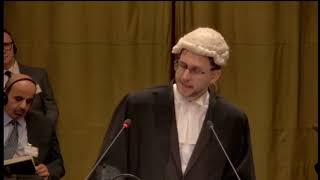
A transcript of Guyana’s oral statement to the International Court of Justice arguing that Israel’s occupation and de facto/de jure annexation of Palestinian territory is unlawful and must end. The speaker cites a wide body of United Nations material—dozens of General Assembly resolutions (from the 1970s onward), multiple Security Council resolutions (1968–2016), reports and statements by successive UN Secretaries‑General (examples cited from 2010 and 2015), the UN Independent International Commission of Inquiry (September 2022), and UN Special Rapporteurs (reports in 2021 and 2022)—to show a consistent UN finding that Israel intends the occupation to be permanent. Guyana urges the Court to issue an authoritative advisory opinion declaring the occupation unlawful and calling for its immediate, comprehensive and irreversible end, as a basis for justice and a lasting peace.
Chapters
Annexation of the Occupied Territory and its intention for the occupation to be permanent has been widely recognized and condemned by the United Nations. I offer five examples, but I stress that these are merely illustrative and they are very far from exhaustive. First, literally dozens of General assembly resolutions from the early 1970s onwards have expressly referred to and condemned Israel's annexation of the occupied territory. Examples of those resolutions, which span a period of more than half a century, are listed in Guyana's written statement. This vast corpus of resolutions demonstrates a clear, consistent and emphatic recognition by the General assembly that Israel has unlawfully annexed much of the Occupied Territory with the intention of retaining it forever. Second, multiple resolutions of the Security Council between 1968 and 2016 expressly recalled the prohibition on acquisition of territory by force and condemned Israel's annexation and settlement of Palestinian territory on that basis. Examples of those resolutions are also listed in Guyana's written statement. Those resolutions represent a clear recognition by the Security Council that Israel has annexed most of the Occupied Territory in contravention of fundamental principles of international law, and that it intends to exert perpetual control over that territory. Third, successive Secretaries General of the United nations have also repeatedly described and condemned Israel's annexation of Palestinian territory in official published reports. In 2010, for instance, the Secretary General referred to Israel's annexation of East Jerusalem, which is a flagrant violation of international law. In 2015, the Secretary General reported to the General assembly that in the west bank the establishment and maintenance of the settlements amount to a slow but steady annexation of the occupied Palestinian territory. Similar statements are once again cited in Guyana's written statement. Fourth, the UN's Independent International Commission of Inquiry has also concluded that Israel has illegally annexed much of the west bank and intends the occupation to be permanent. In its September 2022 report, the independent Commission concluded that Israel treats the occupation as a permanent fixture and has, for all intents and purposes, annexed parts of the West Bank. The report went on to describe Israel's settlement enterprise as the principal means used by Israel to create irreversible facts on the ground to support its permanent occupation. The Commission added that statements made by Israeli officials provide further evidence that Israel intends the occupation to be permanent. Fifth, successive UN Special Rapporteurs have similarly concluded that Israel has annexed the occupied territory. In 2021, for instance, the Special Rapporteur reported that Israel's occupation has become indistinguishable from annexation. He highlighted the Deira annexation plans made by Israel, and he cited the plentiful evidence that Israeli policies and practices are designed to pursue a strategy of de facto annexation and permanent control of over the Palestinian Territory. In a report published the following year, the Special Rapporteur observed that the implantation of hundreds of thousands of settlers in the Occupied Territory was intended to demographically engineer an unlawful sovereignty claim through the annexation of the Occupied Territory. He concluded that Israel's occupation had burst through the restraints of temporariness long ago and that Israel has progressively engaged in the de jure and de facto annexation of occupied territory. Mr. President, Israel's annexation of Palestinian territory and its clear intention for the occupation to be permanent render the occupation unlawful as a whole. This has already been recognized by the United Nations. In 2022, the Independent Commission of Inquiry concluded that there are reasonable grounds to believe that the Israeli occupation of Palestinian territory is now unlawful under international law owing to its permanence and to actions undertaken by Israel to annex parts of the land de facto and de jure. In January this year, the Secretary General, citing international law and the resolutions of the Security Council and General assembly, concluded bluntly that, quote Israel's occupation must end. When the United States read aloud from the Secretary General's statement earlier today, it regrettably excised these crucial words. However, the State of Palestine read them to you on Monday. As the State of Palestine pointed out, the Secretary General stated one month ago that Palestinians must see their legitimate aspirations for a fully independent, viable and sovereign state realized in line with United nations resolutions, international law and previous agreements. Israel's occupation must end. Diana emphatically agrees both with the Independent Commission of Inquiry and the Secretary General. The occupation is unlawful. The occupation must therefore end immediately, comprehensively, irreversibly. Mr. President, this court needs no reminding of the importance of international law or of the grave consequences which ensue when it is systematically disregarded. The Court also needs no reminding of the profound contributions that its past advisory opinions have made to the plight of peoples and states afflicted by the scourge of colonisation. For many, many years, Israel has chosen to place its own expansionist interests above the duty to respect international law, including Yuskogan's norms and the UN Charter. The result of that deliberate defiance of international law has been decades of dispossession, oppression and injustice for the State of Palestine, the Palestinian people who have been systematically deprived of their fundamental right of self determination. These advisory proceedings are a vital opportunity for the World Court to address and to begin to redress the immense harm wrought by Israel's unlawful occupation. With international law as its bedrock, justice as its guide. An advisory opinion from the Court will provide a lodestar for the United nations and all of its member states to chart a course which reverses that dispossession, which relieves that oppression and which remedies that injustice. In Guyana's submission, it is only through the rule of international law that a permanent and peaceful resolution of this decades long conflict may be achieved. An authoritative exposition of international law, including a determination by the Court that the occupation is illegal as a whole and must be brought to an immediate end, will serve the ends of justice, will vindicate the rule of international law and will provide the basis for a just, comprehensive and lasting peace. Mr. President, members of the Court, I thank you very much for your kind attention.