James McConnell Interviews Ayn Rand About the New Intellectual
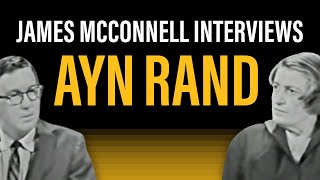
Ayn Rand argues that reason is man's only means of knowledge and that intellectuals have betrayed this by embracing mysticism, particularly Kant's philosophy. She calls for new intellectuals to champion capitalism and productive achievement as the moral purpose of human life.
Chapters
Understanding our world based on the resources of the University of Michigan.
I have held the same philosophy, and I hold for as far back as I can remember. I have learned a great deal through the years and expanded my knowledge of details, of specific issues, of definitions, of application, and I intend to continue expanding it. But I have never had to change any of my fundamentals. My philosophy, in essence, is the concept of man as a heroic being with his own happiness, as the moral purpose of his life, with productive achievement, as his noblest activity, and reason as his only absolute.
University of Michigan television presents an interview with a challenging critic of intellectual life and leadership in America today. An interview with Ayn Rand, noted American novelist, author of the Fountainhead and Atlas Shrugged, and philosopher, spokesman for America's new intellectual. To interview Ms. Rand, Professor James McConnell of the Department of Psychology at the University of Michigan.
Ms. Rand, a moment ago we heard you mention the fundamentals of your philosophy of life. I suppose it's true that at least in one sense, every novelist is a philosopher. But I think very few novelists have devoted the time and the energy that you have to the development of a consistent philosophical system. So let me begin by asking you, do you consider yourself primarily a novelist or primarily a philosopher?
I would say I'm primarily both equally and for the same reasons. You see, my main interest and purpose, both in literature and in philosophy, is to define and present the image of an ideal man, the specific concrete image of what man can be and ought to be. And when I started writing, when I approached the task of literature and began to study philosophy, I discovered that I was in profound disagreement with all the existing philosophies, particular codes of morality. Therefore, I had to do my own thinking. I had to define my own full philosophical system in order to discover and present the kind of ideas and premises that make an ideal man possible, in order to define what kind of convictions would result in the character of an ideal man.
I think your novels show very clearly that you have achieved that sort of fusion of philosophy and fiction that I think you aimed for.
Thank you.
You know, in several of your novels, you've made the point that leadership in any culture, not only in art, but in literature, morality, politics, and economics, that this sort of leadership must be provided by what you call the professional intellectuals. I wonder if you could tell me just what you mean by the term professional intellectuals. Who are they?
For example, the professional intellectuals are, in effect, the field agents of the army, whose head or commander in chief is the philosopher. The philosopher, the man who defines the basic fundamental ideas of a culture is the man who determines history. And professional intellectuals are all those whose professions deal with the humanities, the studies of men, as against the physical sciences. The professional intellectuals, in all their various professions, carry to the rest of the culture, to the rest of society, the philosophical premises, the ideas which have been defined by the philosopher. Therefore, they are the transmission belts. They are the ones who determine the goals, the values and the direction of a culture.
Is this true in any culture? Would it be true no matter where you found them?
It is true in any civilized culture. But historically, you must remember this. The new intellectual, or rather the intellectual, is a very recent phenomenon. There were no such phenomenon as a professional intellectual prior to the industrial revolution, in the birth of capitalism. Prior to that, man could not make a living, could not make a profession of intellectual work. The mind, the intellect, reason had no value in those earlier cultures. It is only since the birth of capitalism, free society, that man, for the first time in history, acquired the chance to make a living by means of dealing with ideas. Reason became a practical issue for the first time, and the height of it was the 19th century. Today, this is the value which we are losing, and it is the intellectuals who are betraying.
You think then that America's intellectual leadership has collapsed?
Yes, collapsed and abdicated.
How have the intellectuals failed to do the things that they ought to do? How have they not lived up to their responsibilities?
By betraying the very premise that made their existence possible, by denying the intellect. For decades now, the intellectuals have been progressively preaching and advocating the idea that the intellect is impotent, that man can know nothing for certain, that reason is unreliable, and in effect, man has no power to know the facts of reality. This amounts to men who proclaiming themselves intellectual, spend their time denying the validity of the intellect. That is a form of committing suicide. And today, when you see the rise of such openly mystical, anti intellectual philosophies as then Buddhism or existentialism, doctrines which cannot really properly be called philosophies, this is the admission of intellectual bankruptcy on the part of those who accept it. If in a group of men, such a theory as Zen Buddhism, which is a doctrine originating about the 5th century BC, if that becomes the latest word of the mind, it isn't I who am condemning them. They have condemned themselves by their own actions. They have given up, they have declared their intellectual bankruptcy and have gone back to the mysticism of the Dark ages.
Why do you think they've done this?
Because since philosophers are the ones who really set the basic premises of all intellectual profession, the philosophies of the Western world have been going progressively more and more towards mysticism ever since the Renaissance. The Renaissance was achieved was the intellectual result of the Aristotelian influence of Aristotle's philosophy, which in effect destroyed the Middle Ages and broke the way for the Renaissance. But ever since then, while men, while the culture in general, were achieving incredible progress, culminating in the 19th century, on the basis of that Aristotelian influence, the intellectuals, ever since Immanuel Kant, were going progressively more and more against reason. The trend started, of course, before Kant, but I consider Kant the crucial destroyer and the crucial turning point. He was the philosopher who undercut the validity of reason. He did not really succeed, but his is the most skillful system of pushing reason of the philosophical scene altogether. And to the extent to which other philosophers and intellectual accepted his basic premises, to that extent, they have been moving towards a nominal mystical world ever since.
Oh, you mentioned Kant. You mentioned Aristotle and his influence on the Renaissance. Who, under whose influence was the world before the Renaissance? Let's go back and look at some of the.
Before the Renaissance, the Middle Ages, Dark Ages were ruled by mysticism, that is, by religion and philosophy. And in those periods, philosophy was considered a handmaiden of theology. The predominant philosophical influence was Plato. Plato through Plotinus and Augustine, who were philosophically Platonists. Aristotle's triumph in effect began with Thomas Aquinas, who brought back the philosopher Aristotle most particularly its most important part, epistemology, logic, reason.
What, in particular about Kant's system of philosophy do you think was responsible for the trend that we see today in philosophy?
The very cumbersome, very complex and very false and phony system of dividing man's intellect, man's mind from reality, of declaring that what we perceive is only an illusion created by some special kind of categories and forms of perception in our own mind. By declaring and allegedly proving, allegedly, that we can never perceive things as they are, which simply means that any object which is perceived is thereby false. If an object is perceived, it means our perception is incorrect. It was, in effect, an attack on the whole concept of consciousness. Not only human consciousness, but any consciousness. It was the denial of the reality or the validity of our perceptions.
Well, if this is the situation that we're in right now, this brings another point. You talked about the trend into mysticism, but in your latest book, I know you talk not only of mysticism, but this is only one part of. Of a trend that you have traced. And you called the mystics the witch doctors, as I remember, per se. And you also talk about the rule of force and the men of force, the atlas of the world. So how do they fit into your framework?
Well, you see, in fact, reason is man's only faculty for perceiving reality. Reason is the only means by which man can achieve knowledge of reality. And, and by reason, of course, I mean the faculty which perceives, identifies and integrates the material provided by man's senses. Therefore, reason is man's faculty for perceiving reality. But reason does not work automatically. Men have to decide will to think and to perceive. Men can receive sensory data or integrate sensations into perceptions automatically, but they cannot form conceptions, they cannot form abstractions automatically. That has to be evolutional function of man's consciousness. And since most men, guided by their philosopher, do not wish to think, since they consider thought and reason either dangerous or impotent, or too much of an effort, most human cultures, with very rare exceptions, have been ruled by what I call witch doctors. And a witch doctor is any man who takes his emotions, not his thinking, but his emotions, as his tool of cognition and his guide to reality. He functions by means of face. He acts on the basis of blind beliefs, which in fact are nothing more than his wishes. He is guided by his wishes, by his whims, which he takes as a guide to reality, no matter on what level of culture you observe him. That type of man is a witch doctor in the sense of his psycho epistemology, of the way he uses his mind. And since he has to deal with other men, since on the ground of emotions no one can deal with reality nor with people, the natural ally of the witch doctor will always be the type I call Attila, that is, the primitive, savage, tribal chief, the man who acts only on the range of the moment, on his immediate sensory perceptions, who is contemptuous of and refuses to consider ideas, principles or abstractions, and whose way of dealing with reality and with other men is by means of brute force. Attila is either the gangster or the dictator or the military conqueror, or any man who believes that force is practical, any man who refuses to think and wishes to loot, enslave or force others. All through history, all major cultures, with very few exceptions, were ruled by an alliance of the man of faith, that is the witch doctor, with the man of force, which is the Attila. The witch doctor provided the goals and the values and the moral sanction for Attila to enforce. In the world, and in today's world, you see the same phenomenon in allegedly civilized terms, but the essence remains the same as dictatorship, which is the Attila, a Man like Khrushchev and his political theorists, the modern leftist liberal socialist intellectuals, who are philosophically Attila ists, they in effect provide an allegedly non mystical moral justification, a philosophical justification for Attila and for the rule of brute force. I call them the neo mystics because they are as much against the validity of reason as were the original jungle witch doctors.
I can see the relationship of what the mystic or the neo mystic can give to the Atilos. But why do the mystics need the Attila? What is the relationship the other way?
Why do the mystics. Yes, because the mystics first are motivating force is dread of physical reality, since it is a man who holds his emotions above reality, who in any conflict between his feelings and the facts of reality, will select his feelings and will abandon reality or denied. He cannot deal with reality at all. And his mysticism is a form of escape from the necessity to deal with reality or with facts. Therefore, he needs Attila as a protector. He needs Attila to save him from the necessity of dealing with facts, to provide his material livelihood and to enforce his edicts on the victims.
Well, earlier you said that each culture should have its philosopher, and then the intellectual should be the people who more or less put the philosophy into action. It seems to me that there's another side, another issue of this too. What about science?
Well, science is a very recent phenomenon. Science is of course, the product of the 19th century, of the industrial revolution, of capitalism, of a free society. Now I must mention the third type of man who has been very seldom the ruler of history or of any society. He has been the forgotten and exploited man of history, that is, the man who lives by means of reason, that is the man who in his psycho epistemology is not guided by his immediate perceptions, nor by his emotions, but by logic, by his concepts, by reason. That is the man whom I call the producer. He is the man who creates not only the material values of mankind, but also, and above all the intellectual, the philosophical values. The first producer in history, in this higher sense of the word, would be Aristotle, who was the first rational philosopher. Scientists certainly should be producers. They are the men who are supposed to be, and by the nature of their profession, have to deal with the study of reality by means of using reason. Unfortunately, today, most of them, outside of their own narrow profession, outside of their laboratory, in effect, are turning more mystical than any other group of men. The fault is partly theirs, but predominantly the fault of philosophers. Since there is no philosophical guidance at all, many scientists today are turning to a witch Duckling type of mysticism of their own.
You mentioned producers, aside from those people who give us intellectual products. What about the businessman? You talked about capitalism. I'd like to know his role in this.
Well, the businessman also is as recent a product as the intellectual. Before the birth of capitalism, there were no professional businessmen and there were no professional intellectuals. Both the mind and material production and trade were enslaved and ruled by the various combinations of Attilas and witch doctors, which means by a powerful government, by an absolutist type of government, whether it was the feudal of solidism or the absolute monarchies of Europe of the past Renaissance period. In any case, the producers of material goods, the traders and the producers of ideas, the teachers, philosophers, the early scientists were men without official status, without a profession, and the total mercy of the political rulers, which means at the mercy of rule by force. It is only since the Industrial revolution, the birth of a pre society society of capitalism, that there was a new class of men which is the pre producers of material goods, the businessmen, the industrialists. They of course are the producers in a stricter sense of the word, or should be, but they are the greatest victims of today's society. They are the ones who have been betrayed by modern intellectuals. And in this sense, both businessmen and intellectuals will commit suicide by destroying each other. And the fault belongs to the intellectuals. The businessman is the man who has to use his mind to deal with reality, study facts to produce material goods. He is the man who serves as the transmission belt of the discoveries of science and carries the products of science to all levels of society. He is the one who takes the invention of a theoretical scientist or of an inventor, transforms them into useful products and putting them into mass production, makes them available to all levels of society. The businessman is the man who has achieved the enormous, historically miraculous rise in the standard of living of mankind during the 19th century. He is the one who has lived up to the role of a producer, to the role of a rational, creative man. But the intellectuals have never given him credit for it, have regarded him as if he were an attila and being afraid of freedom themselves, have been looking from the start of the Industrial revolution for some form of an attila to protect them. The intellectuals against the free market of ideas.
Well, you know, you've been talking about the bankruptcy of our modern intellectuals, and I know that in your most recent book, this is really a manifesto to a group that you called the new intellectuals. Would you mind telling me just who they are in your own words, and how they differ from the old style Intellectuals.
But since the old style, the presently existing intellectuals have declared their own bankruptcy by abandoning the intellect. What we need today, what I call the new intellectual would be any man or woman who is willing to think. Meaning any man or woman who knows that man's life must be guided by reason, by the intellect, not by feelings, wishes, whims or mystic revelations. Any man or woman who values his life and who does not want to give in to today's cult of despair, cynicism and impotence, and does not intend to give up the world to the Dark ages and to the rule of the collectivist.
Root for the new intellectual then you would imagine would be a fairly recent phenomenon. Have there been any this type in the past that you can remember that you would like to point out?
What type I would hold as the new intellectual? Well, only to name a few historical examples. In the most general way, Aristotle is the man I would take as the first intellectual in history, in the best sense of the word. The Founding Fathers were America's first intellectuals because they were thinkers who were also men of actions. They were the men who knew that reason is man's died to reality. That man can achieve an ideal way of life on earth by means of his reason, and that man requires freedom in order to be guided by his judgment and his mind. That men should deal with one another by trade, by persuasion, but not by force and compulsion. It's the Founding Fathers who established in the United States of America the first and only free society in history. And the economic system which was the corollary of the American political system was capitalism. The system of total, unregulated laissez faire capitalism. This was the basic principle of the American way of life or the American political system. However, in practice it has never yet been practiced. A total separation of government and economics had not been established from the first. It was implied in principle. But certain loopholes or contradictions were still allowed into the American setup and into the American Constitution which permitted collectivist influences to undermine the American way of life. And today it is practically collapsing. Today there is nothing left except an undefined tradition. The active intellectual direction of our society at present is anti American and anti intellectual. It is going back to the primordial mysticism of dictatorships and rule by force. Therefore, the new intellectuals now should be those men who will stand up for two fundamental values. The value of their own life, of their inalienable rights, of their self esteem, their independence, and the value of a non coercive free society in which men do not use Force against one another.
You mention in your book, the latest one on the philosophy for the new intellectual that in our founding fathers talked about the right of the pursuit of happiness. Do you think this is really important?
I don't know what else could be any more important if you attach exact meaning to concepts. The pursuit of happiness means a man's right to set his own goals, to choose his values and to achieve them. Happiness means that state of consciousness which comes from the achievement of your values. Now, what can be more important than happiness? But happiness does not mean simply momentary pleasures or any kind of mindless self indulgence. Happiness means a profound, guiltless, rational feeling of self esteem and of pride in one's own achievement. It means the enjoyment of life, which is possible only to a rational man on a rational code of morality. What that code is I couldn't possibly tell you in a brief interview. But those who are interested will find it in my books, particularly in Atlas Shal.
Do you think it's important then that we be guiltless in our feelings about this?
I wouldn't even know how to answer such thing as is it important to be guiltless? To put it in my terms, I would say it is important to be moral. I would stress the positive, not the negative.
The new intellectuals then that you've talked about should assume the responsibility of formulating what we might call the solutions for the crisis of civilization. This brings to mind immediately then the question, if someone wants to be a new intellectual, how does he begin? Where do the new intellectuals start and how do they work?
Well, they would need above all an integrated, consistent, comprehensive philosophy of life. Now, to accept or define or even agree with a new philosophy is a very long process which requires very careful thinking because an intellectual will not accept it on pace nor an arbitrary say. So to acquire a new philosophy is a long process. And if any man takes this issue seriously and wants to become a new intellectual, he would have to begin by accepting two premises which I call the basic minimum of civilization. They're not axioms, but a man would have to prove them to himself. He would have to convince himself. Then his mind would be free to consider the arrest or the other questions of philosophy. But the first two, which a man would have to define to himself before he can proceed, is the relationship of reason to emotion and the evil of force among men. The first premise, the relationship of reason to emotion, means that man, if he wants to be an intellectual, has to learn how to differentiate his thinking, his reasoned judgment, from his emotions, wishes, hopes, fears or whims. He must learn that feelings, emotions are not tools of cognition, that emotions are the product of his premises. They are not a guide to reality. They are not a form of knowledge and perception. Therefore, the first thing that a man who wants to be an intellectual would have to accept is a full understanding of the fact that man must be guided by reason and that it is only on the basis of reason that he can approach other men and discuss, cooperate or act with them, or deal with them. On the basis of emotion, he would have to resort to blind force because emotions are irrational or unprovable. If two men act on the basis of their emotions, they have no means of communication. When emotions are put in their proper place, which means as the consequence of reason, not as the leader of reason, then men have a common vocabulary, they have a common means of understanding and a common frame of reference and arbiter, which is reality.
What about force and the use of force?
Now that is a basic social moral principle which an intellectual should accept. That no man has the right to initiate physical force to compel another man. No individual man has that right.
You have been listening to a discussion of the intellectual crisis in modern American society. Special guest on today's program has been Ms. Ayn Rand, noted American novelist, philosopher, whose analysis of the current plight of the responsible American intellectual holds this hope for the future.
Those who will accept the basic minimum of civilization are. Will have made the first step toward the building of a new culture. In the wide open spaces of today's intellectual vacuum. There is an ancient slogan that applies to our present position. The king is dead. Long live the king. We can say with the same dedication to the future, the intellectuals are dead. Long live the intellectuals. And then proceed to fulfill the responsibility of which that honorable title had once implied.
This program was recorded in the University of Michigan television studios in Ann Arbor. This is University of Michigan Television.










