"The Fascist New Frontier" by Ayn Rand
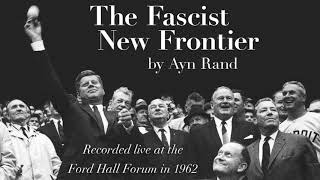
Ayn Rand compares Kennedy's New Frontier policies to fascism, placing Nazi quotations from 1920 alongside Kennedy's speeches from 1960-1962. She argues FCC chair Newton Minow's licensing standards and Emanuel Celler's antitrust inquiry blur private property and government power, enabling censorship under the guise of public interest.
Questions this video answers
February 24, 1920.
July 15, 1960.
January 20, 1961.
June 11, 1962 (Kennedy's Yale address cited).
Newton N. Minow, Chairman of the Federal Communications Commission (criticized for licensing/"public service" standards).
Chapters
Ladies and gentlemen, I will begin by making a small experiment. I will read to you some proposals taken from a political program and ask you to consider, as you hear each proposal, whether you agree with it or not. I quote we ask that the government undertake the obligation above all of providing citizens with adequate opportunity for employment and and earning a living. The activities of the individual must not be allowed to clash with the interests of the community, but must take place within its confines and be for the good of all. Therefore, we demand an end to the power of the financial interests. We demand profit sharing in big business. We demand the broad extension of king are for the aged with amend the greatest possible consideration of small business in the purchases of the national, state and municipal governments. In order to make possible to every capable and industrious citizen the attainment of higher education and thus the achievement of a post of leadership. The government must provide an all round enlargement of our entire system of public education. We demand the education, at government expense of gifted children of poor parents. The government must undertake the improvement of public health by protecting mother and child, by prohibiting child labor, by the greatest possible support for all clubs concerned with the physical education of youth. We combat the materialistic spirit within and without us. And are convinced that a permanent recovery of our people can only proceed from within on the foundation of the common good before the individual good. Do you agree with this program and with its overall intention and spirit? Would you be prepared to say that it is a fine, progressive, liberal program? Observe that all of its proposals are being advocated and most of them have been enacted into law in this country. Ladies and gentlemen, these proposals are from the program of the National Socialist Nazi Party of Germany, adopted in Munich on February 24, 1920. A science which has all but vanished from our universities. Political philosophy would have spared you any astonishment. And would have prevented our country from sliding as far as it has down that kind of road. Political philosophy would have taught people to recognize fundamental premises under any superficial variations. It would have told them that the same moral political principles will have the same practical results in any age, culture or countries that adopts them. Let me give you some examples of the moral political principles that dominate today's culture. I wonder how many of you would disagree with the following declaration. It is thus necessary that the individual should finally come to realize that his own ego is of no importance in comparison with the existence of his nation. That the position of the individual ego is conditioned solely by the interests of the nation as a whole. That pride and conceitedness, the feeling that the individual is superior, so, far from being merely laughable, involve great dangers for the existence of the community that is a nation. That above all, the unity of a nation's spirit and will are worth far more than the freedom of the spirit and will of an individual, and that the higher interests involved in the life of the whole must here set the limits and. And lay down the duties of the interests of the individual. Most of today's intellectuals, both conservatives and liberals, would subscribe to this expression of the altruist collectivist creed. It was said by Adolf Hitler on October 1, 1933. Now, would you remember who said the following? That is the choice that our nation must make, a choice that lies between the public interest and private comfort, between national greatness and national decline, between the fresh air of progress and the stale, dank atmosphere of normalcy, between education or mediocrity. It was said by Senator John F. Kennedy in his acceptance speech acknowledging his nomination as presidential candidate on July 15, 1960. Does that awaken any echoes in your memory? Do you remember who regarded normalcy as mediocrity, scorned private comfort in the name of national greatness and demanded the production of guns instead of butter? It was Goering. To whom would you ascribe the authorship of the following quote? If we then understand national solidarity aright, we cannot but see that it is based on the idea of sacrifice. In other words, if somebody objects that the continued giving involves too heavy a burden, then we must reply that true national solidarity cannot find its sense in mere taking. Adolf Hitler said this on September 30, 1934. On January 20, 1961, in his inaugural address, President Kennedy said, quote, and so, my fellow Americans, ask not what America will do for you, ask what you can do for your country. Unquote. Here is another item, quote. Once the whole nation has really succeeded in grasping the fact that these measures call for a sacrifice on the part of each individual, then they will lead to something far greater than a mere lessening of material need. From them will grow the conviction that the community of the nation is no mere empty concept, but that it is something which really is vital and living, said Adolf Hitler, quote. But the new frontier of which I speak, said Senator John F. Kennedy, is not a set of promises, it is a set of challenges. It sums up not what I intend to offer to the American people, but. But what I intend to ask of them. It holds out the promise of more sacrifice instead of more security. Fascism, said Mussolini, is, quote, a life in which the individual, through the denial of himself, through the sacrifice of his own private interests realizes that completely spiritual existence in which his value as a man lies. The highest principle of Nazism, said Goering, is, quote, common good comes before private good. Now, who said, quote, private rights are important, but the public interest is a greater right. It was Mr. Paul Rand Dixon, chairman of our Federal Trade Commission. On September 18, 1962, Generalissimo Francisco Franco of Spain declared that, quote, his regime would seek a just distribution of the national income and the quality of opportunities and sacrifices for all. President Kennedy finds it a little harder. According to the New York Times, he said that, quote, he was confident of victory in the Cold War and that any necessary sacrifices would be made. However, he said he did not know how to distribute these sacrifices equitably in a free society. Observe that any social movement which begins by redistributing income ends up by distributing sacrifices. The basic moral political principles running through all these statements is clear. The subordination and sacrifice of the individual to the collective. That principle, derived from the ethics of altruism, is the ideological root of all statist systems in any variation from welfare statism to a totalitarian dictatorship. In today's intellectual chaos, when all political viewpoints agree on a single absolute to permit no clear definitions of any political concepts, most people believe that the liberals lean towards some diluted version of socialism. Although the liberal leadership seems to know better, most of the rank and file liberals believe it too, or anxiously hope so. The grim historical joke is on them. The new frontier, which they dare not fully identify, is not a version of socialism, but of fascism. The difference between these two is superficial and purely formal, but it is significant psychologically. It brings the authoritarian nature of a planned economy crudely into the open. The main characteristic of social socialism and of communism is public ownership of the means of production and therefore the abolition of private property. The right to property is the right of use and disposal. Under fascism, men retain the semblance or pretense of private property, but the government holds total power over itself. Use and disposal, the dictionary definition of fascism, is a governmental system with strong centralized power, permitting no opposition or criticism, controlling all affairs of the nation, industrial, commercial, etc. Emphasizing an aggressive nationalism, unquote. Under fascism, citizens retain the responsibilities of owning property without freedom to act and without any of the advantages of ownership. Under socialism, government officials acquire all the advantages of ownership without any of the responsibilities, since they do not hold title to the property, but merely the right to use it, at least until the next purge. In either case, the government officials hold the economic, political and legal power of life or death over the citizens. Needless to say, under either system, the inequalities of income and standard of living are greater than anything possible under a free economy. And a man's position is determined not by his productive ability and achievement, but by political pull and force. Under both systems, sacrifice is invoked as a magic omnipotent solution in any crisis, and the public good is the altar on which victims are immolated. But there are stylistic differences of emphasis. The socialist communist axis keeps promising to achieve abundance, material comfort and security for its victims in some indeterminate future. The fascist Nazi axis scorns material comfort and security and keeps extolling some undefined sort of spiritual duty, duty, service and conquest. The socialist communist axis offers its victims an alleged social ideal. The fascist Nazi axis offers nothing but loose talk about some unspecified form of racial or national greatness. The socialist communist axis proclaims some grandiose economic places plan which keeps receding year by year. The fascist Nazi axis merely extols leadership, leadership without purpose, program or direction, and power for power's sake. Which of these two styles and policies fit Mr. Kennedy's administration after two years? Have you any clearer idea of what is meant by the new frontier than you had when you first heard it? The only thing which has become clear is Mr. Kennedy's demands for power and ever more discretionary power. I said that the liberal leadership, that is Mr. Kennedy and his advisors seem to know the direction in which they are going, if one judges by their efforts not to let anyone else discover it. The style of their public communications, their dialogues, as they call it, is a carefully calculated mesh of equivocations, approximations, and generalities which are slightly off focus, which are not clear enough for them to be accused of saying what they do say, but just enough to register a certain suggestion, as if they intended to condition the listener not by means of words, but by means of the unsaid between the lines. Although Mr. Kennedy's theoretical or philosophical speeches have provoked criticism and and resentment, insufficient attention has been paid to their meaning. And yet they are enormously significant. Mr. Kennedy is waging an ideological war against ideology. The brashly cynical tone of his attempts seems to convey the impatience of an activist who is seeking to brush aside the most dangerous barrier to any any ruler's ambition, man's intellect, and its weapons, political principles. Consider, for instance, Mr. Kennedy's address at Yale University on June 11, 1962. In the 1930s, the advocates of capitalism were warning this country that the political economic principles of the welfare state state would necessarily lead to growing government controls and ultimately to a totalitarian dictatorship. The liberals denied it vehemently. Today, when these predictions are coming true, Mr. Kennedy's sole answer is that the principles are not applicable any longer, because these are the 1960s, not the 1930s. In that speech, Mr. Kennedy was begging his audience to drop such illusions as conceptual knowledge, theories, principles, abstractions, and to consider only the specific problems of our day, singly, never relating one problem to another. This means to adopt the concrete bout mentality of a Babbitt or a savage who does not look past the range of the immediate moment, sees nothing but immediate problems and solves them without reference to any principles, usually by means of a club. No caricature of a Babbitt could project quite so venomous a hatred of the intellect. Illusions, truisms, stereotypes, myths, cliches, platitudes, slogans, labels, incantations, rhetoric are the terms Mr. Kennedy used to describe what, since he avoided naming it explicitly, one has to read his entire speech to discover the enemy on whom all that abuse was poured. The enemy is philosophy, ideology, principles, ideas, or any man who applies them to political problems. It was not against any particular ideologies that the speech was directed, but against ideology as such. It was not businessmen or Republicans that Mr. Kennedy was denouncing, but all those who raise the obstacle of principles in the path of governmental action. The example of Western Europe, he asserted, shows that governments, prepared to face technical problems without ideological preconceptions can coordinate the elements of a national economy to bring about unexampled growth and prosperity. What causes economic growth? What is the source of prosperity? How does one coordinate a national economy? All such questions are irrelevant. According to Mr. Kennedy, a government should act, rule, control, unhampered by any theoretical knowledge. Political science and economics are ideological preconceptions. As an example of a specific practical, non ideological problem, Mr. Kennedy offered the following quote, how, in sum, can we make our free economy work at full capacity, that is, provide adequate profits for enterprise, adequate wages for labor, adequate utilization of plant, and adequate opportunity for all? Since all political economic principles are to be discarded, by what standard does one determine what is adequate and who determines it? Mr. Kennedy did not say quote. Economics is secondary, said Adolf Hitler in 1922. The history of the world teaches us that no people has become great through economics, but indeed has perished on its account. Mr. Kennedy seems to agree. Quote, what is at stake in our economic decisions today, said Mr. Kennedy, is not some grand warfare of rival ideologies, but the practical management of the modern economy. At a time when every country in the world, including the enslaved ones, is torn by the life and death struggle of two opposite ideologies, freedom versus statism. Mr. Kennedy permits himself to sneer at some grand warfare of rival ideologies. Since he could not possibly mean that that global conflict has somehow bypassed our country. There is only one other thing that he could have meant. That for us, the conflict is is over. And statism, a government managed economy, has won. Quote the differences today are mainly matters of degree, he stated. And we cannot understand and attack our contemporary problems if we are bound by the traditional labels and worn out slogans of an early, earlier era, unquote. If we don't use any labels, which means if we never identify the nature of different political systems, we will not discover that we are accepting statism or notice how that switch is pulled on us. Quote each sector of activity must be approached under its own merits, said Mr. Kennedy, and in terms of specific national needs. Generalities in regard to federal expenditures, therefore, can be misleading. Each case, science, urban renewal, education, agriculture, natural resources. Each case must be determined on its own merits if we are to profit from our unrivaled ability to combine the strengths of public and private agencies, public and private purposes, public and private interests. When has that been our unrivaled ability? Such a combination is precisely what the Americans system, a free economy, was not designed to be and cannot support for long. A mixed economy, a mixture of freedom and controls, is an unstable combination anywhere, but particularly unsuccessful here in America, as witness our falling rate of economic growth. The United States States was the freest economy in the history of the world. Though some government controls did remain, they were marginal at first and contradictory to the rest of the system. It was the growth of those controls and contradictions that gradually wrecked our economy. Yet in an oddly casual aside, Mr. Kennedy is slipping in the suggestion that government controls were the distinctive characteristic of the American way of life. That suggestion was strengthened in his speech a few paragraphs later. The solid ground of mutual confidence, said Mr. Kennedy, is the necessary partnership of government. Without all the sectors of our society in a steady quest for economic progress, partnership is an indecent euphemism for government control. There can be no partnership between armed bureaucrats and defenseless private citizens who have no choice but to obey, what chance will would you have against a partner whose word, whose arbitrary word is law, who may give you a hearing if your pressure group is big enough? But who will play favorites and bargain your interests away, who will always have the last word and the legal right to enforce it on you at the point of a gun, holding your property, your work, your future, your life, your in his power. Is that the meaning of partnership? Does such a use of language contribute to the clarity of our national dialogue? Government control over all sectors of a society is the essence of the totalitarian state in any of its forms. Fascism, communism, Nazism, socialism and any mixed economy on its sliding way to one of those major four. The differences are mainly matters of degree. No, Mr. Kennedy does not believe that the ideological switch has already been accomplished. That is what his speech was striving to accomplish. It is on the last transitional lap of that fatal slide that it becomes important to silence ideological discussions. Such is Mr. Kennedy's view and preview of our economy. It is not an unprecedented view. Herman Messerschmitt give the following description of the Nazi view of their economy. The economy serves the state and thus the people. It is a national economy, thus an economic order whose tasks and goals are determined by national events. 1. On the one hand, it is not a state economic economy that is not an economy administered as a whole by the state. 2. On the other hand, it is not an economy of social interests which in complete self sufficiency from the state seeks only the highest good of the individual. 3. On the contrary, it is controlled and free at the same time. A the economy is controlled because it is unconditionally obliged to serve the laws of national life. B the economy is free because within it personal creativity and accomplishments can fully develop. Unquote. Clear, isn't it? This sort of verbal chaos, this unintelligible scramble of political terms which denies that controls are controls and pays lip service to freedom is typical of fascism. It is also typical of the new frontier. Mr. Kennedy's address at Yale seem to be part of an attempt to pull an intellectual coup d'. Etat. Mr. Kennedy and his advisors seem determined to cash in on our cultural bankruptcy and on the cowardice of their opponents. An intellectual coup d' etat would consist of the keep switching the meaning of political concepts until they dissolve in an unintelligible fog. Get people conditioned subliminally to accept the implications of the doctrines you would not dare proclaim explicitly. Then let them wake up some morning to fait accompli, to the astonished realization why everybody knows that freedom is slavery and that Americanism is statism. There are other examples of the odd little touches that seem to suggest Mr. Kennedy's attempt to rewrite the ideological history of the United States. On April 11, 1962, in his televised denunciation of the steel industry for raising its prices. Mr. Kennedy made the following remark, quote, price and wage decisions in this country are and ought to be freely and privately made. But the American people have a right to expect, in return for that freedom, a higher sense of business responsibility for the welfare of their country. Here is an explicit declaration by the president of the United States that freedom is not an inalienable right of the individual, but a conditional favor or privilege granted to him by society, by the people, or the collective, a privilege which he has to purchase by performing some sort of duty in return. Should he fail in that duty, the people have the right to abrogate his freedom and return him to his natural condition of slavery. Rights, according to this concept, are the property of the collective, not of the individual. This is the basic principle of statism. A remark of that kind could not have been mere rhetorical carelessness on the part of Mr. Kennedy, who prides himself on his knowledge of history. Where were the conservatives on April 11th when Mr. Kennedy slapped the Declaration of independence? In its philosophical face, probably the same place they were on the 4th of July, which he chose as the day to commit the mean little indignity of making a speech entitled the Declaration of interdependence. Now observe the cementing of the dialogues that preceded the steel crisis. Secretary Goldberg announced as a definitive statement of Mr. Kennedy's administration's philosophy that the government henceforth would define and assert the national interest in issues of collective bargaining. He declared that labor management relations should no longer be resolved, quote, on the old testing ground of clash of selfish interest, unquote. And he made it clear that the new testing ground would involve three clashing the selfish interest of management, the selfish interest of labor, and the unselfish interest of the nation as enunciated by the government. Observe the hypocritical euphemism of such a phrase as the intention to define and assert the national interest. Anybody can define and assert anything he pleases, so this is obviously not what the phrase was intended to mean. If it were, Mr. Kennedy would not have flown into a rage when the steel industry ignored the government's assertion. The phrase meant, and was so intended to be understood, but not publicly translated, that the national interest is whatever the government chooses to say it is, and that any, any assertion of the government's wishes is a command. No, Congress had never passed any law giving Mr. Kennedy the power to dictate prices and wages, but it had passed many non objective laws, such as antitrust, which gave him the power to crack down on Any dissenter. And to make legality obsolete, the German Reichstag voted itself out of existence. Our congress seems to have achieved the same end piecemeal. Gradually and cumulatively. The authoritarian violence of Mr. Kennedy's behavior was too much for most people. It's all overtones were too obvious. Time magazine called it, quote, one of the most savage, sustained attacks ever launched by a United States president against big business, and mentioned the almost totalitarian thrust of his attack, unquote. The new republic, which is not exactly pro business, published an excellent article by Charles a. Reich entitled another such Victory. In a free society, wrote professor Reich, there can be no unitary public interest nor single authoritatively fixed idea of the public good. Freedom has little meaning if it only allows action that responsibly conforms to the president's idea of the national interest, unquote. And further, quote, will business now come crawling to the government to seek its pleasure? And what is more important, will individual citizens fear to disagree with national policy? President Kennedy's victim may have advanced peace and plenty, but it did no service to freedom. Is freedom a part of Mr. Kennedy's program? The dividing line, the frontier between a mixed economy and a dictatorship, lies in the issue of freedom of state speech. The establishment of censorship is the tombstone of a free country. Observe the concerted efforts of the administration to push, or rather to smuggle us across that particular frontier. I say to smuggle because these efforts are as devious as the new frontiersmen's use of language, and the fog of their terminology is here at its thickest. The advance member of the border patrol struggling diligently to stretch the barbed wire lines is Newton N. Minow, chairman of the federal Communications Commission. His task, apparently, is to pull a crucial swing in the realm of free speech. First to obliterate the distinction between private action and governmental action, and then to invert their meaning. It is an old collectivist switch, but it has not been asserted quite so openly before. Freedom of speech means freedom from interference, suppression, or punitive action by the government, and nothing else. It does not mean the right to demand the financial support or the material means to express your views at the expense of other men who may not wish to support you. Freedom of speech includes the freedom not to agree, not to listen, and not to support one's own antagonists. A right does not include the material implementation of that right by other men. It includes only the freedom to earn that implementation by one's own effort. Private citizens cannot use physical force or coercion. They cannot censor or suppress anyone's views or publications. Only the government can do so. And censorship is a concept that pertains only to governmental action. Mr. Mino is trying to reverse that concept. Mr. Mino has announced officially that any television or radio station which does not satisfy by his unstated criterion of an unspecified public service will lose its license, that is will be silenced forever. This, Mr. Mino claims, is not censorship. What is censorship then? Believe it or not, censorship is a sponsor's refusal to finance a television program, or a station's refusal to broadcast a program, or a publisher's refusal to publish a book. And it is the government's duty to protect us from such infringements of our freedom. Such is the protection racket from the other side of the new frontier. The views, the ideas, the convictions, the choices of private individuals on the use and disposal of their own material means, of their own property are censorship. What then is non censorship? Mr. Mino's edicts this is a clear illustration of why human rights cannot exist without property rights. And how did the destruction of property rights leads to the destruction of all rights and all freedom? If the New Frontiersman succeed in obliterating in people's minds the difference between economic power and political power, between a private choice and a government order, between intellectual persuasion and physical force, they can then establish the ultimate collectivist inversion. The claim that a private action is coercion, but a governmental action is freedom. I should like to quote from an article I wrote on this subject in the March 1962 issue of the Objectivist Newsletter, a journal of which I am co editor. It is true, as Mr. Minow assures us, that he does not propose to establish censorship. What he proposes is much worse. Censorship in its old fashioned meaning is a government edict that forbids the discussion of some specific subjects or ideas. An edict enforced by the government's scrutiny of all forms of communication prior to their public release. But for stifling the freedom of men's minds, the modern method is much more potent. It rests on the power of non objective law. It neither forbids nor permits anything. It never defines or specifies. It merely delivers men's lives, fortunes, careers, ambitions into the arbitrary power of a bureaucrat who can reward or punish at whim. In a recent issue of Barron's magazine, December 10, 1962, you will find factual evidence to support and illustrate my statement. Quote Last week, writes Barons, the bureaucrat who uses words so well, Mr. Mino for once was speechless. For the staff of FCC, taking their cue from their outspoken leader, had been caught sending letters of alarming frankness to television stations throughout the country. Unless they proved properly receptive to the agency's views on the content and timing of programs, the message suggested they might have trouble getting their licenses renewed. The magazine broadcast, which exposed the whole affair, bluntly called it another step towards centralized program control and blatant coercion. Mr. Minow is not the only prominent member of the new of the new frontiers border patrol. There is another, older one who has been waiting for many years for a frontier of just that kind. On July 15, 1962, the New York Times carried a story announcing that an antitrust panel of the house Judiciary committee is preparing a broad inquiry on the press and other news media. The head of that inquiry is Representative Emmanuel Seller. We are very much aware of the First Amendment, Mr. Seller declared. We are also aware that the courts have said you can distinguish between the business practices and the editorial operations of newspapers. Apparently, Mr. Seller regarded a declaration of his awareness sufficient compliance with the Constitution, because he then proceeded to announce that the inquiry will deal with such non editorial issues as, quote, handling of news and the impact of syndicated columns on the gathering and presentation of local news. Mr. Seller will also investigate the fact that in some cities one man or company owns both the morning and evening newspapers. Quote, we shall endeavor to find out, he stated, whether in those cities the news is slanted according to the prejudice or idiosyncrasies of those common owners, whether the editorial policy is clear, consistently politically slanted, a non editorial issue. Does this mean that the owner of a newspaper has no right to hold consistent political convictions and that a newspaper is not entitled to a consistent editorial policy? If the owner of one newspaper possesses the right of free speech, does he lose it if he acquires two newspapers? Who determines what is slanted and which political views are prejudice or idiosyncrasies? The government, quote, also, declared Mr. Seller, we are interested in seeing whether or to what extent the columnists might be drying up local talent in assaying the news of the day, unquote. Well, it is incontestably certain that the talents of the local high school bugle could not possibly compete with nationally syndicated columnists. Here we see the essence of the antitrust doctrines in so grotesque a form that no such satirist would venture to offer it as a caricature. Yet it is not a caricature. It is the naked, brutal truth. If it is right to sacrifice ability to incompetence or success to failure or achievement to envy, if it is right to break up giant industrial concerns because smaller companies cannot compete with them, then it is right to silence every man who has acquired a national audience and clear the field for those whose audience will never grow beyond the corner drugstore. If it is right to deprive the small towns of the wider choice and lower prices offered by the big chain stores and force them to support the little corner grocer, then it is right to deprive them of any intellectual contact with the nation, of any famous voices, of any TV network programs, and confine them by law to the news of local rummage sales and ice cream socials, to the assaying of such news by cracker barrel pundits, and to the poetry recitals of the league of Mrs. Wall Worthington's daughters. Freedom of speech why we don't deprive any man of his freedom of speech, the trust busters would chorus, provided he is not heard beyond the boundaries of his township or of his city block. No, the government would not establish any censorship. It would not need to. The threat of antitrust prosecutions will be sufficient. We have seen what it did to the steel industry. Rule by hidden unprovable intimidation relies on the victim's voluntary self enslavement. The result is worse than a censored press. It is a servile press. This are examples of the theoretical paid work along the new frontier. For an early preview of the practical results, consider the news blackout during the recent Cuban crisis and the official attempt to manipulate news as an instrument of. Ladies and gentlemen, no dictatorship, neither Nazi Germany, nor Soviet Russia nor any other has ever abolished freedom of speech at a single sudden stroke. It has always been done by a series of gradual steps like the ones just describe. What makes any of it possible. That magic pass key which opens and locks the gates of a totalitarian state. The public interest. The concept of a public interest that demands the sacrifice of individual rights and lives. Mr. Kennedy and and his advisors are not the only ones who uphold that collectivist doctrine. It is shared by virtually all of our political leaders, liberals and conservatives alike. It was invoked by Republicans in the 19th century as a justification for the growth of government controls of the particular controls which they favored. The Sherman Antitrust act, the most destructive of our statutes, was passed by a Republican Congress and to this day is supported by most conservatives. Mr. Kennedy's administration is not the cause but the effect and the product of a long collective strand. It is the ultimate result of of a mixed economy. A mixed economy is an institutionalized civil war of pressure groups that fight for special legislative favors at one another's expense. And thus create an ever accelerating growth of government controls. In this respect, Mr. Kennedy is not an innovator, not a New frontiersman, but a panicky defender of the status quo, the untenable collapsing status quo of the last stages of a mixed economy. He is not for or against business or labor or any other group. Since he is expected to reconcile the contradictory demands of all pressure groups he has, he has no choice but to seek arbitrary power and to act on the blind expediency of any given moment. There is no way to reconcile the irreconcilable or to make the unworkable work. In such conditions, there is nothing to seek but power for power's sake. The guiltiest ideological school today are the welfare statists, who claim that they are not socialists, that they had never advocated or intended the socialization of private property, that they want to preserve private property with government control of its use and disposal. But that is the fundamental characteristic of fascism. It makes no difference whether government controls allegedly favored the interests of labor or business, of the poor or the rich, of a special class or a special race. The results are the same. The notion that a dictatorship can benefit any one social group at the expense of others is a worn remnant of the Marxist mythology of class warfare refuted by half a century of factual evidence. All men are victims and losers. Under a dictatorship, nobody wins except the ruling clique. Mr. Kennedy may be right in one respect when he declares that the differences today are mainly matters of degree. He is right in regard to the so called practical politicians and party platforms of the immediate present. It is true that all the advocates of a mixed economy, liberal or conservative, democratic or republican, have accepted the basic principles of statism, and that the differences among them are only matters of degree and of time. Some wish to gallop, others to crawl toward the same disaster. In this respect, Mr. Kennedy is merely cashing in on their evasions and confronting them explicitly with the consequences of what they had been advocating implicitly. But like the rest of them, what Mr. Kennedy does not care to name explicitly is the fact that the system emerging from their haphazard, piecemeal efforts is fascism. Mr. Kennedy's public posture and speeches are designed to condition us to the notion that his nameless system is our only alternative to communism, that our only choice is a choice of rulers, that the totalitarian state is here to stay, that the possibility of a free, non coercive society, the society of capitalism, has collapsed or vanished or had never existed, and is not to be discussed or considered. But in fact it is statism that has collapsed as an intellectual power or a cultural ideal. The altruist, collectivist creed has run its course. The 20th century has seen its climax and the end of its inhuman trail. The new Frontier is only a feeble afterglow, a worn, tired, cynical remnant patched from scraps along that trail. In today's intellectual vacuum, it holds a position of leadership only by default. If you wish to oppose it, you must challenge its basic premises. You must begin by realizing that there is no such thing as the public interest, except as the sum of the interests of individual men. And the basic common interest of all men, all rational men, is freedom. Freedom is the first requirement of the public interest. Not what men do when they are free, but that they are free. All their achievements rest on that foundation and cannot exist without it. The principles of a free, non coercive social system are the only form of the public interest. Such principles did and do exist. Try to project such a system in today's cultural atmosphere. It might appear to you like a journey into the unknown. But like Columbus, what you will discover is America.










