Dr Greg Bahnsen - New Year's Messages: A God of New Beginnings (Isaiah 65:17-25) (Part 5)
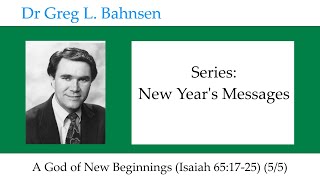
This is a New Year’s sermon (delivered around Jan 1, 1990) by Dr. Greg Bahnsen focusing on Isaiah 65 and 2 Corinthians 5. Bahnsen argues that God is a God of new beginnings — from creation through Israel’s renewals, the messianic work of Christ, and the inaugurated ‘new creation’ now active in the church — and applies this to personal conversion, sanctification, reconciliation, and church ministry.
Chapters
For the remainder of this month, I will be preaching on matters pertaining to the life and conduct of the church, our particular congregation, but the Church of Jesus Christ in general. However, this Lord's Day I have chosen to begin the New year with a New Year's message and would ask you to turn in your Bibles for our reading from God's Word first in the Old Testament to Isaiah, the 65th chapter, Isaiah 65, where I'll read verses 16 to 25, The prophecy of Isaiah, chapter 65, beginning the reading at verse 16, please hear this, for it's the word of God to you, so that he who blesses himself in the earth shall bless himself in the God of truth. And he that swears in the earth shall swear by the God of truth. Because the former troubles are forgotten, and because they are hidden from mine eyes. For behold, I create a new heavens and a new earth, and the former things shall not be remembered nor come into mind. But be ye glad, and rejoice forever in that which I create. For behold, I create Jerusalem a rejoicing, and her people a joy. And I will rejoice in Jerusalem, and joy in my people. And there shall be heard in her no more the voice of weeping and and the voice of crying. There shall be no more thence an infant of days, nor an old man that hath not filled his days. For the child shall die a hundred years old, and the sinner, being a hundred years old, shall be accursed. And they shall build houses, and inhabit them and they shall plant vineyards, and eat the fruit of them they shall not build, and another inhabit, they shall not plant, and another eat. For as the days of a tree shall be the days of my people, and my chosen shall long enjoy the work of their hands they shall not labor in vain, nor bring forth for calamity for they are the seed of the blessed of Jehovah, and their offspring with them. And it shall come to pass that before they call, I will answer. And while they are yet speaking, I will hear the wolf and the lamb shall feed together, and the lion shall eat straw, like the ox, and dust shall be the serpent's food. They shall not hurt nor destroy in all my holy mountain, saith Jehovah. Our reading in the New Testament is found in 2 Corinthians the fifth chapter, where I will read verses 14 to 21. Second Corinthians 5:14. Hear again. God's word for the love of Christ constraineth us, because we thus judge that one died for all, therefore all died, and he died for all that they that live should no longer live unto themselves, but unto him who for their sakes died and rose again. Wherefore we henceforth know no man after the flesh, Even though we have known Christ after the flesh, yet now we know him so no more. Wherefore if any man is in Christ, there is a new creation. The old things are passed away. Behold, they are become new. But all things are of God, who reconciled us to himself through Christ and gave unto us the ministry of reconciliation, to wit, that God was in Christ, reconciling the world unto Himself, not reckoning unto them their trespasses, and having committed unto us the word of reconciliation. We are ambassadors, therefore, on behalf of Christ, as though God were entreating by us. We beseech you, on behalf of Christ, be reconciled to God, him who knew no sin he made to be sin on our behalf, that we might become the righteousness of God in him. And thus far, the reading of God's holy Word. The beginning of a new year is a significant time to do some reflection in the ongoing cycle of years. This last week, we've come to another beginning. The beginning of the New Year, 1990. And so calendars have changed and are changing. Businesses are beginning a new accounting season and calculating their gain or their loss for the past year. Individuals are totaling up the past year for the IRS and making a new start. New laws passed by the government go into effect on the first day of the year. And as you know, people make new resolutions, they turn over a new leaf. They make New Year's resolutions at this time of year. The new month that we're entering have entered actually is called January, named after the Roman God Janus. And if you know your ancient mythology, you remember that Janus was imagined by the ancient Greeks, Romans, in this particular case, to have two faces. One face looking backward, one face looking forward. Was it the other way around? Anyway, two faces, because, well, January is like that, right? In the month of January, we look back. The previous year is over, and we look forward. A new year is beginning now. This particular year is not simply the beginning of a new year. It's also the beginning of a new decade. Just imagine for a moment what the 1980s have meant and what the 1980s have represented. What has transpired? What important things have happened in the last 10 years? What important things have happened in the world? What important things have happened in our nation? What important things have happened in our individual lives? Imagine the changes that are in store for us in the decade of the 90s. We're at a very significant time, a change of a year, change of a decade. And in fact, we're entering the decade that finishes out a century. Soon it will be the beginning of the 21st century and we'll be looking at a new 100 year cycle of years and thinking the same sort of things. And then your Life and Time magazines will get bigger and bigger because then we have to cover not just a year or a decade, but now hundred years. And when we get to the end of this decade, of course it's going to be a massive volume of pictures. I don't know if the pictures will go all the way back, but we'll have a thousand years that we're thinking about because we'll be entering a new millennium. Not many people in the history of the world have experienced the change to a new 1,000 year cycle on the calendar. But in 10 years, Lord willing, we're going to enter the year of our Lord 2000. Now where have we come since the year 1000 AD? What will the new millennium mean for the world? What will the new millennium mean for the Church of Jesus Christ? And as I'm speaking of the church, I should stop to observe, as we have earlier in our time of prayer, that this is a significant Lord's day for our own particular congregation. Covenant Community Church. It was precisely 10 years ago today, on the first Sunday of 1980, the two families met in a living room in Placentia for the first worship service of Covenant Community Church. And so much has happened since that day. We began in that living room with 15 people. We worship now in a place we're pushing, you know, the limits here of 120, 130. God has given us great growth. God has given us more than numerical growth in that first year that we met as a congregation. I'm trying to remember, I think my salary was $200 a month. We're doing much better financially as well, and we're doing much better in terms of ministerial service and outreach. Back in those days, there was a great deal that had to be done that rested upon the shoulders of the one teaching elder and one ruling elder that we had. And now we have a chairmanship system and we have numerous elders and numerous deacons. And we're even looking at our next congregational meaning of perhaps adding more to that list. We have people in our congregation that are active not only in the ministry and the outreach of this particular church, but elsewhere, whether it be in pro life centers or in education. Our own congregation has taken on a School ministry, which this is not a pat on our back, but I just want to remind you how significant in Orange county, what we have to offer is how important that kind of ministry is. We're beginning a publication ministry that I believe God will bless and will be very significant. In the last 10 years, we've taken on some aborigines from the previous Plymouth Congregational Church, members of our congregation as well. God has brought us some precious believers to share with God has brought us some resources, some opportunities. He has brought us skill and an opportunity and a heart to pursue ministry for him. And now we're unitedly heading into the last decade of the century, the last decade of this millennium. We're going to celebrate our anniversary, as you heard, just a few weeks Saturday evening, the 20th this month before our annual congregational meeting. Well, so in terms of the calendar, in terms of this church, this is a good time to reflect on the subject of new beginnings. Being able to put the past behind and to launch into a new start for us. You know, a Christian understanding of the world and a Christian understanding of time is the only one which can really make sense of that conception of putting the past behind and progressing into the future. The conception of a new beginning, the conception of progress in time, conception of change in history is all tied to a Christian outlook on life, a Christian understanding of reality, history and our place in this world. For the Eastern religions, history is cyclical. History goes in cycles. It repeats itself over and over and over again. Over this last couple weeks, I had lunch with my oldest son in a Chinese restaurant and it so happened that the paper placemat that they had, you've probably seen them in some Chinese restaurants, explains the Chinese conception of the calendar and how, I don't know whether I think it's a 14 year cycle, maybe it's something different, but every so many years we come back around and we start repeating the year of the ox and the year of the monkey and the year of the Goat. I think I was born in the year of the Rat. I'm not sure what that says. I think that's true, but I'm not worried about that. Because you see, that conception of history says that everything repeats itself, repeats itself, and one can never break that cycle. There is no genuine progress. There's just things coming back around and starting all over again. Or think about it from an atheist standpoint. The atheist worldview holds that there is no absolute meaning and there is no absolute measuring point in a chance universe, a universe of relative values. And so it in an atheist universe, there can't be anything like progress because there's no fixed point by which to measure such a thing as progress. Even in the Marxist worldview, that does have something of a historical dynamic, the dialectic working itself out in history. Even in the Marxist worldview, there is no explanation for the inevitability of progress. There's nothing like the Christian concept of the Incarnation that could account for why things are going to get better. And of course, the Marxist understanding of the inevitability of progress has proven not to be so inevitable after all as what has happened in Eastern Europe has recently pointed to. Anyway, at a significant time like this, we as Christians, not having the difficulties of those other worldviews, we as Christians can look at the course of history and the course of our lives. We can stop to reflect upon the fact that we worship a God of new beginnings. He is what makes history change. He is what makes starting over possible. He is what makes progress secure. It's by his grace and it's by his power that we may experience not simply the change of years, but radical change and renewal in our lives. He's indeed a God of new beginnings. First of all, just think about how the biblical story begins. In the beginning, God created the heavens and the earth. There is no account for our existence. There's nothing to give us understanding of who we are and what we're about and what we should be doing. Apart from that opening line of the Bible. In the beginning, God and God called this world into existence from nothing. He did not extend his own being. We are not all just somehow the extensions of God's being. Nor did God have to work with some kind of recalcitrant eternal matter that existed with him as well. God called by his own powerful word, God called into existence the world as we know it from nothing. A God that has that kind of power should be called exalted, should be called Almighty. He is the One who can do all things, because he's the One who's created us and created the world in which we live. That's where the biblical story begins. A God of new beginnings, a God of creation. But throughout the history of God's people, throughout the history of God's old covenant people, we see how often he granted new beginnings to them as well. We see a new family line granted to Adam and Eve when their two sons were not able to get along and one murdered the other. We see the godly line of Seth instituted a God of new beginnings for the human race and a new world for Noah. To live in after God destroyed this world in judgment, the church, judgment of the flood, and a new identity for Abram, who becomes Abraham, the father of multitudes, a new land and a new prospect for Abraham's family. We see a time of new freedom for God's people under the leadership of Moses, a new priesthood instituted under Aaron, a new inheritance won for them under Joshua, a new king promised to them, promised to David, a new covenant declared for them through the prophet Jeremiah, and a new age of Messianic blessing promised through the prophet Isaiah. And so we come to the prophecy of Isaiah, our text for this morning. And I'd like you to see in the context of Isaiah's prophecy, the stress that Isaiah has placed in chapter 65 under the inspiration of God, the stress that Isaiah places upon newness, a God of new beginnings. We need to understand the context of the book of Isaiah. And if I had my heart's desire today, I'd preach all 66 chapters. This is a wonderful book in the Bible. I trust that it's on your regular schedule of devotional readings and that you're studying at your from time to time, you need to remember Isaiah's prophecy, the general context of it. The prophet Isaiah declares the sinful condition of Judah in particular, and declares that God will come in judgment against his people, first in the threat of Assyria, and then finally in the exile under Babylon. God is angry with Judah. Turn to Isaiah, chapter one, beginning at the second verse. Hear, O heavens, give ear, O earth, for Jehovah hath spoken. I have nourished and brought up children, and they have rebelled against me. The ox knows his owner and the ass's master's crib. But Israel does not know. My people do not consider. Ah, sinful nature, nation, a people laden with iniquity, a seed of evildoers, children that deal corruptly. They have forgotten Jehovah, they have despised the Holy One of Israel. They are estranged and gone backward. Why will ye be still stricken that ye revolt more and more? The whole head is sick, and the whole heart faint from the sole of the foot, even unto the head. There is no soundness in it but wounds and bruises and fresh stripes. They have not been closed, neither bound up, neither mollified with oil. Your country is desolate. Your cities are burned with fire. Your land, strangers devour it in your presence. And it is desolate, as overthrown by strangers. And the daughter of Zion is left as a booth in a vineyard, as a lodge in a garden of cucumbers, as a besieged city, except Jehovah of hosts had left unto us a very small remnant. We should have been as Sodom. We should have been like Gomorrah. Hear the word of Jehovah. Ye rulers of Sodom. Give ear unto the law of our God. Ye people of Gomorrah. What unto me is the multitude of your sacrifices, saith Jehovah. I have had enough of the burnt offerings of rams and the fat of fish, beast. And I delight not in the blood of bullocks or of lambs or of he goats when you come to appear before me. Who has required this at your hand that you trample my courts? Bring no more vain oblations. Incense is an abomination unto me. New moon and sabbath, the calling of assemblies, I cannot away with iniquity in the solemn meetings. Your new moons and your appointed feasts, my soul hates. They are a trouble unto me, and I'm weary of bearing them. And when you spread forth your hands, I will hide mine eyes from you. Yea, when you make many prayers, I will not hear. Your hands are full of blood. Wash you, make you clean. Put away the evil of your doings from before mine eyes cease to do evil, learn to do well, seek justice, relieve the oppressed, judge the fatherless, plead for the widow. Come now, let us reason together, says Jehovah. Though your sins be as scarlet, they shall be as white as snow. Though they be red like crimson, they shall be as wool. If you be willing and obedient, ye shall eat the good of the land. But if you refuse and rebel, ye shall be devoured with the sword. For the mouth of Jehovah hath spoken it. How is the faithful city become a harlot? She that was full of justice, righteousness lodged in her. But now. Murderers. Thy silver has become dross, thy wine mixed with water. Thy princes are rebellious and companions of thieves. Every one loves bribes and follows after rewards. They judge not the fatherless, neither doth the cause of the widow come unto them. Therefore, saith the Lord, Jehovah of hosts, the mighty One of Israel. Ah. I will ease me of mine adversaries and avenge me of mine enemies. And I will turn my hand upon thee and thoroughly purge away thy dross and will take away all thy tin. And I will restore thy judges, as at first in thy counselors, as at the beginning. Afterward thou shalt be called the city of righteousness. A faithful town. Zion shall be redeemed with justice and, and are converts with righteousness. But the destruction of transgressors and sinners shall be together, and they that forsake Jehovah shall be consumed. For they shall be ashamed of the yokes which ye have desired, and ye shall be confounded for the gardens that ye have chosen. For ye shall be as an oak whose leaf fadeth, and as a garden that hath no water, and the strong shall be as tow, and his work as a spark, and they shall both burn together, and none shall quench them. See, that is a long introductory statement. But by that Isaiah, you see, summarizes now the course of his prophecy. You are wicked, and God sees through you. And in fact, God is very weary of you. And God does not want your religious vanity anymore. And God does not want your hypocrisy and your social unrighteousness. He despises the injustice of your land. And so in judgment he will arise. And yet the same God of judgment will sovereignly redeem his people. He will wash away your sin. He will restore you and make you a town of righteousness. Once again, in chapters one to 39 of this prophecy, we read of God showing his sovereignty in that judgment, and God showing his sovereignty and sending salvation to his people. But then, at chapter 40, indeed chapters 40 through 66 of the prophecy, the prophet elaborates upon how will God do this? He elaborates upon the coming of the Lord himself to his people and the salvation that he will accomplish, and then the future blessing of the Messianic age. Just look at chapter four, 41 2. You'll get an overview of what the prophet will cover in this section of his prophecy. Comfort ye, comfort ye, my people, saith your God. Speak ye comfortably to Jerusalem, and cry unto her that her warfare is accomplished, that her iniquity is pardoned, and that she hath received of Jehovah's hand double for all her sins. Comfort, my people. The Lord will release you from captivity. You will come back from exile. He will again grant to you the land which represents his kingdom on earth. And indeed, the suffering servant of the Lord will come and will do a work that is nothing less than that of pardoning iniquity and washing you clean, clean. Isaiah 52 and 53. Tell us of that. Awake. Put on thy strength, Zion. Put on thy beautiful garments, O Jerusalem, the holy city. For henceforth there shall no more come into thee, the uncircumcised and the unclean. Shake thyself from the dust. Arise, Sit on thy throne, O Jerusalem. Loose thyself from the bonds of thy neck, O captive daughter of Jesus. Zion, the captivity will end. Stand up and be clean. Dust yourself off, God Will bring you home. For thus saith Jehovah, you were sold for nothing. You shall be redeemed without money. For thus saith the Lord. Jehovah. My people went down at first into Egypt to sojourn there. And the Assyrian hath oppressed them without cause. Now therefore, what do I hear, saith Jehovah, Seeing that my people is taken away for nothing? They that rule over them do howl, saith Jehovah, and my name continually all the day is blasphemed. Therefore my people shall know my name. Therefore they shall know in that day that I am he that doth speak. Behold, it is I. How beautiful upon the mountains are the feet of him that bring good tidings, that publish peace, that bring good tidings of good, that publish salvation. That saith unto Zion thy God reigneth the voice of thy watchman. They lift up the voice Together do they sing. For they shall see eye to eye When Jehovah returneth to Zion. Break forth into joy. Sing together, ye waste places of Jerusalem. For Jehovah hath comforted his people. He hath redeemed Jerusalem. Jehovah hath made bare his holy arm in the eyes of all the nations. And all the ends of the earth have seen the salvation of our God. Depart ye. Depart ye. Go ye out from thence. Touch no unclean thing. Go ye out of the midst of her. Cleanse yourselves, ye that bear the vessels of Jehovah. For ye shall not go out in haste, neither shall ye go by flight. For Jehovah will go before you and the God of Israel will be your rearward. Behold, my servant shall deal wisely. He shall be exalted and lifted up, and shall be very high like as many were astonished at thee. His visage was so marred more than any man, and his form more than the sons of men. So shall he sprinkle many nations. Kings shall shut their mouths at him. And that which had not been told them shall they see. And that which they had not heard shall they understand. Now who's going to believe this message? Who hath believed our message? To whom hath the arm of the Lord been revealed? For he grew up before him as a tender plant and as a root out of dry ground. He hath no form nor comeliness. And when we see him, there is no beauty that we should desire him. He was despised and rejected of men. A man of sorrows acquainted with grief. And as one from whom men hide their face. He was despised and we didn't esteem him. Surely he hath borne our Griefs carried our sorrows. Yet we did esteem him stricken, smitten of God and afflicted. But he was wounded for our transgressions, he was bruised for our iniquities. The chastisement of our peace was upon him. And with his stripes we are healed all. We, like sheep, have gone astray. We have turned everyone to his own way. But Jehovah hath laid on him the iniquity of us all. He was oppressed, yet when he was afflicted, he opened not his mouth. As a lamb that is led to slaughter and a sheep that is before his shearers dumb. So he opened not his mouth. By oppression and judgment he was taken away. And as for his generation, who among them considereth that he was cut off out of the land of the living for the transgression of my people, to whom the stroke was due. And they made his grave with the wicked and with the rich man in his death, although he had done no violence, neither was any deceit in his mouth. Yet it pleased Jehovah to bruise him. He hath put him to grief. When thou shalt make his soul an offering for sin, he shall see his seed. He shall prolong his days, and the pleasure of Jehovah shall prosper in his hand. He shall see of the travail of his soul, and shall be satisfied by the knowledge of himself. Shall my righteous servant justify many, and he shall bear their iniquities. Therefore will I divide him a portion with the great, and he shall divide the spoil with the strong. Because he poured out his soul unto death and was numbered with the transgressors. Yet he bare the sin of many and made intercession for the transgressors. And then Isaiah begins the metaphor of the barren woman singing for joy. This is a fantastic prophecy. I realize we don't usually read long portions of scripture like this, but you really can't understand the Beauty of Chapter 65. If you don't have something of this, you know, dynamic built up behind it. Chapter one begins with the unrighteousness of Jerusalem and Judah and God. God's hatred. So bad is the hatred of God toward them that he says, when you pray, I will not listen. When you come to me in my solemn courts, I will say, who has required this of you? I don't want your sacrifices. I don't want your gifts. You sicken me, indeed. You are sick from the sole of the foot to the head. There's nothing but wounds and bruises, and there is nothing in you that I should desire but I'm going to send one who will suffer, and there will be seen in him nothing to desire. And men will despise him and reject him. But in his rejection, you shall be received. The grace of our God says, I will bring you back from captivity. And when you leave, don't touch any unclean thing. I will go before you, and I will protect you from the rear. And you come back and become my people and enter my land. And immediately, Isaiah thinks of the suffering servant of the Lord again. And how will this happen? What is this all about? Is this just a geopolitical movement in the ancient world? Is the significance of this simply that the Jews have come back to their land? No, the significance is that God is restoring his people by grace. Grace. And he will do it through his Son, through his servant. And his servant will come and suffer and suffer in our place and justify many. And so Isaiah speaks of the coming of God to his people, the salvation that he will accomplish for them to reverse their circumstance in this world, so that God, who has despised them, will rather make his Son to be despised. And God, who has rejected them will now receive them, because his Son will be rejected instead. And the saving work of the Messiah, Isaiah says, will not end. There, you see. It's as though Isaiah is standing back and looking down a corridor that gets wider and wider and wider. And at the very opening of the corridor, he sees the restoration to the land. He says, jehovah will make Jerusalem to live again. He will dust you off, and you will stand up and you will walk home, and he will establish the land. But beyond that, he sees that the land is established, the kingdom is put in place for the sake of the king who is coming, who will die for his people. And then as he looks further down, he sees that the work of this Messiah will not simply be individualistic, will not simply be spiritual in the sense that individual souls will go to heaven after they die. But he sees the work of the Messiah as actually renewing the whole creation. And that's why when we come to the end of the prophecy, or near the end of the prophecy in chapter 65, the stress is placed upon God granting a new beginning to his saved people. Isaiah 65. Just look at the newness here, verse 16. The four former troubles are now past, and not simply past, but forgotten. Isaiah says, in that day, he who blesses himself in the earth will bless himself in the God of truth. He that swears in the earth shall swear by the God of truth. Why? Why will there be such a day? Of sanctification and God centered living because the former troubles are forgotten, they are hidden from mine eyes. I'll bet you've had times when you wanted God to say that to you, where God says not only are sins forgiven, but they're blotted out and I see them no more. I don't know how we can understand that promise really experientially come to grasp the meaning of that that God says I will not remember your sins anymore. God knows everything. And of course the torture is that I remember my sins and Satan reminds me of my sins and I'm so often broken down because I feel so bad about the kind of person I am. But God says the former troubles will be passed and I won't remember and I won't bring it to mind and I will no longer treat you as though those things were true. Verse 17 tells us that this will be nothing less than a new creation that God is going to bring through the Messiah. For behold, I create a new heavens and a new earth, and the former things shall not be remembered nor come into mind. I'm afraid many of us have been conditioned by the preaching and the reading that we've experienced in the past to think of the new heavens and the new earth as simply something that will take place when Jesus returns. But here Isaiah makes very clear that the new heavens and the new earth in token form began when Israel came back to the land and were established at the work of the Messiah, the suffering servant of the Lord, and that his work will accomplish something even prior to the consummation that will be called nothing less than a new creation. It will be a time of God's favor, and because of God's favor a time of rejoicing for his people. Behold, I create new heavens and a new earth, he says. Verse 18 but ye be glad and rejoice forever in that which I create. For behold, I create Jerusalem a rejoicing, and her people a joy. And if that isn't a happy enough promise, God tells us why we will be rejoicing in a joyful people. He says, because I will rejoice in Jerusalem and take joy in my people. And when God has that kind of joy, then his people will not weep and they will not cry, because there will be no more the voice crying in her, and it will be a time of long life and blessing. Verse 20 says, There shall be no more thence an infant of days, nor an old man that has not filled his days, for the child shall die a hundred years old, and the sinner being 100 years old shall be considered cursed. You know very well, in our day and age, if people live to be a hundred, we think that's remarkable. When people die at the age of 100, in the Messianic age, people will say of that that's a child or a cursed sinner. A hundred years is hardly anything because of the blessing God will bring. And there will be a time for enjoying the work of our hands. It will not be for futility any longer. They shall build houses and inhabit them. They shall plant vineyards and eat the fruit of them. Remember chapter one, which I read for you at length. What did God say? You will build houses, but you will not live in them. You will plant vineyards, but you will not drink from them, because I will give it to another. Assyria will threaten, Babylon will take you into captivity, and your land will be desolate. And now God says, I will reverse your fortunes. And now when you do your work, you will see success and prosperity from it. You will enjoy the fruit thereof. They shall not build and another inhabit. They shall not plant and another eat. For as the days of a tree shall be the days of my people, and my chosen shall long enjoy the work of their hands. They shall not labor in vain, nor bring forth for calamity, for they are the seed of the blessed, of Jehovah, and their offspring with them. How often we in our own day think that we are working for nothing. We see the calamity that comes with, well, I've put in all these years, and what has it accomplished? God says, but I will reverse the fortunes of my people. And it will be a time of God's tenderness and answered prayer. You have to remember chapter one again. You know we go from the beginning to the end of the prophecy. What did God say in chapter one? And when you pray, I will close my ears. I don't want to hear you. And now he says in verse 24 of chapter 65, it shall come to pass that before they call, I will answer. And while they are yet speaking, I will hear. What a marvelous promise. Just those three words, I will hear you. You will not be bouncing your prayers off the ceilings of your homes. God says, I will be there, and I will hear. And in fact, so tender and solicitous will I be toward you in your need that even before you pray I will begin to answer your prayers and to meet your needs. And it will be finally a day of peace where the wolf and the lamb shall feed together and the lion shall eat straw like the ox and Dust shall be the serpent's food. I don't take that in the literal sense of animals living in that particular way. I see that as a beautiful metaphor of the peace that God will bring on earth. Through the Prince of peace, His Son and war will be diminished because they shall not hurt or destroy in all my holy mountains, says Jehovah. So what a time is coming when those kinds of blessings are enjoyed through the reconciling work of God's Son. It will be a time that is nothing less than a new creation, a new heavens and a new earth. And the New Testament tells us that this new beginning has begun. This new beginning has begun in Christ. For Christ's birth inaugurated the new age of salvation. In his preaching, he announced the coming of God's kingdom. In his death and in his resurrection, he accomplished the forgiveness of our sins and reconciliation with God. His rising from the dead has conquered the last enemy, and his ascension has enthroned him at God's right hand. And from God's right hand Jesus has sent the Holy Spirit into His church to inaugurate the new age of regeneration and faith and joy and power for God's people. God has not only sovereignly come into our world to accomplish accomplish salvation, he has come right into our hearts to apply that salvation to us. That's what Paul is talking about in 2nd Corinthians 5. Had we the time if we were at Bible study, I might prolong this a bit and point to all of the connections in Second Corinthians, especially centering around chapter five with Isaiah's prophecy. I have no doubt in my mind that Paul clearly was thinking of Isaiah's prophecy when he wrote many of these words. Words. Just as one example in Second Corinthians 6, you will notice that he says at the end of the chapter, come out from among them, be separate, and touch no unclean thing. Specifically referring to Isaiah's prophecy, God will restore you from captivity, so be a sanctified people. But here in chapter five, Paul tells us that reconciliation has been received in Christ. And not only has reconciliation been received, but we have received the ministry of reconciliation, making us ambassadors of the word of reconciliation and of Jesus Christ the reconciler. And because we have been reconciled and because we have that ministry of reconciliation, Paul says it is nothing less than the new creation that has come. In verse 17 he says, Therefore, if any man is in Christ, there is a new creation. Now I realize that most of your translations are going to say, if any man's in Christ, he is A new creature. That is logically an inference from the fact there is a new creation. That is not what the Greek text says. And that's why you have italicized words there to try to smooth that out for you. I think Paul is saying something much bigger than your translators thought. He wasn't simply saying that we, when you as an individual are in Christ, that indicates that you are a new creature. True though that may be, he is saying something much more. If any man is in Christ, if the day of reconciliation has come, then the new creation has come. And so in Christ that new beginning prophesied by Isaiah has indeed begun. The new age is upon us. The new creation has now begun. And the Bible tells us that this new creation will one day be consummated when Jesus returns again in second Peter 3. We learn from Peter that we are anticipating a new heavens and a new earth wherein righteousness dwells. For God will have purged away the dross, and will have purged away by the fire of his judgment all the things that offend. And in that day nothing will be left but righteousness in the new heavens and the new earth. In Revelation 21:1 5, John describes for us what this new heavens and new earth will be like. In that day I saw a new heaven and a new earth, and the first heaven and the first earth are passed away, and the sea is no more. And I saw the holy city, new Jerusalem. What had God said through Isaiah? Isaiah, I will make Jerusalem over again. And now the new Jerusalem will come down out of heaven from God, made ready as a bride adorned for her husband. And I heard a great voice out of the throne saying, behold, the tabernacle of God is with men, and he shall dwell with them, and they shall be his peoples, and God himself shall be with them and be their God. And he shall wipe away every tear from their eyes, and death shall be no more. Neither shall there be mourning, nor crying, nor pain anymore. The first things are passed away. And he that sits on the throne said, behold, I make all things new. Isaiah spoke of a day where a man dying at a hundred will be considered but an infant. John says, I speak of a day where death will be no more. God says, I will make everything new. God of new beginnings, from beginning to end, from COVID to cover. In the Bible, the story of a God of new beginnings. And so at this onset of a new year, nearly at the onset of a new millennium, what new beginning do you need to make trusting in this God of new beginnings? For some of you, you need to see a new beginning of life spiritually. And I say that with a heavy heart. Even for some who may have professed faith in in Jesus Christ and are members of this congregation. It may be that at this time of reckoning and reflection upon the significance of the turn of the year, you need to think about the significance of your own life before God. Are you converted? Are your affections changed? Has God made all things new in your life? Or do you find yourself really running with the world, really running with worldly desires and worldly priorities and worldly aims and worldly happiness, instead of receiving the reconciliation from God that wipes the tears from our eyes and grants us peace and prosperity and someday a glorious day, day of Messianic blessing. Have you chosen the wrong sorts of things in your life? Is it time for you to have a new beginning? Is it time for you finally to say, I want to put the old away. I want Christ to be my new life? Paul could say, I am crucified with Christ. Nevertheless, I live. Yet not I, but Christ lives in me. And because this faith that I have in the Son of God who gave himself for me, because I live by that faith, I have a new life. You might call it death because I died. But you see, in Christ's resurrection I arose a new man. In Romans 6, Paul says, if we are crucified with Christ, if we've been crucified with him, if we've been baptized with with him, then we must lead new lives. As he rose to newness of life, we rise to newness of life. Do you have a new life? Be honest. Don't give the answer that you might have to give. If you stood up in the congregation and didn't want to be embarrassed. Forget the congregation. Don't even think of yourself before your mirror at home. Think of yourself before the almighty presence and searching gaze of God. Is your life new? Has he made you over again? Are you converted? Or does God save you sitting here now, even this morning? Why do you come here and sing these hymns? Why do you pray your prayers and come to the table and hear the preaching of my word? I am sick of your religious exercises. I don't know who you are. I mean, even the animals know their cribs and their homes. But you don't know where you belong. You don't know me. You don't love me. Does God say that of you? Do you need to confess that this morning? Do you need to hear what Paul says? That Christ became your sin, that you might become his righteousness do you need to hear that message of right reconciliation and have your life changed? Is that what the new year could present to you? Then praise God, you are not trapped by your past. You do not have to remain in unbelief because God will grant the life you need and the enlightenment you need, and God will give you the faith you need to save you. This could be a glorious beginning for you, the beginning of a new life in Christ. For those of you who do know Christ, for those of you who are converted, should this be the beginning of a new cycle of sanctification in your lives? I know so many of you do not read your Bibles daily, do not pray daily. And some of you say, well, what do you think that is? Some kind of magic word wand, Pastor? So we just go through these exercises? No, I don't. I think it's just as understandable as eating your daily food. Many of you know, over the last few weeks, at least until the holidays came, I was losing weight, I was not eating as much food. And I understand what that is. You know, you don't have as many calories in you. You're not as peppy as you might have been. And I also know that if I kept going that direction, if I didn't have any calories put into my body, that I would eventually pass out. I might even die. That's something magical. If the doctor were to say to me now, Greg, what you need to do is you need to have a more regular diet, you need to put a few more calories into your body, then you'll be feeling better. Do you think I would say to the doctor, oh, you think that's some kind of a magic wand? I just eat my food and I'll get feeling better? The doctor would say there's nothing magical about it, but it's certainly true. You're not daily sustained with physical energy. You're not going to feel good physically. And I'm telling you as the doctor of your souls, if you do not have a walk with God, if you do not read your Bible daily, if you do not pray daily, if you do not pray without ceasing, you will be sick and weak and you'll be prone to temptation, giving in to temptation, and you'll struggle with sin and you'll struggle with depression and you'll struggle with self doubt. You can have plenty of those kinds of problems even when you are walking with the Lord. Now, when they come into your life and you don't have that to fall back on, what will you Do. There are some of you here that I know are struggling with besetting sins. I don't know all your secrets, but I know many of you. Some of you have trusted me enough to share those secrets. These besetting sins need to be set aside because God will make you new. He did not redeem you simply to put away your guilt, but to leave you in your pollution. He redeemed you to make you new, to give you power over sin. Indeed, sin shall not have dominion over you, Paul said, because we belong to Jesus Christ and we have new life by his spirit. Maybe the newness that you need to see in 1990 is conquering those sins, those besetting sins, crucifying them, putting them to death, mortifying them, as Paul would say, and living more and more unto righteousness. Perhaps you need a new beginning in ministry in the Kingdom of Jesus Christ. For the fact of the matter is as proud as I am of our congregation for the fact that we distribute the ministerial load much further, percentage wise than any other congregation I've ever known. And I do commend you in God's name for that. The fact is, it is still being held by a minority. The work of the Church of Jesus Christ, even here in Covenant Community Church, is still being done by less than 50% of the members. Maybe it's time for you to say, I want to put away my indifference and put away my passivity and put away my letting everybody else do it and put away my spectator approach to being a member of this church. And I want to find what I can do to serve the Lord Jesus Christ here and turn over your bulletin sometime and look at the chairmanships that are there. Look at the fields of ministry, the various things we do. You know about our school ministry. You know about our publication ministry. You know about evangelism and education and prayer and all the things that we do. What are you doing? Is this a time for a new start for you? In the 1990s of ministry within the kingdom of no longer burying those gifts and talents, those skills, skills, those opportunities, those resources God has given you. Is this a time of new beginnings, for reconciliation with you? We sometimes see people alienated from one another and not pursuing reconciliation because they believe it's too late. Late. God can't do anything now. I know someone dear to me who feels that way. You know, people like that. Maybe you're like that. You need to know that God is a God of new beginnings. Maybe your marriage is struggling. God can restore your marriage. Maybe you're on the verge of losing or have lost a very good friend because one or the other or both of you have not acted in a peaceful and godly manner toward each other, God can renew your friendship. God can bring reconciliation. If God can bring reconciliation between himself and us and the ugliness and depth of our sins, he can certainly take care of the minor adjustments needed to bring reconciliation in our lives. Perhaps the new beginning that you need to see is the understanding that your life is not over because of some despair that has come in this year into your life. I know some of you have struggled with that. I have struggled with that. We sometimes feel our lives are over. That's not true. If what I've preached today is faithful to God's word. God is a God of new beginnings. And even if you don't see your prayers answers in the way that you would like them to be answered, even if you feel that you've blown it so badly or things have happened so grievously to you that there's really nothing left for you, God says, no, I make all things new. We're not trapped by our past. We're not trapped by our failures. We're not trapped even by our sins and our disappointments and our heartbreak. Because as we come to this new year, we need to remember what Isaiah prophesied and Jesus brought into reality and which Paul reflects upon when he tells us, if any of us are in Christ Jesus, God is making everything new. Let's pray. God, we ask you to renew our lives and to keep your powerful word of promise promised to us to make everything new. We do thank you that you are going to restore this world. We thank you that a day is coming when peace and longevity and prosperity will be enjoyed. But we pray more personally, more individually, that you would make us new individually. God, I pray for those whose hearts, even at this time, are weighed down with doubt and the feeling of guilt because of their sins, those who are honestly asking whether they belong to you at all, whether their lives have ever been changed in the first place. And I pray that you'll change them. I pray that as you created in the first place, you will create in the second and make a new creature at of those who wish to know you. And I pray that you would renew those who do know you, that you will, in your people stir up sanctification, a daily walk with you, fellowship so close and so sweet that it cannot be put into words. I pray that you would help us to put away our besetting sins, to lay them aside and to run the race before us, looking to Jesus. I pray that you would renew us in the ministry of Christ's kingdom, that you'd forgive us for our sloth and our indifference and our willingness to be spectators as to what's going on in the ministry of this Church and in your kingdom in general. I pray that you would stir us all up to serve you, to find avenues of service, to express our joy in salvation and our submission to the King Jesus Christ, to use our skills to glorify him and advance his kingdom in this world. And I pray, Father, that you'd bring new beginnings where there has been a lack of peace, where reconciliation is called for before people. I pray that you would stir up our hearts with hope. Hope that yout are a God of reconciliation, that yout can start things over again for us. And indeed, you'd can start things over for us, even when we feel our lives are over and despair has overtaken us, or we have done so poorly and have fallen so short of youf glory that we worry that we've backslidden right out of youf grace. We praise youe God, that that's not possible. We thank you that you hold on to us, that nothing can pluck us from your hand, and that you not only forgive us, not only renew us, but you don't leave us there. You give us new beginnings. You fill our lives with hope so that we know that the future will no longer be the night that we have experienced, but will be the eternal day that you are bringing in Christ, fill our hearts with gratitude and change our lives. In 1990. Be to us a God of new beginnings. In Jesus name, Amen.
More from BahnsenAI




Dr Greg Bahnsen - Proverbs: Proverbs 16:28, 30 (Some Tips on Promoting Strife) (Part 72)

Dr Greg Bahnsen - Proverbs: Proverbs 15:23; 16:21, 23-24 (True Religion: A Bridled Tongue) (Part 71)

Dr Greg Bahnsen - Proverbs: Proverbs 14:21 (Imitating the Father's Tender Mercies) (Part 70)

Dr Greg Bahnsen - Proverbs: Proverbs 15:25; 22:28; 23:10-11 (Widows and Property Rights) (Part 69)

Greg Bahnsen R C Sproul Debate Part Two Presuppositional vs. Classical Apologetics


Greg Bahnsen VS R C Sproul Debate Part 4 Presuppositional Vs Classical Theology

Greg Bahnsen vs R C Sproul Debate Part One Presuppositional Vs Classical Theology