Dr Greg Bahnsen - Peter's Apologetic: Humble Boldness (Part 4)
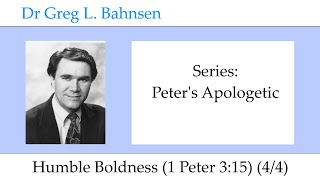
This is a transcribed sermon by Dr. Greg L. Bahnsen (published via BahnsenAI/Bonsen Institute) centered on 1 Peter 3:15. Bahnsen exhorts Christians to be "ready" to give a reasoned defense (apologia/logos) for the hope in them: preparation should be intellectual, systematic, and non‑emotional. He contrasts Christian apologetics (reasoned, evidential, and worthy of study) with non‑rational religious approaches and contemporary anti‑intellectual cultural trends, urging educated, philosophically engaged, and logical Christians.
Chapters
This recording has been released into the public domain by the Bonson Institute, where we aim to bring into captivity every thought to the obedience of Christ. Peter, Chapter three, which I'd like you to turn to in your Bible. We'll read our text of the morning. 1st Peter 3. The 15th verse, 1st Peter 3, 15 is our text for the morning. I will put it in context, however, by reading for you from the eighth verse. Hear now God's word. First Peter 3:8. Finally, be ye all like minded, compassionate, loving his brethren, tenderhearted, humble minded, not rendering evil for evil, or reviling for reviling, but contrawise, blessing. For hereunto were ye called that ye should inherit a blessing. For he that would love life and see good days, let him refrain his tongue from evil, and his lips that they speak no guile, and let him turn away from evil and do good, let him seek peace and pursue it. For the eyes of the Lord are upon the righteous, and his ears unto their supplication. But the face of the Lord is upon them that do evil. And who is he that will harm you? If ye be zealous of that which is good, but even if ye should suffer for righteousness sake, blessed are ye, and fear not their fear, ere neither be troubled. But sanctify in your hearts Christ as Lord, being ready always to give an answer to every man that asketh you a reason concerning the hope that is in you yet with meekness and fear, having a good conscience that wherein ye are spoken against, they may be put to shame, who revile your good manner of life in Christ. For it is better if the will of God should so will that ye suffer for well doing than for evil doing. Thus far the reading of God's Word Last week we noted that in Peter's epistle he stresses three particular thoughts. These keep coming up over and over again, the thoughts of privilege, persecution, and purity. They're easy to remember because they're alliterated for you this morning. Privilege. We are the inheritors of a blessed inheritance made possible by the resurrection of Jesus Christ. The grace of God has put us into a wonderful place of blessing, a tremendous place of privilege. However, we are persecuted because the world doesn't love God's people and doesn't love the truth of God. The world slanders and distorts. The world will not get along with those who are the temple of God. There is no real fellowship between light and darkness. And so Peter says, we will be persecuted, but we should rejoice in persecution. We should be happy when we suffer for righteousness sake. After all, this has been the lot of all of God's people. And more particularly, it is the lot of God's own Son who first suffered and then entered into his glory. And so, even as Jesus suffered, we will suffer. And as he suffered in a non retaliatory way, we should suffer in a non retaliatory way. We should be people who in purity are submissive to our government, submissive to our masters. Wives should be submissive to their husbands, and husbands should honor their wives. There should be purity of life about us, such purity that even when we suffer for the sake of righteousness, those who slander us will have to be silenced. They'll see the good manner of our life and have to respect what God has done for us. Now, it's at this point that Peter calls upon believers to be prepared to make a defense of the faith. He says we must not only silence the slander by our good conduct, we must also vindicate the truth claims of our holy religion. It's not enough simply to have a lifestyle that that is commendable. Peter says we must also be prepared to defend the faith and to speak those things which are true and to show that they are true to others. And it's this task of vindicating the truth claims of Christianity that we call apologetics. Last week I reminded you that apologetics doesn't mean that we go around apologizing all the time, saying, oh, I'm sorry for this and I'm sorry for that. Apologetics comes from the Greek word apologia, which is the technical term that was used for the defense which a man would offer in a court of law if an accusation were brought against him. He would go to court and he would present his apologetic. He would give his apology, his defense and his conduct. The most famous instance of this, of course, is Plato referring to Socrates going to court and answering against the charge of atheism, that is not accepting the state gods, corrupting the youth of Athens, answering that his was a life of purity and the value of philosophy. And so here we have the apologetic that is presented by Socrates. Now Peter calls Christians to an apologetic. He says, you must be prepared to make a defense to anyone who asks you a reason for the hope that is in you. In last week's message, two things came out in our series about apologetics. I want to remind you of them because we're going to move on from that, add another element to it today and then next week, another. Last week we focused on two aspects of Peter's call to apologetics. First, the key to an unperturbed manner or demeanor. Do you remember what that is? How is it that we can present a witness to the world that isn't agitated, fearful, distressed when we come under attack? Peter says there are two things we need. One, a clear conscience, good conduct, knowing that if we suffer, we are suffering for righteousness sake, not for unrighteousness sake. And secondly, Peter says you must have an answer for the challenges that are made to your faith. If you know that your conduct has been clean and that you have answers for those who would attack the faith, then there's no reason for you to be agitated. There's no reason for you to be perturbed. There's no reason for you to be fearful or upset when people attack the Christian faith or attack you personally because you know that you stand on secure ground and that security can be communicated to others. We don't need to show an uneasy demeanor. So that's one thing we learned how to have an unperturbed demeanor in defending the faith. And secondly, we learned that we must approach the defense of the faith with a Christian mind, a Christian mind, a Christian mind that sets Christ apart as Lord in the heart. And we looked at each one of those words or phrases. They're very important to set him apart, to consecrate him, to make him different from every other commitment, and to set him apart in our heart, not meaning just emotionally, but in the very center of our being, where we think and understand and reason and plan and feel in the very center of our being. Christ is the Lord over our thinking processes, our planning, our attitudes, and he is to be the Lord. And as the Lord, he is beyond challenge. No one can challenge the word of the Lord. No. Loyalty is a higher loyalty. This supersedes all others. And so we have the attitude that Paul had in Romans the third chapter when he said, let God be true, though all men are liars. The word of Jesus Christ is beyond challenge. He is the beginning of wisdom and truth. The fear of the Lord is the beginning of knowledge. And Colossians 2 tells us, In Christ are deposited all the treasures of wisdom and knowledge. And so our basic plan as apologists, when we approach the subject of defending the faith is that which Paul tells us in 2 Corinthians 10:5, when he says that we bring every thought captive to the obedience of Christ. When there are all these reasonings or surmisings that are cast up against the knowledge of God, we cast them down boldly, because every thought is brought captive to the obedience of Christ. And if Christ is indeed Lord in our hearts in this way, we have a Christian mind that refuses to be neutral. I think that's the hardest thing in the world for people today to say no, I refuse to take a non committal approach to this subject. I refuse to lay all commitments aside and approach this from a neutral, uncommitted standpoint. We need a mind that refuses to be autonomous, a mind that refuses to set standards for judging God. For as the law of God says, you shall not test the Lord your God. God is not in the dock with us at the bench judging him. We are in the dock and he is our judge. And we must submit then to his judgment. And we must not defy the field of knowledge. I said we must not think that. Well, of course, once we're committed to Jesus Christ as Lord, then everything comes under his lordly prerogatives. Then his Word governs. But up until that point in apologetics, we must have the authority of reason to guide us, as though a man were to use a ladder to climb up to the top of the house. And once he gets to the top of the house, then he kicks the ladder away. And so we use reason and autonomous thinking and these standards to get to the point where we accept Jesus. And then once we accept Jesus, then we throw the ladder of reason away and we say, okay, now we bow to your authority. That divided field of knowledge is not honoring to the Lord. It suggests that he's not lord over all of life, even the reasoning of the unbeliever. It suggests that there is a reason that is a justification, some excuse for the unbeliever to subject God to some kind of autonomous pattern of reasoning and judgment before we finally say, oh, I guess you were right all along. And now I'll submit to you, no divided field of knowledge if we have a Christian mind. And then finally, we must learn to think Christianly. I know that's not good English grammar, but it makes a very good point. To think Christianly means that in everything we think about, we think in terms of the judgments of God. The law of God is to be written upon our forehead and upon our hand. And that means that God's law informs what I do in the world, how I operate in the world, what I do with my hands, as it were. And it also should govern the way I see the world. I see everything through the spectacles of Scripture. I see everything in terms of God's categories and standards. So I think in supernatural categories, you don't get that at the modern university today. I think in supernatural categories, I think in eternal categories, I think of heaven and hell and what's going to be the final day of judgment and God's reckoning with respect to what I'm thinking or doing or what others are thinking or doing. And we think God's thoughts after him. To put it in the words of St. Augustine, we think God's thoughts after him in every area of life. Well, that's what we talked about last week, talked about having a Christian mind, an unperturbed demeanor, because we have a clear conscience and we have an answer for the challenges of the faith and a Christian mind. Now this morning, we move ahead in our discussion of apologetics through a consideration of a reasoned defense. A reasoned defense. This is what Peter calls us to be prepared to present to anyone who asks. He says, and I'm being somewhat pedantic here, in translation of the Greek, he says, be ready always for a defense to everyone asking you for a reason concerning the hope that is in you. Be ready. I want to focus on two words here in particular. Be ready. He says, be ready to offer a reason, a word, offense. First of all, I want you to stop and meditate on this word ready as we find it in the text. Very significant. In fact, I think actually I can go on for an hour or two just on the significance of that word. Be ready. Do you know what it is to be ready? Let me give you some examples of how that word is used in the New Testament. It's the same word that would be used in Greek for calling people to a meal which is about to be served. You probably heard that sort of thing in your house. Supper is ready. That's the word ready, prepared in advance. It's now waiting in Mark 14:15. It's the word that's used for the dining room that was made ready for the Passover feast for Jesus and his disciples. In 2nd Corinthians 9:5. The word is used by Paul for the collection that's to be gathered and sent to the saints in Jerusalem. That collection was to be made ready ahead of time. And this word ready is also the word we find in Matthew 25, verse 10, where we are told that the wise virgins over against the foolish virgins. The wise were ready when the bridegroom arrived for the marriage procession. They were prepared ahead of time. And of course, there is this fascinating story in Acts 23, verse 21. Remember the account of Paul's nephew? Many people aren't even aware of the fact that Paul's relatives are referred to in the Bible. Paul had a sister and she had a son. And that son got word of a plot by the Sanhedrin. The Sanhedrin wanted the Roman centurion who was holding Paul to bring him down the next day to the Sanhedrin to question him further. But they had lined up 40 men who had taken a vow that they would not eat or drink anything until they had killed Paul. And these 40 men were stationed. They were to ambush Paul when he was brought down. Well, his nephew got word of this and he went to the centurion, told him the story, and then he says, and they are now, the word is now they are ready. Now, that is, you see all this planning that went into this, all this plot, and now they're set ready to pounce upon Paul as soon as you take him down. So be ready for them. And the word is used in another very precious verse in the New Testament. Many of you will know from John 14:2, Jesus said, I go to prepare a place for you. I go to make ready a place for you. Well enough survey of the use of this word. I hope by these many illustrations you get the point. To be ready or to make preparation for something means to set out in advance, to prepare ahead of time, to put in effort before the time comes. Jesus goes to prepare a place, the meal has been prepared. Those men are now prepared and waiting for Paul. And Peter says, you be prepared to defend the faith very simply. What that means is that when we defend the faith, it should not be ad hoc. Ad hoc. You heard that expression from the Latin, we don't give a here and there answer. We don't just say, oh, well, now what should I think about that? And how could I possibly answer that right now? Rather, we should have a reservoir of reasoning and meditation and thought about this, so that when somebody gives us, we say, yeah, we know the answer to that. I know what needs to be said about that. I know what assumptions you have that are wrong here. I know what implications there are to this line of thought. I'm prepared for this not being ambushed intellectually, let's put it that way. Apologetics means we should not be ambushed intellectually. Or somebody comes along and says, yeah, well, how about this? If you're a Christian, you go, well, I'd never thought about that. What should I say about that? You know, at a time like that, when the Christian is caught off guard, even if you come back two days later and say, you know, I thought about that, or I've talked to my priest, or I talked to my pastor, or I talked to my professor, whatever it may be, and I have an answer for it. By that time, you've already given an impression about the Christian faith to this person, and that's that your commitment to the Christian faith is not a reasonable commitment. It's an emotional and personal commitment. And that what you need to do is go and get the answers after the fact. Peter says, no, you be ready. Just like supper is ready ahead of time. You be ready to defend faith. I guess another thing this tells us about the defense of faith is it can't be emotional, can it? If we're to be. Can you prepare for emotion? Well, some people prepare in the sense that they put on an act, right? I guess a person who has to cry in the third scene of some play might prepare to cry during the third scene or something like that. But you see, you don't prepare for an emotional outburst. Emotional outburst is something that happens ad hoc here and there on the spot, right, because of the circumstances of the moment. But a defense that is prepared must be a defense that is thought out. A defense that is intellectually geared, one that appeals to reason, one that can be waiting there. You know, you don't have crying and laughter and enthusiasm, different emotions sitting there just waiting to go pick up and make use of. But you do have reasons, you do have answers. You do have considerations and lines of thought. And so when Peter says to be ready, when he says to make preparations in advance to defend the faith, that tells you right then and there about the defense of the faith. It's not ad hoc and it's not emotional. Rather, the defense of the faith requires thought, study and meditation. The very things our culture discourages, the very things our culture despises in our day. I've been personally, and I'm not preaching this, by the way, just out of my own personal experience, but I must say I've had enough experience of this to know, in many cases, good natured. In many other cases, kind of cutting the humor about being a student, reading so many books, always thinking about things. You see, our culture not only discourages, it discourages because the appeal in our culture is to not the written medium, but to the visual medium. Television has replaced reading books, and the battle's been lost. There's no question about that. I mean, I'd like to get up here and say, you know, we're waging this grand battle in the public schools and all the rest, to reclaim the minds. It's gone, public schools are gone, reading is gone. The only hope you have to get some kind of a commitment to an intellectual, verbal medium of education today is private education. And their not always all the private schools, but totally apart from where our students go. How about the rest of us who are out of school? Does our culture encourage us to read good books? Encourage us to think heavy thoughts about the meaning of life, about the foundations of our ethical commitment? Not at all. Our culture says, hey, as it feels good, do it. You only go around once in life. Grab for all the gusts that you can get. This is not a thinking culture. This is an existentialist culture. That's a culture that says, be true to yourself. Don't worry about eternal verities, don't worry about principle, don't worry about logic and consistency. Just do what feels good at the moment. It's a culture of situation ethics. It's a culture of pleasing yourself and don't worry about principle. It's a culture which belittles acting and thinking on principle. So I say our culture discourages it. But more than that, our culture despises it. Our culture, it doesn't simply get in the way of those of us who may want to think through heavy issues and to have answers for the deep issues of life. Our culture despises doing that. It belittles doing that. And so you have nothing going for you. Nothing going for you except this one preacher on this one morning telling you that's what God wants you to do, though. And when you leave here, I can't follow you into your homes and say, why don't you read a good book today? Or why don't you? By the way, this isn't all reading either. Why don't you stop and think about this issue? Just think. Often in my philosophy classes, that's what I have to tell my students. I say, well, Dr. Bonson, we haven't got any homework, do we, for Thursday? And I'll say, yes, you do. Go home and think. Just think about what I'm lecturing on. Because in philosophy, which is what we're talking about in apologetics, talking about the issues of life, the presuppositions for our thought and behavior philosophy, the issue is not to memorize what so and so said, it's to be able to see why he said it. What leads a person to hold this view, what application does it have to life, what are the implications, that sort of thing. And sometimes you don't get that by just having somebody spoon feed you. You have to stop and think hard. Have you ever had an afternoon where you said, I just want to go off and be myself and ask myself, the heart, why does God allow evil in this world? I mean, I want to be satisfied in my own mind that I know how to answer that for me, so that when others ask me that question, I can give it to them. Our culture will not encourage that. They'll say, you did what? You wasted a whole afternoon doing what? Thinking. You could have been out earning money. You could have been watching tv. You could have been pleasing yourself. You could have washed the car. And to that I say, oh, I could have prepared for eternity. See, an afternoon preparing for eternity and helping others to prepare for eternity is an afternoon well spent, my friends. Peter says, prepare to give an answer. Prepare. Don't just wait until it comes and then call Dr. Bonson. Although, by all means, don't misunderstand that if you're in a corner, you're in a jam, call me. Hopefully I won't be, but if I am, I'll call somebody else. I mean, we got to work together and we've got to educate each other. That's true. So don't hesitate to call the. But what I'm suggesting is we do a much better job of defending the faith if we don't have to say, wait a minute, I've got to call the priest, I've got to call my pastor. I've got to get hold of the professor and get the answer. No, you prepare so that anyone who asks you, you will run into the philosophy professor from the local university and get into a conversation at the store, down at the beach, or what have you. Be prepared for anyone who asks you to give an answer. Does that mean you have to read all their books and use their vocabulary? No, but it does mean you better have thought through the sorts of issues that are foundational. Whatever language you use, whatever books you read, those issues that are going to come up in the defense of the Christian faith, intellectual labor and systematic reflection on things are far from the interest of most people today. And let me add one last caveat here in this little part of my outline. And they're far from the thinking of most people who are in the Christian church today, too. The fact of the matter is, if you turn on your TV and you see most of the religious programming, we have quite a bit of it here in Southern California, most of the religious programming would not only discourage but would despise the very thing I'm calling you to do. I remember how offended I was. I won't mention the name of the evangelist, but I'll tell you quite a following. A lot of money, a lot of time, a lot of effort going into this man's ministry. And he'll stand up and he'll say, systematic theology, Phooey. Who needs to think systematically? God never saved anybody through systematic thinking. You see, nobody's going to go to heaven because they think systematically. And so forget systematic theology. What an insult to the word of God. What an insult to the Christian life. What an insult to the truth of the Christian faith to speak that way. So it's not just the world. It's most of our Christian brothers around us, too, who don't believe in thinking hard, in preparing, in reading, in reflecting, in meditating. So the first thing I tell you this morning, prepare to defend the faith. And secondly, Peter says we should prepare by being ready to give. Now, the Greek here, I'm going to have to teach a little Greek. This is easy. Most of you already know the Greek word for word is logos. And that's what Peter says here. He says, be prepared to give a logos to any man who asks you. Well, he says, to make a defense to any man, you are to give a logos in response to their question about the hope that is in you. Now, we might very simply translate that to give a word to somebody, but that would really miss the point here, because the word logos, it turns out the Greek word logos is one of the most notorious and common words in intellectual discussion in the Greek language. Each of the major philosophers previous to the New Testament period had his distinctive view of the logos. Heraclitus. We all know about Heraclitus. We've read about him, right? Heraclitus is the one who said, you can't step into the same river twice because everything's flowing, everything's in flux, and so nothing's ever the same. There are no permanent thing. Well, there is one permanent thing, the logos, because the logos is the law of nature that governs all this constant changing of things. Heraclitus had his law, Parmenides had his logos, too. Parmenides is a philosopher who said, everything is one. Everything, to be reasonable and rational, must not move at all. So you have one man who says the logos keeps everything moving. Another man who says the logos says nothing moves at all. The philosophers had a lot of things to say which are not real valuable to you. I realize you may not see the value of that. You may not see the significance of it, but my point is the word logos didn't just mean a word. Logos was something far more important. The Greek philosophers sometimes used it for the universal reason governing things, sometimes for the law of nature, sometimes. And those of you who studied communication will recognize this. The logos are the rules that guide rhetoric, from which we get our English word logic. It's the logos or the logic that governs how we debate with people. In fact, the developing sciences in this period also use the word logos. And so we get bio logos bios. Logos are biology, meaning the study of life and psychologos. Psychology is the study of the human soul or spirit or mind. And so the various sciences use the word logos too, not meaning just any word about this, but a system of reasoning about our exploration of life or mind or what have you. And so the word carried a much richer and fuller connotation than just a lexical unit, as we would say in English, a word or an utterance. When Peter says, be prepared to offer a logos, he means be prepared to offer a reason, a systematic defense, a way of seeing things which is persuasive, that is logical, that is well thought out. In the New Testament, the word logos is often used for something much more than just a saying or a statement or a word. In Acts 19 it refers to an accusation. A complaint is called a logos. In Romans 14:12, we're told that all of us will give a logos before God, a reckoning of ourselves before God. In Philippians 4, 15 and 16 it's referred to giving a financial accounting. In Acts 10:29, the word is used in the expression or the question, for what reason did you summon me? For what logos did you summon me? And so we see that the word had a much wider use than we might think in the English language. One more illustration that will simply get the point across as well as any others, I think. In Acts 18:14, the phrase according to logos is used, meaning to be reasonable, to do something rightly according to reason, according to the logos. And so Peter requires us to be prepared, and to be prepared with a word concerning the hope that is in you. That is, be prepared with a reasoning, a reckoning, an explanation, a a discourse or a defense about the hope that is in you. And one immediate application that must be made of this. You must see. Not all religious faith can do this. Not all religious faiths put value on having a word of defense. Not all religious faith value reason, being able to give evidence, thinking clearly, consistently and truly about things. It is an honor to be a Christian. If you are a Buddhist, you despise reasoning if you're a Hindu, you say, all reasoning is deceptive. There are faiths, you see, that will not tell. You have a reasoned answer for accusation. They say, oh, no, we need to get beyond reason. We need to glory in contradiction. We need to stop worrying about the matters of this world. Sense, experience and evidence and defense. No, we need to meditate upon the One. How do we know about the One? How we know about the One is not important. It's that we know about the 1. Do we know about the One? We don't answer these questions. We just experience it. You see, beyond all of the nightmare and the horror and the lost condition of these religions. Christianity says, we have a reason for the hope that is in us. And it can be presented, it can be uttered. The Logos, a word of explanation can be given, a word of defense, something that can be thought about, thought through and used to persuade. Not all religions are capable of an intellectual defense of their claims. Contrast that to the apostle Paul, who goes to Athens and what was Athens, the intellectual capital of the world in his day. He went to Athens, the home of Plato and Aristotle, the home of the Stoics and the Epicureans and all these philosophical schools. It was the university center of the ancient world. And Paul went to Athens, and when people heard him preaching the Resurrection, they hauled him before the Areopagus Council and they wanted from him some further word about Jesus in the Resurrection. And Paul laid it on the line. Paul said, I see that in your religious efforts you're very superstitious. You don't really know about God. But the One that you don't know about, I declare to you. And Paul goes on to reason with them about creation and about Providence and about final judgment. And of course, many of the philosophers, the Stoics and Epicureans, were there that day. Many of them scoffed at him and said, who is this seed picker? A word that was slang for that day, for a gutter sparrow that goes through the gutter picking at seeds. Then Paul doesn't know what he's talking about. And Paul, against that, gives this reasoned defense of the Christian faith that silences the philosophers who have no answer. And they say, well, we'll hear you another day on this. Meaning we better go home and study a little bit before we take on Paul again. No, it's a great honor to be a Christian, to know that we can give an areophagous address. We can stand up in the center, the intellectual capital of our culture, our day, and say, what I have is true. What are some applications of what we learned this morning that we should be prepared with a reason for the hope that is in us. First of all, we need educated Christians. We need educated Christians. I don't mean to say that those who are not educated can't be Christians or can't be good Christians. And by the way, education is not an institutional matter, too. That should be made very clear. Clear, by educated Christians. I don't mean people who have degrees. I mean, that may be nice, that may be valuable for some, but that's not the only way to get an education. In fact, it's Peter in this text who calls us to be able to give a reason for the hope that is in us. Remember what was said about Peter in Acts 4:13. Just look at that. I think it's interesting. In Acts 4:13, Peter is given his defense along with John, and it says, now when they beheld the boldness of Peter and John and had perceived that they were unlearned and ignorant men, they marveled and took knowledge of them that they had been with Jesus. But wait a minute. Who is this guy who is exhorting us? Who is this fellow who's reasoning so persuasively? He's a fisherman. He's not a learned man. He hasn't studied in our schools. He is not one of the intellectuals of our age. And yet Peter had brought them down. He was an educated man because he had been with Jesus. But he may not have gone to the institutions of learning of that day. So I'm not talking about institutional education, although institutional education may be the way for many of us. The fact is we need educated Christians. It is nothing to be proud of, to say, well, I don't know what the answer to these problems is, but I just know I love Jesus. That sounds so pious. But it's no honor to the Savior who says, I am the way, the truth and the life. Jesus doesn't want to be honored as something that's not true. So we need educated Christians, prepared Christians. Secondly, we need to study and think about philosophy. Maybe not everything that's called philosophy today is the most helpful thing to study, but for the most part, even those struggling, even those giving the worst of philosophies are struggling with questions we need answers for. What is the foundation of moral absolutes? How can moral absolutes be applied in history when it's always changing and cultures are always changing? What is the meaning of life? How do we know the difference between ourselves and others? What is human dignity? Is there a soul? Do I Survive death. These are philosophical questions, and we need to study them. Now, in Colossians 2. 8, which I want you to turn to before we end this morning in Colossians 2. 8, Paul seems to say the very opposite. He seems to say, don't study philosophy. And there are plenty of fundamentalist preachers who have got hold of this verse, and boy, they've really rung it dry to tell you, don't worry about philosophy. Because Paul says, take heed, lest there shall be anyone who makes spoil of you or robs you through his philosophy and vain deceit after the tradition of men, after the rudiments of the world, and not after Christ. There it is. He says, don't study philosophy, Right? Wrong. He says, study philosophy in this verse. You realize that Paul says, study philosophy in this verse. He doesn't say it literally or doesn't say it explicitly, but this verse requires you to study philosophy. Why? Because what this verse tells you is, avoid bad philosophy. If you're to avoid bad philosophy, you'd better study to know the difference between good and bad philosophy. Right? Think about a doctor. How would you feel about a doctor you go to? You know, you say you have some growth in your body or a broken bone or some illness you don't know how to take care of, and you ask the doctor if he can handle, and he says, well, when I was in medical school, I didn't want to specialize in negative things like broken bones and illness. Now I'm interested in health. You see, I'm not here to make people sick. I'm here to make people healthy. And so what I studied is I studied good, healthy, strong bodies. I never studied disease. I never studied broken bodies. I didn't study bad cases of a person's physical or bodily state. I just studied good bodies. Now, would you stick around? Person who told you he didn't know a whole lot about illness and disease? No, you'd say, I want to know that this guy knows the difference between the two and knows how to treat this. That's why we study philosophy, so that we know worldly philosophy when we see it. You see, most of the time, Christians who imbibe worldly philosophy don't even know they're doing it. They drink it down by the gallon. I assure you, Christians drink in worldly philosophy by the gallon and don't even know it. Because you know where they get it? They get it from the TV and off the radio and the way people advertise things and the way their neighbors talk and what the relatives Say, over Sunday dinner and so forth, we pick up our attitudes toward life. You know, for instance, how many of us. How often do I. And I'm supposed to know better. I've been trained in this. How often do we talk about things being real when you can touch them? You know, we talk about ideas. Well, not that I'm talking about something that's real, meaning something I can touch. Well, you see, that expresses a philosophy, doesn't it? It's called materialism, the philosophy that what is real is something which is tactile. It's part of the physical world. Ideas and all the rest are an illusion. Well, that's only an illustration. On and on I could go. We talk about things being true when they work, when they give me happiness. That too is a philosophy. It's called pragmatism. It's not Christian. We all get philosophy, but we don't know it. Because when these things come across, when the TV communicates an idea to us, it doesn't say, time out. Everybody be aware. A philosophical idea is coming now. And then they go back, you know, and then they play this thing down. No, you just watch and you don't even realize this thing is just coming and coming and coming, and we take it in. Paul says, beware of it, though. Now, how are you going to be aware of it? How's the doctor going to help you get over your disease or heal your broken bone if he doesn't know the difference between health and disease and doesn't know how to deal with disease? Paul says, beware of this bad kind of philosophy. And if you're going to be aware of it, that means you need to study to know the difference. He also suggests that what's wrong with worldly philosophy is that it's not after Christ. If that's what's wrong with it, then what's he implying? There is a philosophy that is after Christ. There is a Christian philosophy, a Christian way of looking at man and the world and knowledge and how to live our lives. And so Paul says, you need to understand these things so that you don't get robbed by the bad kind, but rather follow the good kind. So first of all, we need educated Christians. And I plead with you, be people who read, be people who think. And secondly, we need people who think about philosophical issues. Be interested in these matters. Don't be afraid of them. Don't say, well, I haven't got but a high school education, or I'm not a PhD in philosophy. That doesn't make any difference. We're always doing philosophy, just a matter of how well we want to do it. Thirdly, we need to be logical. We need to put value in that. And the reason for it is very simple, because we value the ninth commandment about telling the truth. Telling the truth. You see, when I come to you and I suggest, I'm going to give you an argument that the world must have been made by some cause. The argument goes like this, called the cosmological argument. Everything I look at in the world has come into existence or passes away. That is to say, it's contingent, it's not necessary and eternal. Everything in the world about me, you see, is unstable. Even the redwood trees, they die. They came from somewhere, okay? And then, of course, there are just little insects that live for a minute or two and they die. So from the redwood trees to the insects, even the devices of men, things we make, they break. They break down. They pass away. Everything around us comes into existence or passes away. And therefore the world as a whole must have come into existence and will pass away. The world as a whole is unstable. Now somebody says, does anybody really use that argument? Yes, they do. Books continue to be published using that argument. The problem with it, of course, is that it commits one of the most notorious of logical fallacies, called the fallacy of composition. I'm going to give you the fallacy all over again, but in a case where you'll see it right away. You all know what Legos are. These little toys, people, children, sometimes big children, build things out of. Right? All the Legos, there's little plastic pieces, but they have these notches in them, and you put them together. Well, I've actually been at the shopping center where some big child used Legos to make a humongous, I mean, city or a boat or something that's just incredibly big and heavy. I mean, there's so many of those little Legos. This thing is weighty. Now, what if someone were to say, every one of those Legos is lightweight. Every one of those Legos is just a little puff of something. Hardly feel it when you hold it in your hand. Therefore, that thing which is made out of Legos is lightweight, too. You see, the person is reasoning from the quality of the part to the quality of the whole. And that's always fallacious. That isn't to say the conclusion is always wrong. It just says that the conclusion is never based upon those premises because those premises won't support the conclusion. Likewise, when I say every part of the world passes away, and every part of the world is contingent. Therefore, the whole world passes away as contingent. I'm making the same mistake. Well, you see, in the one case it's silly, the Lego illustration. We all laugh it off, say, he's joking, of course. But you see, there are people who are defending our most holy faith with the same argument. And when they suggest to the unbelieving world, you can count on my conclusion, because here are my premises. They are lying against the truth. In other cases, they know they cannot reason that way. They cannot move from such premises to that kind of a conclusion, and yet when it comes to apologetics, they do so. Logic is not to be despised by Christians because logic is a matter of following the ninth commandment, using only patterns of reasoning which will lead to truth. Fourthly, the need for reasoning in defending the faith. Today we have people who will tell us we don't need to defend the faith because the Christian faith is like a lion. You ever need to defend a lion, just let it out of its cage. It'll do its job. I mean, how often have I heard that pious little remark, Christian faith is like a lion. It needs no defense. I'm going to tell you something just to use the analogy, a lion would need a defense if you put it downtown LA on a freeway system. The Christian faith is like a lion doesn't mean that every situation in which the Christian faith is put will not require some kind of explanation and help to people. Yeah, the Christian faith doesn't need a defense. I mean, God's doing perfectly all right. He's sovereign over all. It's not as though we're coming to rescue him from crumbling or something. No, the Christian faith doesn't need a defense. It's the people out there in the world who need to know that the Christian faith has nothing to suffer by the attacks and challenges of men. It's not for God's sake we defend the faith. It's for the sake of those who don't know better. And so this analogy about the lion and not needing a defense is not helpful at all. And then people say, but argument never converts anybody. Well, but the lack of argument has kept a lot of people from becoming Christians. Argument may not be sufficient to bring somebody to the faith, but the inability to give an argument keeps a lot of people away. And on top of that, God does deign to bless our arguments. That's right. Argument alone doesn't convert anybody. But a person's got an honest answer about whether there's a God or whether Christ is the Son of God, or whether he rose from the dead, or if there's an answer for the problem of evil or miracles or the second coming, you're not going to convince them by saying, well, argument never changes anybody's mind. You just need to be converted. That isn't helpful. We need not experientialism and emotion or obscurantism that says we don't answer problems. You just need to be converted. Then you'll see it our way. We need rather a reason for the hope that is in us. And so finally, we need the intellectual challenge of the gospel. We need to be able to say what Paul did in 1 Corinthians 1:20. Where is the wise? Where is the scribe? Where is the debater of this age? Has not God made foolish the wisdom of this world? And no one will be prepared to give the Pauline challenge of the gospel until he first of all makes ready, makes preparation to give a reason, not just the testimony, not just the emotional appeal, to give a reason for the hope that is in him. And so we need not just a Christian mind we see this morning. We need a reasoned defense. Let's pray. God, we thank you this morning that you have called us to the gospel of your dear Son, and it is a gospel which is true and defensible and reasonable. We thank you that we don't have to sacrifice our intellect and become irrational, uneducated, or unconcerned with the truth and evidence in order to be Christians. We thank you that you have given us a faith which is worthy of defense, and we pray you would make us worthy of that defense. Help us to give the necessary time to studying and meditation, to prepare to answer the kinds of things people ask us about the Christian faith. Help us to be faithful to Jesus Christ in doing that, that we might show that he truly is the truth. Help us to develop a reasoned reply and not just to rely on the weak evidence of our own personal testimony or emotional appeals to people. Help us, Lord, to be in the position to have the security and the confidence and the humble boldness of Paul to be able to declare, where is the debater of this age? How we thank you that Jesus Christ has come and has enlightened our minds, has saved our lives, and has given us a hope which has a secure foundation for we pray in his name. Amen. This recording has been released into the public domain by the Bonsen Institute. Duplication sharing and distribution is encouraged. For more information about the life and Ministry of Dr. Greg L. Bonson, visit our website, bonsoninstitute.com where we aim to bring into captivity every thought to the obedience of Christ.
More from BahnsenAI




Dr Greg Bahnsen - Proverbs: Proverbs 16:28, 30 (Some Tips on Promoting Strife) (Part 72)

Dr Greg Bahnsen - Proverbs: Proverbs 15:23; 16:21, 23-24 (True Religion: A Bridled Tongue) (Part 71)

Dr Greg Bahnsen - Proverbs: Proverbs 14:21 (Imitating the Father's Tender Mercies) (Part 70)

Dr Greg Bahnsen - Proverbs: Proverbs 15:25; 22:28; 23:10-11 (Widows and Property Rights) (Part 69)

Greg Bahnsen R C Sproul Debate Part Two Presuppositional vs. Classical Apologetics


Greg Bahnsen VS R C Sproul Debate Part 4 Presuppositional Vs Classical Theology

Greg Bahnsen vs R C Sproul Debate Part One Presuppositional Vs Classical Theology