Dr Greg Bahnsen - Proverbs: Proverbs 12:25-26 (Goodwill Towards Others) (Part 47)
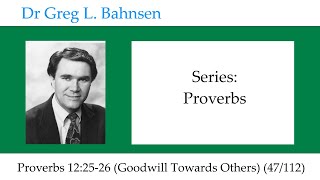
Dr. Greg Bahnsen examines Proverbs 12:25-26 on goodwill toward others, contrasting human impulses toward criticism and vengeance with biblical commands to encourage neighbors, help enemies, and imitate Christ's sacrifice for those who opposed him.
Chapters
Verses 25 and 26. And consider the theme goodwill toward men. Proverbs 12. And we'll read at verse 25. Hear now God's word. Heaviness in the heart of a man makes it stoop, but a good word makes it glad. The righteous is a guide to his neighbor, but the way of the wicked causes them to err. And thus far the reading of God's word. I have told this congregation on a number of occasions, especially in Christmas season, how the translation of that wonderful passage in Luke where the angels are singing to the shepherds on the fields, on the hills before they go to see the Christ child, how that message has often been mistranslated. The idea of peace on earth, goodwill toward men. And I hope by this time you understand that that really should be understood as peace on earth to men of God's good will, meaning of God's favor, those on whom his favor rests. Rather than being a basically humanistic message about let's all be sweet and nice to one another all the time. But having told you that, I'd like to preach a sermon this morning that has as its basic theme we should be sweet and nice to each other all the time. Even though that is not the meaning of that text. That is something which, in wisdom toward God and godliness of heart, we should demonstrate toward one another good will toward men. This message is especially relevant to me. It's relevant to those of you in this audience which hold strong doctrinal convictions of a Calvinistic sort of, and I'll be very honest with you, why that is, I think we tend to be a critical sort of people. We've had to be critical to come to these convictions. We've been forced to them by hard study of the word of God, which takes us against the grain, if you will, against the grain of the modern Christian church and certainly against the grain of the world and the way it thinks. To come to these kind of convictions, you have to learn to kind of swallow hard and say, I'm going to be different from these people. In fact, you have to be rather critical of other points of view. View, those of us who are Calvinistic believe that not only are there hard doctrines in the Bible which we are obligated to believe despite their difficulty, and we are to believe them in the face of the opposition of the world and much in the church, but we also believe that God is a critical God. We believe the heart of the gospel will not be understood and felt if men don't first feel the weight of their sin. And so we tend to be holding to moral absolutes and that makes us censorious of people. And then I think just quite a few of us, in all honesty, don't rise above the ordinary cantankerousness of our human nature. And when we weld that with the need for a pious and godly attitude and doctrine and a pious and godly attitude and morals, and that leads us to being critical, our cantankerousness and our critical mindedness come together and make us something of monsters. We all tend to be rather hard on people. We have kind of a negative outlook. We tend to be cutting. Often we have to confess that we are harsh. And so this morning's sermon is one which I need to hear and, and I think this congregation needs to hear. Forgetting all the humanistic clap trap that sometimes gets in the way of this. We should be people who demonstrate goodwill toward men. And a number of the proverbs show us the wisdom of that. We're going to be surveying those as we go through this morning's message. We begin at Proverbs 12:25, 26, where we learn about the necessity of good words and of sound guidance. Proverbs 12:25 says, Heaviness in the heart of a man makes it stoop. I'm on something of a time schedule this morning in order to get through all the things I'd like to talk about. And so I'm resisting very much the temptation to talk the whole time about just this one line. Heaviness in the heart of a man makes its stoop. I think you know from experience what that's all about. The word in Hebrew for heaviness, by the way, perhaps is best translated in its normal sense as anxiety, Care, fear, trouble. Anxiety in your heart. You know what it is to get a phone call to find out that maybe something's wrong at work or there's something amiss in your family? You know what it is to be concerned about the financial welfare of your family or someone's health? Anxiety makes the heart to stoop. In fact, we don't like to get bad news before we're getting ready to go to a party or to go on vacation or anything good like that, because it tends to put a cloud over everything. You know what we're talking about then, don't you? Anxiety makes the heart weigh down and stoop. And yet we learn that on top of that, a good word can make that heart glad. A good word. A good word that cheers people. A good word that relieves people. In fact, the Good word might be something that removes the cause of anxiety. Sometimes we are able to say something to people who are down in the mouth that will relieve them of their anxiety, will show them they don't really need to be so concerned that everything's going to be okay. The Bible here is not talking about whistling in the dark. I think we all get just a little tired of people who say very flippantly at the very outset of hearing about our problems where everything's going to be just fine. How do you know that? What do you know that? I don't know. Give me some reason to believe that. Now, the good word here is not supposed to be whistling in the dark. It's supposed to be one that does give cheer and when it can relieves people of their anxiety. But sometimes we can't say something that relieves someone of their anxiety. If you've got a mother that has cancer that's on the verge of death and that's weighing your heart down, I can't say some magic word that's going to take away the grief. I can't take away your anxiety. However, a good word sometimes does not relieve of anxiety. It gives the courage to face it. And I can give that. I can always give someone courage to face the problem they have. I can give them courage because they know they don't stand alone. I can give them courage because they have a heavenly father who understands their infirmity. I can give them courage because the Lord Jesus Christ paid the ultimate price and loves us unto death. There are always cheerful, encouraging, and notice that encouraging words that give courage, words we can offer. But you know, the fact of the matter is we don't give those words very often. If someone is very close to you, if you have a friend who's going through a tough time, then you probably rise to the occasion. But there are many opportunities where someone that you only know in a passing way, a colleague at work, or more importantly someone here at church, tells you there's some difficulty he or she is going through. And we could be a messenger of sympathy, we could be a messenger that supports that person at that time, but we're too busy or we're too awkward and we prefer to give in to our awkwardness and say nothing than to take the chance that maybe we'll be taking us too serious or whatever it is and say some encouraging word. Fools give in to their awkwardness. Wise and godly men give a good word of cheer. And so the proverb tells us heaviness in the heart makes it Stoop. But a good word can make it glad. And then another verse follows this that shows us the kind of goodwill we should have toward people. The righteous is a guide to his neighbor. Now, this first line in verse 26 has been rendered a number of different ways, and perhaps your translation doesn't have it the way mine does. I do believe after studying it, however, that the American Standard Version, which I'm reading from, perhaps is the best candidate, the most likely candidate for what the original meant. The righteous is a guide to his neighbor. And that sets up a suitable contrast to the wicked in the next part of the verse, where we learn that the wicked treats others differently. The righteous, or the upright, offers guidance, shows people through their problems, gives them direction and advice, which is helpful. But the wicked seduces them into error. You probably all have seen on TV or have heard jokes or maybe even have experienced yourself situation where someone's out on vacation and they're lost and they drive into a filling station hoping that they'll get some help. And the person at the filling station purposely gives them the wrong directions, realizing they're not going to be back here and won't be a real yuck to see them drive out the wrong way and have even further problems. They say, boy, how low, how mean. Well, that's just a very dramatic illustration, however, of what goes on all the time in the give and take of life, even in the mundane affairs of life. For those who are not righteous, the unrighteous do not guide people properly. They do not give advice that helps them. The unrighteous don't truly care for the outcome of the lives or of the projects or of the intentions and desires of people. And so they don't really give good advice. In fact, what advice they do give seduces into error. Well, here's the way I'd handle that, of course. You see, here's the person giving advice on how to save a marriage who's gone through two divorces already himself. But here's the way I'd handle that. You've probably seen that too, haven't you? The unrighteous don't know how to give good advice. They are fools. They don't know God. They don't know God's world. They don't know how to get along in this world. And so even when their hearts are not malicious, they don't give good advice. But often their hearts are malicious. Often their hearts are frivolous. Often their hearts don't really care the good of people. But the upright, it's different for them, they want to show people the way out of their problems. That is, when they're willing to talk to people about their problems. Do you face that problem? That when someone comes to you that's weighed down, someone who is confused, someone who needs help, and you're thinking, I really haven't got time for this. Emotionally, I'm not ready for this. And so we kind of put them off. The Bible says that those who are righteous have a good word for those that are depressed and have advice for those who are confused and need guidance. We show goodwill toward men. That means you're going to have to get up every day and have a little bit different attitude than you usually get up with. You get up, probably, if you're like me and you say, now what do I have to do today? What do I have to get accomplished? What's on my agenda? What do I want for me? Or even if I'm ministering to others, what do I want for my sake to get accomplished? And then when the phone call comes in or someone needs help, then you say, wait a minute, this is getting in the way of meeting all of my goals. Don't you understand? I've got things to do and places to get. Now we need to get up every day and remember that we as Christians live for others. Is that hard for you to swallow? Is that native egoism that is in you, something that's hard to put on the shelf? And remember that since Christ died for us, we must be willing to die for our brothers and sisters in the Lord. We need to get up and have goodwill toward men so that when we see them kind of dragging, we say, what cheerful thing can I say? What encouraging word can I give? What advice might I offer so they'll feel better and their load will be lifted? In Proverbs 14:9, we see a call to preserve good will among men. A trespass offering mocketh fools, according to my translation. But among the upright there is goodwill. Two translations are possible here. The first line might have been rendered. Well, actually is rendered in my version, but it's not the one I prefer. A guilt offering scorns fools. It could be translated that way. And what it would mean is that the offering made by fools for their sins is unavailing. Their offerings mean nothing to God. And then that would make the second line of this verse a comment upon God's attitude toward men. When in fact, I think the second line expresses something about relations among men. In fact, the Hebrew makes that rather clear. Among the upright there is good will rather than toward the upright. There is God's favor. And so how would we translate it? The other way to take the Hebrew, and I think this is preferable, is to say every fool mocks at guilt. Not the guilt offering, but the fool mocks his guilt. He's unconcerned with the damage he does by his trespasses. Every fool makes lightly of his sin. Big deal. He scorns it. It's of no avail to him. He doesn't care. Whereas in contrast to the fool, the upright are concerned to preserve goodwill between men, favor between men. You know, there are people who are so foolish that when they have it brought to their attention that their sins are destroying a family or their sins are creating disruption within an organization, that their sins are bringing a lack of peace to a congregation, and on and on the illustrations can go. There are people who, when that is brought to their attention, really don't care much at all. Big deal, I'm getting what I want. And so they make light of their sin. But the upright want to preserve good will. The upright want peace and kindness and happiness among men, and they work hard to preserve that. My guess is you don't think that you're the kind of person who tries to needle others, who tries to create disruption in personal relationships. You're not a malicious person. But then, on the other hand, you probably have to admit you're not someone who worries a lot about, frets over, prays about, and tries hard to preserve goodwill among men to be the peacemaker in a group. You probably think of yourself as somewhere in between. I just don't work hard enough to be that person preserving goodwill. But the upright work to preserve it. The upright seek it with all their hearts. The upright don't want to be even pawns, passive cogs in a machine, if you will. In a situation where there's going to be a lack of goodwill and sin and its consequences being made lightly of Proverbs 24:17, 18 shows us another way in which we are to show goodwill, not only by our good words and by our good guidance and our efforts to preserve peace among men. But in Proverbs 24 we come to something that runs exactly contrary to our character, even the character of those of us who are believers. Proverbs 24:17. Rejoice not when thine enemy falleth, and let not thy heart be glad when he is overthrown, lest Jehovah see it, and it displease him, and he turn away his wrath from him. If we're going to preserve good Will we need to learn not to gloat over our enemies? That is so hard to do. Everything in the sports mentality of the 20th century leads us to gloat over our enemies. You know, when USC beats UCLA in football, I don't care what kind of year USC has had. If they beat ucla, that makes me happy. Now, we understand perhaps there are some sinful consequences to that that need to be dealt with. But I think we understand that in the sporting context, the school spirit and crosstown rivalries and all that. The problem is when that is our attitude toward life in general, when we want to see our opposition put down. We just love it when we see that person who's given us a hard time at work get into trouble, don't we? We just love it when we see that person who has cut us off on the freeway and goes zooming up the lane in a mile, has a highway patrolman pull him over. Yes, I know, and we could go on and on. I'd get some more reactions from you too, because we all could tell stories like that. We just love to see the other guy get what's coming to him. Proverbs says, that's not a godly attitude. Rejoice not when thine enemy falleth, and let not thy heart be glad when he is overthrown. If we live with good will toward men, we don't want to see people get their comeuppance. We don't want to see people put down. We want to see them change. We want to see them redeemed, converted, turned around. But I'm afraid we have a hard time with that. That spirit of vengeance is in us, and we'd rather see people who have been bad to us get what they have coming to them. The Bible says that your glee over the misfortune of your enemy, however, may prove to be a sin much more punishable than all the guilt of your enemy. Take me seriously. God may look with much more disdain upon your gloating over your enemy than he does at your enemy and what that enemy has done to you. We have to remember that we're going to be judged by God with the same standard that we use to judge our enemies. A nice illustration of that is found in Romans 11:18. Romans 11:18. Glory not over the branches, but if thou gloriest, it is not that thou bearest the root, but the root thee. Thou wilt say, then branches were broken off, that I might be grafted in. Well, by their unbelief, they were broken off, and thou standest by thy faith, be not high minded, but fear. For if God spared not the natural branches, neither will he spare thee. Now here we have an illustration of the Gentiles coming into the place of favor of the Jews. God has cut off the natural branches of the olive tree and he's grafted in wild branches. He's grafted in the Gentiles. They have now become his kingdom. But Paul says, but don't gloat over that, you Gentiles don't rejoice over the rejection of the natural branches, because if God rejected them, he will also be willing to reject you. The same standard that God applied to the Jews, he will apply to you. Don't think you're somehow better. Now that's a particular theological point about Jewish Gentile relations. But it's generally true. God will hold us accountable to the standards we lay upon others and by which we judge them. And when you gloat over your enemy getting that ticket, just remember, you too, if you drive that way, will get a ticket. God doesn't spare you just because you're a Christian. God doesn't spare you just because you've been mistreated. Now, how would you like people to be driving along when you get a ticket and all pointing the finger and laughing at you? Does that make you feel real good? Don't gloat over the downfall of your enemies. Now, verse 18 might easily be misunderstood. It has by one commentator been very badly misunderstood. Note it says, lest Jehovah see it and it displeased him and he turned away his wrath from him. Now I think you can see what's coming here. Someone might think that we should avoid gloating over somebody because it might arouse God's pity for that person and he might turn away his wrath from that person. You see, the proverb has been read very poorly as saying that if you have this bad attitude toward your enemy, then God will say, well, then maybe I won't have such a bad attitude toward him. And so be careful. If you gloat over your enemy, then the judgment of God will turn away from that person. That isn't the meaning of the Hebrew. To turn away from that person means to turn from him to you. The idea is that God will turn his wrath away from your enemy and direct it at you. Because of this terrible attitude that you have. God will turn away his wrath and you will experience it. Because as I said at the beginning of our comments, this gloating over the downfall of your enemy is something far more punishable than what your enemy has done to you in the first place. Maybe at the end of our message this morning you'll understand why that is. It may seem to you that's not quite right. People mistreat you. God should really have it in for them, just like you have it in for them. And if you're glad that they get what they have come unto them, that shouldn't be something bad. But I think you'll see why it is in fact contrary to the very character of God. Ok, another way in which we show good will toward men. Proverbs 24:29 say not, I will do so to him as he hath done to me. I will render to the man according to his work. Here we see the spirit of vengeance in the previous passage, Something has happened to your enemy, not at all due to your intervention, your initiation, and you just kind of sit back and you gloat over it. But here you're saying, I'm going to get even. I'm going to even the score. I'm going to say something to somebody else or do something to that person that's going to hurt them. I'm going to get even. I'm going to get them for what they did to me. The spirit of vengeance and that verse that conservatives hate to see brought up, but has got to be discussed. Matthew 5:39, the Sermon on the Mount. Jesus says that this is what is expected of those who would be righteous. But I say unto you, resist not him that is evil, but whosoever smites thee on the right cheek, turn to him the other also. That's a hard one. What Jesus says is don't take your own vengeance, don't take it into your own hands to get even. And so to speak poetically and hyperbolically, to overstate the point, Jesus says turn to him the other cheek, rather than giving him a bust in the chops. And I want to make very clear here, this is not conditioned by the political circumstances of the day. This is not something like when you have to put up with it, then go ahead and turn the other cheek. As some writers have said recently, Jesus is talking about an attitude of goodwill, of not wanting to take vengeance. Alright? And now, for the sake of those who are going to ask the questions, let me just get this out of the way. Yes, you have the right to defend yourself. If your life is threatened, then you go ahead and you hit back and you do what you have to to save your life and run, or save the life of your children or your wife. You have the right to do that. You also have the right to go to the civil magistrate and to seek redress when someone has done you wrong, when some compensation is coming. No doubt about that. But what we want to focus on here and what Jesus was talking about was this interpersonal attitude. What is your attitude towards somebody who comes up and hits you? Well, if it's anything like mine, it's I'm going to bust him back and show him he can't get away with that. But Jesus says, let him get away with it. Show goodwill toward him. In fact, if you have to, give him the other side of your face to hit, too. We don't like that. Now, maybe you see the dentist is drilling down into the nerve a little. We don't like to be told that's the way we should be. We want to get even. Romans the 12th chapter, verse 19, tells us, however, avenge not yourselves, beloved, but give place unto the wrath of God. For it is written, vengeance belongs to me. I will recompense, says the Lord. You see, here's the heart of the matter. We don't believe that. We don't believe God is in control. We don't believe God does pay attention to those little details. And so we figure we've got to take care of it. If we lived in utter dependence and trust upon God, if we really saw his sovereignty, if we trusted it for all we're worth, if someone hit us, we could say, God will take care of this. Again, it may be a situation that you have to go to the civil magistrate about, and it may be a situation where you can't get away from it. You've got to defend yourself or your family. But you see, in terms of interpersonal relations, we don't need to feel, I've got to get in the last punch here. God will take care of it. Vengeance belongs to the Lord. He sees everything, and I trust him. I don't think God's going to let this guy get away with this. I really don't. But if you do think God misses these little points, if you do think God is unjust, then you may want to improve upon his efforts. You may want to do better than the Lord can do by you. And so you'll hit the guy bad. By the way, this doesn't have to be a physical exchange of blows. It could be verbal. It could be one bad deed for another. But the principle is the same. Do you have an attitude of goodwill that walks away from the difficulty and says, God will take care of it, or is your attitude I'm going to get even. Proverbs 20:22 states the same point that we've just looked at in Romans 12, Proverbs 20:22, say not thou, I will recompense evil. Wait for Jehovah, and he will save thee. Don't say to yourself, I'm going to get even. I'll recompense it. Let God deliver you. Let God be your avenger. Let God take care of the situation. And so, as Proverbs 24:29 had said, don't say, I will do to him as he's done to me. I will render to the man according to his work. What should we say? That should have a familiar ring to you. It doesn't say what the Golden Rule does. It's the opposite of the Golden Rule. But it's put in the same framework. It's the same approach. What did Jesus say in Matthew 7:12? Do unto others as you'd have them do unto you, right? Or, don't do unto others? He puts it negatively, actually. Don't do unto others as you would have the things that you wouldn't want people to do to you. Here in Proverbs 24:29 we have the opposite. It parallels this, but don't try to get vengeance for people from people who have done bad things to you. Rather, do to them what you'd have them do to you. We try to teach that to our children sometimes, not always successfully. You find two of your children bickering, maybe having a fist fight, wrestling with one another. Why are you doing that? Because he did this to me. Proverbs says, say not, I will do to him as he has done to me. So parents memorize this verse. Really good for counseling your children. But then when you get done, go look in the mirror and counsel yourselves. Don't you say, I'm going to get even with this person. Say rather, how would I have him treat me? That's the way I'm going to treat him. And we follow this with Proverbs 25, verses 21 and 22. If thine enemy be hungry, give him bread to eat. And if he be thirsty, give him water to drink. For thou wilt heap coals of fire upon his head, and Jehovah will reward thee. Most of us, if we saw our enemy. Let's say you've got a neighbor that's been particularly bad to you in some way. If you're driving off to work some morning, you saw your neighbor have a flat tire. I think the tendency would be to say, I'm glad he got that. He deserves it. The Bible says stop and help him change the tire. But he's my enemy. He'll wonder what's going on. Yeah, well, maybe that's part of the joy of doing it. Just making this guy wonder, why are you being so nice to me when I'm so crummy towards you? If he's hungry, feed him. If he's thirsty, give him to drink, meet his needs. This doesn't have to be just simply food and drink we're talking about. If he needs someone to give him a ride somewhere, give him the ride. If he needs a loan, give him the loan. Whatever it may mean, provide for his needs. You see, that's the pinnacle of having an underlying care for other people. When your enemies are provided for by you, that's the pinnacle of trusting in God. When you say God, everything I have comes from you. I'm willing to share it with this person. Even if it's a good word or a ten dollar bill or time out of my day, I'm going to meet this person's need. You see, that idea is promoted repeatedly in this book. It's promoted so often in this book that I have to come to the conclusion that it's a real test of our wisdom and our righteousness and our godliness before God whether we are willing to show this kind of good will. Of course, this passage has been found many times over in the New Testament. Matthew, the fifth chapter, verses 43 and following. Jesus says, you have heard it said, thou shalt love thy neighbor and hate thine enemy. But I say to you, by the way, hate thine enemy will not be found in the Old Testament. That is a Pharisaical commentary. He is not quoting Moses at all. Jesus says, but I say to you, this is the real meaning of God's law. Love your enemies. Pray for them that persecute you, that you may be sons of your Father, who is in heaven, who makes his sun to rise on the evil and the good, and sends rain on the just and the unjust. If you want to be children of God, love your enemies. Why? Because God loves His. And so pray for those who persecute you. It may be the hardest commandment in all the Bible. I have found it to be very hard. I bet you do too. Have someone who has really mistreated you. Pray for their good. Feed them if they're hungry. Give them water to drink if they're thirsty. Paul says the same in Romans 12:20, Romans 12. At the 20th verse in a long passage about not avenging ourselves, but doing good to others. Paul says, but if thine enemy hunger, feed him if he thirsts, give him to drink, for in so doing thou shalt keep coals of fire upon his head. Paul quotes the proverb you see in his concluding remark is, don't be overcome with evil, but overcome evil with good. That runs contrary to our character, runs contrary to our habits, runs contrary to our training in this world, but overcome evil with good. When people do evil to you, be good to them. Be good to them. Don't return evil for evil. Don't do to others what they've done unto you. Show goodwill toward men. And then two more passages and we'll quit this morning, that shows another aspect of this doing good toward man. Proverbs 24:11 12 tells us it is our obligation to not be silent bystanders when someone is about to be hurt, we are to rather rescue the perishing. Proverbs 24:11. Deliver them that are carried away unto death, and those that are ready to be slain or appointed to die, see that thou see that you hold them back if thou sayest, behold, we knew not this. Doth not he that weigheth the hearts, consider it. And he that keepeth thy soul, doth he not know it? And shall he not render to every man according to his work? Situation arises and you're able to save someone who's getting into trouble, someone who's going to get hurt, someone who may even be on the road to death. The Bible says you need to throw yourself in the way of that. That's asking an awful lot. You mean we need to take trouble into our lives? We need to take danger and adversity into our lives for the sake of others? Yes. Rescue those who are appointed to die. Don't let it happen to them. Stand up for them, speak for them, defend them. And we can make great movies out of dramatic situations where we stand up and save the lives of other individuals. And perhaps if you thought a movie was going to be made about your life and you did this, you'd be willing to give your life. Maybe you would. But you see, the difficulty is the Bible calls on you to do this when no one's going to hear about it, when there isn't going to be a nice story in the paper about it or a movie made about your life. You be willing to sacrifice yourself for others? You willing to sacrifice your reputation to stand up for the unborn who are being appointed unto death all the time in our culture? You willing to take A stand for that, knowing that perhaps your employer might not give you favorable consideration. You willing to take that stand if you knew that your employer would fire you? There are some situations where that's a possibility. You're willing to take that stand if it meant your family was going to hold you as being some kind of a moral prude or censorious of them? What are you willing to give up for the sake of saving others? The Bible says, stand up for them. And don't pretend you didn't know. See, that's the easiest cop at all. I didn't realize it was so dangerous. I didn't realize what was going on here. Because the Bible says, doesn't the one who weighs the heart see you too? Don't you think he knows what's going on? And he will render to every man according to his work. Rescue the perishing. And then Proverbs 31:8 9 finishes out this series of thoughts. Open thy mouth for the dumb in the cause of all such as are left desolate. Open thy mouth, judge righteously and minister justice to the poor, poor and to the needy. Those who are dumb here are dumb because they do not have what it takes in society to get a fair hearing. They may be the poor in society. They may be the fatherless who we're taking advantage of all the time. They may not have connections. They may not be educated. They may not be the right color. They may not have a lot of money. There are a lot of reasons why people are dumb in our society. Not dumb up here. But they are not able to speak for themselves. It's as though no one hears them. And the Bible says when that situation arises, you open your mouth and you put yourself in the way of the injustice that's coming upon them. And let me tell you what will happen when you do that. People will say, why are you butting into someone else's business? That's right. When you do the righteous thing and stand up for the innocent who are being mistreated, then those who mistreat them will find fault with you. And when you do this sort of thing again, wonderful stories will not be written about your life. You will be vilified. Men will spread rumors about you. And yet the Bible says if you're a righteous person, you'll show that good will toward others. You will not stop and say, now what's the outcome going to be for me? You will rather judge righteously and minister justice to the poor and to the needy. When you see someone who is in need of help, Again, Is it at work? Is it in your family? Is it in the church? Is it at school? Do you see? People are being mistreated? And you could say the right word. Could you stand up and say, I won't let you get away with this. I know what you're doing wrong here. And then you stop and say, no, wait a minute, though. I mean, I was hoping to get an advance here. I was hoping to get along with people when you save your own reputation and your own skin because you just don't want to have the hassle that's going to come. The Bible says, don't claim to be wise. Don't claim to be godly. Open your mouth for the dumb. Well, now, the problem is we started out on a nice Christmas theme about goodwill toward men. And I'm feeling pretty guilty about all this because these passages show us a standard of living, a standard of goodwill and kindness and goodness toward others that none of us match up to. I think we all have been sitting there thinking, what about me? What about, I don't do that. I don't do that either. I don't do that either. So where do we see this kind of good will? Well, I think you know the answer. There was one who was once appointed unto death and stood before his shearers as a dumb sheep. That's what Peter says. In 1 Peter, chapter 2, it says, the Lord Jesus Christ was appointed to die and who stood up and spoke for him? Do you remember? Was it the beloved apostle who put his head upon Jesus breast? Did he stand up for Jesus? No. Was it that burly fisherman, Peter, who swore that he loved Jesus more than all the others and he'd never let Jesus be taken away? No. In fact, at the time Jesus was being condemned, Peter was denying before a small girl that he even knew him. Who stood up for Jesus? No one did. Because at that point in history, the set of those who were righteous and those who belonged to God had been narrowed down to one man. And not even his closest, most intimate followers. There was only one who was the righteous in that day. And he stood there and he took the injustice. Why? Why didn't he fight back? Why didn't he call the legions of angels that were at his disposal to deliver him from this? Why not? Well, the Bible tells us why he didn't. And I'd like to conclude this morning by looking at the words of Romans, the fifth chapter, verses 8 and 10. The Bible says God was commending his love toward us and that while we were yet sinners, Christ died for us. And verse 10 puts it this way. For if, while we were enemies, we were reconciled to God through the death of His Son, much more being reconciled shall we be saved by his life. The reason why we need to start demonstrating this kind of goodwill toward men, even toward our enemies, and to stand up even for those who are appointed to die, is because God shows that kind of love toward us. When Christ died for us alone, betrayed, with no one to speak for him, he did it for his enemies. It's incredible. He didn't do it for nice cleaned up, sparkling, shiny saints. He did it for enemies and sinners, those who were still lost and depraved people like you and me. While we were his enemies, he met our needs. While we were his enemies, he died for us. And those of us who have anxious hearts, weighed down, how can we be right with God? Jesus speaks the good word. Jesus brings the gospel word. He says, I died for you. You're afraid to face the judgment of my Father. I faced it for you. You're afraid that your righteousness will not be adequate. My righteousness is. Is yours. Are you afraid to stand alone in the presence of God? Then I'll stand with you. I want to remind you, Jesus did not do that. After we made all sorts of promises to clean up our lives and to become nice people, he did it while we were his enemies. That's why Christians above all need to learn the lesson, difficult though it may be. Need to learn the lesson of the goodwill toward men because it's goodwill that God has shown us. Let's pray. Lord, we confess to you this morning that we are really very self centered, very unloving, and much more concerned about our own comforts and our own vengeance and our own ways. Much more concerned about these things than we are for helping others and certainly much more concerned about those things than for helping our enemies are those who are appointed even to die, those who are being mistreated round about us. But we pray that you would so change our hearts in the direction of our lives by your grace, that we would begin to imitate the goodwill you've shown us. To remember the love that you demonstrated while we were your enemies, to remember the goodwill you have toward us and the good news that has come to us so that being transformed by this powerful grace, we would become more like you and able to show your love. We do pray that your love would be demonstrated through us toward others. We might realize that in showing this kind of good will toward men, we are really demonstrating an answer to you, demonstrating a favor and goodwill toward the Lord who saved us. Help us to do this not in our own strength and not even for the sake of others who we may not like. Help us to do these things for your sake because youe loved us in this way. For we pray in Jesus name, Amen.
More from BahnsenAI




Dr Greg Bahnsen - Proverbs: Proverbs 16:28, 30 (Some Tips on Promoting Strife) (Part 72)

Dr Greg Bahnsen - Proverbs: Proverbs 15:23; 16:21, 23-24 (True Religion: A Bridled Tongue) (Part 71)

Dr Greg Bahnsen - Proverbs: Proverbs 14:21 (Imitating the Father's Tender Mercies) (Part 70)

Dr Greg Bahnsen - Proverbs: Proverbs 15:25; 22:28; 23:10-11 (Widows and Property Rights) (Part 69)

Greg Bahnsen R C Sproul Debate Part Two Presuppositional vs. Classical Apologetics


Greg Bahnsen VS R C Sproul Debate Part 4 Presuppositional Vs Classical Theology

Greg Bahnsen vs R C Sproul Debate Part One Presuppositional Vs Classical Theology