Dr Greg Bahnsen - Seminary Apologetics: Neutrality (Part 8)
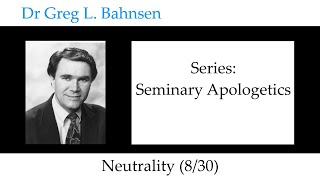
This is a transcribed lecture by Dr. Greg Bahnsen arguing that neutrality in apologetics is impossible and sinful. Key claims: (1) Neutral philosophical starting points rob Christians of "all the treasures of wisdom and knowledge" (Colossians 2) and lead to intellectual and moral failure; (2) Biblical teaching forbids serving two masters or occupying a neutral "no man's land" (Matt. 6:24; 12:30); (3) There is an antithesis between unbelieving and believing mindsets—unbelievers' reasoning is "vain, darkened, ignorant" while truth is in Christ (Eph. 4; Rom. 1); (4) The foundation of all knowledge is God's revelation (Matt. 7:24; Ps.36:9; Prov.1:7); (5) God's authority is self-attesting (Jesus speaks as authority; John 12:48–50; Rom.3:4); (6) Revelation is inescapable and supplies common ground and a point of contact with unbelievers (Rom.1:20; Ps.24:1; Gen.1:26–27). The lecture is presuppositional in method and prepares to discuss practical method for defending the faith.
Questions this video answers
Colossians 2:8–3 (esp. Col. 2:3) and references to 'stoicheia' (elementary principles).
Matthew 6:24; Matthew 12:30; John 17:17 (thy word is truth).
Ephesians 4:17–20; Romans 1:21–22 (and Romans 1:18, 20).
Matthew 7:24–29; Psalm 36:9; Proverbs 1:7; Psalm 24:1; Psalm 139:7–8; Genesis 1:26–27.
Chapters
This message is a continuation of the previous tape. The same word stoicheia in Greek is used in the book of Hebrews for the abcs of learning. Okay, the elementary principles. Is it pushing it a little bit? I don't think so. To say presuppositions of the world, those standards by which men learn their ultimate abcs. And Paul says, don't be mugged by a philosophy that's after the tradition of men and after the presuppositions, the rudiments of the world. And now listen, and not after Christ, how do you defend all the treasures of wisdom and knowledge that are found in Christ? Verse 3 of Colossians 2 tells us that all the treasures of wisdom and knowledge are in Christ. How do you defend that? Don't be mugged by a philosophy that's not after Christ. You don't start with a philosophy that's irrelevant to or indifferent to or in opposition to Christ and then think you can save all the treasures of wisdom and knowledge that are deposited in Christ. And so Paul tells us, as the chapter title indicates, of the robbery of neutrality. If you approach something not thinking after Christ, but after the traditions of men and the elementary principles of the world, you're going to be robbed. And what are you going to be robbed of? Verse 3, all the treasures of wisdom and knowledge. So where does neutrality lead? To intellectual poverty. Those treasures are not there. You're going to become poor, intellectually poor, philosophically poor. You're going to be deprived of wisdom. You're going to be made a fool if you follow the pointless, misleading philosophies of men whose abcs of learning are not after Christ. In John, the 17th chapter, we read of Jesus high priestly prayer for his people. And Jesus prays in John 17:17 that we would be sanctified by the truth. The word sanctified means to be set apart, to be consecrated, to be different men, make them unlike the world, set them apart from the world, consecrate them, and consecrate them by the truth. And immediately Jesus adds these words, thy word is truth. And so what is it that's to make us different from the world? Paul said, don't follow the pointless and misleading philosophies of men that are after the traditions of men and the elementary principles of the world, not after Christ. Christ says, set them apart by your word of truth. And so I want to take it as an established principle that if Christ is to be Lord in our reasoning, we are not allowed to be neutral in our argumentation. That seems Pretty obvious. When we approach things in a religious, biblical, devotional way, when we go to the Bible, it should be obvious. I can tell you that all over the country, probably all over the world, but all over this country there are people who are teaching apologetics who begin a different way and they come to a different conclusion. And they begin by saying, we can't beg the question. We can't expect the unbeliever to enter into the discussion with us with our minds close, saying Christ is Lord from the outset. What we have to be willing to do is to set aside our most heartfelt convictions about who Jesus is and ask the unbeliever to set aside his hostility to that conclusion so that we both, with an open mind and with a neutral beginning point, can go and ask, what does the evidence support? And you know, I've seen Christians, good Christians, you would think sanctified Christians, sit in a classroom and just nod their heads through that kind of step by step by step. Of course. Yes, of course. Oh, I can't do apologetics presupposing the truth of Christianity. That'd be begging the question. I've got to do what I expect the unbeliever to do, to be neutral. Now, how is it that I have taught you over the last few minutes and I don't see anybody really squawking about this, having a real hard time. It seems so obvious you take this risk. How could anybody think neutrality is a possibility? It's absolutely ruled out. Well, where did I begin to convince you that you can't lay aside your commitment to Christ speaking in the Scriptures when you go about defending it? How did I begin to convince you? I went to the Scriptures, didn't I? Now what happens in the classroom, hypothetical classroom that I just described? Did somebody start with the Scriptures and then come to the conclusion we've got to be neutral? No, he started with what we want the unbeliever to be open minded, so we have to be open minded. That means everybody has to be neutral. It sounds so reasonable. It seems like common sense to people. But notice the difference where you begin. If you begin with the Bible, you'd never come to that conclusion. You begin with what seems to be, quote, common sense. Maybe neutrality is an attractive option. So now we have something of a crisis. I guess we have to decide which approach should we take. Can we keep going down the road with Dr. Bogson, the biblicist, the guy who's begging the question? The guy who says, let's open the Bible and let it direct us as to how we defend the Bible or should we go with common sense? Well, I mean, I've set it up in a way that hopefully it's not just flattering me, but it's leading you to see you've got to take the option of letting the Bible direct you about how to defend the faith. And this is politically incorrect, what I just told you. The opening chapter and the second chapter of my syllabus are utterly deplorable in the eyes of most Christian philosophers. And they say, well, when you want to act religiously, of course you can't be neutral, but in philosophy we have to be. To which the appropriate answer is, then Christians can't do philosophy because any place I have to go and anything I have to do, where I set apart the lordship of Jesus Christ is sinful and rebellious. Whatever is not of faith is sin. And so when you try to teach me to do philosophy in a neutral fashion, you're teaching me to sin, to do something without faith. That leads to the second chapter of the Immorality of Neutrality. I began by pointing out that the Bible says you're going to be robbed of knowledge. You're going to end up in intellectual poverty if you follow a philosophy that's after the world and its presuppositions rather than after Christ. But now I need to push a little bit harder. It's not just that the consequences are going to be dire if you try to be neutral. The Bible says that the the attempt to be neutral is positively immoral. Positively immoral. Let's look at Matthew 6:24 in our Bibles. Matthew 6:24, Jesus says, no man can serve two masters, for either he will hate the one and love the other, or else he will hold to the one and despise the other. No man can serve two masters. Now, when the Christian enters into the apologetics arena, wanting to serve his master, the Lord Jesus Christ, but attempts to do this by honoring the master, that the unbeliever follows the way of thinking, the ultimate authority, the standards of the unbeliever, isn't he attempting to serve two masters? Let me bow down to autonomous human thought so that I can teach you autonomous sinners to bow down to the Lord Jesus Christ. And Jesus says the outcome of that is what? It can't be done. And if it can't be done, then you need to be worried, Christian, that in the end you're not serving Jesus at all. Though you think by your good intentions that that's what's going to happen. You're not serving the Lord Jesus Christ. You're despising him while you serve the master of human autonomy. Matthew 12:30 he that is not with me is against me, and he that gathereth not with me scattereth. Now how much room for neutrality is there in this verse? Jesus says, well, you know, we've got Christian territory and we have non Christian territory and then there's no man's land in between, right? And what we need to do is get Christians to leave their territory to come into no man's land. Non Christians leave their territory, come into no man's land, and see if we can't convince them to come back with us. Right? He says, no, there is no no man's land. There is no neutral buffer zone between faithfulness and unfaithfulness if you're not with me. See, that's who we're starting with, right? We're starting with people who are not with Christ. If they were with Christ, they wouldn't be unbelievers. I mean, wake up. Apologetics is dealing with the world. So I'm starting with somebody who's not with Christ. And so Jesus tells me how to do audience analysis. Jesus tells me, this person cannot be neutral. Don't try to invite him into a no man's land where we put aside our prejudices and open mindedly look at the evidence. Jesus says he can't do it. He who is not with me is against me. You know, the people who say kind things about Jesus can be against Jesus. That's what we call flattering with faint praise. Those of you who've heard me speak before know the illustration. I love this. Bill Cosby, you know, was told once when he was going out on a date with a girl that was overweight, his mother said that he had to be polite and make sure to compliment his date. And they went to a roller skating rink and his mom's words kept echoing in his mind and he said, what am I going to do, you know? And so after they skated a while, they sat down and finally he turned to her and he said, you know, you don't sweat much for a fat girl. That's a compliment. But of course it's such faint praise that it in fact is damning, isn't it? Now, isn't something like that taking place when somebody says, I think Jesus was a good man? Yeah, that's damning. Jesus is not just a good man. Of course he couldn't be a good man if you don't also accept what he said that he was the creator of all men, that all men would be judged by him, and so forth and so on. But you know how ignorant people are. They don't really know the claims of Jesus and they just, well, I want to be respectful of Jesus. You don't sweat much for a fat girl. That's not praising Jesus. If you are not with me, Jesus says, you're damning me by faint praise, or worse, openly condemning me. You're not with me, you're against me. And so neutrality is impossible. And the Bible says it is immoral. To see the immorality of neutrality. It will be helpful to see the difference between the thinking of unbelievers as the Bible portrays it, and the mindset of believers, again as portrayed in the Bible. And to do that, let's turn to Ephesians 4, verses 17 and 18. Ephesians 4, 17. This I say, therefore, and testify in the Lord that you no longer walk as the Gentiles walk in the vanity of their mind, being darkened in their understanding, alienated from the life of God because of the ignorance that is in them, because of the hardening of their heart. Paul says, you are forbidden to have the mindset of unregenerate men, the Gentiles, as he puts it here, and their mindset is described in a very unflattering way. The nature of unbelieving thought, according to the Bible, is not something that we should be longing for. It's not something that's worthy or praiseworthy. It's rather, as Paul says, vain, darkened, ignorant and illustrative of a hardened heart. So why then, in order to advance the Lord Jesus Christ with sinful thinkers, would you go and say, let me participate in your vain, dark and futile thinking to show you how Jesus is the truth. Romans 1:21. Keep your finger in Ephesians 4 though, because we're going to come back to it. Romans 1:21. Because knowing God, they glorified him not as God, neither gave thanks, but became vain in their reasonings, and their senseless heart was darkened. Paul tells us that unbelievers know God. We're going to return to this thought. But notice what happens knowing God. They don't glorify him as God or give thanks, and their reasoning becomes of what quality? Top notch, right head of the class. Oh, if I could only be like Kant, I could only be like Epicurus. Boy, you can't imagine the apostle Paul saying that. Why then do Christian apologists feign to follow the philosophers of the world? Here's what Paul says. They became Vain in their reasonings. The way in which they thought through things was futile, it was pointless, it was empty, it was vain. So on the one hand, the Bible teaches us that unbelieving thought is ignorant. It's vain, it's useless. And then the Bible tells us by contrast, what we are like those of us who have been born again. And now let's turn Back to Ephesians 4. Paul, having described the way the Gentiles think in verses 17 through 19, says in verse 20, but you did not learn Christ in this way. Isn't that startling? Paul says, that isn't the way you came to Christ. You didn't learn Christ by following the Gentile feudal mindset. You didn't try to reason like the fools of this world only to come to the wisdom of Jesus. He says, but you did not so learn Christ. If so be that ye heard him and were taught in him, even as truth is in Jesus. Poor Paul, Sunday school deluded child. He just has this simple faith that truth is in Jesus. But you see, it's that simplicity of faith that the Bible requires of Christian philosophers. I'll put it very simply to you. You think one way, I think another. And here's what I think, or what God says, and I agree with him. What God says about the way you think, it's futile, it's vain, it's foolish. But the truth is in Jesus. That's what the Bible says. We did not come to Jesus by following the world's mindset. And we're supposed to have a different mindset. If so, be that you've heard him and were taught in him, even as truth is in Jesus, that you put away as concerning your former manner of life, the old man that waxed corrupt after the lust and deceitful, and that you be renewed in the spirit of your mind and put on the new man, that after God's been created in righteousness and true holiness, okay? And so when we've come to Christ, we learn that the truth is in Jesus and that's the way we live our lives. We are renewed in the spirit of our mind and we put away the old man. I don't want to think like I did when I thought I was autonomous. I don't want to think like I did when I was rebelling against Jesus. I don't want to be part of that lifestyle at all, even in my reasoning. And yet throughout my life I've been taught by Christians who say we've got to think like the unbeliever does. We've got to meet him where he is so we can bring him to Christ. Well, their intentions are good and I don't want to, you know, overlook that. But again, it's not just the outcome that we're interested in. We want to do God's work in God's way. I don't want to go back and think like I used to as an unbeliever. I don't want to enter into that mindset of the Gentiles and vanity and futility and foolishness so that I can lead them to Christ. If I were to do that, I would be compromising Christ's prayer that I be what consecrated by the truth. Where's the truth? Well, here in Jesus. What did Jesus say? Thy word is truth. What I am attempting to do, and I really think I'm only scratching the surface, but I don't know any booklet or anything that does this even to this degree, which is minor. But I'm trying to point out that if we looked at biblical concepts, the antithesis would be obvious to us. We're not to think like unbelievers think. And we don't bring people to Jesus in that way. We're not to be neutral. And the attempt to be neutral is to set apart our distinctive character as Christians consecrated by God's word of truth. Now, another aspect of the lordship of Christ. I probably need to kick this into a faster year who I'm going to finish today. Another aspect of the lordship of Christ in our reasoning is not just the rejection of neutrality and the recognition of the antithesis and hostility between the thinking of the believer and the unbeliever. That's what I've been talking about in case you have missed it. But thirdly, in terms of the lordship of Christ and reasoning, we need to see that the Bible teaches that the foundation of all knowing, not just religious knowing, the foundation of all knowing is God's revelation, God's disclosure of himself. Since we're in the New Testament, let's begin with Matthew 7:24. Every one, therefore, that heareth these words of mine and doeth them shall be likened unto a wise man who built his house upon the rock. And the rain descended and the floods came, and the winds blew and beat upon that house, and it fell not, for it was founded upon the rock. Jesus teaches us here that a life that is going to be indestructible must be founded on what he says. If our thinking is not going to crumble, if it's not going to become vain, empty, futile and pointless if it's not going to be foolish. This applies to our thinking and our conduct. All of our lives, then our lives must be built upon the rock. And he identifies the rock as these words of mine. The man who hears these words of mine and does them has built his house. His life has been founded on on the rock. And so you notice that according to the teaching of Jesus, and it's very simple, as I said before, it's what we teach our Sunday school children. They all know this story. We're not supposed to be apart from the foundation of God's word, the foundation of what God has taught us. Jesus says, my sayings are the rock. That's the basis for all that you do and all that you think. Now what happens if we don't take the word of God as the basis of our thinking? Psalm 36:9. For with thee is the fountain of life. In thy light shall we see light. The Bible teaches that it's in the light of God that the light that we see is possible. Isn't that interesting? We don't see light. So that we can now come to the conclusion God is light. We don't begin with ourselves seeing light and then incorporate the bigger light of God. God says, it's in my light that you can see any light at all. If you don't begin with me, then you don't see. Psalmist says that thy word is a light right unto my path. And so men are in darkness. To use biblical figures of speech. They're in darkness when they refuse to build their lives on the word of God, on the revelation of God. Proverbs 22:17, 21. Incline thine ear and hear the words of the wise, and apply thy heart unto my knowledge, for it is a pleasant thing if thou keep them within thee, yet they be established together upon thy lips, that thy trust may be in Jehovah. I have made them known to thee this day, even to thee. Have not I written unto thee 30 sayings of counsels and knowledge to make thee know the certainty of the words of truth, that thou mayest carry back words of truth to them that send thee. Now how is it that we know the certainty truth? The book of Proverbs says it's based on the wisdom God has revealed to us. I've made these things known so that you would know the certainty of the words of truth. And we can back up all the way to the beginning of Proverbs through one of its thematic statements, Proverbs 1:7, where we're taught the fear of Jehovah is the beginning of knowledge. But fools despise wisdom and instruction. There again we have the antithesis. You have those who have knowledge set over against those who are fools. Fools despise knowledge, learning and instruction. The wise person doesn't despise it. And what is it that makes someone wise? What is it that makes it possible for us to know anything? What's the opening, the beginning point, the rosh, the head, the key point? The fear of the Lord. If you don't fear the Lord, you don't know anything. You know, the world doesn't appreciate us saying that, but that's part of what we have to preach to show the indictment of sin. We have to say, you know what? You don't bow down to God. You don't fear him. You're stupid. Maybe you'll choose different vocabulary in different settings, but you're intellectually dull. You're a fool. You can't know anything. So where does the Bible say knowledge comes from? You build your life and thinking on the rock word of Jesus. The light that you see must be in the context of the light that God gives. You must have at the key opening point, the head of knowledge, the fear of the Lord. And so when we teach that Christ is the Lord over reasoning, from a biblical standpoint, that means we're going to challenge the world. That knowledge is impossible apart from what God has made known to us. You reject God and you end up in darkness and foolishness. And so the summary and application that I have made of these lessons in the syllabus, as you see in chapter six, is the self attesting authority of God. The self attesting authority of God. God's authority is disputed by the unbelieving world. And we're making an effort at defending the truth, giving a reason for the hope that is in us. Now, what will we appeal to to show that God really is the authority? I have three passages I'm going to look at quickly. Matthew 7:29. To put it in context. The 28th verse says it came to pass when Jesus said, finish these words. The multitudes were astonished at his teaching. And what astonished them? For he taught them as one having authority and not as their scribes. How did the scribes teach? No scribe would be so arrogant as to claim to have enough authority to interpret the word of God himself. He always said as Rabbi so and so said and Rabbi so and so before him. If your teaching was to have any kind of, you know, credibility, you had to back it up with tradition. Jesus, they were astonished that this Jesus comes and as the scribe of the law teaches it, and he doesn't call on anybody to back up what he's saying. He just says, but I tell you, you've heard it said by the ancients, by the elders, but I tell you. And Steve's nodding his head. If you understand Jewish culture, you can really appreciate this. I mean, that's just astonishing. Offensive, but astonishing. Jesus didn't think that he had to back up what he taught by what anybody else said. So what's the ultimate authority as Jesus sought Jesus himself. If you'll stop and think about this for a minute. Every argument has an ending. No argument goes on and on and on and on and on. Let's say I want to argue that a certain person is guilty of a crime. You say, well, why do you believe that? Well, then I offer certain ends, evidence for that and say, well, we found his fingerprints on this gun and we've done, you know, examination of the bullet and so forth, and the bullet came from this gun and so forth. But then the next question was, why do you believe this evidence to be true? Well, because so and so collected this evidence, or we photographed this, or we have these lab results. Well, why do you trust the lab reports? At some point along the line in that argument, we're going to come to an end where somebody says, well, yeah, that settles it. What if we have an argument over the number of square miles in Brooklyn? You know, you say that it's 210, and I say, oh, no, no, no, way too much. It's only about 160. I really don't know what it is, but follow the illustration here, okay? And so at lunch, we go back and forth and we just can't get, you know, you can't get me to give in to your point of view and I can't get you to give into mine. So we get back and we pull down an encyclopedia and we open up to Brooklyn and it says right there, the square miles are. Now, for most people, we'd say, okay, that's it. That's, you know, ground zero. We've settled it. Of course, if somebody wanted to challenge the encyclopedia, you can say, oh, yeah, well, that's an old encyclopedia. They've got it wrong, too. And then for that person, maybe you have to go out there and actually measure it, you know, all the way around Brooklyn and do the math and check the computer to make sure it didn't make a mistake and all those. But my point is, everybody finally gets to a place where they say, well, you can't go any further. That's rock bottom. If that doesn't convince you, I don't know what to tell you. It's not just Christians who recognize this. Ludwig Wittgenstein, whom I've mentioned already in his essay Uncertainty, says that he goes, you know, two people argue with each other and eventually, he says, they reach romance, rock bottom. And at that point they can only call each other heretic. Please turn the cassette over. At this time, Who wasn't a Christian, but he understood that dynamic. He goes, you know, when I get to my ultimate authority, I can't go beyond my ultimate authority. If the encyclopedia says it, that settles it. Or if I've done the tape measure of it, that settles it. Now for Jesus. What was the ultimate authority? Did Jesus say, go look it up in the encyclopedia? No. The only time Jesus referred to any authority to back up what he said, he referred to what? The scriptures. That's right. And he also said that those scriptures were his. So nevertheless, that too is round about what he's doing here. Jesus taught as one having authority. He didn't say, go listen to Rabbi so and so. Go pull out the encyclopedia, run the computer program. He said, I've said it, that settles it. We see that attitude in John 12:48, 50 as well. John 12:48, 50. He that rejecteth me and receiveth not my sayings hath one that judgeth him. The word that I spake the same shall judge him in the last day. For I spake not from myself, but the Father that sent me. He hath given me a commandment what I should say and what I should speak. By the way, to tie this in with what we've just looked at, Jesus didn't teach as the ancients. He didn't say, here's my opinion. And Rabbi so and so said Jesus said, here's my opinion. God sends us. I only say what the Father tells me to say. Verse 15. I know that his commandment is life eternal. The things therefore which I speak, even as the Father hath said unto me, so I speak. Jesus, why should we believe what you say? If you reject my sayings, then you'll be judged on the final day. By what standard? By my sayings. Well, what right do you have to say this? I'm saying what the Father tells me to say. So what I speak, I speak ordinarily. By the way, that expression at the end that we just read, we have a colloquial expression in our own culture like that, you know, but when people say things like that, we usually think they're being disrespectful or arrogant. I've said it, I've settled it. Jesus said, so what? I speak. I speak. He has self attesting authority. Self attesting. You've heard me use that expression a number of times already and I want to make sure you understand it. If I offer you the opinion that Brooklyn has 160 square miles in it, you might want to ask me, in what attestation do you have for that opinion? What can you offer that will back that up? Or to put it another way, authorize that? What is your authority for saying that? And I say, well, I looked it up in the encyclopedia this morning. And so my opinion that I've taught you in this class is attested to by the encyclopedia. What I've just taught you is that Jesus doesn't appeal to encyclopedias or scribes or anything else. Jesus appeals to himself. And so his authority is self authorized or self attested. If you ask him what gives testimony to what you're saying, Jesus says, I give testimony to what I'm saying. Again, that's one of those things where you just can't accept Jesus as a good teacher and then decide to disagree with some of the things he taught because this good teacher said, you have to accept it all because I said it, pure and simple. And then the attitude of the Apostle Paul parallels this. In Romans 3, verse 4, He says, God forbid, yes, let God be found true, but every man a liar. So you're out there testifying to somebody of what the word of God says. And they say, well, but wait a minute, the scholars of this world have come to these conclusions and they conflict with what you say. God said, let God be found true and every man a liar. This may not be the words you actually utter, but what you need to say is, well, if the scholars of this world disagree, they're lying. Wow. How can that be? Why can't we just throw this into the no man's zone and to be weighed equitably by fair minded, neutral people. Well, in the first place, because there are no fair minded neutral people. And secondly, because God says I don't need to be weighed by anything if I say it and someone disagrees with it. In fact, if the Gallup poll shows that 100% of the human race disagrees with it, they're all liars. That's strong stuff. In fact, I think it's probably of such nuclear strength that it scares off many Christian apologists. They don't want to go out into the world and be ridiculed for holding this kind of position. Why do you believe these things that are taught in the Bible? You say, well, because the Bible teaches them and God is his own authority. And you know, roaring laughter, ridicule. Well, you, I mean, you've sacrificed your intellect, you've given up your impartiality, you have given up your autonomy. You got to think for yourself. You got to come to your own conclusions. You got to let the evidence take you wherever it's going to take you. And that is the issue, as Van Till said right there. Does the autonomous man identify himself and say, that's what I know for sure. Now let's see about God. Or do we begin with God identifying himself and saying in that light? That's how you understand everything else. My authority is authorized by my authority. God says that his authority attests to itself. Let's move ahead to the next point in the outline. Revelation, common ground and point of contact. Revelation, common ground and point of contact. Again, I'm choosing these subjects because the Bible says things about them that are relevant to the defense of the faith and we want to defend the faith biblically and so we're letting the Bible teach us these things. There is no neutrality. We must recognize the antithesis between the believer and the unbeliever. And revelation is the foundation of knowledge. God's authority is self attesting. Those would be the sub points you should have under B. Christ is Lord of reasoning. Now, in terms of revelation, common ground and point of contact, let's turn to Romans 1 and the theme here is inescapable revelation, inescapable knowledge. In the syllabus it's chapter nine, Romans 1, and at the 20th verse. For the invisible things of him. Since the creation of the world or from the creation of the world are clearly seen being perceived through the things that are made, even as everlasting power and divinity, that they may be without excuse, because knowing God, they glorified him not as God. Neither gave thanks, but became vain in their reasonings and their senseless heart was darkened. Professing themselves to be wise, they became fools. Now in this passage Paul teaches us that the revelation of God cannot be escaped. It's not as though we need to direct people's attention to this or that aspect of the created order, to this or that argument, to this or that line of reasoning, so they might eventually come into contact with God's disclosure. Paul says men can't avoid being confronted with God. It's an interesting commentary on Jean Paul Sartre the existentialist, that in his autobiography, Words, Sartre said that he could not bear the idea of a God who was constantly looking at him. So he said one day he collared the Holy Spirit in the basement and threw him out. That amazing honesty, the man said straight out, I don't want a God that's inescapable. So I'm going to throw him out. Now, if the apostle Paul were talking to John, Paul, we say, well, you know, I'd like to redirect your attention over here. You really shouldn't be, you know, throwing God away like that. He'd say, good luck, as John Calvin might have put it. So you can't throw God away. You can't escape him. Everywhere you look, if you open your eyes, there's God. That's the horror of the unbeliever. He cannot escape God, Paul says, so the invisible things of him from the creation of the world are clearly seen, being perceived by the things that are made. And how do we know that they're clearly seen? Because God is the one who manifested it unto them. God doesn't put through a call and expect you to call him back. He reaches out and he touches someone. That's it. No one refuses God's call. He has made himself known. You can't miss it. Now. What happens when you try to miss it? Well, the Bible says you become a fool and you can't know anything at all. This theme, that if you reject God's revelation, you'll be led to foolishness or the inability to know anything, has caused great offense even in reformed circles. And the comeback is, how could you possibly say that unbelievers do know a great deal? In many cases, unbelievers know more than believers. You know, some of the leading scholars in the world saying computer technology or, you know, astrophysics, whatever it may be, are unbelievers. The two doctors that did open heart surgery on me, as far as I know, were unbelievers. I was willing to say they know a whole lot. I wouldn't ask Steve Schlissel, just because he was a Christian to do open heart surgery on me. So let's admit it. Many unbelievers know a lot about the world. So how can you say that those who don't follow the revelation of God couldn't know anything? They can know things. Don't you say there's another alternative, though? I say those who don't follow the revelation of God could not know anything. We look out and we see that unbelievers know a whole lot. The critic says, therefore you're wrong. That if you don't follow revelation, you couldn't know anything I say, or you're wrong in thinking they're not following God's revelation. That's the dirty little secret, isn't it? And apologists are not willing to put that out on the table because do you expect the unbeliever to say, oh, yeah, you caught me, that's right, my hand's in the cookie jar, I was following God's revelation. No, the unbeliever has convinced himself he's not doing that. So when you tell the unbeliever, first of all, you couldn't know anything apart from the revelation of God, he goes, well, I know a whole lot more than you do about this. That and the other say, exactly. And so you do know my God. Reminds me of a debate I had with an atheist at the University of California, Irvine, a number of years ago. His name was Gordon Stein. And in the debate I offered a transcendental argument having to do with the Christian worldview to the effect that the laws of logic, which are presupposed by debate, themselves make no sense within the atheist worldview. So I said, in essence, by coming to the debate, you lost. Because by coming to the debate, you were committed to laws of logic which don't fit into your worldview. They only fit into my worldview. Well, he didn't really understand it that well that night. If you listen to the tape, he's pretty much befuddled. And so it doesn't surprise me that later a person brought me a copy of. And I won't remember the title of the newsletter, but was was some atheist newsletter that he edits. And in it he gives an account of the debate that he had with me. So I think this would be interesting to hear what his point of view is. And, you know, he goes on about how, you know, shocking. He heard this new argument for God's existence, the transcendent argument for God's existence. Of course, I wrote back and said, no, it's transcendental, not transcendent. He thought, well, big deal, you know, big words, big words, they sound alike. I told him that'd be like a doctor going into surgery confusing lungs and legs. They both begin with L, after all. But nevertheless, he tries to give his account of the argument, and he has it completely wrong. And so I said, I realize, you know, this may antagonize you and you don't want to engage in it. And it's not my, you know, that's not what I'm trying to do. But if you would like, I'd like to explain in writing what this argument is so at least you know what it is you disagree with and what you reject. Well, that kicked off a long series of correspondence back and forth between us, and much of it was not very pleasant in terms of the insults and the sorts of things he wanted. He's a very arrogant person, in my humble opinion. But in the process of arguing the transcendental point of view, I had occasion to say to him, since you can't account for the laws of logic, mathematics and so forth, on your atheist worldview, you couldn't even balance your checkbook. Okay, so here's my claim. On the atheist worldview, you couldn't even balance your checkbook. Well, he wrote back to me and he thought he really had me now. He said, well, as a matter of fact, I do balance my checkbook. And I wrote back to him and I said, then obviously you don't follow the atheist worldview. Do you? See, that's what I'm getting at here. When we make the claim that the revelation of God is foundational to knowledge and somebody says, but unbelievers know a lot of things and we want to say, yeah, then the dirty little secret is they must be depending on the revelation of God. That's what Paul says in Romans 1. God has made it clear to them they cannot escape it. And in terms of that revelation, they're able to go about studying God's world and even gaining dominion in God's world. But what they will not glorify him or give him thanks. Dr. Van Till used to use the illustration of the poacher. You know, the guy who goes on another man's land and is very helpful, I mean, very gratified by all the game that he's able to get there, but all along pretending it belongs to him. The unbeliever is poaching on God's land, as Van Til taught us. And the unbeliever knows that he's on God's land, but he won't acknowledge it. His hand's in the cookie jar and he won't say that his hand's in the cookie jar. Inescapable revelation is the reason. I mean, our commitment to God's revelation being inescapable is why we believe that the knowledge of unbelievers is inescapable. Yes, they know things. In fact, if we were being so ridiculous as to claim that unbelievers don't know anything at all, then they wouldn't be guilty of anything, would they, before God? They'd be totally ignorant. God doesn't condemn anybody for ignorance. You know that. This too, as an aside, will be helpful to you in apologetics, when people say, well, how can God condemn to hell all these people that haven't heard about Jesus? Well, that argument that it would be unfair of God to condemn to hell people who have not heard about Jesus presupposes that if they haven't heard about Jesus, they don't know about God. What does Paul say? He says, all men know God. They can't escape it. And so when people ask me that question, how can God send people to hell when they haven't heard about Jesus? I say, God's not going to send anybody to hell for not hearing about Jesus. God's not so unfair. He's not going to send people to hell for rejecting something they've never heard. Well, then why is he going to send them to hell? Because he's going to send them to hell for rejecting what they so very well know, his own holy character and living in rebellion against him. So we do think unbelievers know things. They know a lot. And they could only know what they know because they first of all know God and his revelation. Secondly, the Bible teaches us that there is common ground between the believer and the unbeliever. Common ground between the believer and the unbeliever. I have to say this because often it is thought that if you're a presuppositionalist. In fact, Van Till made passing reference to this in what I was reading from this morning. It's often thought that if you're a presuppositionalist, what you're saying is you've got your presuppositions, I have mine. I. We're in watertight compartments. We can't talk to each other, won't do any good. Or to put it in the parlance of the 1940s and 50s, people would say Van Till rejects common ground. Well, that's never been true to the writings of Van Till. But that's maybe for another day. We're more interested, what does the Bible teach us about common ground? The Bible teaches that the believer and the unbeliever have common ground. They have extensive common ground. And let's read about that. Psalm 24:1. Psalm 24:1. And in reading this, you'll see what is the real issue on the issue of common ground. The earth is jehovah's and the fullness thereof, the world and they that dwell therein. Everything belongs to God. The whole world and all the people in it. That's our common ground. This is God's world, and every one of us belongs to Him. That's true for the unbeliever and it's true for the believer. They live in God's world, and they both belong to God. A marvelous verse, right? It's all the common ground you need. The whole earth and every person. We have everything in common. Everything in common. Of course, here's the kicker. What we have in common is not neutral. When people say Van Till doesn't believe in common ground, what they really mean is he doesn't believe in neutral common ground. And that's true. And how could there be neutral common ground? If you look at Psalm 24:1. Can you show me where you can squeeze in a little? No man's land. There is no neutral common ground. Because the earth is Jehovah's and the fullness thereof, the world and they that dwell therein. So all of us live in God's world, and all of us therefore have common ground, whether we're believers or unbelievers. But it's not a common ground that's religiously washed out, indifferent or neutral. It's common ground. All of which gives testimony to God. Psalm 139, verses 7 and 8. Psalm 139. 7. Whither shall I go from thy spirit? Or whither shall I flee from thy presence? If I ascend up into heaven, thou art there. If I make my bed in Sheol, behold, thou art there. If I take the wings of the morning and dwell in the uttermost parts of the sea, even there shall thy hand lead me, and thy right hand shall hold me. So where can men flee to to avoid the presence of God? You know something that's theologically arresting. We can't really discuss it here. It's amazing. This says, even in hell, God is present. We usually think of hell as what? Alienation from the presence of God. But you see, if hell were completely outside of the presence of God, it couldn't exist. The great irony is that God will be there, but it won't be pleasant. He will not be there in blessing. And that's what people will be alienated from. But nevertheless, heaven above, hell, below the uttermost parts of the sea. You can't run away from God. So, yes, there's plenty of common ground, but the common ground is not neutral. And then, real quickly, we can talk about point of contact. Since there is common ground, we shouldn't have any difficulty with point of contact. But people will say, no, no, you believe in common ground, but you don't believe in a common interpretation of the ground. And that's what we're looking for, a common interpretation of this ground from which we can argue to Christ or against Christ. And so since you don't have a common interpretation of this ground, you have the antithesis between the believer's mindset and the unbeliever's mindset. There still isn't a point of contact with the unbeliever. The world's out there and you have it in common, but the person you're talking to has a different mindset than yours. And your presuppositionalist then can't ever contact the unbeliever. Well, that too is a misperception. Genesis 1, verses 26 and 27. I'm not going to read it for the sake of time. You all know the passage I'm sure teaches us that God created man as his image and all men are the image of God. And therefore the person I'm talking to, even though he professes with his mouth something that is antithetical to what I'm trying to profess as a Christian, he nevertheless is made in the image of God, and I've got a point of contact with him. He cannot be what he says that he is. What does he say that he is? Well, in simplest terms, autonomous. But he can't be autonomous because he couldn't know himself without simultaneously knowing his God. He's the image of God. So I've still got a point of contact, even though he doesn't acknowledge that, because point of contact is not a matter of getting people to agree as to what they're saying. Point of contact is a matter of fact. What is the person. And so since he is the image of God, he can understand what I'm saying. Romans 1:18. For the wrath of God is revealed from heaven against all ungodliness and unrighteousness of men who suppress the truth in unrighteousness. Do we have a point of contact? We sure do. They've got the truth. What are they doing with it? Well, they're mangling it, they're mishandling it, distorting it, trying to run from it, but they can't ever get away from it. They suppress the truth and unrighteousness. It's a simple illustration. I don't know. Do you go to pool parties on the East Coast. Does it ever get warm here? Well, have you ever been pool party where people are throwing a volleyball around and somebody plays this game? What happened to the volleyball? You know, what they've done is they've suppressed it under the water, you know, and they're actually sitting on the ball so it can't come to the surface. You know, their hands are up and they're playing innocent. Where's the ball? Where's the ball? Where is the ball? Where they're sitting on the ball. Are they in contact with it very intimately? Yes. They know the ball even though they're pretending they don't. And the Bible tells us that the unbeliever is suppressing the truth. He's pushing the volleyball under. That doesn't mean that he's getting away from it, just means that he doesn't want to acknowledge it. It's below the surface. He doesn't want to tell you where it is, but he knows it, he feels it very intimately. And so we've got a point of contact with people because they're made in the image of God and what they're doing is suppressing and therefore are in touch with the revelation of God and the truth of God. So we need to take our lunch break. But at this point, I hope you're beginning to appreciate as a Christian, what God tells you about the apologetical situation. Christ must be the Lord over all of your reasoning. Know neutrality. Recognize the antithesis. See God's revelation as necessary to know anything. See his authority as self authorized. Note that the revelation of God is inescapable, that everything is held in common between the believer and the unbeliever, because everything is God's. And finally, the unbeliever. We always have a point of contact with the unbeliever in what he actually is, the image of God and what he's actually doing. Suppressing the truth, unrighteousness. Then when we come back, we'll get into what the Bible says about the method for defending the faith. This recording is distributed by Covenant Media Foundation, a non profit educational organization. Unauthorized reproduction of this tape is strictly prohibited. A free catalog of the Foundation's tapes and articles is available by calling 1-800-553-3.
More from BahnsenAI




Dr Greg Bahnsen - Proverbs: Proverbs 16:28, 30 (Some Tips on Promoting Strife) (Part 72)

Dr Greg Bahnsen - Proverbs: Proverbs 15:23; 16:21, 23-24 (True Religion: A Bridled Tongue) (Part 71)

Dr Greg Bahnsen - Proverbs: Proverbs 14:21 (Imitating the Father's Tender Mercies) (Part 70)

Dr Greg Bahnsen - Proverbs: Proverbs 15:25; 22:28; 23:10-11 (Widows and Property Rights) (Part 69)

Greg Bahnsen R C Sproul Debate Part Two Presuppositional vs. Classical Apologetics


Greg Bahnsen VS R C Sproul Debate Part 4 Presuppositional Vs Classical Theology

Greg Bahnsen vs R C Sproul Debate Part One Presuppositional Vs Classical Theology