Dr Greg Bahnsen - Taking it to the Streets: Worldviews in Collision (Part 1)
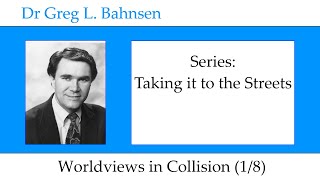
A recorded public-domain lecture by Dr. Greg Bahnsen introducing practical Christian apologetics: the responsibility of every believer to be prepared to give a reason for the hope they have (1 Peter 3:15). Bahnsen contrasts subjective/relativistic/eclectic responses with the biblical call to objective, public defense of the faith, and emphasizes doing so with gentleness and respect while taking apologetics "to the streets."
This recording has been released into the public domain by the Bonson Institute, where we aim to bring into captivity every thought to the obedience of Christ.
Apologetics is not about saying I'm sorry. It may be good, a good Christian virtue, part of your sanctification, to learn to say that you're sorry. But apologetics, what we call apologetics, is not a matter of saying I'm sorry for something. It's a matter of offering a defense of the things that you believe. When people don't agree with you and they ridicule what you believe, or they challenge what you have to say, they offer arguments against it. Christians in the ancient world knew very well what it was to have accusations and ridicule directed against their religious convictions and against their religious practices. If you read the New Testament, you'll notice that at the very beginning of the Christian church, the account of Jesus resurrection was already taken as an idle tale by people in that culture. It was branded a lie by certain people. King Agrippa said it was impossible that the dead should rise because believers preached the resurrection of Jesus Christ. They were arrested by the Jews, they were mocked by the Greek philosophers. That isn't all. On the day of Pentecost, the Christian church was accused of being a gathering of drunkards. In Acts 6, we read that Stephen was accused of opposing the previous revelation of God. In Acts 17, Paul was accused of introducing new gods. The church was accused of political insurrection in those days. And experts openly vilified what the Christians taught, and they vilified their persons as well. As Paul says in 1 Corinthians 1, the Christian message proved to be a stumbling block to Jews and utter foolishness to Greeks. And so, on the one hand, Christians in the early days of the church knew what it was to have a great deal of negative publicity opposition. But they knew what it was also to have people receive the Christian message too enthusiastically. They knew that they had to guard against the wrong kind of positive acceptance of what they were teaching as well. In Acts 14 we see that the apostles were confused for gods by advocates of pagan religion. In Acts 16, they were given a very unwelcome commendation by soothsayers. In Acts 15 we see that their message was absorbed by heretical legalists. And so I think you, in the 20th century, certainly I can as well sympathize with our brothers in the ancient world, because in our day and age, the Christian faith continues to see the same variety of attempts to oppose it and to undermine it as they did in their day. It was almost 34 years ago that the Lord opened my eyes and my heart to the truth of the Gospel. I suppose I'm like many of you. We will never forget what it was to finally have that dawning awareness of the truth of what the scripture says. And that despite our sin, God in His grace has loved us, has taken care of our problem, has assumed the judgment that is our own, and has given us a new life and a new start. Ever since that night that I realized the angels in heaven would rejoice when one sinner is found. I've learned to sing. Jesus is all the world to me. He really is. Jesus is all the world to me. He was that night because I knew finally that I was right with God. Jesus has been all the world to me ever since that night as well. Not simply because I know that I have an eternal future with him, but also because he lives with me day by day and he makes life worth living. He's made life worth living through death threatening illness, life worth living through heartbreaking family problems and everything that has happened. Jesus has been adequate to my needs. Now because of what God has done in my life, I want to share this with people. You know, when you find something that's really good, unless you're a terrible person, you don't want to be selfish and keep it to yourself. You want to share it with people. You want them to know what makes you happy, what makes life worth living. And so I've always had an interest in sharing the Christian faith with people. But just like Christians in the early days of the church, I found that as much as I just positively want to share the love of God, so they might know that people might know the good news and they might trust in Christ and their life would become worth living and things would fall into place in terms of how they see the world and so forth. As much as you or I would like to share that with people in our day and age, there's a great deal of opposition to it. People will tell you on all sides and in many ways that you can't possibly believe that anymore. You cannot believe in that kind of God. You cannot believe that the Bible is what it says it is. You cannot believe that Jesus Christ is the Son of God and Savior of men. There's a large number of ways in which our claims and our beliefs as Christians have come under attack. People will tell you that what we say doesn't even have meaning, that it's just nonsense. People will reject the possibility of miracles. They'll tell you that God can't reveal himself or that there is no personal God. They question the Incarnation. In fact, theologians today question the Incarnation. Believe it or not, doubt is cast upon the historicity of the New Testament, the deity of Christ and the very existence of God. The accuracy of the Bible, scientific accuracy, historical accuracy is attacked. People will tell you that what the Bible teaches is not logically coherent. They'll tell you that it's impossible that there be conscious life after death. They'll tell you that the doctrine of everlasting damnation is an ugly and unpleasant doctrine that is unworthy of any noble religion. I tell you that the way of salvation proclaimed by the Christian church is wrong, that we really do need to live a good life and to earn merit before God. There are many religious systems that are set in competition over against Christianity. You may have noticed in our own day the influx of Islam in American culture and the challenge that it presents to the claims we make as Christians, the ethical that we hold as Christians, what we offer as a lifestyle is ridiculed. Psychologists will tell you that it's perverted. Many tell us that the political applications of Christianity are disreputable and we need to get away from that. And on and on and on it goes. And what do we say when all of this then is thrown at us? When you have people in your family that ridicule your faith and when you go off to school somewhere and professors will say it's academically disreputable to be a Christian. When we see on the television set night after night an approach to life and so forth, that will actually suggest that what's going on in Waco, Texas, is really characteristic of everybody that has a fundamentalist approach to the Bible and so forth. We're getting hit from all angles, aren't we? And so I want to offer to you first of all tonight something that may not look like good news, but it is. The APostle Peter in 1 Peter 3:15 tells us that we are to sanctify Christ as Lord in our hearts, being ready to give an answer to any man who asks us a reason for the hope that is in us. Yet with gentleness and respect. Peter says that you are to be prepared to answer any man who asks you a reason for the hope that is in you, no matter who it is that approaches you, no matter what his problem may be. Peter says, you need to be prepared to answer that. And the first thing you've got to be thinking if you're paying attention tonight is, well, that's not me, Dr. Manson. I can't answer every objection that comes along. I mean, maybe you can don't take that for granted, but maybe those who have studied can, maybe the professionals can, maybe my pastor can, maybe those who teach or write can, but that's not for me to do. How would you like it if we were to change our example, though, and look at what the New Testament has to say about loving our enemies? The Bible tells us that we're under obligation to love our enemies. That's a very hard thing to do. Our conference is not on Christian ethics, and so I won't take a long time on this. But I would tell people I often do when I'm instructing them. But I think that's my personal opinion. It has no theological weight, but I think that's the hardest command in the whole Bible to obey. There are a lot of things that are hard to do as Christians, but it's hard to love people that have mistreated you. It's hard to love your enemies. Now, what if because it was difficult to do, I ought to say, well, that's not for me. I mean, that's a command that looks like it's for all Christians, but that's really for the super spiritual. That's for those who have been Christians for 50 years or more and I've only been a Christian for a little over 30, so I don't have to start loving my enemy now. You'd say, well, that's ridiculous. You're rationalizing, Dr. Bosn. You're making an excuse for your disobedience. And you'd be right. Let's go back to what Peter says to you. Each and every one of you. You are to be prepared to give an answer to any man who asks you a reason for the hope that is in you as Christians. Any man who asks you that might be your next door neighbor. He might just have some kind of passing easy question that you've already thought through. Or it might be the local college professor who has some kind of academic and detailed problem with being a Christian, and he throws that question at you. Peter says, be prepared to answer any man. And how many of you feel prepared to answer any man? Tonight, many of you are thinking, boy, I'm not coming back tomorrow. I can't do this kind of thing. But before you run out, I want to remind you that if that's your response, you're being disobedient to the word of God. The word of God doesn't say those with PhDs in philosophy answer any man who comes along it says, all of you are to be prepared to answer anybody who asks a reason for the hope that is in you. And who is it that wrote 1 Peter 3:15 who is buried in Grant's tomb? Right. Who wrote 1 Peter? Peter wrote 1 Peter. Now, what was Peter? Was Peter an achaemedician? Was Peter a scholar? Was Peter somebody who had studied with the doctors of his day? No, he wasn't. What was Peter's occupation? He was a fisherman. And this fisherman tells you, of course, fisherman come. Apostle Peter did leave his nets, finally. But nevertheless, this is not somebody who would be considered the most brainy Christian in the early church. Peter, with his fisherman background, says, you be prepared to give a reason to anybody who asks you, a reason for the hope that is in you. You should be prepared to answer people who say miracles aren't possible, that Jesus couldn't rise from the dead, that the Bible couldn't be the word of God, that there can't be life after death. And whatever else they may bring to your attention, Peter says, you be prepared to answer any man. You know what this tells me? 1st Peter 3:15 tells me that it's about time we took apologetics to the streets. That for far too long, especially in evangelical and reformed circles, apologetics has been something of the cloistered domain of the academicians. For those who are students of the subject, to those who are teachers, perhaps those who are pastors, they do apologetics, but the Bible doesn't tell us that. The Bible tells us that every Christian is under obligation to be prepared to answer for his or her faith, to take any challenge that is brought and be able to give a credible answer to it. And I'm here to tell you tonight, you can do that. You can answer anybody who asks you why you're a Christian and how you can believe these things. You can answer any objection that is raised. And by the time you go home tomorrow afternoon, Lord willing, you will be convinced as well as myself that you can do that. And that's why I've come here from California to spend some time with you. I'd like to train you to do that. I'd like to show you what is really at stake in apologetics and in so doing, show you why you are able to handle and any variety of objection or criticism or ridicule that comes to you as a Christian. You know, the bad news of First Peter 3:15 is that it requires so much. You have to be prepared to answer anybody. The good news is that because God is the one who sends that command to you, you are able to do it. It is not too hard. It is not beyond you. It is something that you are able to do. God requires it, and God will equip you to do it. So there's the good news. We can take apologetics to the streets. We really need to do that. Because I think studying the theory of apologetics and having a number of brainy people around with PhDs who talk about it may be of interest, it may be of some help, but it's not altogether practical for the advance of the kingdom of God. I remember reading once of a man who had studied the theory of firefighting all his life. He had become very intelligent about these matters. He knew all the different theories, how to attack fires, all the different strategies to use, and so forth. And he'd become so good at this that he even went around giving lectures to fire companies and so forth about these different theories of firefighting. And then at the end of his life, as he was looking back over all that he had done and accomplished, he realized that for all of his knowledge of the theory of firefighting, he had never once put out a fire. I'm afraid that many Christians, and many Christian teachers as well, often have the same difficulty. They study the theory of apologetics, they study the different strategies for defending the faith, but when all is said and done, they just haven't done a whole lot of practical defending of the faith. And so I'm not going to be talking to you this weekend about theories, apologetics. Of course I have a theory of apologetics, I have a strategy of apologetics, and I hope that it's a biblical one, and I can convince you that it's a biblical one. But what I want you to pick up on are not the inner school debates between different ways of doing apologetics. I want you to pick up on how to actually put fires out so that you can go out to the streets and start putting some fires out. Jesus said, many are called and few are chosen. And when he said it, he was not referring to apologetics, but we have, in the Christian church, acted like that was true. Everyone's called to do apologetics, but only a few are really chosen to do so. And so let's get rid of that at the very beginning this evening. You must defend your Christian faith, and you must be able to do so regardless of who asks you about it. And no matter what the area of criticism is, no matter what attack is brought to you, whatever the question or challenge, you need to be prepared to defend the hope that is in you. Apologetics is not for just the brainy ones. Apologetics is not just for the classroom. Apologetics is for the streets. So that's why we're calling this conference Taking it to the Streets. I'd like to prepare you to do that. In order to help you do so, however, I have to close a few doors so that you don't run out and think you're doing apologetics when you're really falling short of what God wants you to do. When you stop and think about the almost insurmountable challenge with all those different kind of objections, and I'm telling you, you need to be able to answer them, it might be tempting to think, well, what I'll do is take this or that or other approach, and I'd like to warn you in advance that you're not doing apologetics if you do one of these three things. First of all, it has often happened that those who are willing to speak and defend their Christian faith settle for much less than apologetics. And what they offer is subjectivism in its place. Instead of defending their Christian beliefs, they are willing to give a subjective answer to those who ask them a reason for the hope that is in them. What do I mean by subjectivism? You get subjectivism when a Christian tells you that he or she has received a great sense of inner peace and confidence before God, that they have a real internal sense that they are right about what they believe. Now, there is a truth to that. I wouldn't for a minute want to take that away from my Christian brothers and sisters or from myself, because Jesus is who he says that he is. The Holy Spirit does give us inward peace. The Holy Spirit does give us confidence. But obviously there's a great deal of difference between that psychological state of confidence. There's a great deal of difference between the subjective acceptability of Christianity, because it makes me feel better, and. And the objective truth of what the Bible has to say. Confidence is a psychological property. It's a feeling of assurance that some proposition is true. Many people have confidence in things, but obviously confidence does not speak of objective truth because, you know, people that are very confident that they saw Elvis at the 711 last week. Confidence, and they may be telling the truth. They say, I am just sure that was Elvis. And they are. They're sure, but, you know, they're being sure doesn't make it true, does it? Remember back when I was in graduate school at the University of Southern California? Can I say that here is that safe speak of USC we had in Southern California, as I'm sure everyone does, various representatives of cultic groups going door to door, evangelizing and so forth. And when people would come to my door, I always make it a habit of trying to engage them in conversation and say, yes, I would like to discuss those things. And then next month they don't come to my house anymore. They always X me out. Somehow I don't like that. But anyway, I remember a young lady who was a Mormon coming and wanting to talk about the claims of Mormonism and so forth. And we got into a interesting discussion and I kept giving her reasons to feel uncomfortable with her Mormonism. And it wasn't one of these things. And if we had time, I could tell you a lot more about the strategy of dealing with people. But it wasn't like, you know, she's yelling one thing and I'm yelling another, and it's real hostile. It was a very pleasant conversation. But I'd say, well, but now, if you believe this is a Mormon, then what about this and what about that? And why does the Book of Mormon say this? And it was that kind of thing. And so she got flustered and flustered, and she came back a second time and she thought maybe she had finally rounded up some answers and so forth, but it generally went the same way, and she ended up pretty flustered. And I will never forget that when we got to the end of that second afternoon and I invited her to come back again, I said, would you please come back and we'll continue this? And she told me she would not be coming back. And then she had one final word. She said, can I just tell you one last thing? So I said, sure. What is it? And so she's standing at the door ready to leave. And she said, I just want you to know that if you would pray about this, that God would give you the inner confidence that he has given me, that Joseph Smith was the prophet of God. Now, you know what's haunting about that is that I know many evangelical Christians who would have ended the very same way. When all else fails, what you fall back on is Jesus has given me the sense of assurance. Just pray about it. God maybe will do that for you as well. That is not apologetics. There is a place for Christian testimony. There is a place for telling people what Jesus has done for us and how it has changed our lives and the inner confidence that we have. But telling people about those subjective matters is not a defense of the objective truth of Christianity. That is taking the low road of subjectivism where Jesus Calls us to take the high road of defending his claims as being true. Another low road that people take sometimes is the low road of relativism. Relativism is closely allied with subjectivism, but it's not exactly the same thing. It is a distinctive error of its own. You see, the subjectivist is actually denying the public nature of truth. The subjectivist is saying that truth is always an internal thing. Okay? But the subjectivist believes that there is a truth. It's just that you feel it inside rather than being able to defend it objectively and intellectually. The relativist is much worse. The relativist says, no, there is no one truth for everybody. Truth is relative. Or as the music of the 1960s used to say, it's different strokes for different folks. Everybody has their own truth. Relativism believes that all convictions held by people, and especially religious convictions, are conditioned by cultural factors and conditioned by individual biases in such a way that there can't be an unqualified and a universal truth for people. If the Christian proclaims that God is a person, but Hindus teach that the supreme reality is impersonal. If the Christian warns that all men will answer to God for their sins, but the master of some cult insists that God would never punish people for their misdeeds, the relativist looks at all of that and takes the low road by saying these disagreements cannot be resolved. What is true for you is not necessarily true for for me. Please be on your alert when you hear people use that expression true for you, true for me. That is a perversion of the English language and it will mislead you terribly in terms of the way you look at the world. For you see, truth is not something person relative. The truth is not relative to persons. Now, there are truths about persons. It may be true of you that you like Cocoa Puffs for breakfast, and I'd rather have Canadian bacon. There is a difference between individuals, and there are truths about those differences. But truth is not relative. For you. See, it is true for me that you like Cocoa Puffs for breakfast, and it's true for you that you like Cocoa Puffs for breakfast. You understand what I'm getting at? It's one thing to say different people have different feelings, and it's nothing to say that truth is relative for everybody. When people say it's true for you but not true for me, that's really a perverse way of saying you believe it, but I don't. Okay? True for you is just a long way of saying you believe it. But of Course, we already know that when we get into an argument with somebody, we already realize that one person believes this and another person believes that. How do we resolve that? We don't resolve it by saying, oh, well, I guess you believe this and you don't. That's just repeating the initial conditions under which we began the discussion and the argument that doesn't resolve anything. So subjectivism is not apologetics. Relativism is not apologetics. And nor is eclecticism. Now, that may not be a word that you use a lot. Eclecticism, here's the paraphrase, fruit salad approach to things is not apologetics. The eclectic says, I want to take a little bit of this and a little bit of that, but nobody's going to be exclusively true. I bet you have friends that talk that way, right? When you tell them about your Christianity and so forth. You know, it's not like they want to reject all of it. They say, well, there's some good things there. I really like part of what Jesus had to say, you know, and I have to be very honest with you, Jesus would be much more welcome at the cocktail parties in our culture if he would just mind his manners. Because in whether it's cocktail parties or not, in social gatherings in our country, people don't mind that. If Jesus would settle for that kind of acceptance, like a little bit of this and a little bit of that and a little bit of Jesus, then everything would be fine. But the problem is that's not the Jesus of history. That's not the Jesus that walked on this earth. The Jesus that walked on this earth was not the sort of person who fits in well to modern day pluralistic, relativistic America. Jesus had this unsettling nerve to claim to be the only way to God. Jesus said that no man knows the Father but the Son and He to whom the Son reveals him. And no one wants to hear that today. As a generalization, people don't want a Jesus that claims to be the only way to God, the only one who can reveal God. If Jesus would just be willing to be put on a par with Buddha and Confucius and the Bhagavad Gita and all the rest of the, then Jesus could gain the acceptance of our culture, but he won't do that. Eclecticism, the fruit salad approach, a little of this, a little of that, is not Christianity. See, Christianity claims to be the only way to God. And if it's the only way to God, then you can't go around choosing from other religions what you'd like to incorporate into it. Christianity claims that Christ alone is the divine Savior, that only through him can you be right with God. And so human imagination and all the other creative religions of the world are nothing in comparison. And so what am I asking you to do? I'm asking you to take your Christian faith to the streets and not settle for a subjective testimony. Jesus is really important to me. Not settle for a relativistic. It's true for me, but it might not be true for you. And not settle for an eclectic approach that says, well, Jesus has something to add to all the other great religious leaders. Please give him his due. What I'm asking you to do is to take your Christian faith, because Jesus does mean all the world to you. To take your Christian faith to the streets and proclaim that he's the Way, the Truth, and the life, and that no man comes to the Father but by Him. That if you do not know Jesus Christ, then you are off the proper path. You don't know the Way and you don't have the truth. Truth is not relative. It is tied to Jesus. And you don't have life either. Moreover, nor will you come to the Father and find acceptance unless you come through Him. I want you to take that kind of claim to the streets and to feel confident that no matter what you hear back, you'll be able to deal with it. And I assure you, you will be able to do so. The New Testament shows us that as Christians, we are called to the high road of argumentation. I did not say we are called to the high road of being argumentative. We are called, however, to argue. There's a difference. Argument is the exchange of different premises leading to conclusions. Consideration of this, that, and the other, which is supposed to support a particular conclusion, and the interchange of people of such premises and evidences, and so forth, is argument. But you know, there's an argumentative and a peaceful way of doing that. There's a respectful and a disrespectful way of doing that. So let me remind you that in 1 Peter 3:15, which we began with this evening, Peter, this fisherman who is confident he can answer anybody, and so can you. Peter says, sanctify Christ as Lord in your hearts. Put Christ apart. Consecrate Christ as Lord in your hearts, being ready to give an answer to any man who asks you a reason for the hope that is in you. Yet with what gentleness and respect, Peter reminds us that the way in which we do this is not contentious. It is not to be done in a way that is argumentative. And so you see what a great task we have set before us. You are to go out to the streets, present the claims of Jesus Christ, not as subjective, not as relativistic, not as eclectic as the only way to God, and as objectively true. Being able to answer anybody who asks you a reason for the hope that is in you. And you are to do this without getting into into fights with people. You're going to do this in a way that shows the gentleness of Christ. So you need to learn to be very firm, to be very good in presenting your arguments. But you need to use a kind of boldness that has humility tied to it and a kind of Christian grace that shows the spirit of our Savior. That's quite a task that I've lined out for us tonight. You may want to take 15 minutes and think about that. When we come back, I'm going to start showing you how you are able to do that. Let's take a break.
This recording has been released into the public domain by the Bonson Institute. Duplication, sharing and distribution is encouraged. For more information about the life and Ministry of Dr. Greg L. Bonson, visit our website, Bonson. Where we aim to bring into captivity every thought to the obedience of Christ.
More from BahnsenAI




Dr Greg Bahnsen - Proverbs: Proverbs 16:28, 30 (Some Tips on Promoting Strife) (Part 72)

Dr Greg Bahnsen - Proverbs: Proverbs 15:23; 16:21, 23-24 (True Religion: A Bridled Tongue) (Part 71)

Dr Greg Bahnsen - Proverbs: Proverbs 14:21 (Imitating the Father's Tender Mercies) (Part 70)

Dr Greg Bahnsen - Proverbs: Proverbs 15:25; 22:28; 23:10-11 (Widows and Property Rights) (Part 69)

Greg Bahnsen R C Sproul Debate Part Two Presuppositional vs. Classical Apologetics


Greg Bahnsen VS R C Sproul Debate Part 4 Presuppositional Vs Classical Theology

Greg Bahnsen vs R C Sproul Debate Part One Presuppositional Vs Classical Theology