MobileMoxie - News SEO VIP Roundtable
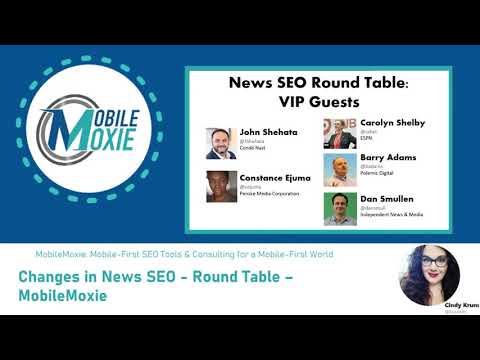
Five news SEO experts from Penske Media, INM, ESPN, Condé Nast, and independent consulting discuss how Google's shift toward Knowledge Graph authority has changed rankings. They cover the impact of paywalls post-COVID, Google Discover's opaque algorithm, and tools like Chartbeat and Parsely for tracking performance across Google News and Top Stories.
Chapters
Hi, and welcome to the News SEO Roundtable from Mobile Moxie. Today we are excited to present to you 5 amazing news SEO experts— John Shehada, Constance Ejuma, Carolyn Shelby, Barry Adams, and Dan Smullen. All of these amazing people are here with us to chat about the changes in news SEO and what you need to know. This was an amazing roundtable.
So So enjoy.
I'm excited to have you guys joining us, and thanks to the audience members as well. So here are the rules of the road. Please be sure to mute yourself unless you're talking. Please be sure to unmute yourself if you are talking. And please let the VIP guests participate first. We'll do every question to the VIP guests first, and then we'll open it up to everyone else. So if you're just joining us as a participant, don't worry, you will have time to interject, give us your thoughts, ask questions that you want to ask that are on the topic. And this is supposed to be casual and fun. And knock on wood, we have no bombers this time. So let's, let's get going with introductions. So who wants to go first? Let's do Constance first because Constance, I don't know you, and then we'll do Dan. No, you guys.
Lucky me to go first. Uh, hi everyone, my name is Constance Ejuma. I am the VP of SEO at Penske Media Corporation, uh, where I've been working for the past 5 years. Uh, we manage a number of entertainment and lifestyle brands including Variety, Deadline, IndieWire, SheKnows, um, and, and many others. Prior to my time at Penske Media, I used to be with Demand Media. known for eHow.com and DeepLiveStrong.com. We were almost also infamous for more or less triggering Google to start working on the algorithm update back in the days. So it's, it's been a long time that I've been in the industry and I've seen quite a bit. And I'm very excited to be on this panel talking to other experts in the field.
Excellent.
Good job. And it's a tradition I always make people tell us their favorite ice cream flavor.
Mine would have to be caramel or pistachio.
Fancy. Okay, Dan, you're up.
Yeah, hi guys, my name is Dan and I'm head of SEO at INM. So it's an Irish media group. So we'd have the likes of Independent.ie, Belfast Telegraph, a few other regional publishers in the group. Day to day, I would be liaising with the editorial team as well as the technology team from a technical SEO perspective. And then pretty much anything that falls under the Google radar. So anybody that needs help with showing up on Google, whether it's the classified sites, the property listing pages, different like that, it just falls in my lap. So very experienced from that front. I kind of fell into the deep end about 2 years ago in news SEO. Before that, I came from agency, so I worked on primarily e-commerce brands with Wolfgang Digital, and that's kind of my experience. So it was a real awakening how different news SEO is to regular search, and some things that you kind of take for granted with regular search doesn't really happen in news. You can get away with quite a lot, I've noticed over time. So yeah, absolutely delighted to be part of the panel, and, you know, some absolute legends on the panel, including everyone. So Looking forward to chatting and talking everything to do with news SEO.
Fantastic. Thanks for being here. What's your favorite ice cream?
Oh yeah, favorite ice cream has to be cookies and cream, 100%.
All right. Awesome. Carolyn, you're up next. You have to unmute. I know. I unmuted myself.
Sorry, I had to find it. My name is Carolyn Shelby. I am at ESPN right now. I work on all of the ESPN websites. But I also help out with other Disney Corporation properties. So when lately I've done a little bit of work on ABC News as they need the help. We've got some other, I don't even know if I'm supposed to say them. We've got some other stations that are gonna be relaunching soon in January. So I'm helping out with those too. But primarily I spend my time working on ESPN, which in case you don't know, covers sports news. So prior to that, I was with the Tribune Company, and I worked on their newspapers. And their newspapers include the Chicago Tribune, the LA Times, the Baltimore Sun, the New York Daily News. We bought that one late. But as far as news SEO goes, I've been working on ranking sites in Google News since like, God, it was like '98 or '99. It was a long, long time ago, which sounds like the beginning of a song. It's been a fun ride, but it definitely is, to Dan's point, a lot different than regular SEO. And I think that's something that gets lost in a lot of conversations. And I'm glad that we're all kind of able to get together and recognize in each other that we do something that's a little bit different than than what everyone else frequently talks about.
So yeah, it's funny, for local SEO conferences but not any news SEO conferences, and they're, they're different enough that maybe there should be. I don't know.
But I just don't know that there's enough of us to justify a whole conference, you know what I mean? So it's that tricky thing right there. Plus, you know, newspapers don't like to pay for anything, so.
So true.
There it goes. I'm saying the quiet part out loud.
Oops.
Oh, ice cream. Sorry. It's kind of a toss-up. I really like mint chocolate chip, but I also really like butter pecan.
You and my mom. All right, Barry.
All right. I'm Barry Adams, a Dutchman living in Northern Ireland. I used to have Dan's job, is that I was the head of SEO at the Belfast Telegraph. way back in 2009, 2010, I think. I started out on my own in 2014 and then started working with other UK-based news publishers. I've sort of become, I suppose, infamous to a certain extent for working with what I call the unholy trinity of news publishers, which is The Sun, Daily Mail, and Fox News. But I also work on the other side of the political spectrum. I recently completed a project for The Guardian. I work with technology websites like TechRadar, PC Gamer, financial news websites like Investing.com, basically any news website that needs some external consulting. I focus heavily on the technical SEO side of things, but I also do editorial trainings. So in the last 5, 6 years especially, I think I've specialized, started specializing in news SEO because I love it so much and because the part of SEO which I suck at, which tends to be links, because you have to have people skills to be good at link building and I don't like people. So I'm more of a technology geek, which is why news websites are so well suited to my skill set, because you don't have to necessarily have people skills, you just have to be good at the technical side. At least my sort of skills lend themselves well to the technical side of things. I think that's probably also one of the reasons why I'm a consultant rather than in-house, because I don't think anybody would hire me anymore nowadays. And I've been looking up to people like Carolyn and Johan for many, many years, and I've learned a lot from them over the years. So it's an absolute privilege to be part of this panel as well. And my favorite Uh, ice cream flavor would probably be anything that has peanut butter in it because I just love peanut butter.
Great.
Awesome. All right, John. Hello.
Uh, I'm very excited to be with you guys. Um, okay. Uh, I started about 20 years ago, uh, with SEO. 19 of those are specifically on news SEO. I'm currently the VP of audience development strategy and CRM at Condé Nast. For the ones who don't know Condé Nast, most likely all of you know Condé Nast. So this is like Wired, Vogue, GQ, New Yorker, and so on. And very soon I will be the global VP of all the brands in US and internationally. I have been working with news for a long, long time. I was at Disney prior to Carolyn and I worked in ABC News, helped a little bit with ESPN, worked also all Disney channels for kids and ABC Entertainment. Before that, I worked on about 35 local newspapers and a lot of news sites, and now I work at Condé Nast. I also develop a lot of products, so I built a ton of products for the companies I worked for, from like machine learning, uh, trends recognition and relevancy and so on. I also built a product called Falcon for Condé Nast where we recognized the most important post to share on social that caused about 40% increase on social traffic. But recently I just developed my own tool which is called NewsDash with a Z, and it simply focuses on news, Google News and Google Top Stories. And yeah. I'm enjoying the ride so far. My favorite ice cream, I'm a simple guy, so it has to be Häagen-Dazs Dulce de Leche, if I'm saying it correctly. Yes, anything that has caramel, sign me up.
So yeah.
Thank you. Yeah, I'm so impressed. We've got such a rockstar group here. So for those of you who don't know me, my name is Cindy Krumm and I'm the CEO of Mobile Moxie. And I care about news SEO because it ranks well in mobile. And we have a tool that lets you simulate mobile searches from anywhere in the world and see exactly what is in the result and actually click through to it. And so sometimes other SEO tools aren't great at localizing their results or at showing you news stuff or what images are there or whatever. So our tool lets you do that because Google basically thinks we're phones. Uh, so that's why I like news SEO. Okay, so let's kick it off with the first question, and I don't have anyone in mind for this question, but it's, how has COVID impacted news SEO, and what about the other major shifts in the industry? Now I know Dan has some thoughts about major shifts in the industry, but Dan, can you wrap that in with the COVID question, or are they 2 separate topics? This is a challenge right out of the gate.
Yeah, yeah, we can totally wrap them in because it is quite related. So obviously what I've noticed anyway, what I can speak of, is we had obviously, like most publishers, had a massive surge of traffic when coronavirus peaked in all different countries and people were just desperate for information to learn about this horrible disease that we all have in front of us. And we just— what I noticed quite a lot was, and I think I spoke to John or Dan about it, was basically there was a big shift to live reporting we see in news. So a lot of times when it was the coronavirus and in the various different countries, you found it was a massive weight that Google had on publishers that had implemented either live markup schema. Now obviously, with any kind of big enterprise organization getting these kind of things into the development pipeline is quite difficult. So we had to kind of react quite quickly. And what I noticed was, even though the journalists have been creating content and updating it, one of the biggest things that Google still hasn't kind of got its head around is kind of how you can abuse the publish date. So each time going in and change the publish date can actually push you to the top position. Even just as simple as like 2 minutes before another publisher has published something, you can totally get in front of them, obviously, by just doing that. So I suppose it's a shift that I've seen anyway with the coronavirus, with the impact I've seen with Google focusing on the most up-to-date information, shall we say, ranking in the top, especially for news events. And then in terms of what we've seen, it's been quite hard for publishers, obviously, because their ad revenue completely plummeted. You know, so you've seen loads of publishers in the likes of Australia and even the US as well cutting, like, cutting the staff. Obviously stuff you've heard the news of BuzzFeed and different things. And yeah, massive shift towards publishers going towards a paywall. So that's kind of what I've noticed anyway with the coronavirus.
All right, Carolyn, sports and kids.
My little microphone kept disappearing. So sports and news, you know, I'm jealous that a lot of other, a lot of other publishers saw huge avalanches of new traffic because people were interested in COVID. But the problem was people were so concerned about where they were going to buy toilet paper that people cared a lot less about when sports were going to come back. Because once they got suspended, it's like, all right, well, that's off the table.
Now where am I going to buy my Charmin?
So I've almost taken it as a welcome opportunity to work on some of our core fundamentals and get things buttoned up that maybe we didn't have time to button up before, because with news, because it's ongoing, it's every fix and every change you make is like trying to rebuild the train while the train's in motion, right? So this was an opportunity for me, at least, to slow the train down a little bit so we could make some changes and work on some things that I just normally don't have the opportunity to work on simply because everything's moving so fast and you have to pay attention to, you know, what's next rather than what you need to work on right now. So sports, at least, is a little bit of a different— lockdown's been a little different for us. Just putting that out there. As far as other shifts, I will say that coronavirus itself, A, it was a wonderful opportunity to illustrate to writers how choosing the right word based on the word that is performing better in Google Trends can really help your stories do better. So for a while in Google Trends, coronavirus was doing much— was much more highly searched than COVID-19. And there was a definite point where that kind of switched. But using that as a live opportunity to illustrate that, hey, if you're gonna put this in your headline, and by the way, we should put this in our headline, let's use this word versus this word. This is how you check how it's doing in Google, in Google Trends to kind of get that information. So I, I had a lot of really good teaching opportunities during, during the whole lockdown. Other shifts? I think that's probably it for other shifts. I'm sorry about DJ coming in. He's— we're doing homeschooling, which has been a real good time.
So.
Happy to have him. All right, Constance, what do you think?
Well, it's been interesting for us because when the pandemic first hit, there was a lot of uncertainty about how things were going to go, how the audience was going to react. And I think we were a bit surprised to see that we definitely had a positive impact as a result of the pandemic. And I think that had to do with the type of websites that we have and the types of topics that we cover. Not surprisingly, because everybody was locked down and, you know, seemingly had more time on their hands, entertainment became a thing that became much more interesting and much more accessible. And so with a lot of developments happening on streaming platforms and films now having to be released on streaming platforms as opposed to movie theaters, people were very curious about staying up to date about development— developments happening in the entertainment industry. We also do have a number of lifestyle websites. SheKnows.com is one in particular where we cater to a lot of, you know, parents and people who are now having to stay home and take care of kids, but also work at the same time. So to your point, Carolyn, we, we had an audience of people who were looking for toilet paper and, you know, the best way to take care of kids or the best, you know, strategy for homeschooling in this kind of unprecedented time. So I think the biggest shift for us was in user engagement and the types of topics that people were searching on. And surprisingly, even when our entertainment sites started to cover COVID in more kind of topical ways in terms of writing about face masks and things like that, it's weird, like on a site like Variety, that content was doing well as well. But, you know, I'm always somebody who's looking far into the future, and I know this is a situation that's not going to be permanent or indefinite. And so while the traffic is exciting, I'm always somebody who's waiting for the other shoe to drop. And I'm making sure to really warn our editorial teams, like, you know, this is not the new status quo. And so while this is happening, we still have to kind of keep our core values in the back of our minds so that when things do shift back to a more quote unquote normal way of things, then we are prepared to kind of go back to the things that made our sites work in the way that they did before.
Okay, awesome. Barry and John, thoughts on this one?
Go ahead, Barry.
John, go ahead.
No, I wanted to say that, so it's good to have, like, we have about 20 different brands that cover all kinds of verticals, right? So you have travel that got impacted Really hard, right? You have fashion that people in in March and April weren't interested at all, right? Then you have sites that focus on health and so on. So we noticed early on in March and April people were in a panic mode, right? All the stuff that they care about is like give me the latest updates on coronavirus. Is it in my town? Is it in my state? How can I cancel my travel? How can I cancel my vacation deals? And so on, right? And then slowly after April, in May, June, there was a huge shift, right? People accepted the fact it's here and it's going to stay for a while. So they start thinking about what can I do while I'm home, right? So it was like, I call it stay-at-home kind of searches, right? How can I be healthier? How can I be fit? What type of accessories I need to buy for my home office? Right? Ring lights, you know, people, men buying hats like crazy because their hair was growing long and, you know, the Zoom calls, so everyone is wearing a hat, right? So you see, oh, hair clippers went up the roof, right? It's like fitness exercises at home, right? And people trying to find projects to do. So you see a shift slowly. And it's funny, like by June The amount of content that's sending traffic to non-COVID versus COVID content has kept going further and further and further apart. So people, I'm not saying they're not interested in COVID, but it's not like March, right? They like, they want to go on with their lives, right? So there is a huge shift. The other shift also, which is like very important for publishers, traffic is cheap, right? Yes, you get a ton of traffic, but you don't have advertisers that spend spending money, that traffic doesn't mean much, right? So SEO became a business function more than a traffic function or a scale function. How you can focus on things that really drive revenue to the company. So if you're a publisher and you have affiliate revenue, this is the main focus. It's not about just driving traffic to the site. It's like, how can I help my business, help myself, help the job by driving more revenue in direct revenue streams. So you see like people working in affiliate revenue, face mask. I always say that face mask is one of the gifts to publishers, right? Or like top commerce moment and so on. I'm gonna leave it to Barry, but there is a huge shift in user behavior, publisher behavior, and so on.
Yeah, I don't think I have much to add to that. I've had some clients who had massive surges in traffic off the back of the impact of the coronavirus and others who have had negative impact or seen not a lot of change in general. And this is fairly typical of the changes of user behavior. What I find very interesting, however, is the start of the coronavirus coincided to a certain extent with Google completing a 4-year project of merging Google News with regular Google web search in terms of the infrastructure that it's using and the algorithms that it's using. And some of that have had some unforeseen circumstances. In the last probably 2 or 3 months, I've had more requests for websites that need help because they've dropped out of Google News and dropped out of Top Stories than ever before.
Mm-hmm.
And because of the shift towards an algorithmic inclusion in Google News, there is really very little you can do to try and get websites back into Google News besides just doing the basic best practices that news websites should be doing. You can't manually reapply to be included in Google News anymore. The new Publisher Center that Google has launched is purely there for inclusion in the News app and has very little impact, if any impact at all, on inclusion in Google News and top stories on the web. So a lot of websites are blaming COVID to a certain extent for that. But I think it has more to do with the fact that Google has now entirely switched Google News to their infrastructure that they also use for Google Web Search because it has much better and much smarter algorithms and is less prone to be exploited like the old Google News was, because I think we've all done those Google News tricks where you tweak a headline a little bit and voilà, you're back in top stories. And, you know, just having a keyword in a headline used to be enough to get in there. Whereas nowadays Google relies much more heavily on the Knowledge Graph to decide what the topical focus of a website is and whether or not any article deserves to be ranking in top stories on any topic based on that expertise associated with the website in general. So it's been a very interesting period these last few months where sometimes we're not sure If a particular shift in traffic and a shift in visibility is because of an actual change in user behavior off the back of the pandemic, or whether it's something that's more inherent in how Google's algorithms have decided to look at websites slightly differently now that Google News is more or less wrapped up into regular Google web search.
So would you say it's consolidating based on trust or based on just Probably both.
I think in my experience, at least Google now is increasingly relying on a news website node in the knowledge graph to decide what topics a news website has trust and authority in and what it doesn't have trust and authority in. I find that, that when websites have a history of good reporting and good publishing on specific topics, they regularly get top billing in top stories carousels when they publish on that topic. Whereas if they step outside of their lane to a certain extent and publish about something that they don't have a lot of experience in, that historically they've had very little content on. They're just not getting that traction anymore. Whereas previously, especially prior to 2018, a publishing website like the Daily Mail could write about any topic and they would get top stories billing because of the sheer volume of links pointing to that website and the sheer authority that that website has. And that's not the case anymore. Nowadays, Google tends to assign certain topics to a certain extent to websites, and they can write about that and get rankings. But if they write about something else, they don't get rankings. Which I think is the impact of Google's integration of news with the Knowledge Graph so that it's much more keenly aware of what websites' editorial specialties actually are.
So if Wired were to write a story about masks or how to make your own hand sanitizer, it's a no-go?
It'd probably not perform as well as if it was another website which has more of a history about writing about health topics or fashion topics or lifestyle topics. Yes.
So I agree with Barry on everything, but you will be surprised about face masks because I have like 4 or 5 sites already writing about it. I mean, I agree with Barry on everything, but the interesting part, authority become more important than ever in top stories. And authorities is not just the sense of like ESPN write about sports. Kobe Bryant, for example, if you take that example, Kobe Bryant is an authority ESPN, absolutely, but he also connected to LA Times. Right? And then if the celebrity, like a sports celebrity, have been in the gossip or the tabloids for a while, you will see TMZ ranking as well, right? So the authority in the sense of like, this is a sports figure, uh, right, as a knowledge graph, so only sports sites— it's more than that. It's like throughout their history, right, which are the different areas? Oh, they live here, so LA Times wrote a ton about them. You know, the gossip and so on. So it's a mix of different things, but authority is stronger than ever in top stories.
Okay.
Yeah, also on that one as well, I think it's also good for smaller local publishers as well. Like, so for example, like, where, like, we would have traditionally, because we're quite a large presence in Ireland, we would have just, like Barry said, we could have written anything and we would have been number 1 by default. But what I've seen a big seismic shift towards is, especially in the organic side, a big shift towards niche publications, but also local. So for example, let's say a local place in Ireland, Galway. If there was a topic in Galway, you'd see Galway publications from that location outrank the big national players like ourselves and different. So I definitely think the knowledge graph has a massive play to it, but I definitely would agree wholeheartedly with Barry's point in that big, huge publishers don't have as much clout in areas that they don't necessarily normally specialize in. Whereas previous, prior to that, by default, any kind of article up there, you would have ranked either 1, 2, or 3 by default. So I definitely think it's got a lot smarter in understanding kind of where you live in terms of your topicality of the website. But yeah, 100%.
I do think it's long-term authority on a specific topic because for, you know, going back to the Kobe Bryant, we were always number 1, you know, maybe number 2 occasionally, but very high up there for Kobe Bryant's organic results for his bio page. And I think that's what really helped us do— I don't want— I hesitate to say do well in terms of, you know, a horrible tragedy like that. But we were, we were very prominent in the carousels at that time. And I think it's directly related to how well we performed on Kobe historically and for the length of time that we were doing well on Kobe.
So Carolyn, do you think that what Dan is saying about being location sensitive is because those publications have authority based on their history? association with the location rather than any kind of geo understanding?
I think I would say it is. So if when they look at that particular topic, that publication will have this very long history of being very strong on that particular topic. So their authority level on that specific topic, the topic happens to be a location, is going to be very strong. So when there's a tie like that, it's going to help them pop right up to the top.
Yeah.
And also, like, if you break the news about a certain celebrity, even if you didn't write about that celebrity much, and everyone was sharing you, later on you start gaining authority on that celebrity. So for example, Tiger Woods. Recently, if you look at the people who are ranking, you will see TMZ ranking on the top against all the other, like golf.com and ESPN and so on, because they broke a couple of stories before in the past about him. So what I'm trying to say, authority is not one shape or one form, but it can take different shapes and forms. The long-term, your content-level production, your buzz around that, the geo, and so on.
I definitely agree with you, John. I think we've had the same experience at PMC where, you know, we have a couple of entertainment sites that are subject matter experts. Experts on a handful of celebrities. And yet we've seen in the past that when something trending happens or news breaks about that celebrity and one of our sites, you know, publishes a news article about them, what ends up happening is that if CNN covers that, that person or ABC or the Washington Post, somehow these sites that are highly, highly authoritative and they've been respected by Google for a very long time, when they write about these people, they end up outranking some of our brands that have spent years and years covering these particular people. So I definitely think it's a mixed bag. It depends on, yes, the authority that the site has based on how much coverage they've had on a specific topic. But I also think that the value that Google assigns based on a site's quote-unquote reputation or the power of their brand also plays a role in this.
There's the power of the brand, but then when you start talking about very, very high, high, that, that top tier of news sites that tends to dominate, there's also, I think, a little bit of technical SEO at play where they are just so, so laser-focused optimized on, on that and getting that news out and getting that news out fast with very little clutter on the page. And they're, they're designed to pump into Google News. Whereas I think magazines and some other publications that are maybe smaller or on not as fast of a news cycle kind of publishing, I've noticed that their structure tends to not be quite the same as what you're looking at with the CNN and Washington Post types of publications. So I don't know how much the— I would be hesitant to assign a percentage value. to the underlying technology, but I do think the underlying technology is a factor when you're comparing the performance of 2 different sites.
Anyone from the audience have anything to add or questions that you want to drill down into? Speak up. Nobody?
All right.
All right, we'll go on.
Very shy.
I guess so. I know that there are some smart SEOs out there who probably have questions, and I will save calling on them till later. Okay, so question 2: In your opinion, what's the long-term impact of Google News or Google Discover on news? So who wants to take this one first?
Barry?
Oh wait, John has opinions, I see.
Oh.
So I have been focusing on Google Discover for the past 7, 8 months, right? And before I answer this question, or maybe let me give some insights on things that I discovered with Google Discover. No pun intended. So first, like, you know the regular stuff, right? You must have like high-resolution, large images, all that stuff, right? And it's highly personalized to your history and so on. And Google recently, last week, I think John Mueller came out loud and said there is no way that you can optimize for Google Discover. Okay, so this is the 3 things that everyone knows. A few things that I noticed. One, I made a study, uh, 3 months ago on the correlation between Google Discover traffic and 17 other metrics, uh, everything right from Google, uh, web search traffic to Google News traffic to Twitter engagement broken by retweets and likes and so on, to Facebook and so on. And it's so interesting to find that the top 2 metrics that have the highest correlation in US are Twitter retweets or engagement and Google News traffic, right? So I'm not saying there is any causation, but in US, these were the top 2 like almost like 0.9 something, right? And it's funny because when you look at Germany where Twitter is very small and Google News is not such a big driver, you will say, okay, it's— so what's happening in Germany, right? Is there enough— I call it the buzz factor. Is there another buzz factor that Google looks at to determine what's important? They have the searches and they have everything, but in US, I know that for sure. The other thing also I noticed is location does matter in a big way. If you are the same user and you're in New York, same exact user, and then you travel to LA, right, your Discover content in LA is different from your Discover content in New York. So location plays a major role.
So your current physical location?
Yes, your current physical location, right? The third thing I noticed as well, um, There was another important thing. It's the engagement, the Google News, the location. Can't remember, it's gonna come to me. But it was very interesting to put all of— oh, the Android consumption, right? So Android consumption in US versus Europe or versus Asia, right? You look at your Google Search Console and you see some brands like in India, 80% of the Google Search Console report. You would say like this is 80% Discover, 20% Google Search, is very high. But when you look at US, sports has a huge Discover percentage, right? So in general, I have seen 20% to 40%, 50% in US, right? But sports specifically have a very high consumption, even though the Android consumption is low, but sport itself as a vertical, most of the audience in US are very connected to sports. So these are the 4 things I noticed with Discover. I just wanted to share it with the audience.
That's wonderful. Did you publish the, the research anywhere, Jon?
No. You know, I keep like searching and doing stuff and put it together, but I'm very lazy when it comes to writing, so I wait for these conferences and I share everything.
All right, who else has thoughts? Dan, go for it.
Yeah, Google Discover. So to me, looking at the data that we have, like, we're predominantly a news publisher, so we have 40% Discover traffic. It's quite large. It's definitely one of the biggest, largest growing referrers that we see anyway. But I haven't a clue. Like, I— like, it is such a black box to me. Like, even by doing correlation studies and different things like that, like, definitely really helpful. But I definitely think it's that classic, it depends. Like, I think it might have been yourself, Valentina. I think you're seeing you in the audience there. You showed where you can actually report a bug in Google Discover and you can actually see why you've triggered in your own personal feed. And obviously we've seen Kevin Indig's study there recently on his own Discover traffic and stuff. It's highly personalized. It's based on your history. So obviously, if, like in Ireland anyway, we have a huge amount of direct traffic, people that just come to our sites. So obviously their history is going to have an impact on them. It's meant to be a personalization engine. It's supposed to be an AI-driven engine. So I think stuff that's popular. So obviously that makes a lot of sense. So if stuff's trending on Twitter, if it's trending like that, that makes sense why you'd see a good lot of Discover traffic. But I just quickly looked at our Discover traffic and it makes no sense. Like, we've got 2 million impressions, 2 million hits for a piece that was created on Vera Wang, which has nothing to do with our audience that would be that interested. It's basically her pics when on her birthday cocooning. So it's really weird, like so hard to interpret it in terms of to optimize it for it. Like obviously when it comes to news, it's, you know, you look what's trending, you look what the news topic is, you make sure those keywords in the headlines, make sure they're covering the different angles and the different things people search for. When it comes to Discover, from my opinion anyway, it is just a black box and how you improve it, I haven't a clue. But I will take all the traffic it gives the sites, but I've no idea, like I just think it's such a difficult one to try and say that we can optimize for it.
Carolyn, are you seeing what John was seeing in sports?
I do feel like it's kind of a black box. In my experience, it's been the one constant that I've seen is it's related to AMP. So the videos will do well and the AMP will do well. I have some other sites that I have access to and I've noticed that they're starting to get stories. in Discover and they don't have AMP at all, which confused me greatly because for the longest time I was firmly of the opinion that it had to be AMP or it wasn't going to happen.
I was on your boat. I thought it had to be AMP.
It's not. I thought so. It's not. It has nothing to do with AMP. It's not even a requirement for Discover.
It may not be a requirement, but of all the sites that I look at, and I'm not isolating this to To where I— to my employer. I'm like, in the universe of websites that I've looked at, it does tend to predominantly be AMP. And if there's something wrong with AMP, the Discover traffic craters. And fixing AMP will fix that. But then there's these other sites that I know don't have AMP at all, and I have no explanation for that, to be perfectly honest.
Can I say something? I think What you're saying is, if there is a problem with indexation with AMP, AMP issues that impact traffic, regardless where it is, it's going to trickle back to Discover. So if there's technical issues with AMP that impacts SERP traffic and Google News traffic, you see it trickles down to Discover as well.
Well, no. I don't know that I would agree with that, because there's a difference between it's trickling down and it flatlines.
Yeah, it impacts it, right? If you get hurt in Google and Google News, you will see the same hurt in Google Discover.
But what I'm saying is there wasn't the same hurt when you've got several different opportunities to rank in regular Google, right? And AMP is just one of a very small— it is just one portion of that where you go from everything is still basically okay, but there's a problem with AMP and AMP is a small portion to there's literally no referral traffic coming and it's solely because there was something wrong with AMP. I think that to me makes it seem like AMP has a very big role in it. But then I cannot also explain why there are some sites that don't have AMP at all that do get a lot of referral traffic from Discover.
Barry was wagging his finger. I want to make sure he gets his response in. You disagree with Dawn?
Oh no, he used the, the indexation word. That's one of my pet peeves, you know.
Not indexation, but what I said—
indexing, John, indexing. The word is indexing.
Indexation, like, in many, many, many years ago, it's a word.
Yeah, it's a word. It's just not an SEO word. And it's just the hill I've chosen to die on. And, and I will fight you to the death for that one.
Okay, well, we'll set an appointment then because it's a word.
No, but I— what I have seen, in my opinion, when sites got impacted due to technical issues, specifically AMP, and they lost a lot of traffic in Top Stories, and they lost a lot of traffic in Google News, they also lost traffic in Discover. Also, I saw that with sites that got impacted with core updates, where they lost 25% of their traffic in Google, Not similar, not to the same extent, but they also lost traffic in Discover. There is a connection between all Google services. That's what I'm trying to say.
So Marshall wants to know— I think that was Marshall asking if this is the beginning of the end of AMP. If you don't need AMP to be in Discover, are we towards the end of AMP? And Barry, of course, doesn't like AMP.
Really? What gave that away? All you need to do is Google what is Google AMP and click on the first result to see what I think of AMP. Ironically, Google has rewarded me with that particular top ranking in most English language versions of Google, despite the fact that I'm not a fan of AMP. I don't know if it's going to be the death of AMP. I think to a certain extent, Google— how do I phrase this? Google has said that they're going to remove the requirement for AMP for top stories on mobile in 2021. And I think that might be the beginning of the end of AMP, because at that stage, how many publishers are going to want to maintain duplicate development tracks, parallel development tracks for AMP versus the normal websites? Having said that, I think we sort of have to wait and see how much of that promise for Google is actually going to be true. They might remove the requirement, but I still find it very likely that AMP is going to dominate top stories on mobile. And the same with Discover. I expect AMP to dominate Discover as well, even though you will see non-AMP versions of articles there quite regularly. So I'm not necessarily advising my clients to just ditch AMP the moment that requirement is dropped, but to sort of take a bit of a long-term view and be a bit conservative about that to see, is, you know, not necessarily something they need to put a lot of resource effort in to keep up to date, but at the same time, don't just kill off your AMP track entirely. once this requirement is dropped.
But do you think that the requirement for AMP to have Top Stories, when you don't have AMP and then you're not in Top Stories, then you cut off one of the signals that Google was using to get you into Discover? So in 2021, maybe it's going to be easier for non-AMP content, even easier for non-AMP content to get into Discover. Does that track?
Yeah, probably to a certain extent. But then again, you're sort of preempting it. And as we all know, we can't really take Google's word on any particular declaration. They wrap themselves up in vagueness and disinformation to a large extent. So we sort of have to wait and see how much that's actually going to be true. And there'll be another pet project for Google, you know, to throw their weight behind and say, oh, now you need to do this, or now you need to do that, and score maximum on this or that, and have Core Web Vitals scores, which are all in the green band before before we show you in top stories. So it's— I'm just in a bit of a wait-and-see mode. I mean, I've been a fierce critic of AMP for many, many years, um, so I will be very happy if and when it dies a swift and hopefully very painful death. But, um, I have to put the benefit of my clients first and foremost, in which case I just tell them, keep your AMP versions live until we have some more clarity on what's actually going to happen.
In here, do you have thoughts on this one? Constance? No? No idea?
No, everyone has pretty much covered this topic.
Can I add something very quickly, Cindy? So from an in-house SEO, I'm indifferent. I don't care much for AMP if it survive or not. But when you work with large companies, right, and you know all the different priorities that, you know, all the different projects that fight for priorities, getting the technical teams to work on speeding up the sites, right, it becomes a really daunting task to fight with everything, revenue and so on. AMP came as a solution where, you know, publishers— it still has a technical, uh, technical depth to it, right? A debt to it. But it's not like speeding up the sites with 300, uh, calls, external calls and tracking codes and so on, right? So it was so much help for SEOs and publishers and users to speed up the site. Now what's gonna happen is— and I— that's in my opinion, right? But what's gonna happen is Google gonna remove the pass/fail requirement, right? Like before, it's like you look at AMP and say, is this AMP? Okay, now I'm gonna consider it for top stories. If it's not AMP, I'm not gonna consider it. Now it's like they're removing that condition. But it doesn't mean that your non-AMP stories will make it to top stories. Because what they're gonna do now is they're gonna compare AMP to non-AMP, right? So if you look at all the different signals and authority, and so on, including the Core Vitals, right? Now they're going to be compared against each other. Interestingly enough, after the Core Vitals announcement, maybe a week or two after, if you start checking the Lighthouse, you will see that the AMP scores changed. And they announced that they have done some improvement to the infrastructure of AMP. And if you track, like we track a lot, thousands of pages, right? And we'll get their scores all the time. We noticed that the AMP scores rose in numbers after a couple of weeks. So it's not just like, hey, AMP is gone. I agree with Barry. As SEOs, we test. And you have to test a section. You have to test after a few days and see if you can make it with your non-AMP pages. You can't just switch. So my 2 cents.
Okay, fair enough. Anyone from the audience have input on this experience that you want to share?
So I could add something that John mentioned previously. He said he noticed that when he travels between New York and Los Angeles, he sees different results. I definitely can confirm that one. And I also can add that as a Google user, you can add your home location and your work location in your user profile for Google Maps, for example. And that also is part of what Discover considers. So if you look at Discover, there are different cards, and Google calls it cards categories. At least that's what it's called when you look at the feedback button. And the different cards— there's one local, which is basically locally trending. So it's stuff that's trending near your location, but also some localization personalization, which tends to be about your home location. So your workplace and your living place, basically.
What?
And I also noticed that in earlier versions, at least of the iOS version, of the Google app, which basically is Google Discover, you saw a lot more entities connected to your profile, and that's gone now. So everyone who wants to look at its connected entities, he will have to look or she will have to look at the profile on the web page. And that's not nearly as much entities which will be shown there. as were shown before. So I believe there are much more entities connected to your personal profile than Google is revealing to us right now. And I believe there's still a lot to be discovered in Google Discover.
That's awesome. That's great feedback. Thanks. Anyone else want to chime in on that? Anyone else seeing stuff like that? John, how did you do your correlation study and how are you tracking Discover? Is it all manual or does NewsDash handle discover?
NewsDash doesn't handle discover yet, but it's one of the projects I have on my list for next year. It's not like just regular crawling or scraping or tracking, whatever you call it, right? It needs a really highly customized infrastructure. What I did is I used Parsley, and a ton of publishers using Parsley, or Uh, you can use also Chartbeat, both of them. And because you have all kinds of metrics, uh, social and, uh, and, um, regular traffic numbers from all different channels and so on, so I downloaded all the metrics along with the Discover numbers from Google Search Console, did some, some simple formulas, and I came up with the correlation. Uh, the other thing also, I think— I can't remember who who wrote that. Uh, uh, it was an article written about entities and Knowledge Graph and Discover. So if you take all the articles that drive traffic in Discover and then download all the keywords in Google Search Console that drive traffic to these articles and start doing like machine learning clustering, and you start understanding which topics for the audience, uh, on your Discover, right, that drives traffic to your site and start— you can optimize for Google Discover, but you can feed Google Discover of more of the same kind of topics, right? You know that these are already working for you in Google Discover. And we did a couple of tests, and in the end they worked very well. So you take the same topics that already drive traffic for you and you write more about them, and the majority of them start popping again and again in Google Discover.
Fantastic. All right, I've got to advance us through questions. We're skipping question 3 because it was about AMP and we've covered that. So we're going to go straight to question 4, and this will be the last question. So typical SEO challenges with news SEO. We've talked about the changes in the business model, but maybe a bit more on tools and what tools you're using. I guess Parsley and Chartbeat. Are there other— there's of course NewsDash, and John, you can tell us a bit about that, but I want to get Constance and Dan in a little bit more as well, talking about what tools you're using that are different from a regular SEO tool.
Funny you should ask, because I had a meeting with John many weeks ago to talk about the of bringing on NewsDash to some of our brands. Still a work in progress figuring out how to make that happen, but a few of us do use Chartbeat. But, you know, we follow Google Trends, and a lot of our publishing teams have relationships with— because we have a lot of B2B kind of relationships in the entertainment industry. So there's aspects of sites like Deadline and Variety that are very business-to-business, as well as Women's Wear Daily and a site like Sourcing Journal. So we're always looking out for tools that help us with the business-to-consumer part of the business. And I think tools like Chartbeat and NewsDash are very useful in that, in those areas. But as far as my company goes, we're always looking out for stuff like that. But right now it's just Chartbeat.
Okay.
Dan, what about you? Do you have any special tools that you use?
Yeah, so exact same as Abe. So obviously Chartbeat or Parsee or that, the engagement tools, they're obviously used by editorial quite a lot because it gives you the insights into what's engaging for your audience. That's obviously really important. But from an SEO perspective, it is really— and obviously I've been chatting to John a bit about NewsDash because one of the challenges that I've seen anyway with news SEO is that the keywords traditionally as we know them, like with the likes of e-commerce or whatever, they stay. Their search volume outside of coronavirus and stuff, they kind of stay similar in terms of how much monthly search volume they get. But with news SEO, you just don't know what the keywords could be tomorrow. You just don't know what. And it's even really hard to predict what's going to happen. what's going to be in the news, obviously. And even just giving your internal stakeholders an idea of competitive intelligence, like what share of voice do you have in terms of the news right now? Because a lot of times, because the keywords haven't been searched before, it's very hard to do competitive benchmarking in real time. So yeah, definitely the News Dash is definitely interesting. But to be honest, what I find biggest with what we have at the moment, especially being news, is that what tends to trend on social tends then to trend on search. And I quite find that that happens an awful lot of times where you can almost predict what's going to be in search because people, like, how do they know about these keywords? They've obviously heard it on the TV, the radio, whatever the case may be, right, about it. So they then search more information about it. That's why search has high intense traffic when it comes. But one of the tools we use in Ireland anyway, it's called Spike. And what it does is it basically crawls through every single publication out there and it tells you real time, you can track it and you can, it pulls in entities, it pulls in all that kind of stuff. It's actually really, really pretty cool tool and it has an API and it pulls into Google Sheets as well. So you can ping it real time, send it into Slack. So yeah, I even have it set up at the moment where like if it basically hits a certain threshold, so It uses ML to figure out if something's going to work on social and it triggers an alert. And then that, I push that then into Slack to the news team so that, you know, I don't have to be like looking through social and figuring out what's happening. It basically does it automatically through a trigger and then pushes that into Slack. So we're always up to date in terms of the breaking news and like the different niches that we're trying to cover. So that's the only other tool, but definitely from an SEO, like news SEO perspective, yeah, very interested to hear. hear a lot more about John's news tool, 100%.
Well, and so that was Spike, the social listening tool?
Yeah, Spike. And let me jump in.
Hold on, I know we have some people that have a hard stop, so if you do, just jump right off, but we're gonna keep going. But thanks for joining us if you have to go, but if you can stay, do stay. So, okay, Spike, and then I think Brandon wanted to jump in, it looks He's unmuted.
Yeah, one, uh, one, one at least question for you, Dan, at least as it relates to Spike. Uh, so when you're talking social, are you specifically just talking about Twitter, or does it also pull any of the other kind of how we refer to as off-platform? So does it include Facebook? Does it include Instagram? Um, things are much more newer, at least for TikTok. Or, um, so is social listening just Twitter?
Yeah, no, it has all of them. So like YouTube as well, it's got Instagram, Pinterest, all that kind of, all social media. It's basically crawling and using the APIs off various different platforms. But for us, what we find is Facebook generates the most amount of traffic. And in Ireland anyway, you have it for news anyway. Like Facebook is kind of where you're going to get your most traction. Like Twitter is very small in terms of a referral source for us. So yeah, across your Facebook and you can follow like your competitors and various other things in it as well. Yes, it's quite a good tool. It's an Irish tool as well, I think, just to plug an Irish tool there. The tool is actually called newswhip.com and it's Spike from Newswhip. So obviously I'm no way affiliated to the tool. I just think it's quite cool because one of the biggest challenges I found anyway was like it takes a lot of time to like look at data. So when you can, and Tobias actually, he's on the call, he's got a great tool he actually built himself, which is really cool. And I've used it as well. It pushes in Google Trends and it automatically keeps you up to date with what's trending in Google News. Tobias, definitely.
Tobias, check in. What's your tool?
My tool? That's just a test version. I have nothing to show actually currently. It's not running as smooth as in the beginning anymore.
Ah, okay.
It is awesome. He's being modest. It's really, really cool. It's an integration with Google. Is it the library or something? I don't even know how you do it, but it basically pushes information into Slack. It's awesome.
Very cool. All right, anyone else want to chime in? Anyone from the audience have tools that they would suggest or that we should be checking out, or ideas about the biggest technical challenges that you're facing?
Can I add a few additional tools? Tools is my passion. So if you can afford Spike or NewsWeb, which is very popular for publishers, right? But it comes with a hefty price. Try crowdtangle.com. It's a free tool provided by Facebook for publishers only, right? So you can track Facebook, Instagram. They used to have Twitter, but it's no longer supported. I can't remember if they have Reddit or not. It's not on the same as Spike, But it provides you— you can create multiple dashboards. We use it for some of our teams like pitchfork.com, for example. We track a lot of musicians and we're on top of it. And, uh, I agree, social becomes search, so keeping an eye in social gives you a lot of insights on what's gonna trend later. This is one tool that is great. Another tool is Google came out with Google Insights, uh, Shopping Trends. I think I'm saying it correct. Google Insights Shopping Trends. It's similar like Trends, but it's mainly for shopping. So if you're doing commerce or if you're heavy in that, uh, ecosystem, is like it provides you with like within every category what are the trending products that are going up, going down, stuff like this. Uh, what are the brands that are most searched? So there is a ton of information, it's free, and you get a newsletter. Um, uh, what else? Google Trends, you have to be on top of it, right? Uh, it provides a ton of information and you have to know how to manipulate it. Uh, these are a couple of good ones. Uh, I have a presentation about like maybe 17 tools that are focused on trends. If I find them, I will send it to you, Cindy, and then maybe you can send it to—
From the video. Carolyn, do you have other tools that you would suggest?
I am not permitted to discuss tools.
Okay, so proprietary stuff happening over there, I would guess. Barry?
Yeah, the only thing I can add is Google recently launched Realtime Content Insights, which I think is very useful, especially for news publishers. If you have Google Analytics as your main analytics platform, you can use Realtime Content Insights to see real-time what pages on your website are performing well. And I want to add Google Data Studio to this because I find that especially for editorial teams and SEO teams that are fairly novice to a certain extent in optimizing for the web, with Google Data Studio, you can build dashboards for them that really make this stuff come alive for them and make them feel a sense of ownership and sense of buy-in. Into the performance of their articles and not just do journalism for the sake of journalism, but also try to optimize for clicks and optimize for engagement. So with good use of Google Data Studio, you can plug it in from Search Console, plug in data from Google Analytics. You build this sort of real-time dashboard or historic dashboard of which content is performing best, which sections of the website are performing well. And that gets a sense of enthusiasm with especially editorial teams. that they feel like it's part of their job, a part of the remit to help the website become more successful.
Absolutely. DevTools is awesome.
The same tool that Barry mentioned, the Google Insights for Publishers, they also have Trends in it. So they have 3 parts and they have Trends. So you can see the trends in Google Analytics as well. So they built 3 parts and one of them is Trends in addition to real-time content. So it's a great tool actually. So, look next time.
And Barry shared it in the chat. Okay, anyone else have anything to add on this one? We'll open it up to the audience. Questions, comments, things that I should have asked that I didn't? We're rounding out the end of the hour, so, so this is your last chance if you have something you want to share. Okay, with that, we're skipping question 5 because we did it. And I'll say thanks to everyone who joined us. It's been just about an hour and it's been the, the best one we've done so far. And you guys are so nice and you don't talk over each other. It's— that's a first as well. Usually it's fighting for the mic. So good job everyone and thank you. If you like this video, hit the thumbs up. To be notified about future videos, click the logo. And to try the Mobile Moxie mobile SEO toolset, use the promo code YouTube to get 30 days free. They're mobile-first SEO tools for a mobile-first world.
More from Barry






NewzDash Webinars: Barry Adams ON Advanced Tech SEO for News Publishers and LIVE Q&A


