Is the BI Dashboard Dead? Barry McCardel on Hex, AI Agents, and the Future of BI (FIXED)
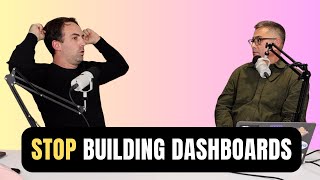
Hex CEO Barry McCardel explains how AI agents are transforming analytics from static dashboards into conversational tools. He shifted from skepticism about machine learning at Palantir to building AI into Hex after GPT-3, and now emphasizes building durable frameworks that won't break when models change.
Chapters
What's up? What's up?
Welcome to the—
Hello. Welcome. Welcome to our office.
Thank you.
I'm glad we got to do this live. This is fun.
Yeah, this is super fun. Yeah. You hit me up and it's like, let's do a live recording and then let's do that.
I think it's great and it's, it's like everything, you know, you, you can do these things over Zoom and that's magical and wonderful and when that works, it works. But yeah, you always have higher bandwidth conversations in person. So I'm really glad we made this work.
It's awesome. Yeah. Yeah. So for the audience, I, uh, Barry, um, was it last month actually at a small data conference? We're on the street actually.
I was on my way out.
You were on your way in.
What's up?
So good to finally catch up here. For people who don't know who you are, do you want to give a quick intro?
Yeah, sure. I'm Barry McCardel. I'm co-founder and CEO of Hex. Nice. For folks who don't know, Hex is an AI data tool, basically. We like to say we bring the magic of AI to data for everyone. Nice. Yeah, we've been at it just over 5 years now. And I think this is like just the best time ever. It's like you can just build these amazing new things and get to like fulfill our mission in this whole new way. So it's like a really cool, really cool moment.
It's such a fun time. Before we get to today, what's the origin story?
Yeah, so the origin story briefly, I've been a builder and user of data tools my whole career. And like at every stop along the way, whether it was doing kind of quote unquote data science, network science analytics in undergrad, I was in consulting where I was doing a lot of like crazy spreadsheets and like Python scripts on the side. And then I was like the data guy on all my consulting projects. And then I went to Palantir for 5 years and worked on a bunch of interesting stuff. And then after that, I went to a healthcare startup in New York. Like at every stop, we kind of saw, I kind of saw the same basic shape of problem. And that Hex solves. And so I started this journey as a buyer, not a builder. Like in my last company, it actually started with like being like, this sucks. Like, like literally, you know, we had a pretty modern data stack. It was like we had like Redshift and we were early DBT adoptees. We were kind of in the inside track in like the New York 2018 early DBT emergence. And we had Looker, perfectly serviceable BI tool. But then it was like 80 to 90% of the interesting data work happening was happening in like everywhere else, right? It was like a menagerie of SQL queries and spreadsheets and Jupyter Notebooks and scripts and these bespoke data apps and spreadsheets we were building. And it was just kind of like this crazy thing. And then like, you know, we'd share things with the rest of the company as like screenshots of charts in a PDF of a deck. Oh yes. Sent in an email. It's like, you know, it was like kind of state of the art. And like, I kind of just come from Palantir where we kind of, you know, we build a lot of our own stuff. We're in this hermetically sealed thing. Kind of had some good things in there, kind of not. But, but so I started being like, well, the, the looking for a tool that we could adopt to solve this.
Yeah.
And people were like, oh no, that, that thing exists. Go check out this startup's thing.
I was like, oh great.
And we try it and really disappointing. Or people would be like, hey, well, you know, open source Jupyter can do this if you install these 5 extensions and you have this version of JupyterHub and then you have the right JupyterLab client and it's all in the right ver— but don't install this other extension cuz then that'll, the, if it's on the wrong version, it'll break these other ones. And then like, like if Mercury and Jupiter are aligned in the sky, then like everything will work. And it's like, oh, that's not a good solution. And so I was kind of bopping around New York, honestly, like meeting up with other people on data teams. Like, what are you guys using for this? And someone was like, well, you, maybe you should build it. And now we're here. Great. 5, 6 years later, we're here. So my co-founders were two people I worked with really closely at Palantir and like, it took us a while to kind of get our heads around that we should do this. We weren't like, we were somewhat reluctant founders. We weren't looking to start something. A lot of people are like founders first and then looking for a problem. We were very like the other way.
So, um, now that memory serves me right, I think, did you do any demos on locally optimistic, say like 2020?
Definitely.
Yeah. Yeah. Okay. I think I, I think I actually crashed one of your demos.
I'm sure. Maybe it was the first one. Katelyn Moorman. Hosting them.
Yep.
Caitlin sits right over there.
No way.
Analytics engineer here. Yeah. Small world. Yeah.
Because I remember it was just like this notebook thing called Hex and it's like, okay, sounds good.
And Katie Bowers here, a bunch of people from that vintage. Claire Carroll. So it's— yeah, we've kind of been able to bring a lot of people from that time through here.
But yeah, it's crazy how that kind of works out.
Yeah, that's right.
Small world. So I mean, that's an interesting journey, right? So, you were sort of reluctant founders building a product. What was that like? Because you were at more consulting, and that is almost oil and water for some people when you're going into product land.
Well, yeah, the Palantir journey was actually very interesting. Oh, yeah? I was in consulting before. They recruited me because I was super data nerd consultant. They were like, great, that's like kind of the intersection we're looking for. It was a part of the reason I joined. But then in my 5 years there, we went from basically being services and like we wouldn't admit it, but effectively we were doing mostly custom dev for people to fully product where we took the things that were, we got really good at taking these things we were doing in the field and productizing them into this platform that wound up getting built.
Wow.
And so I think being part of that experience both exposed me to a world-class product development organization and connected me with some amazing people, including both my co-founders. It's super cool. Yeah.
And so fast forward to today. And by today, I mean literally today, because the world seems to change every second.
Yeah, that's right. We should like say it's December. What is it? December 18th, 2025.
Yes. At 4:20 PM.
Yeah, that's right.
Or 3:20 PM here. So if you were to kind of look back, an interesting thought experiment I like to do with people is if you were to explain today's world and capabilities to Barry in 2020, How do you think Barry of 2020 would have responded?
That's a great question. So Barry in 2020, I think, would have had a lot of questions about this. So an interesting thing is I had actually become conditioned to be very AI skeptical in a way, or ML, I should say, ML skeptical.
Okay.
We spent a lot of time at Palantir trying to do ML use cases and ML solutions for customers. And what we found was typically a lot of things weren't really working well in prod. I mean, most ML projects circa mid-2010s were just R&D.
Yeah.
That never really got past that. The other bit, and we, we over time kind of became conditioned to be almost skeptical and it was like, okay, well, like most of the value is going to come from data integration. If you're looking for a magical ML, we'll just machine learn on it and it'll just work. Like that was just like not a thing that we really saw breakthrough work. Some, some limited use cases, but like. Getting ML into prod at that point was like incredibly Herculean task and it had to be a core competency of an organization. And in some ways I think that skepticism colored why I became so fanatical about AI earlier on, early on, because I, it almost was such an obvious shift from something that took this Herculean effort to get working to something that, wow, this is just behind an API. And all the type of like feature engineering and feature stores and all these other things you had to worry about in the previous era just starts to melt away. Just send it a bunch of text, you get a completion back.
Right.
And I started playing with the GPT-3 API in like early 2022 and I had it like on my phone. I would like show people on my phone. It was like not even good for mobile, but like, I remember like, like literally a party trick. Like, that's probably a very boring party, guys, because like, have you seen this shit? Like, you can send it some text and it'll complete it. And it was like, It was before the chat, any of the chat things, any of that. And so I, when I, but it felt like such an amazing change that it almost radicalized me. It's almost like the most, um, religious, you know, zealot, uh, religious person is usually the convert, you know, the born again, you know, it's kind of how it felt. And so if I think if I was going back and trying to explain this to myself in 2020, I think I would be starting from that frame. I'd be like all the reasons that this was always something we were skeptical about being able to really get. Working well for a lot of use cases, there's like this discontinuous shift. And the other thing that I think is interesting, if I think back to Bridge at that moment, was how many of the things, without knowing this was the future, how many of the things we were building on Hex in 2020 have turned out to be right place, right time.
Interesting.
Call it intuition, call it sheer dumb luck, whatever. But like some of the things we built then have wound up being incredibly fortunately useful today.
Interesting. Tell me more about that.
The fundamental thing we wanted to do with Hex, we didn't want to build a notebook. We didn't want to build another BI tool, which was always this positioning challenge for us. It was like, are you guys a notebook, BI tool? We actually made these notebooks, like literally leather paper notebooks. We embossed on the front, "Not another notebook," and we gave them out at conferences, 'cause it was like, we had this bigger vision of what we wanted to be, but fundamentally at the core, we took, we did, it's true, I'll admit, we took the notebook format, this sort of cellular format, which in the previous world, in the Jupyter world, which Jupyter's great, by the way, I have no ill will, we wanted to take these things further, and the Jupyter world was just Python and Markdown cells. They're basically text delimiters in this, you know, it's effectively in a script, it's effectively what it is. We took that and we said, hey, we think that this format actually has legs. And if you look at what people are using notebooks for, people use them for a lot of different things, but a big sort of catchment of things people would do with them was analytics, where it was like this very exploratory flow. And it is so different than what you could do in any other type of analytics format. Like, you know, if you think about a traditional BI tool, it's very tile-based where they're sort of tiles that are destined to wind up on a dashboard.
Right.
Query, viz, query, viz, query, viz, query, viz. That's kind of the constraints. And then, you know, that's great for building dashboards. We felt like, hey, there's this need for this other type of product to help people do this way more interesting and intensive data work. That's deeper dive, exploratory, all the things that people loved using notebooks for. And so we built SQL cells and viz cells and we built this reactive execution engine and collaboration, all these other things around it that made it really great. And it turns out that this format with cells and that emit data, then have dependencies. And this almost way of working in a notebook, which is like iterative— I'm going to take a step, I'm going to look at the output, I'm going to take the next step, I'm going to look at the output, I'm going to go back up and edit this and reason— maps really well to the way agents work. Yep. And we— I actually wrote a feature spec. We had a feature spec that we worked on in and in some early prototypes we worked on in mid-2023. So about 2 years ago, they were called chained analysis. And because it became really obvious that you could probably use the LLMs to do this type of task, this type of what we now think of as a Gentec task. That was not a term even all the way back 2 years ago. The world moves so fast, right? That people were thinking of. And we spent a long frickin' time trying to get that to work. And it just didn't work because the models weren't ready for it.
For it.
Right. But I think pretty early on it became obvious to us that this format that we had, if I'm, you know, being, you know, bold, I'll say we took further and sort of invented the next chapter of that format and what we built in Hex was going to be massive with AI because now you could have an AI agent that can go and do, help partner with you on this type of deep dive analysis. That just sort of very quickly came into focus for us as like, this is something that should work. Unfortunately, it just took 2 years to really get working, so.
Yeah, but it, 2 years though, right? So I mean, before we started recording too, we were talking to another of your team and they were just talking about how things just seem to be moving at such a rapid clip now. 2 years is now 2 days, basically, or 2 hours.
Everyone's living in dog years, yeah.
Like, how does, you know, so it's interesting, you look at the timelines of how things have moved. Where do you think, like for you personally, how are you thinking in terms of what to focus on next, what to build? Because I think that's one of the questions that the gentleman over there had, which was, what do I work on?
What do I work on?
Is it going to be obsolete by the time I'm done?
We've tried to develop a lot of mental models around this. So there's a couple of things that I think a lot about. There are some longer, durable, sort of secular trends you can look at and reason about. So like one example is like, you know, it's clear that like the more value you're providing on top of the underlying models, the more valuable your product is in terms of— and that may sound kind of obvious, but, you know, it's, I think, a thing everyone at the app layer has to be thinking about, which is how much of the value that's going to my customer is in the product we're building is just coming from the model versus coming from the things we put on top, whether that's proprietary data, proprietary workflow, UI, whatever that is. So I think a lot about that structurally as maybe like a really big picture as CEO and the one, you know, kind of overseeing all of our efforts. Like, where are the big places we're investing time and energy at a macro level, quarters, half, year-long levels, big picture resource allocation. I think more specifically, we try to be really cautious about where we are having to do, I would say having to do a lot of work. And specifically what I mean by this is we have found in the past that when you are having to work really hard and do a lot of hard engineering to get the model to do something.
Yeah.
It is like, like that just, it should smell like something that is maybe a bad use of your time. We have spent a lot of time in the past doing optimizations and engineering around kind of current model limitations and trying to get something to work. And it's very easy to get to the early demo of it. But then now there is a lot of hard work that goes into making our system work so well. We have built some really cool stuff, proprietary stuff, things that we're very proud of that feel durable, like our search infrastructure as an example. How we've built our capabilities frameworks around our models, how we've built our context retrieval frameworks, how we built a bunch of these things. These to me feel like hard work building a durable framework that as the agents get smarter, it will just be able to leverage that more. But when we feel like we're having to do a lot of engineering around the current level, intelligence level of the model, it's almost like, hey, we should probably be working on something else. I'll just give you one quick example. Like we did, we did this whole optimization. It was a little while ago now. It's all optimization about how fast it was going to be to generate charts with AI.
Okay.
Right? Like, you wait, you ask it to build you a chart, it takes a long time because it's having to do a lot of stuff. And we're like, well, what if we do this little diff-based format and it's like, we'll have a little stub of the chart and then it'll expand to the full spec and like, then we'll have the spec to, you know, it's a very complicated little pipeline. And then like, one day OpenAI releases a new model that's like 5 times as fast and 1/10 the cost. And it's like, oh shit. We could do the dumb approach with this new model and it will be faster than the really smart approach with the old model. And it's like, that was not a good use of our time.
Yeah. That seems like it. How do you— tell me where you've got it wrong.
I mean, so many things, but, and that's being a little harsh because there are a bunch of things I think we've gotten very right. And I actually think at a macro level, one of the theses, some of the theses we got early on, we got really right.
Yeah.
And they've been durable. Wrong about, I would say the middle era of some AI stuff that the early one-shot stuff is good. There was a bunch of stuff that we, I felt like should work. We felt like should work that we spent time on and not, it wasn't like the whole company spending time on it. It was a dedicated group of people spending time on stuff that just didn't wind up getting to prod in the way we thought it should. And like I just mentioned, like these sort of optimization things. I think another thing, I'll actually say something interesting. I'm not sure if I've shared this publicly, but last year we kind of got sucked down the rabbit hole a little bit of building what I would call broadly BI features, which is funny because like Hex has had a chart builder for a long time. You can write SQL.
Like, yeah.
You could basically build dashboards. Don't you guys BI? Like, yeah, but like, you know, we'd go to customers who would have a legacy BI product, like a Tableau or something. And they, you know, they'd say, hey, we love Hacks. Maybe they're already using, a lot of them are already using it alongside. We just want to fully replace this. And we want to build, we want you to build Hacks, we want you to build incremental nth Tableau feature that you don't have. And I think last year we were kind of in between stations. We were in between, um, the, the, the AI stuff wasn't working to the extent yet that it was like sort of clearly broken open in terms of this new set of capabilities. And I think we spent time trying to build some of that stuff that they're like, they, they were good features. Like, you know, at some level they were like correct in that like we shipped them, users like them. True. Yay. But I'm not sure that that was. Once the models got good enough, I think we probably just should have dropped almost everything else besides pushing through that door. And in a funny way, I feel like we spent the better part of 2 years kind of grinding on a lot of the AI stuff with conviction and clarity in our hearts that it was going to— and we were right. We were right. But we had this conviction that AI was going to change the way these workflows worked. And like kind of keep being disappointed a little bit by like the state of the models and the state of our ability to wield them. And when like the next nth versions of Claude came along that really did break this open, I think we were still stuck building some of these BI features, kind of chasing this local maximum when a lot of the magical things we're doing now. I mean, it's, I'd be, I'm very self-critical, right? It's like we have this amazing product now. It's like, well, we could have had it 4 months sooner. You know, it's like, again, everyone's living in dog years, 4 months, 4 months of lost time to me feels like forever, but. It's probably not the end of the world, but I think that is an interesting observation for me in the nature of almost the innovator's dilemma of like, you have existing customers who have existing product asks and they don't know the next thing to ask for. It's the classic, it's the faster horse thing. Yeah. It's a classic parable, right? I think we built a good number of faster horse features for a few months after like the internal combustion engine was possible. Right. If that makes sense. Yeah.
So you bring up an interesting point though. So customers are asking for features or maybe better versions of this feature or that, you know, can you do what Tableau does or so on and so forth. But what are you seeing now with customers in terms of the asks or I guess maybe another way of phrasing this is what is their level of certainty or uncertainty about what AI is doing to them as well?
I think there's two things. There is an extreme sort of this excitement about change. Like, you know, every, a lot of software, everyone's exposed to AI in some way today, whether they're using ChatGPT, they're using other AI products, or they're just consuming AI slop online, right? So it's clearly a cometh. And so I think there's an awareness and people want to be excited about that, but change, people don't like change because change leads to uncertainty. You don't know where things are gonna wind up, and so uncertainty leads to anxiety. And it's a natural human thing. That's true in a lot of places in our world right now. That's an eternal thing, right? There were the Luddites, they were smashing looms, right? People didn't like the printing press, right? It's every new technology that comes along, there is this, and it's a valid, I actually think it's a valid human emotion. On some level. And I'm not saying, by the way, I'm not saying data people are any flavor of Luddite or whatever. It's just a natural human thing to feel, right? So I think what people are looking for is what their place in the world is, because there's companies out there marketing AI data scientists and AI data analysts and trying to go and say, you can get rid of your data team, right? I think a lot of people feel like, well, that's probably not true, but what does this look like then? Sure. And so when we talk to customers, what they're excited about is like, we have AI features in our products that really, really work. And they work today for the things they're doing. And the things we're working on and the things we're talking to them about and the things we're building with them are things that are not just like, oh, hey, this will make it generate charts faster or whatever, you know, all these next things you want the agent to be able to do really well. But they're also help— they're helping create a bigger story and framework around how does it look to have AI analytics at scale in an organization. How does it look to give access to that to a large number of people with trust? Yeah. How does it look to break the trade-off between the traditional way we've always thought about doing data and this new way, but make sure that data teams are having the right level of visibility, control, all of that. That's the interesting thing happening right now. And no one knows the right answer. We've got some hypotheses, we've got some things we've already shipped that we think are right and in the right direction. We've got some stuff that's coming soon that we're like, it's going to push that, but no one really knows. And so we, I think as much as possible, try to be like empathetic listeners. For sure. And partner with people on that and listen to our customers because they're also very smart. And it's fascinating watching the way they deploy and use our products and it's teaching us a lot. We have a great data team like Katie Bauer. Oops. I feel like I mentioned her name earlier. Like, she's been around data for a long time. Really experienced. One of the reasons she's here as our head of data, she's like, you know, we almost overprovision our data team because we want like the best fucking people to work with. We have these incredible people. Partly because like they're here to do data work, but they're also here to like help us. Like, you know, they're our first dogfooders. They're very involved in product. And so they also wind up talking to a lot of customers and being very connected to stuff. And we're trying to figure this out ourselves. Like, how does this look? So yeah, I don't think anyone knows the answer right now.
I travel the world talking to teams and leaders all over the world, all types of companies, and it, it's definitely— it's a talk I was giving this year, uh, this fall about, uh, kind of the great reset button has been hit on every industry, including ours.
Yeah.
And we're all sort of staring off collectively into the void wondering what's on the other side of it. And so what's been fascinating is, um, what I've been telling people is just, you know, you have capability right now, a once-in-a-lifetime opportunity to build this future that doesn't exist yet. Like all of us are sort of, you know, feeling around and yeah, you know, but, uh, you have the tools. We all have the same tools now, which is kind of crazy.
And so you worry, you know, one, one worry is like, okay, well, like, you know, just stepping outside of the data world for a moment. Um, I was talking to one of the engineers on our team earlier this year. He's like, well, I worry if I start using Cursor and then Cursor winds up doing most of my code that maybe you guys don't need me anymore. I'm like, no, we're going to need more of you, man. Like, like, I'm not hiring you to type faster. Like, I'm hiring you to like think about the things you're building. And so, but people don't necessarily, it's hard to grasp for that sometimes when you're feeling that scarcity. And look, you're right, no one knows. And I'm sure there's, you talk to a lot of founders, vendors like me, I listen to some of the clips on your show. People always want to show up and be like, well, no, here's the way, here's, they want to project the answer because I don't know, they got something to sell. I've got something to sell, right? There's stuff I'm really certain about. There's other stuff that it's like, hey, we just got to go and learn as fast as we can. Absolutely. I mean, that has always been true to an extent in tech. The clock speed has just been increased. The metronome is moving really fast. Oh yeah. My number one job as CEO of this company is like, I think making sure our clock speed is keeping up with that and that we're learning and iterating really quickly. Oh yeah. Which is, which is, I think the only way you're going to win.
Oh yeah, like a DJ. And it's funny just because I think we were at a, you know, the club was playing probably at 90 beats per minute and now you're like 300.
Yeah, yeah.
And you cannot stop.
And so it's, uh, but you know what, it feels like you can't stop, right? You can't stop off the dance floor. And I think that that's another thing that I do try to think about sometimes, which is there's an old saying I— someone told me long ago in a very different context in life, which is Slow is smooth, smooth is fast. This is a common saying, I guess, to some circles. Slow is smooth, smooth is fast. Now the goal is to be fast, and goddamn do we need a sense of urgency if we wanna keep building great things for our customers and keep pushing the envelope and the frontier, which I feel like we're at on products in the space. But there's a difference between urgency and haste, and we certainly make our share of mistakes in the past of trying to build and ship something and get it out there. And then, so like we actually spend a very non-trivial amount of time now building frameworks around a lot of our agent stuff. We have really talented engineers building that stuff. Theoretically, we could be moving faster to get the products to market.
Right.
If they were just cranking features out. But like we, but like I think we've taken a very thoughtful approach now that we feel like we've grasped some of the core physics here. Now that we feel like we understand some of these, what some of these more durable abstractions are, building some frameworks around that. We're probably wrong about some of that. And maybe some new model architecture comes out and we're like, oh God, we built that framework, now we do this. But we try to be really, going back to what I said earlier, we try to be really thoughtful about that. And my goal is to have an organization where we can scale. We want to grow a lot staff-wise and everything-wise in the next couple of years. You're going to do that by building these durable frameworks that we can go move quickly on. Absolutely.
And how do you, how do you build things that people love to use? I think maybe that's a core component of Moat going forward, whatever that means in the future. But it feels like, I mean, the slow comment is interesting because it's a very human comment. I mean this in the best way possible, where I think this is what people are going to want to use is if I'm going to use a tool, an AI tool, I want to, I want to love using it. It's So I don't really care if you're shipping out features faster. I want the features that I care about.
Yeah, I want it to work. I want it to work well. I want it to work for me. Yeah. I want it to work today. Not promise vaporware.
Right.
How do you build stuff people like? There's, I, you know, the first thing I think is having some good taste and intuition. And, you know, I think you kind of, I don't know, maybe you're born with some of it. Maybe it's just like the places you were raised in terms of the cultures you were exposed to.
Yeah.
And raised maybe even literally, because for me, I mean, I've been a nerd going back super long time. There's things from my youth I can point to. I think it somehow carried through. I don't know. But, um, but maybe, maybe a much more specific answer is I think people just don't talk to customers enough generally. And I have a blog post on my site that still gets tons of views. I posted a few years ago, tons of views. Relative for my blog. It's not— it's probably low for your content, but it's called Commitment Engineering, and it's something I've tried to proselytize really broadly. It's one thing I think we actually got— or not the one thing— among the things we got really, really right at Palantir, which was— it's kind of the root of the forward-deployed thing, which is even though we don't really do forward-deployed engineering at Hex, we're building a SaaS business, it's still very important to me, which is go build with your customers. Now the risk there is you have the faster horse thing. And so you have to be disciplined about just asking what feature do you want, but why? What's the problem you're trying to solve? All of that. Yeah, but a lot of PMs, a lot of product orgs work where the PMs go and are very theoretical. You know, they're doing research and they're writing PRDs and all this, and they're not like rabid and fanatical about talking to customers all the time. They write tickets, then that gets sent to the engineers and the engineers build the things and then there's a ticket for the designers and designers build the mocks and then like they ship the thing and then they go talk to the customers. I just think it doesn't work and it doesn't work especially now with the world moving so quickly. And so we try to get our engineers spending as much time talking to customers as possible.
That's cool.
And our PMs, like I think a good PM spends as much of their time talking to customers as like someone on sales. I know it sounds extreme, but like—
That's awesome.
Literally some of our PMs are, I, I just see, you know, I constantly, constantly multiple customer conversations a day. And unless you are like really grounding out on what people actually want, I try to do user on whenever I get the chance to, like I was in New York last week, I went and did like on-sites with customers and what, like not just have a pleasant meeting, but like show me what you are doing on your screen.
That's so cool.
I had a boss. Boss's boss a long time ago. I came back from an onsite when I was at Palantir, and I came back and they were asking me really specific questions. I was talking about a user. I was like, yeah, there's this woman, Anne. She was using our product. It was really great. I think we built something cool for her. She gave us good feedback. And he goes, what did she have on her desk? Fuck. What were the other browser tabs she had open?
Oh, interesting.
What were the other browser tabs? What, do you want me to be some spy? Like I'm snooping on what else she's doing on her computer. I thought it was so weird. I was a little shit about it. Well, the next time I went on site, I looked at her other browser tabs, Chrome tabs at the top. Our product, the new feature we shipped on the last open tab all the way on the right. All the other tabs were the old product that she said she stopped, their legacy thing that she said she stopped using to use ours.
Interesting.
Interesting. I was like, hey. This is great. I'd love to talk about our thing. And I can't help but notice, right, that you got a bunch of the old thing up there that you're using. And I'm not offended by that. Like, if our thing isn't cutting it, yeah, help me do my job. Tell me. She clearly had like known I was coming by her desk. It's like, okay, 3:30, Barry's coming by my desk. I'm going to open the thing so I can show him, you know. I had the best user interview of my freaking life.
Really?
Because without ever looking at our product, who was just looking at all of her other tabs of what she was using and why our shit wasn't cutting it and why she kept going back to this other thing. And I will never forget that, where I think often when you are building a product, you wanna have the happy ears. Cool, tell me about what you're doing in the, you know, maybe they're not even showing you their screen. I'm just, I'm obsessive. Like, can you screen share that? Can you show me that? Can I come by your desk? Can I look at this? What's that tab? Like, you gotta really understand the person and their workflow and what they're trying to solve. And all the different constituent parts of it if you're going to build something really great. And it's really hard to do. So yeah, that's my recipe.
That's fascinating. How have you instilled that practice amongst your team?
I don't know. I try to, you know, I should probably be more religious about, you know, structured about it, but we have these product review meetings where I just ask a lot of questions. And they ask for examples and I will ask, what's the name of the user you're building this for? I especially, actually, especially when I talk to designers, sorry to any Hex designers watching this, I'm sorry for the trauma I've inflicted on you, but I'll be literally like, which user are you shipping this for? Like, I just like, it's really important to me that people know. I ask engineers like, what's the user? What's their name? It's like, oh, this is for the non-technical user. No, no, no, no, no. I need a human name. Like, what's their name? Where do they work? What are they using to do this today? Like, I just try to ask those questions and, you know, I don't try to shame people, but, you know, I make it clear I want them to know that.
Sorry, designers. I know, that's actually a good thing to do. I have a question and this is something I always like to ask, you know, data BI companies, you know, but it's this paradox I see and I brought this up at Small Data SF actually on the panel with George and those guys, but it was like, The paradox is this: it feels like a lot of dashboards, crufty ones, whatever, Excel sheets, they contain a lot of answers, most of the answers that people would need to run their business. At least that's my experience when I visit companies. There's the report that Bob has in his spreadsheet.
Yeah.
It has most of the numbers you probably need to run your business. Nobody looks at Bob's report. It's probably in SharePoint. Or emailed out. And yet, so you have that, and I would say that's pretty normal in a lot of companies. You have this AI wave that's happening right now with, you know, we're trying to figure out agentic analytics and so forth. Where do these worlds converge?
I will play devil's advocate or respectfully disagree with you on the first point. Okay. I, here's my theory of the world right now and data. I think for the last 20 years, people have bought BI tools thinking that what they were getting was like, now everyone will be data-driven. Sure. I'll buy a seat for everyone and then they'll use it to go and do their analytics. And is that the battery? Okay. Is that one?
Okay. Well, we saw that one.
Okay.
Okay.
Okay. We'll cut it. I think for the last 20 years, people have bought BI tools thinking that they were going to get this like data-driven affect in the org. For sure. And that they were, you know, one BI seat, you know, like a contract with seats for everyone away from self-serve nirvana, right? And that it was going to happen. But there were two big problems with that. The first is that most people aren't just fundamentally aren't going to go and use these tools. There's a lot of clicks, a lot of buttons. Even if you have a really nice data model, it's just like most people find that to be high friction to go and still go and explore and root around for something themselves. Right. The second problem, and I think a more fundamental one, is that these tools weren't built to actually be able to answer the questions that matter. How many widgets did I sell last month? You are right that Bob's spreadsheet might be able to tell you the most of the— you said most of the numbers you need to run your business. I mean, I think it can tell you trivia about what happened. Sure. How many widgets did I sell last quarter? But the way people actually operate in the real world, in real life, isn't just wanting to know those sort of like trivia numbers. It's they have a million follow-up questions. And I find in general that dashboards raise more questions than they answer.
I agree.
Yeah. You share a dashboard, someone has got a lot of follow-up questions. Okay, well, why is that? What's going on here? What does it correlate to? Can I drill down on that? And I just think the old paradigm around BI was never, ever going to solve for what people actually want working with data. And so I think what we're seeing is a rebirth and reboot of this category. And as much as I traditionally, I was always like, well, don't call us a BI tool because I didn't want to be head to head compared with all of your feature tabloid builders we talked about earlier. Of course, what we are doing is fundamentally reinventing how BI works, but I think that a lot of these workflows will actually just invert. Like the thing we're shipping soon, we don't even talk about this, but viewers of the Joe Riche podcast, we have inside track on some new features coming. We're shipping soon is like when you get a dashboard email to you, it should contain a natural language summary in it. Like it shouldn't just be like a screenshot of the dashboard at the end. This is a typical BI workflow. Every morning I want my, report emailed to me with a PDF attached, right?
Yeah.
So what do you, what do you do? You get that, you get the email on your phone with the PDF and you go, you look at the numbers and look at the little chart. You're like, and then you've got follow-up questions, but like those follow-up questions just kind of die. What are you gonna do? Like go ping the data team and wait 2 weeks to get an answer back, go log into the tool and drill down yourself. It's just like fundamentally the funnel just starts to get really narrow of like, I'll just put my phone down right there.
That's fine.
It's a place for it. Fundamentally, the phone, the funnel just starts to get like really narrow as you go down that. And I think a lot about how the fundamental thing AI is doing in some parts is taking the funnel all the way from, I have a question, or I want to know what's going on in the world. Like, I want to know, people, people aren't like, I want to know what, enterprise pipeline is doing. I mean, or I want to know how many, you know, new enterprise leads we generated last quarter, right? Like, that's the kind of very like BI brain question of like, there's a metric I want to know. No, what they actually want to know is how's the business doing? What else should I be doing? What else should I be doing? What should I be thinking about? What's going on? Like, and I think a lot about the funnel all the way from I have a desire to better understand my world. Yeah, it's a very abstract sort of high up the hierarchy of needs thing. The funnel today from that to what traditional tools could do is brutally narrow. Brutally narrow. Maybe you can get to the Bob spreadsheet with, okay, here's this one metric.
Yeah.
But from there all the way to why is this happening, what should we be doing differently, that usually requires, you know, pinging the data team and waiting for it.
It never gets answered, really.
Never gets answered. So And this is the other thing I think that people really misunderstand, especially people that are sort of tourists here. There is an infinite demand for insight. Think about the number of decisions made every day in an organization that could be made with data and how many of them are. Think about the number of questions that might pop into someone's head that could be an interesting data question that aren't answered. Like what percent do you think are really actually like matriculate down that funnel to?
Sure.
I viewed a dashboard that satiates my thing where I've gotten an answer from the data team on a timely fashion that helps answer that question. It's just brute, it's single digits at best. I mean, oh, for sure.
And my litmus test has always been how many rogue Excel reports have people made to answer these questions?
And even that, like, even that, like you try to answer it in Excel and you're trying to join up data from different systems and I want this to refresh every day. I'm like, that doesn't work. It sucks. The whole thing sucks. I'm sorry to say.
We've all been there and done it.
20 years of buying BI tools and it it sucks. Yeah, I've used them all. They're not very good. And I think we built something pretty damn cool in the first chapter of Hex, but even Hex had some of these limitations, right? It's just like so much you can do. And now there's this window starting to open like, wow, this actually has fundamentally changed. And I think there's an obvious thing that people say is, well, there'll be less data people. This will replace data analysts and data scientists and all of that. Man, I'm not sure because that kind of starts from this assumption that you have the number of data. Interesting thing is when I talk to people who run data teams, I'll ask, how many people do you have in your org? Okay, 24 people reporting to me. Okay, do you have that number of people because you went and did an analysis of how many data questions you got from the organization, how many answers people could answer each week, whatever, divide that, okay, and then that's 24 people? Like that's a supply and demand match.
Yeah.
Or is that just the number of people the CFO lets you hire? What's the number of people the CFO lets me hire? Okay. If you were to really wanted to keep up and you wanted to have your org be really data driven and keep up with the demand from around, how many people would you have? It's like way, way more. So I don't know, what will that 24 become? Mm. Will it become 10 because AI will just evaporate 14 of those people's jobs and effort? Maybe. Well, it become 24 and those people are now like actually able to do a lot of other things other than chasing QQs and they're actually just way more valuable. Yeah. Is there a weird world where we want more of them because they are more valuable? I mean, that's kind of how I feel about engineers right now.
Yeah.
I've never been able to hire enough engineers to keep up with all the things we want to do. But like AI is making our engineers even more productive now. I kind of want more of them. Like, yeah, like maybe like with AI and coding, we're not going to have fewer engineers. We're just going to have way more software. And maybe with AI and data, we're not going to have less data people. We're just going to have way more answers. Yeah. And that the data people can now support an organization finding answers in a way they weren't able to before. And they're able to get the sophisticated answers to the sophisticated questions back to people faster than they were ever able to do before. Sure. That this, this world is just starting to open up to us. And, um, You know, you asked this question about dashboards in the new world. Clearly dashboards are now just going to be a jumping off point, not the destination. Correct. The dashboards were always treated as the destination. They just raise more questions than they answer. Well, great. Let's let them be that. You know, we have— we're also launching chat with your dashboard, chat with your app soon, where you can have a public dashboard. You can ask questions and it'll go pull in context from things outside the dashboard to help answer these extra questions.
Yeah.
Great. Let's let a dashboard be that. But man, It's really opening up this new universe of what this looks like. And that's really exciting. I agree.
I feel like we're entering a world where there's not going to be as much toil for data teams because it has been this sort of— you've just been treated as a cost center, right? A lot of data teams have. And it's like, well, give me my reports, right? But I see it's changing though, too, where now you're going to be driving— I have this comparison of enterprise land where data is a cost center versus product land loosely where data drives revenue. And I feel like this is where hopefully things start going. You are pointing out that data is, I think it's gonna be used differently for the first time in a different way, but in a, I think a productive way for a lot of companies.
But this is, you know, Pedram Navid, who I'm sure some of your viewers are familiar with, kind of data Twitter nerd, a good friend, good friend of Hacks, nerd in a good way, had an actual LinkedIn post about this today. Where he was like, you know, selling to the data team is really hard because I think he said cursed, but I'll say really hard because it's fundamentally not tangible to execs. It's, it's, you know, kind of the, it just is, it's the value of it is very intangible and it's fundamentally never going to be valued. Yep. That's it to try to summarize it briefly. And I, I actually think there's something to that. I think that, that has been a historical challenge. The thing I'm keeping an eye on very carefully, and we're starting to see happen a lot, is as AI opens that funnel, right? Agentic data tools open that funnel. You can have more people actually pursue their curiosity and ask and answer questions with data. I think that makes the value of these tools much more tangible. And I think it makes the value of the whole data stack much more tangible. And I think there's a world where data teams and their data people in analytical roles, data analysts, data scientists are much more strategic and embedded because they move fast and keep up with the pace of the business. And they're not just bogged down by QQs. That's a good thing. There's also a world where the whole stack, like all the analytics engineering and data engineering underneath, just is much more strategic and valuable. And that even things like data quality, which traditionally would be like, oh, that's for the data team, that almost the data team suffers from that. All right, well, they have to go fix that shit. Right now, if that's making it so when you're chatting with your data, it doesn't work, you're getting wrong answers. Well, that's going to start to be really tangible for people. And just like if your website goes down and it's messing with your ability to make revenue, all of a sudden you really care about observability. If you get hacked and it's causing problems with the business, all of a sudden you really care about cybersecurity. I feel like there's some of these kind of below-the-line cost center things that will maybe feel much more tangible in terms of value for people. So we've never really had this problem with Hex in a sense, because like Hex, you know, is mostly used by data teams and there's active editors, but, you know, the outputs were so tangible and people loved it. The thing we see now is now that way more people are able to do these workflows with AI, it's like people get really excited about it and super cool. I think that's interesting and that maybe that changes that cost center perception. Yeah.
Let's hope so.
Let's hope so. We should back out.
Yeah, just closing out. One more question. How is AI changing your, you personally and your role as CEO of a company?
That is a great question. I think I can, I'm able to absorb and synthesize information a lot more quickly. So we have AI workflows internally, whether it's something that summarizes our Gong calls or gives me, if I'm obviously using Hex, to do analysis and understand what's going on with the business. I just able, I think I'm able to keep up with more things because I'm able to get it sort of synthesized and summarized in a way and then pick what I'm drilling down into. Super cool. I think that the other thing that's really cool for me is I'm very far from being able to be an active participant in like our software development. No, I should not be writing any more production code ever. But I actually have a little bit this year. That's so cool. Like little things where I'm like, oh, I want that to be different. I want to prototype this. Over the summer, I was on pat leave and I used some of the— it took a few weeks and there's nice long lulls of time in such a circumstance. And I picked up Cursor and started prototyping some stuff and it will never ship, but it actually built my intuition a lot. Right. About some parts of the product, prototypes and features that we're actually building now. I'm able to have conversations with some of the engineers about them. That's so cool. Yeah, so it's just not helpful. It's actually like the barrier to entry for me kind of having gotten in and hacked around would have been like very, very high. Right. Just like, I don't know our code base. I'm not spending enough time in it to know. Now I can kind of partner with an AI and sort of poke around and ask and see and test some hypotheses. That's really fun.
That's power.
And so it helps me get sharper on that as it also helps me get sharper and stay current with the business. So I like that. Barry, this is great. Thank you very much for coming by, man. Of course. Anytime. We should head to the magic show.
Thank you. Let's go to the magic show. See you guys.
All right.
Thank you.
That was great.
More from Barry

Dashboards to decisions: How AI is closing the gap between insight & action | The Airwallex Podcast
From Palantir to Hex, How Barry McCardel & Caitlin Colgrove Built the Modern Data Workspace | S13E5
Hex CEO Barry McCardel Discusses Trends Reshaping The World of Data Analytics and Data Engineering