How AI Companies Can Win Back the Public with Ben Braverman (Partner at Saga Ventures)
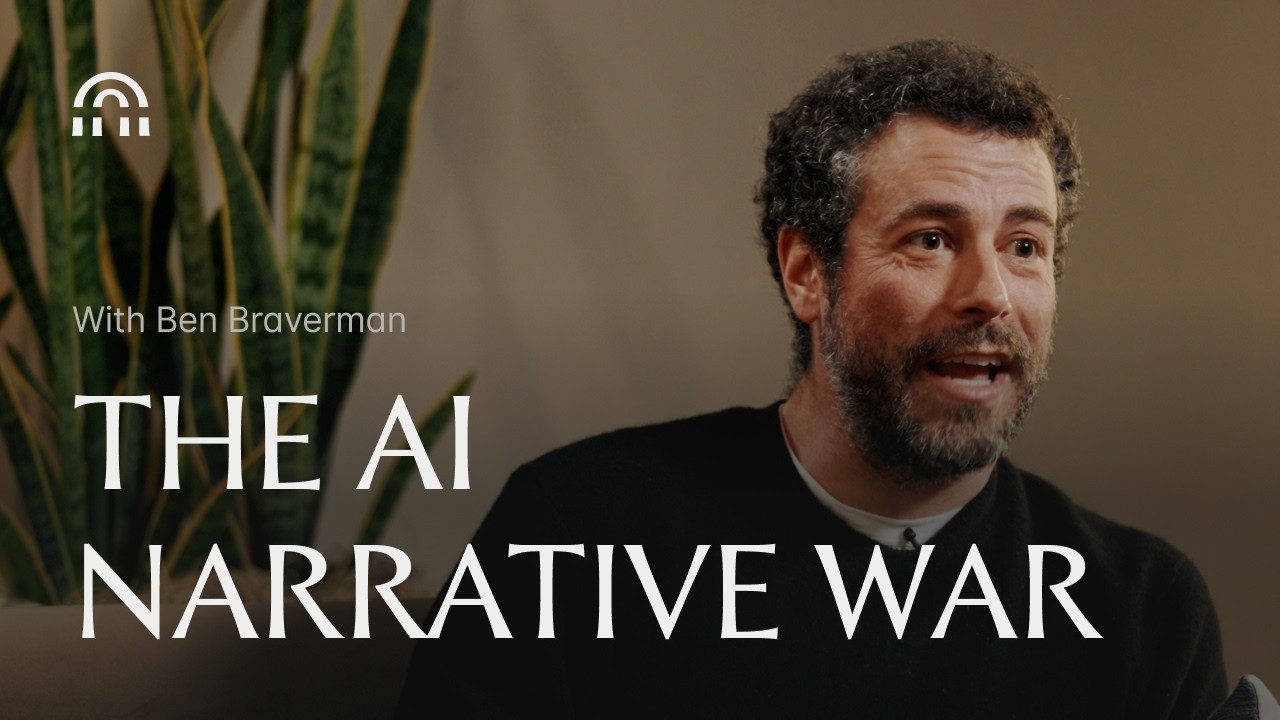
Ben Braverman, former Flexport CRO and Saga Ventures co-founder, argues AI companies must go public and become public-good forces to win back trust as white-collar job losses accelerate. He breaks down Flexport's sales playbook: obsessive list-building and a 40-foot whiteboard mapping the logistics value chain. Saga backs compound startups combining domain expertise, software, and physical infrastructure.
Chapters
It's very clear though that if you lose 20% of white-collar jobs in 48 months, like, we're gonna have— there's going to have to be some sort of social response. But when you get them one-on-one, when you ask them about competitors, when you ask them about their plans, it feels militaristic. It feels like you get chills to a degree that you're like, "Oh, I could see in a different context how you could be on a battlefield." Truly, like, the curves look almost vertical. That if you don't have it, you're not gonna get credit for the AI story no matter what.
All right, everyone, super excited to have my friend Ben here today, Ben Braverman, former chief revenue officer at Flexport, where he helped scale revenue from $100,000 ARR to nearly $2 billion, and now co-founder of Saga Ventures, where he's investing in companies that are solving deeply technical problems like Varda, Hadrian, and many others. Great to have you here.
Yeah, great, great to be here. Thank you so much for having me, all of you.
I want to start in the early days. Tell me about the infamous meeting with Ryan Peterson at DuBose Park. You know, you've talked about how when you meet an N-of-1 person obsessed with a worthy quest, it's generally obvious what you're supposed to do. But there's a lot of smart people in San Francisco that are focused on the wrong quests. So I'm curious how you tell the difference between a worthy quest and a fool's errand.
Oh, that's a great question. So I mean, first of all, has anybody in the room met Ryan Peterson? Anybody? He is one of the more magnetic humans on the planet. I think this is one of those things you find time and time again. Sam Altman spoke at our AGM, which is an annual general meeting. It's where a venture fund gathers all of their investors in one place. These people who are able to build these giant companies, there is something about them where you just feel it right away, where you're just like, hey, how do I get physically close to this person? How do I hear more of what they think? How do I get them to talk to me more? I also got a little tip-off in the sense that Ryan was wearing a YC hoodie at the dog park. It turned out it was his brother David, who's another genius, wonderful human being who'd been in YC the batch earlier. But as far as like worthy quest versus a whiteboard founder, I think like again, it's the easiest answer here just to give Ryan's story. Ryan was obsessed with global trade basically from the time he graduated college. Ryan likes to joke that when he got into Columbia Business School, No one had ever made fewer dollars in the prior year. He made $17,000 on his tax return, but he was doing that exporting goods from China. Like, he lived in mainland China in the late '90s, early 2000s, like a very different time in mainland China versus today, much more closed ecosystem, pre-internet in a lot of places, and he was one of the first exporters to sell things directly from China online. He did that, he taught a course for free at, I think, UC Riverside. He was just obsessed with global trade. He was obsessed with getting goods moved around the world. Ultimately, then he built a business called Import Genius. Import Genius, I think, like in terms of good quest versus good business, Import Genius is just a good business. Import Genius takes all the public data that's sitting physically at the US ports, so like who imported what. The example that made Import Genius famous, good example of what a good marketer is, Ryan was the first person who broke that the iPhone was a thing. Import Genius figured out that Apple had filed a customs entry for basically a 4-inch rectangle with a screen and no buttons, or one button or whatever it was. Ryan then, he published what was then Public Record. Import Genius went totally viral. They went from zero to a few million ARR overnight. That business is really cool. There's no investors other than Ryan, his brother, and one of their friends. To this day, very lucrative as far as I'm aware. But that was the business that gave them the base, 'cause he and David are co-founders of Flexport. It gave them the base to go on what I think is the good quest, which is when they had been exporting goods from China, and they were exporting everything from dirt bikes. Geely, which is now like one of the biggest electric car companies in the world, they started off exporting very low-quality dirt bikes. The Petersons were one of their main partners. There's a few things that they learned along the way. The major one was the actual buying of goods in China wasn't that hard. Getting them moved around the world legally, compliantly, paying the taxes, doing everything properly, borderline impossible. And that set Ryan off on what became ultimately the good quest, which is Flexport.
—And you joined Flexport with no experience really in logistics, and you were tasked with mapping out the end-to-end logistic system, which resulted in 40 feet of whiteboard filled out. So tell me, as an outsider, how did you overcome that imposter syndrome in solving a problem that had not been solved yet?
—The greatest thing in the world is not knowing anything about a complicated problem, because people who know a lot about that problem will be so excited to tell you what they know. That was like one of the key unlocks in my whole life. I really think I almost picked this up by osmosis from Ryan, that he's just— if you've spent time with him, he is the most obsessively, wildly curious person. If you have a cab driver who happens to be from Portugal or Brazil, you are going to listen to Ryan speak to the guy in Portuguese for 30 minutes while you drive together. Like, he is just that kind of human being.
I think ultimately, like, the curiosity is what drove it all. Enjoying the conversation? Got a question? You can ask Ben's digital mind. Just check the link in the comments or description. You've said that Saga looks for the ability to persuade people to undertake seemingly unreasonable tasks in founders. What are some unreasonable tasks you hope to get tackled over this next decade?
You know, I think the big unreasonable task that we're all going to have to come to terms with is I think the— whatever political opinions you had sort of before the takeoff, before the singularity, whatever you're calling this moment that's clearly coming, We're all going to have to adapt. Like, I never would have thought I would have been like a government interventionist under any circumstances for any reason. It's very clear though that if you lose 20% of white-collar jobs in 48 months, like, we're going to have— there's going to have to be some sort of social response. I think the labs that are effectively becoming nation-states in terms of their level of power and influence, they're going to have to make massive shows to the public. That they are here as forces of good. So in terms of what I hope gets built, I think it's more like, how does the conversation evolve so that— we all should be super excited. The idea that we're not just all pumped, that everybody in this room— I think everybody in this room is under 50 years old, under 40 years old, maybe under 30 in some of your cases. You all could live to 200. You could live to 175. You could experience a world where getting cancer is a thing that's like— predicted via a urine test and treated on site, and you just go about your day. The fact that we are not all super pumped for the next 50 years means that we are losing a narrative war that is sort of disappointing. And I think when you hear— the leaders of the labs take very different tones on this. I think Dario is a little more alarmist. I think Sam is a little more like, man, look at the miracles that are already happening before our eyes. We are seeing breakthroughs in material sciences. We are seeing breakthroughs in chemistry and biology. The fact that we are not seeing people celebrating in the streets, but we are instead seeing people fight even the building of a new data center that's going to be a massive tax driver for a community, it means like, OK, we've sort of lost the plot narrative-wise. So in terms of what I hope gets built, it's all the stuff that's getting built. Frankly, we are building towards an amazing future, but we now need to do a much better job communicating about it. And I think like Hershey in the 20th century, They built an amusement park for the residents of Pennsylvania. I don't know what the modern AI equivalent of that is. I don't know if people want roller coasters. But I do think we are going to have to build monuments to human greatness. We're going to have to build things that are public utilities. It can't just be a small subset of us get to live in the future and be immortal, and the rest of the world just goes on as is. Because I think at some point, maybe they try to burn it all down.
So build for humans in a way that will make them optimistic. Yes. Yeah, it's a good call for action.
Couple more questions, then I want to open it up to the team.
Sure. Your Twitter bio says growth cures all, and I think there's a lot of hype about growth at all costs on Twitter. You see companies that maybe have growth with no product at all, and so where does growth not cure all?
So Flexport is a great example. We are selling fundamentally under the surface a series of commodities. So we are in the— Flexport is in the insurance business, in the lending business, in the ocean freight business, the air freight business. There are little— there are literal commodity indexes that are tied to these things. Obviously, oil prices are heavily tied to shipping prices. At the same time, though, you have this rational bet when you're acquiring a customer. And I think this is like— there's a lot of parallels to what's going on in the hyperscaler AI buildout right now. If you believe that once you acquire one of these customers, even if technically what you're providing is a commodity, that over time you're going to have them doing so many different services on your platform that the collective economic transaction is in your favor. The scariest thing in venture right now though is it's really hard to tell which is which. Like it's hard to tell, hey, are we subsidizing token consumption right now? Like is it really that simple? If— when you look at a lot of these companies that are wrappers around the core models., and you look at their unit economics, and you say, hey, look, you're building this app, it's really Cursor under the hood, but we're paying some third party to intermediate to make the interface a little nicer. Are they just subsidizing the token consumption that would have been even more expensive had you gone to Anthropic directly? We don't know right now. And I think growth cures all as long as that is not true. As long as we are not buying dollar bills for 95 cents— or sorry, as long as we're not buying 95 cents for dollar bills, and we are just— acquiring customers that will economically switch off of our platform the moment they find a cheaper way to buy, growth generally does cure all. Like, if you look at what's going on right now in the SaaS apocalypse, like, if you look at why these companies are trading down so much, it's not that people really believe that like everyone's going to turn off Salesforce. We're not all going to build our own CRM. We're not all going to build our own single sign-on instead of Okta. But it's going to mute their growth a little bit. And if the expectation of baseline growth rate for SaaS goes from 15% to 20% a year down to 7, 8, 9% a year or 4 or 5% a year, it just totally rewrites the quality of the asset class. Like it rewrites where we can invest in these companies for entry valuation. It rewrites where companies can acquire them on a multiples basis. It just— it totally rewrites everything if the growth slows. So yes, I do think in the business that we are all in, growth basically cures everything. And even if you go to the OpenAI conversation right now, yes, like it is, it is worrisome to think about a company that has to consume this quantum of capital. Having said that, everyone kind of believes them when they say, hey, we're going to get to— I think they say they're going to do $100 billion in 2028. And no one thinks they're crazy. Everybody goes, yeah, that seems about right. So in that sense, growth even cures consuming $100 billion. So yes, I do believe growth cures all.
What's one question you wish you were asked more?
I think one of the things I think a lot about is, why companies should go public. And I more and more think we've sort of lost something. Like it's sort of tragic that it is so regulatorily complex to be a public company. I think it is sort of tragic right now that to get access to OpenAI or Anthropic or SpaceX or Cursor or even a Profound, you really have to be either very wealthy or a very powerful institution. You have to pay a series of middlemen and middlewomen, your financial advisor, or at a venture firm. Like, at a certain scale, these companies are in the public interest. And I do think we've got to have a conversation about why they are not choosing to be public companies. And it's not just that they are more overvalued as private companies. And certainly that's the case in some areas. But in the case of those three names I just mentioned, I think they would actually be more highly valued as public companies. So we as a society have to ask ourselves— again, and this again goes back to making people feel like they are sharing in the win. In a world where you don't have 150 million Americans who are shareholders in OpenAI, Anthropic, SpaceX, like these companies that whether you like it or not, they are going to build the next 50 years of our lives. Like from the robot that maybe takes care of one of our parents, to the cures that hopefully everybody in this room doesn't need, but some of us will. This is all coming. But if you are not a shareholder in it— and I think going public, we did some cool things this year. We're giving young people $1,000. Michael Dell gave away a bunch of money. It shouldn't just be that you are a shareholder in legacy companies. It should be that you are a shareholder in the cutting-edge things that are changing your day-to-day world, that are maybe the reason why your college major isn't applicable anymore, or whatever it may be. What would it take from a regulatory perspective for everyone to be excited to be a public company? What would it take for— because you have all these companies right now that are sitting at $400, $500, $600, $700 million of ARR that are afraid to go public. And some of that's just, hey, market demand. But a lot of it is just, hey, the sheer complexity relative to the scale is crushing. So that's the number one thing I think about is, how do we give people more access to these companies that I am so high conviction on? 'Cause it just bums me out that people aren't owners.
Yeah, yeah, and I think that may solve the problem of people being more excited about the future of AI. Yeah, maybe. Yeah, maybe. So 90% of revenue came from outbound emails, and you've called list construction actually the most important thing. Yeah. And so I'm curious, like, why list construction first, and is there anything non-obvious that you view as doing list construction right versus just finding people and like creating accounts and emails?
So again, I have to give credit here to Parker Conrad. I think Parker, It's so funny, he built this business that does not feel salesy in some ways, like it is your HR stack, it is how you buy insurance, it's how— originally Rippling was supposed to be a laptop provisioning business. When we met Parker, it was when he was building Zenefits, and Zenefits was on top of the world. I think he has now been vindicated based on how well Rippling has done, that Zenefits probably should have ended up a giant company, but we won't go there. Parker was generous with his time with both Ryan and I. Ryan had been an investor in Zenefits, and then again I think in Rippling. And he basically let us come into his office and he said, look, here is how Zenefits is growing as fast as we are. And it is this obsession with— and I think companies like Clay now have sort of made this a more repeatable process. They became obsessed with understanding every possible Zenefits customer in the world. They became obsessed with understanding everybody who worked there, all their contact information, how the organizations were organized, the hierarchies, who reported into whom. They just mapped these companies in a way that felt like overkill, that felt like, oh my gosh, you're spending so much time before you even contact the customer. Customer, but what it allowed them to do was this level of outbound that was not spam, that was, hey, I know that you report here, I know these are the people that are going to be involved, I've already sent an email to this other person, our CEO reached out directly. He built this like symphony of outbound around what he had done at the top of the funnel, such that he was able to then go generate a crazy number of opportunities per SDR. Parker also gave us all permission to build this hyper-pyramidal sales organization structure, which, you know, I was a new CRO at Flexport. I'd been a head of sales at two other YC companies, but I was new to the level of scale. Parker also gave us permission to say, there's not that many good sellers in the whole world. Like, in terms of closers, in terms of people who you want demoing your product, in terms of people who are really going to drive the number, and by the way, in the whole history of Flexport, I think it's probably 10 people or fewer who drove the majority of the revenue in history.— so this turned out to be true for us too— Parker just said, look, embrace it. Ignore what the CFO tells you, ignore the financial model. AE headcount— account executive, quota-carrying salespeople— that headcount does not scale linearly. In fact, every one of those people you add who's actually able to close is a miracle. Jam their calendar. Make it so they are coming to you and saying, Ryan, Ben, we are dying. I'm doing 12, 14 demos a day. I don't even have time to send people quotes anymore. Then you can hire more AEs. Until then, hire more SDRs, hire more junior folks at the beginning of their career that are willing to do outbound, but are willing to do outbound in this system that Parker had designed, which was hyper-specific, hyper-focused, not spam, not automated in a lot of cases. So yeah, Flexport, 90% of the revenue was driven by outbound, and I think probably the thing that has changed the most in terms of like how I invest and how I advise companies Until AI, we were right. Like, we were right in the sense that you could not grow a company this quickly. Like, us, Rippling, Ramp, Brex, like every company that grew like this, we all were running the exact same machine. And I think to this day mostly still are. It's this ton of focus at the top of the funnel, SDR heavy, really custom, really beautiful outbound that doesn't feel like spam, outbound that's a symphony of local events and physical giveaways and and actual phone calls from executives, all the things that actually get people to show up and take demos. For the first time, we are seeing companies that are growing faster than any of our companies grew, and they aren't doing any of this stuff. So I'm trying to figure out now, OK, are these motions going to be the things these AI companies add later, or are these a relic of sort of a prior era? I don't know. But if you look at Cursor, if you look at OpenAI, you look at Anthropic, They are not running these playbooks and they're certainly growing faster than we ever grew. We have one company in our portfolio called Profound that is— every time they try to turn on outbound, and when I invested I said— I was militant, like guys, we have to build an outbound team. Every time they try to turn it on, they have so much inbound, they end up just rerouting the team and saying, guys, just field inbound for now. We can't turn down this many people signing up. So I don't know. It may be this is still going to go back to being the durable way that companies grow. Or it may be that now that the new products just sort of sell themselves, but I guess we'll find out.
Seems like a lot of companies are automating this list construction process, like Monaco, they're filling it in. So how does the seller today stand out in this AI world?
Yeah, so I think Monaco is a great example. Sam Blonde, good buddy, very fortunate that we are investors in that company. For those of you who don't know, Sam Blonde, contemporary of mine in CROdom, he actually was Parker's head of sales, CRO, at Zenefits when we were learning from them. He helped us build Flexports, our early outbound motion. He was CRO at Brex. He was partner at Founders Fund. He's got a new company called Monaco. The observation behind Monaco is effectively that, as all of us as CROs around the industry, a huge part of our job was buying tech and then integrating it. And the buying of the tech wasn't that bad. The integrating of the tech was just a freaking mess, where the amount of money that every one of these companies spends on internal Salesforce or various CRM integrators, outside consultants. It actually, in some cases, it's way more proserve dollars than it is even software dollars. Like, you are paying more humans to try to connect this stuff and make it work. And when I say this stuff, I mean your CRM, the things that sends your outbound emails, your Clay or whatever you're using to get data and enrich leads, your Gong so you're recording calls, like all this stuff that needs to be connected for you to really get maximum value. In the old world, it was just this huge slap to make any of it work together remotely. Monaco is this very obvious new AI-powered version of all of these companies bundled in under one roof. They are obviously not targeting the enterprise. If you've already done all this work, they're not saying, hey, rip out your CRM. But they're going to the newest companies, they're going to all these YC companies and SPC companies and everybody like that and saying, look, if this is day one for you, we can give you 98% of the functionality of a mega enterprise, from lead enrichment through outbound, through sending gifts, through call record, all of it, it's unified under one roof, and we're gonna use AI to help you build smarter campaigns in the platform. When you look at like the SaaS apocalypse, and like, you know, I think public market SaaS, the Bessemer Index is down like 30% in the last 4 months, like something that would have sounded nuts if you said it to someone even 180 days ago. Companies like Moneco are pretty terrifying, where it's like, Wait a minute, I'm buying one product and not 10, and by the way, it works better? So yeah, I do think if there is going to— if outbound is going to be the way of the future, it's not going to look like how we did it, where one of our core competencies, which is we were really good at using the tools, we were really good at integrating them, I think that's no longer going to be a competitive advantage over the next, call it, 36 months.
Earlier you mentioned Profound, and specifically, the CEO of Reddit talked about Profound in their earnings, and you tweeted, one-year-old companies aren't supposed to be this important. With this new fund, how do you think about what venture beliefs to carry forward, things that have worked, versus which ones to throw away?
Yeah, I think— what lessons do we carry forward and what do we throw away? So everyone, every VC— and I'm sure you guys have interviewed people who are much, much more prolific than I am— every single one of us is trying to figure out what to do with the companies that are sort of in the tier right below the profound of the world. Like everybody knows what to do with whether it's Profound or Lagora, like everybody knows you just put all the money in, they will let you. In the case of Profound, our relationship with them has just become almost like admiration of like how in the heck are you guys doing this? At the same time though, we have a bunch of companies in our portfolio that by any normal standard are crushing it. Like the customers are really happy, They're growing by the old standard really quickly, but they're having to work for it. Like, they have to send outbound email. They have to, like, follow up with people. It's not just order taking. You know, their cohorts don't go from $100K to $1 million over the course of 6 months without anybody contacting the customer. Like, it is a more normal company building experience. Everyone is trying to figure out what these companies are worth. Everyone is trying to figure out which of them are going to accelerate their growth, because, like, the reality is, There's a ton of companies right now that if it weren't for the SaaS reset, they would have raised Series As already, that have gotten $0 to $2, $0 to $3, $0 to $4 million of ARR in their first 18 months, and the market isn't quite sure what to do with them. I do think the two categories though where the market is much more confident is obviously like core AI, anything that's growing. If it's not growing vertically though, you are not going to get the AI multiple. I think there's a lot of founders who have tried just to say, hey, We are an AI company now, look at our pivot. The companies that are really getting the multiple are the companies that have used AI to transform their business. There's another one that we're not an investor in called Handshake that's gotten some press recently. They were doing campus recruiting, and it was a good business, you know, they were unicorn, like Garrett, wonderful human being, wonderful founder, but like was not setting the world on fire, was not, you know, planning an imminent IPO. In the course of the last year, they've become one of the most important data labeling companies on earth. Because they recognized, hey, it turns out if you have all these master's students and PhD students on your platform, you can actually satiate this need for data labeling in more sophisticated project better than anybody else. But he's got the growth to prove it. Like if he just showed up to VCs and said, hey, we're an AI story now, everybody sort of goes, OK, we've now seen enough of these where the growth is truly— like the curves look almost vertical— that if you don't have it, you're not going to get credit for the AI story no matter what. The other thing that we're seeing that's having no trouble raising are physical infrastructure plays that are either beneficiaries of hyperscalers in the AI trend or that are just competing with legacy players in the category that can't satisfy needs. So like, we just invested in a company that is a water filtration and cooling vendor to hyperscalers. Technically, they have done some things that are pretty unique. They can make water more thermally conductive, which across the scope of a whole data center is pretty important. But they were like, look, even if we couldn't, our number one competitor can't fulfill all the demand from hyperscalers. Like, they're literally turning down projects to deploy water filtration right now. So even if we are just as good as the legacy player, we're going to be a $10 billion company in 48 months. Like, here's the math. Those two kinds of companies, either like vertical AI growth or infrastructure to support said growth, everybody kind of knows exactly what to do with. We are all sort of confused at how to play these companies that would have been winners 4 or 5 years ago. Go.
Yes. Um, you've talked about these magnetic founders where their success is almost inevitable, that you want to be part of their journey, and you've talked about their characteristics, like curiosity. What else do these founders have that you can detect?
This is one of those things where you have to be a little bit careful because I don't want this to sound negative at all. Like, I love these— I love all these people. They are not to be trifled with in the sense that, like, if you look at how Parker has communicated, you know, with— you know, they had the spy come into the company and how he has just sort of aggressively gone after it. If you look at how any of these guys or gals play the game, it is for all the marbles. Like, there is no notion of, oh, I built a pretty good company. There is no notion of, oh, $10 billion is a pretty good outcome. It is, I dominated my category, I was the most important person in the world for the thing I am working on. It is total domination. And it is— and when you get— and they won't— a lot of them won't talk about this publicly because it's kind of unbecoming, but when you get them one-on-one, when you ask them about competitors, when you ask them about their plans, it feels militaristic. It feels like you get chills to a degree that you're like, oh, I could see in a different context how you could be on a battlefield. And I know people make fun of VCs for saying stuff like this, but that is the sense of leadership that these people are bringing to the table. And they're leaving— there's no question about whether or not they would give the company everything. There's this quote, like, generals eat last. Like these people all feel like generals, and they all very clearly are the ones eating last. Like the number of founders in this current cycle who've sold no secondary while their employees have sold a ton or have sold very little would shock you. Like there are $40 and $50 billion companies in this cycle where the founders have sold $0 of secondary. That's the kind of person that, and again, like I don't begrudge anybody for wanting to buy a house, but we want that level of like, pathological, obsessive, just like come hell or high water, we are winning this category? Because it just seems like right now if you bring anything less, it's just too hard. It's just everything moves too fast. OpenAI, Anthropic, they'll pay your employees too much. Like if you are not a 12 of 10 on the intensity scale at this moment, like for building companies right now, it actually feels like you probably can't play. Maybe that changes, maybe it gets softer again.
Last question. So this episode will be used to train your Delphi. Yeah. So listeners can ask you questions to learn about Saga, to learn about your time at Flexport, and it's going to surface any opportunities to you. So in 2026, what opportunities do you want to attract for you, for Saga, whether it be people, ideas?
Oh yeah. So Saga, we lead pre-seed through Series A. Heavily focused on pre-seed and seed. Generally, if we're doing a Series A, we're co-leading it. Our last two Series As we co-led, one with First Round Capital, one we led with Jack Altman, who— the artist formerly known as Altman, AltCap, now Benchmark. So pre-seed through Series A, typical check size anywhere from $2 to $10 million, but we'll go as small as $500K. And if you or any of your friends are founding a company that is, as Trey Stephens say, a good quest, and for us a good quest is generally a compound startup at this point, We want to invest in a thing that requires either a lot of domain expertise and a lot of software, a lot of physical infrastructure and a lot of software. Like, we just— we believe that the marginal cost of building features is probably going to zero, so, you know, we want things that are not features. And we are totally okay with things that sound outlandish and wacky and early. Sweet, man. This was awesome. Thank you. Thank you so much for having me.
Thanks for tuning in. If you enjoyed today's episode and want personalized advice from Ben, Head to the link in the comments or description to ask his digital mind on Delphi.