Best Diet for Insulin Resistance (+ Extra Tips) • Dr Benjamin Bikman
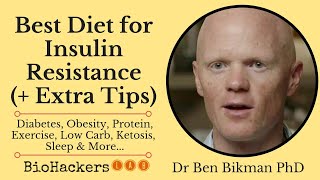
Dr. Ben Bikman explains insulin resistance and how low-carb and ketogenic diets can help manage it. He covers the biology of insulin, why protein matters, and practical ways to test and control your insulin levels.
Hello everyone and welcome to Biohackers Lab. I'm your host, Gary Kirwan and on today's episode I have Dr. Benjamin Bickman. Dr. Bickman earned his PhD in bioenergetics and was a postdoctoral fellow with Duke National University of Singapore in metabolic disorders. His current focus is to better understand chronic modern day diseases with a special emphasis on the origins and consequences of metabolic disorders. Ben, thanks so much for coming on for today.
Gary, thank you for the invitation. I'm delighted.
Yeah, I'm super excited to have you on because you're an insulin guru, because I've been following you for a while on Twitter and I've got you as one of my low carb, high fat diet experts too. I'm honored you share a ton of good information and I recently watched a YouTube interview that you did and that too was just mind blowing, the amount of knowledge bombs that came out of that. So I'm so glad I can try harvest some of that information out of your mind today for the listeners.
Oh, great. Well, I'm thrilled. Yeah. The more metabolic topics we cover, I figure the more people come away having learned something good.
So you love insulin and you know a lot about insulin. So that's where I want to start. If you wouldn't mind, for anyone listening, could you just describe what, what exactly is insulin in a brief description?
Yeah. So I do love insulin. Gary, thanks for putting it that way. In a way though, I sort of, I have a healthy respect and I won't say fear, but I have a respect for insulin that most other people I don't think do yet. But insulin is a little hormone that we secrete from and it is quite small in fact, but a small little protein that we secrete from our pancreas, the beta cells of the pancreas. And that's What a type 1 diabetic. So unless you're a type 1 diabetic, for all the rest of us, we're making insulin all the time. It's coming up, it's coming down, coming up, coming down. Most of that is dictated on the levels of our, the glucose levels in our blood. And as we eat a starchy meal or a sugary meal and our glucose levels spike, that can be, it is in fact lethal. If glucose stays high for too long, you can die from something called a non ketotic coma. And so this is, we have a mechanism in place to move that glucose from the blood very quickly and that is insulin. So one of insulin's main jobs is to clear the blood of Glucose and usher it into muscle cells and fat cells. Most specifically other tissues in the body, like the liver and the brain, they can pull the glucose in without insulin telling it to do so. But muscle and fat, which by mass is most of us, that's most of what we are made up of. And so it represents a tremendous sort of sink for the glucose or a place for the glucose to be dumped into. Insulin comes to the muscle cells or the fat cells, knocks on the door, opens the door, and allows the glucose then to come rushing in from the blood.
Okay, and so, so you said that insulin was a protein, but it is classified as a hormone, right?
Yeah. Right, yes. So I. Most hormones. So a hormone is anything that is released from one cell type and moves into the blood and then goes to another cell type and elicits some action, you know, from A to B. It does something on B as it's come from A. This can be. Most of the hormones are. Are proteins. So when we think of insulin, we think of glucagon. Any number of other hormones that I can't think of at the moment, those are proteins. There are other hormones that are based on cholesterol, like the sex hormones, testosterone and estrogens, those come from cholesterol. So they're not protein, they're more of a fat type of hormone. But anyway, so insulin is both protein and hormones.
Okay, excellent. Yeah. Because I think when I've looked at people who suffer with weight issues, I don't know if I may be correct here, but this will be interesting to get. Your endpoint is that it's a hormone imbalance of some sort. So there's an energy deficit or excess, and their body's not able to cope. So when I've gone down my rabbit hole of looking at food, it's just like, how does food influence my hormones or certain hormones? And that's why I was thinking about insulin. Is that a right way to think about food?
Absolutely. Absolutely. That's the way I look at it when I'm deciding what I'm going to eat. Essentially, I'm asking myself, what will this meal do to my insulin? And that requires some speculation. In some instances, as we start mixing our macronutrients together, it's not so clear. But nevertheless, that is the question we. And it's relevant because human obesity is more than just calories in, calories out. We can't keep saying that same sort of nonsense. We're not a thermodynamically closed system where energy is perfectly accounted for. I mean, it is accounted for. The laws of thermodynamics are immutable, we'll say, but nevertheless, in the human organism, in any other organism, it's more than just how much energy came in. And can I quantify all the energy that's come out? We can't. And hormones decide, especially insulin, what the body does with the energy that it has. We're always consuming energy or we have it stored. Insulin is one of the main signals of telling the body, you have energy coming in. This is what I want you to do with it. I want you to sock it away and store it. Stored as lipids, stored as glycogen. And there are other hormones that counter that, like glucagon, for example, being an easy one. It's sort of the yang to insulin's yin glucagon. When it's up, it's saying, hey, body, you have energy stored. I want you now to mobilize it and get it moving through the body so that we can use it.
Okay? And that brings me on to insulin resistance, because when in the low carb or the ketogenic community, it gets touted around that you may have insulin resistance or you're eating that particular way to avoid insulin resistance or to fix it. Could you just explain to listeners then, what is insulin resistance in an understandable form?
Yeah, sure. This is how I start my class that I teach here at byu. My undergraduate teaching assignment is pathophysiology. In the very first four hours of all of the lecturing in the semester, I start with, what is insulin resistance and why does it matter? And so to me, the most accurate and yet simplest way to describe insulin resistance is that the cells of the body begin responding to insulin differently. Now, that's important. That's a sort of a bit of an ambiguous answer, but it's relevant because some cells of the body can continue to respond to the insulin as well as they ever did. And so it's not a universal head to toe, top to bottom. Every cell is now resistant to insulin. It doesn't work that way. It's that some cells are very resistant to insulin and insulin cannot do what it used to do. And that is generally what happens at muscle cells when they become insulin resistant. We lose that anabolic signal of the muscle of insulin at the muscle cell. Then you have another cell, like the endothelial cells, for example, of the blood vessels or the cells of the liver, where some of the biochemical processes of insulin are compromised, Some continue to work perfectly fine. And so it's a very It's a phenomenon on a spectrum where there's this insulin doesn't work at all. Insulin works perfectly. And then even within the same cell type, like the liver cell, there's sort of some things that aren't working, some things that continue to work just fine. And so again, insulin resistance is defined as a state where the cells of the body aren't responding to insulin the same way they did before.
Okay, that point you just made there too, that anyone who's thinking about insulin resistance, that it isn't a universal thing, that not every single cell in your body becomes insulin resistant. It's certain areas or certain cell types or certain organs that have an issue dealing with the role of insulin at that level. And I guess in this case, is it predominantly muscle and fat, again, because those are the two that rely on the insulin? Is that.
Great question? Yeah. No, it's not just them. So every cell. I know of no exception to this. So I'm going to be very bold, even as a scientist and say every cell in the body has insulin receptors. It's just depending on the cell type, Insulin will do different things, even though it's the same receptor. Once insulin comes and knocks on that door, which we can say is the receptor, what then happens after the door? That depends on the cell. So in the muscle cell and the fat cell, for example, insulin comes and knocks. One of the actions will be the glucose comes in. But insulin is doing hundreds, if not thousands of things within every single cell. And so when insulin comes to the liver, it's activating certain processes that aren't even available in the muscle, just because these are two different cell types. And so insulin is doing all kinds of things way beyond just what it does with telling the cells to take in glucose.
Okay, yeah, because, I mean, me, I've. I've gone through physio physiology classes, but I've never really thought of the role of insulin in all other tissues except. Yeah, except those two.
So insulin affects nerves, it affects leukocytes in the blood, it affects macrophages, for example, it affects bone cells, osteoblasts and osteoclasts. Honest to goodness, Gary, we could pick any cell type in the body. Anyone? Erythrocytes, you know, the red blood cells. There are insulin receptors, and insulin's doing something there. Usually, I mean, the theme of all of it is insulin's telling the cell to grow. That is the overwhelming theme of insulin. Whatever it's doing on any cell type, the theme is get big.
And so when you have an issue like insulin resistance, or you move along the spectrum to being diabetic, then do you have the issue where the cells can't take the message in from the insulin? And as you said, that's, you know, it's all cell types. And that explains, like, diabetic retinopathy or when a person with diabetes gets eye problems and nerve problems and they can't feel things.
Yep, yep. So I love those examples you just mentioned. We always think of retinopathy and neuropathies with diabetes as consequences of glucose. We say, this is why we care about taking your glucose levels to a normal realm, because we don't want retinopathy and neuropathies. And yet those begin to happen before glucose levels have changed. And so that, once again, suggests the relevance of insulin resistance as this absolute primary component of type 2 diabetes, especially where we look at type 2 diabetes as a glucose problem. And so we'll do whatever we can to control that patient's glucose levels, even if it means giving them insulin or a drug to increase their insulin even higher than before. Which is unfortunate because it's the insulin that's primarily driving all of the pathologies associated with the diabetes.
And that's why I wanted to get you on, because the further I've again gone down this low carb rabbit hole, the focus, a lot of the focus has been on sugar. You know, so cut sugars, sugar, sugar, sugar, which is. We'll use the word glucose. But looking at it, there's a signal before the glucose, which is the insulin here. And so that's why it's so good to hear now that, yeah, even with diabetes, that your focus shouldn't just be on your sugar levels, your glucose levels.
You're actually.
You want to get your. Your insulin under control. So that leads me on to maybe, I don't know. Did you see there was a paper, I think, published in March or some early 2018, trying to classify diabetes as five types now instead of two types?
Yeah, I saw that, and I don't disagree with that sentiment. There are, for example, there's a type of diabetes that sort of looks and acts like type one, and so it often gets misdiagnosed as type one. And that's called modi. And there are all kinds of different types of modi. But just the short and skinny of it is that if someone has type 1 diabetes and they see that they have siblings and parents and grandparents that also have type one, that's a red flag that it's probably not type one. It's probably this other Type that's just very overlooked, called modi. And that's relevant because in that case, insulin is not the best therapy for them. There's a particular drug that ends up doing much, much better. But even still, yeah, the more we try to tease these diseases apart, the better off we'll be, because at the moment, we lump them together just as disorders of glucose. And that's unfortunate. It really is. Especially in the case of the obvious Type 1 versus Type 2. A Type 1 diabetic has to get insulin injections. There's no alternative. They don't have it. And they will not have a healthy long life if they don't have insulin in the case of a type 2 diabetic, because we look at them both as glucose problems, and we say, well, insulin works for the type 1, so insulin will work for the type 2. And yet most type 2 diabetics have insulin and in fact have elevated levels of insulin. And giving the type 2 diabetic insulin kills them faster. And they're swimming in a sea of insulin. And we know this, treating a type 2 diabetic, they're more likely to die from heart disease, they're more likely to die from cancer, and overall mortality is up. And so giving, there really is no better analogy. But giving a type 2 diabetic insulin and hoping it will help them is like giving an alcoholic another glass of wine, hoping that will help them. It's the alcohol that's caused the alcoholism, it's the insulin that has caused the type 2 diabetes. There's too much of it. And so when we focus on glucose rather than insulin in the type 2 diabetic, we're trying to control their glucose levels. And we say, well, who cares if we give them more insulin? We don't care about insulin. We care about the glucose. That's conventional medicine. And yet by doing so, we are killing them faster by focusing on glucose control. And second, and this is important, by focusing on the glucose, we miss the disease up to 10 or 20 years later, where, if we looked at insulin as the marker of the disease, then we could detect that much sooner, decades, potentially, before the glucose has ever changed. Because they're eating a diet that's increasing their insulin over time, but they're sensitive enough to their own insulin, they can keep their glucose in control. Then they keep getting more and more resistant to their insulin, so they have to have more and more and more of it, but it's still enough to keep the glucose in control. And then eventually they're so resistant to their own insulin. That they can't make enough. They've reached their limit of how much insulin they can make. And then, and only then does the glucose start to climb up. Now we detect the problem, and now we put you on insulin or whatever, and it's because we're chasing glucose. And if we looked at type 2 diabetes as an insulin problem, oh, boy. Then we're suddenly solving. We're detecting it and treating it very, very differently. And I would argue significantly better by using glucose as the marker of interest.
Yeah, I love that. So it's like a paradigm shift that people have to get in their heads. Like, don't just focus on your sugar levels. If you see rising sugar levels or abnormal sugar levels after you eating something, think insulin.
Oh, yeah.
So it's like, okay, so this. You just got the indicator, but actually look at what is powering the indicator and see what's going on. Don't focus on the indicator. Yep, perfect. Yeah. Okay, so people are going to go, okay, so how do I actually test my insulin now? So I'm a little bit worried because Dr. Berkman said, yeah, you know, if your glucose is going up or you're a type 2 diabetic, so don't just focus on the glucose. Make sure you get the insulin under control. And I'm sure lots of people want to go, okay, I want to test it. How do I know?
Yeah, yeah. So the only way currently is to just beg and plead and insist that the clinic or the physician or whoever, the blood lab will measure your insulin. And it can be done. It is as easy as measuring pretty much any other hormone when you go in for a blood test. Honestly, one of the barriers is, I find, at least here in the US a lot of people will tell me, but my doctor says, I don't need it, and they don't want to do is so puzzling to me why general practitioner or just medicine in general would be reluctant to measure this. And I can't help but wonder whether it's just the physician or whoever the medical practitioner is thinking, well, believe me, insulin doesn't matter. It's glucose. And that's all one and done. I mean, a person only knows what they've learned. And so it's not fair to expect every medical practitioner to know what we just spent the last five minutes talking about. This is something they would have had to be taught or learn on their own. And we need to kind of be a little forgiving because when you look at the average physician, and I hope this doesn't come off as offensive to any potential medical practitioners listening to this. This person doesn't get paid to read scientific publications. They get paid to see patients. And so it's quite understandable that they might not know the latest and the most relevant research. That's not their job. Someone would say, well, it is. They need to know this. But they don't get paid to do that. As a scientist, for me, I get paid to ask questions and the relevance of insulin and its superiority over glucose as a marker of type 2 diabetes, disease and progression. That's a question I've been asking myself for years. And so it's allowed me, you know, I get time here in my office to answer these questions, to dive into the literature, and that's why I want to be shouting it from the rooftops for those people who don't get to do what I get to do, which is to ask questions and find the answers to those questions.
So it's not an abnormally expensive test to do then?
No, no, no. I can't speak to any specific amount, though my insurance covers it where I am. When I get my blood test every year, I get that done.
So it's just a case of asking for it.
Yeah. And so in some cases it can be covered, in other cases it won't be. And then you just have to be prepared to pay the 30 bucks, $30 or whatever in the US to get it done.
So, yes, when I'm thinking it, we're not talking hundreds or thousands of dollars to get your. Because it's such a specialized blood test of some sort.
No, that's right. That's right. Now, Gary, I will say I'm at the risk of shifting the topic, so you bring it back as we need to. One at home test a person can do that is a surrogate marker of insulin is ketones. We know that if your ketones are elevated, insulin must be low. Now, unless you're drinking ketones, of course, that's artificial and that's separate.
Yeah. The exogenous ones.
Yeah. Right. And that's fine. They may have a role in healthy human function. They really may. So I don't want to poo poo exogenous ketones. But in that case, you can't use your blood ketone levels as a marker. But insulin absolutely just smashes down on the brakes of ketogenesis or the production of ketones from the liver. You know, then that it ends up being this sort of opposite indicator or inverse indicator. If your ketones are elevated, you must have low insulin that has to happen. And so it ends up being this fairly reliable indicator that if a person's thinking, well, it's not convenient for me to go get my insulin measured every day, and it's not, I'm going to look at my ketones instead. And now it's not easy to stay in ketosis, as everybody knows. And so ketones aren't a perfect indicator, but nevertheless they're about as close as someone can get in their own home.
So then I like that because the whole idea with the show is to make things actionable and you've just given a great action tip someone that you could get an inexpensive ketone meter and start checking your ketone readings to sort of see what's going on. And I'd be interested to know then you don't have to be at nutritional ketosis level, which is 0.5 millimolar on the meter. Even if you were fluctuating between 0.1 to up to 0.5, would you say that's a better. You have a good control of your insulin levels then?
Yes, I would. In fact, Gary, one of the things in the low carb ketogenic community that I think about is why nutritional ketosis is defined as 0.5 millimolar. In fact, I was. Because there is no reason why that's ketosis and not say 0.3. There really isn't. There's nothing inherently special about that jump. But it was of course a concept put out by Jeff Volek and Stephen Phinney. And what I appreciate and I respect the work they've done, it's just they have really paved the way for scientists and anyone else to kind of come after them but. Or to follow them. I mean, when Dr. Phinney gave a talk at low carb Breckenridge just a week or so ago when I was there, I was quite delighted to hear him say, looking at their own patients through this virta clinic, that people would be in the range of 0.3 and 0.4 in him saying maybe something to the effect that perhaps this needs to be included in the range of nutritional ketosis. I thought that was a very self aware statement and honest as well. And certainly something that I considered gratifying because I've been thinking the same thing, thing that there is no, there's nothing to say point five is that much better than zero point three that now you're in ketosis or now you're not. So to be honest, the moment. I don't mean to make a plug for anyone, so I Won't say any name, but here's my ketone monitor.
Another one you've got. Don't worry, it's the same one I've used on all my public tests. The keto mojo.
So, yeah, exactly.
Damien's a good guy. I met him at a conference, too.
I don't know anyone who makes it. Just was the most affordable and seemed pretty reliable. And for me, the moment it stops saying low and is giving me a number, I'm okay with that. I really am. Someone can make the case. Yeah, but you want to be higher. It's better for you. Maybe. Maybe it is. So, to me, nutritional ketosis does not mean to be, does not need to be 0.5. If you're getting there, maybe around 0.3 or so, then to me, you're doing it. And again, you would know my insulin is in control. It's pretty much a guarantee. The moment you're detecting your ketones on there because of a low carb diet or fasting, you can sit back and nod your head and say, yep, I'm putting my insulin where I want it to be, which is keeping it at fasting conditions.
And that's a great tip, too, because I think, especially if someone comes from a ketogenic background, they're always chasing the magic 0.5 and above. I feel there's sort of like a pressure to hit that point or stay above that point. And it's quite refreshing to hear that. No, don't. Don't put that pressure on yourself that you have to be at 0.5 for metabolic health. You could be in your metabolic health. So better control of your insulin, even if you're sub 0.5, you're just registering some level of ketones.
Absolutely. And the reason I think that is so important to be reasonable with ketones is that. And that was part of what I just spoke about at that same Breckenridge meeting. It was that if we're trying to stay in really high ketone numbers all the time, we may be fearing protein to our detriment. And where we have people that are eating a ketogenic diet and they're so afraid of getting out of ketosis that they won't eat protein, because protein can increase insulin, although it also increases glucagon, which counters what insulin is doing and helps maintain ketogenesis. But even still, I know me personally, I feel physically better when I'm being liberal with my protein consumption, where I'm not trying to cut my protein, and yet still very liberal with fat and yet and sort of priority number one being controlling my carbs. And that keeps me generally in a range of ketosis typically around 0.3 to 1 or low ones. And then it's only when I'm really cutting protein or fasting a lot more that I'm getting into two and beyond. And my, my worry with that, not me personally, my fear then or my concern. And the reason I wanted to speak about that at the meeting was you see people that are so determined to stay in ketosis that they're eating in a very weird way. And there's no other way to say it, or maybe a nicer way to say it is kind of an unnatural way where it is all about oil. You know, it's I'm adding oil to every drink I'm drinking so that I'm getting my calories and yet I'm not doing anything to my insulin. And that is, I just don't think that is the right way to do this. That we need to make sure we're getting that 1 to 2 grams per kilo body weight of protein. And who cares what that does to our, to our ketones. If there's some fluctuation in our ketones for an hour or so, we should be okay with that because we know I'm helping preserve my lean mass. And that to me matters as a middle aged guy who wants to be a healthy, fit, capable dad and a fit, capable grandpa someday, which is my absolute priority in life and enjoy a long life with my wife of doing things. If I'm avoiding protein, my fear is I'm not optimizing my muscle protein synthesis. And then what am I doing all this for?
And that's exactly why I spoke with Professor Stuart Phillips.
We had him come to BYU you a year or so ago and he is the legend on this stuff.
Yeah. And that was one of my questions to him was the issue of protein restriction on a low carb or ketogenic diet. Because it is something I know again that especially the gluconeogenesis protein is going to make your sugars go up and as you said, fluctuate your ketones down. And that's why again the people try to think 0.5. I don't want to drop below 0.5. It's going to be an issue. And. But then it's exactly what Stuart said. But you got to think how hard it is to maintain lean muscle mass. And that is a massive metabolic tissue to help make you healthy. And you need to feed that protein to keep it healthy. So don't restrict that. What is nice to hear from your side too, is that you can confirm, yes, you can get the benefits of ketones and still eat enough protein to maintain your lean muscle mass.
Gary, I am going to look up that podcast where you had Stuart on, and I'm going to listen to it the moment we get done.
Oh, yeah, well, it's Amy Berger, one of the previous podcast guests. She shared on Twitter recently and it blew up the Twitter sphere a little bit because it is all about getting your protein levels right on a ketogenic diet. And Stuart tells it as it is too, about the levels. And I think even after my interview with him, it changed my mind on protein so much. And then now I'm loving this, where we're talking about protein, insulin, because I then did my carnivore diet experiment where I, you know, did like Dr. Baker does.
Yeah.
And I guess there it was interesting to see a lot of people do keto carnival. So they're ketogenic, but carnival. But then I guess a lot of people would be thinking, how do you do that? How do you eat all that meat but keep your ketones and your insulin under control? Or I mean, sorry, your glucose and your insulin under control. Yeah, yeah.
Well, that was one of the things I had in mind when I was preparing my talk about this. It's that if you're eating all these, this kind of blossoming of carnivores among us, that is mostly protein. Any meat, even the fattest cuts of meat are still mostly protein. I mean, bacon may be the closest thing where it's kind of a one to one. But you look at any hamburger, any steak, and that is several times more protein, protein than it is fat. And my response to that would be, so what?
So in that case there, if anyone's listening and they've had the fear of protein because of gluconeogenesis or that it's going to cause a rise in glucose, would you be able to appease their mind saying, look, it's okay to have some protein on a low carb or a ketogenic diet?
Absolutely. Yep. And that was the focus of my talk. It was looking specifically at, at what does insulin and glucagon do in response to dietary protein. And we always have been saying protein is insulinogenic and it spikes your insulin. And yet those studies were done in people that were carbohydrate fed people. And when you compare that to a low carb person eating protein, it's a totally different response where the insulin to Glucagon ratio, and that's a general ratio of my anabolic or my catabolic. The insulin to glucagon ratio climbs almost 20 fold when you eat protein within a high carb fed state. So a 20 times increase when you eat that protein in a low carb fed state, it doesn't change, it stays completely flat across the board.
Wow.
Yeah. And that was from studies done from Roger Unger's lab in the mid, in the 1970s out of a Texas hospital in Texas. That was one of the most important things that I wanted to share. It's that when you have to have gluconeogenesis happening to maintain normal glycemia, in the case of someone who's not eating glucose, you have to be making it. That's a good, normal thing. And thus we can't afford to have a big insulin spike from the protein, because if insulin went up a lot, that would stop gluconeogenesis from happening, which we don't want. We need that to happen so that we don't faint and die from hypoglycemia because we're not eating it. The reason our glucose levels stay normal on a low carb diet is because of gluconeogenesis. And that is the reason why we don't have an insulin spike. Presumably, if we're trying to understand why it's happening, we know it is. It's presumably because we can't afford to stop gluconeogenesis. And yet in the case of a person who's eating plenty of glucose, there's no concern about stopping gluconeogenesis. And so insulin spikes, which does stop gluconeogenesis and starts to tell the body, hey, you're eating glucose. And so store it, tuck it away into the liver as glycogen or tuck it away into the muscle as glycogen. And so there's no concern for inhibiting gluconeogenesis because we're eating it. So gluconeogenesis is not the demon that people think it is. It is absolutely essential to our survival, especially on a low carb diet. The reason our glucose levels stay normal is because the liver is so good at making glucose and keeping us alive because of it.
Cool. When you were saying about the carbohydrate being the key element there. So if you're eating lots of meat, but you're eating lots of carbs, you have a very different response if you took the carbs out and you were still eating lots of meat. And that's what I found because coming back to when you were saying measuring ketones as a surrogate marker for insulin levels, when I was very strict carnivore, my ketone levels went up.
Exactly.
So I was, you know, in that case it would be okay, I'm eating, I'm trying to eat 1kg of meat a day or I couldn't get there, unfortunately. But my ketone levels went up and I was always fluctuating between that 0.1 to 0.5 range when I was very strict carnivore. So in that case, with all that only protein as my daily source of food, my insulin was better controlled.
Yep, that's right. So that's. To me, the proof is in the pudding that the fact that you have these keto carnivores whose diet is, let's face it, at least, at least equal amounts of protein to fat. Something, something. I don't know what your Mac. Do you know what your macros were? Did you track them at all?
No, I didn't. I just tracked the weights of the meat that I was doing.
Yeah. So it would be certainly more protein than fat. I'm sure if with meat. And yet you were still in ketosis. And that to me just is really proof of the fact that once you've done step one, which is control carbs, then to me the next step is prioritize protein. Make sure you're getting enough protein and then once you know you're getting enough protein, and that has all gotten you to around, let's say, 500 or 600 calories just by making sure whatever your foods are, then all the rest of your calories, that's fat, and let it be fat, and that's fine. So then to continue my steps, it's control carbs, prioritize protein, fill with fat, and so fat fills the remaining of all your caloric needs. And that to me is an ideal way to control insulin and optimize your health.
I love that three step program there.
Yeah.
That is such good dietary advice.
That's pretty easy to remember too, by making sort of alliterative. It's easy to remember.
Yeah. Three steps. Step number one, control the carbohydrate intake. Step number two, make sure you eat enough meat proteins.
Prioritize protein.
Yes, prioritize protein so you can make that lean muscle mass and have good metabolic control and then top up with healthy fats. Yeah. So easy and so simple. I wish we complicate things quite a bit.
We do, and we're no exception in the low carb yes. So maybe we complicate things almost a little more. And that I think can sometimes be a consequence of this being a community. That's pretty savvy. One of my. So my first, it was one year ago, almost exactly where I gave my first non academic, non science meeting talk. It was at Low Carb Breckenridge 2017. That was the first time ever being introduced to the low carb community as you've known it for a long time. And that was my first exposure. And one of the themes of this since the beginning for me was how competent and educated people are in this community. And I didn't expect that. Not that I thought everyone would be dim witted or uninformed. I knew that there had to be some degree of basic information you're familiar with. And yet you have people that are not academics, that are not scientists in a classic sense, not PhDs or physicians, but they're scientists in the sense that a scientist is defined as a seeker of truth. These are people that want to know the truth. And because of the incredible access to all kinds of information, they've become experts. And more than PhDs that I know, more than fellow scientists that I know, these are people who can go through the biochemical pathways of metabolism in a general sense, nutrient metabolism, and speak about it as well as or better than scientists that I know. So these in a way are scientists because they love it, not scientists because they get paid for. You know, there's a very personal passion to be as informed as possible. And I've just been delighted by that. But nevertheless, maybe one of the consequences to this is because we're all learning so much in this community, we are tempted to make things too complicated sometimes when they don't need to be.
Yeah. And yeah, it's all about n equals 1 experimentation. At the end of the day, take theory, imply, you know, apply it to yourself, test the results and see if the theory is true or not in your particular case, if it is, maybe it confirms it, if it's not. Or you get. And as I've had Dave Feldman on, you know, Dave with the cholesterol and he's breaking through on stuff, you know. Yep, it's what it's all. It's what it's also what I love about the community. Community is that willing to test and then to maybe change theories.
That's right. That's exactly right. That's what we as scientists are all of us, we at any moment, we can never embrace our hypothesis too firmly. We have to at any moment Be prepared to step away from it. We have to, or else we're just as bad as the other side, which is vilifying saturated fat and saying that fats of the devil. We cannot be accused of the same thing. We have to always be willing to nod our heads when someone is presenting an alternative version and then just simply request the data.
So I want to bring it back to a common question I've had in my mind, and I think you've semi answered it already, is that you could have normal glucose levels, so normal sugar levels on a glucometer, but you could have abnormal insulin levels. Could you?
Yes, absolutely. That's absolutely possible. I mean that's most people. Most people, insulin resistance is considered clinically silent because the person can have this happening and yet not have any obvious manifestation. Usually even before glucose would change. I wouldn't be surprised if you have people that their blood pressure is changing first and blood pressure is so intimately yoked. Insulin resistance as the body's becoming insulin resistance, altering blood pressure is one of the first negative consequences. And so if someone finds that they have hypertension, I would almost say in some people that's going to be an earlier indicator of insulin resistance. But even still, it's clinically silent, partly because we're not looking at the right things. If we were looking at insulin as the marker, then it wouldn't be so silent. We'd be able to detect it, we'd hear its voice earlier.
And another common thing I think some people can relate to is that they'll feel this is when they aren't adapted to a low carb lifestyle, that if they don't eat carbs of some sort, that they get shaky or jittery, but then they check their glucose levels and it's normal, Would you say then what they're dealing with is more of an insulin response? And then when they load up on carbs of some sort as an energy source, it helps to create a homeostasis, a balance again to reduce that feeling.
Yeah, I think so. I think that we have people whose sense of wellness and whose homeostasis, their kind of functional, kind of underlying physiology is so built on a foundation of glucose that then they're subject to the peaks and troughs of glucose. When you're a glucose fed person, glucose is a molecule that's going to spike up when you eat it, of course, and it's going to spike down. And there are people, one of the early flags of insulin resistance is that they have a relative rebound hypoglycemia. Even though they won't technically be hypoglycemic and it's still in a perfectly normal range because they're so dependent on glucose as their fuel, they're used to running up around here somewhere, even though they should be here. They eat that starchy meal, they eat that bagel, huge spike in glucose, a subsequently huge spike in insulin to drive that glucose down. And then they go below, they have that rebound hypoglycemia. Even if it's not clinically hypoglycemic, it's relative to them hypoglycemic. And yes, indeed, that hour or two hours following that starchy sugary meal, they're feeling this rather than just sort of stick it out and let glucose and insulin come down, they feel that almost panic, need to top up again and so they go right back for their starchy snack and that brings them back up and then they feel okay again. But the only way to stop that roller coaster is to just get off it is to just say, I'm not going to have my metabolic and brain health be connected to insulin to glucose anymore, which is always coming up and down when I eat it. I'm going to have it be connected to more consistent fuel sources like fat and ketones.
So that's the treatment for insulin resistance then? Because it is. You would say that one of the best solutions is just adopt a low carbohydrate diet.
Absolutely I would. I'm extremely comfortable saying that on the sum of all of the available clinical data, there is a clear winner. Now, if someone start just for the sake of being open and honest, if someone goes from the standard high fat, high sugar diet and just adopts a low fat, low calorie diet, mind you, that's usually something someone doesn't adhere to for very long. But that will improve insulin resistance. No doubt about it. That is a step that will get them in a healthier direction. But then that's still not as good as low carb. And we know that because of the studies that have compared low carb versus low fat, there is an overwhelming winner.
And do you think too then some of the benefits with say even a low fat diet, people tend to go more in a calorie restriction mode and we know that calorie restriction improves insulin resistance.
Yep, that's what I think the benefit is. It's that pretty much. Well, firstly, anytime you start telling someone to eat differently, they're going to get acutely better, you know, temporarily. That's going to work for a little while. And yeah, I mean, basically when they go low fat, it is because they're fearing calories always, and that then just starts to mimic some degree of fasting which will lower your insulin.
Yeah, yeah, that's what I'm just thinking of that study. I've forgotten the doctor's name, the scientist where he showed that he could reverse type 2 diabetes by putting people on a very restricted diet for a period of time, and it completely changed their type 2 diabetes. And that was just through calorie restriction. And that's what I'm thinking happens with low fat. Because when you're low fat and you're trying to eat small meals and you're not getting enough energy because you're cutting out the fat.
Yep. So insulin absolutely comes down. And so for me, as an insulin resistance scientist, I have to acknowledge, yep, a low fat diet can work. I just feel obligated to add in the short term because it's just not feasible to tell someone they have to calorie restrict for the rest of their life. That is just a miserable way to live. And every impulse in them will be fighting that. Because by telling someone to eat less and exercise more, yes, that is a way to lose weight. It is also the exact prescription to tell someone how to be as hungry as possible. In fact, when I teach that concept in my undergraduate class, I ask them, I present a situation where I say, imagine I'm inviting you all over to my home for an all you can eat buffet where the world's most famous chefs are preparing the food. What would you do to come as hungry as possible? And among these hundred delightfully bright students, there always is a consensus of two things. They would exercise more the day before and that day, and they would skip some meals. I'd say, yep, that's a perfect way to make sure you come as hungry as possible. And yet. And by the time they've said those two things, some heads are starting to nod, some jaws are dropping. They realize that that's the exact prescription that we give people to tell them to lose weight. But the reason it's doomed is because that's also the perfect recipe to make them as hungry as possible. And you can't stay like that forever. You will lose. You're fighting these physiological urges to tell, screaming at you, we don't want to starve and you're starving us, and yet there's food all over eat. And so eventually that part of the person will win. I mean, some people can get away with calorie restricting forever, but why would you want to. One of the benefits of a low carb diet is that it puts your hormones in the same place as fasting without the actual caloric restriction. You stay in a low insulin, high glucagon state, a low insulin to glucagon ratio, just like fasting. And yet you're not starving your body. You're able to eat and have the satisfaction of eating.
So do you think we need to do intermittent fasting to fix insulin issues?
I think we can. Absolutely my only worry. But to be clear, absolutely, fasting works and can work incredibly well. It's just something that has to end at some point. And so it matters how the person ends their fast. And I worry a little bit that fasting has become so popular so quickly and there are some very intelligent people in this space and I respect what they're doing. You know, for example, just to be very obvious, Jason Fung, I mean he is so smart and he is so capable. And I would say if someone was going to adopt an intermittent fast and was being very diligent about doing it the way he says to do it, then I would, I'm okay with that. But yet I know people that aren't doing that, they just sort of shrug their shoulders and say, I'm going to do a seven day fast. And then I worry there are potentially lethal consequences to that. I would want everybody to know about something called the refeeding syndrome, where someone's been fasting, there's been a change in the amount of potassium in the body and in the blood. And when they start eating a meal after a fast, if it's a starchy meal that increases their insulin, they can die from something called hypokalemia or this. Too low of potassium in the blood and basically the heart just spasms and dies. And that's naturally a pretty serious thing. And so. But of course it's uncommon too. The body is amazing in its ability to survive. But even still, I am a little wary of people jumping on multi day fasts without really being prepared or informed. And so multi day fast is something that I speak about with a very big dose of respect and caution. And then more comfortably, I think everyone should regularly engage in what I call time restricted eating, which is where within a 24 hour window, they simply identify a period of time within that window where they will get their food. I'm going to eat my food in six hours, all of it, no calorie restricting per se. I'm going to eat as much as I want, but it's going to happen between noon and 6:00pm, you know, missing breakfast. And for me personally, that's the easiest way to do it because it has less of an impact on my family. I don't want to not eat dinner with my wife and kids. That's just more difficult to work. Nevertheless, that's something I regularly will do a couple times or a few times a week. It's very easy and it just lets me know, boy, I had 18 hours of my insulin being really in control. And that's great because I want to stay lean and healthy.
And that's what I found when I was on the carnivore diet experiment. The strict version is that I went into that time restricted feeding cycle naturally. And that's what circadian biologists talk about too. They find that our natural body clock, it's healthy for our system. And I actually want to get a circadian biologist who looks at the circadian flow of insulin. Have you ever gone down that field into actually looking at insulin secretion according to time of day?
Yeah, no, I have, I have. And insulin. Now I'll try to, I'll stretch a little bit to remember there is an inherent sort of circadian diurnal pattern to insulin release. Where it starts, it's kind of climbing a little more in the later part of the morning and then it settles down mostly for the rest of the day. But even within that, insulin has these little micro cycles where it can have a little subtle spike and then come back down on a little subtle spike. And that's just evidence of the intimate sort of orchestra between hormones, where we have some hormones like epinephrine and cortisol and growth hormone. Those are hormones that are all insulin antagonists. And so, for example, in the later part of the morning when we're about to wake up, cortisol starts to go up. And that's to mobilize glucose to get more glucose for the body that's about to become more active. So it has a very rational reason. But because of that, insulin has to work a little harder to control blood glucose. And so insulin kind of climbs as cortisol, makes the body a little insulin resistant because cortisol's antagonizing insulin's effect. And so a lot of these changes in insulin are a result of other changes in other hormones. But it's always this ebb and flow, as I said, the symphony or orchestra, all these, each instrument being a different hormone. They're all working together to maintain homeostasis.
And I guess another point I'd like to go touch on is supplements. Because a lot of people, when they. This is coming back to type 2 diabetes or insulin resistance kind of effect, that they go, oh, my sugar levels aren't well controlled, or I feel the shaky effect. And I've heard there's supplements that can control my blood sugar levels. Do you see those as being any benefit? Is it that they are controlling glucose levels or is it that they're influencing insulin?
Oh, yeah, yeah. So that's the one I would go with. Now, there is evidence, in fact, plenty of evidence to suggest the relevance of these. Maybe we can call them micronutrients. What we're supplementing and just kind of adding to the diet. These vitamins and micronutrients, they absolutely can matter. But really, it's only if a person is actually deficient in one of these micronutrients. But even still. So before I mention that, though, I will say that a person has to have their macronutrients in control. If their macros aren't in control, the micros are irrelevant. If their macros are in control, usually the micros will be taken care of. Because as you start eating more real food, protein and fat, you're going to get pretty much everything you need. I mean, almost at its simplest, if you eat an egg a day, you're almost guaranteed you're going to get everything you need by way of micronutrients. But even still, if someone's genuinely deficient in, let's say, chromium or zinc or genuinely deficient in vitamin D, if you give them those things, their insulin sensitivity gets better. We know that the same goes for other substances like cinnamon that can improve insulin sensitivity. Magnesium can improve insulin sensitivity. And once again, I would say that that's probably only happening because there's something deficient in them. Not that we have an inherent need for cinnamon. So cinnamon may be an exception, but, you know, so those sorts of spices can improve insulin sensitivity. But. But if a person's macros are in control, all of that's just going to be minutia.
Okay, so it's not that you have to rely on that. Then the cinnamon is a great one, because that was something where you would sprinkle that in your latte because the having a coffee latte is going to cause massive insulin response too. But then you think, I'll sprinkle some cinnamon on at the local coffee shop and that will help buffer it down.
Yeah, I mean, if it does anything, it'd be teeny. But that's my point, that macros have to be in control. And if your macros are in control and you're still looking for an advantage or a benefit, then I would say yes. Scrutinize some of these things. Get a little more magnesium, for example. Make sure you add some cinnamon to some things and that may help, but it's going to be small help. But especially if your macros are already good, then you've really already. You're going to be diminishing returns. Anything you're doing beyond getting your macros in line will be a subtle effect, if any.
So if I get my macros right, I'm on a well controlled low carb diet and I'm potentially doing intermittent fasting, could I ever get to the stage that my insulin is too low? Do you get that issue?
No, that's not possible. Insulin. That's a good question, though. That's a fair question to ask. But no, because the liver will always be making glucose through gluconeogenesis. That means. And that always happens. If that stops, you're dead. On a low carb diet, but we don't die, we thrive. In fact, we get better. But because there's always glucose being made, there's always insulin being made, and that's why you can't eat yourself in the ketoacidosis. So, Gary, if we, you know, went on a total fast for several days, our ketones are going to get up, maybe 4 or 5, maybe even higher, 6, 7, maybe our ph won't be affected at all in our body that we can buffer that, no problem. It's only when we get, you know, maybe three or four or five times higher than that, then our PH starts to get affected. And now we've gone beyond ketosis into ketoacidosis. But that does not happen. Even in absolute starvation, you don't get to ketoacidosis. It's because there's always enough glucose there, because there's. Because there's always enough insulin there, because there's always enough glucose being made that. That amount of insulin. Yeah, exactly. And so that amount of insulin is enough to keep ketogenesis in check. And it's only when there's a genuine deficiency of insulin, we just aren't making any. Like a type 1 diabetic now we have a fear of ketoacidosis.
And another one I want to just touch on before we about talk, we probably come to the end of the show just because we're coming into the hour here is how much does sleep impact insulin?
Oh, yeah, yeah, yeah. Quite A bit. To put it at its simplest, yes. Now, there's no simple number though, because what some one person needs for ideal sleep is absolutely different from someone else. So I don't love when we say everybody needs eight hours. I personally don't remember the last time I slept eight hours. In fact, it was probably before I had kids, 10 or 11 years ago. And yet I've been healthy. I get five hours of sleep probably and I wake up and I'm ready to go. I would say as long as the person's confident that they're observing good sleep habits, winding down in the evening and being fairly consistent with when they're waking up, you know, and minimal napping during the day, nothing more than maybe like a 20 or so minute power nap, then they're going to be all right. But sleep deficiency within a day causes insulin resistance the next day. This has been very well studied.
Within a day.
Within a day. This was college aged males. They had one group of males sleep through the night. The other group, they kept up that next day. They were resistant, detectably insulin resistant.
Wow. Because I am going to get a sleep PhD on the show to talk more about sleep. But that's fascinating to think because I do think a lot of people are sleep deprived. Generally they're on the wrong sleep cycle for them, whatever that sleep cycle happens to be.
And I would say it almost has to be connected to their exposure to screenshots. Once upon a time we just didn't have this spectrum of light that we do that we now are living with all the time. And so for me, I turn off everything at 9pm if anything's been on anyway. And then I am stretching. I'll take about 15 minutes to stretch. And then I read. I'm a religious person. I'll read the Bible a little bit. I'll read some other book. I'm reading a wonderful book about oxygen and its relevance in life and just survival. And I'll read, I'll just take some time to just kind of wind and it'll only be me and a lamp and then it slides out.
Wow. So you know what I'm getting today? Hopefully everyone's now understood what is insulin resistance, what causes it and how to fix, well, how to test it and now fix it. So diet using your three principles. Really easy to remember that. And then, yes, you can use some supplements. But then sleep just like again, within one day you could be getting insulin resistance.
Now the nice thing is though, of course, as quickly as that settles in, it just as quickly gets Fixed, you know, you give a good night and then you're back to normal. And so someone doesn't need to think, oh, you know, oy vey, I missed one night, I'm done. I have insulin resistance. I now have a chronic disease. No way. That's sort of, that's an acute version of insulin resistance that is fixed just as quickly as it was caused.
But if you're doing major dietary changes to improve your health and say you're monitoring your glucose and you're thinking about insulin, sleep then is vital to make sure that you get that right. So you can't mess with that too. Is what I'm getting from this.
Absolutely. The older I'm getting and the more I'm really paying attention to how I feel when I'm observing good sleep habits and being strict with myself. And that's so important because we're grown ups, we don't have a mom or dad telling us it's time for bed, it's time for turn out your lights. I mean, we do our children such a service by being such good parents and yet are we doing it to ourselves? You know, I'm so mindful. The moment I was a parent, I was so mindful of these little moments of hypocrisy in my life where as a parent we are so good at telling our kids, don't eat any more of those things. You've been watching that TV long enough. And do we do it often? We don't. We think that our own advice doesn't apply. And sleep is one of those things where we have to just crack the whip on ourselves and say, self, you want to get, you want to feel good tomorrow and you're engaging in an addictive habit because you won't put your stinking phone down. Stop. I mean, we have to just be our own voice of reason and be disciplined enough to listen to it. And that's not easy.
Well, I think you gave another great reason because now people go, oh, I'm going to cause insulin resistance if I don't go to bed.
Yeah, good. Now there's a more metabolic motivation to just turn off the lights.
That's the new fear that's going to run through the low carb society. Now I'm developing insulin resistance because I stayed out too light. Party.
I wish if there was a big fear and healthy respect of insulin, then my job is done. It'd be time for me to start studying something else.
We didn't touch on exercise. Exercise improves insulin resistance too. That's another quick thing to fix.
Absolutely. Very, very easily. Even low intensity, just going for a walk. In fact, one study found that of all the times of day to go on a walk, doing it right after dinner had the greatest impact. Now I say that though, and yet I don't do that to me just for the sake of my family and being a young husband, relatively young husband, father, or I should say a father of young kids, if I don't exercise in the morning, then I don't get it done. And then I would also emphasize that minute for minute intensity matters. So not that everyone every day is just going all out, but make sure a person please make sure anyone listening when you're exercising, really challenge yourself at some point in the week, if not every workout, every day, really make sure that you just got spent. If you're running, you had some sprints. If you're lifting, you went to failure. Intensity matters.
And that comes back again to the lean muscle mass and the protein that we were talking about earlier. Because when you do that, you help make more of that stuff. And so it how it all feeds back into better control of your hormones, which is insulin, general metabolic health. So there's multiple ways of fixing yourself.
That's right. That's right.
Ben, you dropped a load of knowledge bombs today. I've I'm way more enlightened about insulin resistance myself now and how to fix it. But how can anyone listening to this follow you keep up to date with you Are there any social links, website links or anything like that you'd like to share?
Yep, you bet. Yeah. So one of the things I love about being a scientist is it is my job to see what's being published and stay informed. And I've made it a point over the last two years to really share that with people. And that's all my social media. It's just sharing people the latest published articles, anything having to do with metabolism, most especially insulin and diet. So I'm easy to find on Twitter and even Instagram. I think that handle is the same. It's Ben Bickman, Ph.D. and Bickman is spelled B I K M A N. So B E N B I K M A N P H D. And then I have a public page on Facebook, Benjamin Bickman. And so someone can find me there. And those are the easiest ways to keep informed.
Great. And for anyone watching this or listening to this, I've got that all in the show notes below on this episode too. Ben, I just want to say thank you again so much for enlightening us and this could be so much more. We could talk about insulin. And maybe I might need to get you on again to keep. Fantastic.
Thanks, Gary. Thanks for the invitation. This was great. Thank you.
More from Dr.



Insulin Expert Exposes The CARB CRISIS - The Rules of Weight Loss Have COMPLETELY Changed




Ben Bikman, PhD | Rethinking Metabolic Health: Insulin, Ketones, & What Comes Next | Metabolic Link

