The Metabolic Truth Podcast Ep.1 - Conor McGregor Taking Ketones (goBHB) Mainstream?
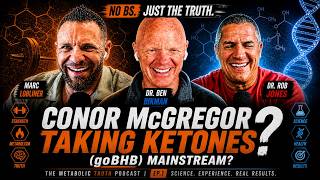
Mark Lowbliner, Dr. Ben Bikman, and Dr. Rob Jones discuss exogenous ketones like GoBHB, now in Conor McGregor's MAC energy drink. BHB fuels mitochondria without insulin regulation and acts as a signaling molecule that reduces inflammation and preserves muscle. The panel covers dosing around 2.5 mM, different delivery methods, and potential benefits for athletes and aging adults.
Chapters
So in the world of science, there are people who know stuff and then there are people who don't know stuff. And lucky for you, today we have two people who know stuff. And I'd like for you guys to introduce yourselves because, well, if you don't know who I am, I'm Mark Lowbliner. I'm the president of Ketone Labs. I'd like to introduce you to these two gentlemen right here.
Go ahead, Ben.
Yep, yep. Thanks, Mark. I'm always happy to talk about science. I'm a scientific advisor for Ketone Labs. and I am a professor of cell biology and just a metabolic scientist, which has allowed me to study ketones, specifically BHB, for several years.
And I'm Dr. Rob Jones. I'm actually educated as a chiropractor, but I am a sport and rehab specialist. I'm in my 27th year of practice, and I basically in my second practice. Um, we moved to Florida recently. I spent about 20 years with the University of Kansas in high-level athletics. And I spend my days basically teaching people to get better, not older. And basically what that means is movement is medicine regardless of what the scans are showing. I help people move every day regardless of what they have. And my impact to this conversation is to try to sound half as smart as Ben.
Well, good news is no one's trying to start to sound as smart as me. You're like, all right, there's that guy. Yeah. So, you know, I think this is a fun week to actually kind of get together because speaking of the ketone space, the GoBHB space, there's been a huge inflection point in the last couple of months. And I speak because, well, I'm kind of there, right? And you saw this huge launch of Conor McGregor announced he has his new energy coming out called MAC, and it has cognizance, some natural caffeine, but the main driver of the drink is GoBHB. And what I think is fascinating is we're starting to see these kind of applications. So you guys see this, seeing, you know, what we would consider kind of like a niche ingredient go into the mainstream like this. What do you think about it, Ben?
Yeah, yeah, thanks. I am— I agree that really BHB seems to be having a moment in the sun. In fact, if anything, it's, it's going to get brighter and brighter. One thing that I think is, is relevant is the, is the unique nature of BHB, and I can see why Conor McGregor would want this because the energy drink area is built on these commodity ingredients that anybody can get. And like, like B vitamins, for example. Yeah, B vitamins are great. They help provide the machinery for a cell to make new energy, but it's not actually giving the cell its energy. And I think just by way of keeping this answer a little brief, it would be BHB is a source of energy that is unique because you could say, well, I have sugar in my drink and that's energy. Yeah, sure. But it also has multiple metabolic fates where that sugar can be stored as fat. It can be stored as glycogen. You might not be burning it for fuel. BHB demands priority boarding on a metabolic bus, if you will, where when that hits the system, every cell with mitochondria, it's going to be burning that BHB and it can't store it. It has to burn it. There's no multiple pathways, multiple metabolic fates. It goes into the cell. It goes into the mitochondria and it'll get burned for fuel. And it's every cell from brain cell to bone cell and all those cells in between.
Yeah. And really from my side of it, on really the human movement side, but specifically the athletic side, having BHB on board actually being what I refer to it when I talk to my patients in lay terms about it is it's really having a primary fuel tank and a secondary fuel tank. So Ben, you were talking about, you know, people who intake carbohydrates or sugar, you know, converting it into, to glycogen if they're not gonna use it. Well, athletes I work with, they need as much glycogen as they can get and they need to spare it for later in the quarters, later in the half, later in the race. So really what we're looking at with, with BHB is immediate fuel, keep the brain sharp, keep the muscles firing, and then now you want to kick on the afterburners. Now when that's burnt up, you can go ahead and use your glycogen as that secondary energy source, and, and you're not looking at a depletion, and you're really not having to, to subsidize that with, you know, some of the garbage drinks that are out there. You know, we're not putting red dyes in, in young students' bodies, and, you know, fruit— high fructose corn syrup and some of the other garbage that we see in a lot of these, you know, these drinks that are out in the ether.
Yeah, I think when you look at energy drinks, you know, they put them in one kind of bucket where energy drinks kill people, energy drinks are bad for you, you And, I think there's a paradigm shift here where you're actually putting an ingredient or a technology in it that's actually, I can argue, it's one of the healthiest things you can put in your body. I mean, we found new data on heart health. We have data on cognition. You look at the aging population. Do you see even with the caffeine, now you're looking at modest, I think it's 200 milligrams of natural caffeine. And, is there a difference between natural and synthetic? We can argue back and forth. Anecdotally, people say it's a little bit smoother, but we also, we also have a little bit of an inkling that GoBHB actually potentiates caffeine and eliminates some of the side effects you get from caffeine, like the jitters, and actually makes it work better without more caffeine. So what I would like to ask is, is this an energy we could actually kind of— if you put GoBHB in something, you almost consider it, assuming you don't have the stuff Rob just talked about, in it, could you consider it almost a healthy beverage at that point?
Oh, oh yeah, I think so. Uh, the— when we start to think about the wide scope of BHB as a, as a calorie nutrient, uh, you know, when I say that, I mean other things like, you know, glucose and fats. Those are also calorie nutrients. It's really unique because not only is there the energetic component that I already mentioned, which is any cell is gonna gladly pull that in and burn it there, and there's no regulation too. Again, many of the body's cells, if they want to burn glucose, it needs insulin to be acting as a gatekeeper. And so there's a regulation point. Ketone does not have a regulatory step. It comes in, it gets burned. But, but where BHB is further unique is its ability to act as a signaling molecule. So when you talk about the potential health benefits of, of an energy drink or any, any, any drink that has GoBHB in it, you can look at it not only from an energetic perspective, but also the— back to Conor McGregor's drink, who— this is a high-performing athlete, or even it's the older person who wants to preserve whatever muscle they have and they're not a high-performing athlete but just want high-performance living. BHB has been shown to preserve muscle protein, where Dr. Jones mentioned the, the glycogen-sparing effect. That's a very well-defined benefit of BHB helping muscle keep more of its glycogen on hand for that kick, perhaps, whatever the athletic performance is requiring. But you also have a sparing of the muscle protein. Dr. Sri Nair at the University of, I think, Minnesota at the time, decades ago, found that when he bumped up BHB levels in people that were fasting, they— it reduced the amount of leucine oxidation. So highlighting a direct a muscle protein sparing effect. And then we published a paper just a few months ago where people were on a low— on a weight loss protocol, and they either had a calorie-matched placebo or they had the GO-BHB. And the GO-BHB group had a greater preservation of muscle mass in the midst of that weight loss, which nowadays of course is particularly relevant, um, in the with the rise of these very powerful weight loss medications, which, which I have a nuanced view on, topic for another time. But, but as, as they're getting used, I think it's in people's best interest to engage in any, uh, strategy they can to help preserve that muscle protein. So, Mark, back to the, the question, to what degree is, is GoBHB a health drink? I think I'm just sort of adding one more component, which is not only is the energetic benefit but the signaling benefit where it's coming to a cell, binding to cell receptors, and then telling the cell to do something beyond its ability to fuel it.
Yeah. So again, I could just listen to Ben talk all day. I actually— I'm going to fanboy here for a second, but Ben and I have talked about it in our previous conversation.
I wish my wife felt this way.
Same. How do you do that?
Like, yeah, we don't— we all— yeah. My wife's awesome, but I think my wife and your wife could get together and spend plenty of time complaining about us. But, this is the thing I love about this product. And Mark, when you guys first approached me a couple months ago about coming on board with GO BHB in general, I said, I have to try it for myself 'cause I'm not gonna recommend it to patients unless it works for me. I'm my trial monkey on this, okay? And the thing I'm learning specifically from Ben, but also the research I'm doing myself, Like, I just learned something new today. I didn't know you had that caffeine potentiation with, with GO-BHB. So here we go, another thing that I just learned. But specifically in my space, because I work with a ton of athletes, but I also live in Florida, so I have a, I have a really high percentage of an older population. And this older population is becoming more and more aware of age-related sarcopenia and, and the need for muscle in general. And it's really, it's because of Ben's voice voices like Dr. Rhonda Patrick and, oh my God, I can't believe I'm— my gosh, I can't believe I'm blanking on her name— very fit tattooed doctor.
Ben, I think you know her.
Gabrielle Lyon.
Gabrielle Lyon. I mean, she's been beating the drum for a couple years now, and that's really pertinent for my patients, but also from an injury standpoint. You know, we're seeing some data that some of our colleagues shared with some inflammation with regard to injury, but I had a gentleman today who was up in your neck of the woods several months ago, Ben, skiing, and he got into a pretty bad accident. He had a partial tear of his glute. And, of course, I have my recommendations for rehab and how I'm going to fix him. But, one of the first recommendations I have aside from collagen and curcumin and all these things to propagate the healing process was to get them on ketones because I want the muscle-sparing benefit of it. Even if he is fasting overnight for 10 hours, if he's got some ketones on board, you know, he's not going to get any of that gluconeogenesis happening. So again, every single day I'm surprised at, like, I'm, I, I, I dare I say, the miracle molecule, honestly.
Yeah, that's, that's really the, the, the muscle preservation part is what really, as a meathead, kind of got me. And then I remember we were digging up some old studies, Ben, and we found that one Crazy study. I think, was it 1984?
I think so.
It was the year BYU won the national championship in football. Sorry, it's been a long time, Ben.
It's been a long time.
I know you did, you did, you did beat Miami in— what was that, '90, '91 was it?
When they beat with that, with, with Detmer.
Yeah, Detmer. I'll never— I was— I remember that game. My dad went to Miami, he was pissed.
Um, I haven't heard the Stormin' Mormons in a long time.
Ah, you haven't, you haven't hung around us yet. We bring it all up. Dr. Ben Bikman: So, you know, the fascinating thing is they did this study and it's an IV study. And I don't know if we ever got the exact dosage equivalencies, but they had these bedridden patients and they had control. Of course, you can lose a lot of muscle, sarcopenia, terrible. You're bedridden. So they gave the BHB IVs to the others and to the other group, and they actually gained— they didn't gain like steroid-like gains on, but they they didn't just not lose muscle, they actually had some slight hypertrophy, which was fascinating. And I'm not quite sure the mechanism it happened, and if anybody is, it's Ben. But it would let me— lead me to believe that there could be some potential hypertrophy benefit.
Oh yeah, I agree. We would all of course agree that the primary stimulus always has to be just working the muscle.
Absolutely.
You know, get in there and work that muscle. But after that, all things equal, there is— it's like, I mean, that study I think is the clearest articulation of the benefits. Now, part of it could be— I don't think they defined the pathway, but this is something that we've sort of touched on— but a lot of it could be at least partly by inhibiting excessive inflammation, where that is another one of BHB signaling effects that has been really well defined. BHB inhibits this master inflammatory switch. Now, some inflammation is necessary for muscle recovery, but too much, I think we can easily make the case. In fact, that's part of that same inflammatory pathway is actually what potentiates, uh, muscle loss with bed rest. Um, it's, it's an inflammatory pathway actually. My, a friend of mine at the University of Utah, NLRP3-1. Well, the NLRP3 is like the master switch, but then it appears to be at least partly going through this toll-like receptor 4, TLR4 pathway, and then the accumulation of this molecule called ceramides. But that might be part of the mechanism. But yeah, I mean, everyone who wants to build or maintain muscle, so the athlete to the aged, they, they're going to share one thing in common, which is the preservation or defense and building of muscle mass. And whatever the mechanism may be, BHB has been clearly shown to do that.
So Ben, if I'm not mistaken, just back to the muscle physiology for a second, you actually need some, if not a small amount of inflammation to, to stimulate satellite cells for hypertrophy, correct?
You, you do need inflam— yeah, I mean, Mark, I think, would probably have some great insight on this, but I think there are studies to show that athletes who have a, a challenged stimulus to the muscle who then take strong anti-inflammatory medications, they blunt, they blunt muscle protein synthesis. So you do need some If I can interject in the—
there was this— it was the early 2000s. And I know everybody here knows what arachidonic acid is. It's a pro-inflammation, fatty acid, if I'm not mistaken. And so it's found in pretty high concentrations in eggs. But they came out with this arachidonic acid supplement. People were making— this is in the message board days— people making these crazy gains. So I'm like, all right, I'm going to take this, right? I'm young. I wouldn't take it now. I'd actually research it, you know. I'm in my 20s and I swear I tore every muscle in my body. I was in more pain than I could ever imagine. It was the worst muscular pain, constant soreness because you're promoting inflammation. Now, that's the thing is that too much systemic inflammation is probably the worst thing you could do to yourself. And so, having that inhibitory effect on inflammation is great for all layers of health. Yeah, but obviously with these results it is doing that, but at that— it seems like it's that— I don't want to sound overstate this— it's at that right level where it's preventing the bad inflammation yet giving you enough to be able to preserve and build muscle. If I'm read— that's just my interpretation. Yeah, but I think very simple. Ben's very smart, I'm very simple, so that's, that's why I like to look like—
yeah, right. Yeah, well, I wonder whether— I wonder whether part of it I wonder whether part of the benefit that we see is that it, it can block some of the inflammatory signaling but not mitigate blood flow, because, you know, you want to be able to maintain blood flow. And in fact, speaking of BHB, some of the— I, if I had to identify the single hottest area of, of ketone BHB research, I think it's probably the effects of L-BHB, the oft-overlooked version of BHB that— and its effects on the dilation of blood vessels, where there is some incredibly compelling data. It's, it's a, it's a pig heart study. Now, lest anyone think, oh, well, then it doesn't apply to humans, the pig heart is so close in function and physiology to the human heart that you can actually take pieces of the pig heart and graft it into a human heart to improve, to help maintain function. So it's, it's like the closest analog you can get. And they found that by just infusing LBHB at very reasonable low millimolar levels, they were able to so dramatically dilate the great arteries, the great blood vessels, that like cardiac output— so the amount of blood being ejected from the heart, I can't remember the number, but it was over 50% improvement in cardiac output, but without the heart having to beat harder. That's the key here, that someone who has high blood pressure or compromised blood flow, they don't— they might not want more blood flow if it comes at the cost of the heart beating harder and faster. Right. But if it's because the pressure that the heart is beating into is down, well, now every time the heart beats, it's able to get out more blood flow. So this is kind of my meandering thinking when we try to wonder at the muscle-specific benefits where there's a balance. So you need some inflammation, but, but, but you don't want too much. Maybe the way BHB is working, and I'm speculating now, is that it is blocking some of the inflammatory signaling that ends up becoming more harmful than beneficial, but at the same— but it's not doing so at the cost of restricting blood flow, which is how some of those molecules, those, those anti-inflammatory drugs do act.
They're very effective.
Yeah. So interesting, the— just back to the kind of the porcine model, the, the pigs. But in my world, Dr. Stuart McGill up in Waterloo, Ontario, he's thought of as like the foremost spine researcher in the world on the planet. He's figured out more for spine pathology than really anybody has, but he uses pig models because you can't take a real human and bend them and twist them and see what herniates a disc basically. So, but oftentimes when I look at his research, it's kind of hard to discern when you're looking at an MRI of a pig or a human. It looks pretty close. But, yeah, again, I mean, I talk to patients, I try not to get too deep into the physiology with them, but You know, I talk about hydration status a lot because, you know, if your heart, if your stroke volume is, you know, a small percentage, even down a little bit, you're going to feel that with regard to your energy level because the heart is having to work harder because, you know, the constituency of the hematocrit and the plasma, you know, the plasma is going to be down, so the heart is going to have to work a little harder to push more through. So again, any little bit is going to help on that. Again, I'm kind of fan of Dr. Ben Bikman, but I didn't know this about the vasodilatory effects of this.
Well, well, I'm not only— we— so we have data going on now. Actually, we've just started working on the publication. It involved two different models. One was an endothelial cell culture where we're growing little endothelial cells in a petri dish, and endothelial cells are the innermost lining of the blood vessel. And then we actually have some human pilot data looking at this, but I won't mention the human data other than to say it does look like in fact there may be systemic benefits to blood pressure with LBHB. But with the endothelial cells, we found that when we— even at the modest dose of, of 2.5 millimolar, which we all know that's very achievable through supplementation— we already started seeing a huge increase in production of nitric oxide. So it could just be that among another aspect of BHB's signaling effects that we've come back to, that it's both an energy and it's a signal. One of its signals is to increase nitric oxide, which then acts as a vasodilator.
Absolutely.
Wait, wait, so you said nitric oxide. I want to go back to that. So obviously that's in sport nutrition, that's huge. But I mean, nitric oxide— and pardon me for going a little bit TMI— but it's been used in men's sexual health treatment. Um, I remember they used to— was it yohimbine, arginine? Those have all been prescribed by the what a natural— naturopaths or whatever they're called. Um, so is there a nitric oxide pathway with BHB that we can look at? Maybe for the— we think about the pump, but you also got to think about what it does from a— blood flow is everything. Like, if you think about everything from heart to erection is governed by blood flow.
Yeah, specifically cardiovascular activity. You know, a lot of cardiovascular-heavy athletes like marathoners and half marathoners and triathletes, I mean, they're looking at whatever they can do to get their nitric oxide up because you're going to have you know, more vasodilation. I mean, it just follows the cascade, right? More hemoglobin binding and all of that. So, so anything that is going to go down that path is going to be beneficial. And if you can, if you can get it into that elite— look at it from like an elite lens at those folks who are in that, you know, Olympic level of running, or, you know, Power Five Division I, or whatever division of athletics it is, and then micro that into the daily population on how when you have somebody, if this is their baseline and moving the needle up a couple of percentages is going to be the difference between them having energy to go for a walk at lunchtime or go for a walk at dinner, which is going to significantly bump their activities of daily living to a level where they can actually have some achievable fitness versus, "Oh, I'm too run down. I'm just going to stay at my desk and look on YouTube for the next 30 minutes or whatever." I mean, that's, again, these little micro victories, I think, for the general population is is what we have to look at because we're starting such— at such a low baseline for health. I mean, dare I say, with, you know, there's no ego intent here, but like the three of us and our wives, we're not in, you know, we're in the standard deviation, right? We know the vast majority of Americans don't function at a very high level. So if we can help them boost just a little bit and help them recognize, hey, you don't have to feel like crap all the time. Just a little bit of a physiological bump is gonna pay huge dividends down the road, man. If we can do that and introduce them to these type products, you're moving the needle big time.
Yeah. Yeah. Mark, you, you'd asked about the, the potential signaling mechanism. There are, there are in fact a couple pathways that we're, we're speculating on and some of our data support this. One of them is that nitric oxide pathway where BHB is known to bind and activate what's called a, a G-protein coupled receptor. And within the whole realm of cell biology, there are probably more reactions in a cell because of the activation or inhibition or just regulation of a G-protein-coupled receptor than probably any other. In fact, the guys who discovered G-protein-coupled receptors won the Nobel Prize. It was that influential. So that's one mechanism where BHB binds a particular G-protein-coupled receptor, which is known to then activate this, this nitric oxide synthase enzyme, so kicking out more nitric oxide. But then the second one actually comes back to a molecule you mentioned earlier, which is arachidonic acid. When a cell metabolizes or breaks down arachidonic acid, there are once again multiple fates of this molecule. One fate is to go into this prostaglandin pathway, which further promotes inflammation. BHB, by activating the G-protein-coupled receptor, actually shifts it— the arachidonic acid pathway into more prostacyclin which is a different vasodilator. So it's a separate mechanism than nitric oxide. So there are two potential pathways here. The nitric oxide one, the more famous one, and then this more overlooked, lesser-known prostacyclin pathway. Wow.
Wow. That, that's, that's a, that's a lot of words.
Clip that thing. Clip that bugger.
So, you know, we're talking about LND-BHP. And this is a fascinating thing because before you had the DL because that's just how they made it, but we really thought the D was doing all the work. And then we come to find out that the L is— I mean, I'm not going to say it's the more magic. I think they both have their place, but we talk about applications and what they do. And you talk about the L-BHB on the heart. And also, we had the cognitive study done by our good friend Dr. José Antonio, which showed the cognitive benefits. They both had them, but the L outperformed. So, when you look at the L isomer of BHB, where do you think it— like, what do you think makes it so magical? Is it the signaling properties? Is it the extended half-life? Is it a little of each? Is it some other reasons?
Yeah. So, I can only speculate as this is just such a new work kind of at the bleeding edge of metabolism research when we start talking about L. In fact, I think just for the sake of ease, I think you probably outlined the, the main one. So, so one is that we know it's metabolized more slowly. So it's— I think it's fair to, to look at L as a slower burn than D, where D-BHB is the— in the structure that the mitochondria is looking for when it burns BHB. L is probably still able to be burned, that those enzymes may still work on it, but it appears to not have quite the affinity. But L can also, to a degree, be converted to D. But then separate from those— so separate from its potential to just act as an energetic molecule, it clearly has a different signaling effect. So its unique structure, it, it must be unique in that it, it is— it identifies different receptors on a cell. And that is what's enabling— like DBHB, for example, in our studies, we found that both D and L are capable of inhibiting the inflammatory signal. Oh, when we would insult these endothelial cells with a noxious stimulus to, to aggravate some inflammation, both D and L potentiate or mitigate that rather. And then when we looked at nitric oxide, D does not do it, L does. And so there must be something unique about its flipped structure that is making it specific to other receptors, which when activated are then now propagating that nitric oxide signal. And again, maybe the prostacyclin signal as well.
Hey, Ben, this is— I'm not sure if you guys have jumped into this research, but this is kind of a big curiosity for me. When, when you're looking at tissue repair, we're really looking at aggregation of fibroblasts specifically to tendons. And, and microscopic muscle tears. We want to see aggregation in an aligned fashion. Part of what I do working with patients is making sure that fascial restrictions and tissue restrictions aren't present because it chokes off circulation. Have you seen anything— and again, you can say no to this, but I, I, I'm, I'm willing to bet you have an answer at some point— have you seen any potentiation or increased influence on a macrophages to clear cellular debris or injury debris, um, like in that endothelial cell, like if you're talking about the tunica intima specifically, you know, if you have an inflammatory marker, you're gonna have some damage to the tunica intima. Are you seeing macrophages come in? And then are you seeing an increase in fibroblastic activity? Is that something that you've—
yeah, yeah, yeah. So I, I have not seen this. We have not done those kinds of studies. To the first point, So I— there is an answer for the second point that you just asked, the, the fibroblast role. But with regards to the macrophage and the resident macrophages, I don't know. I can only speculate and probably invoke the anti-inflammatory effects because the macrophage is the, the one of the main molecules in that realm, for both better and for worse. Um, but with regards to fibroblasts, there is very clear evidence that at physiological ranges, that very low millimolar range of BHB, that it, they, it enhances fibroblast proliferation and, and migration. And that's been measured with very specific types of assays called like scratch wound assays. And also BHB upregulating collagen expression, type 1 and type 3. And, and so in fact, there, there has been some— I don't know if this was published yet, but there was a dissertation published from the lab of Dr. Dominic D'Agostino where they looked at using BHB topically, and I think internal as well, but all with the intention of improving wound healing. And the results were fantastic. And a lot of it was, I think, piecing in other data. It's going to be likely due to some enhanced fibroblast function to facilitate wound and recovery.
Wow, that, that's huge for my world. And I'm assuming it would have to do with— and again, assumptions, kind of an ignorant assumption, but it makes sense physiologically. But if you're getting a vasodilation effect, you're going to have an easier time, you know, for constituents of healing to arrive at the site. So amazing. Again, I just, again, I learned something new again. So, I need to enroll in one of your classes, Ben.
Yeah. Yeah. I wish my students were so enthusiastic. Dr.
Jones, they just say, "Is it going to be on the test?" My professors are not nearly this interesting, but I probably just didn't care about subject. So just one last thing, and we'll make this a regular thing. I think that talk about the D and the LBHB. So a lot of times, you know, you see a lot of things labeled ketones, like a lot of people, MCT might have the ability to increase ketone levels in the body and other things called 1,3-butanediol. So before we, you know, kind of close this one off, is there any— can we get like a, from both of you, maybe a quick like description of the differences between— we already covered D and L, but then go into kind of MCT and what it does. I'm a decent fan of MCT and then also, you know, 1,3-butandiol and what it does.
Yeah. Yeah. So my brief answer to that. Yeah. MCT is a ketogenic fat where it's— in fact, it's kind of the fat version of BHB where the shorter that fat is getting, most of the fats people consume are what's called long-chain fats. But then the shorter that fat gets, it goes from long-chain to medium-chain and then to short-chain. Now the problem with short-chain is they taste like, like vomit, um, for the most part. In fact, that's, that's where, when you vomit and you have that strong taste in your mouth, it's because of the, the extreme taste of short-chain fats. But medium-chain fats are, are inert with their taste. And, and once you get to around 12 to 10 carbons-ish, which is still a medium-chain fat, you can't store it. It has to be burned. And so the liver is taking up that MCT and burning it so fast that it's creating ketones from it because BHB is, after all, a product of fat burning. So if, if someone were to take a straight exogenous BHB, they'd see an immediate hit to their BHB levels. By that I mean a spike, I should say. But then if they take MCT, that's gonna happen an hour or so later. And so, and, and never to the same magnitude that you can get I mean, really, with straight BHB, if you try to take too much MCT, your intestines are going to let you know, and, and, and you better not leave your house for the next couple hours. Um, don't go out on a date or anything social. So that's, that's the MCT timeline. And then, yeah, another, um, another widely shared, uh, I'll put this in air quotes, exogenous ketone is actually this molecule, 1,3-butandiol. And, and the reality is It's not a ketone. It's, it's, it's, if anything, these companies should call themselves alcohol something. It's not ketone at all. It's an alcohol precursor, similar to how MCT is a precursor to, to BHB, and the liver can burn that and create BHB from it. The liver can do the same with 1,3-butandiol, but it comes at a cost from both an inflammation and and I don't want to say scarring in this case. I'm trying to recall the findings from Dr. D'Agostino's lab where the 1,3-butanediol harmed the liver overtly. And then Dr. D'Agostino and I published a follow-up paper finding that this, this molecule, this alcohol precursor really compromises the electron transport system specifically at complex II, just to be really precise. But the end— the net effect of this is that when we measured the ability of the liver to generate ATP, or just to generate energy in response to BHB, it was a huge increase in ATP production. So the, the liver was able to take this molecule in and create a lot of energy from it. In contrast, with 1,3-butanediol, there was an almost minute per minute reduction in the amount of energy that that liver was, was producing. In other words, it was spending energy in order to create the BHB, in order to facilitate that conversion. And when you combine all of that— so when you think about an athlete, the last thing you want to do is have to be burning energy when you need every spec you can get when you're out running in high— at high— at a high performance level. You don't want to waste any energy, and that is really what's happening. It's burning energy in order to convert it to, to BHB, not to mention the increased inflammation that comes from it as well, both of which Dom and I found. So to me, accept no substitutes. That while you could make the case that MCT might have a role because you do want a bit of a longer production of BHB, but when it comes to you just wanting to get ketones in your system just get the ketone, and that's only going to come in some form of GO-BHB.
Yeah. And Ben, if I could add to that, and, and correct me if I'm wrong, but do you not have some stimulation of hepatic release of glycogen when you take in MCT?
Isn't there? I don't know, I'm not sure. Okay, I'm not sure.
No, but, but anyways, so the interest for me with, with again the, the butanediol was, again, I am not recommending anything to my patients that is not going to be 100% fruitful for them. And I actually had a couple of Olympic athletes that I had recommended the product, you know, with the butanediol, and they did notice a net benefit in training. You know, like, they felt like they could— they had a little bit more gas for the end of training. But I pulled them off of it because, A, it was costing them ATP. It's almost like you're, you're burning gas to make gas, and it's just, it's, it's not a good coefficient, right? But, again, some of it tastes like alcohol and that's, you know, it's because your liver can't really discern whether it's breaking down alcohol or it's breaking down butanediol. And, again, we want performers to be at their top of performance and I don't want any hindrance in any of the performers I work with, whether they're Olympic level or, you know, people that just want energy to go for the walk in the evening. So, Yeah, yeah, huge difference for me.
Yeah, that's awesome. Well, anyway, guys, I know we'll be back. So what I want you guys to do who are watching this, go in the comments, what questions you want. It doesn't have to be about GoBHB. That's obviously something we really like, but any questions you have, just put them down below and we'll do our best to answer them next time we're together. Would really appreciate that. And where can they find you guys?
Yeah, yeah, for me, just my social media handles are just Ben Bikman PhD.
Yep. And mine, heydrrob.com is my website. And across all of the, the platforms of social media, it's Hey Dr. Rob.
And I'm @marklowbliner. Pretty simple, just like, just like yours. Well, Hey Dr. Rob's kind of cool. But anyway, for more information on GoBHB, go to ketonelabs.com. And for the group, everybody signing off. See you guys next time.
More from Dr.



Insulin Expert Exposes The CARB CRISIS - The Rules of Weight Loss Have COMPLETELY Changed




Ben Bikman, PhD | Rethinking Metabolic Health: Insulin, Ketones, & What Comes Next | Metabolic Link

