Why We Get Sick: The Insulin Resistance Connection
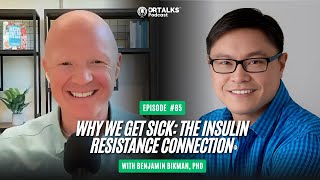
This is a YouTube video titled "Why We Get Sick: The Insulin Resistance Connection" created in September 2025. It features a detailed conversation between Jason and Dr. Ben Bikman, a biomedical scientist and professor specializing in insulin resistance and metabolic disease. The discussion covers the root causes of chronic diseases such as type 2 diabetes, obesity, metabolic syndrome, and cardiovascular disease, emphasizing the role of hyperinsulinemia and insulin resistance. They explore mechanisms like fat cell behavior, liver metabolism, and the impact of insulin on various health conditions, challenging conventional medical views on insulin and cholesterol. The content is educational and aimed at understanding longevity and metabolic health.
This is doctor talks, real talk from real doctors on the issues that matter to you most. Hey, Ben, good to have you here. Thanks for. Thanks for joining us.
Oh, yeah, my pleasure. Thanks, Jason.
Yeah. So Dr. Bickman is a good friend of mine. We've known each other a while and it's. He's one of the smartest guys I know, honestly. He's really, you know, looked at really in a deep way the sort of root causes of disease. And. And he's not a physician, he's a researcher. And I just want to maybe go back over a little bit of your background about how you sort of got to where you are and. And then maybe your book, why We Got Sick, which is really very insightful about sort of root causes and sort of where we stand, because our focus here is longevity. So, you know, obviously trying to avoid why we get sick is so important. So. Yeah, why don't we start there?
Yeah. Yeah. So, as you noted, I am a biomedical scientist and a professor. My research focus as a scientist is to study insulin in. As one main theme in. In addition to that, my lab focuses on mitochondrial function. We do a lot of mitochondrial work, but it's all thematic of trying to get a better understanding of. Of the metabolic influence in chronic disease. For example, we have published a few papers over the past couple years looking at some of the mitochondrial problem in Alzheimer's disease. We have published a handful of papers looking at the differential effects of insulin versus ketones on fat tissue metabolism. So all of these things are just. Just offshoots of our central focus, which is to just understand the role of metabolism in disease. And my. My evolution is. You. You'd mentioned just providing a brief overview. There was actually one that started with an interest in muscle tissue, but then in the late 90s, I stumbled across a paper that had just been published that documented how. How fat tissue was, as it grew, as it expanded, was capable of secreting pro inflammatory proteins, and that these pro inflammatory proteins, called cytokines, were then capable of causing insulin resistance, which was this foundational problem with type 2 diabetes. All of this was a. An app, was a total revelation to me that I was certainly aware of the twin epidemics of obesity and type 2 diabetes. But I had not even been interested enough to start to learn about what was the bridge connecting them. What was it about this fat tissue that was causing insulin resistance, the foundational problem with type 2 diabetes, and that. And that. That the. There wasn't. There was two things that really set me on the path that I'm still on to this day one, it was the learning that inflammation had metabolic consequence. And that was in fact something that I went on to study for my dissertation work and my postdoctoral work, my, my fellowship. But at the same time, what blew my mind at the time was learning that fat tissue is an endocrine organ. That was an absolute revelation to me. I had, I'd not been taught that before, even though in hindsight there were hormones that had already been identified from the fat tissue. The most famous of which is, was of course leptin, and still is. But I didn't know that at the time and set a curiosity, this, this burning wonder in me to want to learn more about fat tissue. And so what had started as an academic career that I thought would be mostly devoted to muscle tissue and we do muscle work, it really quickly became a career that was more interested in fat tissue. And then to kind of really make the long story sees.
And that's where if you don't have insulin, this blood, the fat cell can't take in those calories. And therefore people, you know, even with all those calories, they, they just lo, they, they, they become extremely skinny until they die, basically. So what happens in this situation, in the situation, the opposite situation where you have too much insulin? What happens there?
Yeah. So then this is what I like about this segue is that it allows us to present the paradigm that type 2 diabetes is the opposite problem of type 1. That I think it's one of the great tragedies of modern medicine that we have lumped these two total opposite diseases into one family because they share one single thing in common, namely that they both can eventually manifest with high glucose levels. But how they get there is to exactly opposite scenarios. So it's, it's unfortunate because then we believe they need to be treated the same way, which just compounds the problem. So when there's too much insulin, you now start to create insulin resistance resistance. So I would, I would say there are two things that I, I'd want to emphasize here and then the conversation can proceed on either of these as you see fit. So on one hand, chronically elevated insulin causes insulin resistance. I have, I've published reports on this. Many other basic scientists have published reports on this. Clinicians have observed this. The, the. Where with type 2 diabetes, there's, there's. I think it's important to note that in true type 2 diabetes, insulin never drops to zero. That does not happen. It has been really, really high. Sometimes it comes down a little, but it is still multiples higher than it ever was before they started on that disease progression. So the idea, this kind of cleverly false language of insulin production becomes insufficient to control glucose, well, that's a pretty subjective term. They're still loaded with insulin. And by putting the type 2 diabetic on even more insulin, they become more insulin resistant. So a point that I was getting around to and distracted myself is that every cell type we've used in the lab, muscle cells, liver cells, neurons, brain cells, if they are exposed to even physiological, but higher chronically elevated levels of insulin, they become insulin resistant. You can create all, whether it's cells, whether it's animals. I've done that and published those results. Whether it's humans, that's been published in use, biomedical models, cells, rodents, humans, if you increase the insulin and keep it there for a period of time, they become insulin resistant. And lest someone think, well, I'm not a dish of cells or a rodent, I'm a human and I eat when I want. Yeah, but you probably eat a lot of starches because 71% of all calories consumed globally are carbohydrates. And you're probably like the average individual nowadays who eats about six times a day. And in considering that it can take insulin up to 3 or 4 or 5 come back down to normal, depending on how much you ate and what you ate and how insulin resistant you are, it's not a stretch to assume that most adults and children are probably spending every waking moment in a state of elevated insulin because they wake up in the morning, insulin has finally had time to come down overnight, and then they spike it with starchy, sugary breakfast. And then right when the insulin's about to start coming down, they spike it again with a mid morning snack. And that just continues until they're eating evening snack and now they're going to bed hyperglycemic and hyperinsulinemic, and they're not sleeping well. But anyway, so one chronically elevated insulin causes insulin resistance.
Let's, let's, let's pause on that moment for a moment because I think it's a, it's a really, really important point because this is the crux of the matter. So, and a lot of doctors simply don't understand this. And I think it's actually crucial. Insulin resistance, we all agree, everybody in the world pretty much agrees is a problem. If you're insulin resistant, then you're much higher risk of all kinds of other diseases, heart disease, cancer, and all this stuff. So if you take the next step and you say, okay, Insulin resistance is a problem in everybody. What causes it? And like 9 out of 10 doctors will be like, we don't know. It's like, what the hell, right? You don't know. So insulin resistance being such a huge problem and it's been, you know, syndrome X. Gerald Reeven identified it like at least by the 70s. So we're talking about 50 years of sort of medical research and you're telling me that and it's, you know, three, four, five times higher. Diabetes is three, four, five times higher than it was in the 70s. In certain countries it's like 10 or 20 times higher. So it's like you have this huge epidemic. You've been studying it for 50 years. You've known insulin resistance is a problem for 50 years. So what causes it? And the answer is, we don't know. It's like, okay, well do you have any idea? And again, I've asked lots of doctors this, by the way. They are like, I have no idea. I asked trainees this and they have no idea because they've never been taught. They. And I'm always thinking, why don't you actually think about this problem? Because if you think that the problem is hyperinsulinemia, right, which is too much insulin causes insulin resistance, then it's, it's a, it's an important link. Because if you say too much insulin causes insulin resistance, therefore the answer for a lot of these problems is to help lower insulin. And how are you going to do that? Because up until recently there were really no drugs that did that. Ozempic now can do that, but in a different manner, right? So that's such a crucial point that the hyperinsulinemia, the too much insulin problem is what we should be focused on. Because again, as you point out, it's been done. Like if you want to, if you think too much insulin causes insulin resistance, do a study, take people, infuse insulin, see what happens. You know what every single study shows they get insulin resistant. You can even take insulinomas, which are these rare insulin producing tumors. You take them out. So you take a condition where you have too much insulin and they return it back to normal. What happens? That insulin resistance completely disappears. And it's like, okay, well, yeah, there's.
Something so intuitive about it. If you just think about it for a moment, a person very quickly comes to the, the, oh, I see. It's just, it's an inconvenient fact because it challenges so much of how these issues are treated. But too much of something causes a resistance to that Something that is how biology. That is one of the fundamental biological principles. If there's an incessant stimulus, the cell, the body by extension, or the tissue by extension, then the body by extension will attempt to reduce the response to that, to that signal, assuming, just kind of placing it into the background, and it becomes deaf to the signal. In other words, in this case, it becomes insulin resistant.
And that, and that's important because this is a sort of fundamental biological principle and it's a protective response. Right. So the cell is protecting itself from too much insulin by becoming resistant. And you see this everywhere. Right. If you're, you know, listening to loud music, what happens? You go deaf. Why? Because your, your ear needs to protect itself from the loud noise. So therefore it goes a little deaf.
So even still, Jason, if you'll allow me to insert into that metaphor, what do you do to try to continue to hear the music? You continue to turn the volume up.
Yeah.
And I mean bringing it back to insulin resistance. It becomes this vicious cycle where the pattern of eating lots of refined starches and sugars, eating so frequently is pumping up the volume to get to some early 90s music references. But then it's, you're becoming deaf. So, so, and then what do you do? I want to still hear this. The cell wants to continue to respond to insulin, and so the body will start to have this compensatory response and increase insulin, which further promotes insulin resistance. And so it becomes a vicious cycle.
Exactly.
The punishment.
It seems obvious that you should pump up the volume. Right? Because it's like, hey, I can't hear. Yeah, I need to pump up the volume. But that's the exact wrong thing to do. And in fact, that's what we've done. Right. If insulin is too high, it causes insulin resistance. We saw that insulin resistance and said, we need to pump up the insulin. So we gave people insulin. We told them to eat six times a day. We told them to eat lots of low fat, high starch foods. That is the equivalent of making that insulin higher so that you don't have, you overcome this resistance, but it actually makes the underlying problem worse, not better. You actually have to do the opposite. Even though it seems a little counterintuitive, if you will, at the time, but it's, it's, it's actually the only way. And the only way really is to look at that sort of underlying root cause of, of disease, which is that, okay, too much insulin, let's lower insulin as opposed to, oh, well, the insulin isn't responding. Let's Pump up the insulin, which is such a, you know, it's. It seems so obvious to you and me, but unfortunately, I think like 99% of the medical institution thinks you should just sort of give more insulin, sort of.
Oh, yeah, yeah, yeah. And the way they justify it is, and I say this with sympathy lest it sound like either of us as being too harsh. You only know what you've been taught. And so, unfortunately, these clinicians and the average individual has been taught that glucose is the marker that matters most. And if you see metabolic health and its consequences when it goes poorly through a glucose centric lens, then it is easy to justify pushing up the insulin even more. Or not even measuring the insulin, as we both know, is more common. Is common. It's common that a clinician doesn't even think about measuring the insulin, that they will just look at that glucose and they say that's the marker that matters. So we just need to lower that glucose at all costs, even if it means increasing the insulin, because they have no awareness of one, what insulin levels actually are in the patient, or two, they have no appreciation that chronically elevated insulin is highly pathogenic.
And I think that's the part that also sort of stuns me, is that if you look at some of the basic research of chronically elevated insulin, it's not good for you.
Oh, gosh, no.
Oh, like, no.
And the irony, right, these type 2 diabetic patients, they, if you put them on insulin and you're needing higher and higher doses in the midst of having optimal glucose levels, the more insulin you're giving them, their risk of dying from heart disease triples, Their risk of getting Alzheimer's doubles, their risk of dying from cancer doubles. This is. I know you're very familiar with this work and the listeners need to be, but that's just proof positive that it's not the glucose that's killing these patients in type 2 diabetes. Because even while you're struggling and fighting mightily and successfully keeping glucose in a generally acceptable range, the more insulin you have to give the patient to do it, the more all of these chronic disease, they get fatter and sicker and die faster.
Yeah. I mean, we'll come back to obesity and diabetes in a second. But even for diseases like cardiovascular disease, for example, you can look at insulin and what it does, and you can bathe these cells in insulin. And not only does it, you know, it causes a lot of problems like smooth muscle proliferation and inflammation and all these things, because we know, you know, and again, I sort of shudder Sometimes because everybody has this idea that coronary artery disease, which is the blockage of the coronary artery is like getting clogged with cholesterol. But it's like, again, I went to school in the 90s, even in the 90s, we were taught that that's a foolishly simple hypothesis. And that's not what happens at all. In fact, what you get is chronic damage. That's why you get, see them at birth, bifurcations in the arteries. Right. But it's a response to injury thing. So what happens is that there's injury to these, to the lining of the cell. And then under the condition of high insulin, you get a lot more of the smooth muscle proliferation, you get the sealing off of the damage, the inflammation, and then the damage that's covered up by this cholesterol cap and so on. So you, even if you study the effect, the isolated effect of insulin on sort of atherosclerosis, it's pretty obvious that it's really, really bad. There's actually six or seven different mechanisms. I remember I looked at one paper and they're talking about it, it's like, okay, well that makes sense. Insulin is a hormone. It's a natural hormone. Everybody says, oh, I think it's evil. No, no, it's a natural hormone.
But if you don't have it, you'll die.
Yeah, exactly. It's like thyroid hormone. Like, I have nothing against it, but if it's super high, you need to bring it down. Insulin is the same. If insulin is too high, you need to bring it down. Like, what could be more simple than that? People so over complicate this whole thing. It's like, but the effect of insulin on coronary disease on, on, on atherosclerosis is. It's been around for. Oh yeah, since the 90s.
Yeah. In fact, I invite anyone, yeah, I invite anyone to find a paper that has looked at predictive variables with heart disease. And there's inherent flaw those studies because they're always correlational, always correlational, which as a basic scientist I kind of look at with some disdain and scorn. I want mechanism. And you just don't find that in these kinds of studies. But be that as it may, look through all the correlational studies that will measure a marker of insulin resistance and LDL cholesterol and compare which one has the more statistically significant connection, which one has the greater predictive value every time it's going to be the insulin resistance. And in fact, most of the time the LDL cholesterol Levels won't even reach statistical significance. They have to get tossed. It's an inconvenient little sideline in the, in fact, I remember some in the abstract they will say something like, we've been unable to explain these results because they're so married to the idea that LDL cholesterol is the singular causal variable here that when the house of cards tumbles they don't know how to explain it. Well, the explanation is because it's not causal.
Yeah. And, and they ignore the triglycerides and hdl, which is in that same cholesterol panel, but somehow and are always much more significant. Right. So they're usually twice or two times as significant and insulin resistance is like 10 times more important than LDL cholesterol. Right. Yet again, some people say it's because of the, you know, the pharmaceutical influence. But we focus like so much on ldl. Like there's people who are out there saying, oh, it's the one true cause of atherosclerosis. And I'm always like, oh my God, are you insane?
There's such inconvenient data though, because some of the most consistent findings, speaking of longevity, which I know is an emphasis with this gathering here, it's one of the most predictive or consistent variables with the longest lived humans is the highest levels of ldl. Boy, that is an inconvenient. Right? I mean it is, it's the people with one of the most common themes. They'll say that uric acid is low, blood glucose levels are normal, good range, and wouldn't you know it inconveniently, LDL tends to be high in these long lived people. Their immune system is a little more robust. They have a lower risk of infection, they have a lower risk of blood based cancers. Jason, it's sort of, there's a tragedy here, but in another timeline within the multiverse, which I don't describe to at all, of course I'm being a little silly here. I can imagine one version of history where LDL with its. Even in our current timeline, it is well known to have a powerful influence in the immune system and, and a positive influence in some other place in time. LDL was initially identified as a hero of the immune system, which it is, rather than being maligned and vilified incorrectly, I would add as a villain of the cardiovascular system because it, that is not a reputation it has earned. Based on the data that has been a convenient finding and, and reached was able to integrate itself into the framework of modern medicine without really, despite Many ardent claims against it even at the time. And yet it just was so entrenched. It's hard to see it getting kicked off its place. There's so much interest in keeping it where it is as this villain of the cardiovascular system. And again, that causes us to just pay no attention to the substantial body of evidence that exists now finding how important LDL is in optimal immune function.
Yeah. And I think that, you know, a lot of it is based on the statin data, of course, but statins have other effects. And that's, that's always been the sort of argument. So then people have started to say things like, oh, every time you lower ldl, things improve. And it's like, that's completely not true. You know, SGLT2S is one class of medications that raises a LDL. Right. It raises LDL. And what does it do to heart disease? Oh, it improves it by quite a lot. Yep. And people always forget the whole hormone replacement therapy. One of its purported mechanisms, purported to, to, to prevent heart disease, remember you know, 30 years ago, is a big thing, was that it lowered cholesterol or by like 25, 30%. So they're like, oh, give people, give these postmenopausal women hormone replacement therapy, lower their cholesterol and, you know, prevent heart disease. Of course, then when the real studies came out, like the randomized trials, it was like, oh, it doesn't present heart disease at all. It might raise it and it might raise breast cancer risk, by the way. Right. And all of a sudden you didn't hear anything about the cholesterol effect. Right. And it's like, okay, well, just so much data that's, that's not consistent, like even the statin data. The problem with a lot of the statin data is, I think, the same problem with evidence based medicine in general, which is that the, the doctors and the researchers have basically sort of prostituted themselves to the drug companies to do the study. You need money, and the drug company will give you so much money. But at the same time, we know that if a drug company sponsors a study, you're like 10 times more likely to find a positive result.
Yeah. You will alter the data any way you can to tell a favorable story. And I'm sympathetic. As a scientist, I can attest to the frustration that it is to get, get science paid for. It is a brutal process. And so I can see the temptation to get into bed with that kind of money. But it, absolutely, I, I think I'm thrilled that you bring that up. It's, it's a topic that can make us be accused of being conspiracy theorists. But, but, but I think that there's a little bit of naivete involved in that sort of perspective that, you know, money talks and, and it goes a long way in science, as it does in every aspect of life.
Yeah, for sure. Getting back to insulin. So, you know, let's talk about insulin and the metabolic syndrome. How does it, like, from a mechanistic standpoint, how does it influence the metabolic syndrome, which is not just obesity and diabetes, because they are clearly linked. And just as an aside, this is the thing that bothers me like crazy. If you ask an endocrinologist or a trainee or some other doctor, you know, you know that people who are obese have more type 2 diabetes. That's again, not for dispute. And you say, why? They'll be like, I don't know. Right. And then it's like, okay, well, obesity is a state of hyperinsulinemia. Type 2 diabetes is a state of hyperinsulinemia. Like, do you think that's like. Yeah, yeah, you know, and, and so metabolic syndrome is identified as this sort of cluster of five things. It includes type 2 diabetes, obesity, abdominal obesity specifically, but also hypertension, Hypertension, high triglycerides, low hdl. Yeah, that's the five things.
Yep.
And they all cluster together. Right. That's the, that's the important finding of metabolic syndrome is that when you have one, you very much more likely have the other. And when you have multiple, your risk of cardiovascular disease sort of jumps with each. Like, hugely with each one. Right. How does insulin play a role in the metabolic syndrome? Because I think that's crucial for today's population because metabolic disease is by far and away the most important thing we know we need to treat.
Yeah, in fact, I completely agree. In fact, just to help the listeners appreciate the scope of this, you know, why would guys like Jason and I be spending time talking about it as a. For me, as a biomedical scientist, why would I have devoted my whole career to studying insulin resistance? It's because it is the single most common health problem worldwide. And Jason, you very aptly mentioned Gerald Reeven, who we absolutely must give credit to for the metabolic syndrome. It used to be called syndrome X. It also used to be called the insulin resistance syndrome, but that's not quite as sexy as calling it the metabolic syndrome. So I appreciate, I can appreciate the justification for the name change, but I also grown because I fear that it somewhat confuses the issue, because if you just call it metabolic syndrome, you don't really appreciate that they all have one thing in common, namely chronically elevated insulin and insulin resistance. And those two things always go together. If anyone tries to tell you that there's insulin resistance without hyperinsulinemia, they don't know what they're talking about. Those problems go hand in hand. You really cannot separate them. So with the obesity aspect, in fact, maybe I'll end with that one because it's. It's such an interesting effect on the fat cells directly. But with hypertension, you. You alluded earlier to the. In the evidence with insulin and heart disease, in fact, Gerald Reven identified multiple mechanisms that explained how insulin resistance and hyperinsulinemia. But I'm kind of repeating myself. Cause hypertension, including forcing the kidneys to retain salt and water, which is increasing blood volume too much, which increases pressure. It induces the growth and the narrowing of the blood vessel wall itself as another mechanism. And then maybe just one more that I'll mention is that chronically elevated insulin also activates the sympathetic nervous system. And so that's resulting in even more constriction of the blood vessels and the heart beating harder and faster. In fact, as a little tangent, one of the reasons I feel so strongly about people not snacking on starchy, sugary fruit foods in the evening, yes, it's the insulin bump. But that, combined with the hyperglycemia, is a powerful stimulant of the sympathetic nervous system. So the person's lying there at midnight wondering why their heart is beating so hard and why their body temperature is so high and they're so uncomfortable. It's not that they're anxious about something, it's that they went to bed hyperglycemic and hyperinsulinemic, and now their sympathetic nervous system is telling them it's not time to rest, it's time to fight or flight when they're trying to rest. So we have the hypertension and then we have the elevated blood glucose. That, of course, is very much going hand in hand with the insulin, because glucose is the primary stimulus for insulin, and that's one of insulin's most famous jobs, is to try to bring that glucose down. But as the muscles become insulin resistant, that's the main consumer of glucose. And now it can't pull in as much. It's not pulling in because it's not responding to insulin. Insulin normally tells the liver to hold on to glucose, to store it for later, and not to release it when insulin's high. But the liver is getting a little death to that signal, and now it's releasing glucose when it should be holding on to it. So that explains the hyperglycemia and then the dyslipidemia, the high triglycerides. Boy, insulin tells the liver to make fat and it does so very, very well. So if insulin is up, it's telling the liver to start creating triglycerides and packaging them into the triglyceride rich lipoproteins to be dumped into the blood with the VLDL and the ldl. Now mentioning LDL though, it's, it's conspicuously absent in the metabolic syndrome, which I think is a testament to kind of how irrelevant LDL is. Just one more evidence. Then the final point with hdl, insulin accelerates HDL intake back into the liver. And so it, it's forcing the, the liver to be clearing the blood of HDL more rapidly than it would otherwise. So it's just one more evidence of insulin resistance and then having maybe go.
Over that a little bit more like the de novo lipogenesis. Because I think we, we don't talk about this enough because as you said like 95% of cholesterol stuff is LDL, but that's not actually the most powerful predictor like in that cholesterol panel, the classic cholesterol panel of hdl, triglycerides and ldl, it is like the weakest link, right? Oh yeah, it's by far and away. And we've known this for a long, long, long time. Despite the outsize attention, HDL and triglycerides, which actually always go hand in hand, they almost always go hand in hand. Right. When triglycerides go up, HDL down, it's almost like it's, it's far more predictive of future heart disease than the ldl. So, so maybe mechanistically it might be good to go over sort of fatty liver, genova, lipogenesis and that packaging you mentioned of the vld, because I think that doesn't get enough sort of look.
Yeah, yeah. Well, the liver, I like to refer to it as the sacrament of nutrient metabolism because it can handle everything that comes at it. And it will, it will hold on and it's the ultimate giver as well. You know, like if the body, it's sort of sampling the body saying, hey, you're getting a little low on glucose. Well, I've got some here for you and I'm going to give it up. Hey, we need to rearrange and store some. We got extra energy coming in, I'm going to turn it into fat and then I'm going to send that out so that the body can burn it or store it, which, which the, you know, the fat cells can do. So with regards to lipogenesis, the liver can essentially take any excess carbons, mostly that's going to be from, from glucose, but it will only happen if insulin is telling it to. So this, once again, this is another phenomenon where insulin is telling the liver. It's basically able to tell the liver, hey, we, we have energy now and it's a moment of, of abundance. Let's sort of package this up and concentrate these carbons into a concentrated energy. And fat's the most concentrated form of this. So take all these carbons, a lot from glucose, turn it into stored form of fat, and then let's send it to the fat tissue, for example, or to the muscle or anywhere else the body wants to be holding on to or even burning fat. That is lipogenesis, the process of taking some carbons and starting to link them together. But you do not have lipogenesis in the absence of an insulin stimulus. And so insulin will be up and then it tells the liver, make these triglyceride rich lipoproteins. I basically need some vehicles to take these fats around. I'll hold on to some and so the liver will get fat, but I also need to share some and, and hopefully the fat tissue will take some of this up, you know, just as an example. And so it will pass.
Let's. Yeah, so I think that's a really key point that I just want to emphasize again too, that it's like you need insulin. This is one of insulin's job. Right. It's not that it's a bad thing if, if you're, you know, have a lot of food to eat and you're going to be facing a winter of, you know, low food. This is very, very good. This is not, you know, something insulin is not supposed to do. That is his job. The problem is it's too high. Right. And, and the key is that insulin is a hormone. It's a nutrient sensor. It tells you that food is, you say, is currently right now in abundance. We need to store some away just like a bear will store fat for the winter. It's the same idea. It's a good protective mechanism. It's a normal thing. It's just too much of it in the modern world. Right. So I think that that's really important because fatty liver is another disease that's gone through the roof, right? So you have too much glucose. The carbons and you could have too much protein too, but you have all this excess glucose and then a lot of insulin in response and tells the liver, let's store it away. How are we going to store it? Well, we need to make new fat. So this is de novo lipogenesis, which is. De novo means from. New lipogenesis means creation of fat. So it's the creation of new fat from glucose. That's like, that's like verbatim translation. So it's like, well, obviously if insulin is a key player in de novo lipogenesis, it's going to create all this new fat and you're going to get fatty liver. That's, that's why fatty liver appears all the time in conjunction with, you know, the type 2 diabetes, with the epidemic of obesity, with the epidemic of diabetes because it's also a manifestation of hyperinsulinemia, which gets back to the sort of excess carbs. And fatty liver, of course, is now probably the most important liver disease, bar none. So 20, 30 years ago, it was sort of down there. Hepatitis B, hepatitis C have actually largely receded because of, you know, sanitation and vaccines, you know, so those have gone down. And now all you're seeing is a huge wave of like a massive epidemic of fatty liver disease.
Even in children.
Even in children, yes. Steatohepatitis is the technical name. And it's like, that's crazy because in 1980 it was actually practically a. Unheard of. Like the first case report started up in, in 1980, I think in fatty liver disease. It's called non alcoholic fatty liver because you can get fatty liver with alcoholics. But it was this guy, this janitor, I think, who was drinking 20 Coca Colas a day and he had fatty liver, swore he never drank a drop of alcohol. And they said, wow, this is so interesting. I'm going to publish this now. Of course we see it, you know, every second patient has fatty liver disease. Right. So I think that that fatty liver disease is a key component of the whole thing. It's not, not part of the, the metabolic syndrome, but it goes along with. Okay, so now you have this liver with all this packed fat. You've made all these new fat, these triglycerides. So what happens to that?
Yeah, yeah. Well, if insulin's up, insulin is going to stimulate the fat cells to activate an enzyme called lipoprotein lipase. And so if we sort of continue the journey, the elevated insulin and the sufficient fuel is making the liver fat and it's making the liver share that fat, which in and of itself isn't a bad thing. But in the presence of chronically elevated insulin, you can't burn it. You're forcing the body just to continue to store it. And the fat cells. Now with the high insulin telling it, it's basically the insulin's basically telling the fat cell, hey, there's going to be some buses, some school buses of some fatty little children coming by and I need you to pull them in. And that is what the lipoprotein lipase is doing. So when lipoprotein lipase gets stimulated by insulin, now, when all of these triglyceride rich lipoproteins, these fatty loaded lipoproteins are coming by, the fat cells are pulling it in, and they're pulling it in as individual fatty acids. But in the, in the same presence of that elevated insulin, that fat cell itself is going to start storing more of that fat and basically joining it back in to a stored form of fat, which is the triglycerides. But as people like to focus only on that aspect, and they will say, well, that's the only way fat cells get big, by circulating fat. And that is absolutely not true, that even that same kind of glucose stimulus that those glucose carbon building blocks that the liver was using to create fat, the fat cell can as well. Now, some of the confusion has come where you have influencers, influencers who are saying this sort of idea that the glucose isn't a building block for the fat cell to create fat. It's because they're looking at studies that were only looking at enlarged fat cells. It appears to be this sort of shift where the smaller the fat cell, the more it is able to be pulling in the glucose and turning it into fat. And so it does that very, very well. So that same glucose that's making the liver fat can also be making the smaller fat cells fat. In contrast, when the fat cell starts to get bigger, then it is primarily a function of just pulling the fat in. The glucose is a much more modest contributor to an already enlarged fat cell. And that itself might be a reflection of the insulin resistance that can happen at fat cells. And that sort of brings us back to that, that fifth and final part of the metabolic syndrome, which is the obesity aspect, where insulin will not only. So as the, as the fat cells get bigger and bigger. So there, maybe I'll take one step back where the, the listeners may be interested to know that humans can get fat through two different processes. We can get fat, or two different people could be gaining the same 10 pounds of fat so they've each gained two college roommates. They were buddies in college. They get back together 10 years later for a reunion. They've both G pounds. In fact, more likely it would be £20, but let's just go with 10. And. And one of them is just a little chubbier, but he's doing fine. He's still generally healthy. His blood pressure is normal. He doesn't have any other sort of signs of the metabolic syndrome. Whereas his roommate, who also gained 10 pounds of fat, he is now type 2 diabetic. He has fatty liver disease. He has hypertension. What could explain it is very likely how they gained that 10 pounds of fat. So more important than the mass of fat that someone gains, it's the size of their fat cells. And there's. There's some interesting ethnic shifts here. Like, one of the reasons I did my fellowship in Singapore was because the government of Singapore was interested in why Europeans and Chinese Singaporeans had such differing propensity for metabolic problems at such different body fat levels. So let's say the one roommate who gained the 10 pounds and was still healthy, let's say he's sort of a typical kind of European Caucasian guy, but his roommate was a sort of Chinese typical kind of Chinese ethnicity guy. They've each gained 10 pounds. And these two ethnicities tend to be on the far ends of the spectrum where Caucasians tend to have a little more ability to make new fat cells. And so this guy gained fat, and yet he has more fat cells, but they're all still a little more modestly sized. So they're generally relatively small. And small fat cells still have a lot of room to grow. And so they are still sensitive to insulin because insulin wants fat cells to grow. It wants everything to grow. And. But when the fat cell starts to reach a point of maximum dimension, it must start to limit its growth lest it literally pop, which will be a very messy. Where the membrane of the cell cannot hold on to its size anymore. It's the water balloon that's getting overfilled and it's about to burst. That, that tends to be, say, the other roommate, where in his body, he has a very limited capacity to make fat cells. In fact, he's made them already, and he's not making more. This actually is how most people get fat across all ethnicities. But now his fat gain is happening because each of his fat cells is getting really big. That's called hypertrophy, as opposed to hyperplasia, where the fat cells are multiplying, and the larger the Fat cell gets the mo. Two things happen that create a particularly problematic metabolic scenario. One, it becomes insulin resistant. So now rather than it, it, it still is taking in fat, although it's not taking in glucose as much. That aspect has become a little resistant, but it's not a, it's not a universal phenomenon. A cell can manifest with selective insulin resistance, where some things aren't listening to insulin anymore, but some things still are. So the hypertrophic fat cell can still take in fat, but its insulin resistance is manifested by it's also leaking out fat. Insulin can no longer force the fat cell to hold onto the fat. And so as much as it's still force feeding some fat in, it's now also letting some fat out. And that creates this phenomenon referred to as ectopic lipid deposition, or the body's now storing fat where it shouldn't be storing it, including in the liver or the muscles or the kidneys, where there's high levels of fat in the blood. These free fatty acids, normally the body would burn those, but if insulin is up, it has to store it, it can't burn it. And so we start storing all of that fat in all kinds of places that aren't suitable for long term fat storage. So the fat cell becomes insulin resistant to try to restrict its growth. But then second, which compounds this problem throughout the entire body, the overfilled fat cell starts to get, it starts to push itself and its neighboring fat cells further and further away from capillaries and the life giving blood. Because cells need to be within just a few micrometers of a capillary in order to get all the oxygen that it needs and give off its CO2 and other metabolites. But the fat cell can expand to 300 or 400 micrometers, which is well over 10 times the distance that it should be from a capillary. And thus it starts to suffocate, or at the level of the cell, we would use the word hypoxic, it becomes hypoxic. Interestingly, one way the hypertrophic fat cell can correct the blood flow is flushing the system with pro inflammatory cytokines, these pro inflammatory proteins, because some of them act like a trail of breadcrumbs. And then the capillaries will say, oh, okay, there's some cells over here I need to grow out to. So it will stimulate the synthesis of new blood vessels to try to correct the hypoxia. The tragedy here is that these two things that the hypertrophic fat cell has done to ensure its own survival, namely become insulin resistant to stop growth, become very inflammatory to correct the blood flow deficiency. Also happen to compound and exacerbate the metabolic problem throughout the entire body. As, as mentioned now, we're storing fat in all kinds of unsuitable places. And second, we've activated these immune pathways which in their own right are capable of causing insulin resistance. So the body suffers all for the sake of the fat cells trying to survive.
That's fascinating. I mean, it really explains a lot about sort of what's been happening in the world, really. But also the. With the different ethnicities, because we, we see this actually clinically a lot where you might have usually a Caucasian who's, you know, quite overweight and not diabetic in the least. Yep. And on the flip side, you have some, you know, Chinese or Indian person. I actually have a lot of Indians who are like this too.
Yes.
And their BMI is like 24 and they've got. Got terrible diabetes. They're getting heart disease. Yeah, very.
The skinny fat. The skinny fat, yeah. Yep.
Yeah. And it's, it, it really explains a lot about that. So, you know, I think that that's really important, you know, when we're thinking about these diseases and how to avoid them. Right. Then, you know, keeping in mind this sort of insulin levels. Insulin, you know, the, the sort of key role this plays because I think, you know, to me, this sort of insulin versus calories debate is not a real debate because they work really at different, like completely different levels. Right. Like, obviously a calorie is not a hormone. Like it's just a, it's just a measure of energy. You know, if you have carbohydrates versus proteins versus fats, they have different hormonal responses. Right. Insulin is a hormone, so it has completely different. Like you can't compare that.
Right.
On the one hand, that there's an overlap because if you're eating more calories, if the diet is fixed, then you're going to have more hormonal effect. Right. So there's always an overlap and that's where the confusion comes. But I think you've done a great job in trying, you know, and really pinpointing sort of what the important aspects of chronic disease are, you know, in the, in the 21st century. I mean, this is really what we need to focus on because it's just not like heart disease, cardiovascular disease and cancer, like, are the two biggest killers of Americans, like by a long shot. Right. There's other things such as infections and stuff, but they're really much further down. So if you want to talk about improving your health, it means avoiding these diseases. And I think insulin is one of those key factors. So, you know, I just want to wrap it up by saying thanks. And you should check out Ben's book, why We Get Get Sick is super, super insightful, written sort of for the layperson. So it's, it's, it's a really great book. And do you have anything else on the, on the horizon?
Yeah, yeah. Jason, in fact. Thanks. Yeah. So in fact, Jason was kind enough to write a foreword for that book. So I still appreciate that in my why We Get Sick book. And, and really the reasoning for it was I just thought not enough people were having this conversation that, that there was one medical variable, insulin resistance, that just was not being highlighted sufficiently. So I follow up book called how not to Get Sick. But also I try to create all the content I create. I try to compile it@insuliniq.com so people can find me there.
Yeah, that's a great resource. And also on YouTube, I've seen some of your. You do the little, little pieces.
Yeah, My metabolic classroom. Yeah.
And that's my cute channel on YouTube.
Yeah.
Or catch you one of conferences. Those are always, those are always very enlightening. So I always learn something. So thanks so much, Ben, for, for being here here.
Oh, my pleasure. Thank you.
Thank you for tuning in to doctor Talks.
We hope today's episode has enlightened and.
Inspired you on your path to optimal health. Each day is a new opportunity to make choices that empower your well being. For more insights and strategies, subscribe to our podcast and Visit our website, www.doctortalks.com. stay connected, stay healthy and join us next time on Dr. Talks. Real talks from real doctors on the issues that matter to you most.
More from Dr.



Insulin Expert Exposes The CARB CRISIS - The Rules of Weight Loss Have COMPLETELY Changed




Ben Bikman, PhD | Rethinking Metabolic Health: Insulin, Ketones, & What Comes Next | Metabolic Link

