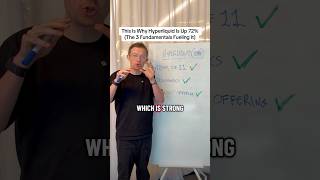
In this solo commentary, Ben Simpson explains why the Hyperliquid (HLP) token has risen roughly 70% year‑to‑date, outperforming Bitcoin, gold, the S&P 500 and many other altcoins. He outlines his original investment at about $23 per token, the platform’s business model (a perpetuals exchange that lets users trade tokenized assets 24/7), and how Hyperliquid generates revenue that is 97 % returned to token holders despite having only ~11 employees. Simpson then educates viewers on tokenomics, contrasting circulating, total and max supply, token unlock schedules, and the inflationary pressure that can cripple many projects (e.g., Immutable X). He stresses the importance of early‑stage buying on decentralized exchanges to avoid paying inflated prices after listings on major exchanges. The video moves on to criteria for assessing crypto projects: product‑market fit, on‑chain usage metrics (volume, open interest, TVL, development activity), and macro tailwinds such as oil price volatility driven by the Iran‑related war. Simpson differentiates evaluation metrics for exchange tokens versus layer‑1 blockchains. He concludes that Hyperliquid’s strong fundamentals, high fee‑return rate, and favorable macro environment explain its outperformance, while acknowledging that future performance remains tied to Bitcoin’s direction. Viewers are invited to explore his research link for deeper investment methodology.
Chapters
Most investors are losing in Bitcoin and digital assets right now while all markets are feeling the pinch of global uncertainty, the rise of cost of living, inflation, the war, oil costs. This particular investment that I got in at $23 and shared is now up to close to $40. It's up 70% year to date, and I want to share with you the principles as to why I invested in this close to a year ago, why this has strong fundamentals, and why you need to be so, so selective when investing into the Bitcoin and digital asset space, because you can get sucked into the noise by influencers and content creators who get you excited about tokens that, you know, seem good on the surface but fundamentally have very, very weak value. And we want to talk about the token economics today. I want to talk about what separates a good project from a bad project and why this particular investment has done so well. It has actually knocked Cardano out of the top 10. It is now into the 10th spot on the cryptocurrency market cap leaderboard. It is outperforming gold, the S&P 500, and it is a cryptocurrency project. All right, now the core piece as to why I shared hyper liquid close to, or a bit over a year ago now, at around $23, was back in February. It was particularly at the time around, you know, some interest that we started to, you know, the analyst and I started to get into around perps trading, the ability to trade assets 24/7 that, that actually couldn't be invested in otherwise. As an example, gold, silver, stocks, oil, you cannot trade them outside of stock market hours. Hyper liquid trading platform that you can trade these assets, essentially tokenized assets, 24/7. And the volume has been phenomenal. So Hyperliquid is the platform that you're looking at here, and it has had close to $370 billion worth of total deposits. It's had $4.2 trillion worth of total volume. It's got over a million users, and the total volume continues to grow. All right, why is that? Well, the biggest reason is that the ongoing war in Iran has spiked volatility on oil, and people that want to trade oil outside of ours can't. So you've essentially got a finance company in Hyperliquid that has created a platform to trade these assets on crypto rails. So Hyperliquid generates revenue from the fees that you trade on the platform, and 97% of those fees go back to the token holder. Now, how can they do that? Well, they only have approximately 11 employees. All right, every business owner in the world would love to do hundreds of millions of dollars in token volume or revenue and only have 11 employees. How is that possible? Well, it's possible because of blockchain. Blockchain allows you to essentially have a product that you can interact with peer-to-peer without the need of a middle person. If you take a normal brokerage as an example, they take the fees, they take the revenue, and they give a little bit back to the shareholders. But for Hyperliquid as a blockchain-based company, 97% of those fees go back to the token holders. Now the other thing as well that is really positive from a token unlocks perspective is that is necessarily a non-factor. One thing that a lot of people don't understand when they're getting into cryptocurrency is what we call token unlocks, all right? And this is the tokenomics. So the second part of reviewing any sort of investment when getting into cryptocurrency is looking at the tokenomics. Now, when you look at the tokenomics, you are not buying a share like you are in the stock market. If you're buying a share, you actually own a portion of that company. Well, in digital assets, tokenomics matter because this is the opposite to how shares work. Essentially, what happens with these altcoins is that you get inflation of supply. All right, the amount of supply that is created or available to be created is the amount of tokens it has, and usually has a big number of unlocks. What does that mean? Well, basically every period of time you have these tokens that unlock money into the supply, into the market for investors to scoop up and buy. Now the problem with a lot of these tokens is that what happens is that there's not a lot of demand for the token, which means that there's no one buying when there's tokens coming out on the open market. So essentially what you get is these highly inflated token supply, and they create tokens into the market, and then you've got no buyers. All right, and a perfect example of that is like so many of the gaming projects that we've seen over a period of time. All right, if we looked at something like Immutable X, you know, on the front end, great idea, you know, product that worked, it did what it said on the tin, didn't get a lot of product-market fit, and it has a lot of supply— 2 million, 2 billion tokens— that it will eventually put into the market. They're only about 853 million right now, so only about 40% of the total supply is in the market. And then you look at the market cap of Immutable X, it is essentially down from all-time highs 98%. Why is that? Because they've created a lot more supply, there's not a lot of demand, and there's not a lot of buyers to come in and buy that token. And that is where tokenomics is very, very important. The real core thing here you want to look at is the basic supply figures. All right, you want to look at circulating supply, you want to look at total supply, and you want to look at the maximum supply. All right, that's really, really important. The circulating supply is the total number of coins or tokens in the market at that point in time. The total supply is the total number of coins that exist in a given moment. And then the maximum supply is the total amount of maximum coins that will be created at any point in time. Now, the most important part that a lot of people miss when looking at token economics or just an investment is that a lot of people don't buy early enough and they only buy when it gets to major exchanges like Coinbase as an example. By the time Hyperliquid got actually listed on Kraken and Coinbase, the price had already done 100-200%. I bought back here where you had to buy on decentralized exchanges or native markets as they call it, because that is where you get the early access to the tokens. That's part of the research that we put out. If you're not buying at that point, you are essentially, most of all, usually exit liquidity for some of these early projects. The reason why they have a lot of supply, a lot of these altcoins that unlock, is because they have to fund their project, all right? And VCs and the employees create the tokens, sell the tokens in the market, and then pay for their bills. How do they do that? Well, they create marketing spin. And this is the third part that is really very important when analyzing a project, is that you need to understand, is this project actually just creating hype not Hyperliquid, creating marketing spin and narrative to buy, to, to make you invest, or does it actually have fundamental value? All right, so when you're evaluating this, not only do you have to look at the tokenomics and look at, you know, what's actually happening with the, the project itself, but I like to actually look at, okay, is anyone actually using this product? And Hyperliquid has product-market fit. A lot of people during this Middle East war have turned to Hyperliquid as a way to trade on their platform. All right, the volume you can see here continues to spike, right? This is something we look at, the open interest rates. We look at the volume of the project. We look at, you know, how these projects are actually being utilized. Now, as an exchange, this is one of the, you know, uh, platforms that you can trade these projects on at the moment, or assets, and it is outperforming so many other exchanges with the volume. So this is really good. Now, if you're looking at another asset like a Layer 1, as an example, you want to be looking at different metrics, all right? Not all metrics are the same for different cryptocurrencies. It's not just like you're looking at EBITDA multiples, and that's the thing that you want to, you know, analyze on the share market. Depending on the cryptocurrency that you're looking to analyze, there is different metrics that you look at. So for layer 1s, as an example, like, you know, layer 1 blockchains, which are simply the app store, the decentralized app store that applications get built on top of, you want to look at things like, you know, volume of the, uh, of the layer 1. So Ethereum, Solana, etc. You want to look at things like, uh, TVL, so total value, so the amount of money that's been invested in the project. You want to look at the, the volume that it's doing over a 24-hour period. You're going to be wanting to look at things like development activity, blockchain uptime. You're going to want to be looking at, you know, uh, monthly volumes, inflows as well, the amount of money that's coming into these chains. It changes depending on the token, all right? And that's the part here around token economics and the fundamental value that you've got to be really careful about, all right? Now the last thing I want to share is why is it outperforming. If we look at Hyperliquid, and the reason why it's doing so well again is the amount of investors and market participants that are investing at the moment in Hyperliquid is primarily driven by macro factors. Cryptocurrency is susceptible to the upside and downside on macro factors, and we see this with good and bad news. So Hyperliquid has really, really outperformed over the last— you know what, it's done really well over the last 18 months, but particularly year to date. If we look at Hyperliquid against, let's say, gold and the S&P 500, in the chart here in the green you've got Hyperliquid, and then in the blue you've got the S&P 500, and in the purple you've got others, which is the altcoin market cap, all right, outside of the top 10. So you can see this outperformance is just ginormous because it's got some very strong tailwinds around why someone would want to use Hyperliquid. And that is exactly why, you know, we put this, you know, investment research out over nearly a year ago. This is where I put in I was buying Hyperliquid. It is still in our portfolio to date. Would I be buying at these levels? That's a different conversation depending on, you know, the, the price point that you're looking at. I personally got it at $23, so it's a little bit different. All right, and, and I'm holding because I do believe, you know, this is going to be a really strong project, you know, moving forward. Is it going to continue at this rate and growth? Will it you know, correct here based on the market. That's a bit of analysis that we'll wait and see based on what Bitcoin does. These altcoins are essentially leveraged positions on Bitcoin, and depending on what Bitcoin does, sometimes a lot of the weight of the growth or decline of the asset relies on Bitcoin. But Hyperliquid has been the big outperformer year to date, and I expect it to do well if the market can continue upwards. If you're interested in seeing how our research works and how our sophisticated investors are utilizing this research and education to help them invest into the digital asset market, you can check out the link in the description below where I talk a little bit about how we invest into Bitcoin and digital assets and how our research works. But that is all for today, folks. Hopefully you enjoyed that video. If you've got any other questions or topics you want to talk— want me to talk about in terms of fundamental investing and the tokenomics of these projects, let me know in the comments below. Thank you for watching, and I'll see you next time.