In this lecture, the speaker critiques Edward H. Angle’s long‑standing classification of malocclusion (Class I, II, III) as a root cause of harmful treatment decisions. He argues that the classification encourages orthodontists to diagnose Class III cases as mandibular prognathism and to perform mandibular setback or maxillary backward surgeries, which frequently narrow the upper airway and precipitate or worsen sleep‑disordered breathing. The talk cites a 2017 study showing that 13% of patients developed new sleep apnea and 27% experienced louder snoring after bimaxillary setback surgery, with significant reductions in retropalatal and retroglossal airway volumes. Through a series of clinical cases, he demonstrates that most Class III patients actually have retrusive maxillae (and often retrusive mandibles) rather than a forward‑projecting mandible. Alternative treatment strategies—such as orthopedic face‑mask therapy to advance the maxilla combined with fixed braces—are presented as successful, avoiding surgical setbacks and preserving airway space. A historic case of a patient who underwent mandibular setback in the 1970s and later suffered severe sleep apnea is revisited; reversal surgery that advanced the jaws restored airway volume, eliminated CPAP dependence, and improved systemic health. The speaker concludes that the Angle classification should be abandoned in favor of diagnostic goals centered on facial balance and airway optimization.
Chapters
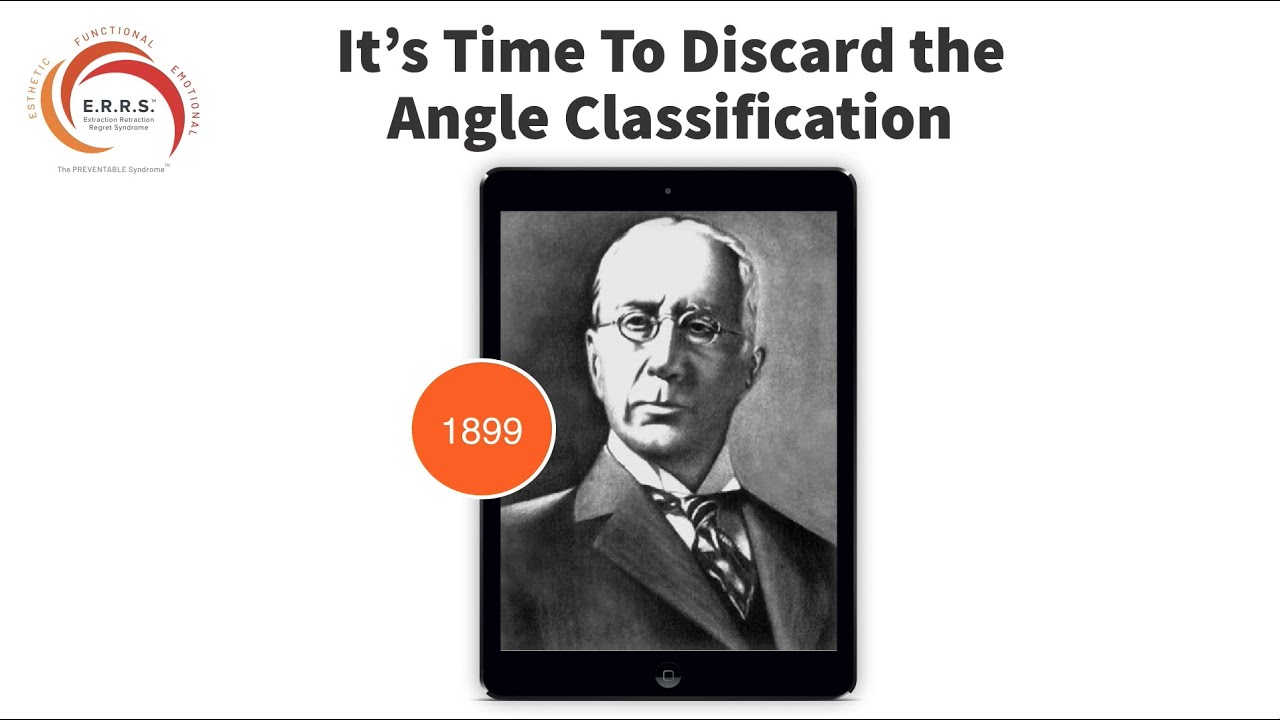
Welcome back. This segment is entitled Angle's Classification of Malocclusion. This slide off of the internet talks about how Edward H. Angle published his classification system starting in 1899. Basically, for the entire history of the orthodontic profession, orthodontists have been treating Class I malocclusions, Class II malocclusions, and Class III malocclusions. I think the time for that to change is now. I put this up here for you to consider: Is the Angle classification killing people? You may think I'm overstating my case, but let's see with the slides I'm going to present to you right now. If you look on the internet, you can see this is a depiction of a Class III malocclusion. The dentist, the dental situation on the left-hand side and the face depicted on the right. But the fact is, they don't, that doesn't tell you where are the teeth in the face. When we talk about Class III malocclusions, most orthodontists immediately start to think about the mandible being prognathic and being too far forward. Now, indeed, in this particular depiction off of the internet, the mandible is too far forward relative to the Bolton norm. But the fact of the matter is, this is a relatively rare occurrence, and usually the mandible is back rather than too far forward, and the maxilla is also back. And we're going to illustrate that to you in a But let's look about the impact of such diagnosis. Here we have an article published in 2017 entitled The Structural Changes of Upper Airway and Newly Developed Sleep Breathing Disorders After Surgical Treatment in Class III Malocclusion Subjects. This is a group of patients who had surgery to set both the upper and lower jaws back in some instances. And here's the results. No patients complained of sleep-related symptoms, and the results of sleep studies showed normal values of treatment before surgery. 3 of the patients, 13%, were newly diagnosed with mild or moderate sleep apnea, and 6 patients, 27%, showed increased loudness of snoring, over 40 decibels, after bimaxillary surgery. According to cephalometric analysis and 3D CT results, The retropalatal and retroglossal areas were significantly narrowed in Class III malocclusion patients showing snoring and sleep apnea after surgery. In addition, the total volume of the upper airway was considerably reduced following surgery in these same patients. But if we look at how they did the diagnosis, it talks about Class III malocclusions would present with skeletal discrepancies such as a prognathic mandible, With or without a protruding maxilla. And this is where the problem comes. In reality, very few Class III patients have prognathic mandibles, and almost always the maxilla is too far back. So, if you believe that the mandible is too far forward, then you do a mandibular setback as shown here, and it's been routinely used as an orthognathic surgical procedure for mandibular prognathism and bimaxillary orthognathism. Orthognathic surgery, including mandibular setback and maxillary backward movement procedures, are commonly used to correct Class III malocclusion. This is why this— the problem exists for these patients, and they're having sleep apnea afterwards. The diagnosis of where the jaws are in the face is completely wrong. Let's look at this gentleman, for instance. This young boy, his chief concern is his bite relationship. He was referred to us by his general dentist. He sleeps well, doesn't have a snoring problem, no evidence of sleep apnea, and his tonsils are not enlarged as they often are in Class III patients. His temporomandibular joints don't click and he has no pop. So, here is a rare case where we put the Bolton norm on and his mandible is dramatically forward from where it ought to be. And most people would say, well, surgery is the only way out of this. In reality, that's not the case. So, what do we do? The same young man wears a face mask to advance the maxilla. He wore it full-time for about 5 months and wore braces. And what you see here also is that we've opened some space between his upper second bicuspids and his upper molars to compensate for this unfavorable growth. We've got a normal overbite-overjet relationship for him. All of this is done with a combination of face mask and fixed braces. You can see the nice improvement in his bite relationship and in his smile. And you can also see the dramatic change in his facial skeletal pattern after the treatment. No longer does he have this very forward appearance of his chin. And you can see him without the Bolton arm on right here. In reality, what we're really dealing with in most cases is a Class III patient like this. She was treated orthodontically, but what you see here is both of her jaws are back. She needs surgery. But the fact is, the surgeon who's going to treat her understands that both jaws need to be moved forward rather than back. Here's another case. Here's another Class III case, and you can see how dramatic his bite relationship, how poor it is. He's got Class III bilaterally, one side worse than the other. But when you look at his face, you see that both jaws are too far back. Using the Bolton norm. Here's another person. He's Class III, also with an asymmetry, with a somewhat different bite relationship, but a full cusp Class III. Look at his face and you can see his maxilla and his mandible are back. His nose is bent back as well. Result of chronic, a lifetime of chronic mouth breathing. And here he needs surgery, but it's going to be done properly and not going to have, he's not going to have— His jaw is set back. So, let's look at someone who has had the mandible set back. Here's such an individual who, he already had orthognathic surgery in 1976 to set his mandible back to correct a Class III protrusion. And this is what he presents to us with when he's in his 50s. You can see this end-on-end relationship and a poor bite relationship. But he doesn't come to us because of that. He comes to us because he's on a CPAP, which is not helping. He's on blood thinners, and life is not good for him, and he wants to lead a normal life. So, notice how far back his face is relative to the Bolton Norm. I can't even get the Bolton Norm on it in this particular picture completely. The point is, when he had his mandible set back, it was focused entirely on making the teeth fit. In the 1970s, no one was talking about the airway, tongue space, and the effect that it might have. Unfortunately, this type of surgery is obviously still being done. So, here's his airway prior to us doing any surgery. It's not the best, it's not the worst, but in his case, it collapses at night and causes him to have a severe problem with severe sleep apnea. Here he is after treatment. He's had surgery. Notice we haven't closed any of the spacing in here. He frankly doesn't care. What he wanted out of this was— has nothing to do with straight teeth and everything to do with wanting more tongue space. So, you can see that we've left some spaces here. His face was brought forward surgically here on the right after his second surgery to reverse what was done in 1976. But his airway was improved from the pretreatment to the post-treatment, and this is enough to get rid of his sleep apnea And essentially have him see that his blood pressure drops and he gets healthier and has hopefully a normal lifespan. So, you kind of say to yourself, why did you have to set the mandible back? And that's my whole point, is that Class III patients don't need the mandible set back. They don't need the maxilla set back either. My point then is, what good is the Angle classification if we— if it causes us to focus on these patients improperly And we do something that's not going to help them be healthier. I would submit to you that we need to eliminate the angle classification from orthodontic diagnosis and set a goal of optimizing facial balance and optimizing airway for all of our patients.