In this lecture, Bill Hang critiques conventional cephalometric analyses as unreliable, citing Larry Andrews' claim that they vary up to 12 mm in ideal incisor position. He introduces the "indicator line" (also called the "cosmetic line") as a simple, age‑adjusted linear measurement (21 mm + age for males, 23 mm + age for females) that predicts facial attractiveness and maxillary support. Hang explains that values within this narrow range correspond to highly attractive faces, while deviations of 5 mm or more signal the need for early orthotropic intervention, and deviations of 10 mm or more predict severe aesthetic and functional problems (e.g., TMJ risk). He provides case examples of children with normal, borderline, and extreme cosmetic line measurements, illustrating how the metric predicts crowding, deep bites, gummy smiles, and long‑term unattractiveness. The talk also offers practical referral guidance for other clinicians, warns against relying on traditional orthodontic evaluations that may simply increase the line, and includes a cultural commentary on the prevalence of braces as a status symbol. Throughout, Hang blends clinical instruction, personal anecdote, and a persuasive stance on adopting the cosmetic line as a primary diagnostic tool.
Chapters
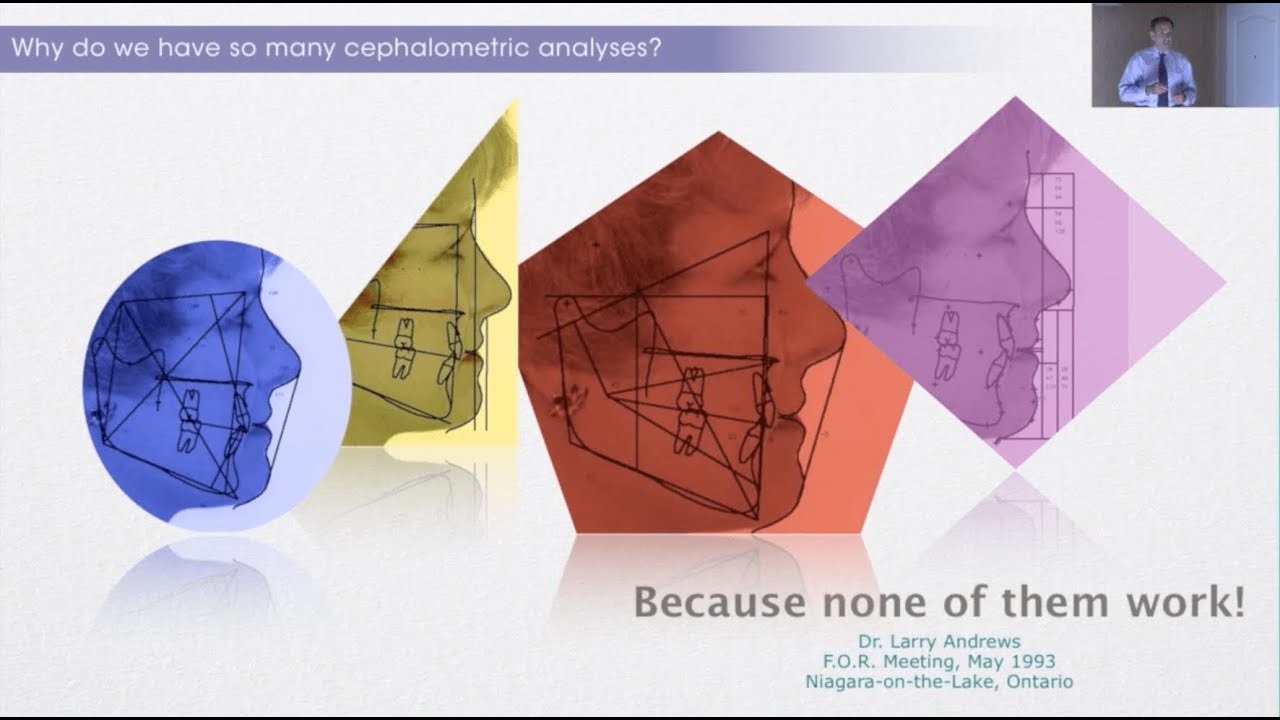
Teeth together, lightly or slightly apart, tongue to the roof of the mouth, lips together without strain. Is that good? Okay, cool. It only took me about 18 years to learn this. I was doing biobloc orthotropics, and when I took the course, to me it was still about correcting a Class II occlusion to a Class I. I was still in that orthodontist mode of trying to focus on that. The more I learn about it, the more I understand just how much there is to learn, and I will die someday, hopefully at a ripe old age, Still learning as I do this, and you will too, hopefully. So what is the holy grail of orthodontics? When the x-ray was invented, that pretty much took it over, didn't it? Now, if you don't know cephalometrics, you are not— you can't be in the club and you can't be part of the game. So I encourage you to go learn some cephalometric analysis, which I'm not going to teach you. If you want to learn some of that stuff, you can take a course on how to put bands and brackets and wires on from Brian over here in the American Academy of Nephrological Orthopedics, which is great. I encourage you to do that. And you'll learn these things, so it's nice to be able to know the language. But do I— I put this quote up here from the guy who invented the straight wire appliance, Larry Andrews, speaking in Niagara-on-the-Lake, Ontario, at a meeting that I attended, May of 1993, a long time ago. He said, why do we have so many cephalometric analyses...? Because none of them work. Really. And then this one he followed up with: using various cephalometric analyses, the ideal position of the upper incisor in the face can vary by as much as 12 millimeters. So being the crazy guy that I am, I always have to have an image for that. And this is the image I came up with, being at Jerry Pond's birthday party when I was about 8 years old and playing pin the tail on the donkey. When you're blindfolded. And you put it up there and that's the position of the upper incisor. Not terribly accurate, but maybe just about as accurate as you are if, if the range is within 12 millimeters. And the fact is that almost all of those analyses would find that it's fine to have these teeth in a certain position, but almost always relative to what John Mew would say, they're going to be too far back in the face. So don't use it. So many of you will ask me, well, what analysis do you use? I don't use an analysis. A lot of people have that very hard— they really don't believe me. They'll keep asking the question. I said, I've never traced head x-rays since I got out of training. I don't do it. They don't mean anything to me. Do I know SNA and SNB? Yeah, I do. And this is it. If you learn this out of the course, this is the most important thing. What we call the What John calls the indicator line, and people in Michigan that I was working with called the cosmetic line because they hated the term indicator line. I don't know why, but so we call it the cosmetic line. And the norm is 21 millimeters plus the patient's age in years and 23 millimeters plus the patient's age in years. And this is in your book, so you don't need to worry about it. And if you find faces that are within this range, you will be looking at incredibly attractive people, male or female. Doesn't matter. But you'll rarely find a child. I showed you one this morning, and his face was literally on the money. As an adult male, it's 38 to 42, and a female, 36 to 40. And again, a very narrow range. If you find people that are in that range, those people are very attractive people. Everyone will look at them and say they're attractive. The bigger the number is, the worse it's going to be. We don't treat somebody until they're at least 5 millimeters out of the range. So if it's an 8-year-old child and the number should be 31 and it's 34, I'm not going to treat this child with biobloc orthotropics. If it should be 31 and it's 39, okay, I'm going to treat this person very likely. We'll get into why you would, a lot of other factors. But it's nothing more than a measurement of how far down the maxilla has descended from where it ought to be. And why does that happen? Because the upper incisor doesn't support the anterior maxilla, correct? That's it. If you had the tongue plastered to the roof of the mouth, the whole face would grow forward normally. But no matter what the malocclusion is, all cases, the upper incisor is going to start to drift down and back in Class I, Class II, Class III. So you may get crowding, deep bites, recessive lower jaws, open bites, gummy smiles, And you can recognize that some of this is going to happen for these patients long before you really could recognize it. If this number is 10 mm— if it's an 8 mm kid, excuse me, an 8-year-old kid, and it's 10 mm or more from the norm, you're going to see a child whose face is not going to be okay. And if it's your kid, you want to do something about it starting yesterday. So we recommend an orthodontic evaluation as soon as that number is over on the high side of 5 millimeters. Yes? When you say orthodontic evaluation, do you mean this is part of the— Right, that means we're saying to someone who's a referring practice, if they were to see someone and they were to measure this, and we have a tool for this, we'd love to see them. Okay, a traditional orthodontic evaluation for this number means nothing because all they're going to do is make the indicator line, cosmetic line, But most of what they're going to do is going to make it bigger. Okay? So this is a classic, and it's in the book. I'm confident that this picture is in John's book. This is Louisa, a cute little girl here, age 6, and by age 9, she's— hardly anyone on planet Earth would say this girl is cute. And yet, the seeds for destruction were already sown. And those of you who have taken Mark's course and understand myofunctional therapy, You'll already know that this lower lip is flaccid and rolled out, and it's kind of like, okay, not okay. You know this isn't going to be okay. Just to look at how close this is, let's test this number. So here's a little girl that comes into my practice, 9 years old. It's 32, and it should be 30 for a girl. Put the Bolton Norm on her and look how close it comes. Right on the money. And her teeth are right on the money. Contrast that to this girl who's 10 years of age with a cosmetic line of 46, and the ideal should be 31. It's 15 millimeters. If you find someone who's 15 millimeters above this line, the number, you have got some child that is incredibly unattractive and is going to get even worse. Forget about how the teeth fit. It doesn't matter. This girl happens to have a deep bite occlusion like this. And a girl like this is a classic from my perspective. She's got, in my book, a 99.9% chance of having a TMJ problem in her life. Aside from the fact that she's not attractive, and by the time she goes through puberty and all of this, this has increased by more than a millimeter a year. Which would be normal. She'll be incredibly unattractive. She won't look out of place because there's going to be a lot of other people that are equally unattractive. So when you come, there's a place over in Westlake Village where my practice currently is, diagonal from my office, called the Promenade. It's a very nice outdoor shopping plaza, and there's a Barnes& Noble store there with a Starbucks. So if you want to really have some entertainment, what you do— and there's a fountain outside— so you get yourself a Starbucks tonight, You sit outside and you look at the primitive mating ritual which will be going on in front of your eyes. It's right here in Westlake Village. And you'll see all the teenagers, every one of them, by the time they're a junior or senior, it was genetically programmed and they have a God-given right to wear braces whether they need them or not. They will because their parents can afford them. Look at the faces. You'll be amazed.