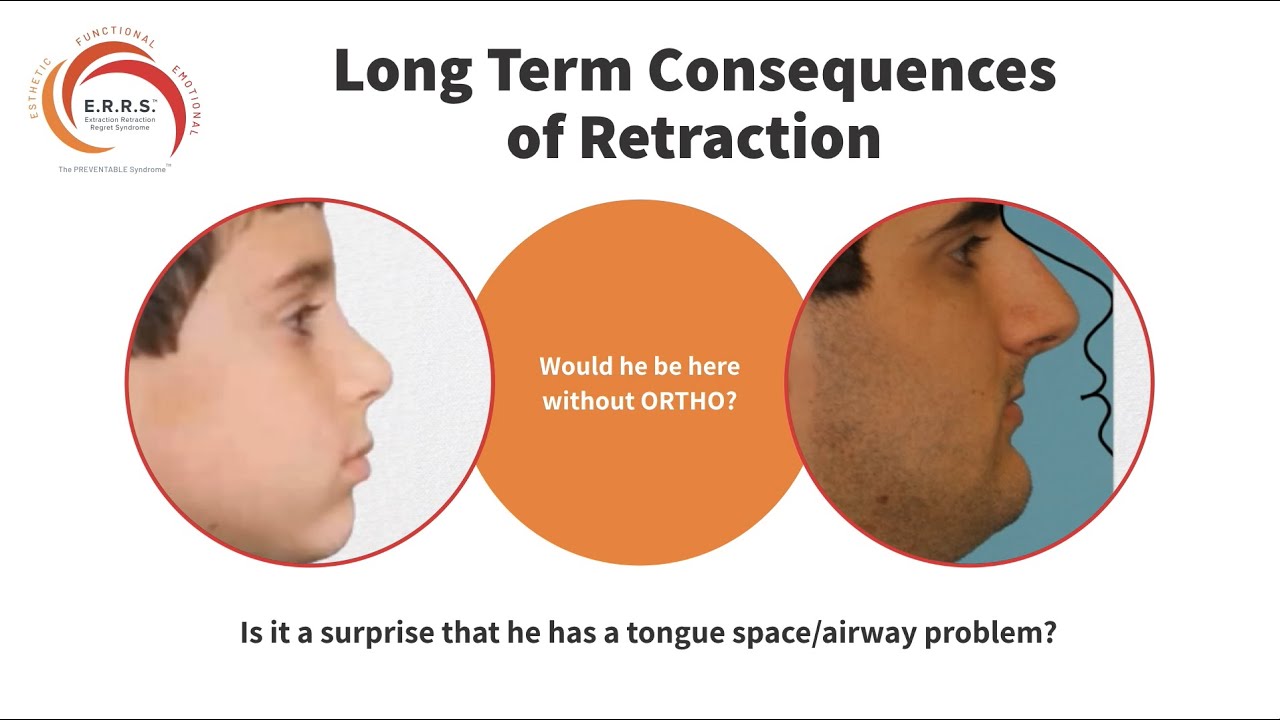
In this clinical presentation, the speaker examines the long‑term outcomes of a traditional orthodontic approach that involved extracting four bicuspid teeth from an adolescent male. The case is illustrated with morph‑sequences showing a dramatic posterior facial retraction, bilateral posterior open bite, severe gingival recession, loss of papillae, compromised tongue posture, and a markedly reduced airway. Despite two rounds of braces and the use of vertical elastics, the open bite remained unstable because the retracted arches left no functional space for the tongue. The patient ultimately required orthognathic surgery to advance both jaws, improve airway patency, and achieve a more functional bite. The speaker contrasts this outcome with a female patient treated with Phase 1 orthotropic therapy, whose facial profile remained close to the Bolton norm and who did not experience the same adverse effects. The presentation questions whether patients and families would choose extraction‑based retraction if they were aware of these potential long‑term complications, and suggests that such cases may be more common than assumed.
Chapters
Welcome back. This segment is entitled Long-Term Consequences of Retraction. Let's explore the case of an adolescent boy who had 4 bicuspid teeth removed as part of his orthodontic treatment. Here he is on the left-hand side, and we're going to show a morph of his face from where he was prior to the treatment, and here he is morphing into what he looked like after his adolescent treatment. Compared to the girl on the right, whose face is coming forward in a Phase 1 orthotropic treatment, now look at the boy on the left as he matures from his adolescence to his college years. Now look at the girl maturing after orthotropics to the time she goes off to college. You can compare the 2 profiles to the bold norm. Her face is virtually ideally positioned Relative to the Bolton norm, and in his case, the nose and both the upper and lower jaws are dramatically back from where they ought to be. But let's look at what really happens to him and his teeth, because there's more to the story. He has a bilateral posterior open bite, and this is after he's been treated twice by the same orthodontist. Later in his teens, this posterior open bite developed, and the orthodontist put braces on again and used vertical elastics to bring the teeth together. But they didn't stay together. And you ask, well, why isn't this stable? The fact is, there's no place for his tongue to sit in here, and his tongue would fit between the posterior teeth and cause these teeth to be in a lateral open bite. Please notice that he has rather substantial recession with no papillae between his lower incisor teeth, and yet we as orthodontists are taught that bicuspid tooth extraction is necessary to retract, to get the teeth upright over basal bone, so that we can avoid recession. Certainly hasn't happened in his case. Let's look at the airway in this 6'7 gentleman, which is even more important. Looking at the airway in cross-section, this is not a great airway for a young man who's this tall and this big. He needs a dramatically better airway than this. This is not a situation where I can reopen the 4 extraction spaces and make the teeth fit. Unfortunately, this is now a case requiring surgery to fix. So, here he is, notice here he is prior to his treatment, and here he is prior to us doing any treatment after he's matured and in college. See the dramatic change in his face from his pretreatment to his post-treatment plus several years profile. Hard to believe that this is the same individual. Here he is after orthognathic surgery to advance both of his jaws, and you can see he's still a bit swollen and the teeth don't fit so ideally, but he had to undergo surgery to bring the jaws forward to open his airway and make his teeth fit so that he could chew on his back teeth. Here you see his teeth fitting together better, 2 years post-treatment, and the teeth are staying together a bit better after this orthognathic surgery. Here he is prior to the surgery on the left-hand side and after on the right-hand side. Do you believe that that little boy and his parents would have, would have decided to go ahead with the treatment they did had they known what he was going to get into? So, again, the long-term consequences of retraction of teeth. Do you think that this retraction patient is the only one with a similar story? I don't.