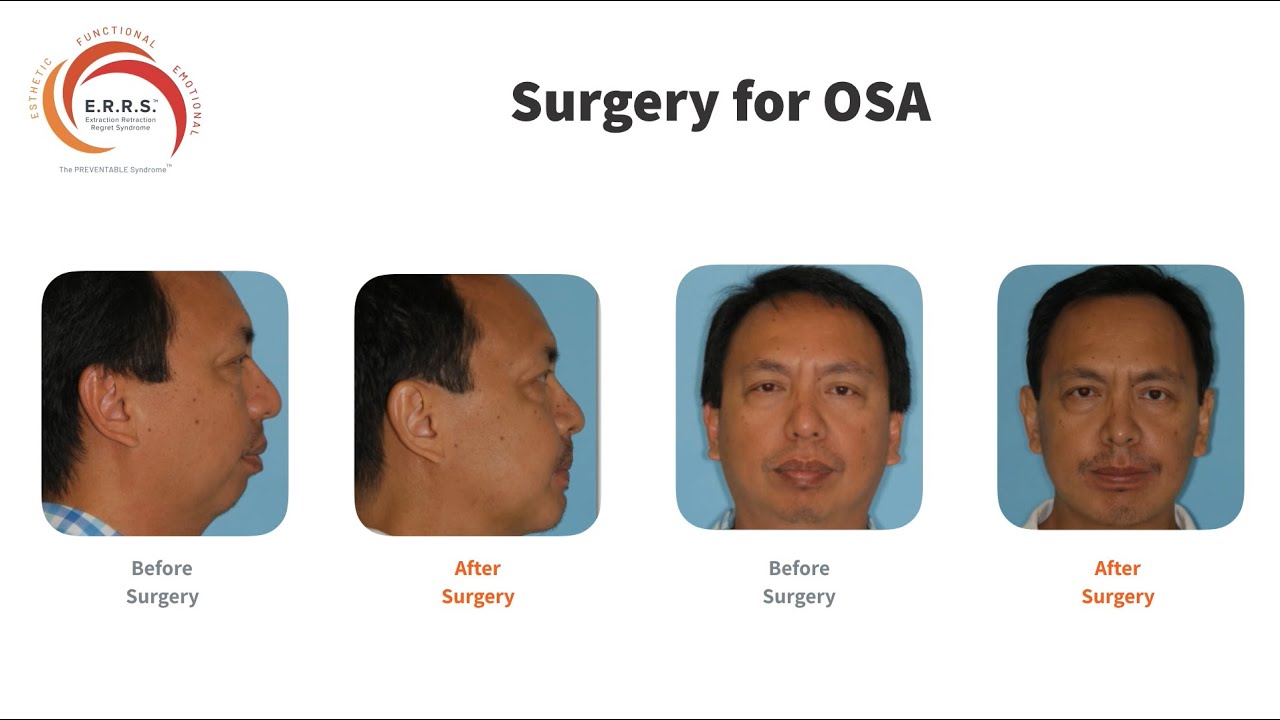
In this video Dr. Bill Hang presents an emergency orthotic case of a male patient with severe obstructive sleep apnea (OSA) (AHI 53.3, oxygen desaturation to 65%) and markedly elevated blood pressure (163/120). The patient sought cosmetic improvement of his lower face and had a history of upper bicuspid extractions. Dr. Hang suspected OSA, ordered a sleep study (performed within two days), and initiated CPAP while planning definitive surgery. The surgical plan involved extracting the lower first bicuspids, performing a mandibular sub‑apical osteotomy to set back the six anterior teeth, advancing the mandible 10‑15 mm, advancing the maxilla, and performing genioplasty. Post‑operative ICU photos show a corrected facial contour angle, and the patient reported rapid blood‑pressure reduction to 127/78, restored energy, improved sleep, and enhanced facial aesthetics within weeks. Dr. Hang emphasizes the importance of dental practitioners screening for OSA, asking the right questions, and considering aggressive surgical correction when conservative options are insufficient, drawing on his 40‑year experience.
Chapters
Welcome back. This segment is entitled Surgery for Obstructive Sleep Apnea. Most people have never seen a true emergency orthotic case, but I'm here to present you with one. This gentleman presented to me hoping that I would be able to do some kind of conservative treatment to develop his lower face forward. He'd seen some things online and hoped I was going to be able to do adult orthotropics. He had upper bicuspids extracted as an adolescent in his home country because his teeth were supposedly protruding, and this is where he presented to me. As he said to my wife, who was my treatment coordinator, he stated, all my insecurities relate to the fact that I have no chin. When I saw him for the very first time, I strongly suspected that he had sleep apnea, and I took his blood pressure, which was 163/120, and he'd been on meds for 4 years. I asked him if his doctor had suggested a sleep study. No. Had your doctor even asked you if you'd snored? The answer was no. I suggested that he needed to have a sleep study, and literally 2 days later, he had a sleep study done. His AHI was 53.3, which qualified him for a severe obstructive sleep apnea diagnosis. And he was desaturating to 65% oxygen saturation. For those of you who have any training in sleep, you realize this is a very serious problem requiring treatment right away. In his particular case, we got him on a CPAP machine while we planned his treatment. Here you see his face relative to a Bolton norm. His forehead is sloped back dramatically. It should be virtually horizontal— virtually vertical, rather. But this way he keeps his chin forward and keeps his airway open. If you look at his airway, his airway is actually dramatically bigger than you might expect. But we had a surgical treatment plan which we wanted to do, because I wanted to completely eliminate his sleep apnea and not just have him on a CPAP machine for the rest of his life. So, in his particular case, I wanted to do a mandibular subapical osteotomy to set his 6 lower anterior teeth back. And I did something that I virtually never do, which is to extract the lower right and left first bicuspid teeth. I'm very much known for not extracting teeth. In this case, it made total sense because extracting the lower first bicuspids allowed us to surgically set back the 6 anterior teeth and dramatically make a bigger overjet for him so that we could advance his mandible much more. We're going to do a mandibular advancement, and you can see coming forward several millimeters, more than 10 to 15 millimeters. We needed to advance his maxilla as well, and we brought his chin forward to give him a better-looking chin. This is all part of the pre-surgical orthodontic plan. Here he is at the time of surgery. That part of the mandible, the 6 anterior teeth, had been set back surgically, and here he had the genioplasty. Very next day, this is what he looked like in the ICU at the hospital. And his chin had been back at a 27-degree facial contour angle, and here it is at an almost ideal -13 degrees, with 11 degrees being the ideal. Most importantly, a few days later, he emailed me from where the surgery was done, and he said this: Hey, Dr. Hang, couldn't wait till next week to tell you, My blood pressure as of today is 127/78. It's been on a downward trend ever since the surgery. Amazing! Woohoo! It went from 163/120 to 127/78 in a matter of days after he had surgery, which made it so he can breathe and sleep. Here he is approximately 3 weeks, and you can see he's all kind of got stuff in here with a splint. keeping his teeth together, and he's still healing up after the surgery. At 5 weeks, he's got almost 100% of his energy back, sleeping well refreshed in the morning like never before, getting vivid dreams, and taking selfies, which he'd never done before. Here he is prior to treatment. Here he is just a few weeks post-surgery. You can see that profile change for him, and from the front, you can see the change in his face. We finished his case without closing up all the spacing which was left after the surgery. He was completely happy with this, and I didn't want to take the chance that that might reverse things for him and cause him to have sleep apnea again. So, you can see here, we left him like this, with his permission and total acceptance of this result. We were not straightening his teeth. We're dealing with a medical issue here. We also left some space in the lower arch. Look at his face pre-treatment and post-treatment. A dramatic improvement in his, in his facial balance. From the front, you see a nice improvement. And from his smile. Another nice email from him to me and the surgeon who treated him. Just wanted to let you know I'm greatly enjoying my new life. Thanks for everything you've done. The new me. You have patients like this in your practice and they're, they all need the same kind of treatment. You just have to be asking the right kind of questions. Yes, surgery may seem very aggressive for some of you, but I've been doing it for more than 40 years and I've seen many dramatic changes like this for people who have no alternative to this type of treatment. Your practice and every other dental practice is full of patients that are, that have, that suffer like this.