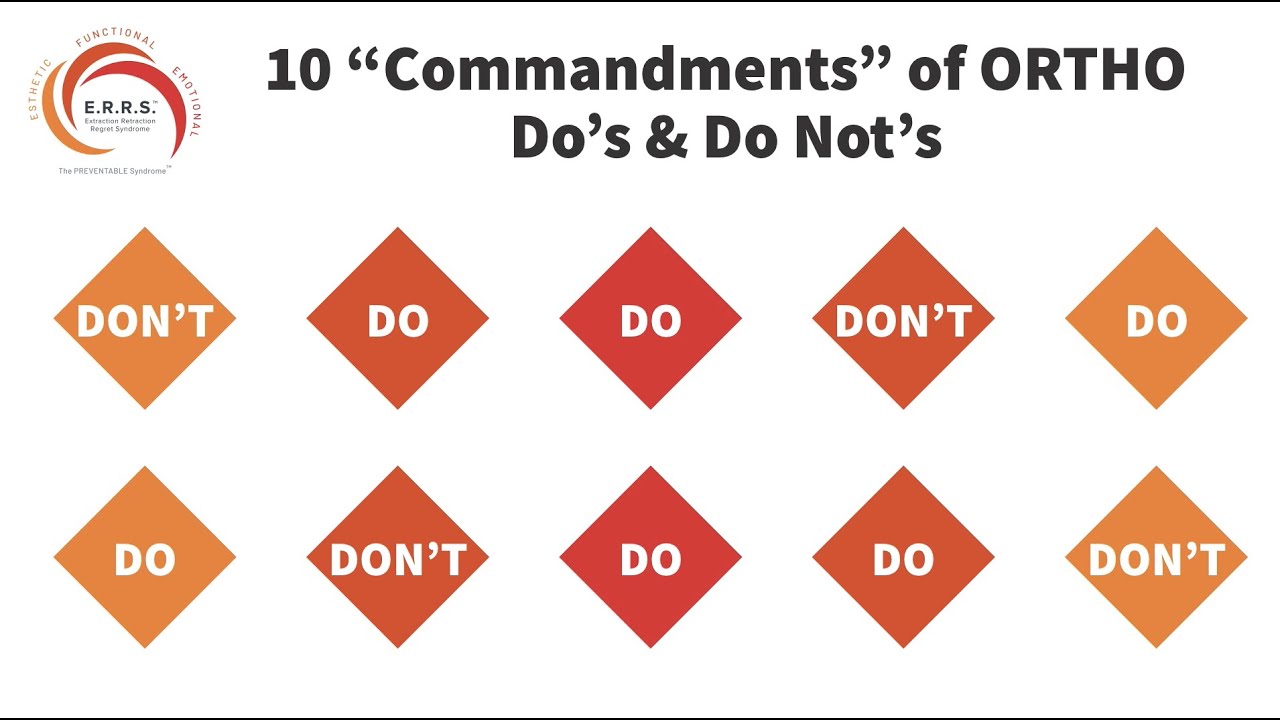
In this video, the speaker presents a paradigm‑shifting set of guidelines—dubbed the “10 Commandments”—derived from a March 2017 Cranio article co‑authored with Michael Gelb that advocates an airway‑centric approach to orthodontics and TMJ treatment. The core premise is that traditional orthodontic practices—such as headgear, appliances with a headgear effect, extractions with retraction, and the use of TADs for retraction—often compromise maxillary and mandibular forward growth, reduce airway volume, and can exacerbate sleep‑disordered breathing. Each commandment is illustrated with clinical case photographs and longitudinal outcomes, showing how avoiding these interventions, preserving natural arch space, creating space to advance teeth, treating patients early, addressing underlying postural and breathing issues, and allowing residual overjet (or opting for surgery) protect or improve the airway. The speaker also critiques current American Board of Orthodontics standards that reward space closure and overjet reduction, urging a shift toward rewarding space retention and airway preservation. The final commandment emphasizes interdisciplinary collaboration, acknowledging that no single practitioner can solve all airway‑related problems. Throughout, the tone is instructional and persuasive, with a consistently critical stance toward conventional methods and enthusiastic support for the airway‑centric philosophy.
Chapters
Welcome back. This segment is entitled 10 Commandments of What to Do and Not to Do in Orthodontics. They're all contained in this article in the March 2017 issue of Cranio, an article that I wrote along with Michael Gelb, entitled Airway-Centric TMJ Philosophy: Airway-Centric Orthodontics Ushers in the Post-Retraction World. Here's the first one: stop using headgears. And you'll notice that we've shown you a picture of Charlton Heston here from the movie The Ten Commandments, just to illustrate how important we think this is. Here you have a boy wearing a headgear, and he has a 130 or 135-degree nose-lip angle with no chin. And why would somebody like this be wearing a headgear? He needs full support. Forward development of the maxilla and the mandible, not retarding the growth of the maxilla. Number 2, stop using appliances with a headgear effect. Well, what might those be? A MARA appliance, a Twin Block appliance, a Bionator, a Frankel appliance, a Forsus appliance, a Herbst appliance, All of those have, tend to have retractive effects. Number 3, stop extraction and retraction. Here's a young boy on the left, at the time when he had 4 bicuspid teeth enucleated. Here he is post-orthodontically, then 1 year after that, and 2 years post-orthodontics. And you'll notice that he's not gone through puberty yet. Please notice how his cheeks have gotten flatter and flatter as the time has gone by, as the maxilla was retracted back and his nose appears larger. The really bad thing to go on here was the fact that the distance between the neck and his chin is dramatically decreased. And as he goes through puberty, the point is the maxilla and the mandible will continue to fall back. With the maxilla falling back, the soft palate falls back. With the mandible falling back, the tongue falls back, decreasing the airway. This is not airway-centric. And we show him here with a larger airway, like a garden hose, to start with, but by the time All this treatment is done and his growth has gone by. He's no longer having an airway even as big as a drinking straw, but more like a cocktail straw. Number 4, stop closing generalized spacing by retraction. This gentleman had some space between his upper front teeth, and what we've done is to close that space, but create a space between the second bicuspid teeth and the first molars in both arches. These spaces are large enough that they're actually very cleansable. If the patient doesn't like them, they can easily be taken care of with some overcontouring of the 2 adjacent teeth with bonding material. If you look back to your oral anatomy, realize that primates have primate spaces. And so, why should we feel bad that we've leave— leave some space in the arch somewhere? The point is, you can close spacing, which people don't like. By not retracting. Number 5, stop using TADs for retraction. This girl has had orthodontics. She has straight teeth. There are her straight teeth. But look at what has happened to her airway. She's gone from a fairly large airway to a much smaller airway. And this is what she looked like in the lower left prior to the treatment. She was an end-on-end Class II on the one side, and they used TADs to retract her back. That small amount of retraction decreased her airway. That's not okay. Number 6: Create space in the lower arch to reduce an overjet in a non-surgical Class II patient. Now, notice this man has a beard. It hides the fact that his chin is back. He's already had some orthodontics, but he's a snorer, and his general dentist wanted the orthodontics redone so he could properly restore the case. We ended up opening some space in his case, and you can see here he is in braces. There are no missing teeth, but you can see that we've created a space, a full bicuspid width, mesial to the first bicuspids and distal to the cuspids. You can also look down below and see that there's no recession with us having advanced these teeth this far. Here he is following the removal of the braces. You can see he's ready to have restoration done with implants, for extra bicuspids. Please notice there is no recession, as you might expect, or as you've probably been taught if you're an orthodontist. The fact is, this made him a non-snorer. His wife reported that not only was his sleep apnea gone, but he doesn't even snore at all, just by this advancement of the lower anterior teeth. Number 7, treat early. Here you see a girl with a very deep bite occlusion, in the primary dentition, and she has a very gummy smile. All these are primary teeth, but we treated her in the primary dentition to normalize her facial growth. We advanced her upper anterior teeth and spaced her teeth out, and then moved her mandible forward to get a very nice improvement in her bite relationship. But not only did her bite relationship change, her face changed. Her face is much fuller, the way it ought to be. Notice the Bolton Norm on her face, Please realize that she is Asian and has a shorter nose than a Caucasian. The Bolton norm is really only applicable for Caucasians. The point is, her face is fuller, her tongue space has improved dramatically, and she has her teeth together, her tongue to the palate, her lips together, and she's breathing through her nose. Number 8, treat causes such as poor restoral posture, not symptoms like crooked teeth. You can look at the teeth here and realize that this gentleman has severe crowding for his upper cuspid, and the lower incisor teeth are all tipped way back. He looks pretty bad. Many people would want to take out teeth. Of course, we would not. But that's not the point. Straightening his teeth really isn't the point here. Look at his poor restoral posture. His lips are apart dramatically. He is a chronic mouth breather. His lower face is back. His chin is almost nonexistent. These are things that need to be taken care of. They need to be taken care of long before he has all the permanent teeth in at this age. Number 9: Modify the American Board of Orthodontics requirement to reward spaces being left in the arches, overjets not reduced, and eliminate the extraction case. I give this patient as an example of that very issue. She came to me for a second opinion, and you can see her in braces. With a closing loop being used to close the small space between the cuspid and the first bicuspid. You notice that there's absolutely no overjet here. This patient, upon this examination, we found that she had a 3-week-long headache that was going on, and she didn't know why it was happening. I told her that it was likely due to the fact that she was being retracted, and I advised cutting the closing loop out. So, I cut the closing loop out. You can see that picture here on the right. We removed it at the very, that very appointment, the first time she came to the office. Here you can see the occlusal view of that first examination. And the note here is, again, remember she had a 3-week-long headache that was unrelenting. One week later, these pictures were taken, and you can see the space has opened up on its own just by the tongue pushing the teeth back forward, Without the force of the closing loop closing the space. I called the girl at her house a couple of days afterwards, after, after we'd cut the loop, and she indicated that her headache had been gone 2 hours after I cut the loop. On the right, you see her 6 weeks later. Her headache is still gone, and the space is even bigger at that point. The point is, if we were to close these spaces, we would produce those— that headache again. So, she has to be treated in some fashion or another to not retract her and not close the space. Number 10: Leave patients with overjets in Class II or do surgery to develop the face forward? So, here you have a picture of Class II elastics. No, Class II elastics retract the upper anterior teeth, and we have to be comfortable with leaving them in an overjet. Here's a patient who has an end-on-end Class II relationship. And a moderate overjet. The teeth are a bit crooked, upper and lower. He wants them straightened, so we line the teeth up and we leave him with the slight overjet. He has the teeth aligned, but leave the overjet. That should be rewarded. Number 11, work collaboratively with others because no one has all the answers. We need to work with other professionals to help us help other people breathe better and look better. So, those are the 10 commandments of what to do, and more importantly, not to do in orthodontics. In reality, they're a completely new paradigm, and this is what must happen if we're going to improve or protect the airway for our patients.