In this presentation, Dr. William M. Hang recounts several patient cases to illustrate the long‑term consequences of traditional adolescent orthodontic protocols that rely on extractions and delayed treatment. He describes a mother treated in the 1970s whose facial profile deteriorated over decades—her nose bent, chin receded, and mouth opened—despite having straight teeth after bicuspid extractions. He then details a 9‑year‑old boy who also underwent four extractions; over the next few years his facial structure “melted away,” his chin retreated, and his airway narrowed. Hang argues that such outcomes stem from ignoring the “lip‑apart posture” and the airway during adolescent treatment. He advocates intervening between ages 4 and 10, before the airway and facial growth patterns are compromised, and suggests that early, non‑extraction approaches can preserve facial aesthetics and airway health. The talk is a cautionary critique of late‑stage, extraction‑heavy orthodontics, emphasizing the need for early, holistic treatment planning.
Chapters
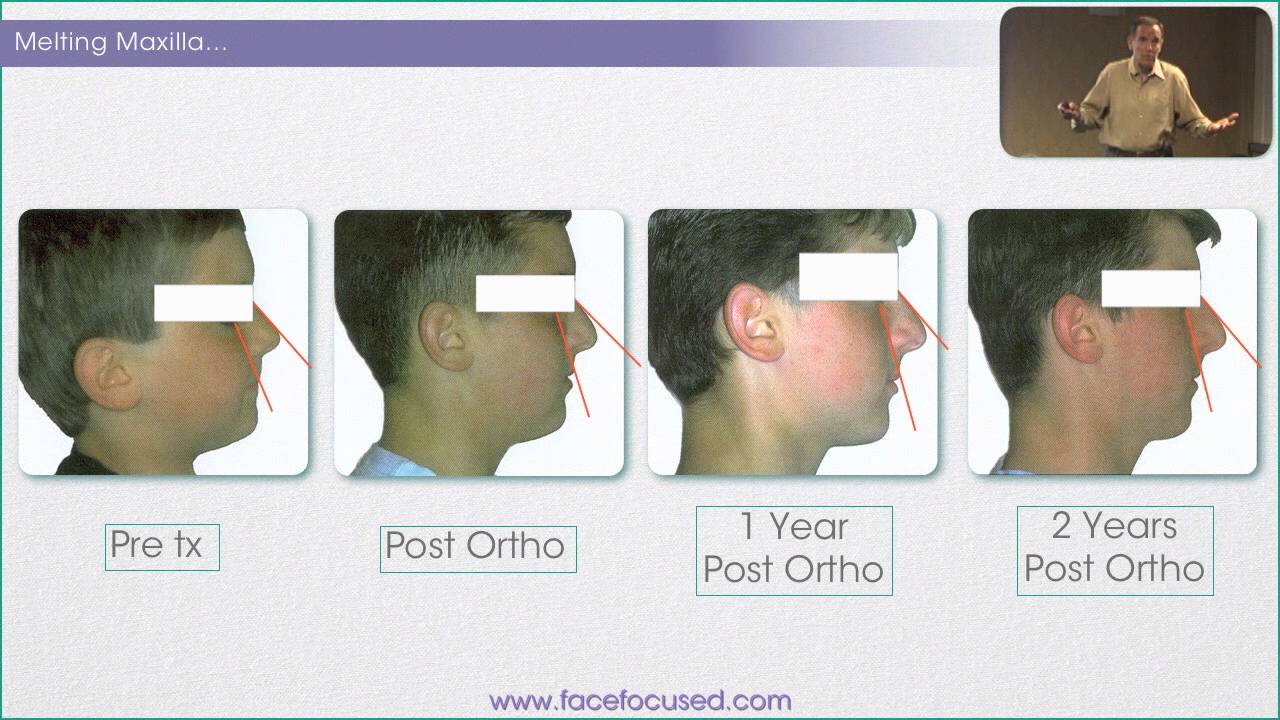
This is my own patient. I treated her back in the '70s, and she came back with her kid to get me to straighten her kid's teeth. And by the time she came back, that's what her nose looked like. It had bent like that. But look at her chin, it's way back, and her face is longer yet. Mouth is open. Her mouth was open way back here, didn't mean a thing to me. It meant nothing. I took out upper bicuspids for her and she got straight teeth. What more would you want? So the traditional adolescent orthodontics does not address lip-apart posture. So you need to do this in the 4 to 10-year-old age group. That's when you want to be dealing with it. Now this is one that really gets me. This kid was treated. He had 4 teeth taken out. The family moved to a town near me, and the only reason in the world that he came to me was because they came close— moved closer. The mother had had orthodontics, gummy smile, huge nose-lip angle. I'm looking straight down her nostrils. She's looking at me. I'm looking straight down her nostrils. I can see back to, you know, the posterior pharynx. So, the kid is at 9 years, 11 months, had 4 teeth taken out. Enucleated. And I look at him and think, oh my God, I'm going to say open up 4 spaces, put 4 implants in, and then there's going to be the lawsuit that I'm going to have to testify in because they're obviously going to think something was done wrong. And I'm the only guy in the whole state, or the 2 states, who would have said open the 4 spaces up. And it'll be me against them. So I sadly took the path of least resistance and just, okay, fine, put the braces on. Here's Here he is, 9 years, 10 months of age. Here he is when I finished the ortho. Here he is 1 year later. Here he is 2 years later. Now notice he doesn't have a whisker in place. This guy's got a long distance, a lot of growth to go before he goes through puberty. And think about what's going to happen for him, but look at what already has happened for him. Look at the face has melted away. Now it really gets fun when you look at that. Look at the distance between his chin and his And you say, this is over a space— he's in his probably 14 or something like that here. Now if this is your son and you're a really good mother, you've probably noticed that something may have gone on here. But if it occurs so slowly, it's kind of like gray hair, you don't even notice it. So this is what goes on. You started out with a nice airway and now you're down to not so good.