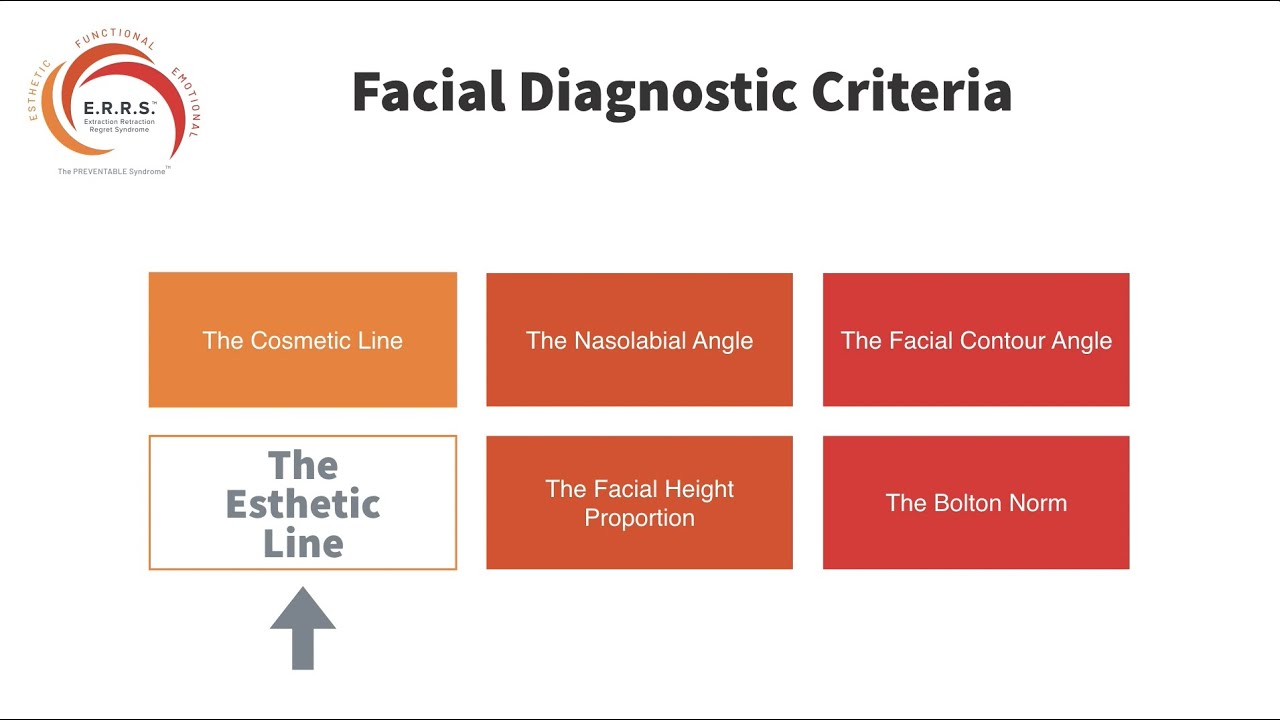
In this presentation, the speaker critiques the long‑standing orthodontic diagnostic tool known as the aesthetic line—a soft‑tissue reference drawn from the chin to the nose that prescribes a 4 mm distance for the upper lip and 2 mm for the lower lip. Using multiple patient case studies (a mother‑daughter pair, an adolescent male, African‑American and Asian patients) the speaker demonstrates how reliance on this line can lead to misdiagnosis, excessive premolar extractions, incisor retraction, and consequent facial profile collapse, reduced tongue space, and airway narrowing. The talk highlights ethnic variations (shorter noses in African‑American and Asian patients) that render the aesthetic line especially misleading, and introduces alternative assessments such as the facial contra‑angle and Bolton norm. Clinical outcomes are shown where non‑extraction, airway‑preserving treatments improve facial balance and resolve systemic symptoms (sleep, autonomic imbalance). The speaker also cites peer‑reviewed literature, including Chinese studies, confirming that extraction‑based treatment for bimaxillary protrusion reduces pharyngeal airway dimensions and alters hyoid position. The overall message is that the aesthetic line is the most misused soft‑tissue measurement in orthodontics and should be replaced by more comprehensive, airway‑aware diagnostic criteria.
Chapters
Welcome back. This segment is entitled Diagnostic Criteria: Aesthetic Line. Here is the aesthetic line. It's been used in orthodontics in the United States since the 1940s. A line is drawn from the chin to the nose, and the upper lip is supposed to be back about 4 millimeters and the lower lip about 2, in an ideal profile. Very easy to do, very easy to see. Let's explore that, however. Let's look at how we use that in a patient. Here's a mother and her daughter. The mother has undergone orthodontic treatment with removal of 4 bicuspid teeth. And you can see just how caved in her face looks using the aesthetic line. Her daughter presented with a near identical situation, but was treated orthotropically, and you can see how much further forward her lips are than her mother. And obviously, her face appears to you as more balanced than her mother's does. Here then is a patient who underwent orthodontic treatment with extraction of teeth as an adolescent. You can see him on the left where he hadn't had any whiskers, he hadn't gone through puberty in the beginning. In the middle, here he is after his orthodontic treatment. And later on, you see him about 13 years later where his face is dramatically caved in. Right. because of the extraction and retraction. Incidentally, this is my patient, one of the last patients I actually treated with removal of teeth. And I'm not really happy about this, that I did this, but you can see the dramatic effect on his facial profile using this line. Let's apply this to something from the refereed literature. So, here we have patients who are going to be treated for what is known as bimaxillary protrusion. And that is defined as when you put this aesthetic line in here, if the lips are ahead of that line, and you can see out of this article how the lips are actually ahead of that line. That's the way the diagnosis is generally done. The fact is, it ignores the fact, in this case, that the mandible is way back. So, you can see, using the facial contra-angle, that the chin is way back. This number should be 11 degrees, as we've noted before. Now, if the chin were forward at 11 degrees, those lips would not be ahead of that line. The point here is that the facial contra-angle has been completely ignored, and the patient has been diagnosed with, quote, bimaxillary protrusion, when in reality, the teeth do not protrude and the face is not protrusive. The chin is recessed. Here we have an African-American person, And an Asian person. And I'm illustrating this here with the Bolton norm, showing how the Asian and African American noses are shorter. The point is, you don't ever want to use the aesthetic line in a patient like this, because the nose is shorter. And you put the line on here, and naturally their lips are going to appear fuller, because their nose is shorter. The aesthetic line should literally never, ever be used for one of these patients. So, let's look at this African-American person who has had 4 bicuspids extracted, and she is not happy. She doesn't like the appearance, and she cannot stand the reduced tongue space, which has happened because of her extraction-retraction treatment. And as she says, I can't live like this. And she's flying more than 4 hours to our office from another city in the Midwest to have us treat her. We put the facial contour angle on her. You can see that her chin is back very moderately from where it ought to be. Combine that with her shortened nose, and you can see why her lips probably appeared to the orthodontist to be too full. She did not feel that way at all. Even with her airway, which was dramatically bigger than some, she didn't feel she could sleep. This is her airway prior to our treating her. Here she is in the midst of treatment, and we're opening up the spaces. You can see the dramatic increase in space we have, dramatic increase in the width of the arches as well. And her symptom pattern has largely gone away. She had numbness of her hands and feet, and that's gone. She had breathing and sleeping difficulties, and that's gone. She had sensitivity to light, that has been eliminated. Basically, she was having— she had a severe imbalance between her sympathetic and parasympathetic nervous systems, because of the reduction of her airway. And giving her airway back dramatically changed all of that for her. Let's now look at an Asian patient. And please look at this patient. All she wants is to get her teeth straightened. She does not have a symptom pattern. And yet, you see that the upper left cuspid is 100% crowded. There's no room. She's 8 millimeters short of space for that tooth to be properly aligned. And she's received a number of orthodontic opinions indicating that she absolutely needs to have 4 bicuspids removed. But let's look at her with the Bolton Norm, showing that both the maxilla and the mandible are already back dramatically. Put on the aesthetic line and her face looks too full. But in reality, her mandible is back, as we stated earlier. Almost always, when the bimaxillary protrusion diagnosis is arrived at, the chin is almost always back, making the bimaxillary protrusion diagnosis completely wrong. Again, remember, the nose in an Asian person is shorter, making the lips appear dramatically forward. Here then is what we've done for this person using removable appliances of various sorts and braces. We've aligned her teeth, and you can see that we haven't pushed her teeth off of the bone support in doing this. She has nice straight teeth, and we've respected her airway. She has a nice broad smile here versus the narrower smile that she had. And you can look at her profile and you say, yes, it may be fuller, but that's a small price to pay. It's not much fuller, and it's a small price to pay for protecting her airway. Let's look then at the refereed literature and talk about what actually happens. And here we have an article which is from China, actually. Changes in pharyngeal airway size and hyoid bone position following orthodontic treatment of Class I bimaxillary protrusion. The very kind of person that we just illustrated to you. And it says, the pharyngeal airway size became narrower after the treatment. Extraction of 4 premolars with retraction of incisors did affect the velopharyngeal, glossopharyngeal, hypopharyngeal, and hyoid position. In another study, From the refereed literature, it states that bimaxillary protrusion is a common disease. I don't believe it's a disease, but they think it is in China, and is commonly characterized by protrusive and prominent upper and lower incisors and an increased procumbency of the lips. Typical orthodontic treatment includes extraction of the bimaxillary premolars and anterior tooth retraction with maximum anchorage achieved through the placement of mini screws. If you do this. It says, you're going to get large incisal retraction, leads to a narrowing of the upper airway in adult bimaxillary protrusion patients. So, here you have it. A very easy-to-use diagnostic criteria, the Aesthetic Line. And as I said, it is the most misused soft tissue measurement in all of orthodontics.