In this presentation, the speaker explains Orthotropics, a treatment philosophy developed by Dr. John Mew over the past five decades. The core "tropic premise" holds that light tooth contact, firm tongue posture against the palate, and relaxed lip closure allow the face to grow forward to its genetic potential. Orthotropics first advances the maxillary anterior teeth (typically 8‑10 mm) and then brings the mandible forward without headgear, while encouraging proper restoral posture. The speaker shows several patient cases, illustrating dramatic improvements in facial profile, airway cross‑sectional area, and functional outcomes such as reduced fatigue and better academic performance. He cites multiple peer‑reviewed articles (including a Cranio study and work by David Hatcher) that demonstrate significant airway gains and refute the belief that large tooth advancement causes gum recession. The talk concludes by questioning why Orthotropics is not the standard of care despite these reported benefits.
Chapters
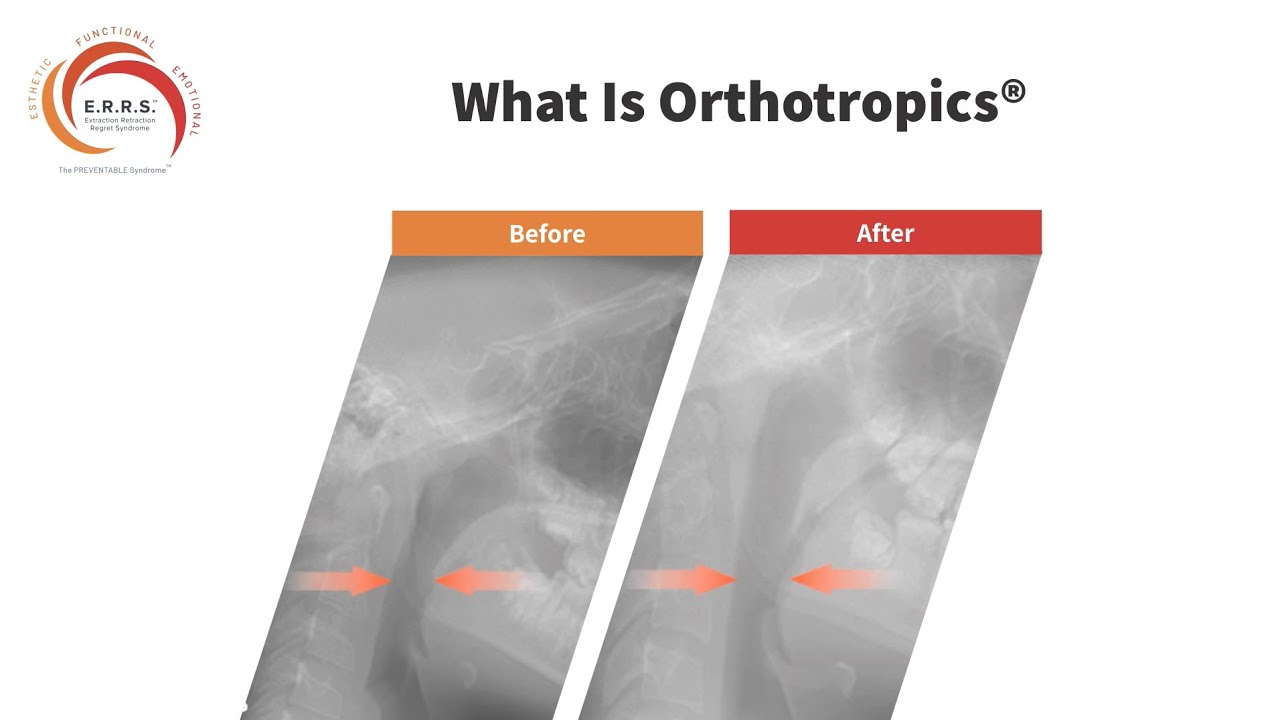
Welcome back. This segment is entitled, What is Orthotropics? Orthotropics is a concept developed by Dr. John Mew of London, England, starting approximately 50 years ago. The book here in the center was published in the 1980s and followed up by another book published more recently, about 5 years ago, The Cause and Cure of Malocclusion. What Dr. Mew recognized was that the first thing to happen in every malocclusion is the dropping down and back of the upper incisors in the face. He developed the tropic premise, which says, if the teeth are together lightly, the tongue firmly to the palate with the tip behind the upper incisor teeth, and the lips closed without strain at rest, the face will grow forward according to its genetic potential. He further states, orthotropics first develops the maxillary anterior teeth forward to their ideal position in the face, That's usually 8 to 10 millimeters in cases that we treat. And then brings the mandible forward to meet the maxilla without a headgear effect, while helping the child to develop proper restoral posture. Let's look at a typical case. We'll do a morph here. Now, you can watch and see how the face changes as the upper lip moves forward, and then the lower jaw moves forward in this case, to develop a very nice profile. And of course, the face looks nice, but there's more to it than that. You can see in this case that the patient's airway was dramatically improved. You can see the patient on the left with a moderate overjet, and on the right, the overjet is eliminated. In reality, what has happened is the maxilla and the mandible have been moved forward, and you can see the resulting improvement in the airway. Here's another patient whose father actually has horrible sleep apnea, and this child could easily have sleep apnea as well. But watch how his face moves forward nicely as he adopts proper restoral posture, the entire face moving forward, developing a very nice profile. Now, let's look at a patient, a typical patient that we might treat in the mixed dentition. And in orthodontics, we have the discussion about should we treat someone early or late? And really what that's focusing on is whether we should straighten the teeth early or late. In reality, that's kind of a silly question to ask. We're more concerned about the face and developing the face forward. So, with orthotropics, we would take these upper anterior teeth and move them forward approximately 10 millimeters at this age. And then we would develop the mandible forward with an appliance which negates the headgear effect, and that's the goal of the treatment. So, let's look at this. And now you can see that the upper anterior teeth have been pushed forward. And many of you may think, well, that's crazy. You're going to push the teeth off the bone support and the gums are going to recede. I'm here to tell you that there are at least 8 articles in the refereed literature which make it— make me very comfortable in doing this, because they talk about the fact that advancing the teeth dramatically does not cause recession, as all orthodontists seem to have been taught in their residencies. Now, let's look at what the face looks like when the mandible has been brought forward. In just a few months, usually 6 to 8 months, when the patient wears the appliances very well. You can see the face has dramatically improved. And again, the gum tissue looks fine in both the upper and lower arches without any recession. The mother reports that this child is no longer tired all the time, and she's 2 grades ahead in most coursework. If you look at this picture right here, the x-rays on the left, you can see the dramatic change from the pretreatment to the post-treatment. treatment in terms of the facial balance, much improved facial balance on the right-hand side. But you can also see the airway improved dramatically from a minimal cross-section of 13.1 square millimeters to 186.1 square millimeters minimal cross-section. When this patient's mother saw these x-rays and saw the dramatic improvement in the airway, she says, I think I'm going to cry. She was incredibly happy about what had just happened for her daughter. With a husband who has sleep apnea, she was very aware of the significance of this improvement. If we look at David Hatcher's research, we've taken a young lady from having a high probability of sleep apnea, with that less than 52 square millimeters minimal cross-section, and put her into a category of very low probability of sleep apnea, with well over 110 square millimeters minimal cross-section. And some people will say there's no research to support orthotropics, and that's absolutely untrue. We've done a research project many years ago published in Cranio on the airway, and these were on consecutively treated patients, on the airway improvement which we've achieved. And you can see here a 31% improvement in the airway at the dorsum of the palate, and at the posterior airway space, a 23% improvement. And even down low in the hypopharynx area, we got a 9% improvement. And if you look at this patient, you'll see on the left, she has a very large overjet. She's a Class II patient. And what we've done here is we've advanced the maxilla massively and developed the mandible forward as well. And you can see that the airway improved to this degree. So, that's what orthotropics is. And some of you may now be asking, Why isn't orthotropics the standard of care? And I frankly think that's a good question to ask.