256: Scaling Up Insights — Coach Panel with Ami Kassar, Cheryl Biron, and Dominic Monkhouse
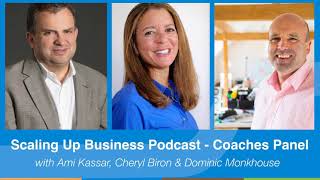
Ami Kassar, Cheryl Biron, and Dominic Monkhouse discuss what COVID taught them about running businesses. Women lost jobs at higher rates, remote work killed some of the best parts of being together, and companies that pivoted to direct-to-consumer or online models survived.
Questions this video answers
April 21, 2021
Chapters
Foreign.
I'm Bill Gallagher, scaling coach, host of the show. And I'm joined by some other coaches in different realms, couple of scaling up coaches and someone in the world of, of finance in particular, lending and things like that. Ami Kassar, Cheryl Baronet and Dominic Monkhouse. Ami, where are you today?
Hello, I'm in College Park, Maryland today visiting my son.
Oh, awesome. And Cheryl, you're in Florida.
Yes, I'm in Florida in Lakewood Ranch, which is about an hour out of the Tampa Bay area.
Nice. And Dominic, you're in the.
I'm in Salisbury in England and it's raining. You won't be surprised to hear.
It'S sunny here. I don't know if you could see out my window there, but you got a little bit. And I'm looking forward to it, but it's, it's been cold this last week. Vern was here in town, we were doing a workshop for Asia remotely and he's like, what's the deal with the weather? It was cold as hell. It warmed up by the end and we had a good time. So we're going to get into so much, so much more today with all of this. We're starting off with what we're noticing about women in business. I think one of the tragic bits of news that we've seen most of our, our conversation today comes from Vern's insights and then the coaches experience with them. But in 2020 and December alone, women accounted for 100% of the jobs lost in the U.S. and so while jobs got lost and came back, the net loss was borne entirely by women, or so it seems in the thing. And that makes perfect sense, not in the moral or justice sort of sense of things, but in terms of who's taking care of kids that aren't necessarily in school with people working from home right now and where things are caught. What are you guys seeing with your clients and friends and that kind of thing?
I was actually at an event last week where a fellow EO member client was opening an office down here in Tampa and his wife used to work for the company and she had to stop working for the company because the school was just too unpredictable. And with three children in elementary through, you know, that tween middle school age, it just was becoming unmanageable. And for them, you know, it's, it's a hit. It's hard, but they can probably afford it. But for people who can't afford it, or single moms, I'm sure it's just, you know, really staggering in terms of what the effect is on their families.
We've got a furlough scheme in the uk, so employees wages are mostly being met by the government. If. If they're. If the. If the organization's still closed, schools are back, which is good. Good for. Good for parents and good for children. I have a deep, deep admiration for teachers.
Yeah. You know, I've seen both. We have women on our teams, we have women leaders, women CEOs in the companies that we're working with, and then we have quite a few in the others. But in many cases, as we see kids running into people's lives, and so many companies are still using a blended kind of work from home. So some are going into the office, some are not. Schools are a very mixed bag across the companies that I work with in the different areas, and I'm concerned about the quality of the perspectives and contribution and the social impacts if something doesn't change with this thing.
Well, one of our clients in the UK actually is an academy and runs four primary schools in disadvantaged areas of the Midlands. And they've just been doing some testing, looking at the difference. Their thing is all about trying to drive the gap, reduce the gap between the advantage and the disadvantaged in the children that they teach. And they're saying, you know, homeschooling really failed completely the disadvantage. And those kids have really made no progress at all in the last 12 months. So they're now trying to work out exactly what they can do and what resources they can bring to bear to try and close that gap over the next 12 months.
I do think you have to. We just have to look at, in addition to the male, female disparities, I think it's fair to say that the pandemic has hit the sort of lower socioeconomic class a lot harder and a lot of those jobs just haven't come back yet, or aren't coming back. And so that's almost like a double compounding effect.
Yeah. Unless you're like a driver, warehouse worker. Right. Those have stayed strong and increase delivery.
Right. Yet there's this ongoing disparity where I speak with so many CEOs, and their number one issue is finding employees. So there's like a disconnect. They cannot find people. Many people cannot find people to get to work and that you hear all this data and I don't maybe. And it might be people don't want to come back in the hours and the constructs that people are used to, I'm not sure. Or it might be that the unemployment benefits are too Strong. But it's definitely, there's definitely disparities, I think in the data and what's happening out street.
Work that you can do from home versus not. And so you have all those restaurant workers and the people in retail, restaurant.
Retail, hospitality, those are particularly hard work from home. Anything where there's a lot of face to face contact has been particularly impacted.
Right. And I do think for leaders and for business owners and CEOs, there's, I mean the pivoting has just started. Yeah, we had to deal with the shock and all of it last year. Now we have to deal with what we've learned and what's going to hold and what's not going to hold and how we're going to do things. And what were the, some of the benefits of working at home. And it's not all black and white. It's quite great.
So I think that's a huge, huge conversation. I'm certainly thinking about it personally. But our clients are thinking about when do we go back to the office, how much go back do we go back? What are the advantages of not having everyone in an office, of having developed and adopted remote work habits and structures, but also like, oh, they can hire from anywhere now. They don't just have to hire in San Francisco or wherever they happen to be. They can recruit from all over the world, work all over the world. And yet they're clearly hungry for and missing something and anxious to get out of the house to put on some real pants.
I think there's definitely a mixture there because there are people who don't have the luxury of having a home office and they're working on a kitchen table or something like that. And then you have the people who were commuting hour and a half each way a day.
I needed to hire a consultant to do some work for us, like building some dashboards and KPIs and all that better tracking of our data. So I went to Upwork and I loaded up the job and I got like 40 proposals. And the first thing I did is I just went, I picked the four to look at that were within driving distance of our office.
Why?
Why is a good point. Because I like, I want to meet this. It's like that old habit, right? I want, I want to meet this person. And then I met the guy I spoke to the guy I really liked who lives half an hour from my office and he's on paternity leave and doing this for a few months and he's not going anywhere because he has a Newborn in the house.
Right.
So my bias was to pick the people sort of who I could see and could come to meet with us physically and all that, but I'll never meet them.
That's funny.
Being in similar time zones or closer time zones. Right. Working with somebody whose day is your night and vice versa is harder just in terms of finding times to talk and waiting to connect on things and. But being able to hire somebody in the middle of the country versus on the coast has a tremendous amount of benefit in terms of the cost of the operation. Right. And the cost of living for the person. If you're not trying to live in one of the major urban areas, coastal areas, is going to be tremendously different than we have in a place like San Francisco or Los Angeles and so on.
I think it's interesting because I. We've. We've had some clients who've been coming down to the farm all the way through because there's been a. There's been an exception for business meetings in the UK and some, some of those clients have been coming in. We've had some clients just come back to us. Who. The team, you know, the team they've hired. They've hired maybe half the leadership team in the last 12 months. And so, you know, in the last couple of weeks, this is the first time they've ever met. People are almost tearful.
Right.
I mean, overcome with emotion that they're now able to, you know, shake hands with people and be in the same room as people, you know. So if you, if you could do it virtually and I think the quality of the work with clients is probably about 70% on Zoom versus face to face. Definitely think we have more. We work certainly I work more impactfully with clients when it's. When we're all in the same room versus Zoom. And I don't. I think that's probably true of most teams in most companies.
So we have noticed that we are way more time efficient on Zoom.
Yeah.
Like in terms of total output of how long we take for a planning session or annual strategy work, there's no question that we get it done faster. In Zoom, however, you miss all of that qualitative rich conversation. So the. Is the work product compromised or is the team connection compromised?
I don't know.
It feels to me like where we're headed for in the things we're talking about are a blended reality where we've got a little bit of in person, a little bit of remote, you know, a mixture of things like that.
Yeah, it's interesting Isn't it? Because if you look at the, if you look at the data on hybrid teams or if you think about your own experience, the only person in on a conference call who wasn't in the room.
Yeah.
You know, I spent most of my working life being the guy in the Europe talking to guys in the US and, and my experience was definitely as, as a second class citizen in any of those meetings. Right now think about, you know, everybody goes back to work, six people go in an hour and 45 commute and one person decides not to come in. I don't know, I just think, I just think when you look at, when you look at how those teams used to behave in the past and managers would behave in the past, you know, the person who didn't come in would always be disadvantaged.
You would be, you wouldn't have the time to network and create connections and relationships and things like that.
Right. Yeah. So I've seen it work where it's a sorry show. Go ahead.
No, that's okay. I was just saying that's what we miss also with clients because you know, coming in the night before having dinner with them, you know, really just getting to have that interpersonal connection is missing when we do it on.
I just came back from Gils Global Leadership Conference for EO1 watch party in Austin and they hosted like, they invited the boards of like five chapters and the Austin chapter was there and there were like 60 or 70 people there and it was, it was just, you know, those chats in the bar at night or hanging out late or those conversations or those chats when you're bored with the speaker and you're hanging out and those relationships that you're never more speaker.
Right.
No, but it was, what was interesting about it was I still hope that in some ways it won't all go away. Right. So some things. So there I think there were a couple dozen watch parties happening around the world and a speaker being.
I found the hours weird though. Like the, the beginning session for that conference was like 5:30 in the morning my time. Well, I don't feel like driving somewhere to hang out with people at 5:30 in the morning and barely got coffee in me and opened my eyes. Right.
For.
I know some people are great at 3am but not.
I get it. But there were like 7,000 EOs around the world participating in this thing this year and usually at GLC I think. What are they about 1500 bill or so? A thousand?
I don't know.
Yeah.
We don't want to lose anybody. EO is the entrepreneurs organization and they're about.
It's an art like we also have vistage, we have ypo, we have a range of. Of other organizations of, of folks in our listeners. Viewers.
Okay, good.
So they just had their global leadership conference which is normally for the leaders across the organization to connect and learn and plan their years and that kind of thing. And we've all been involved, of course scaling up started there. And even though we maybe are a little more popular today in YPO than in eo, but we were the Global Platinum sponsors, the coaching organization this year for the conference. So we certainly got a lot of response and interest from people that, that will probably continue. So the thing that I'm hearing from people I think is worth thinking about is when and what does going back to work look like? And I think you've got a plan about your office and what can you take advantage of and bring forward of the good aspects, right. The silver linings of the way that we learned to work in this last year and then what it is going to be like in the future. And it's probably best for it to be a blend and there's significant emotion in and probably gonna show up in different places. So we have clients and friends in Toronto right now and they're going into or in a pretty substantial lockdown. Other places around the world are going into significant lockdowns again. And yet I think the word is in California that we're about 37% who've had at least some vaccination at this point point. And like 25% are fully vaccinated. My adult family members now in our extended family are all fully vaccinated because of their different occupations and work and that kind of thing. And so we had a big family celebration together. Huge meal together. Well, huge. There were like 12 of us, right? Not huge, but, but, but several families, right, all visiting together in person for a meal. It was like nobody wanted to do that until recently. And it was as Dominic said, like, you know, it was very. People cried and laughed and some were still angry. Some were still like, I'm angry about this year and everything that's been. And you know, so a huge range of feelings are going to go on as people kind of come to terms with it. And there are places that are resenting the fact that, you know, we're moving faster ahead in, you know, places like Israel and the US that are rapidly getting vaccinated. Dominic, how are you feeling over there?
Well, we are, I suppose we came. What do we. Last Friday you could meet six people from multiple households could meet again outside. So. And the weather over the Easter weekend was great. One of the, one of my team said to me on Tuesday morning as I reconnected with them after the long weekend that they had partied for four days and were out of practice because they were feeling very rough. They'd sort of Friday, Saturday, Sunday and Monday, they'd met different groups of people and had a few glasses of wine. Pubs open up outside. From Monday, you can stay away in a Hotel from the 17th of May. You can at the minute, at the minute. International travel is banned, but it's, it looks like we're on track for it being unbanned on the 17th of May, but you're going to be. Have to test on the way out. Test before you come back in quarantine when you come back in.
Yeah.
See how, how.
And the UK is doing better than the continent is in their vaccination.
Yeah, we've got, I think we, I think with the Office of National Statistics, we're saying it was over 50% now if the population had had had their vaccines.
So in the course of the last year, a lot of companies have pivoted and many who have adapted to the circumstances of thrive. Vern Shared news from Jeremy Han, who was in our workshop this last week from Singapore about a Vietnamese woman who had a huge growth. In the last bit. Did you guys read that, follow any of that?
I took a look at it and it seemed like one of the things that she was talking about was getting really great people in place and the core values and the core purpose and just the whole right mindset in order to make sure that they had that foundation in place to make the company grow. And they had taken several months off at the beginning and really focused on how they could add value to the students and came up with a new program for the students. So really taking that time and instead of saying, oh, this is terrible, kind of strategizing and saying, well, how can we add more value and make things better?
I also think that in managing today there's, there hasn't been and I don't think there will be still for a long time boundaries between personal life and business life and just people are just exhausted and people are hurt and everyone's impacted one way or the other and people are still reeling from it. And I think as leaders and entrepreneurs, if we don't, the empathy muscle is more critical than ever. And taking the time to really know and understand what's going on with our teams and you know, we have morning huddles now for half an hour every morning over zoom and a lot. Sometimes the conversation's just about just riffing about what's going on in people's home lives or personal lives, or just checking in on how people are feeling, creating almost like a support structure for, for everybody. And it's essential because people are fried and that's not going away. I don't think.
That that feeling and that lack of separation.
Yes.
Yeah, I definitely get that. I, you know, this room that I have now is a home office and studio, was once a kid's nursery and then became one of the kids rooms as one moved to the other room and so on. And so at one point behind me there were bunk beds, but now it's totally a dedicated office and, And I keep the door closed except when, you know, I'm working. And then I open and I come in and then I close it. And so I, I create harder separations when I want to. And you know, sometimes I'll work. A lot of times I'll work outside or sitting around different parts of the house when it feels good. But I definitely feel like I go to work, I leave work. I could choose to answer email or take a phone call or whatever from time to time, but I don't have to do that kind of thing. Right. And I don't think everybody has that.
But Bill, you don't, you don't have young kids at home, right?
Yeah, my kids are both grown. One lives in la, one lives New York.
Right. Or you don't have kids, I mean, or you don't have. Well, I know you're the people of the empty.
Nature is different than.
Yeah, people have people, close friends or family who've died of COVID or complications of COVID or you haven't been able to see them or their support structure is gone, or the grandparents used to watch the kids and the grandparents haven't been able to watch the kids for a year or. Yeah, everyone's got. Sorry for the, for the. For the word. And if you don't take the time to recognize that and empathize with it and embrace it and offer people support for that, then you're not tuned in with what's really going on. And people are unhappy in their personal lives. It's hard to get the best out of them in their work lives.
Last week I was chatting to two different people about two interesting observations in the uk. One, Daryl Scott was saying he thinks that lots of people in the UK have become. Examples what you do is you take a baby elephant and you tether it up. Learned helplessness. You tether an elephant with a chain at the beginning and it pulls and pulls and pulls and pulls and eventually you can tether an elephant with a piece of string because it stops fighting. And so I had that conversation with him at the beginning of the week. And then I was talking to Nick Marks who's got a company called Friday Pulse that does weekly staff engagement surveys. And you could see that the general population data from the UK dipped and then it came back up again towards Christmas. And looking at the data reminded me of Jim Collins that, you know, Scottdale paradox where, you know, it felt like people were getting. It got to Christmas and then there was a new lockdown in January and it was like they just sort of gave up. Right. You know, his example where some people who thought it's going to be over by Christmas, it's going to be over by Easter, you know, died of, died of unhappiness. And there's that you just got a sense of that sort of people giving up, you know, that sort of learn helplessness and just a reduction in happiness at a, at a national level.
Well, I think we've had that certainly now in responsible for some of the, some of the surges because people who were doing things that were keeping it kind of under control. I had a company that went like 9, 10 months without much Covid at all and then suddenly just had all kinds of cases sweep through in the fall because people were just like, forget it, I'm going to go see my mother, you know, or whatever it was. Right. They just kind of gave up on those things and then they suddenly got hit with a lot of, a lot of stuff. Right. A lot of impacts as a result of that.
My experience here in Florida is completely different from what I would be experiencing if I had stayed in New Jersey. Because you would semi never know that the COVID is happening based upon the look way the government is handling it down here. Whereas up there, you know, there are.
Actually that kind of thing.
And so networking events have been going on, you know, more recently in person. They've always had, you know, some in person. I mean, I've never gone to anything. I've been locked up for a year. I just started going back out. But a different life down here compared to up north. So I think there are a lot of regional differences as well. So I have friends in Manhattan who, you know, have a completely different experience than we have down here. And it also, you know, Kind of affects the workplace by region, I believe, as well.
I think that the thing that I'm hearing between all of our experience is that you've really got to get in people's worlds and deal with the unique differences that are all over the map. Right. I had somebody going off to me about how Covid is not a thing and whatever. And I had just had a friend get Covid and die in six days. And my mom spent months in the hospital and will never live in her own home again. Like, she, you know, she had to move to a retirement community or assisted living. And I just wanted to punch him. You know, like, listen, a hole.
I was sitting with a guy.
But I think you're, like, dealing with and addressing that. So there's that, all right, good. Will you be you? And then there's the people who are really freaked out or who are sheltered. And I have another family member who, you know, would look, put on a Hazmat suit to go to the grocery store. So there's kind of like a big range of that. So addressing, we know people with kids, without kids, people who've got other situations, like being adaptive to folks helps you not only be address your marketplace, but also engage your employees. Right. And your suppliers and all that.
But there's a. I'm. I'm hesitant in some ways. You know, I meet people and I ask them if they've had a good year, because I want to know whether their experience is down here or up here. And if it's up there, then I can have a very different conversation. If it's down there, it's. It's, you know, empathy.
Yeah.
But I won't share with them any good news that I've got. Yeah, they just don't want to listen. Well, or. And, or it might be, you know, upsetting, but, you know, it's, you know, I meet some entrepreneurs who for last, you know, the last 18 months has just been sensational, and they've had a great year. I meet people who've had a great time during lockdown. You know, they've spent time with their family that they wouldn't have otherwise done. And then I meet other people who. For whom the experience has just been awful.
Yeah, I know I've made people angry. I. By sharing how, you know, we've done well. We have a nice home. We have. We don't have lots of kids to deal with, and there's been a great need for coaching, and we've helped companies to adapt and pivot, but it makes some people Very upset to hear that right there.
Our experience here, you know, we ended up with two of our adult children all with us, you know, from January or February through August, September. And so even though, you know, from a business and coaching perspective and some of my other businesses, too, it was a bit of a challenge. Having them was just such a gift. Like, we had a lot of fun together, but, you know, you don't want to tell people that. We did also, you know, lose people, and that was really terrible. But I think Dom is saying, you know, you got to meet people where they are. And, you know, before you interact, your.
Customers, your employees, your suppliers, you got to be sensitive to where they are. It's funny, our daughter came home in the beginning and was like, okay, I'm going to shelter at home for a while because it feels weird. And. And then when it seemed like there was no end in sight, she's like, oh, forget it. I'm going to get on with my life. And she moved back to.
And there's a whole additional component right away.
Right.
Some people are not going to get vaccines, and that's going to create a whole. That's going to create a whole other set of tension and issues.
I can't wrap my head around that. Like, I was so emotional, so glad, relieved, and grateful. Like, okay, there's a. You know, probably I'd be okay. I'm relatively young and. Or I like to think of myself actual, you know, dog years.
But.
I like to think of myself anyway. I probably would have been okay. I have friends who've been okay with it, some of, you know, a whole range, but who knows how it would have gone. There's an interesting quote Vern shared. He said, lots of people want to ride with you in the limo, but what you want is someone who'll take the bus when you. With you when the limo breaks down. Oprah Winfrey. And I think it's a great quote. Like, you know, you don't just want the person who's gonna marry you or. Or, like, do business with you in good times. You want the person who's gonna be with you through all of it. And. And I think if. If you're appreciating where people are coming from, what they're grappling with, people will, you know, people will go through all kinds of great challenge with. With you. Like, people love a good challenge if they feel like you're honest with them, if you feel like you appreciate them and their struggle.
Yeah. I've met some people on Zoom during this whole Period, who had different business struggles. And I would just, you know, kind of help them think through, like, what their next steps would be or how they could overcome these different things. And it wasn't like they were a client of mine or anything, but just, you know, an entrepreneur or somebody like that that somehow I got connected to that just, you know, really needed help. And just being able to be there for that person for that short period of time was also something that made me feel like I'm having an impact and I'm meeting them, you know, where they are and helping them to get to, you know, where they might want to be in the future. And it's just, you know, that's been kind of a gratifying experience too.
To.
Be able to just help people other than, you know, the regular clients that I have.
What are you guys doing or, you know, how has the coaching evolved for you? What were you doing before? What are you doing now?
How.
What kinds of interactions have you had over the last year and where are you at today with people?
People?
I'm mostly on Zoom, except I had one group that's local who was dying to get back together. And so I was fortunate enough to have a space that I have access to where, you know, if it's 20 something people and we have three people masked at, you know, two ends of a table and, you know, like Dominic was saying, you know, once you're back physically together in the same room, the dynamic, you know, just was so much better. But we did do a lot of really great work, you know, online obviously. So with those, you know, like that type of client, it's really, we're just very fortunate that we can do that. And it's, you know, small group of people, a small leadership team, but with the other ones, with a larger leadership team and, you know, maybe further distance and that kind of thing, it's, you know, just still waiting to be vaccinated and have everybody kind of safe to travel and that kind of thing.
Well, we, we took the decision a few years ago to build, build some facility down on the farm. So when I'm working with clients, they would typically come here for the quarterly off sites, one or two day off sites.
I love this about this facility. This is fabulous.
Well, it's called the management lab and we can get sort of 20, 20 odd people in.
So.
You know, I was working in, I was working out of hotels in London mostly, or, you know, maybe even the client office space. The client offices were worse because people would say, I'll be back In a minute. And then that's it. Everybody's waiting for 45 minutes or. And then you decide to carry on because they don't come back. It's probably the worst experience we had. And then, you know, you know, you, you're. You're just. For most of the hotels that have got decent accommodation, it's expensive and the coffee's crap. So we said, right, well, we'll build something, we will build it. They will come. And so I transitioned from. We went into. We went into lockdown and we went on to Zoom. And I hadn't used Zoom for coaching like everybody else, Scrabble to get my head around Mural. I like you, Bill. My experience is that if you've got that Zoom mural thing, it's very, very time efficient. But I personally, you know, if I'm doing. If I'm working with clients here, there is, you know, you work hard, you're on your feet all day, you're. You're exhausted, but you get some energy back. And the energy back to me from Zoom is probably, I don't know, maybe 20% of what it is when you're doing work face to face. So I get to the end of the day exhausted but feel much less fulfilled than if I'm working with clients face to face. We've had. We've been lucky that there's some firms that we work with who are local and they've more or less. Wherever there's been a gap in the regulations that have allowed them to get here, they've been in. And then, as I say, we've just had clients who haven't. We haven't seen them face to face for 12 months. And we've had two groups of clients back in the last couple of weeks. And I didn't want to do workshops virtually. So last week we ran two workshops. Wednesday, Thursday, we did two workshops. And that was great to get new people we hadn't spent time with together. You were talking earlier about Zoom doesn't allow the sort of interaction. I reckon about 30% of the time in the last few weeks when I've been with clients has just been people talking about nothing because they just can. And so. And so things are definitely slower than they would have been before because people just have got that, I just need to talk to somebody. I just want to get something out.
Well, so we started in the initial phase, right? This time last year, I was doing lots of free coaching. You know, you're in a crisis, whatever, I'm going to talk you off the ledge. I was dealing with people and their panic. I was dealing with people or anxiety or whatever you would call it, their worries. I was helping people develop contingency and adaptation plans to think about how to deal with it. Then came the adaptation. So first was sort of shock and fear. Then came a lot of coaching around adapting. How are we going to operate? And so there was a lot of like, like we moved our, we got good at doing video and mural and although I don't know if my videos and audio are so good today, but, but in general. And we moved our tool we used to do in person, we got very good at doing remotely and, and then we started getting into pivots. Right. How could you actually profit and thrive? What could, how could you help people deal with what was going on in the world? And that seemed to be an interesting period. And then people started adapting. They were finding there were places that they could in places they couldn't and places they were still wishing for the whatever's next. And now I think I'm dealing with a lot of folks who are trying to figure out, well, what's it going to look like like next? And, and how do we navigate this return to normal or what are we expecting? There's a lot of like wondering about what's going to be. After having been vaccinated and being around a lot of other people, I noticed a definite exuberance. So I had, have had some dinner out right in restaurants face to face, meeting with different people. I took one trip by air. Now I'm about to take a vacation trip by air and go spend some time on the beach. My mind is that. And although I recognize a lot of people are still not even close to there, that will come and will that bring a new roaring twenties? Certainly. John Ratliff thinks that there's something like that on the way. And I wonder if we have because there's such a pent up like come on, I want to go to the pub and I want to go meet some people and you know, hugging my mom when I thought she was going to die. You know, last fall was extraordinary, right?
Bill, I think that, well, if you in Austin last week, you, you would think it was the roaring twenties again. You wouldn't. Or driving to College park last night down the sort of the strip of the college town, you would, you would say what pandemic? Yeah, I, but I think that, I mean it's a legitimate question is okay, so let's assume the vaccinations are going to work and the world will Be reopened again? I think that's a good assumption. But then are we going to go back to just as coaches or in our businesses to doing it just like.
We used to do in it?
Because we kind of long for that world.
I was so happy to be at a conference last week. You have no idea.
Okay, but are we going to have an idea?
Yeah, but are we going to go back to that world or are we going to learn and adapt some of what we learned to do this year? And I don't think it's black or white. Ultimately, the challenge we all face is how to find some of what we've learned and keep it. So maybe planning sessions will be with clients, will be quarterly. Planning sessions will be twice a year in person and twice a year of a zoom or whatever it might be as a speaker. I'm thinking to myself, I mean, it's crazy. I spoke to. I used to run around the country like a dog and talk to 2500 entrepreneurs a year. Yeah. And last year I spoke to, I think 40,000 over Zoom. And I would refuse to do webinars before.
So now your topic was kind of, kind of on the topic.
People about.
Emergency funding and things like that was sort of relevant.
Okay. But now when I get called, asked to come out and speak, I'm saying, jesus, I can speak to your group for an hour over zoom and get it done. Or it's two days of traveling.
Yeah, that's how I feel too. Like traveling up to Michigan, to Canada, even back to New Jersey. It was just so much time that was not productive compared to doing it over zoom and mural. So that hybrid model was what I was going to jump into saying maybe two day annual and one of the quarterlies in person, and then the other two quarterlies maybe still over zoom as an option or like a hybrid type of thing. And then locally, more in person all the time.
Right. So we've started to reimagine things and I hope our companies are starting to reimagine how much in person. What does the office look like? What's it going to be?
You know, I mean, I'm using mural even face to face.
So that's what we haven't done yet. And I'm thinking about doing that. We're going to do that in our next face to face. Tell us about how you're using mural face to face.
What mural is first if they don't.
So you're the best.
You keep. You keep grounding us. Thank you.
Good.
Thank you, Carol.
Interactive collaboration space. So In Face to Face, we'd have used whiteboards and post it notes and sticky pads and we can capture all of that on Mural and when we're working.
So you can do sticky notes and flowcharts and sketching and everything else, like a collaborative workspace in mural, whiteboard, sticky note wall space that you can work together remotely, in person, etc. Yeah.
So everybody logs into Zoom, like this type of thing, and then they log into Mural at the same time. And so you see them moving around with their little name bubbles and collaborating. So that's what we're talking about.
Yeah, and putting people into virtual breakout rooms and have them work on different chunks of the board at the same time, which is really good.
That's a huge call out for people. I can't believe people don't realize you're doing Zooms all the time in your company. Enable breakout rooms, use them a lot. When you put two or three people in a breakout room versus six people in a Zoom, it's dramatic.
That is where I think Zoom might even. There are times there where Zoom then is better than being face to face. Because if you got six people in a room and you don't have any other space to put them in, it's six people in a room. You know, I wouldn't have in the past split up six people into two groups of three, but on Zoom, you know, do that all day long. You know, two groups of three, three groups of two. It's people working in parallel. Just makes it go faster and makes it a better experience for everybody because the introverts get to speak and do stuff. What we'd done is we'd found ourselves getting through a load of work in half a day. And then I had some clients on site and it got to lunchtime and we really hadn't made any. We made almost no progress. So I said, right, get your laptops out, let's get onto Mural. And forced the pace with a timer and people working in. Working in breakout rooms, you know, virtual, you know, physical, physically sitting in different parts of the room and. And we picked up the pace and got done by the end of the day. So that's worked well.
You haven't tried to buy one of those big boards to do it, right?
Yes, I have. I've got an 86 inch touchscreen in the next door in the farm. Yeah, you know what? Now when I'm on Zoom, my experience is fantastic because I've got, you know, I can get up and I can draw stuff, pull things around. So you know, either when, either for when I'm facilitating or when people are here, it's great. Or where sometimes you've got, you know, most of the people are here. One of our clients, they're here, but the CEO's down in Australia. So, you know, we do it hybrid.
Yeah, I want this, I want like this indoor outdoor space where I can like open up the whole thing when the weather's good and let people kind of move around or close it when the weather's bad or put heaters or whatever and then have one of those big units and then have people with their individual laptops be able to do something like that. I think would be really, really cool. Yeah, well, have people remotely as well, right?
Yeah. The bit that the worst bit of the remote experience is they don't get the catering. So all of our normal catering partners have been closed, which means there are plenty of chefs to hire. So what we did last week a couple of times is we hired a chef and he came in and did food for people. So the guy in Australia, the guy in Australia saying, Matt in Australia saying, dom, is mine being delivered anytime soon? The door hasn't gone yet. What's going on?
Listen, if you don't have a coach, we can help you find a coach in this area. One of our listeners reached out to us. I had a conversation with them and then I think Cheryl is starting to talk to them now about getting growing who are in their area. You can reach out to all of us here if you want to or you can just drop us a note, infoscalingcoach.com we'll help you or go on our website. We'll help you find a coach in your area. If you don't have a coach, you should get one at any kind of capacity. Get some external. It doesn't have to be one us and many of us stay pretty busy, especially this last year. But we have about 200 around the world. So drop us an email, say, hey, we need a coach. We want to talk about coaching options. Live, virtual, remote, online, self paced. Like, you know, there's a world of approaches that are available and possible and different styles. Right. I like to tell people I'm a particular style and type of coach. That's not for everyone. For reals, right? Like you want. I had somebody say, we really want more accountability. I'm like, oh, I'm not going to do that. I don't do accountability coaching. You want somebody who's going to make sure you do what you say you're going to do. Yeah, that's not me. But there are coaches who are really awesome at that and love doing that. Like grill you hold your feet to the fire. Right. Like that's a, that's a valid type of coaching. There are others who are very much about the numbers and dialing into it. You know, if I wanted critique on my stuff, I might use Joss or I might use AMI to figure out how to fund things and what the business looked like. I wouldn't do that either. Right. And figuring out that perspective or that approach, I think is really important. Getting that good match. Right.
Speaking to a couple of people before you pick your coach also.
Yes.
Yes, definitely that different styles because you have to be able and willing to really confide in that person and trust that person to help you get to the next level, what you're looking to do. And in terms of financial versus cultural versus executional versus you know, having people keep you accountable, make you make sure you do what you're supposed to be doing. You know, like Bill and I are like, we're not doing that, but some people love it.
Some people want people to run their, their monthly meeting. Right. And we have coaches who will do that. I won't do that. I'll teach you how to do it once or twice.
Right, right. Instead of giving them.
Yeah, we have lots. Dominic, do you any. Do any monthly meetings or any of that kind of thing?
No, I do. Well, I do fortnightly calls with the CEO. Otherwise it's, it's one or two day court lease. What I do do is though, I've got a, one of the guys on the team, Carlos will. Might do huddles or, or weekly meetings with people if they're, if they're stuck and they need some help. So. Because that's not. I'm not going to do that. But Carlos loves to do that. And in fact, you know the software we use at the back end to keep all the stuff and he runs a sort of a monthly tournament across all the clients and he's got a scoring system so there's a sort of a championships for that sort of accountability. Nice. So interesting to see which clients win.
I do actually offer half day monthlies for clients who want to get really quickly through. Through strategy or that kind of thing. And then you know, if they're having some executional issues. But it's an official, you know, cadence that we're doing versus me popping in and running a weekly meeting for them and that kind of thing.
So we want to talk about the niches the things that are people are specializing in. Vern shared a couple in the last little bit. A woman owned toy manufacturer who grew a ton and, and, and then someone who did vintage Saturns like really vintage. There are a lot of old cars I really love but a Saturn will never be on that list.
I think, I think the niches now I'm sure it's possible to go broad. I, I'm sure somebody somewhere has been successful running a company by being all things to all people but I think it's serendipity rather than by design and then when they trip up over that, you know my own business experience has been you know being an inch wide and a mile deep and when I work with clients, those that have a really clear core customer and can differentiate, you know, can, can be, can be specific about the language that they use just makes all the difference in the world. You know nobody wants to go to an Indian Thai fusion restaurant. You just think it's going to be rubbish.
Exactly, exactly. Somebody's going to go open one now.
Good, good luck to them.
We've had actually a lot of interesting fusions of things and people will find their way. But, but I think you pointed something there. I used to think it was just early stage and for sure it's really common. Right. When you're starting out you'd be like you'll pay me, you want me to do something, I'll do it. Right. And that's a beginning business entrepreneur. I'm going to do anything for anyone who's got some money. I'm going to try to keep my company going and that's early stage. But I find the lack of focus we can still see that up to hundreds of millions of dollar company stage not well actually we can see it in multi billion late stage companies who get too big and screw things up. I mean we've certainly seen where companies ran 100 or 1000 companies poorly and evolved from having once been really clear about what they were good at. We have seen that more recently with ge. Right. A thousand badly run companies. But so it's not exclusive this lack of specialization. What are you really good at? What should you focus on? Who really loves you and who should you be letting go? Right. That's a very valuable lesson to learn at any size of business and also.
Who you love working with too versus who's draining your energy.
Yeah, yeah.
But Bill, isn't there something to be said of you know, who survived the pandemic or who thrived during the pandemic? It's the businesses that it's that adaptive adaptability and flexibility muscle and that's not going away. So it always struck.
Well let's call out some obvious stuff first. That is in our sector but for sure, Amazon, Walmart. Right. Others like very big companies have continued to leverage their strength and presence, their political advantage, everything else and have crushed some small companies. We're talking about those small and medium sized business says who of those have done well and it is those ones that you say that that were nimble, that, that adapt that and that chose.
To adapt it always. It strikes me up the street from us as a strip mall and there's one restaurant that they're all that quickly as could open up tents and opened and then they pissed off the township because they went too far into the, into the parking lot and they had to shut them down and they opened up takeout and they, and they, the minute they could open up inside, they opened up inside and they literally pounded through and did every single thing they could do to adapt and just survive. Then three doors down is another restaurant that just shut down for eight months.
Yeah.
Didn't try a thing. And what strikes me, I mean it's partially, it's just related to who the government chooses to help and not to help but they're in the same business and they're in the same industry. One put on their entrepreneurial flame and they got to work and they figured it out. I mean there's a little Japanese place down the street from us where you.
Have to line up an hour to.
Pick up your takeout food and people line up and they, they don't let, they don't let people in the door. And there are other places that are on the verge of collapse if they've not had to collapse. So what does that say and what does that say about. And that, I mean that's what strikes me is that the government's pouring aid into all those restaurants because who didn't do anything. And it's hard for the restaurants who are thriving to get money to grow and expand and hire or whatever. But it's that innovation muscle that we all have to be looking for.
Because.
The need for that and adaptability and flexibility is still here today. It isn't going away.
I think some companies have the capability to do that and some of them are more the technician like in the E. Myth revisited and they just know how to bake the pies and they don't know from the business side of how to survive and thrive and they don't really know where to look to get that help. So that guy that didn't open up probably just, I know how to cook really well. You know, I know how to make my food. I don't know how to run a business and just didn't know how to seek out help to run that business.
See, I, I. When I'm doing the functional accountability chart with clients, I put new product development on because the average entrepreneur is 12 years in an industry. They know how to bake pies, they open a bakery, and then if they have to pivot, they didn't create a new product. They just took something they already knew how to do and take it to market. And so often. And to Bill's point about large companies, I've got clients who are large clients who have no ability to do new product development. What they do is they look inside and we go, we make widgets, we sell widgets. If you want to buy widgets, we're here. And the clients that win are the clients who say, who's our customer? What's their problem? How could we re. How could we re. Energize? How could we repackage what we do? You know, one of. Not a restaurant that I know, but somebody was telling me that, you know, the restaurant closed down and they started doing cookery straw. And then they decided not to open back up because they were making more money doing cookery school online than they were for main when the restaurant was open. So they just carried on doing the cookery school. They might do cookery, you know, later. But I think Army's thing about restaurants, you know, last summer there were some people who were certainly restaurant restaurateurs that I spoke to, and they, they hadn't had a bad year, even though they had been closed for a period of time because they'd put up space in the car park and tents out the back and had found other ways to make money. And then some of them are just gone. I think when a rising tide floats all boats. And I remember about a year ago, I spoke to Jack Stack, and he said, I love a recession. I love Black Swan events. He said, this is my seventh black swan event. We've got $500 million in the bank every single time we've had a Black Swan event. We've doubled the company in the next five years. Bring it on. And it's like. And so it's that there's, like, there's this attitude of, you know, prepare for the next disaster, because it's definitely around the corner and Then the people who sort of have. Have no plan, have no thought, can't adapt, don't adapt.
So I think there's a. We forget the conscious choice in the matter as well. So there's chance, unable, doesn't play to my strengths, that kind of thing. But there's also the choice. And I remember reading a New York Times article about a restaurateur that said they were talking about the restaurants adapting and that kind of thing. And I know lots, and I have patronized them that have adapted and have found ways to. Whether it's the parklet dining outside, which may or may not be safe, depending on how they did it, or the takeout or that kind of thing. We've used a ton of them over the last year. But this one New York restaurant said, look, I started my restaurant to create a particular kind of experience. She had a vision for connected in person dining experience. And she said, takeout is not that. It's not connected, it's not social, the food's not good, it's not right, it's not warm form. And she's like, I'm a no. And she shut her business down. And I think, you know, if you. If you could take responsibility for that choice and be like, this is. I choose to do this without, you know, screaming at anyone else, then, then I think that's totally valid. Like, look, I don't want to be in that kind of business, but. And I. I know another friend who's in the service business and. And there were others in their business in the same area dealing with the same situation and restrictions, that kind of thing, who did fine, who adapted, who found ways to do it, and this person did not. And I don't know if they're conscious of it. They would say, conscious about their personal choice and decision, they would say, it can't be done. You can't do it. Right. But I think that they were just at a stage and a point in life that they just didn't want, want to.
Or they didn't need, or they didn't need to.
Bill. Didn't want to, didn't need to. I mean, it. It's had a very significant financial impact on this person. But. But others clearly did and found a way and are operating today, and they are not. And their assets are being sold, you.
Know.
So, you know.
Their core purpose, you know, like this woman you mentioned, you know, they want to exist to enhance the eating experience, you know, in person, whereas the other one, you know, might want to just feed people, you know, good Food from our culture or something. And then you have the one that I love to cook, and I want to share that with others. Or that's, you know, kind of like our pivot tool. We've done a bunch of workshops with that. When you're looking at your kiki capabilities and say, all right, well, how can I use them in a different way? And pivot.
There's also, though, like, I'm emotionally done. I don't want to do this.
Oh, yeah, yeah, that's valid.
I did this for years. I'm not doing that anymore. I know how to do it. Yeah.
Well, there's a. You know, Bill like you, I was doing some work to help local businesses survive a year ago, and. And one of the guys who. He got through it by the skin of his teeth, and he said, this is going to be another 10 years. I'm not. I'm not sure that I want to do this for 10 years. Like, it was. It was okay before. Now it's been really hard. You know, we're further behind. We're more in debt.
Yeah.
This just feels like I'm gonna have to slog my way out of this, and I'm not sure I have the energy. Well.
Right. So there's two approaches. One says, if you're going through hell, don't stop.
Keep walking.
Right.
Keep moving.
And then the other one is like, you know, if that train ride sucked, get off at the next station. And they both seem valid. But I think this thing of, like, let's figure out who you really love working with, who loves you, who pays you. Gladly. Who raves about you. You know, I have a couple clients that just refer us nonstop to other people. And they're the best things. You know, one or two conversations with someone, and they usually are good fit for us because they're referred by somebody who's a good fit for us. And, you know, there's easy chemistry. And, you know, most of those people we end up working with figuring out who. Who that is that loves you, and you love them, and it's easy and. And they're willing to pay you, and, you know, that kind of thing, you do a good job. That's the kind of business that we all need. And then as Dominic and Ami spoke to, like, do think about what these people are dealing with right now. Help those people. Right?
But I also think the challenges now as coaches and are different now. It's like, it's almost to the roaring twenties part. Sometimes there's people. Sometimes people who want to go do 20 things at once now, like, they got out of jail.
Of course you can't.
Sorry.
Of course you can't do that. You can't do 20 things at once.
Yeah. And people are out of jail and they're jubilant and they want to go do this. This. At some point, you also got to say, slow down, pick your focus.
Choose.
What'S important, what are your priorities. So that's what I just say. The pivoting has just, in my opinion, started last year was like pivot in crisis. Now what do we learn? What's the world going to come to? People are different energy levels. Some people are just so excited to be out of jail. Yeah. Some people are exhausted.
So here, let me pull two thoughts from our conversation together. Your business is surviving Army. You were talking about recruitment earlier. I think some of the work I've done with clients recently is working out what their ideal employee would be because they're struggling to hire. What I've got. I've got a client with 50 open vacancies at the moment. All of those people are billable. If they could fill those. Spill those seats. And so how do you attract. How do you attract the people? You know, what is it that you go to market with? What's your proposition so that you can fill your open headcount?
Right.
I think that the successful clients I have, that's their biggest challenge today. You know, they've solved that. You know, go to market for customers. They now need to go to market for employees.
And it's kind of like creating that avatar, you know, when you do it for your core customer, doing it for, you know, the employee that's successful in that role, in that culture. And, you know, taking a look at the different employees that you have that are your real stars and saying, who would you like to, you know, clone? And then figuring out what's important, important to them and how to attract them.
Yep.
So there's a. Vern shares a story that one of the other coaches, Cheryl both Koakler, worked with a company, a toy company, eboo, and talks about how they were. They were slammed, but then came out and that they first talk about the pivot where and sounds like they were selling too small toy stores. Right. And independent shops and gift stores and that kind of thing. And they went direct to consumer and then guru as a result. But pivoting direct to consumer then took a significant focus on the execution habits, the meeting rhythm, and that kind of thing about focus and staying on point and not trying to do everything and Just getting to that one thing. Because if you think about it, if all those things close, but you make educational toys, games, puzzles, that kind of thing, there's a lot of need for that right now, for the last year anyways, with kids at home. Right. So here's a need for something. But your normal distribution is off. And we saw that in food and toilet paper and produce and all kinds of things like that. Like, oh, we sell through these channels and not through supermarkets. So now the restaurants and food distribution shut down and now we've got food rotting and that kind of thing. Like, there was a lot of that in the early days. And if what AMI is saying is true, we're going to go through waves of this adaptation. I don't know if we're going to have 10 years of, of this adjustment period. I'd be be really surprised. But I think, you know, you still take off your shoes and remove your toiletries when you go through the airport. In 2001, where all that stuff started is a long time ago, right. Like there's a new normal now. We've just figured out, gotten used to it.
I tell a story a couple months ago, I went with my daughter to the mall and there was a Banana Republic that was shutting down in the mall. And sadly, about 20% of the retail has gone in that mall. And I was psyched. Okay.
I.
Got. No, I got like 900 bucks of clothes for like $130.
Oh.
I was like, this is, this is freaking awesome. And then I chatted with the woman was helping me and suddenly I felt awful because she'd worked there for seven years. Yeah. And she was losing her job that Saturday and it's not coming back. As I thought about it, I said, well.
People.
It's not that retail's dead, but people have been. And not that demand for clothes is dead, but so many people have been forced to shop online this year. And not all of them. It's not black and white, but a percentage of them aren't coming back to the store stores because they got used to it. They like it. And down the street, somewhere within 10 miles is an E commerce business that's thriving. And how's that woman? There's still need for her, but she might need to go work in an e commerce business or something. So that's just a something. It's not like retail's gone, but I don't think people. But people learn to shop online. A percentage of those people are going to keep shopping online.
Well, the old traditional retail is Gone and dead. Right. Like that's been declining for a while and then the decline of it really accelerated the last year. But there is a category of retail that's remaining, that's more about entertainment and experience. And it's not black and white.
It's not like saying the Internet never killed print media, changed it. Never killed it.
So there are more magazines that come to my house anymore.
I know, but there's still magazines or there's still newspapers.
It's not phone or my.
It's not. It's. All I'm saying is that none of these things are completely binary.
Right.
But some percentage of people that used to go to the mall to buy their stuff, some percentage of them learn how to do it online, they say, hey, this is pretty easy and pretty convenient. I'm not going back. Yeah.
I was going to say Scott Galloway wrote that book post Corona that talked about that Corona virus. The COVID pandemic. Pandemic made everything speed up. So perhaps going on our way to closing a lot of retail stores anyway, but it just sped things up. Telemedicine sped it up. You know, that kind of thing.
Yeah.
And there's some businesses, unfortunately, in our. I mean, in our world, we see it all. Right. And there. Some businesses that. Corona was the last nail in the coffin. They were just run so badly and so poorly and so mismanaged.
Yeah.
That this was their last death wish. Not wish death, whatever. And maybe that's okay. I don't know.
I have to say the. My experience with my GP now is you bring them up and they ring you back. I've got no desire to go down to my GP surgery and hang out with ill people. People. Next time I need to talk to my doctor. Right. Sod that. I hope they keep that. I hope they keep that up.
Things.
Things like that.
Right. All of that. Right. Are definitely a good thing. Like. Okay. And. And that changes things pretty significantly. I don't know. So let's talk about workshops for a minute. Any of you got workshops coming up.
Next? One here is July.
July in person.
July in person. But what we're doing is we've got. I think Justin Roth Marsh is speaking on Verne's next summit. Justin runs a sales enablement business called Ballistic. Wrote a great book called the Machine. Yeah, we've got him. Hopefully we've got him over in May for a workshop in May.
If you haven't done our summits, you should do our summits. You know, you used to have to travel to them and they've Been largely online now, and we'd love to do a mix of things, but we've gotten good at it, you know, like accelerating things. I always said, well, I want to have a TV show. And then over the last period, look, I'm like, here I am on camera, I'm speaking on stages, and I said, oh, I want to get good at reaching a wider audience. So we've accelerated stuff. Our summits are now really easy to attend online. You can even watch replay of them. And we have unbelievably good speakers. Come and talk really about a whole range of topics that could be valuable for your teams. So super cost effective. Find those scalingup.com summits or just go to scalingup.com and click on the summits button, register there. If, if, if you like one of us or are working with one of us, then just click our name as your coach and, and if we have any special deals or whatever, you'll get that. I think there's a lot of value we're getting ready to do. I don't have a date yet, but we're working on doing some longer Deeper Dive workshops so people can do a little more of the work in our, in our 12 day workshops. So we'll do that soon and we'll announce that. Just follow us if you want to get invited. Do one of those Deeper Dive workshops.
Are you doing that virtually, Bill? Are you in person?
Yeah, we're gonna do another one virtually and then we'll probably do a little in person. I mean, to be honest, it's really easy for people when we do them virtually, but we have had a lot of requests, so for people who want to do something in person. And since I've got some space and that kind of thing to do it now, I may start to do that.
So.
That'S the evolving pivot, Bill, Right?
Yeah, yeah, we'll probably do a little bit of both. I don't know that I'll do one where you could attend either virtually or in person. Do that blended thing. I don't love doing that, even though we've done a couple like that in best. We did one event we did, we had a speaker and then we live stream for the event for people who couldn't be there. And I think that is somewhat valid, but, but not so much on the interactive side. So to live stream, you know, an event with a speaker and that kind of thing, and some people are in person, it's. It's much more like broad broadcast. And our workshops are intended to be More like ask a question and get some feedback and do an exercise and that kind of thing. Right.
Speaking of workshops though, when you said soon, I was thinking soon. But I do have something coming up in September and it's a blended workshop with I'm collaborating with a local person who is going to do like I'm speaking at his event. And so it's an annual strategy planning retreat for two days for entrepreneurs and other kinds of business owners. And we do, I'm going to be the speaker on day one and then on day two it's a personal planning day. And it's all going to be about tools to integrate into your work life by the book, using the book the Power of Habit. And so you know we have the Scaling up side on the first day for the business and then spouses and significant others are welcome to come as well to see how they can integrate that into their lives from both sides. So that's September 17th and 18th.
Let me just also say if you are somebody who'd like to do you've got a YPO group or a, whether it be a forum or a chapter, a Vistage group, an EO chapter. I know many of those folks are, are planning now. I'm president of our our local EO chapter next year and we're planning our calendar now and booking our events, that kind of thing. But if you'd like a scaling up workshop or a deeper dive on any of the subtopics there, this is a good time to get people booking. Our coaches are probably hungry. I know although my business overall went up last year, the piece of public speaking was workshop type stuff went way down. So you know, I'm happy to go do some things now. So contact us and book us if you want to do anything like that. Right now we're open and motivated. I know as I'm filling our calendar for our local chapter that speaks to us, come speak to us again. So a couple other call outs. I mentioned the summits, I mentioned the coaching, I mentioned the workshops. We also have software, the scaling up software, scalingup.com Software called the Scoreboard Scaling Up Scoreboard brought to you by Align Technology. Align today is the one that we use with most of our clients. We have people using other things. But Align is a purpose built software tool. So if you want something to just make it easy and get started, that is a perfect fit for that. For Scaling Up Align is your tool. And I also want to mention our Growth Institute online education. So we're now offering the Scaling Up Core course Along with some phone and zoom sessions. So if you want to go through self paced work through some of that stuff and save some money or just do the basic and get started, you can get the Growth Institute online course with us and then, and then get a few feedback sessions tied to that. So we have that now. And you can also go deeper. There's a huge library of content@the growthinstitute.com and they also have a full comprehensive course, the Master Business Dynamics and the Scaling Up Master Business Course, both there. So if you want to go look little deeper with any of that that's available.
Yeah, I've had some good feedback there. We've had clients who have hired new people into the leadership team and have taken the, the online course as a way of feeling like they're catching up. So some really good feedback from clients on doing the online course with the Growth Institute.
That's great.
Nice.
And some of my clients will gather together, you know, once a month and watch a video together over lunch or something like that for a subject matter that they're all trying to improve on.
Did you guys see Arianna Huffington by any chance in the, in the conference last week?
I did not.
I thought she was really surprising and I heard mixed comments, but I thought she was great. And she said fearlessness is like a muscle. I know in my own life, the more I exercise it, the more natural it becomes to not let my fears run me. And if there's anything that this last year taught us, it's to sort of lean into what's going on and find a way to adapt it. But at the same time, always, every year, another quote I think really stood out that Verne pulled from Ellen Johnson Sirleaf. If your dreams do not scale, scare you, they're not big enough. Right? The bhag, the thing we're reaching for, ought to be not a simple linear projection of where you are now. It ought to be something a little scary. It's big, hairy and audacious. That's the point of it. These things inspire and excite us as well as frighten us. That inspiring and frightening are kind of two sides of the same thing, aren't they?
100%.
I mentioned earlier the Excelsior Map, the Academy Trust in the UK that I've done some work with. And they, when they created their B hack, they said, we're going to be world famous for innovation in education. And I said to the CEO, how does that make you feel? He goes, that scares me shitless. But what they did is the moment they wrote it down and agreed it, they started to pave differently and they started to share their vision with prospective employees. And they went from having 30 people apply to 300 people apply. And as the schools in the UK were closed, but the schools in Sweden were still open and in Denmark were opening up, they were looking for best practice there to bring children back to school safely. And they've now got a global newsletter where they share best practice about how to, how to teach kids, you know, in a Covid safe way or how to, you know, bring classes back to school and how to support teachers. And so they're already becoming world famous for innovation in education. And it's just fantastic to see, see a client, you know, transform their business or in their case transform their delivery of education just because they sat down and they said, well, this is, this is what, this is what we're going to do.
And it's a great story to close our show with. Reach for something huge, do something really cool and interesting. That is the world that, those are the kind of people that we all love coaching so much people up to stuff. Ami Kasar multifunding.com Cheryl Barone lexagen.net Dominic Monk House Monk House Co. Thank you guys for joining and, and talking with us and, and our listeners viewers this week, this month. It's really helpful. Love having a conversation with the coaches.
Thanks for.
Thanks, Bill.
My pleasure. Thank you so much, everybody.
I want to give a big shout out to Lucy Summers who gets us all here together. If our show helped you, please share it with somebody else right now. Like it, subscribe it, get them every week. You can send us email to infocalingcoach.com or go find any of the nearly 300 episodes we've done so far at scalingcoach.com Big thanks to Bert Harnish, author and creator of the Scaling Up Framework. Our audio is edited by Albert Burge. Hopefully he'll clean up some of the mess that we've done today. He'll do his best with it. At Popfly Productions who does our show and our show notes are written up by Ayn Kadina and read by Tim McGowan. Thanks again everyone for listening watching. We'll see you again next time. Keep scaling Up.










