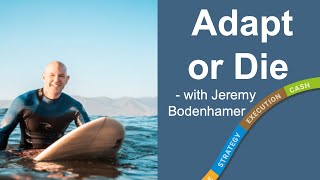
This is a recorded interview (YouTube/podcast) where Bill Gallagher interviews Jeremy Bodenhamer, CEO of ShipHawk and author of Adapt or Die. Bodenhamer traces his entrepreneurial origin from a failing pack-and-ship store to founding ShipHawk (packing/shipping software for ERP-connected companies). The conversation covers market consolidation and marketplace power (Amazon and four other major platforms — Walmart, Alibaba, JD, Shopify — framed as the "five APIs"), case studies of brands competing with marketplaces (Grove Collaborative, Parker Clay), and operational levers merchants can use (packing optimization, multi-carrier rating, dynamic routing, ship-from-store). Practical claims and metrics discussed include substantial misrouting rates in legacy operations (~22% of shipments misrouted to non‑optimal service), throughput improvements after software adoption (typical 3x–5x, up to 9x reported), and the social/environmental impacts of delivery practices ("neighborhood optimization"). The episode closes with recommended resources (jeremybodenhamer.com, shipping strategy assessment) and three takeaways for merchants: assess shipping strategy, consult a vetted solution partner list, and persist as a differentiated independent merchant.
Chapters
Oh, gonna remove.
There we go. Live once again. I should probably put our guest photo up prominent less of me in that title image, more of the guest foreign. Good morning, good afternoon, good evening, everyone. Welcome to our listeners and viewers. So we're talking today all about how to adapt or die to the big changes that are going on. That's been a big theme this year. We have a special guest on to talk about the impact on a particular set of industries. But no matter what industry you're in, there's lessons here for all of us about adapting to the changing realities of the world. My name is Bill Gallagher. I'm the host of the show, your friendly neighborhood scaling up coach. Every week we bring a new episode here talking to a guru, a thought leader, a CEO, somebody with a lesson, a story, a message in the world of scaling up, dealing with the big four decisions, people, strategy, execution and cash. And we often also touch on what I like to call the fifth decision. What kind of leader do you need to be through all of this? So we're talking today with definitely an expert in his field, a friend and a client and a true scaling up success story, grappling with and right in the middle of adapting, helping so many other companies adapt or die. And of course, we're actually looking to thrive, not simply, not simply avoid dying, but how do we play to win? So before we get into that, let me remind our listeners that we have over 238, I think episodes now, approaching 240 episodes on from all kinds of thought leaders, all kinds of things. And just because that episode happened a year ago or whatever, there's lots of gold back in there. So go find that whole back catalog and more of great episodes in the four decision areas at scalingcoach.com can also find an iTunes, Stitcher, YouTube, like wherever you go, get your regular podcast type updates. We've got it, I think there, if we don't have it somewhere, let us know and we will get them all loaded there as well if you want to. So find all that. And then if you want to subscribe or any of that kind of thing, you can go to scalingcoach.com I'm joined now by Jeremy Bodenhammer, who you can see on the screen here as well if you're a viewer versus listener. But Jeremy is an expert in all things to do with that crossover between E commerce and shipping. And he's been featured in TechCrunch, AOL, Fortune Internet Retailer Entrepreneur. He was a 2018 supply chain executive, Protono. He's a Volunteer in his community. He's a dad to three boys who are CrossFit fiends like him and a surfer. So I wish I was more of the crossfitter and less of the. And I wish I got more surfing time, but I love when we're not in a whole pandemic. Stay at home. I can get down there. So he lives in Santa Barbara with his wife and those kids. And he is CEO of Ship Hawk. But we're here today to talk about his new book, Adapt or Die, which is talking about dealing with the profound shifts and in retail and e commerce and the movement of things, many of which our clients have been dealing with. And I personally have dealt with a great deal in our last company in particular. So we're talking all about these ideas. Jeremy, welcome to the show.
Hi, Bill. Thanks for having me.
Right, four minutes in, you actually get awarded. So it's gonna be 71 degrees here today. I'm just saying that to remedy all the people who live in the snowy areas. I'm in Oakland Hills outside of San Francisco. Jeremy's down in Santa Barbara. We both live in beautiful places until there's either fires or floods. Except for that.
Exactly.
So let's talk about the book. But before we get into that and the lessons here, not just if you're a retailer, distributor, manufacturer, but lots of industries get disrupted and there's lessons here for everyone. Before, let's talk about a little bit about your background. Talk about how you became an entrepreneur. Kind of the journey what led you to this company and this book.
Yeah, well, I started my first business when I was 12. My family didn't have much money and had to find some way to help out. Put food on the table, pay the electric bill and bill.
Or were you just augmenting your own?
No, no, no, no. I was contributing to the. To keeping my family afloat at that point. That's kind of my initial catalyst. And then, you know, fast forward. I'm in college and I'm paying my tuition, working multiple jobs. And one of those jobs was in this little executive services firm that did FedEx and UPS. Just small pack type shipments, nothing fancy. And there was an ownership change. I helped that owner double the size of the business right after she, the new owner, acquired it and worked those jobs, got out of. Out of college and by, you know, fast forward a little bit. I always monitored the business for sale listings, those Bisbend listings, telling you what local businesses are for sale. I learned early on that you can tell more about what's going on in the market by how many dry cleaners are for sale in your community than you can by reading the Wall Street Journal each morning. And so I'm monitoring these and I see this little pack and ship store come up for sale. And this was a similar business that I had worked, worked at in college. And so I took note and after a couple days the listing disappeared. So I figured up somebody bought it and moved on. And then another few weeks later, that same listing popped up again. And after that, popped up four or five times, I finally called the broker and I said, dude, what's going on? It turns out that the business had fallen out of escrow with five consecutive buyers. And so I saw the opportunity on the wall. Remember the story when a guy showed up to my parents house with a handful of cash and bought one of their cars out of the driveway for far below it's worth. So I literally begged, borrowed and stole. Took every penny I could get, put it in an envelope, walked into the broker's office and put the envelope in his hand, thinking that the guy selling was, you know, going to be pretty frustrated after so many failed attempts. And he looks down at the envelope, he looks at me and he goes, I assume this is your first offer. And I said, right now this is my only offer. And I walked out of his office, just turned around, left him with the money, tried to make him give it back, right, which nobody wants to do. And he made me sweat for two days. But I got a call two days later and the owner was on the phone and he said, this is a very unconventional way of doing this, but I'm going to accept your offer. So he didn't want to give me the money back, obviously. So I bought myself a failing business and I was putting my wife through grad school at the time. She's the dean of the local high school, but was getting her teaching credential and masters at UCSB here in Santa Barbara. And so I couldn't quit my day job. But the day she graduated, I did. I quit, went to work in the store and this guy walks in with this life size wooden rocking horse. This thing's big enough for two grown men to get on. And, and it's the depths of the Great Recession, 2008, he had lost his house and everything. He's trying to pay his bills, so he's selling his stuff on ebay. And he says, hey Jeremy, can you ship this? And I said sure. And I had never shipped anything bigger than a small brown box. So I did what Any shipping professional does. I called UPS and first lady I got on the phone, just starts laughing at me when I told her how big the thing was. Transfers me around a bunch. Learned some very important lessons when she quotes me something like $5,000 to ship this thing. And then she says, but if you open an account, I'll give you a 68% discount off some tariff from the 90s. I'm like, I don't know what any of that means, but I'll take it. That was my first lesson in freight and shipment pricing. And by 2011, my phone at this little pack and ship store in Santa Barbara, California was ringing off the hook with customers all over the world asking me one question, which is, what is the shipping cost? An enormous amount of business had already moved online and the momentum was growing. And so I figured, hey, I have two options. I can scale this business brick and mortar, which sounded like a terrible, stressful idea, or I could sell the business and try to solve the problem with software. And that's what I did. Raise some venture capital and started Chiphawk. And so today Ship Hawk is a premier packing and shipping software for ERP connected companies. And that's, that's where we're at.
Well, and so, so much has been changing over the last period. We've seen retailers being hard pressed, constricting, shutting doors, and we've seen brands squeezed in the middle. You know, I was a manufacturer, had a brand and manufacturer of a fashion jewelry line for some years. And we found ourselves continually squeezed between suppliers in Asia and around the world and the retailers who were imposing fees and restrictions and things like that, pushing our margins down, successively squeezing our cash endlessly. Meanwhile, Amazon was just growing and growing and growing in its prominence and eating up folks. And I mean, that's what we have in particular in North America, but, and in many places around the world. But in other places they're dealing with other threats as well to, to that whole world, aren't we?
We are. And essentially Amazon is just doing more effectively what the retailers back in your past were doing, right? They built an engine that is virtually impossible to compete against. And so that's the reality of the marketplace today. And one of the biggest reasons I.
Wrote the book now, I dealt with Amazon a couple different times. Once as a reseller or fulfillment partner, another time as a customer. So I have some experience and pretty much negotiating with Amazon was, that's the deal, take it or leave it. And you got to integrate with our system. As unique and quirky as it is, the way that it is. And in fact, at one point they were going to take our brand and they're like, okay, you're going to be like a featured, focused brand within and we're buying from you. And so we're taking inventory. And we had to jump through a lot of hoops to get that done. It was a take it or leave it contract, but in the end it actually didn't matter anyway. We're just lost with everyone else. And they weren't really promoting us the way they were promoting anyone else. And it was just like being with any other big box retailer. We were getting squeezed once again and they held all the cards and we were prohibited from remarketing to people or doing anything like that. So it was brutal.
It is. And when you add on top of that the fact that each new distribution center Amazon sets up, they spend over almost a quarter of a billion dollars with robotics and you know, you know, insane amounts of software and technology. I mean, you just keep adding layers to the cake here. And then you've got these little independents that are sitting there saying, well, what can I do about it?
So we opened our own website. And that website with that old company still exists to this day. But our cost to ship and to process the order was so, so, so high. Especially at the time when we were using one of those really big, fancy, expensive EE Commerce and ERP systems all connected up and that kind of thing. So it's a brutal thing.
It is. And it's, you know, as my kids say to me every day, it's not fair. Right. It's not fair that Amazon's spending less on shipping than, than you are. It's not fair that they have their own army of delivery service providers and you're being capped by FedEx and UPS, who even after their, you know, they've hired hundreds of thousands of people for peak, still can't meet the holiday demand. Yeah, it's not fair. And so we got to, we got to have tools to figure that out.
Okay, but those new vans, have you seen the new little vans? They're moving around. I have start to turn those things over. It's going to be great. Surfer conversion vans as people move into their cars and live van life forever.
I like that.
Okay, so let's actually tell some of the stories. Let's get into some of that. One of the ones that you shared as we got ready for the show is about Grove Collaborative. Talk about that company and, and why that's relevant.
Well, Grove's an interesting company for a variety of reasons. One, they're a long term ship hot customer. I remember early days in San Francisco, sitting with the two founders in, you know, a cramped little office in this room that I think they, they had a name for it, I think it was more like a dungeon and talking about why, you know, they should trust their business to, to ship hawk. So I mean that's, I like telling stories obviously of customers, but they're amazing in their own right because they are head to head competitors with Amazon and they're doing things a different way. One of their initiatives right now is called beyond plastic. And by 2025 they're gonna have zero plastic in their supply chain. All of their products are healthy and green and natural. They involve the things that they sell. They're selling cleaners, household cleaners, things that normally are as far from natural as possible. Right. And they've just exploded. The company's worth well over a billion dollars as of their last fundraise and they're just growing like crazy. So they're doing the right thing, they're being authentic with their customers and they're seeing a lot of success even in that kind of key territory where Amazon plays, which is those more commoditized type, you know, home cleaning products, health and beauty, that type of thing.
And, and you also spoke about Parker Clay.
Yeah, Parker Clay is another amazing example because Parker Clay is a D2C brand that owns their entire supply chain. What D2C is direct to consumer. So they own their entire supply chain. In Ababas, Ethiopia, they have manufacturing facilities where they are empowering women who wouldn't otherwise have employment opportunities. And they now employ hundreds of them and they make high end sustainable leather products. They manufacture them, import them and then sell them all over the world. And they're another company that's just exploded. And you can find very similar things on Amazon. A story I don't tell about in the book, but I just love. The Allbirds CEO found out that, you know, everyone's going to Amazon searching Allbirds and he doesn't want to sell on Amazon for a lot of, you know, reasons that make sense for his business. And so Amazon has products that they're saying are the same, but they're half the price. And so he wrote a letter to Bezos saying, hey, if you're going to copy us, please copy our sustainability. Please use the same products, like together we can have a huge impact on humanity and on the earth. But don't copy our products and use all these harmful elements and say it's the same because it's not right. So these companies that are really being authentic about who they are and taking more of that supply chain in their own hands, bringing it in a house where traditionally they'd rely on third parties or whatever the cheapest way is, are actually seeing it improve sales, right. And drive down costs. So it's a little counterintuitive, but we're seeing it work with many of our customers and other companies.
You know, I hear a few different things going on here. So one of the things I hear is the shift to online. So if I've been selling through traditional retailers, now more and more transactions are moving online. The customer enjoys buying online. I enjoy buying online. I need to find some weird part. I need a filter for the exhaust over my, the exhaust over my stove, right? That's like a weird obscure kind of part. Where am I going to get that? Filters R Us down the street? No, that doesn't exist anymore. If there was a range of filters for ranges at one point, it isn't there anymore. My hardware store doesn't have but a couple of them, if any. And the same thing. True. With the unusual fit to the HEPA filter in my house, air conditioning and heating system, I'm going to go online, I'm going to find those things and Amazon has made it really, really easy and the whole category of online, right. Has made it really easy. So if you've been dependent on selling through one channel and things are moving to another channel, you've got a. That's one adaptation, right? And then if you're retailer moving goods through that or selling through that, you don't want to necessarily be squeezed by Amazon because they have made it easier with one click and almost universal. Find almost anything. Except then there are those trade offs, right? And I think then the trade offs are as a business I'm getting squeezed. As a consumer, I'm getting crap knockoff goods shoved at me with zero. Like I bought things from Amazon all the time. Unfortunately I do buy stuff from them because they're so dominant. Your book is sold through Amazon, right? So there's a time and a place for some of that. Except as you point out with the Allbird CEO example, there's sometimes there's stuff like oh, I'm going to buy a cable and I get this thing that doesn't work or some piece of hardware that falls apart right away. There's like zero quality control and the reviews get gamed. And then there's their competition of their own white label stuff, right? Where they're Knocking off and competing backwards with you.
Yeah. You just covered so many, so many important topics. I'm not going to remember them all. I'll be honest with you. Number one, I think it's important that we talk about is we live in a world now where you cannot get everything locally anymore.
Yeah.
Normal things, things that you just might want to go out and, and find you cannot get local. You have to get them online. And that's something it's super important to talk about. I don't know the exact number off the top of my head but in terms of the companies and products that are sold on Amazon, last I checked in 2019 they had I think about 120 million SKUs. 120 million different products in their inventory that they could sell. And I think the number was up to 40% of those companies selling those products. And those products were from China, they're originating in China. And so you're right, there are controls that are difficult. And Amazon does white label, they white label aggressively. I was on a call two weeks ago with a partner of ours who has a customer who said that Amazon just white labeled dog food to compete with them. And I was thinking, you know, more apparel and you know, furniture and all the things we've heard about historically I had yet to. This is the first kind of consumable product I've heard this, this applying to. But yeah, I mean the world has changed prime. I don't think. Although the consumer understands it digested as today I digest it as you do which is ease, ease of use. Right. You go to Amazon because it's easy. Right? Shopify. I talk in the book about the five APIs of the apocalypse and these five global giants that I predict in the future will own all commerce. Everything's moving to their infrastructure. And Shopify is one of those. Yeah, Shopify is one of those five. But they have a different vision of the future.
Wait, wait, hold. Shopify. Tell us who the five are.
Because the five AP is the apocalypse. So an API is a, is software. It connects different, different pieces of software and it communicates in multi direction two way. Right. It doesn't just dump data, it speaks to each other.
Right.
And the five APIs that I talk about, these giants are Amazon, Walmart, Alibaba, JD and Shopify. And Shopify is the only one that is really doing things in the merchant's best interest. Now am I saying don't sell on marketplaces like these and others? No, I'm not. It's part of a strategy that every business Owner has to consider. What I'm saying is you got to go in eyes wide open and see exactly what you're doing. I've got a buddy with a company that makes a special line of products that they put on Amazon and they don't put their, you know, their premium products over there because they need those customers to come to their site and buy them directly and they don't want to risk the knockoff component. Right.
This is a useful thing as well to point out. So if you're a manufacturer, producer, brand of some kind, you probably already know that people create different versions of SKUs to sell in places like Amazon, Costco, etc. I'll create a variation with a slightly different feature set, a different model number, and I'll put that flat panel out to Costco or that exercise item or whatever that I won't sell anywhere else. So it's not as directly comparable and doesn't erode everything else.
Absolutely, absolutely. And their strategy behind that. Right. And even how you like what the count is, how many you put on there. I mean, you got to go into these things eyes wide open and go in with a specific strategy where that marketplace is going to add value to your business. It's not going to be your business. I tell stories in the book of companies where it was their business and then they ended up having no business. But what you were talking about before about the ease of use, Shopify has actually done a really good job and is going in that direction by merging all of their independence through their payment app, through their tracking app. So if you hit a Shopify store, you may not know it was a Shopify store when you showed up, but your checkout is seamless, it is super easy and it's all connected on the back end. And so I see the, the, you know, the opportunities for independence moving in that direction. But once again that the independent merchants need to go in eyes wide open and make these decisions on purpose at this stage of the game. Can't just stumble upon them anymore.
Yeah, you got to think about, about it. Well, that. So those are all things that are rapidly changing. Right. Platforms, you call them APIs in this case, but they're whole, almost operating systems for their environment and they have pros and cons for each one. And you might want to be on all of them, but with perhaps a differentiated strategy. Right. Repeating Amazon, the one we talk about and think about a lot. Alibaba, Walmart, JD. Who's JD?
For our listeners, JD's in China. They're an Alibaba competitor, think Walmart, Amazon, US, JD Alibaba, China and then Shopify.
Which all have dramatically different approaches, some more than others, to being your connector to that. Incidentally, that old company, we moved from a more expensive, complicated E commerce platform to Shopify as we reposition that and the company became quite a bit more profitable at that volume level. So was really great as it moved less and less from being in retail stores and more to direct to consumer.
Yeah, it doesn't surprise me. And when you say connection, I don't want you to think connection is only software or shipping, right. As people think about Amazon, connection is to the ring doorbell, connection is to your microwave or your oven or you know, Alexa in any device, right. Google Assistant, Siri, I mean these, these assistants and these, these APIs. The software is being injected in everything and those are becoming ordering devices that are able to further compound the power of the marketplace.
Yeah, I, I love the, I love this thinking about the whole approach because there is the broadness of it, right? There's that notion where I feel like I need something, I want something, right? And then there's when it actually shows up and I can open the box or unwrap it or whatever and begin to use it or enjoy it. That whole thing finding it, purchasing it, it getting shipped to me or even as I'm finding it, like evaluating it, maybe I don't know which one I want, right. There's a new kind of surfboard I'd love have. I've been looking and thinking about them. Probably it's going to go well. It could go direct to a producer or a, a maker of things probably produced by an independent contract manufacturing company, but it could also go through a dealer, distributor as well. That purchase decision in the end. So there's the first sort of research and thinking about something and then all the way through to it. I'm actually got it, I'm enjoying it. There's a lot of things happening in.
Between between that there are. And most of us also don't think about the impact of those decisions, the impact on the humans fulfilling those orders, the impact on the environment to place piecemeal orders with Amazon that constantly show up on your doorstep non aggregated. Right. I talk in the book about this next frontier of focus from a distribution perspective being what I call neighborhood optimization. Whether it's Amazon, FedEx, UPS, anyone distributing, they want to stop at every single driveway, just like the post office does, right? Except they want orders for every single driveway and then they want to consolidate or condense that that capacity to get as you know it is concentrated as possible and they drive their costs down that way. So but we're not thinking about the impact of that from a broader perspective and it's significant.
Now I know this show is about recognizing the shifts and adapting to them and, and Shopify's in it positive. But say just a little bit about what Ship Hawk does because that's the line of work that you're in that had you think about writing this book that's broader obviously than your company, but.
Absolutely. So Shiphawk works with retail, wholesale and e commerce companies to lower packing and shipping costs and to level the playing field so they can compete with the e commerce giants. And the way we do that is we have shipping software for ERP connected companies meaning ERPs like a NetSuite or anyone in that category. And we do multi carrier rating for parcel and less than truckload. We optimize cross carrier cross mode. We have packing optimization. So in the warehouse we're telling the people that work in the warehouse what box to use, how to orient items in that box, how to build boxes on pallets, how to assemble the order, all with software. Right. We optimize for warehouse distribution point or ship from store. I read an article this morning that I think 63% of retailers now consider their retail store the final distribution point for all home deliveries. So there's a lot of optimization behind the scenes that needs to happen to identify the best distribution point, how many packages you're sending out to your customers, how the shipping cost influences that. We have dynamic rating rules which allow customization of how shipping is employed on a per item, per order, per customer basis. We have real time analytics and reporting so that they have the data they need to make smarter decisions tomorrow than they did today. We also have full shipping documentation and an on on brand track and trace component which allows visibility from when that order is placed all the way through to the delivery. So all that's in one piece of software and buyers buy it for two main reasons. Well, let me, let me rephrase. Before the pandemic they bought it to number one, take decisions out of employees hands. No one who runs a high volume warehouse wants the warehouse workers making decisions about how things should be shipped. When decisions are made by humans, costs go up. And number two, they bought because they wanted to reduce shipping costs. Then the pandemic hit and not only did e commerce volumes shoot through the roof, but now they can't have as many workers in the warehouse because of social distancing so now our number one reason for purchasing is they have need to improve throughput with fewer bodies, so they need the efficiencies. And that's really what, what we're, what we're good at.
Yeah. It's interesting. I don't know if our listeners and viewers have seen this before, but I visited a huge number of warehouse distribution centers and it's really fascinating how software systems can optimize how the pick and pack goes on, how things are organized around the warehouse, how quickly something gets filled, what size containers they go in, what carrier they go out with that whole flow of things through. And then you're even talking about which distribution center does the order go out to that will optimize the fastest delivery for where we're carrying it, if I've got multiple of them going on. But it's a really complex thing. And then there's the decision about, okay, which carrier am I going to use to fulfill the customer expectation for this time frame and how's that evolving? And we've definitely seen some shocks to that in the, in the last period. Right. As people.
Absolutely. And not even just which carrier, but which service. We did. We analyzed hundreds of thousands, just under a million shipment records of customers and prospects internally and found that Even with only one or two carriers being used, so I'm single sourcing with FedEx or I'm using FedEx in the post office, that shipments internally were being misrouted at a rate of greater than 1 in 4 or sorry, greater than 1 in 5, it was 22.3% or somewhere right around there. Meaning that they, they aren't even using the cheapest service that meets the requirement, the delivery promise, even when it's available. Right. And that's. That comes back to one of those buying reasons.
Right.
Which is if people are making decisions, costs go up. And so if you have a world where not only is that routing an issue, but FedEx and UPS are coming in saying you can only ship this many packages a day or this many packages a week because our network's overwhelmed. How do you intelligently reroute those packages to other providers? Which providers, which ones are the best, which ones meet the promise? Because all of this impacts the customer's experience. Because the only experience outside of the website that they have with the brand is the delivery of which they have very little control. So if they don't take every. I talk to my boys about this all the time about the levers they have in life to control things and there's. They're Few and far between. So if you don't utilize them, you could be left out in the cold. Right. So you got to use the ones you've got.
Yeah, yeah. It's funny, I don't want that end person making a decision on each and every package and understanding it and researching. I mean even if you did do that, and I've played with shipping software where you do that, it's a time consuming thing to change the option and then see what the prices pop up and then pick one of those and then see does this package conform to that with that delivery window. That's a time consuming thing that the computer can solve for you pretty quickly. The software can do. Right?
Absolutely. Which means you're spending money, more money on the shipping and you're spending more money on the fulfillment and every part of your fulfillment.
Yeah. Because it costs that amount delaying your.
Throughput with and delay in your throughput and the, the customer's experience. Right. And so that means that a competitor like an Amazon selling even a similar product of lower quality is outperforming you.
On that experience by a massive amount. Well, if you go and calculate time and effort, study on what you're spending to get things out the door and the time it's taking you relative to a highly optimized multi billion dollar company and what they're doing it and even, I mean we can tell that Amazon is not doing it in the most holistically perfect way because I've got four different shipments showing up that aren't consolidated, all with different packaging and things. And things packaged inside of packages. Inside of packages. Right. Sometimes, yeah. It's crazy making that's not good for the planet or multiple drops. I've got one driver comes by and drops something from that. None of that is particularly efficient in, in the grand scheme of things.
It's not at all. And the main metric we use to look at that internally is throughput within the warehouse and improvement over whatever legacy process or shipping software they were using before. And so what we see is improvements of 3x5x. I think the best we've seen was 9x improvement over their prior process by putting our software in place. And those are the type of little things that make a huge impact in an operation. I mean they can even impact your rent. How much warehouse space do you need? If you've got better throughput, you don't have as much. Your storage costs are different. Right. Maybe it's not as much. In a post pandemic world where lean is going to be frowned on for a little bit because everybody ran out of everything. Like toilet paper, right. Paper towels. But in, in that lean, you know, that lean world, it matters.
Yeah.
It's one reason people love robots. Right. Robots don't use bathrooms or park cars cost you less.
So they need rebooting.
True.
Lubricating, maintenance, recharging. You know, here's another thing I think for our mid market and early stage entrepreneurs. There's another thing I think that both as the consumer and as the entrepreneur there is probably really interesting and that's living in a world of a rich diverse world, right. Versus living in a world of bland sameness and declining quality, declining margins. I remember. So we manufactured in lots of places all over the world, but a lot in Bali. And when my wife first went to Bali years ago and we moved the most production to Bali in those days, it was an amazing, rich and unique kind of place. And it still is to some degree. But a big piece of that was lost. And I remember after we'd been manufacturing for a few years, I went back there on one of our visit the factory work on production, look at new designs, prototypes, things like that, work through issues. And as we drove into the little central town of Ubud, I was overcome with the fact that there were multiple Starbucks and Ralph Lauren shops in the same tiny little town. So now every corner had an Internet cafe, which feels pretty good except most of them were Starbucks or some Starbucks knockoff. And then there were all these Ralph Lauren polo shops. And I'm like what the hell? How did we get to this place where these massive gross sort of global brands of blandness are being pumped out to us for predictability Instead of discovering some unique, delicious Kapibali blend of, of coffee that you're going to drink that you're never going to have anywhere else. You're going to be pumped out some crappy Venti frappuccino nonsense that is the same exactly as you had in Carlsbad. Now you're there on the other side of the world.
My team is going to, you know, at some point hate me because I say this so much. But small and mid sized companies feed families and build communities. And that is one of the keys to everything we do. Why I wrote the book, the whole thing, but unrelated on, on, you know, the note of what you're talking about, it drives me bananas. Drive into, you know, I go to Texas on a trip and it's just fast food chain after fast food chain, Walmart after Walmart, right? And it's there's you can see over time, as I get older, the character of all these places being lost to homogeny. Right. Everything's the same everywhere. And it's not just that we're losing the character. Think about the families. Right. Someone posted on Twitter last week, I posted a response because the concept always offends me and I'm not easily offended. I just get really frustrated when people post how much Amazon is hiring and saying, oh, you said Amazon was taking jobs. They are taking jobs. They're taking good jobs and producing many bad jobs, poor paying jobs. Right. Exploitative jobs in some regards, those people are not people that were working, you know, on Main street before, you know, when Main street still existed, running their own little family business. Right. That that world is gone. And so. But that is the world that supports our communities. I mean, think about what, what an Amazon does to the tax basis locally. Right. All those sales are not happening here anymore. So where's that money come from or where does it go to? Yeah. So if we can, if we connect that entire purchase all the way through, we really have a responsibility as buyers. Right. Because we all bought on Amazon. We're both probably prime members. I am, even though I wrote the book. Right. But we have a responsibility.
I need the, I need the prime TV now.
Correct. But, and I asked this in the book, what kind of buyer do we want to be?
Yeah. Well, here's the thing. We were talking about sameness and blandness and unique character. There's, there's a place for both. Really. Like I go to a foreign country. I love experiencing local culture, local food, the local goods, things like that, or even to a different region. I want to see the unique foods and, and things of that region. I want to experience that. And there's a time when I can remember being in foreign countries and being just like, my stomach is revolting from some of the local food. I'm not, it's not that it's bad, it's that I'm not used to it or it could be in some cases that it's bad and I like, go to a McDonald's for a break. Now, do I like McDonald's that much? Not really. It's a predictable thing that I'm used to physically, mentally. Right. And so you'll go to a place like that for that moment, but if your whole life has lived like that, that's not a good thing. Right. And to have everyone engaging and participating, that's always the thing. That's not. I mean, some of it, yes. Right. I would Rather have some interesting local coffee. On the other hand, there are times when I'm like, oh my God, I, you know, if my barista had any more piercings, I'm like, I can't deal today.
Right.
And then I might go, it's like something's falling out of that dread into my coffee. Like places that are so over the top, I'm definitely pigeonholing myself or typecasting myself as a very mainstream, middle aged white guy there. But there are times when any of us, for whatever reason, is more or less comfortable with something and that diversity of things, including the big brand, including the McDonald's, the Starbucks, the Amazon, the whatever. And if you were growing a company up, you'd want it to get to be that big player. But that, I think what you're talking about is leveling the playing field. Right, right. Adapt or Die is such a brilliant thing right now because we see small businesses that have been hammered, whether it's because retail shops were largely closed for a time or were reduced and they couldn't deal, or people were just afraid and they weren't going out. And then restaurants, now our restaurants are all, again, all takeout. There's no dine in or dine out anymore. For a while we had outside dining. But in that thing, the ones that adapted, some people are like, no, we're not going to adapt, we're going to shut down or we don't know how. And so we're going to just keep doing the same thing and wait for this thing to be over.
Yep. And what are the alternatives? You either meet the people where they're at or you disappear.
You do, yeah. Now, here's the thing I think that's interesting, goes beyond, and I know that you, the title is Adapt or Die, but you speak to this thing. If you lean into the reality and the changes and the trends, there's actually great opportunity. Most of the clients that we speak, that we're working with this year and many of the companies that we speak to that are in the scaling up world are leaning into the trends, are leaning into the new realities, not just the pandemic ones, which has heightened and accelerated things. But for the most part it just brought on things that were already at work. Right. The shift to online, from brick and mortar, from local, isn't new to the pandemic. It just got amplified and accelerated with that whole thing. But the companies that are leaning into this are finding opportunity, are doing really well, are meeting needs.
True. And there's different elements here. I talk in the Book about six different elements. Packing, shipping, warehousing, data and analytics, robotics and operations workers. And so from what you're talking about, hey, leaning into E Commerce. They already had their distribution set up. Even though it may have had some hiccups with inventory, they were able to quickly react versus some of these more legacy retailers who truthfully don't know how to sell online. Right. They have no idea how to do it. They have a website, but there's problems. It's not a good experience. Right. You don't get what you need versus going into their store. But one of the areas that I am more passionate about speaking to and is not as in vogue and I think it should be and I, and I would like to see more businesses lean in is in the treatment of the operations workers. You know, you and I are living the the world of tech and tech and Silicon Valley and venture capital. And in that world it's about in the front office, what type of environment do you have? How do you, how well do you pay? What benefits do you have? Do you have a foosball table and a pool table and kombucha on tap and all this nonsense?
Do you have.
Yeah. Not just snacks, it's like an entire snack like wall.
Right, That's a wall. Beverages.
Yeah. What chef did Google hire? Right, but you go into the warehouse and it is exactly the opposite.
Wait, you don't have a body worker on staff?
I do not.
Some places, massage, child care, dry cleaning.
It's crazy.
In the parking lot.
Yep. Why? Because they want productivity and they want the brain power of those people on the business.
Right?
Yeah, but you go into the warehouse and nobody cares. It's how can we cut another penny off what we're paying these people?
Yeah, right.
And they don't, they don't pay attention to the terrible productivity. They don't pay attention to the high workers comp costs. They don't pay attention to all of the costs that the replacement costs in, in, in regions where Amazon has a warehouse, the warehouse worker replacement rate is greater than 100% every year. And so the turnover cost these companies a fortune. And a great example if you look at fast food, well, we know McDonald's, we know taco Bell. Right. But look at Chick Fil A and their biggest competitor. We could, we could argue is, one could argue is, is Kentucky Fried Chicken.
Yeah.
Well, Chick Fil A is closed one day a week and they pay their workers. I don't have the exact dollar amount in front of me. It's something like 30% more, maybe 40% more. It's a substantial starting pay that goes up. And they sell more than twice the average Kentucky Fried Chicken. Their average revenue per Chick Fil A is something like 4 1/2 million bucks to Kentucky Fried Chickens, 2 million. The same applies if you put the math to In n Out, which operates like Chick Fil a right over McDonald's. Same thing. The manager of an in and out makes 160,000 bucks a year. They invest in their workers. A burger still costs two bucks. Right. The in and out prices haven't even kept up with inflation. But the business does phenomenally well. They take care of the workers. There's a line around the block all day, every day. There is no time that they are open where there's not a line. And with the pandemic, it's even worse because how many other places are you going to go? And so I think there's ways even that we don't think about that we can lean in. Right. As business owners competing against these giants. Like, make it like Parker Clay. Right? Make it part of your mission to take good care of the people that work for you.
Yeah. What a difference it is to lean into the differences instead of just trying to be like them. Level the playing field on the things that you can. Being smart about it, being mindful of what there is, and then being unique and true to who you are and what you care about. Your own special sauce, if you will.
Absolutely. And the companies that are doing that are exploding.
So I want to come back to the resources and the takeaways in just one second. A couple reminders. We do a show like this every week. We also have a tip show. Now we're adding a another show, but we've got a deep dive on some topic. Every work in the world of Scaling up, you'll find all that and more@scalingcoach.com our website. Scalingcoach.com iTunes, Stitcher, wherever you find YouTube, even wherever you find your podcast, the video releases are done live on Facebook, Twitter, Periscope. Where else are we putting them out? YouTube, so on. So if you want to see the live video, you'll get it there, you'll get the audio. But if you subscribe at our website, we'll send you a notice every week and you'll get a direct link along with all the show notes, the resources, the links, the special offers, that kind of thing. So that's all@scalingcoach.com along with, we'll ship you a free copy of our book Scaling up and you can get started Scaling up, just pay the shipping and handling at one low flat rate and so you can get if you want to drop us a line or if we've had more demand for our coaching this year than ever before because people are dealing with and adapting to change and it's a great time to have a coach. We've also got more flexible in the approaches that we've taken with the packages of coaching and the offers. But if we can help you find a coach in your neck of the woods or with your style or particular area within Scaling up, drop us a line to infocalingcoach.com or just remember scalingcoach.com, get in touch with us there. I want to give special thanks to Vern Harnish, the author and creator of the Scaling Up Framework, and to Lucy Summers, who's operating in the background here before and after all our shows, keeping the livestream going and making the camera moves and things like that. Our audio is edited by Albert Burge at podfly Productions and the show notes are written up by Ein Kudena and then proofread by Tim McGowan. So let's talk about your top three takeaways. What are your things that you really want people to get from the book that your points to hammer home?
Yeah, well the top three takeaways I would say are number one, go to my website jeremybodenhammer.com yeah and take the shipping strategy assessment. It's free. It will give you an instant one page response at what you're doing well and what needs to improve and even just the the process of going through the questions will change your mindset on on opportunities where you could drive initial focus. Number two. You know the the number one reason I would say prospects call our sales team is for help with solutioning. They don't know what solutions to use. They don't know the difference between different pieces of software, shipping software, warehouse management software. So I've assembled a list of partners on the website so you can see reputable companies that we have worked with successfully with customers and you know who you can reach out to to do business with and our team's always willing to help help guide you there as well. And then I would say my final piece of advice is if you're an independent business, an independent merchant small mid sized company, keep fighting, don't give up. I know that the giants are giant beyond comprehension big. But if you're unique to yourself and you make that clear in your business, it will work. It will pay off. And if there's anything that I can do to help you there, you can find me at jeremybodenhammer.com or@shiphawk.
My friend, my client, author CEO. Jeremybodenhammer.com you'll find Jeremy Bodenhammer's link in the show, notes on the screen, etc. Etc. You can find him. Go get the book. Adapt or die. Thanks Jeremy for joining us this week for the show.
Thanks Bill.
Thanks everyone. Bye bye. Keep scaling up. It.










