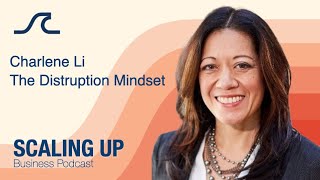
Bill Gallagher interviews author Charlene Li on leading through disruption. They examine how Adobe and T-Mobile transformed their business models, why leaders must embody change themselves, and how to build agency across organizations in constant crisis.
Chapters
Cue the music. There you go. Cue the music. Talking about disruption or building something cool enough that it disrupts things maybe is more accurate. Everybody, my name is Bill Gallagher, Scaling coach and host of the Scaling Up Business podcast. Our show comes to you every week with something cool around the world of growing your business and the leadership required to get you there to and survive and maybe even enjoy the journey. Hundreds and hundreds of shows now@scalingcoach.com Scaling Coach.com also has information about our programs, events, things like that. As I record this now, we have a workshop coming up in just over a month in San Francisco getting people started with the basics of scaling up. I got a boot camp in two weeks up in Lake Tahoe that's already full, but we got things like that all the time to help you get started. Of course, we have hundreds of coaches around the world and happy to connect you with someone in your area that might help you and your company get going and growing. All right, I'm joined now by a guest, an author all around badass in the world of transformation and disruption, Charlene Lee, who I heard speak recently at an event in San Francisco with my friends Ryan and company from the Arkbound Group. And it was awesome. And I thought, let's get her on the show right away. Actually, a lot of those speakers we're going to have soon because he just put together a phenomenal group of speakers and great. Even the people attending I thought were pretty cool. So we welcome to the show, Charlene.
Thank you for having me.
Thanks so much. So everybody, your listeners. Charlene is an expert around all things around that. She's consulted and worked with companies from Adobe to Southwest Airlines. She's got multiple books in the world of leadership and transformation, disruption, and that's what we're talking about today. This latest book, the Disruption Mindset. So what is it that leads to that? What's important to that? She's going to share some great stories with us. So again, happy to have you on the show with us. Tell us a little bit about kind of your background, maybe a little bit more of your personal story and how you got to this. You shared as we were getting ready to go on about your personal purpose, like what point of your life is. So love to hear about this.
Uh, so I worked a lot of my personal purpose about a year and a half ago to just figure out what I wanted to do, just refine that, you know, those good things you do every once in a while to just get realigned. And it came down to my Purpose is to catalyze transformation, to maximize human potential. And it's about maximizing that for individuals and leaders, but it's also doing that for organizations. Because so much of what we do is around work, but also our communities, our families. But it's really looking at how do you maximize that potential. And one of the things I did, I came out of business school in 1993, looked around like, what am I going to do with my life? I was really lost. And I saw this little thing called the Internet and the World Wide web hadn't even been invented. And so I said, I need to be a part of that. And decided to go to the place where it was changing the most. That was Silicon Valley and land at the San Jose Mercury News. Because I figured if anything was going to be transformed and disrupted by this, it would be newspapers. Sure enough, right in the middle of all of that transformation, helping the news, the Mercury News, get online, learning how to sell, just figuring out how to even sell ads, what do ads look like on the Internet? And then just did that for a while, then had babies, decided I want to do something different than managing a whole team of people. So became an analyst at Forrester Research where I focus on Internet marketing and advertising media. I was a person who did all the Internet advertising sizing that drove a lot of the dot com boom. I'll take responsibility for that. Did search and then turned my eye towards social media and wrote my first book in 2008 about how companies and organizations can use social media called Groundswell and have continued to write books. I'm working on my seventh one now and have along the way had the privilege of working with a lot of organizations too as they try to figure out how to use all of these new disruptive technologies to drive huge amounts of exponential growth. So that's about a little bit about that.
It's great to have somebody with a background in journalism working with business because you're so great at finding the stories and distilling the lessons down that some people, when you're in the operations of it, you struggle to pull out the bigger picture of where you are and what you're doing and that kind of thing. But I think it's funny that you mentioned that. I remember I had a couple companies back in the 90s and one of them did a lot of online advertising. And I remember and I taught a class down at the university down there in online marketing and Internet web marketing and it was all about banners and pop ups and. And then it started to get like crazier from there. And, and one of our companies did banners and pop ups for AOL at the time. And so a huge amount of viewer in the sort of pre Internet, pre web days. And you were using things like aol. A lot of the pop up ads that you saw as you signed on, we did those things.
Thank you so much for that contribution.
But you know, it's interesting, like there it was a lot less scattered, fragmented in those days. But they'd have some product that they wanted to sell direct and they were great money builders. But so they'd have like a printer or a scanner or some kind of thing and. And then we developed like four pieces of creative. They'd throw a million impressions at it over lunch and then we'd pick the winner and then run that for a few weeks. Right. Like the, what they could do and how quickly they could do it was pretty amazing at the time. It was. And then seeing the results that got.
Produced with it, you know, it was so revolutionary. You forget how revolutionary that was because back then we were looking at traditional media. We didn't know whether something worked and was really hard and expensive to actually understand what kind of response you got. So it was just so revolutionary. It was fun to be in the middle of that as you know it was.
And it's funny, the technology was so limiting. Like we spent a lot of time optimizing for people's dial up connections in those days and like how do we fine tune it so much? And I remember going to one of the big trade shows and, and I think this goes to your topic but. And I went by the Sony booth that it was like COMDEX or something like that and. Or might have been CES or whatever, but it's like a Sony booth. And I go and I like look at their like demo and they had this thing, you click this and then boom. A music video played like instantly. And at the time that was so mind blowing. I'm like instantly high quality video and music on demand. Like I was like, oh my God. And they have the library and they're enabling the technology and like this changes everything.
And it seems that's table stakes today. Right? But it was inconceivable. It was just inconceivable.
Back then when I was a kid, I fiddled with things like acoustic couplers and BBS systems to get on board. And that was a very, very different time than we are today. So dating myself, nobody can at all can relate. So so much of that. Right. Disrupted Jo Journalism. For sure. Media, music, business, like all kinds of things. It used to be important how many records you sold, and now it's really how much touring and how much merch you can push. Like, everything started to shift in so many ways. So let's get into some of the stories around it. You curated a whole bunch and some of these companies I know and have worked with, so I'd love to hear about it. Talk to us about. Why don't you start with Adobe and the movement that they have done?
Sure. So when I talk about the disruption mindset, the concept is pretty simple. You've got to think about disruption and change as a positive force. Because anytime something changes, sure, it's really hard and you feel really disrupted. You feel pulled apart because it's not your normal. And you've got to figure out where you're going to get to. And until you do, you're going to feel disrupted. And the people who are really good at this, who can drive growth, see the opportunity. Because anytime there's a change happening, there are new opportunities being created. And it's a question, can you see it before anybody else does? And that is exactly what Adobe did. They got really, really good at understanding where the future was in terms of its users being really focused on their customers of today, but also anticipating where they were going to be. So the Wayne Gretzky quote, I skated where the puck is going to be, not where everyone else is skating to. Where it is is so, so relevant here. And so what Adobe did is back in 2010, 2011, they realized that the way that they produce software on CD ROMs just wasn't going to work anymore because the cloud was happening. They could get things out on a continuous basis in terms of, rather than waiting 18 to 24 months. But they had a few problems. First of all, the customers actually liked paying thousands of dollars, sometimes upfront, because they could own it forever. Everything that they did, everything that they did as a company was geared towards the CD ROMs. If they want to go to the cloud, everything would have to change. And third thing is, they knew that this transition period, this transformation period, would result in eight quarters of losses for a publicly traded company. And you know what happens when you report losses. The stock price goes down. And they were really concerned about a potential hostile takeover. And yet when they looked at this future, they said, this is, this is really compelling. This is a something we really need to go and explore. And the more they looked at it, the more excited they got. So they literally had one of those Those like, legendary off sites and said, we're going to go do this. And they did all the research. And I remember talking to the product manager and the day that she literally pushed the button and turned it on and just said, I had the company's response. I was holding the responsibility of the company's future on my shoulders when I pushed that button. So this was huge. It was very hard. When they announced that 50,000 of their customers said, we don't want this, we want to go back. And they basically said, no, there's no going back. We've burned the boats. We're moving forward. And the offering was so compelling and so much better that people were willing to give it up. And what happened was when they announced this, the stock price, every time they announced a loss, the stock price kept going up because it was evidence that the strategy was working.
Migrating.
Yeah, yeah.
You know, a lot of companies do things like this, but they do it in a way, like they start a new group that's got the. The online channel distribution and then that, and then they end up competing with each other and then there's little fights internally. Right. Well, our revenue is over here. We got to protect this thing instead of competing with yourself. And then of course, some upstart company comes in, produces the cloud version and just kicks your ass and it's game over. And the old company went away. And we see this a lot of times. You look today at content distribution, entertainment content in particular, and all the convoluted, well, we're going to release it over here, but not there. And you can't get in this country. And we're. You got to download it here and then we're going to rent it to you there. And like, oh, my God, you guys are just jerks and you're hanging on to the past instead of finding a way to, like, move into the future. People are willing to pay stuff. We've seen that again and again.
Yes, they're really the pay for value. People understand that and they also want to honor the creators. They want to support the creators. My daughter's a musician, so I see this day in, day out, and she's turned down quite a few record labels because she doesn't believe in the business model and she can do it without them thanks to Spotify and YouTube and having her own.
My daughter went on tour with a new artist some years ago who is one of the Soundcloud artists, and he became a big deal for. For a while. He's passed on now tragically, but. But he, he launched himself and built his following and started touring and promoted his tour and, and made some money that way. But. But he was essentially putting the music out there, but in a platform he controlled.
Right, right. And, and the thing is, is that these platforms now, you may not control them, but the audiences are there if you can cultivate that audience over and over again. And so she figured out the algorithms, does a lot to build her community. Started out in gaming and has transitioned from gaming, which is 10 times bigger than music, and is able to look at the intersection between the two and navigate through that and has a huge following. You know, she has close to ot, has over a million followers across her platforms. So she's done extremely well. But again, it's really looking at where those customers are, where the audience is and understand how they want to connect with you rather than going the traditional way. The traditional way may work for some people if they're not able to gather that audience. You need to have that distribution. But the new game here is about how do you capture people's attention. It's a very, very different type of way to do that today. I mean, you can do it independently.
Well, think about in the world of books, right? If you've got a big platform, if you've already got a big following, then you really can dictate things with traditional publishers as well. So you have the option to go completely independently or you can go with a traditional publisher, but you, you can call the shots and drive the process.
I self published my last book and I will never publish a book again with a publisher because I have my platform, I have the people who will see it and I can control all aspects of it, from the audio to the graphics, to doing reprints, to doing anything and the speed of it. I can publish a book in six months versus a year and a half of the traditional publisher. So it can be much more timely as a result.
Tell us about leadership and movements and things like that. Talk about T mobile.
Yeah. So leadership, One of the reasons I started looking at leadership is that when you're going through a transformation, when you're trying to grow, and when you're growing really quickly, it is going to be disruptive. There's no ways around it. And what I found is a lot of companies, they start growing, they have a strategy and then realize this is really hard, this is really disruptive. I don't want to go so fast, I'm going to pull back on this. And that's where leadership becomes such an important thing. Because leadership determines the pace, the direction, the sequencing, the priorities of how you're going to grow. And it was really interesting to look at these companies that were growing really fast and also disrupting themselves. To your point, you could have a little startup right in an area tucked away so it doesn't disrupt the core business. At some point it's going to grow and it's going to come back and disrupt the core business. Are you ready as an organization to bring that in? And so at places like T Mobile, again, large telecom company kind of floundering in fourth place. Back in 2012, 2013, new CEO John Legare came in and like, we gotta have a new positioning folks here. How do we do? How do we take on the big bad guys? And he goes, maybe we should just be the UN carrier. So they looked at the brand, didn't want to be a youth brand. We're going to be the customer focused brand. We're going to be the UN carrier. And he was this buttoned up white shirt, tie, kind of, you know, AT&T executive who started wearing a lot of leather and hot pink magenta because that's the color of T Mobile and was just out there advocating for the customers, advocating for the employees, making people feel just amazing. And he built this movement and people stacked up right behind him. But it was clearly a movement that he was creating, the UN Carrier movement. They had a manifesto, they had a call to arms, basically to say, we're not going to treat you like everybody else does. We're different with the UN Carrier. And it was manifested in that leadership. So that is, I think it's fascinating to think that you can do all this strategy. But until we as leaders are willing to come forward and literally show people the path that, yeah, this is hard, this is uncomfortable, but we can do it. And more than anything else, a movement is only a movement when it keeps going without you. I mean, you can get other people to lead a movement. Yeah, because it's all about the follow. It's about getting followers. It's not about leading from the front. It's getting followers and developing this relationship. So the difference is John Leger went to the customer service areas, literally rolled around the whole customer service area. He had a segue, high fiving people along the way so that he could talk to, he could literally reach out and touch every single person in that call center. And he basically said to them, you know, what's the best thing to do? You do it. You don't have to wait for permission. They put guardrails around what you could do, but everyone felt so such a strong sense of agency to be able to do the right thing for the customers and just transform the company as a result.
I think that this is a thing that comes up again and again in the companies that we work with, whether the long term companies or the people who just come to our workshops. And that kind of thing is the critical nature of the leadership in place. And you talk about creating a manifesto, right? Our best companies create some kind of a craft together, some kind of a manifesto, picking a differentiated strategy, right? They look at the industry, they're like, wow, from the customer perspective, all of these companies suck. They all railroad you into crappy plans and then screw you over forever and jam stupid phones down your throat. And we're going to do something different in a different. I'm a T mobile customer and have been for a few years now.
That explains it. You know exactly what you're talking about. Then, wow, look at our plan.
Like it's easy and like now we have like an old grandfather plan and we're like never going to change it. But. But it was really like simpler and easier. And I had been a long term customer before of singular 1 and at and T and so on. And it went through all the different permutations from way back in the day. And I could just remember getting screwed over every time I flew out of the country and used my phone in some other country and it was just simple. And his shift, like personally embodying that as well, like the shift in clothing and tone and language and that kind of thing is so cool. And think about how you are as a leader. Like take a long hard look in the mirror. Because the way that we lead, right, Is like the organization and the way we lead are really well matched to each other, right? And if you don't change the way you lead, you end up pulling the organization down or sometimes it ejects you, right? Because you can't keep up with the transformation.
And I talk about how I work with a lot of leaders about how they show up. I mean, being thoughtful and intentional and mindful about how they show up. And it's not even about, you know, showing up strong and aggressive, but it's about how do you be strong and vulnerable, how do you promote change and order. These are the paradoxes of leadership. And they're required for us to be able to lead from their foot, but also listen very attentively, knowing when to do this. I love the quote from Epicetus, one of the stoic philosophers and he said, we were born with two years in one mouth and we should use it in those proportions. That's the foundation of leadership, I believe, and especially when you're driving a disruption.
It's funny, you said strong yet vulnerable. And this comes up a lot in our work. And I'm like, actually, vulnerable requires a great deal of strength. They're not the opposite of each other. It takes a lot of courage and therefore strength to be vulnerable, to show something that isn't all buttoned up and perfect and, you know, like, show, like, that you're upset right now or that you're a little anxious or whatever it is, afraid even. Like, that's powerful.
Yes. Because especially if you're going through a transformation, you're asking your organization to take a leap of faith. What you want to engender is a strong sense of confidence. And the confidence. I would encourage you to think about it from a different perspective. It's not knowing that we're going to be successful. It's knowing that we're going to be okay no matter what the outcome is. And so we were set off on this journey together, and we're going to go right to the very edge of what is possible, not stay back in the home base where it's safe. We're going to go right to the very edge. We're going to clearly define what that edge is. And if any of us stumble and fall, we'll be right there with you. We're going to pick you up. We're going to keep going, but we're going to go as fast as we can down that road that we've crafted for ourselves. Because guess what? The customers are zooming ahead of us, so we gotta go catch up to them. We can't go slow. We have to go as fast as we can.
Well, I've talked about it many times before. I'll be talking about it till the day I die or retire, whichever comes first. And I think that there are times, like I had a time once where I was in total crisis, at the verge of a company failure, and I didn't have a plan. And I struggled with it for a while, and then I decided to go to the team with it, and I said, I don't have a plan, and I'm terrified. And I'm terrified the company's going to fail. I'm terrified I'm going to fail and personally go bankrupt. It's going to ruin my family and like all that. And I really could use some help and some thinking here that I don't have. And he was pretty vulnerable. I was very emotional in that moment. Sometimes I am when I retell it, but in that moment. But I said, I understand if you can't stay with me, but I could use your help. And here's what I can promise you. I'll promise you honesty, partnership, and that I won't give up, that I'll fight to the very end. They'll have to lock the doors and handcuff me and like, you know, it's going to be. It's going to get real. And people loved it. And it was like a Braveheart moment. People were like, yeah. And they stuck around until we were clearly through it and doubled the company and. And then some of them left because they weren't like long term, but they were so engaged in that fight. They loved it, you know, and I'll never, ever forget that moment.
You know, you mentioned the fact that you were very honest with people. And I think that's what all of our team members, the people we work with, the people in our lives, ask of us, is that we be honest with them and with ourselves about what's really going on. And that could include that I don't know what's going on. I don't have the answers. And I think in this world today, one of my favorite words over the past few months was perma crisis. It was the Collins Dictionary word of the year. Perma crisis means that you're constantly feeling it's a crisis. And if you read the fourth turning on in these other books, there's a reason why we're kind of feeling this right now. But the thing about this. Yeah, and so. Yeah. And the fact of the matter is that when you're in the middle of this crisis, it's so difficult to get that sense of balance, of objective. And so instead of trying to say, I have all the answers, because that's what's usually expected of us as leaders. That's how we got promoted. That's where we are. Because we have the answers. It's actually really important for us to sit back and say, I don't have the answers. In fact, all I have are some really good questions to help us figure out along the way. And so the art of leadership now isn't about leading from the front, necessary, having all the answers. It's about understanding what the situation is, being able to have some objectivity, be able to ask the questions, listen really well, bring all the diverse voices together to have different points of view and then make a decision. And it Requires wisdom is what I'm working on as a next book is what does wisdom look like? Because we can be very wise people, but we'll fall out of wisdom and make foolish decisions. So how do we make better decisions? How do we just. Again, transformations and disruptions are made up of many, many, many decisions along the way. And if we can just make just fractionally better decisions, we'll be so much better off. So how do we actually do that? And I think it requires that we slow down, be realistic with what's going on, be honest with ourselves and being honest and then also being fair. That's what people want to know. Now, fair is subjective sometimes, but you can just say, look, I'm trying to do my best to be fair. You may not always agree, but know that I'm trying to do my best around this and to have an honest discussion around it. That's all people ask us of us.
Well, on this subject of honesty and stuff, I think it's great to talk about a story that didn't go as well. And there's a company that I work with that I see that you also talk about very, very briefly. It didn't take at all. One of my friends, somebody that I worked with in the past, went to work with the US CEO of this very old company, technology company. I went to their office in San Francisco for their US headquarters. It's just amazingly beautiful, this amazing wood conference room. And. And I'm like, oh, I really want to work with this company. 100 plus years old and that kind of thing. And. And the company really just did awful. But they had come from such greatness. Talk to us about Nokia and what you saw there.
Yeah. And I had a chance to talk with the CEO Riso Silasma, and he came in right at the time when they were going through this huge turmoil where the handsets were being displaced by Apple, iPhones and Android and running up to that. He was on the board and he was just a little bit distressed that people kept coming with these reports and the board's like, ignore that. They're just like little bit players. We don't have to worry about them. We're Nokia, we're giant. You know, we run around and we have these big, huge boardrooms been around for 100 years. And the thing is, Nokia has been transforming itself for 100 years. They start out as a rubber boots company and then they took rubber and put it around wires, and then they did those wires and put them on poles. And then when handsets came along, they Said, hey, we don't need to make poles anymore. We're going to make handsets to take advantage of cellular. So they have completely been transporting, transforming themselves every 20, 30 years or so for their entire history. So when the handset business went away and Risto came on, he goes, this is a dog. We can't do anything with it. Got Microsoft to buy it and at the same time bought these two other companies to transform into Internet communications and telecom company. And he likes. When I met him, he goes, you know, from a year, year and a half ago, 90% of the people who are Nokia now were not part of the company. It's a huge transformation. So one of the things he talked about was the, the biggest downfall is that they couldn't take on bad news. They couldn't hear it. So he had a great saying. He goes, bad news is good news, no news is bad news, and good news is no news. And he just said that over and over and over again to people. And it was the mantra to say, if I'm not hearing anything, that's not a good thing. If you have good news, we're making numbers. Okay, fine, that's great. That's not really news. What I really want to hear is the bad news, because then we can do something about it, but only if we're honest about hearing it, looking for it, and we can talk about it.
Yeah, it's an interesting thing. Like, do you kill the messenger on a regular basis? Are you willing to embrace the contrarian opinion around the company, around the table, and hear them out? Where are they coming from with this? It may not even be valid, but it's a data point, right? It's something to consider. Or do you just fill yourself with what feels good? Good is a really useful thing. And. And they did, like, they dominated the handset world and they had their own system and. And they could have done something, but they, they didn't catch it and they didn't move fast enough. And they denied that it was a real threat. They're like, oh, we make the cool slider handsets. And. And it really took them out of a place that they could be.
Yeah, yeah. And they've done extremely well in the new space because they realized it was something they could do from where they were in that, in the ecosystem. So it was a crazy year. And I was talking to Resto, like, how did you manage this? Was it really hard managing the board and all the decisions he had to make? And he said, you know, we had something like 80 board meetings that year. And like, so what was that like? And he goes, it was actually really calm. Wait, how could it be calm? You're doing so many things. He goes, we knew exactly what our plans were. They knew what the future customer that they were seeking. They knew that all the contingencies and scenarios and it was really just getting on the board. Okay, so this is what happened according to our plans. This is what we're going to do. Want to make sure you all are affirming that we're still heading in this direction. All good, everyone? Like, all good. All right.
Yeah.
End of call.
Yeah.
Not many companies can do that.
I think that's the key, right. At first they're denying the change and they suffer, and then they embrace the change and they prosper. Like leaning into it anytime I hear somebody say, well, we're going to just wait this one out. We'll just, we'll get out of the market for a little while now and then we'll do something after this blows over. Nothing ever goes back to the old way. It always is a new state. Right. There's. Well, once this pandemic's over, I don't know, what is it, 20, 23 now?
Yeah. But I hear this from people constantly. The way that people typically deal with crises is they work on the crisis crisis and they go, we'll deal with the long term things once this crisis is over and the reality is right behind us, another crisis and another crisis and another crisis. This is what we're living in, the perma crisis these days. So I look at this and say, we've got to think of it as a different way that crisis, change, disruption is a normal part of our everyday. So how do we orient our entire organization and in particular culture, which is where I was talking about Nokia and this sense of openness as one of the core cultural tenets and beliefs and that you have that along with agency, the idea that everyone has a stake in the game, either real or taken, and then finally a bias for action that we have to go faster than we already are today. So those three characteristics, beliefs are the foundations of disruptive cultures that you need in addition to the strategy and the leadership, you need the culture to be able to make this njinko.
So talk about maybe Southwest or something about the culture and talk to us about that.
Yeah, Southwest has been a longtime client of mine. And one of the things that always amazed me is how strong their culture is. And in particular, there's a tremendous sense of agency, of ownership of every single person and Again, like most airlines, they're unionized. And you saw this recently with their terrible meltdown with the technology. They have a great relationship with the reunions and the attendance. Actually went on strike about a year and a half ago, not to get higher salaries, but to protest the technology platform they were on. It's like, this is not working. We can't serve our customers. This is. And they just said we have to go on strike to just let people know how bad this is. And you see it, if you ever fly Southwest, it feels really different. Each flight crew owns that flight, and it's different for every flight because it's a different crew for every flight. And they do this intentionally in the organizational structure. They have all the usual reporting. And then on the other side, they have people at each of those levels also focused only on culture. The head of culture and the head of operations reporting to the CEO. That's how important culture is to them.
Well, Southwest is certainly one of the most studied companies out there for all of the different things they do from a strategy, an operation standpoint. And I'll be on the Southwest flight in a couple of hours today. And, and why would I, you know, I'm a super level flyer with multiple airlines. Why would I go fly, you know, the bus of the skies kind of an airline? Well, because they have way more flights, way easier to jump on at the last minute. I shoehorn this trip in to go see my granddaughter and, and son and his wife last minute. And that was by far the easiest one to get on. And of course, my wife flies for free.
The one, the companion. Right? It's fantastic. The. And so they just have figured out like, they'll never, they'll never charge for luggage, for baggage, for check baggage, and every single quarterly call, the Allen's like, why won't you do this? It's an easy way to make money. They go, this is the wrong thing for our customers. So they have a really clear idea who their customers are, what they want, and they will not deviate from that vision of the experience for the customers. They just will not deviate from it.
Think about it. It's a low cost carrier, right? But they manage to make it a little bit playful and less like loathsome or sad that some of the other low cost carriers do when they just make you feel like a, you know, their playful attitude and their ownership makes the difference for what, you know, is a, is a. There's no business class, even if you get on first. You know, I'm one of the first people on the plane, but I still am, you know, somebody sitting next to me is going to be any other thing. It's not any distinction there but that, but the way the whole team does and their care for the things and I mean, they had a complete technology meltdown recently and fighting for that change is pretty cool.
Yeah. You know, the, the one thing I find so interesting about Southwest, it's not only a great, you know, people are so loyal even with that meltdown. They go, hey, that's corporate. That's not the people I fly with. I will still say loyal to Southwest. But the thing is, Southwest Airlines was profitable every single year for 49 years until the pandemic hit.
Right.
And, and that is a huge accomplishment in a highly volatile, deregulated industry. Again, Southwest is part of that, but as a low cost carrier, the most profitable airline year after year after year. And they kind of close sometimes, but every year they eked it out, they were profitable. That says a lot. That says a lot. Because in the end, that business performance is what really allows you to do things like have a great experience, to fly lots of flights, to do the operational things. From an operations point of view, they are excellent. Technology wise, it was just a struggle. And it wasn't as if they weren't doing anything. They just weren't doing enough, fast enough.
Well, so we're going to recap a few of the great ideas from the book and our conversation in just a second. Give people a link. But before I do that, let me acknowledge a couple people, give a couple shout outs. If you'd like to know about our next Scaling up workshop or boot camps or summits or any of that kind of thing, coaching programs, go to scalingcoach.com if you'd like to give us some feedback, go to scalingcoach.com, send an email to infoscalingcoach.com if you'd like to do something nice for us because you've been digging the show for a while, we could really use your reviews, especially on the Apple podcast. That's the thing that tracks over there. So go ahead and give us an honest review over on the Apple Podcast platform or wherever you're getting this. That would be helpful. Big thanks to my friend and mentor, Vern Harnish, the author and creator of Scaling up and the Rockefeller Habits that came before it, to our producer, Wanda Mitchell. In the background getting our show ready. And out the door are the folks at podfly Productions who clean up and distribute our audio every week. So for all that more thanks. So a couple things I heard that I think are really useful. The first is this differentiated focus on where the customer in the market's going instead of where you've been and the business that you've had. What does the customer need and where's the market going? That future mindset that's differentiated and distinguished, like we heard with Adobe and T Mobile and that kind of thing, they're going to be different. And then the importance of leadership, of embodying something and being willing to take a stand for it and to lead the charge for it and to dress funny or whatever it takes to move the needle on it and then building your whole culture around it so that all the people in every part of the company are pulling for that future and aligning for it, like the folks at Southwest. There's some great nuggets in there. There's all kinds of that and more@charlenelee.com and her book the Disruption Mindset. You'll find all that more@charlenelee.com There it is. It'll be right there on. There it is on the video if you're watching that, or in the show notes as well, if you want to find that. Charlene Lee L I thanks, Charlene, so much for joining us and sharing more of some of these great stories and that kind of thing with us. I hope you have a great.
Thank you so much. It was a great conversation. Really appreciate it.
Bye.
Bye. Bye, everyone.
Keep scaling up. Talk to you again next time.










