Embracing Wisdom In A Digital Age with Chip Conley
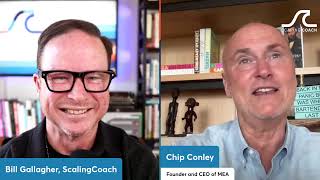
Chip Conley built 52 boutique hotels, sold them, then mentored at Airbnb and founded the Modern Elder Academy to teach wisdom-leadership. He shares routines like weekly lesson journaling and quarterly team lessons, plus creative practices like improv and surfing to stay curious and intentional.
Questions this video answers
54
90 years
52 boutique hotels
John Pritzker (Hyatt family)
Learning to Love Midlife
Chapters
Foreign, We fear it, but there's so much beautiful about it. That's our conversation about today getting older and acquiring wisdom and learning to love it all. Everybody, I'm Bill Gallagher, scaling coach and host of this fine Scaling up business podcast. We come to you every week with a guest, an author, a guru, CEO, somebody, or maybe all three. Who's as today, who's got something to share in the world of growing your business and not only surviving, but maybe even enjoying the journey of the whole thing? Right? Like, what would that be like if you could really, really enjoy all of it, all the parts of your life, including moving through the difficult things? Right. All that and more@scalingcoach.com we've got over 550 shows now with loads and loads of people. So big back catalog of great experts and authors and more. Plus we've got some free tools and downloads. We do workshops every month. We've got coaching programs. We've got a little mini course on the stages of scaling growing your company. All that and more@scalingcoach.com scalingcoach.com Anyway, with all that said, I'm joined now. He's already on the screen if you're watching a video. Chip Conley. Chip Conley, you guys should know, grew a groovy boutique hotel company called Joie de Vie Sold that joined Airbnb as their, well, eventually Modern Elder.
You're a Modern Elder.
Modern Elder at Airbnb, but worked with them on kind of the long term things around the company and, and then he formed this organization called Modern Elder Academy, which I'll be going to later this year. I've been looking forward to thinking about going there for a couple of years now. And he's written a couple of books on the subject. The latest is Learning to Love Midlife. And I think it's really great conversation. I know that true panic and anxiety. I felt the depression that I was in at 45. Now it's 15 years ago when I thought, oh shit, I'm halfway through, it's all downhill. And I, and I was really depressed about that. By the time I got to 50, I had sorted out for myself but. And it keeps getting better for me now at this point. But there was a minute there. So. Welcome to the show, Chip.
Thank you, Bill. It's great. My story was very similar. 45 to 50 was rough and then my 50s was my favorite decade and I'm now 63 and still in midlife and still loving it.
Yeah, I just had this notion like, oh crap, it's all just going to get worse and not less. You know, I had. And even if I thought I was going to live to 90 plus, which would go with my family, like, it still, it wasn't a good thought.
You know, it's a couple thoughts there. Number one is the. We've had 5,000 people go through the Modern Elder Academy, also known as MEA, and from 50 countries and, and the average age of the people who've come is 54. The average age that they're going to, they think they're going to live till is 90. 54 is exactly halfway between 18 and 90. So at 54, you actually have as much adulthood ahead of you as you have behind you. So, you know, a lot of us think at 45, it's, you know, it's all downhill from there. My best years are behind me. The reality is that the U curve of happiness research shows that people get happier starting at age 50. 45 to 50 is the low point. You get happier from 50 on. And bottom line is we have a lot of life still ahead of us. And so, yeah, part of the reason that I wanted to, to really create the MEA was to actually help people to maybe reframe their relationship with aging. Because Becca Levy at Yale, who's been a great. A mentor of mine, has shown in her research that when we shift our mindset on aging from a negative to a positive, we gain seven and a half years of additional life. So, yeah. And just one last thought. Modern Elder. Why am I calling. Why is it called Modern Elder? Because at Airbnb, the three founders who were millennials and I was a boomer, they brought me on and about a month into it, they said, we, we hired you for your knowledge, Chip. I was the head of global hospitality and strategy and I was the in house mentor to them. But we hired you for your knowledge. But what you really brought was your wisdom. You are our Modern Elder. And I said, fuck you, I don't want to be your modern Elder. I thought they were making fun of my age and instead I came to realize, like, no, they said a modern elder is someone who's as curious as they are wise. And as soon as I heard that, I said, like, wow, curiosity and wisdom the night, the nice alchemy of those two, that's what I want to be when I grow up. So, yeah, that's how Modern Elder came about as a term.
You know, it's interesting, that combination of curiosity and wisdom. Like, wisdom implies some experience, some lessons, and like an integration of them. I don't know, like, But curiosity seems at odds with that. Right. Like, if I wisdom can suggest that I know everything. Right. And yet as you get wise, you realize there's so little that I know, such a places that I'll probably never get to. Right.
Like Socrates said that long ago is like, anybody who proclaims that they're wise is probably not wise. And it doesn't mean you aren't on the path of wisdom. And you said it really well, Bill. I say that our painful life lessons are the raw material for our future wisdom. So often it's when we're most troubled. It's when you were between 45 and 50 and you went through a difficult time, as did I, that we were actually in the process of going through that challenging time. We were building up some wisdom because we build up some lessons, we metabolize that experience and we use it in the future. And the difference between wisdom and being smart or savvy is wisdom is a social good. It's supposed to be shared. And so that's why, quite frankly, I think from a business perspective, I think companies that are moving out of the knowledge era, all the knowledge is in AI. Everything in the world is on this damn little phone in my pocket, all that knowledge. But what's different, what's differentiated and what's scarce is wisdom. So one of the things that I've tried to introduce to companies, and we do at the mea, the modern knowledge academy, is we create wisdom leadership practices. How do you become how like, just like Peter Drucker in 1959 coined the term knowledge worker and nobody knew what he was talking about. And then knowledge management practices came along. But today it's about wisdom management practices. How do you create a wise, wise leaders and wise organization?
You know, when people tell me, oh, you're so wise, I, I'm complimented, but also a little embarrassed, a little uncomfortable with it. But. And then if I describe myself, I will say from time to, well, I have some wisdom, right? And I'm talking about having had some good and bad experiences and having time to think about them and integrate them. But, but I would never say, oh, I'm very wise.
Right, right, right. Well, I, I think that's why it's wise for you not to say that. And the other, the other piece of it, the curiosity piece, is the sense of being both a wisdom keeper but also a wisdom seeker. And so when you, when you're wise, you're somebody who wants to constantly learn something new. And you realize as, as we said earlier, that you don't know it all. You can be smart and be a know it all, but if you're wise, you're not going to say you're a know it all. That's for sure. Act like you're a know it all. So what? Here's a practice I've been doing since I was 28 years old. I started my boutique hotel company when I was 26. Jo grew it to 52 boutique hotels around California, and we were the second largest boutique hotelier in the US based in San Francisco. So, long story short is at age 28, I had one hotel. It's in the Tenderloin. It's the rock and roll hotel, the Phoenix, a funky motel that I bought when I was 26. By the time I was 28, I realized I didn't know much. I thought I did, but it had become sort of a. It becomes sort of a rock and roll hotel at that point. But then the Loma Prieta earthquake came along, and all of a sudden, like, nobody was traveling to San Francisco, and I had no money. I had no working capital. And so, long story short, I was like, okay, what the hell am I going to do? And I went home one Friday afternoon, and I took it down. A diary or a journal from my bookshelf that I had never written in, and I wrote on the COVID of it my wisdom book. This is true story. Age 28. And I started a practice that I've been doing for 35 years now, which is every weekend I spend 20 to 30 minutes making a list of my key lessons I learned this last week. Often they're painful, both professionally and personally. And then I say, what am I? How am I going to use that lesson in the future? And so that practice of every week doing that has helped accelerate my wisdom because it allowed me to metabolize my experiences. What I do with my leadership teams, whether it was at Joie de Viv or Airbnb or now at mea, is the following. I don't require them to do this every week, but I do say, once a quarter, we're going to sit down and talk about our biggest lessons of the quarter. So each person on the leadership team says, here's my biggest lesson, and here's what I learned from it and how it's going to serve me in the future. And I can hear the VP of Operations telling me something. I was like, oh, my God, that's a great lesson. I'm going to learn that. So wisdom is not taught, it's shared. So creating an environment where a team can actually learn from each other. And then at the end of the meeting, we ask ourselves, what was the biggest team lesson? And we arm wrestle over that in terms of what was the biggest lesson we learned as a team and how's it going to serve us in the future? So, long story short is I love this, this as a wisdom management practice. And there's, you know, for those who are very curious about that, on the MEA website, which is meawisdom.com if you go down to the bottom footer, you'll see a bunch of free resources. And there's one on there that says why successful leaders value wisdom and feel free to, you know, download it and read it.
You know, two things come to mind as you share this. One of them is that all of our clients that are doing any kind of scaling up and whether it be private or in a group program or whatever, in our quarterly reviews, after we talk about wins and misses and we look at the status of their priorities and their metrics and things like that, we say, great, what are the lessons you learned? And we ask people to net it out. And a lot of people are like, what does that mean? Like, what do you mean? What is what lessons? Like, I'm just like, well, good things happened and bad things happened or things that you assessed as good and bad and then. But what do you make of that? Like, how do you carry that forward? That's the lesson. And it's a discipline of reflection and integration or application. You said, I think, digesting it, like, apply it to yourself now. Yes, that win happened. Great.
What'd you learn from that example of a lesson, which to me now at 63, is obvious, but it was not obvious at 28. So we were going through this hard time and, and there were no guests. So I said like, okay, well, the people who are going to come to the Bay Area right now are in Sacramento. They're going to. They'll dive in and they'll go shop over the holidays. So let's actually, let's like bring a snow machine into the courtyard of the hotel and let's create snowmen so people can come shop at Union Square and then come back to the hotel, swim in the pool and make snowmen. So it's like, it was sort of a wacky idea. So I brought it up at a leadership team meeting. Now, I was the owner of the business and the CEO, albeit I was younger than most of the people who worked for me. And I brought it up in the meeting and I realized that the two people who are natural born critics came up with all the reasons for why it was a bad idea. And therefore other people sort of said, yeah, that's true, that, you know, someone could actually fall and break their arm or, yeah, people from Sacramento, if they want snow, they'll go up to Tahoe. There was lots of different reasons. And so at the end of the day, the idea went away and didn't happen. And so my lesson from that 35 years ago was if you have a creative idea that some people might find threatening or difficult, reach out to the two natural born critics in your group and present it to them first so they can have their fingerprints on it. So that when I present it to the group, I have diffused them or co opted them so that they can actually feel, if I'd done that, we would have done that idea. But I didn't do that, and instead that didn't work. So that is an example of a small lesson that helped me to see from that point forward who are the natural critics. When I was at Airbnb, that was a big one, and I taught Brian, the CEO, who is, you know, 25 years younger than me, 23 years younger than me, about this because he, he, he, he was doing exactly what I used to do. He, he had some new idea that he thought about in the middle of night, he'd bring it to the team. It's like the leadership team. I was like, brian, that's half baked, you know, and like, so, so it just, long story short, is if we don't learn our lessons along the way, we repeat them.
Yeah. You know, the other thing that came to mind as you were sharing that earlier and even now, is that when I'm working with people, whether at one time or ongoingly, and there are a few people who are like, Bill, you keep telling us all your stories and your client stories and things like that. Like, we don't really get anything from that. Right. And my response has evolved to be, well, then I'm probably not your coach. If I haven't either thoughtfully chosen something, or you're not interested in hearing stories from the past from other companies, be it mine or my clients, then you're probably not a good client for me. If you're not interested in learning from events and things that happen now, how you apply it or what you get from the story, I have no idea. But this is that sharing of wisdom. I got things to share that happened, and some of them are strategies or stories. But I'm never suggesting that what you should do necessarily is deal with it in that way. But like hear that and then decide your approach. Right. Like figure out what you're gonna.
The thing, I think the thing we have to be. The thing I would say, I would, I would add to what you've just said is be careful that your war stories aren't always wisdom. So, and what I mean by that is if you're sharing stories that don't have relevance and you're just the okay, boomer guy who's just saying, like, well, back in my day, here's how it worked. You will get an okay, boomer hand in your face like that because you're you. There's an, there's a potential egocentricity about it. You're sort of like, I'm just saying it because it's my story or there's a lack of context. So for me, when I joined Airbnb, nobody wanted to hear my war stories about how many that help people to understand how many maids, how many rooms is a maid clean in an eight hour shift? We were a hospitality company, but it wasn't about, you know, housekeepers doing multiple rooms.
So inventory management.
Yeah, exactly. So the bottom line was, you know, you really have to understand context for your stories. If you, if you can tell the story that, such that it has context, it's really valuable.
Yes.
And if the person you're telling it to concede the wisdom or the insight in the story, they'll even like it more. But, you know, there's an art to this.
Yeah, yeah, yeah. Choose something that's relevant, bring it some relevance. Not just like, you know, oh, we had it rougher. You know.
Go. I used to walk five or seven miles to my elementary school.
I feel both ways. Yeah. What is that skit, the four Yorkshiremen or something like that? It's a Monty Python skit. Yeah, yeah. So how. Talk to us about how joie de vivre ended. What you went through in that time. You, I guess you wrote about it in emotional equations.
Yeah. So I, I started you want to be when I was 26 and grew it to, you know, the largest independent hotelier in the state of California. And we had 52 hotels. And that's a lot. And I loved it when I, when I had the creativity and the freedom. But by the time we had 3,500 employees and 52 hotels, we gone through the dot com bust in 9, 11, and then we were going through the great Recession, I was done. But I didn't know I had never set the company up in any kind of way. So it was structured so I was going to sell it. So in the bottom of the Great Recession, I am now trying to figure out how to make sense of it all. And I was going through a really hard time. Cash flow was challenging. I didn't want to be CEO. I was losing five male friends to suicide, unfortunately, ages 42 to 52. So right there in the earlier stages of midlife. And I had an nde. I had a near death experience where I had an allergic reaction to an antibiotic and I died nine times in 90 minutes after giving a speech. And that wake up call, the hotelier's wake up call, helped me to see I don't have to live my life this way. I don't like doing this anymore. I love doing it for 22 years. The last two years, I'm not enjoying it and I don't have to do it anymore because I might die tomorrow. And so I came up with a plan to sell the company over the next two years. And I sold it for so much less than I could have sold it for if I'd waited four or five years. But I was ready to sell. And so I sold it to John Pritzker, whose family started Hyatt. So Joie de Vivre is now called JDV and it's a Hyatt brand. So that gave me time at age 50 to try to figure out what was next for me. I knew I was an entrepreneur. I, you know, in, in the movie the Intern with Robert De Niro and Anne Hathaway, De Niro says musicians don't retire, they quit when there's no more music left inside of them. So I had music still left inside of me. I would never have called it wisdom. And I needed to share it. And it was. I had two years to sort of just like enjoy myself, write that book, Emotional Equations, go around the world to 36 festivals in 16 countries because I am a founding board member of Burning Man. And I was like, ok, I want to go see, I want to go do that. I had time to be curious as well. But then I got a call at age 52 from Brian Chesky saying, hey Chip, you're supposed to be the in house mentor for us. Three founders for this little tech startup called Airbnb. And I had barely heard of it. And he told me the business plan. I was like, oh, that will never work. And he said, well, let me come over to your house for four hours. He said, half an hour. But it turned out four Hours. And let me tell you about the business, because you'll understand why we need you and only you. So he sold me on it. And I spent the next seven and a half years, four years full time and three and a half years part time, taking the company up to the IPO that led to the company being the most valuable hospitality company in the world. So what an experience. And I really learned that I was a mentor. I was a mentor and an intern because, yeah, I had a lot of wisdom to share, but I'd never worked in a tech company before. I was 52. I was sort of a Luddite who didn't really understand technology. Both my own technology, but also the tech business, even though I was based in San Francisco. And so I was learning as much from the young people. I mentored over 100 people over my seven and a half years there, of course, including Brian and his two co founders. But I learned as much from them as they did from me. And that, again, gets back to a modern elder is as curious as they are wise. So there were lots of opportunities for me to learn. And I wrote a lot about this in my book, Wisdom at Work, the Making of a Modern Elder, which is, you know, basically captures my experience of what it was like to be the old guy at Airbnb.
Yeah, you must have been considerably older than that group. It's funny, I had a couple tech companies in the 90s and then we paused them in 2002, never to resume them again in early 2002. And I remember when it started and I had considerable background as a kid, but I'm also a boomer. And I thought, this is great. And I did this. And then I got out of it. And I've since coached a lot of tech oriented companies, but I definitely have the younger ones who are like, grandpa, you don't have anything to share with us. You have no idea what we're even talking about here. And you'll sometimes get that reaction.
You do. I mean, you have to earn. So if you. If the key is to just be open and curious to learn.
Yeah.
And if you have, you come. So there was a famous executive recruiter. And after my book Wisdom at Work came out, she said, chip, you're going to get people from all over the world who are around age 50 or 55 or 60 coming to you and saying, I just got laid off, I just. Or I sold my company. How am I going to be back out there in the working world and be relevant? And she said, the most important and valuable Advice you can give is if you show up with curiosity and a passionate engagement for what you do, people won't notice your wrinkles, they'll notice your energy.
Yeah.
It's such great advice, because what people notice is your energy. And if they see that, you're like, oh, here's a guy who's 60 years old and he's really curious, and he's open to talking about what he doesn't know, and he wants to learn more about AI, and people actually admire that. Part of the reason I have all those mentors at Airbnb was not because we had a mentorship program where I volunteered. No. All 100 plus of them, other than the founders, sought me out. So, long story short is you got to show up with that passionate engagement, that curiosity, and an energy that says, like, you know what? I want to learn from this person. I want to be like this person. Yes. I was twice the age of the average person at Airbnb, and so I was the age of their parents, but what they'd say to me is, like, oh, my God, I wish my parents could learn from you. And ultimately, I ended up creating the Modern Elder Academy, and their parents ended up learning from me because they came. They came as students to come for a workshop.
So, yeah, you know, yeah, it's interesting about going through that process and seeing that. I think there's a lot to that, like bringing curiosity and openness and learning. When we see somebody who's got a little more years on them, try to act younger than they are.
Right.
And it can be kind of cringy.
Especially as. You know, especially if. If it has to do with just not realizing their age in terms of what they're wearing, what they're doing. And I'm not saying people shouldn't. I love funky clothes. I'm a Burning man guy, so I love weird, funky clothes. It's not that. It's more like, okay, don't wear that Speedo. It's just. It doesn't look good. But you know what? I think what I appreciate is if it's genuine and it's authentic, I love someone like. Like Iris Apfel. I think she passed away recently. 96 years old, however old she was. And she just had those glasses and that look, and it was like, yeah.
Old, right, is the word for her. The big glasses, the color, the out. Like, I'm going to be unique and shine brightly.
Exactly. So it's not about being old. It's about being bold. And if the being bold has something to do with how you're, what you're wearing, great. But if you're trying, where it looks bad is when you're trying to relive your adolescence or you're sort of like you're stuck in an era and it, it's noticeable. So, yeah, I mean, it's not about being youthful as we get older these days. What's that?
Bruce Springsteen wrote a song, Glory Days.
Yeah, yeah. Being youthful. It's about being useful as we get older. It's about being useful, not youthful. And those people who accelerate their aging process and die young are often people who no longer feel useful. So it's that, you know, that's the key. And purpose. I would just say when it comes to purpose, cultivating purpose, it's about finding something that excites you or agitates you or makes you curious or something from earlier in your life you've neglected that you were passionate about. We had somebody come to mea recently, a litigation attorney, 60 years old. And she, she didn't want to be a litigation attorney anymore. She didn't like what it had done to her emotionally. She had armor on because she was always arguing. And long story short is she came and she said, maybe I'll become a litigation consultant. And we said like, that's this. You're swimming in the same pond, so you don't want to do that. So we told her about like these four paths. Excite, agitate, curious, or neglected. These are the four pathways, shortcuts to your purpose. And the first night she had a dream about her grandmother. Her grandmother was walking on the beach and she was walking with her. And our Baja campus is right on the beach. Gorgeous, three mile long, empty beach. And so she's like, what's my grandma doing here? She passed away 20 years ago. It's like, okay, well, take note. The next night she had a dream, but more like a memory of her and her grandma cooking pies. I was like, okay. She said, I could even smell the pies. The next morning she talked with the cohort and she said, you know, it's interesting. When I go to a foreign country, the first thing I look at on a digital map is, where's the nearest bakery? I always want to go and smell the bakery and I want to like, see what kind of, you know, special foreign goods they have baked goods in there in that community. And so like, then she said, like, you know, when I actually invite people over for dinner, I always tell them to stay for dessert because that's the thing I want to cook the most. By the end of the week, she realized that she had more options than she thought. She doesn't have to be a litigation consultant. She could go to pastry, like become a pastry chef and go to pastry chef school for three months to see if she likes it. And she did. And therefore she quit being an attorney and she bought a bakery in her neighborhood that had closed during COVID And she now is an entrepreneur running a bakery. And she's actually about to open her second bakery. So, you know, what we have to do sometimes is create the space in our life, this midlife atrium where we can actually sort of imagine new things that we could do. And we need to sort of come at it from a different direction. And that's part of the reason why MEA has become so popular is because there are a lot of people in the broad definition of midlife, I define it as 35 to 75, who are looking for more options in their life. They're looking for a new pair of glasses in which to look at their life, not just professionally, but sometimes personally as well.
So for me, personally, right. I turned 60 in a few months and I changed my career significantly at 50 and became a full time coach. And I'm pretty clear about that. I want to keep working for a lot of years because I feel good, I enjoy it, I like the kind of work that I do, and I'm pretty clear about my life's purpose and how my life purpose shows up at work and at home and in all areas of life and in different ways, but that there's a through line. And so I'm not like looking for that, but I do really want it to keep evolving. So I don't want the way that I work today, even if I know the general area of kind of work that I want to do, I don't want that to be the way that I work even five years from now. I want that to keep evolving significantly and change the pace of the nature. And I imagine what it'd be like. But then what I think about myself and my life at 60 is really different than what I thought about at 50 or even 55. Like, it keeps evolving. And certainly the last three years really accelerated a lot of things for many of us. Right?
Yeah. I mean that what you're describing is the evolution of learning and that. And curiosity is the taproot of that. And so when you're curious, curiosity is. Is really the. It's sort of the source for creativity and innovation. Creativity and innovation. Get all the. All the highlights and the headlines. But curiosity is often behind that. And what, what curiosity requires is an open. First of all, you have to have enough space to be curious. If someone said, let's have a, let's have a curious brainstorm and we have 30 minutes to do this, no, you have to have the space to be able to be curious. That's really essential. But also you have to have less judgment. You have to be willing to try things and have them fail, come up with stupid ideas, because that stupid idea might lead to another idea. And so, long story short is curiosity is an undervalued part of business. And for you, as you're describing your evolution, your evolution will only happen if you're curious and willing to learn and, and willing to try new things. And so it's all, it makes a lot of sense, but frankly that the process and mechanics of business, it's almost like the process and mechanics of education. It breeds out of us our curiosity, you know, as a teenager or as a business person, because process is what we get caught up in.
One of the sweetest things that my wife does for me over time is she throws out like an idea of something that might be interesting. And she throws out these experiences. And many times at first glance I'm like, I don't really want to do that. And I've learned to take that thought and just say, okay, good. And then to welcome like, well, what might come of that, right? And she'll throw out these different things. And I think of some of my own too, but one of the ones she threw throughout this idea of a class called vocal improv and vocal improv. And I, you know, I use my voice a lot and, and I know I have a good voice, but I'm so, I'm interested in developing it and that kind of thing. So like vocal improv, what's that all about? I'll go to that. You know, so I go there and it. Vocal improv is making a musical sounds with your voice, but not words and, and no plan things. So it's not like, let's learn this song and sing the song or whatever. So they started with a demonstration, the beginning of the day, this one day workshop. And, and the person says, okay, well I'm gonna like do a thing. And so they, she starts like laying down some kind of bass thing and then somebody else throws in a note and then somebody else adds a solo and like there and it's just all like scat singing, you know, kind of, and it sounds amazing. And then they're like okay, well, we're going to get started, right? And then we're in a circle and they're like, okay, I want you to do this and you did that and you do this and okay, you add some color to the whole thing. And. And I, I had this notion, you know what? I'd rather just strip naked in front of these beautiful people right now than do that. That sounds. So I'm just going to sound awful. It's going to be the. One of the most embarrassing, confronting things ever, Right? So I muddled through the day. It was uncomfortable all the way through. I made my sounds, I did my thing. And yet over the next, you know, days, weeks, months, I noticed I was more free just to make noise in the world, you know, to be less constrained or have it all exactly figured out and whatever. I was freer, looser, more playful with my sounds. Speaking in particular, you know.
Yeah. Well, it's so funny you say this because Michael Franti, the awardee winning musician who's been a friend of mine for 35 years, he just taught a workshop here at our Santa Fe campus on finding your rhythm and your voice in midlife. And one of the part, we wrote a song together. There were 35 people in the workshop and wrote a song together from scratch, sang the song together. But each of us had the opportunity to get up there and sort of in an improv way, either using sounds or using words. Speak your truth. And I was not going to do this. Yes, I was his co teacher on this thing because I, you know, I teach here at mea, but I wasn't going to do this until a friend of mine in the workshop called me out and said, chip, you haven't done this yet. I was like, oh. So I got up there and I closed my eyes because I didn't want to see anybody while I was doing this. I didn't want to see faces or. And I started singing my story and it was a combination of sounds and my story and it was, wow, God, it was profound. And I, I really, when I opened my eyes at the end of a four minute or five minute thing I had done and they cut it on video and it's sort of interesting to watch it now. Like almost everybody was crying and I realized what I just said and I'd said things that I hadn't said to anybody else, mostly around my cancer because I have stage three cancer. And I've written about this in my blog, but I've never really sort of talked at this guttural level, this level of, like, it was not just words, but it was the. It was the tones and the sounds that I needed to make. So, yeah, like. But so I. So if so, let's. Let's zone up for a minute. Improv in all of its forms. We do a little bit of improv@MEA is really helpful. It's collaborative. It allows you. It allows you to be less linear and less logical and find a way sometimes to actually see something from a new perspective. So, yes, I'm a big believer in businesses looking at. I once took my company to the San Francisco Museum of Modern Art. Like, senior people, I said, like, your job is in the next hour to go and look for shapes and things that are going to influence this next hotel we're going to create. This next hotel is going to have an artistic sensibility. And I want you to just tell me what. What are some influences in this museum that can help us? And then I know somebody else who took his team to the zoo. And I mean, so breaking out of the conference room and the conference room thinking is really important.
Cowbell for that. Okay, I think that's really, really great. And there's this idea. One of my favorite quotes, John Lennon Life is what happens to you while you're busy making other plans.
Perfect.
You know, we've got our schemes and we're going down. And then stuff happens that you totally weren't expecting in the world. You personally, right. You get cancer, somebody close to you gets sick or something like that. World events happen. And. Okay, I wasn't expecting that. Right? A family event happens, and then you have to deal with that. And interesting things happen from it. Like, you know, Covid put my mom in the hospital for months and she can't live on her own anymore. And like that. And killed friends and family of friends. But also we got really beautiful time. And we remembered that we could be quiet and we could be still and, you know, like, interesting things happen, right? When you kind of lean into these problems and sometimes I had a friend who got cancer and. And realized, okay, this is a unique gift to take and make my time precious and not take it for granted. And there's an exercise a coach led me through years ago, and I've since used it many times with others. And he said, okay, imagine that your life was going to end a year from now. And, you know, there's a. There's a meteor coming with just your name on it. It was going to just wipe you out. And, you know, like, whatever, you're not going to suffer but you got a year now. What do you need to do? And. And people start to think about bucket list and things like that and unfinished projects and like that. And then he said this other one, he said, okay, imagine that it's coming tomorrow. What do you need to do now? And that's mostly about healing relationships, about telling somebody that you've withheld love from for too long, that you're sorry.
Yeah.
You know, or that you forgive them or whatever. Right.
Oh, I'm feeling you, Bill. I'm feeling you. So. Yeah, yeah, there. Laura Kirstenson at Stanford has shown that when we have less time ahead of us, whether it's a cancer diagnosis that's stage four, whatever it is, what we do is we tend to focus less on the future, less on the past, and more on the present moment. And because we do that, we actually get happier. And so there is something to be said for that exercise. I think it was Gandhi who said, learn as if you'll live forever. Live as if you're going to die tomorrow. And I think there's something to be said for that. Live as if this is your last day, but learn as if you're going to be here forever.
My, my in laws, you know, were mostly sheltered in their advanced age going through Covid and then coming out of it. We went to visit them and when everybody's vaccinated, they're comfortable again and that kind of thing. And. And so my father in law wanted to go get a haircut and because he's like, I haven't had a haircut in two years or something. Right. And so I said, okay, let's go. Now he's in his 90s and we get in the car and we get away from his wife and he says, I'm ready to go. And I know he meant, you know, he was. He's like, you know, like, I'm tired, I don't feel good. I don't. There's nothing I need to do. I don't. Whatever. And I can't tell Barbara. And I'm like, okay, but you can tell me. So if you're ready to go, what do you need to do? What is there left? Like, what do you need to say? What do you need to share? Is there anybody we need to call? Tell me about your life and tell me what there is there. Right? So, you know, I. Who knows how much time he has left or whatever. So we go get a haircut, he tells me about things, he feels really great, and then we're kind of having good Conversations. So I'm like, well, let's go out to lunch before we hurry back, you know. And he's like, yeah, I like to go out and sit and shoot the shit with the waitress and whatever. And. And so we go and we get. I forget, like, a Pepsi or something like that, and a Reuben sandwich, and he can't eat the whole thing, but we'd agree to share it. And so we're sitting there and he. And I just, like. I just, like, give it all to me, like, tell me what you got and what your thoughts are. And he shares with me various things, and different things come up. And I'm like, well, do we need to call them? Do you want to say anything? Like, you know, so that you're really at peace with all this stuff? And he. He's like, no, we're good. So kind of get to a place where he's like, thank you for listening and for sharing and for letting me say what I need to say. And. And. And it was really. I feel good. I got my hair cut, I'm fed. I've been out of the house. Like, it's fantastic. And. And I know I could really appreciate the richness of his life, the good and the bad. Like, he shared, you know, sad moments and regrets and things like that, but I could, like, get it all, and I really appreciate it. It was so great. And then we went back to the house and we had to sign papers and do things like that. And he was telling jokes, and we're in the living room and. And then he just nodded over and died.
Are you kidding me?
No. He just. We're telling jokes and talking about this, and then he just went like that and he slumped over.
Oh, wow. That's Bill.
Right? So it was one of the most beautiful deaths, right? Because he's complete. He said what he needed to say. He's having a good time in the living room, and he passed without pain. And what a privilege it was to just like. Like witness someone. Like, just get them without judgment, without. Just accept them and leave them feeling at peace, you know, Like, I want to go like that someday. Wow.
Well, that's a beautiful story. It also shows that as we get older, we can see the future.
We may.
We want to make a live in the present. But, you know, there's. It's interesting. There's some research that shows that when people are on their deathbed, sometimes what. They start talking about things that don't make any sense. It's because what they're seeing is the. They're seeing, you know, their sister who passed away seven years ago, or they're seeing, they're seeing things that are not there. And this is not necessarily, this is anybody. This doesn't have to be Alzheimer's or dementia or anything like that. It's literally just. And so it's that passing. You know, I died 9 times in 90 minutes when I had my ND ease at age 47. And man, I know what that's like to sort of go to the other side and to see things. And you know, it can be quite beautiful.
Talk to us about mea what happens? What do you do? What's that like? What do people see? We've been talking around it a little bit.
You're coming in October, so my wife.
And I are coming with a bunch of our friends, mutual friends and so on in October down to Mexico. And I'm so excited because it does fall over our 30th anniversary. And I'm like, what a perfect place to be. 60 and 30. 30 years. Like invent and imagine the future, right?
Well, our program has the following components. It's usually usually a five day program, five night program. We do public workshops as well as private, private groups like your group's a private group. And the overall umbrella of the content and the curriculum speaks to this idea of how do we feel better about our aging process. My, my new book, Learning to Love Midlife. The subtitle of it is 12 reasons why life Gets Better with Age. We know it gets worse with age, but we are not as aware of what gets better with age. Whether it's emotional intelligence or spiritual curiosity or wisdom, or the ability to tell our own personal story and narrative, or the ability to edit our life. There's a lot of things get better with age, but they're not been amplified. So that's the overall framework. And then the three key pillars are cultivating. I'm sorry, navigating transitions. Because we go through a lot of transitions in midlife. And later cultivating purpose and owning wisdom. Learning how to own your wisdom. And so yeah, it's, it's a deep experience. The normal workshop is where from 20 to 30 people in it and you, whether you're coming with people you already know and you get to know them much more deeply, or whether you're, you know, meeting people for the first time and you create a bond with life changing conversations that we've curated. You know, one of my favorite questions I like to ask, and I don't think I mentioned this earlier, is 10 years from now, what will you regret if you don't learn it or do it now? And it's just a powerful question, and it helps people because anticipated regret is a form of wisdom. And. And so for me, it's part of the reason I started learning to surf and. And span. Learn Spanish when I moved to Mexico, because, you know, will we down there?
Is there an opportunity to go, yes.
Actually, there's an opportunity to learn to surf or to surf while you'll be down there. We're five minutes from a surf break. So the question I asked at 57, when I was living in Mexico, I was like, hey, what will I regret 10 years from now? I'll regret that I didn't learn Spanish because at 67 will be harder than at 57. And then I didn't learn to surf. I had a mindset in my head, which is, I'm too old to do these two things. But anticipated regret is a form of wisdom because it allows you to say, oh, my God, I don't want to feel that 10 years from now. It catalyzes you to take action. So, yeah, so those are the kinds of things we look at. And bottom line is this. You know, people have a lot more life ahead of them. They need to consciously curate and be intentional about how they want to live the rest of their life. Their life. Yeah.
So, well, that, you know, when I think about the wisdom that I have to share with our clients over time, there are a couple big things that stand out, right. And one of them is that you could. You could either let life happen to you or you could design your life now. Circumstances and things will happen, but you could actually design how things are going to go and start to have some agency in the way you navigate them. And. And you'll be presented with things, but then you have some decision about it. And. And the other two things are highly related. One of them is like, this too shall pass. Like, you'll have good moments, you'll have bad moments, you'll have moments where everything seems right, but this too shall pass. And then you'll have moments where everything seems horrific, and that will pass also. And. And then the final one is you got this, like, billions and billions of dumber, less capable people than you have navigated life and made it to the other side in some positive out, and you could make it through. Like, you could. You could. You could navigate this. You. You got this, right?
And you're not alone.
Yeah.
Yeah. So. Well, you're a great coach. So. And. And it's partly because you have wisdom. You know, to become a coach at 25 makes no sense. To become a coach 25. Yeah. To be a coach at 50 makes sense, and maybe at 75 even more sense just because you have that metabolized experience.
Yeah. I think, like somebody said to me, well, you can't. I wrote this public letter to Coach Uber CEO Travis Kalanick when he went through some news years ago, and. And somebody chided me, and they're like, you can't possibly coach him. You haven't run a company of that size and whatever. And I'm like, yeah, I run companies. And what he needs coaching in is not necessarily running the company. That's fine. He needs coaching and being an asshole. And I have a lot of experience in that.
It's interesting with that story is that when I joined Airbnb, Uber and Airbnb were the. The darlings of the sharing economy. No one uses the term sharing economy anymore. But. And so the first thing I said to Brian when I joined is like, we need to figure out PR wise, but also culturally, how are we different than Uber? Because they are not a role model for us. Yes, they're worth more than us at that time, and we ultimately became more worth more than them, but they are not a role model for us. And if we're going to be a disruptor in the hospitality industry, we better not be an asshole.
Yes. Learning to love Midlife is the book. Meawisdom.com is the website to go to. Maybe you want to go to one of the programs. What ages of people go to the programs?
So average age is 54. We've had people as young as 25 and as old as 88. So 16 of the people who come are millennials, which is sort of a surprise. But. But 75% of people are between 45 and 65.
So even if you're not yet 50, you might.
Oh, yeah. Oh, yeah.
I mean, I had that first midlife panic. Right. 45.
Listen, I. I'd say 40s is a great time to come because quite frankly, we help teach you how to go through the most difficult life stage in adulthood, which is our 40s.
Awesome. Well, and then a reminder, also, scalingcoach.com is our website where you've got the 550 episodes. We've got programs and workshops and stuff for kind of every stage of your business. Meawisdom.com is for your life and yourself. Scalingcoach.com is for growing your business, and we can help you with that at every price. Point every stage. Like we got something that's done in some way that probably fits you. So go check it out. Scalingcoach.com thank you Chip for joining us today. Thank you Bill, and sharing your wisdom. It's been such a great conversation. I really enjoyed finally getting time to sit down and talk. I want to thank everyone for watching, for listening. And thank my friend and mentor, Vern Harnish, who created the whole Scaling up framework, without whom none of this would have been necessary.
And Bernhard is an MEA alum.
Is an MEA alum also. Yeah. And to the folks at store on who produce our show, get things ready before and after each week. Christelle, Seth, Cameron and the team at story on the cop. Thanks again everyone for watching, for listening. Until next time, keep scaling.










