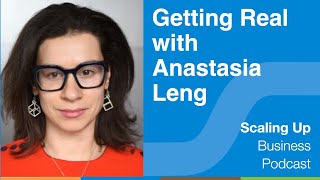
Anastasia Leng, CEO of Creative X, uses AI to help brands like Unilever and Pepsi check massive volumes of ads for consistency, representation, and performance. She pivoted from a failed e-commerce startup by building internal tools to analyze creative work, which became the company. The tension: optimizing for short-term performance can conflict with protecting long-term brand identity.
Chapters
Foreign.
Lessons of scale. We're gonna hear some experience from somebody whose company is going rapidly now. Anastasia Lang gonna share with us about growing her business, AI and creative the Intersection. She'll explain more. Hi again everybody. My name is Bill Gallagher. I'm the Scaling coach, host of the Scaling Up Business podcast. We bring podcasts like this to you every week. Stories from entrepreneurs growing their businesses, stories from gurus and authors and experts in the world of business growth, scaling up. All the things to do with the leadership that goes along with that as well as tips and tricks and things like that to do with growing your business and surviving the process. We do that every week. You'll find all that and more wherever you get your content or@scalingcoach.com check it out scalingcoach.com Our Getting Real episodes are brought to you by the EO organization. The entrepreneurs organization is a global organization, a member led organization of entrepreneurs who come together to grow and scale and develop themselves as entrepreneurs. There's over 15,000 members in that organization all over the world today. And we have three chapters in the Bay Area where I happen to live. I'm president of one of them this year and it's a member led organization as I said. So we help each other, we work together, we bring in speakers and things like that and, and we have forum groups and activities and lots of different things but connecting with other people who have businesses who are founder controlling owners of the, of the businesses and they are all of a particular size. They're either growing through their first million or they're at the that stage or well beyond. Is the core membership. Then we have an accelerator program to get people over that first million. It's a really cool organization. I've been with the org now for, well, I, I joined over 21 years ago and like I said, I served this year as president of one of our Bay Area chapters. But it's just extraordinary. Great value fun like that. If you'd like more information, like to check it out, like to join that kind of thing. You'll find everything@eonetwork.org so go look up eonetwork.org find a chapter in your area, whether it's here in the Bay Area or somewhere else in the world. And we'd love to talk to you more about it. All right, Anastasia, welcome to the show. Thank you for hanging out while I take care of business. Anastasia joins us from the New York area and we're going to get into all of her story and her experience as a leader growing the business, that kind of thing. So I'm glad to have you. Thanks for joining us.
Yeah, thanks for covering the fact that I'm in the New York area, not blowing up by New Jersey cover. New York, New York, very close. One exit away.
J. Yeah. So we love Jersey. So, tech, tell us about this business, Creative X. She's CEO of Creative X. And it's a businessman growing. Later, I said it's the intersection of AI and creative, and they're doing some fancy stuff with AI to improve your creative. But talk to us about it. Describe it better than I do.
That's. Yeah, let's see if we can do that. So basically what we're doing is we're trying to use technology to help brands make better and more responsible creative decisions. And the reason why we're using technology is because the amount of content brands produce as an enormous scale, we're producing more content than we ever have before. So what used to be possible to do with simple human oversight no longer is because a lot of brands are producing 100, 200, 300,000 pieces of content a year. And so we're trying to build technology that sort of learns and is customized and can understand whether or not each creative you're putting out is consistent with your brand, is meeting your best practices, is applying your latest learnings about what's effective down to whether or not that content is avoiding stereotypes about the people that you're trying to feature and the people that you're trying to reach.
So how are you using AI to do that? What are you doing there?
Yeah, well, when you think about all those things I've just mentioned, brand consistency, creative quality, representation, to be able to recognize those things at scale is not possible unless you have technology that starts to fundamentally learn. What are all the different objects and creative elements contained in this image or this video, and do they align it, adhere to the standards of the brand that those things belong to? What we do is we use a combination of different technologies, everything from computer vision to optical character recognition, down to being able to parse out an audio file and make it something that we can understand and kind of collect structured data from. And so we basically combine all that data together to build algorithms that help detect the kinds of things that are important to the brands that we work with and give them a layer of data back about every piece of content they produce.
So tell our viewers and listeners some of the kinds of brands that you work with that are doing this kind of thing.
Yeah, so, you know, we've gotten really lucky here. We power creative decision making globally for some of the largest brands in the world. Unilever, Pepsi, Mondelez, Heineken, Mars, Nestle, Renault, even Facebook and Google. What they all have in common is that they again rely so heavily on visual communication. They're very data driven companies. They're trying to make the creative really work for them and they're trying to learn everything from every creative execution to make the next creative more successful than the last. But what they also have in common is that they care deeply about protecting their brand and preserving their brand. And so they want to make sure that as they go through this kind of huge content growth journey, they're doing in a way that doesn't sacrifice their brands. Right. They're doing in a way that doesn't start to make mistakes because of the sheer volume of content they're producing.
Yeah, well, you can imagine those kinds of brands have loads of assets. While they may have a few focused campaigns, they have multiple products and services, they operate in lots of countries, they're in a whole variety of media. So I can imagine quite a bit of it getting.
Yeah, absolutely. And you know, while they've always been that way, they've always sort of had lots of brands, been live in lots of markets, I think what's really changed is the consumers expect more. Right. So before you could have one, one, one creative that would run on TV for like three months and that was it. But that doesn't fly anymore with digital because if you think about like Facebook and TikTok and Instagram and Snapchat, not only do you have to make different creative assets for all those platforms because they require something a little bit different, but you've got to make them every day because consumers expect you to be present and to be engaged every day. So the kind of, the content growth chart looks something like this, which is where again, in some ways technology has created this problem and we're trying to build technology that helps solve this problem and helps people keep up with it.
Yeah, totally makes sense. So why did you start this company? What led to this?
Honestly, it was an accident. And it was started because I had another business and I was too embarrassed to admit that I was failing. So I spent five years at Google. I left Google to start an E commerce company. I thought that was going to be my big break. I had a lot of people who I trusted and respected deeply put money into that company. Every manager of mine at Google ended up investing in this crazy, in retrospect, e commerce business that never had any chance of success. I felt this real personal responsibility to make it work. And two, three years in, we're finding that we just could not get this E commerce business to take off. The business was similar to think of it as an Etsy, but where everything was customizable. And we started noticing that imagery and video was so important to our conversion path, but we couldn't understand why. We couldn't understand what was it about some creatives that seemed to be working with our consumers and others that weren't. And the company was running out of time and running out of money. We couldn't compete on all the traditional advertising channels, so we just had to get smarter. And we were a team predominantly of engineers and it drove us crazy that we were making data driven decisions about everything except for the creative. And so we were sort of in this place where nothing was working. I was too embarrassed to admit we were failing. So we started basically tinkering with anything and everything to try and figure out how do we turn the business around a little bit. And our thesis was if we could understand what is it about certain creatives that's resonating, maybe we could have a chance of competing on some of these platforms. So we started this experiment and that experiment ended up sort of salvaging the company, the E commerce business. We got to profitable unit economics and the business started doing much better. And long story not so short, we went out to fundraise for that business hatch in the summer of 2015 and a number of investors who were much more clever than I am dug a little bit under the hood of the company and said, well, where's this little growth bullets coming from? You know, what are you doing here? And I said, oh, we're tinkering with some stuff on our own. We built some internal tools to do this and they're like that, that's your business, that's what you should be doing. And you know, this was, again, the context is this was the summer that Pinterest and Instagram and Snapchat all launched their monetization tools and they're all visually led. Right. So I think what investors saw that we didn't at that time is everyone is struggling with this problem. Everyone is going through the shift where all their communication is becoming visual, but there are no tools to help you through that transformation. So look, I wish I could say I was, you know, I had this brilliant idea and I kind of choreographed it from beginning to end, but it was, it was a lot of serendipity and it was a lot of just being Afraid to admit that I'd failed and kind of looking in every corner, nook and cranny to try and make it work.
If you're around it long enough, you fail. Lots of times get very comfortable failing and getting back up again. I thought you were going to say, oh, I just had a bunch of multi GPU boxes sitting around running GPT3. And so I just thought I would.
Apply them to the. Yeah, no, I wish, I wish. It's a real lesson. I think that sometimes these great insights and these really powerful transformations come when you're at your lowest point. And we really were at our lowest point at the time where we finally had this kernel that eventually turned into Creative X. We had no money left in our bank account. My team was basically offering to kindly work for free to see us through this. And we were taking Hail Marys left and right and again, not to create a new business, but to just try and salvage ours. And so I think there is, there is a real, a real testament to what people always say, which is half the battle of being on this entrepreneurship journey is just not giving up.
Yeah. You know, it's funny, I want to underscore something you said because it really, like, immediately resonated with me. So there you are running a business. Things aren't particularly working well. You're running out of cash and you're like, well, what else are we going to try? And you have an insight in that moment. I remember having raised a little money, built a whole demo, gone all over the country to get corporate partners on board for a SaaS business, an e commerce thing back in the 90s, and, and, and we chugged along, but, but it really, it was failing. And then we're like, well, how else could we use this thing we built? Who else could use this? And in that moment, we start trying and playing with something and suddenly people are interested. Of course, then it became 2000, late 2001, and it was like things changed and we put it on the shelf for a while, never to return to it. And it's funny because I look even today at some of the things and they're like, oh, those are still relevant, good things today as we've evolved, you know, 20 years from then. But what is cool that I heard there is that sometimes in that 11th or later hour when it just looks like it's game over and you're going to have to close the doors, that you try something and something starts to show some hope, some work.
Yes. Yeah, absolutely. For us, it really was the 11th hour because we'd come up with this thing again, no hopes of commercializing it, really, just to save the business initiative. And it started to work and I went out to try and fundraise for Hatch, right? So I had similar to you, right, Hundreds of meetings, driving and flying all over the US trying to raise money from anyone who'd listen. And it was rejection after rejection after rejection. And it got to a point where, you know, we started looking at acquisition offers just to at least try and get people some money back over this thing. That I was like, you know, I'm looking at our bank account, I'm looking at our team of engineers, and like, these things just don't add up. There's no way that money's gonna pay for these very expensive people. And it literally was the 11th hour because I flew to California, I had two meetings in my calendar with investors. Everyone had to know up until this point. And on the flight I had this it doesn't matter moment. Like, it doesn't matter. And I am literally following the definition of insanity, which is I'm going in and giving the same pitch about this E commerce business and it's not working. And so I go into my last meeting with, on the Friday, and, you know, I was like, I, at this point, I just have nothing to lose. And so I go in there and the investor says, all right, tell me about Hatch. And I said, you know what? I don't want to talk to you about Hatch. I'm going to talk to you about how we, how we were trying to save Hatch. And I started talking about this tool that we built. And you know, the crazy thing is, two days later we got a term sheet. It didn't even have a company name at the top. It said new company. We didn't have an investor deck. We didn't have a company name. You know, I mean, look, I still think a lot of it was luck, but it really was the very. The last Hail Mary.
That is a killer, killer story. And you know, it's funny, I helped a company scale some years ago that did ad buy. AI ad buy focused on improving conversion rates and things like that. It was really great, but it was on the media side of things, the buy side, not on the creative side. But I've also helped a couple companies work that did some related things to what you're doing in a clumsier way. And I've heard some interesting entrepreneurs speak recently about how they develop creatives. So they create a whole bunch of different creative assets. They try to look at some things that might work, they play some hunches and then they create a whole bunch of variations on it and then throw them out there to see what seems to find a track. So we've got creatives on the one side producing stuff against their best hunches, and then we have quant types who are testing, refining, making selections and then adding volume to the creative that works. Because the creative does matter a great deal. Right? There's an interest area, there's something that gets my attention and something that doesn't. And in a massively noisy world, right?
Yes, yes, absolutely. But therein also lies part of the problem because you've gone from having one creative asset to now these dynamic creative optimization companies taking one or two assets and making thousands out of them. But then you think about, do all of those, are all of those consistent with my brand? Are all of those relying on the.
Things that I learned?
Are they still appropriate? So how do you ensure that as you go through this hyper scale of creative content, you're, there's still some level of governance that's helping you make sure that the things you've learned are applied and you're learning from all those creative executions.
Right. Because just getting the click sometimes can be damaging to the brand. The kinds of things that you would put on it, the gimmicky things and others. And that is something that we saw people do as they, as they iterated on creative and they're like, okay, what are other brands doing? And they started to throw in different elements and you're like, yeah, you could put that little stupid thing, that little ornament on whatever and somehow that seems to be, you know, your sticky or that funny little animation. But that's really off brand for you.
Exactly. That's exactly. And you know, I think there are a lot of companies now who are talking about the fact that they'll unnerve all these creative insights for you and apply them. But the reality is someone might tell you, hey, the color orange works really well. And you're like, well, my brand colors are blue. So you know, what am I going to do with that information? So unless you are a direct response advertiser only who fundamentally doesn't care about brand, all it is is driving conversion and clicks. That is great. But if brand is an entity that you have, that's like an asset on your balance sheet, you need to protect it.
Yeah, really useful to think about. And if it isn't like, why not? I mean, I did work for a company, some of you will remember Called AOL once way, way back in the olden days. And we used to do banner ads and pop up ads for aol. Lots and lots of creative domain. I mean, hundreds and hundreds of ads, which was the equivalent of many thousands today. And then we would test them so we would be like, okay, they wanted to sell something, oh, here's some printer or whatever. Okay, we're going to create four different pop ups for that. We're going to test it over the next two lunch hours and then we're going to pick a winner and run with it. And I can remember having creative review conversations with their team in Virginia and they were like, oh, we don't get this. Oh, we don't like this. I'm like, I don't really care. I don't like it. You don't like it, I don't like it. But that one worked. And we don't really care what worked. We want to know if we could sell a printer, right? That seems to work. Like it's not offensive. There's no babies being abused in the thing or animals. You know, like it's, it's just, it's kind of ugly but somehow, you know, like so. And in that case, it, we're not really about the brand in that case. Although you could say that the whole category pop ups was created an issue for AOL for a period of time, but now, you know, all manner of pop up over under intrusive kinds of marketing is just common. The annoyance, the busyness of it is pervasive on the Internet today. Because people want stuff for free.
Yeah, yeah, yeah, absolutely. And then even if you compare, you know, I was amazed that when I went to China and looked at the way their web pages look and you know, we think our digital experiences look messy and cluttered and certainly when you compare that to theirs, it's a completely different sense of visual sort of overload. But, you know, it seems to work there. So.
So let's talk about lucky breaks. This was in the show prep, right? And as we got ready for the show. But it sounds like deciding not to just talk about the same old thing again to the next. VC gave you your first term sheet and led to the creation of a new business. What are the lucky breaks have you had now as you've gone from this stage, but from that to this.
I mean, I think all the lucky breaks that we've had have fundamentally been driven by people. You know, one lucky break that we had was someone I knew asked me to come speak at an event, an Event that I was not qualified to speak at and talking simply about the idea of what we'd started to build and this, this idea of what became Creative X. And somehow despite again, not really having a product or anything else, there was someone from Unilever sitting in the audience who came talk to me afterwards and said, look, we know you don't really have a product, but the stuff you're talking about, those are some of the problems we were facing. And through that Unilever became our first customer. Can you imagine a startup with barely a company name, no pitch deck, a product doesn't fundamentally exist and somehow Unilever says, hey, yeah, we want to try this out. Right. Again, I think we. So in startup world there's so much emphasis on scale, but a lot of our earliest wins have come from really that one to one human connection, similar to that VC story. Right. I mean part of that VC story was having the self awareness to know that the thing I'd done a thousand times, one wasn't going to work the thousand the first time. Although arguably maybe I should have learned that lesson a little bit sooner. But part of it perhaps also came from the human connection you made with the person at the other end.
Yes. You know, I wonder if that's true. I have a family ancestor that I'm named after that people felt strongly about in my family. And he was a friend of Thomas Edison and Thomas Edison's very famous for having tried 10,000 times before creating his light bulb. I, I don't know if that number is true. Probably it was a lot. He certainly was a salesman and a marketer, so it might be embellished, but he probably tried a lot of things before they kind of came up with their working incandescent bulb. But is it wrong to do that? I don't know when things are really not working well a thousand times. Like how many VCs are there in the world? I guess it depends on how you categorize them. There are probably thousands when you think about individuals, but you can't burn through all of them before you start to think about, well, maybe I should try a different business model, a different.
And even there, you know, we, we got quite lucky because with, even with Creative X, we had about 12 versions of a product before the version we're on now. Rubber really met the road and the way we got there was we had, we had customers who continued buying from us and buying from us, but wouldn't, wouldn't buy kind of an annual recurring contract. And so I eventually went to him and said, look, what's the issue? You kind of keep dipping in and out but you won't commit. Right. Why is that? And they were very honest and said you're not solving our fundamental problem. Like you're thinking about all this performance optimization, telling me what drives more clicks. But that's not our problem. Our problem is that we've got this content deluge happening and we have no way of controlling and protecting our brand. So if you can like, we'll get to performance optimization. But, but like help me control the flood first before we start tweaking the parameters to think about what's going to drive 1% more clicks. And, and, and we had, you know, we were sort of lucky enough or maybe self aware enough to recognize that feedback as a point of feedback we should really listen to and internalize.
Interesting. Interesting. So what would you say have been your big mistakes? Remember our show is getting real, right. So it's interesting to think about the mistakes that we make, especially in hindsight. Right. What do you think have been your big mistakes?
I think all the, you know, all the big things that I think about that have probably sort of weighed the most heavily on me. There's the small stuff, right. Kind of. On a personal level, I don't really believe in regrets, but one of the, one of the few regrets that I have is I, I didn't take any time off before I left Google. So I left Google, I think it was August 12th and I started incorporating my company on August 13th, which meant that I basically have not had a day off in like the last seven years. And I was like, oh, you know, I was so eager to get in. So again, small, small mistake, but something that I do think about and I would encourage any, anyone who wants to go to the founder route, like take a break before you jump in. But, but on a more serious note, I think some of the big mistakes I made, one was when I was raising our seed round. I focused so much on taking money from the sexiest venture capital firm rather than the partner who was best for us. I made decisions for what I think were very shallow reasons rather than finding someone who really believed in my business or finding someone who had a similar philosophy to how we wanted to make decisions or how we wanted to grow. And the result of that was very quickly a lot of misalignment. I think there are some startups who go from zero to one and it's a clear, straight path and we weren't one of them. Our path, as I mentioned, we had 12 versions of a product before the 13th took off. And the reality is sometimes the big VCs with the really prominent names, they expect certain things and when you don't deliver, they lose interest. And so it was a really stressful time because we sort of had these partners, but because we didn't take the path that they expected to take, the path that the spreadsheet said we should take, we found ourselves sort of completely alone and completely unsupported. And from that, the decision that I've made is I no longer care how sexy a VC's firm name is. It is entirely based the decisions I make now that the people we bring on our board are entirely based on the individual. So I've stopped looking for those things which, you know, look, I get they're important, but I've learned that that's not what I want to optimize for.
I love that because we preach this crap again and again to people about their key hires, all their hires for that matter, but also the partners and customers, that kind of thing. Think about values. Think about where your purpose, your values, your brand promises are aligned with the people you're working with. If the people you work with, whether they fund you, partner with you, supply you, all that kind of thing are mismatched to those things, they'll make your life miserable and they will just take up cycles, right? You will spend a lot of energy with people like that and it really sucks. I was talking to my son a few years ago who's done a couple rounds of startups now and he's like, why do we care about the company values and stuff? Like I'm like, well look, you got six people on your team right now and back then, and uh, you know those, you all get along, you all know each other really well, but what if you go now from 6 to 50 people really quickly and you start to have a bunch of weirdos on your team who are making your life miserable because you didn't declare your common values now, you didn't declare the purpose of the company and what really, what problems you're solving. You didn't clarify what the BHAG was or what your brand promises were. So now you're still noodling on your or optimizing your go to market at this point, but now you have a bunch of weirdos who are, you know, they're fine people, they'd be great in some other company, but they're working at cross purposes to you whether they're on your board, on your, on your cap table or somewhere else. Right. That's just people who have a different view of the world and they. They're going to make you miserable. Yeah.
Yes. And, you know, we went through this too. So we. I, by the way, was a bit like your son, where people were like, what are your company values? And I don't know, like, hire smart people, get stuff done. And the team was like, anna, we should really have some company values. And I was like, look, guys, I'm not just putting another poster on a wall with some like, be humble, be clever, move fast stuff. And so I was a real cynic of this. And then we went through exactly what sounds like your son went through. We went from 10 to 50 in about 18 months to two years. And I really started to see it. You know, I really started to see it. And we actually put in company values last year. And I have to say, it's been transformational. I am. I am completely. I'm like a converted cynic. Right. Because what had happened was. And by the way, they weren't weirdos, but we hired people who just didn't want to work the way we wanted to work. And it's not a question of good or bad or smart or not smart. It's just a question of, you know, like, we err very much towards the side of being data driven. And so some folks who, you know. And by the way, that's good and bad. But if you come in and maybe creativity is more of something you emphasize over data, there tends to be friction. We really tend to be more on the side of hiring people who we call sort of independent and thought and spirit, people who will disagree, who will bring their own opinions to the table, regardless if they're disagreeing with our chairman or me or senior leadership. Like, we want that debate. And there are some people who optimize for sort of balance and harmony. And we have a team that likes to debate, that likes to dissent. And so you find that it's not even about, like, weird or not weird. It's just there are certain things we really look for and wanted to emphasize. And when those people weren't performing to the level we wanted to, we needed a shared vocabulary with which we could articulate that. And we found that shared vocabulary in the values.
Yeah, it's lovely. That is really it. When you build a whole culture, set up rituals and traditions and things, you create a look and feel for your company, you attract a certain kind of person, you repel a certain kind of person.
Yes.
And both of those things are really useful. Right, yes, absolutely. Thing that has its own flavor to it and that's a company versus just a product or you know, a task force or that kind of thing.
Yeah, for sure. And I remember when we were going through the process of putting out our values, you know, someone would say like, oh, like this might be a little controversial. Some people won't like that. And I was like, yes, good, good. Then they'll self select out of this. That's what we want. We want to be very transparent about this is who we are. No surprises, you know, take it or leave it, but this is who we are.
Yes. Brilliant. Love this so far. So talk to me about what's your big goal? Do you have a bhag or do you have some of the kind of long term goal, something that you're trying to solve or working to.
Yeah, fundamentally what we're trying to do is we're trying to help people make smarter creative decisions. That again, doesn't just mean things like performance optimization, all the stuff I've talked about. We're now starting to explore what are all the different decisions that are made in the creative and what are some things that we can help to do to help you be a more responsible citizen? Even so, we started going into an area where we're helping brands think about how are you featuring people? Are you stereotyping when you're representing people in your content? All the way down to are you making your content accessible to people who are visually impaired or hearing impaired? Fundamentally what we're trying to do is we're trying to be that invisible technology layer that's there helping you make sure that you're making the best creative decisions for your brand and giving you a framework by which you can measure it. But the vision for us is to be there, to be there optimizing and, and measuring every single creative decision that you make to help you be a better, more responsible brand.
Wait, you're saying we should make fun of people because they look or sound different from us?
I'm saying that some. No, no, I know, but no, but it's actually really important point. Right.
Unconsciously. Right. We do this.
That's it.
And especially if you're, you know, a middle aged, straight white male like myself. Like, it's really like, why doesn't everyone look and sound like me?
Well, you know, it's one of the pieces of research that we did was we looked at what happened to the way brands represented people after, you know, Black Lives Matter and me too. And we looked kind of before and after and what we found on the positive side is that representation of women and representation of people of color actually increased in advertising. So every brand went into hyperdrive and saying, okay, we're going to try and feature a more diverse cast in the ads and the content we put out. But the flip side of that is, as representation went up, so did stereotypes. So, like, because we were trying to kind of scale up being more diverse or being seen to be more diverse, we also reverted back to all the stereotypes we have of people. So, like, the percentage of women shown in the kitchen or with children went up. The percentage of people of color being shown only in athletic activities and not in academic ones went up. So, you know, even when the intention is really good, sometimes the execution of that intention needs to be analyzed to make sure it's actually. It's actually accomplishing the goal that you want it to accomplish.
You know, I think a great thing that we see again and again with people is just the need to be inclusive and, and real. So, like, people are like, oh, you know, why do we need to put more of this or that in? Or why do we need to make it look like this or sound like that? Like, what does your customer base actually sound like? What does your market actually look like? And, you know, if it's all that same kind of thing, then. Then maybe you should, if you don't have any worry about brand liability or that kind of thing. But, But I bet it's not quite so homogeneous as you think it might be. There are certain people you're comfortable talking to because who are, and we attract as human beings, people that are like us. But if you start to find that and look out there, you're like, oh, actually, our customer base is, is way more diverse than we realize.
Yes. And, you know, there's. There's some great research that was published on this a couple of years ago where basically researchers found what they called the. The. I think they called it, like, the marketer empathy gap. And it was this idea that people who are in marketing occupations tend to think their audience and their customers are exactly like them. But there's a huge gap even between things like, you know, household income, sometimes level of education, the values that we prioritize. Right. And oftentimes we tend to look at a piece of content, say, oh, I like it, therefore my audience will too. And that's not actually the case.
Yes, brilliant. So let's talk about strengths, your personal and the company. What are you guys actually good at? What are you good at?
What am I good At.
Yeah.
No, I have to say something. Find it hard not to be self deprecating, but I'll try.
You can brag. It's a good skill.
I think the thing that I would probably say, I don't know if I'm good at this per se, but I think the thing that has gotten me to where I am is that I, I probably am more emotionally intelligent than I am sort of academically intelligent. And I spend a tremendous amount of time thinking about and really trying to understand people's motivations and not even in the things they say they're motivated by whatever, but really trying to understand the underlying motivations and thinking about how do we create an opportunity to realize them. So, you know, when I think about all these instances where everyone, the team should have left because we were heading to, you know, we were crashing and burning our customers shouldn't have wanted to work with us because we had no proof points. And I, I categorize all those successes with the ability of being able to connect with someone on sort of a very base human level. Even our investors joke sometimes like, why are you still around as a company? You should have died 20 times over. Like, how is this? I mean, now we're a little bit more stable, but you know, there was a lot of time where it was unclear how we were still here. And I boil it down to that, you know, somehow I miraculously was able to convince people to stick it out.
Yeah, really well done. And as going along with our strengths. Right. Then there are the bad habits, the quirks, the achille heels. What do you feel like is the thing that you're strong, struggling with or the gap or the thing that you, you need to work on or hire for?
Yeah, yeah. So the thing I'm most insecure about right now is that, you know, as we talked a bit about how the company's going through this like rapid growth and transformation and what that means is I also need to transform with it. Right. And I think I am having a lot of internal kind of questioning and doubt around, you know, I've sort of proven that I can be the CEO and the founder who takes a company from zero to, you know, 10 people and out from 10 people to 50. And now we have to go from 50 people to like 500. And I know that the skills that got us here are not necessarily the skills that are going to get us there. And I no longer know what, you know, I don't know what those skills are. And I don't know if I can do those things. And so there's a real sort of period of introspection for me, of course, mixed in with a little bit of insecurity as to like, can I do the job? Maybe I've just gotten lucky thus far and I won't be able to go on this next journey. But I think within it, the thing that I really struggle with is all my life I've been a doer. You know, my old. It's a longer story, but, you know, someone once called me an underconfident overachiever. And I think that is probably quite emblematic of my previous personality. Like, I get a lot of value and self identity from like doing stuff, but now my job is becoming less about, like, actually people want me to stop doing. And that's really terrifying for me because, like, what is my value if not to do stuff? And that's, that's really scary. And something I'm. I'm spending a tremendous amount of time thinking about.
I love that. I love that. Now, since I'm not Larry King or Terry Gross and I'm the scaling coach, I'm going to tell you that a lot of our clients doing the scaling up work have similar kinds of things. We, you know, the whole scaling up framework is, is about a framework that helps you grow from that, from that early stage through 500,000, through a billion and more in value. But if you're not also dealing with your leadership and the transformation of yourself along the way, you'll either pull the company back down to your comfort level or it'll spit you out. Like one way or the other.
That's right.
And that is a critical thing to think about. Here's a couple hacks that are really cool. The first one is to think about like, these strengths and things that have got you to this point you recognize won't take you further. So jump ahead, envision the end of your career, the end of your life even, and, and think about what do I want said about me? What do I want to be that legacy? How do I want to be remembered for? When you create a picture of that, you think about the people you care about. Family members, employees, business partners, people that you're really close to. You'll see something in that that is not there necessarily now, right? And then that'll give you a focal point on where to go to work on something. When I thought about myself, I thought about how I'd relied on being articulate, on creating a lot of ideas, on being kind of strategic. And so I was persuasive and I was strategic and I created lots of ideas. And then it got me to that point, except I was miserable. I was failing in the current business that I wasn't like. But when I leapt ahead and thought about the rest of my life and the end of my career, the theme was none of that. It was, I wanted to be seen as a generous contributor, somebody who made a difference for other people. And when I thought about that in the present, what I realized was missing was people. It was all about my ideas, my accomplishments, my office, my company, not about the other people so much. And I realized I had to get better at. At working with and dealing with people. That was, for me, at the time, like, revolutionary. So when you think about that, when. When leaders begin to leap way ahead and then look back to the present way of operating, you'll start to see a gap or something that. So I think that's one. And then the other thing is, if you think about leadership that scales, right, you want probably something like a leadership flywheel that lets you keep building on something and leading at different levels. So. And there are at least four disciplines in the leadership flywheel that we've identified so far. The first is being inspiring, like giving people good feelings, creating a positive, hopeful, passionate view. Right. It's all emotional. We want to elicit an emotional response, but then we actually have to engage people. We have to get them to say yes, to see an opportunity for themselves, to go to work on things, to take action. So you have to get good at that second part, which is selling, negotiating, committing, and putting people into action. And then there's the act of planning, which if you have an operational background, is natural. But if you don't, like, you have to develop a process or in respect the actual planning process versus the plan outcome, which is good for like a minute, and then it becomes obsolete. So that ongoing act of planning is a muscle to develop. And then finally to be a leader who truly scales, there's the coaching piece. So we put people back into it, and we generate leaders who generate leaders, who generate leaders, who inspire people, who put them to work on things, who plan and think about things, and who keep them in the game. With coaching, that kind of a framework is the work that we do with people over time that I think speaks to where you personally are thinking about yourself.
Yeah, absolutely. The first part of that really resonates because, you know, you asked a question earlier about, you know, where do we really want to do and what do we really want to be and what do we really want to do. And someone asked me a question recently about, you know, if I could picture any headline a couple years from now, what would I want the headline to read? And the answer for me wasn't about a business outcome or some sort of revenue milestone or anything like that. It was, yeah, I really want this company to be the best place to work at. And I realized for us, the conclusion we've made because I want to provide transformational career experience for the people on my team. I really care about the people that I work with. And a lot of the thinking that I've been spending my time on is in order to be that, that transformational place. It's no longer about. We're not going to get there by trying to kind of match Google on every benefit they offer. Okay, you have free dry cleaning, we're going to give you free dry cleaning and you're going to have free food for lunch. So a lot of what we're trying to think about is how do we reinvent the relationship you have with work so that you can be a fulfilled and well rounded individual outside of work too. So we've rolled out a four day work week. Right. Which as a startup is insane because every investor is saying like, you know, drive your people to the bone, get the most out of them. And we're like, we're just going to go the complete opposite route and we're going to. We're out of four day work week. Yeah. Because once we invest in people, we want them to stay around for longer and we want them to have work life balance because we think happy people do better work. Right. Again, it is crazy when you have investors bringing down your back. Which comes back to my earlier point of make sure you work with people whose vision and values align with yours the same.
Yeah, really good. Well, so much to say about this. A reminder to our listeners, if you want to meet and work with and collaborate intimately with a wide range of entrepreneurs to get other ways of looking at stuff, you should check out the EO organization, the Entrepreneurs Organization, that's our sponsor for the show. And the EO chapters of the Bay Area specifically are who we are partnered with and it's a member led organization where you can learn and connect and grow with and from each other. I've been a member for decades and I'm very, very happy with that stimulus, that connection. Of course we're connected then to 15,000 members across all over the world and I've had the pleasure of working with, meeting visiting entrepreneurs in Kuwait, Bahrain, Pakistan, Greece, the uk, Hong Kong, Thailand, Malaysia, all across the US Canada, Mexico, like everywhere you go. We if you, if you are involved in the organization, you can find that you can very quickly develop a very connected network of people like that who really are happy to take your call, interested to talk with you, collaborate, that kind of thing. So if you'd like to check out and learn more about what's involved, what we do, that kind of thing, eonetwork.org is the place to get more information to apply. So that's the thing. And then if you want more information about Anastasia's company, you should go check out creativexcreativex.com and we'll put that up in the crawl down below here in the show notes and all that kind of thing. And it's been just a great conversation. I have so enjoyed talking with you about your business and you're growing and I love the openness, like you're actually talking about what's going on and both the good things and the bad things. And that is really the spirit of getting real. We love talking with and working with people like that. So thanks for coming on and, and sharing in that way with us.
Thank you for having me.
Thanks to Lucy Summers behind the scenes producing our show, getting our guests ready, scheduled, that kind of thing, getting the shows distributed and all that. And to the folks at Potfly Productions who get the show out the door, Alby Burge who edits our audio, I'm Kadina who writes up our our show notes, to McGowan who proofreads things and then to the author and creator of the original Scaling up framework, my mentor, Vern Harnish. Thanks again everyone for listening for watching. Keep Scaling Up. Bye Bye.










