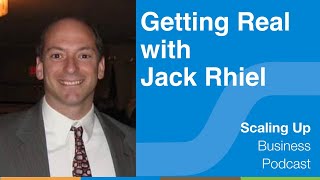
Jack Rhiel built SFCarCare from car washing to a multi-location auto repair business. The 2000 Firestone tire recall became his turning point, driving tire sales and ownership opportunities. He's now shifting toward mobile services and digital ordering.
Chapters
Foreign.
We're talking today about navigating the ups and downs of business, creating a recession proof business and managing all of the ebbs and flows, the people issues, the organizational stuff. This is one of our Getting Real episodes. Listen in as we get real with Jack Real. That's awesome. You should be on every week, right? Hi everyone. I'm Bill Gallagher, Scaling Coach, host of the show and your friendly neighborhood Scaling Up Coach. You can find hundreds of episodes just like these@scalingcoach.com along with the downloads of our tools, notes, all that kind of links@scalingcoach.com these getting real episodes are where we explore with a particular leader about how their leadership has been shaped over time with the growth of their business. What are the lucky breaks that they've had, what are the big setbacks and breakdowns? How have they handled that? What are the things that have frightened or surprised them as they've gone and how have they grown and developed as leaders? So we'll be getting into all that and more in just a minute with Jack Reel. I want to remind everyone that this episode is sponsored by the Bay Area Entrepreneurs Chapters. The Entrepreneurs Organization, commonly known as EO is a member led organization for entrepreneurs to find peers to connect to grow and learn with. And I'm proud to have been a member of this group for over 20 years now through several different companies and in a lot of different roles within the organization. The EO members of the Bay Area are connected and supported to over 14,000 across 61 countries worldwide. And that gives them access to a world of entrepreneurship that is really hard to compare with. If you'd like to apply for membership or to get more information, just visit eonetwork.org or drop us a note and we'll hook you up and connect you there. So eonetwork.org listen in now as we talk with Jack Reel about his story and his business and like that. So welcome to the show, Jack.
Hi. Thank you. Thanks for having me.
So folks should know that Jack, well, he'll tell more of his story, but he's in the automotive retail business. So not cars, but the, well, parts and service and that kind of thing for cars, right?
Correct. Awesome.
So Jack, talk about. Well, actually I think this is a good place to start. Start with when you first thought that you should be an entrepreneur or wanted to be. What, what was that moment and what was your life like? And like that.
Wow. It's way back when I was like eight, you know, we were from poor family, it was a welfare thing. I Had shoes that used to rip and tear and my feet would poke out after a couple days. So I had this internal need to get past all that and I felt like if it was going to happen, it was going to be up to hard work. And so I remember being 10, mowing lawns for people. I would make little index cards and put them on everybody's doorsteps and saying, look, I'll mow your lawn for 10 bucks. Or whatever it was. I mean, I always had that entrepreneur kind of spirit. And may I tell you, I got so many ideas when I was running through school that yeah, it was definitely a busy mind that I had.
So you had this thing and didn't come from an entrepreneurial family, but had some hustle and saw that as a way out for yourself.
Yeah, my next door neighbor, he was a couple of years older than me and he had a little too. We used to go out to the flea markets on the weekends. And I mean, I'm 16 years old and I was out there wheeling and dealing, trying to make a buck. And we were doing everything from selling wax products for shining up people's cars or other kind of retail odds and ends, just trying to make the flea market scene. We buy something and we say we can make money on this. Flip it crazy. So deals that we made and that was exciting time. And I think that kept my curiosity blooming. And as I got into college that spread like wildfire. I had so many little businesses in college that surprised I even got into the car business. I was kind of by accident, if you will. That's something you went to a good school.
Talk about what you studied and why and what you were thinking about in the college years.
Well, I went to sc, usc, the entrepreneur program. However, my grades weren't so good. One of the challenges was I was in sports and then I had to work because, you know, scholarship doesn't cover everything, so. So I had full time job the entire time at school. So we a couple friends in the dorms, you know, they wanted their cars fixed and so I would work on their cars and I had a little mechanic business going. Then I had the auto products from when I was in high school. And so I had done a car wash and detail shop in Beverly Hills for a time and so I had some friends team up with me on that and my thought was, well, this is what I want to do. Then I got lucky and I took my scholarship money and went down, bought a whole bunch of baseball cards and went down to Cosco's club. I think they called it I'm. And went out to a trade show that weekend and I doubled my money, three days, and I was like, well, this is the industry for me. So I started speculating on, you know, autographs and sports memorabilia, and it was sort of like stock market, but it was tangible, it was cash, it was quick deals. And yeah, I found a lot of excitement in that. And when recession hit back in 92, that industry got hurt, hit pretty hard. And I was coming out of college at that time, and that's when I got in the automotive business, so.
And you worked your way through that, learning something along the way, which I think is really interesting. So often you see people going into stuff knowing almost nothing, and maybe sometimes that's for the best because you wouldn't maybe pursue it if you. If you didn't. But in your case, you, you learned a little something about it, washing cars and so on.
Right. Well, one of the challenges of, like going into buying a truckload of baseball cards and trying to flip them, you think that you can do that over and over again. And so, you know, learning the hard way is making deals with all the price clubs and the smart and finals and say, hey, you know, give me first call when these, when this product hits and I'll run down and I'll buy all you got and I'll throw you a couple bucks for a tip. And I'm speculating that, hey, I'm going to buy $10,000 worth of stuff and then I turn around the weekend and double it. And then I find that there's no demand for this product. And all of a sudden I just lost everything I just invested in or this product's not going to move like I thought it was going to be. Yeah. You know, you, you learn the hard way and, you know, sometimes you make easy money, then sometimes you have to learn the hard lesson that, you know, if every, if it was so easy, everybody would do it.
Yeah. So you're moving your way through this. When did you decide how did you go into the business? In the way that it is today or in that.
What was the question? More time.
So when did you actually start. You started learning your way through working in a, in an auto dealership. When did you make that jump and actually buy into or. Or start a. The, the auto business?
Well, when I went to Alexis dealership and I started as a car washer.
Yeah.
And I admired my stepbrother because he was in the service department.
Yeah.
And I was, you know, sitting there going, oh, I used to run companies, why am I washing cars? And that sort of thing. And he enlightened me that, you know, if you're the go to guy and you're the one that people come to to solve problems, you're going to advance in this business because there's a lot of people that you come to and say, hey, I need this car done by five o'. Clock. And you'll hear the excuse, oh well, you know, there's not enough hours in the day or I got other things I'm working on and it's not, yeah, not gonna happen. They want to hear, sure boss, I got it handled. And when you are the go to guy, then everybody likes you, then everybody comes to you. And so that was my goal. My goal was to make all the promises, figure out how to keep them. Case in point, we had a used car dealer and I remember that he goes, you know, Jack, this, this customer is going to be in first thing in the morning. So before we leave tonight, you know, I need the brakes done, I need it detailed, I need it all shined up. Looking at clock at 55 and we close at 8 and there's just no way in hell it's going to happen in five minutes. But I know that if I act like I'm working on it and I come in early at 7am, by the time he gets in at 10 o', clock, he doesn't care if I work on it all night or if I come in in the morning, as long as it's sitting shiny, ready to go in front of his office when he wakes up in the morning. That's the difference between being successful in this business and not being successful in this business.
So give folks a picture that you have today, how locations people give, tell us a little bit what the business looks like.
Well, nowadays I've got a couple retail stores with COVID we have a mobile business that's on hold and then I've got marketing company which helps dealers like me through their accounting, insurance, marketing, website development, that kind of thing. So basically have a little side business where we offer franchise services to non franchise companies. You know, we started as I was a franchisee for a number of years and had a lot of benefits and learned a lot from that. But sometimes franchisee business model isn't right for everyone. And I found that I wanted to be independent, not share all my efforts and hard work with friends of the world and that kind of thing.
So you have two stores that are independent, started as franchise operations before you went off on your Own. And you do what kinds of things in those stores?
Well, we do auto repair, maintenance, oil changes, tires, that sort of thing. So basically everything but smog.
So full service, mechanical company, automotive repair, just not smog.
Correct. Where you're one stop shop, we like to say we're your neighborhood dealership alternative. We can handle all the cars in your garage. You don't have to go to the, the dealers.
So nice. And the. And it does seem like the smog is a specialty in itself. I mean there are shops that just do smog like, like oil changes all day long.
Correct. And you know, it's a specialized business and they got their own business format and you know, equipment needs and space needs and it's a lot easier to separate from retail and broken down cars and that kind of thing.
When you think over your career in this business, what do you feel like has been or even before you got into it, your luckiest break?
Well, I remember I was a service manager at the Ford dealership and they brought me in to teach him about tires and breaks. They had this thing called the around the world program and they didn't really understand and the tire business will change that kind of thing. And so as I was at the dealership, I'm trying to teach, you know, people worked on Fords their entire life and they say, you know, hey kid, how old are you? And I said, I'm 30. And he goes, you know, I've been here 30 years, I don't do oil changes. Or you know, they say, well, you know, you can tell us we're going to do tires, but we don't do tires here. It was like, you know, pulling the cart uphill, which is awesome. And so when the Firestone recall happened back in 2000, I remember all the Ford Explorers having the blowouts and 290 people died and that sort of thing. And I remember all the people come in and you know, all the customers and you know, the employees were going, jack, what are you going to do? And you know, Ford gave me a can statement saying, look, there's nothing wrong with the tires, there's nothing wrong with our vehicles. And you know, it felt wrong to me. You know, this is a good time to kind of get back in the tire business. And so I put out my resumes and luckily one gentleman received it. He called me over for an interview the next day and I went there and he goes, hey Jack, you know, sort of like divine intervention. You know, I was sitting by my bed last night, I was thinking about closing the store We've been struggling. You know, I used to have a whole bunch of gas stations, and I went into auto repair and had all these auto repair shops. And this last I got was just about to close it down when I got your resume. He goes, I know, it's. It's divine. And you're the person that I'm looking for. So I went down, we did a pretty much a full day interview. And I saw that, you know, cars were coming in with flat tires and bald on the edges, and they were just pumping up with air and sending them on their way. And I'm, like, sitting there. This is a gold mine. Why. Why aren't you guys selling tires and doing work on these cars? Why are you just, like, letting all this stuff just get through, right through your hands? This is one of the right people. And he says, don't wait until you're 65 like me to find your replacement. And I said, well, gee, I'm here, so let me get this handled, but I want to own it. And the big old model and how they grew to be the largest tire retailer in North America was they had a business plan set up where they would take their young manager and give them an incentive and say, hey, look, you know, you work the store like you own it. Give us good five years, we'll give you a percentage of the business. And that allows us, you know, the other owners to expand, find other locations, worry about the finance, the operations and that sort of thing. And I explained to him, I go, I want that program, and this is made for me, and I'd love to be a partner. And he says, you raise our business in a year, we'll make you a partner. And that was my big break because, yeah, we really kicked ass that year. And business skyrocketed. And a lot of that had to do with Firestone recall and the business boom from that. And we just sold every tire that we could find. But the difference between our operation and.
Other operations that year, right, I had a Ford Explorer at that time, and we got four new tires. When they started recalling, you know, we.
Were so good, we were doing fine. So it was on every car. And we were literally buying 1900 tires and truckloads and parking them along the street and paying meters all day long. So we went on. We were selling every tire that we could get our hands on. It was a, you know, 6.5 million tires had a be replaced, and Firestone was paying the bill on it. So that was a great opportunity for me to be right there on the ground floor to have access to the product because I knew where to get it. And what we did well is we took care of people well. We were very efficient. We were the easy way to get stuff taken care of. And because of that we kept that business and most places and then went back to normal where we tripled, quadrupled our business and then we maintained it.
Talk then about what's been the biggest hardship or setback that you've had to go through so far.
Well, at some point I had a bright idea of buying my partner out and being on my own. And as the responsibilities came that, you know, I'm responsible for everything and don't have that my side to help with some of the problems and the time management of all the things that we had to deal with. Yeah, it was pretty much too much. And then my thought was that, hey, you know, I saw other people with multi unit locations, why don't I expand? And as I would see opportunities develop or I'd be helping other people with their businesses and then they want to look for an exit strategy, I saw opportunities in allowing them to get out and for me to gain more hold and to grow our footprint. Challenge with that is that you don't have necessarily the managers in place and maybe some of the reasons that their businesses were struggling because they didn't have good personnel or adequate personnel and I was fulfilling some of that need. But the reality is at certain point, if you don't have the people in place, it doesn't matter what kind of business you have, you're only as good as your people.
Do you have a primary regret at this point or something like, oh, I, I walked away from a business or I, I chose wrongly.
Yeah, the, I found this beautiful building, it was huge. And I thought, well, gee, you know, if I can fill this building, I saw a huge dollar sign. Challenges is that the rent factor increases quite a bit the bigger the building is. And you still have overhead with people and advertising and other. Issues to deal with on the day to day. And the challenge is that you might be planning for that growth in five, 10, 20 years. But that first two, three, four years, those are really hard. Most businesses fail in the first couple years for a reason. And you know, to take a new business that started from scratch and to do the marketing and the advertising and try to make stuff happen, it cannibalizes some of the other businesses that, you know, you're starting to take money from one company, need to pay for the loss and then you start getting that slippery Slope that, you know, now you're working four times harder, but you're not making anything.
If you think about how your leadership has developed over time, what do you notice as you think about yourself? What have you gotten good at and what are you still struggling with?
I've always been a numbers guy, so I've always known that if you manage the numbers, good things happen. The challenge is that consistency employees sometimes is where it's been the hardest. And if you have a certain percentage of your employees turning over, you know, maybe that lower 20% of the rung there, it takes a while for people to get up to speed. You know, I've got 20, 30 years experience in this stuff, so it comes naturally, naturally to me. But where somebody who's only got a year experience or maybe none, you're trying to train them from scratch. The expectations that they have to come in, run with the football person, those are pretty high expectations. And knowing that, you know, we have bills and payroll due and all this other stuff that that's happening, we put a lot of pressure on young people. And I don't think I had that much pressure on myself initially because we were doing so well, that these kind of issues, you know, weren't something that was into my day to day. My day to day was concentrating on putting the numbers up. And if I did that, it's not necessarily the case that other people think that way. See, you have to kind of nurture, train. And I think I've been quite patient and learned that, you know, everybody was like me then. There would want to be, They would have my job and not necessarily be working for me. Get my point?
So what are you working on or towards now? Do you have any big long term goals at this point?
The mobile business, especially nowadays? I think that the future in this business is convenience, you know, part of dropping off the car, you know, having it in the shop for a couple days. A lot of times, you know, now we can literally put the shop on a truck, send it out to somebody's house and we can repair the car in the driveway and you never even have to leave the office or have to, you know, take the kids out the house and put them as a load of in the car. We can make a lot of things pretty convenient. The challenge is that the customers and the buying public haven't quite caught on to that yet. And I think that people are still more into the traditional brick and mortar, you know, bring the car into the shop. And I got a feeling at some point that's going to evolve and I'd like to be in that space when it does. And so I do have visions of where I want the company to be. Forward thinking. You know, we've already got the app set up for mobile tires and mobile brakes or oil change or other kind of maintenance. You know, check engine light repairs. We can do all that stuff in the field now and that saves on inventory. You know, you can bring the tire right from the warehouse. I don't have to stock, you know, 3,000 tires in a building. It's like on demand. And then you don't have to pay for the footprint in the real estate. You know, part of store failures is, you know, the huge rent factor when you're paying 15,000amonth rent. But you know, you got a truck that's bought and paid for. It's a, it's a lot more scale. I think that having a lot of trucks out there as opposed to a lot of dealerships might be a better way of running a business in the future.
It's definitely an interesting idea. And one of the scaling success stories with one of my clients has been a mobile mechanic business that we help scale across the country. And they put crews in many cities before being sold to a larger group. But there they weren't going to the end user consumer, they were going to body paint shops. So if you had a collision repair on the car and you needed to reconnect systems, hook back up a radiator, reconnect airbags, all kinds of things like that to get things interconnected as the body shop would be finishing up instead of sending that to the dealership back and forth, which is the more typical thing in that world. This company would come on site and their crew would, their guy would show up with, with a truck and, and the appropriate tools and special things and, and connect it up with which was outside the body shop. And really it just saved time and hassle factor for the body shop. So super lucrative business.
Well, I think tire is a logical place and a logical space to be in because you know, it's a drag to waste a day to bring the car into the shop. And four tires, you know, people don't want to spend a thousand bucks. It's a frustrating thing. You know, our company, we can allow people to purchase on their cell phone, they don't have to talk to salesmen, they can schedule the time to come out and it's done in a two hour window and it's basically seamless.
Right. Come to your office, come to your.
Home, something the car Key. But to get it scalable and to get people and to get it in different cities and different zip codes in different areas, it takes a lot of. And we're not quite there yet. I got a feeling this is going to take a few years, but once we get it going, yeah, that's where, yeah, I'd like to see that baby grow.
Nice. So before we get too much further, I want to remind our listeners, viewers that this episode is sponsored by the Bay Area Entrepreneurs Organization Chapters. We're known as eo and this is a member led organization that is really the best place for entrepreneurs to find peers to connect, learn and grow with, to master their business and develop themselves as leaders over time. I'm very proud to have been a member for the with EO for over 20 years now in a variety of leadership roles and several different companies. Our EO members in the Bay Area are supported and connected with the other chapters, plus 14,000 members around 61 countries across the world and, and that really helps them to deal with all kinds of things. You know, you need something you're going to try someday, you're going to travel somewhere again, but you find yourself somewhere and you need a connection or you need a resource in another country. EO members are well known for having something we call instimacy, where you reach out to someone and they recognize you as a peer, as a friend and are immediately welcoming and helpful to you. So that's something that the organization is really known for. It's really unique to have that kind of support network. Eonetwork.org is the place to go if you'd like more information or to apply for membership. So go check out eonetwork.org so Jack, as we kind of continue and start to wrap up our conversation, what do you think is next for you? What are you grappling with now? How do you see yourself transitioning over the next year as a new normal emerges as we start to get on the other side of the pandemic? Slowly but surely.
Well, fortunately business is up and we're doing good managing our people. We are striving more effective on the phones. We're revamping our website, we're going to go to our 2.0 platform and I feel that we were pretty innovative about five or 10 years ago and most of our competitors have caught up to us in our online presence and started to pass us. So we're starting to invest there. Our people are learning well that, you know, we get a certain number of calls. It's about earning a certain number of we got a certain number of visits, we move a certain number of units. It all, it all works. And as long as everybody knows what their responsibilities are, you know, our business is going to continue to do well.
It's really great. Do you want to give a shout out to is there a website or something that people can go to read more about your business?
Sure. SFCarcare, that's SF like San FranciscoCare.com and you can schedule alignments on we have buy three, get the fourth free sales on tires perpetually up to $100 off and we do complete auto repair, oil change, maintenance, whatever your wants and needs are awesome.
So and we're putting that in the crawl right now. We'll put it in the show notes as well. Find more Connect with jack@sfcarcare.com and there's all kinds of usual specials, so whatever you need starting from tires through all the rest of the typical auto care. Thanks so much Jack for joining us for coming on the show and sharing a little bit of your story and history and trials and tribulations with us. I want to remind our listeners, viewers that if our show helped you share it with somebody else so they can get some value out of it too. If you like and subscribe the show, you'll get updates from us every week. You can find us wherever you go to get your podcast recordings on YouTube, on iTunes, Stitcher, Spotify, wherever, like that. And if you subscribe, you'll get those updates every week. We're doing three shows a week now, a tip show on Tuesday, a deep dive with a guru on Wednesday, and then on Sundays and live. We're putting out our Getting Real episodes with entrepreneurs talking about the things that they've dealt with along the way in whatever line of business they're in. I want to give special thanks to Vern Harnish, author and creator of the Scaling Up Framework and the Rockefeller habits that led into it. Our show is produced by Lucy Summers, who gets the guests ready and prepared and schedules things and promotes the show and gets things out. The audio is edited by Albert Burge at podfly Productions and our show notes are written up and compiled by Ein Kudina. Proofread by Tim McGowan. Thanks again everyone for listening. Keep Scaling Up.
Thanks.
Thank you. Talk to you next time.










