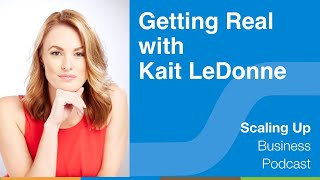
Kait LeDonne, founder of Brand Wise Media, talks about moving from corporate branding into cannabis dispensaries, what she learned in the EO Accelerator about hiring and daily huddles, and her five-step system for building personal brands. She's now focused on profitability using Profit First.
Chapters
Foreign.
Oh, it's a lovely day where I am. How are things in New York today?
Dreary is is the word I think you'd use to describe it.
The sun is shining. It's like 70 something degrees. I've just been good for you walking around after lunch. Blood movement going.
We had, you know, we had like a five day stretch in New York of that and then now we're in the five day brain stretch. We, you know, intervals.
Nice, nice. We're talking today all about how the right habits, the right routines can let you really focus on and grow your business. Hey everyone, my name is Bill Gallagher, Scaling coach, host of the show. You'll find hundreds of our other episodes on leadership and scaling up@scalingcoach.com also all the downloads of the tools, references, links that our guests talk about, everything there and more@scalingcoach.com so this is one of our getting Real episodes and these are all about how our leadership is shaped over time by the growth of the business, the kinds of lucky breaks we've had, how we've handled the breakdowns of things that have frightened us, embarrassed us, the regrets that we have and where we're growing, what we're dealing with as leaders in the business. This episode is sponsored by the Bay Area Entrepreneurs Organization Chapters. That's a mouthful. Commonly known as eo, Our member led organization is the best place for entrepreneurs to find peers to connect and learn and grow with. And I'm proud to have been a member and leader in the organization for 21 years now with several different companies EO members are supporting connected to about 14,000 around the whole wide world giving them access to a world and a community of entrepreneurship. If you'd like more information or to apply for membership go to eonetwork.org so listen in now as we talk to Kate Kate ledone about her experience and in one of our programs growing her business and that kind of thing. So welcome to the show Kate. So happy to be here.
Thank you. Thanks for having me.
So as we pointed out, you're in New York, I'm on the west coast. Our listeners should know that she's the founder of Brand Wise Media personal branding agency. Something that I've been thinking a lot about lately which builds executive and author personal brands using content marketing strategies, social media and she's written a Book Attraction Magnet 7 Insider Secrets the World's biggest brands use to attract customers who can't wait to buy from them to breathe after that title and Israel featured national international publications commentator and so all around expert in building your personal brand, especially for authors and public figures and that kind of thing. And she's also built a course, the Influence Academy, around building your LinkedIn influence and taken over a hundred executives through that program. So did I get the world of it?
You got it. You got the world of it. I mean, you know, ask me on a day to day basis, there's a million more details. Any business owner would have, you know, but, yeah, you got it.
Why this business? Why did you start this business, get involved in this?
I'm going to make a longer story shorter or attempt to. I had.
Oh, no, it's a. Phil, go long, go long.
Okay, great. Buckle up, everybody get ready. You know, I started in corporate brand marketing. Um, I was really helping local businesses in Baltimore is where I started the company, build up their corporate brand. And around about that time, I was just consulting with it. My cousin, who ran a venture capital fund and successfully exited her business after she sold it, of all things, decided to enter into medical marijuana. And it was interesting, and Bill, maybe less interesting if you're in California. And it had kind of been around for a while, but in Maryland, it was a newer thing. And the best part of it was she was probably, she's going to kill me for this, like, later 50s, close to 60s at the time. And so she had spent her whole life telling her kids not to touch, you know, cannabis, and then all of a sudden invested in cannabis. And she called me one day and said, I don't know where you are on this, but do you want to brand the dispensary and all the other businesses? And I was like, yeah, let's go, let's do this. And so I started to brand Greenhouse Wellness and then Placebo and then a few other of the brands in the cannabis sphere. And I sat down with her and her business partner, who was. She was a retired engineer and venture capitalist. Her business partner was a retired obgyn. And I said, you know, we have this corporate brand, but I think you all are really missing out on a personal brand opportunity here. Your story is hilarious. Your two mothers with, you know, grown children who never touched the stuff, always advocated not touching the stuff. And so much of the brand ethos we created was to build a clinical setting where you'd feel comfortable taking mom into a cannabis dispensary to help with her cancer versus some seedy shop. And we're missing the opportunity if we don't build your personal brands around this. So we wrote a book, High Heels How Two Women Found Their footing in the cannabis industry. We built out their personal brands. They ended up on the Today show titles, too.
That's a good team.
I cannot take credit for that, but it was good. And it was spelled heals. H E A L S. You know, double entendre, high heels, because it was all medical cannabis. So we did that. They ended up on the Today show with Maria Shriver, and the website crashed because we got so much traffic. And so the. Yeah, great, right? Everybody loves a crashing website due to so much traffic. So the publicity firm said to me, you know, you're really good at this thing, like, developing a platform for authors and executives. You should do it for other people. We have more clients. No, no, no. I'm just doing this because I have a literal vested interest. It's my family's business. I don't. No, thanks. Like, count me out. And then a few more executives came to me and asked for the same thing as they saw what I was doing on LinkedIn. And like any good entrepreneur, I was like, I'm an idiot if I miss a market opportunity here. There seems to be an intersection of market demand and what I'm. I'm pretty good at doing, and so I'm going to give it a go. Um, and. And that's what I did. And it has grown crazy since because a lot of people have personal branding on the mind.
A lot of people. And even if you. I mean, yeah, you should. If you don't.
Yes, you should. If you don't. There are stats that back that up.
You know, even if you're not in the public figure in your business, we have a friend who works with people on what do they want to be known for. Right. Even if you're a rising within an organization, not the leading, not the ultimate leader of the organization, you ought to think about your personal brand, what you stand for. Because the way that you're thought of in the other room is determining your career. Right. People in other rooms make decisions about if they're going to buy from us and if they're going to promote us and all of those kinds of things. And a lot of times I think we have these delusions about who we are and what we look like and.
Yeah, what a gift. I forget who said it. It would be if only we could see ourselves as the world sees us. And I think personal branding is. Is taking charge of that narrative. But to your point, Bill, you know, we're at a point now where I think there was a time in business where there's always been A time where your network is your leverage. Right. Who you know, you've always heard people say this. It's all about who you know. And before social media entered the game, I would say that that access to people was confined to people that had the privileges to reach that. But then enter social media and there's a more of a democratization or equality in building that network very rapidly. And so you're seeing this opportunity to quickly build a network that before you may not have had the opportunities to build, and then use that as leverage. Whether it's, I'm a serial entrepreneur and I want to use my personal brand, network and equity to roll into corporate brand equity, or I'm in an organization and I'm going to use that as leverage to grow in my career. I mean, your network is your net worth. And at this point, I think if you're not mindfully cultivating that through your personal brand online, because that's so much of where networks can start or at least foster, then you're missing a real opportunity there.
Yeah. Et cetera. So what is your superpower in all this? What do you think you're uniquely gifted at?
I think the thing that had me find early success on LinkedIn and amass a following there, which helped me get this business off the ground was, and I know this is such a buzzword lately, like authentically sharing, but if I'm being Honest, I was 26 years old fumbling my way through a business, and my catharsis of that would be to document my learning lessons, as grotesque as they were sometimes on LinkedIn, just to almost treat it as a diary. And to my surprise and delight, people really rallied behind that and I started to get business. And so I think it was this intersection of being super upfront and vulnerable about that and then having a way to put it into words where it landed for people, and they could really empathize with that. And I think that's how my whole following got built on the platform.
Yeah. You know that a lot of people struggle with that kind of thing, right? The showing anything other than the perfect smile at the perfect Instagrammable place and time and they really try to like. But it's unrealistic, it's not super relatable. There is something about somebody who's willing to look like a dork for a minute or say, wow, I really screwed something up.
Uh, it's relatable, it's human. You know, there was a status the other day I saw on LinkedIn from the founder of Shield App, which is a great program for those of you who are building your personal brand on LinkedIn. Basically, they give you a lot of data around that so you can see what's resonating and what isn't. And the founder of it, this posting that he made, that went pretty viral, it was like, hey, I'm a CEO, but I don't have it figured out. I am failing forward every day. And, you know, he was very, very honest with his evolution as a leader. And I think he got something like 1800 likes and engagements. And I know he got business out of that post. And you would think, or your ego would have you think that that's the antithesis of what you should be writing as a business leader. Like, oh, I'm figuring this out every day as a CEO, but instead, there's that honest humanity in it where everybody is like, yeah, that's exactly how I feel. Thank you for articulating some part of how I feel that I may not even be able to verbalize like that. And I think people really rally behind that.
Yeah, there's something valuable in. In going in. So what is the. What's the biggest challenge that you've had to deal with so far?
Different stages of business have definitely warranted different challenges. And I know everybody kind of deals with this as they grow the business. At first, again, I was 26. I mean, imposter syndrome, sure. Like, I'm here and I know something and, you know, I should value that and charge accordingly and all that good stuff. But after I proved the model to myself and got my own confidence up, then it was starting to scale. Right. And making sure that that touch and that. That thing that made you special, you don't lose that in the process of scaling up. And that quality assurance. And then, of course, that ebb and flow we all feel as business owners. I always say it's a seesaw. Operations and then sales, sales and then operations, operations and then sales and doing that balance and a seesaw between the two of those to make sure you're selling enough to support infrastructure, the infrastructure to support sales. And that continues to be a dance that I would say I dance on a daily basis. That is a challenge I think we all can relate to.
What do you feel like then has been the lucky break that you've had so far? What's given you the biggest boost?
You know, access to people through relationships I've built. But it's tough, right? I struggle to say that that's lucky because I went about them very mindfully. I'm Lucky in that our clients are amazing experts at what they do. So I don't have to, you know, make it up for them. I just have to channel it in a really great way. But you know, I would say getting involved with my cousin's business and learning from somebody who was in venture and had a mind towards scaling businesses and being able to be given a chance and have that much weight in my thoughts around their personal brand and the cannabis brand to lift it up to what it was. I mean I was extremely lucky. I was very fortunate to have and privileged to have that relationship in my life. And somebody who says, you know, I'm going to put all this trust in you as a younger person to really elevate the brand. And I think that that gave me the platform and the chutzpah to do everything else.
Yeah, it's funny. So this is definitely a growth industry. No matter whether you're in distribution or growing. That's, that's definitely on the rise now. We've seen it's gone from medical marijuana to recreational marijuana in the, in California and in many places across the. It's just becoming more normal that people would feel comfortable and, and not be weird about it. But of course when I was a kid it was like this sort of illicit thing. Hey, do you party?
Yeah.
Are you cool?
That's right. Yeah, it's, you know, America doesn't agree on much these days. But I will say I think that's like one of the very few bipartisan topics. Everybody's like, just legalize it. Like what are we doing?
I think there's more and more, it's definite becoming, there's less stigma of it. But we've seen quite a bit of personal brands growing. I know some of the people that I work with and around, I see celebrities launching personal brands in or, or lending their name to cannabis brands now and that tie in with celebrities. In fact, we've got a friend, I should have him on sometime. Has developed, let him tell his stories firsthand. Has developed quite a few celebrity brand tie ins where they get somebody to lend their name to something and they pull in something that' really cool. And I don't know which of those I can share. So I'm going to keep my mouth shut for right now, but we'll have that one back on.
Yeah, I mean, you see, listen, when Martha Stewart is into the cannabis space and Whoopi Goldberg is putting her name on it, like, you know, there's a market to be, to be cultivated there.
Like, yeah, she's like, you know, this is the apple pie you want to eat when you're so baked.
Exactly. I was listening to a show the other. The other week. I think it was like Bill Maher, I had recorded. He was saying that, you know, there was a restaurant in Detroit that was like, you're definitely not allowed in the restaurant if you even smell like marijuana. And he was like, I don't think they understand how munchies work. And I was like, yeah, it sounds like a poor business decision. If you're a restaurant owner, that's exactly who you want coming in the restaurant. Like, they're gonna eat everything on the menu. They don't even care how it tastes. They're just gonna. They're just gonna order it all.
Yeah. It's like putting up salty snacks in a bar. Just keep it coming.
I don't know why.
More peanuts.
Simple business model. It's a simple business model.
So we're going to talk about the EO accelerator program in a minute, where we first met and connected. We're getting a chance to talk in depth. More here, but scaling up and the scaling of content has been part of this program to help companies get started or get through the first stage of growth around the world. And we want to talk about that. But before we get into that, or maybe as a segue into that, what do you feel like has been your sort of biggest mistake or regret? What have you screwed up the worst so far?
Yeah. You said you're good at.
Let's hear it.
Yeah. No, many things, that's for sure. I think not building a team sooner. I think that there is a point there, especially as a consultant, where I thought, I'm going to make a good high income living for myself and grow this and keep expenses down. But what you realize, or at least what I realized over time, is I'd rather make 1% on a hundred people's efforts and mind share than 100 on ones. Because at any point, like, I could get taken out. I'm always going to be limited in terms of my capacity. And I thought that that would give me freedom. Right. Like, I have a team to watch over and I don't have to answer to anybody. And I'm so sick of this corporate stuff. And what you realize or what I did was it was lonely. And there was so much of that, those peaks and valleys of entrepreneurship. I didn't have to weather on my own and carry on my own without having the support and the value of a team. And so for me, I would say I'M very fortunate to have found community and to now have a team of 10, 11, including myself. But before that, it was a lonely slog and it was a slower thing. And I came to think slower because when you're in the middle of it alone, you're usually only afforded to look at it from your perspective. So I would have built it so much sooner. I would have. It comes with its own unique challenges, don't get me wrong. But I would have built it so much sooner.
Yeah, it's interesting. So as I looked at your notes and that stuff in getting ready, I was struck by how you've worked through a variety of things in the accelerator program, but that embracing the framework, the structures, the habits, the meeting habits. So when you do the accelerator program, you get learning in quarterly, you get planning in quarterly, you get some monthly accountability and support structure, and. And now you've got some of those basics. And then it's kind of up to you to do a weekly meeting and daily huddles and that kind of thing. How Talk about what you've learned in the program and how you've applied it.
Oh, man. At the risk of this just being the ultimate plug, because it is so, first and foremost, give me the goods. First and foremost, Accelerator was the impetus for me to cultivate a team. Like, I came into it, I had the online course, and I was generating enough revenue to hit the revenue limit where you needed to enter eoa. Right. And I had a lot of the entrepreneur organization accelerator program. I had a lot of friends who were in EO that were like, you know, they identified something in me and thought it would be a good program. I came into it. And when I realized through the four different pillars. Five, four.
Oh, my gosh, four people. Strategy, execution.
That's right. Sorry. I caught myself for a second there. I got a little in my head about it, the four different pillars. What I realized is I couldn't scale it without people. And so I became dogged about the platforms and the pillars. And within two years, I've grown it like four times over. But it was because especially in the people day, again, going back to my biggest mistake, I was sitting there as a solopreneur at the time who was in EO A and thinking, I don't have people. Like all these entrepreneurs are going back to talk this over with their people. Like, I'm looking. You're looking at the people right here. And so I really started to just get passionate about that and the meeting format, especially daily huddle every single day, all 10 of us run through, you know, win from yesterday, core value, shout out, priority today, help needed, and the KPI you're in charge of. And we have a remote team, and it's been remote before the pandemic even started. But I would say we're more in sync than teams that are in the same office together, because we're KPI driven, we're performance driven, and we have those meeting cadences that keep us all aligned on what really matters and the data that really matters in the organization.
Yeah, I love that all of those things work together well. And then you can focus on more, I think, you know, managing people, getting people. People align, pulling in the same direction, wrangling them. That's the. The thing that people worry about. Right. And then the overhead, if business goes up or down, they worry about having to either let them go or having to come up with the money to keep them. So there's a great deal of anxiety about that. And people start then hatching businesses that they can do on their own, but that keeps them inherently small, makes them grow. Or you've just created sort of a job instead of having one boss. Now you have however many customers you have as your boss, and you're at the whim of up and down, and you're continually aware of that. You're really on your own trying to convince somebody to work with you. But you don't feel like a company. You feel like a person. And maybe at some point in your life, you will have sufficient confidence and security and stuff to pull that off. It's certainly easier for me to be a more visible piece of the company today than. Than I once was. But that. That wasn't me at 20 or 30 even. Right. It was a very hard thing at that age to. To be that.
Yeah.
So in the end, then, what do you find yourself grateful for?
Oh, truly. The team we have together weathered and innovated so many different scaling hurdles. And I just look back on where I was. I mean, truly, two years ago, I didn't have a team. I had, like, another person who's now my ops director, kind of in a fractional capacity. And to see how we pulled together and really look at challenges as opportunities to innovate and get the perspective of so many different people. I just. I'm so grateful. But. And then there's also that part, Bill, where you have. You reframe that. So I was so. I was scared is not even accurate. I mean, petrified to be responsible for somebody's livelihood. Right. And all of my I think I'm like, one of the only people on the team that doesn't have kids. So not just like, their livelihood, like little people's livelihood, who I don't know, but, like, if I'm selling or running this business. Right. It affects whether they have a good life. And there was a point where it clicked for me that that was either going to be petrifying and keep me small or was going to be the greatest opportunity I ever had. And I'm grateful to have the opportunity to be able to contribute to people's lives like that, even if at times it's challenging managing people. I would say there is no greater source of fulfillment than knowing that the work that I'm doing as an entrepreneur is allowing other people, other people to step into that and be compensated and feel great about the work that they do. So I, you know, eternally grateful for that. Grateful for the click and the shift.
For that. Yeah. To get over the thing. Because you can do so much more and you don't have to carry the work alone. Alone. I'll reference a really early show. Sorry about that. I don't know what the deal is with the focus today seems to be going in and out on my camera. One of our early shows, a guy named Tim Danley, who built his business to over $200 million with only four people on his team. Now, there were a lot of contractors, so. And other relationships. So they worked with partners and they worked with different kinds of vendors, but only for employees. And so you could be clever with it. I mean, we have people that do our bookkeeping and invoicing. We have people that work on our website, that produce our podcast, that do a lot of other things for the company. And there's only two core people. And then we have contractors who do sub work for us in special areas that we don't do much of. So we can draw on a big range pretty flexibly. And as a result of that, but it doesn't mean that they necessarily have to be employees to be team members. But there's no question about the guys who are doing our web stuff, that they are part of our team. Like, we don't call other people or shop every job. They're the people, Right?
That's right. And I think that's a big part of Also, you know, EOA is like. I mean, most of my people were 1099. We've now gone through W2 conversions and are doing that to really go to the next phase of the company. But most of them were. And the thing that banded us all together, I mean, certainly vision and mission, but the embodiment of those values every day and hearing different contractors be like, oh, today, you know, I want to shout out so and so for excellence. They. They demonstrated this. It was like, I mean, I had other business owners telling me, like, I can't even build a culture like this with my W2s, who I've had for, you know, years. And you figured this out pretty quickly. Like, I don't know, it's the lived values and again, those frameworks for getting people to share them and build them together that a W2 doesn't. I mean, a W2 status doesn't determine that like a shared value does. In my experience, I've seen contractors so passionate about building a business with you. If the vision and the values are clear and lived every single day in a way that I've seen W2 folks not, not get behind that. So I completely agree with you.
I think that's really insightful. People love to contribute to something, whether as a full time, employed team member or some other kind of team member or key partner. When something stands for something, when you have purpose, values, when you're working towards a bhag, when you have brand promises the world can count on and you're not just, well, we do anything people pay us for. Kind of a business, right?
Yep. Although I did go through that iteration of the business too. It's an interesting sandbox. I don't recommend staying there.
At some point, we're all like, who am I? What do people really want from me? Who's going to pay me for this? Who actually likes what I do? Right. There's always. And that can show up at any stage of your career or business. When you're going along and you're like, yeah, but who are we really? And I have worked with companies over 500 million who have trouble narrowing down and saying, okay, we work for this kind of company and not this kind of company. This is our customer and not this. This is what we do, this is what we don't do. And that, that takes a great deal of discipline. Especially when somebody's like, hey, I need help. You know, here's a million or 10 million or $100 million. You're like, oh, okay, I'll do it, whatever you want. You know, there can be that kind of temptation.
I've almost always regretted that. Speaking of regrets, it was the things that, you know, you know, again, value alignment and kind of like that core feeling of I don't think this is where I want to be wading into. But then the money is there. And every single time, Bill, I'm like, damn it, I should have just lived by those values. Like, I knew it. This came back to bite me. Not gonna do it again. Yeah.
We spent some time in our last business many years ago getting into the Federated Stores, Macy's and the others with our fashion brand. And it was worth a lot of money and a potential to scale quite a bit more. But during the handshaking that the initial, like, setting up the interaction between our purchasing systems and distribution shipment and all that kind of stuff and getting the first goods set up and sold, every step it was, like, really, really hard. It was taking a long time. And every step of the way was, like, fused with this, like, irritating, pushy, nasty edge. And at some point I got on the call with the main buyer to say, listen, could you help us out? We're having trouble with the other part of the business, like, getting the thing. I know you, you seem excited about our brand. And. And she was nasty with me. And I said, you know, maybe we shouldn't be doing this. And I didn't plan to do it. It was very much in the moment, and I was actually in that moment. It wasn't a clear thought, but I think that I thought that she might, like, you know, that that might flip and she might say, no, no, no, we're going to help you. Like, you know, don't. Don't stress, like. And she was kind of like, well, you know, this is how it is. You know, just get used to it. And I was like, wow, maybe we should. Yeah, maybe we shouldn't. Let's, let's, let's stop this. And she was first stunned and then really irritated with me because they'd also invested some time, like, in getting this up, but they were so used to and expecting that people with so much money hanging out there were going to just do anything and suck up any amount of pain and punishment, I was like, forget it. Life is short. This is not a fit for our brand. And it was a really weird feeling, for sure. I was a little like, what have I done? And the sales rep who built the relationship was livid. But I felt actually really great. And with time, I felt better and better about, oh, I walked away. I dodged a bullet there from a nasty partner.
I mean, I think that comes down to having integrity as a. As a business owner. And again, like, knowing what values you want to live by and how you constitute success. Right? Like, you know, There's a certain point where I'm like, I'm quite happy to grow a business of X size. If it means that my people feel fulfilled, I feel fulfilled. That there's value alignment with our clients. That to me is more rewarding. And if it's of a certain again, size that I want it to be, then I'm just going to 10x this for the sake of 10xing it. But I'm miserable throughout the whole journey. It seems like the antithesis of why I started a business. If I wanted to be miserable throughout the whole journey, I would have kept selling my soul in corporate. This is what I left.
Well, we definitely think you should do something you really love, right? That you can pour your whole heart and soul into that you won't regret, something you feel great about doing and will do your best work for, and that you can have some fun in the process. But fun isn't critical to everyone. It's one of our brand values. Our first one is courageous authenticity, like, really sharing yourself in a raw, powerful way. And the last one is to have a little laughter. So we'd like to make you cry and make you laugh, I think.
As you've done before with me, though, as you've done as I shared earlier on in this call.
Not today, right?
No, not today. Bill led a really great learning session for my EOA group. And this was right at the beginning of COVID and, man, it was like. It was one of the most formative EOA learning days I had. And it's because we all had just gotten rocked with lockdown. And it was. I was talking about isolation. I was isolated in my apartment in Brooklyn. And to be able to be very authentic and just. Just cry and be like, man, this shit is hard. I am staring at the walls, grinding through this business and not even having. And I'm terrified to go outside. Like, I don't know. It's New York. This was in the height of New York.
We didn't know in those days. And there were people in hospitals were overflowing and, oh, yeah, I mean, I.
Saw refrigerator trucks walking down the street. It was terrifying. It was absolutely terrifying. But, yeah, we have a similar value. Joy is a core value of our company. And during the hiring process, I feel like new hires are always kind of. Or like, interviewees are always kind of skeptical, like, what is your favorite value? And they're like. I'm also kind of unclear on joy. I'm like, no, yeah, we, we. If you're going to do something, should do it with white hot passion and feel like alive through it and have a little fun in the way. And I always feel like all of them are like, is this a trap? Is this a test? And like no, we really Joy is a core value of the organization. Yeah.
Yes. Nicely done. Talk to us a little bit about you talk about balancing the marketing, the sales side with the process side. What core processes have you identified or are you working on managing all the time or maybe just talk a little bit about how you do what you do.
So first things first. You know, I am very clear on who I am and who I am not. And so I am passionate. I love the big picture. I love to sell. Like that's me. I am not great at process. I hate the details but I know that about myself. And so very early on I found I wouldn't have called her this at the time, but through learning and reading books like Fraction and Scaling Up, I like realized I've got myself an integrator here. And so I think the pivotal first step is finding somebody who comes alive in process development and like project management is their thing and they're like fired up about it. I think it's, listen, I respect any build processes like oh God, I just, I want to go sell something or talk about something. So. So I think that that was fundamental. But then getting clear on, you know, boiling it down in simplicity and simplicity, like just because something is simple does not mean it is easy. And I think we've gone through more iterations of the business of shedding what isn't useful and boiling it down into now a five step process we call the personal brand build system. And I think even putting a name to it and outlining that has increased not only the clarity for our people and clients, but also the value of the organization. And without that systematized and documented, we'd be a mess. I mean I, the wheels would have came off long ago. We wouldn't have been able to grow at the heightened and hyper rate of growth that we have.
Yeah, nice. Yeah. I think there's something valuable about separating that and figuring out which part of the business you should focus on. Right. We've just done the people day heading into execution next for all the folks. So you'll be working on core processes and identifying those and learning about process mapping again.
When you have, when you have clarity around it, it gets fun. And I know where my part of the process is, which is I hated numbers, I'm a creative person, personal branding, things like that. And then when I really understood how processes would drive numbers and metrics that mattered in the business, then becomes like a game, right? You get to play chess a little bit, and it becomes fun instead of daunting. But processes allow that. That data to be clean and clear and everybody to be clear on what they're looking at. And so it's really hard to see that if you don't have the processes in my experience to lead to that data and you can't make what you can't measure. Right. Like, it's very fundamental. You have that down.
So let's talk about what you're working on now. What are you working on? And. And what's your, like, long. Do you have a bhag or what's the big goal that you have in mind now?
Yeah, you know, we find ourselves at a very interesting part of usually a triangulation of teams. So especially with nonfiction business authors, we're working alongside a publishing firm. Right. Think like your HarperCollins, your penguins, like, things like that. And then a publicist. And I would say what both of those two teams don't usually have is like platform development and digital growth. And so my bhag, you know, if I may be so audacious to say it to the external world because I've only said it internal, is like, I want to get a point to. This is so patented and processed and replicatable that we can then, you know, be absorbed by a larger publisher publishing house that realizes, oh, this is more. Makes more sense to bring it in house than keep outsourcing it to partners. So certainly, I mean, if you're telling, like, my retirement plan might be that or something, but certainly to become the go to with the big publishers is the bhag. And again, even clarifying that, I would say we're well on our way where if you can name it and point towards it, I'm starting to see traction on that BHAG way faster than I would have seen without actually putting it out there and getting the team to get excited about it and like, oh, I have a connection at Penguin. Like, maybe, you know, we can talk. It's like, great. Everybody should be excited about this. So, yeah, that's the.
So then if that's the bhag, then what's your challenge? Or what's the gap for you? What do you need a breakthrough in right now to hit that?
Yeah. For you, Profitability, Bill. Truly, I think. Yeah, you know, we. We've just implemented Profit first.
Okay.
That from Cash Day. Love, Mike Michal, for those of you. Yeah, who haven't read his book. You're missing out. So we're going through our first month of profit first and allocations which has been illuminating and eye opening. And again, one of those things that you really start to realize in eoa, especially in cash day is like revenue is super sexy sounding and it's all great for your ego. But at the end of the day like profit is, is the thing. And so I think as we grow quickly it's again streamlining those processes and figure out what we need to bring and how we need to renegotiate things to achieve that, that profitability. So that's kind of, I think what I'm saying when I go back, work.
To be done on the business model.
Yeah, for sure, sure. Yep. That's our Q2 pricing.
Maybe.
Costs. I think it's costs. Yeah, okay. That I become again, get those KPIs down folks, because you start to realize these things, you'll start to pinpoint them and again then they start to become less intimidating and more like, okay, I can do this, I can play this game now. I know the rules, I know the points. Now I'm going to play the game if that makes sense.
Well, okay, so some call. It's. I want to just tell folks if they want to know more about your business, they'll find you@brandwise media.com brand wise media.com. that's the one that's the place to get. You'll find links to their socials and things there as well and and then some other shout outs to of course to eo. The EO Accelerator program that we've been referencing is a program of the EO organization, one of the many programs to help entrepreneurs learn and grow. It's the program for earliest stage entrepreneurs. So most of our listeners are beyond it at this point but it helps you to get over that first million, get your company going and, and get moving from the startup stage then into the first part of the scaling up process. And our show is sponsored by the Bay Area Entrepreneur Chapters, the EO Entrepreneurs Organization chapter, a member led organization. The best place to learn, connect and grow with other entrepreneurs. And I'm proud to have been a member. I'll be the president of our local chapter next year and I've been around the organization for 21 years now. So that's connected to the New York chapter. And I don't know how many do we have in New York now? A lot, I think.
Yeah, you do. You have a lot.
So across countries, 14,000 members around the world. If you want more information, go to eonetwork.org, to get more information or to just apply and then somebody will follow up with you and talk to you about if it is in fact a fit for you or not. If you dug the show then please share it with somebody else right now. Like subscribe. All that kind of good stuff. We love your reviews and comments on itunes. That probably does the most for us. If you want to do something beautiful to make my day, give us a full review there. You can also find us@scalingcoach.com all the back catalog of the shows, the notes, the downloads, all that kind of stuff. And you can drop us line infoscalingcoach.com or you can send us a DM on Instagram or wherever you like to do that. So special thanks to Lucy Summers behind the scenes. Right? I didn't confuse it that time. Lucy. It's funny in the flow. I work with her every day, but then sometimes I like say the name wrong. Lucy Summers. Special thanks to Vern Harnish, also author and creator of the Scaling Up Framework. Our audio is edited by Albert Burge at Poply Productions. The show notes are written up by Ein Codina and proofread by Tim McGowan. Thanks everyone for listening and watching. We'll talk to you next time. Keep Scaling Up. Thank you Kate.
Thank you.










