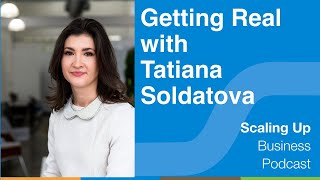
This is a podcast interview (Getting Real) where Bill Gallagher speaks with Tatiana Soldatova, founder of Syllable Design (Toronto). Tatiana describes growing an interior design and architecture practice (retail, corporate, multi-unit residential), operational challenges (cashflow, underpricing), and concrete fixes she applied after participating in the EO Accelerator and studying Scaling Up. Key changes include raising upfront deposits (from 10% to 40%), switching to monthly/time-based billing, enforcing a 48-hour proposal turnaround, documenting processes (cloud-based checklists, Asana), and delegating tasks. She also discusses a large 55,000 sq ft office project, awards and publications, personal leadership (procrastination, panic attacks) and completion of an MBSR program. Practical takeaways center on cash management and execution systems to scale a design firm.
Questions this video answers
Toronto, Canada.
In business with a partner for eight years: four years part-time, four years full-time.
Increased upfront fee from ~10% to 40% of the project fee.
Monthly/time-based billing (recurring monthly charges).
First corporate project ~CA$125,000 (construction and furniture fees); later work grew to ~CA$10 million. Also cited a 55,000 sq ft office project.
Chapters
There we are. There we're going, we're going. Hi everyone. Welcome again. We're going to talk all about actually a couple different things in the world of execution in particular and execution applied to cash, how we tighten up those things to run and grow a business better and better. Hi everyone, my name is Bill Gallagher. I'm host of the Scaling Up Business podcast, your friendly neighborhood Scaling up coach. You can find hundreds of episodes on all things to do with scaling up@scalingcoach.com these getting real episodes are where we talk with a leader about how they grew their business and developed as leaders over time. The Getting Real episodes along with all the rest of the shows are all@scalingcoach.com or wherever you get your podcast. ITunes, Stitcher, Spotify, SoundCloud, you know, wherever you get your podcast content, YouTube, all of it. We got it all. Hundreds and hundreds of episodes there now and then. All the back catalogs, the links, the show notes@scalingcoach.com so we're going to dive into our topic today with Tatiana Soldova of Syllable. Syllable Design and get into that in just a second. Before we do that, I want to remind everyone that our our Getting Real Episodes are sponsored by the Bay Area EO or Entrepreneurs Organization Chapters. It's an organization, a member led organization where members can grow and connect together as entrepreneurs to work on their business and integrating everything that matters in their lives. I think been in the organization. I first joined about 21 years ago and I've had been in with several different companies at this point and I've been a leader nationally, locally, that kind of thing. I've gotten so, so much out of it. It's just an enormous value and a great place to develop as an entrepreneur. We've got three chapters in the Bay Area and then we're connected with chapters on every inhabitable content continent around the world. So there's over 14,000 members around the world that EO members are connected to and really like connected like you can reach out, connect to those folks. If you'd like to know more about EO or EO accelerator program or any of that, just visit eonetwork.org you can apply for membership, get more information, do whatever you want to do there. All right, so listen in now as we talk with Tatiana about her business.
Yeah, thank you so much for having me on the podcast though.
Thanks for joining. So you're in Toronto today?
I am, yes. It's still cold and still in lockdown.
I'm so sorry.
It's okay. We're getting through it.
I've been for the last couple sessions anyway leading the Toronto accelerator program, sessions that you've been participating in and so on. So we're going to talk about that before we get into it a little bit. Tell us a little bit about what does your business do. Tell the listeners a little bit about the business and then we'll talk about you and all that.
Yes. So I run an interior design and architecture practice. My business partners are an architect so we are able to have the interior design and architecture in one. So we focus on retail design so doing rollouts for franchises or one of a kind unique shops. Also doing corporate design and multi unit residential upgrades. So like if you think about condo amenity spaces, lobby entrances, that's kind of what we focus on.
So just not single family bathroom remodels or whatever.
No, no, no, no, I don't do those.
Nor did there. It's embarrassing. I, I'm in the middle of a bathroom remodel right now, so that's top of mind for me. Way bigger project than I realized, so that's cool. So retail, office, specialty retail, multi unit condo and apartment, that kind of thing. And, and you've been doing this for how long?
So I've been in business with a business partner for eight years but I did it part time for four years and I've been doing for the full time for the last four years.
So I mean freelancer for some years and then moved into and started to grow the business and so on. Talk about what made you think to be an entrepreneur ever? Like when did you first become an entrepreneur? Were you really a practitioner in the world of design and architecture first? Talk a little bit about that.
Yeah, so I, so I immigrated from Russia when I was a kid to Canada and ever since I was a child I was always kind of leading of what we're doing, hanging out with friends. I'd be like hey, let's go do this, let's go do that. And as I've worked my way through work and I mean I lived in Niagara Falls and the only place that you can work is hospitality. So I'd be a busser. But then I'd become like the lead busser and I'd be the one who's like, you know, coordinate what the bussers were doing. So I started learning to coordinate and manage very like, you know, 13 years old, pretty early and as I moved my way through all the restaurants until my 20s, you know, I've gone being like head bartender and you know, head Hostess. I've done all of that. And once I started working at an architecture firm, I worked with many different principals and I used to design schools and community centers. So very large projects and you had to work with lots of stakeholders from clients and also the consultants, the engineers you had to coordinate. And I noticed that with some principals and people that I'd work with, and it was really great and other ones was really awful. So I was like, something's. Something is here. Like, why is it one person's really great and the other one's awful? So I started studying, just reading books on body language or how to like lead a meeting. And I started implementing it and I started noticing that things were working and the. I always wanted to. When I was in design school, I wanted to have my own practice, but I wanted to have a practice that was different because a lot of the times in architecture and design, it's, you know, it's a career that's existed for a very long time. It's not something new. Right. Like tech. So a lot of architects that are leading right now that are way older than I am, some of them have some, most of them have a very old hierarchy type based firms where like, I'm the boss and you kind of go down in terms of what you're able to do. And I didn't like that. So because I like doing project management and I liked getting involved in like pricing and costing of things and the principles, I would say, like, Tatiana, like the. This is not your job. Like, go pick tiles. So that's my idea. Yeah, stay in your lane. And I thought that was a huge disconnect. And I ended up doing a master's in strategic design and management and Parsons, which was kind of like a creative mba. And that really, you know, blew open doors for me in terms of understanding, like how the new economy works, understanding startups, how they function and really focusing on people in terms of designing spaces.
So I hear that you, it was more that you were a leader who stepped up into things, who took on more things than you were, like, hustling, learning to sell and that kind of thing.
Yes, I've definitely been underpaid severely through my entire career life. But I knew that I'd say why I'm doing project management or I'm leading this team, but I'd be getting paid as a coordinator and I knew that. But I think at the end of the day, I kind of knew if I put in the time and I'd learn as much as I can from the people around me, I could put that to work for myself, which now 10 years later of putting in the groundwork, I can see the fruits of my labor from back then.
Interesting. And so what has been your lucky break? Where did you get lucky or the biggest things? I'm sure you have many moments that could be considered lucky, but what's been the biggest thing that's propelled your business thus far?
Mm, honestly, I think one of we kind of two. I mean, we have one client that we've had lots of projects with that has been very steady and helpful during the pandemic because our office and our retail space is completely kind of eviscerated within a month. So the multi unit residential kept us going. So that's been super helpful. But I think one of the things that I'm really proud of is we are doing a 55,000 square foot office where we got to hire an anthropologist to do research with the client and also see their existing space, how they're using it and the research drive the design. So that one's like one of our biggest projects. We actually partnered with another design firm to do our production of drawings because we only had 10 people and we couldn't take that on. And that project is almost being wrapped up and it's so unique in terms of, and so forward thinking of what the corporate design is right now. So I'm really excited to get that finished.
Cool. So if that's where you got lucky in some things, what do you feel like has been your biggest challenge? Where have you struggled?
Yeah, I think the biggest challenge would have to be cash flow and also undervaluing yourself. Right. So I mean, I've been doing this for 12 years and mainly because a lot of design owners, practitioners are much older than I am. Right. And I usually sit in a room and I'm, I could be their kid. So that's what I'm dealing with. But I'm leading a firm, so it's just always kind of hilarious being in those situations. But the challenge is, is, you know, having that view of, hey, I, I don't know what I'm doing, I shouldn't be charging so much. I'm a new firm, I shouldn't be charging so much. And we've definitely realized over the years that we can't think like that because we end up our product, our delivery of design is the same or better than firms that have been around for 30, 40 years. And that's based on just the clients that we also grew from doing little startup mom and pop shops to now working with like really large clients. And that work kind of speaks for itself. So that was a hard challenge of swallowing the pill of, hey, I'm not charging enough. And also trying to close down the sales cycle from the initial touch point to actually getting paid that first time.
And where do you think it breaks down in there for you? Is there a particular place where you couldn't do it or hadn't given it away or what's the specific aspect of the sales cycle there that.
So typically the way that a lot of firms do it is in a traditional sense. Architecture, I find is very archaic and how we operate. So the way that it works is, you know, you take a deposit at the beginning and then you bill when you reach certain points. And sometimes when we work, you know, when we have to submit permits to the city, the clients don't want to pay us until after the permit's approved. And sometimes the permit is like, you know, when it goes to the city, it's, it's in a black hole. I don't have any control of that. But the client refuses to pay until the permit's approved. And sometimes that permit can sit there for a month, two months, three months, four months. Right. Depending on where it is in queue. So that was a really challenging part to really communicate to clients. Like, hey, we submit for permit, that's when you have to pay us. Our work here is then and like really communicating that clearly on submission rather than later. Yeah, or we don't exactly. Or we just don't submit it.
Yeah. So you've been in the EO Accelerator program. So Accelerator for our listeners. Accelerator is a program for earlier stage companies, not startup, but the beginning stages of growth. And, and in the accelerator program, the program participants learned to use some of the scaling up tools, a subset of them, and applied at that stage in a particular way to get themselves growing through one of the first milestones, typically the first million dollars in sales. And you've been in that program for a little while now. What are the. You talked about a couple things. Please share with our listeners the parts that have made the biggest difference for you so far.
Yeah, so I actually got exposed to EEO a little bit backwards. I actually read Scaling up on its own, ended up implementing everything in the book as much as I could. And from 2018 to 2019 we grew 300% in our revenue, which was insane. And I really quite understand growing pains to a whole other meaning. Like growing pains is very, very uncomfortable. So once I went through, that's how I discovered the EOA program. And I think having the accountability of meeting with your team every month and setting goals and actually achieving them is really helpful. But I think like Cash Day and execution has been probably by far my favorite days and things that I really garnered a lot of positive experiences from.
So in the Cash Day, what were the couple things that you did or saw, realized and then applied? Tell us the story of what you were doing before and then how you applied it in the business and what happened?
Yeah, so I've been accelerator for a year and a bit now. I just started doing my second round of learning days and the first learning day was Cash Day, which I remember I was like struggling when I went there and we calculated our EBITDA and understanding how much my hourly wage was and I was doing. I mean, I'm very organized and like kind of being really nitty gritty, but also can do like high level strategy work. So, so I calculated like, why am I cleaning the office? My time is worth, you know, $500 an hour. Why am I doing this work? So that really made me look very differently at the business in terms of what I was doing and taking on and kind of hoarding. Cause I had that like, you know, control freak attitude towards running this business. So that really changed my approach in releasing those smaller tasks to other people to help me out. And then the execution was just really understanding the, the systems process. Because when you grow quickly, you know, when you're a one to five person company, which I was when I joined the EOA program, and you go to 10, like your systems completely break. So everything that you were doing before just does not work. You know, people want to have proper naming, they want to have all the folders organized, they want to have checklists. And that's what we worked on a lot. Like it took us probably four months to have a very clean and organ back end the business, which has really helped us streamline all the clients that we take on now.
So just cleaning up that whole thing. But then you also talked about the pricing a little bit as being a thing that earlier on. And what. How did you change your pricing? Was it simply by saying when you're getting paid or was there, did you raise the rates or.
Yeah, so we started taking more money up front. So before we used to take like 10% of the fee up front, then now we take 40. It would take 40% cash to increase our cash flow. And we also now do it on a monthly basis. So I charge on the monthly basis and that's it and then we are.
Very clear about you're charging monthly versus two events. So it's time based, not milestone based. I think that's really brilliant. I talk about that all the time. It's one that I learned personally with a tech develop software development company. And if you got paid on milestones, milestones could get held up with things. In your case permitting, in our case, like client approvals or that kind of thing. And when we went to time based, we stopped stressing about stuff.
Yeah, it definitely helps out when you have some money coming in all the time and you're not waiting. And especially when the city used to hold us up for months, it was like, please. So that helped out. But also we try to be quicker in trying to secure the work as well. Before you're kind of chasing tail for a month or two on projects. Now we try to be a lot more quicker and efficient, even sending our proposals. So we have a 48 hour turnaround policy. Yeah, yeah. Rather than like a week or two trying to drag it out, trying to get all the details. So that's another thing that we really work on in cash flow.
And then you tightened on the execution side, you tightened up processes. Talk about some of the processes, how you approach that, what you did on the execution side of the business.
So the process and execution of what.
We'Re doing, just what, what were your takeaways so far from the execution side of, of the scaling up work you've done?
Oh, my takeaway is well, after we actually did all the systems, I found that I got less questions asked me in terms of are things right or where do I find things? That's definitely was a huge saver. I find that get the same question asked me three times of hey, I can't find something or how do we do this? I realize, okay, we don't have a system for this because I think every business is a system. And that's one really hard thing, I think a pill to swallow as a business owner realizing that you're not unique at all. And you just need to like my product is doing interior design and architecture, but somebody else's product can be creating a computer. Right. So it's the same thing. But how you get to the end product, you need to have the check in points. And it also helps with training staff as well. Because I find, you know, being a senior interior designer and you're trying to offload your information, your knowledge to somebody takes a long time, especially when you're growing, you know, you have five new people Join and you have to download every single person how to do something that's not efficient. So by having those lists of, hey, did you check your lighting layout? Did you check how things are switching? Did you check the building code? Here are the code references. So basically trying to download my knowledge on a full checklist has been super helpful.
So when you did this work, did you do it using an online tool? Did you map it out on your wall? How did you go about mapping out processes, clarifying them, improving them, that kind of thing? What was the physical way that you did it?
So we got our senior team lead. Myself and my business partner, we got together and kind of brainstormed and uploaded all of our knowledge in an Excel doc basically. And then once that was created, then we had another person join on and started actually creating the system of IT and organizing and then we all re review it to make sure that it was flushed out.
So you're using an online deck?
Oh yeah, yeah. Everything, everything's in the cloud.
And how's your team physically organized today? Talk to us about your team. Are you working entirely remotely, partially in the office? All like, what does the, the actual day to day work look like with it?
So we were, before the pandemic hit, everything, I actually had set the business up to work remotely, anywhere because I, what I love doing was traveling somewhere, for example in California, hanging out there, but working remote. So I actually had everything else up to be remote, no problem. And once you know, everything kind of locked down, it is difficult, especially for interior design and architecture. We have samples, actual real samples that we have to look at. And you can't pick tile samples or carpet samples from like an online catalog. It's brutal. That doesn't match depending on your color rendition of your computer. So everyone right now is working remote. I do come into the office because I live two seconds away from it and pay rent. So I'm going to come and come in here. Sometimes the team comes in when we have to do like a quick meeting to review the design direction. But other than that, everyone is remote.
Mm mm. And excuse me, are they all in Canada? Toronto area? Are they all over the world?
So we have, I mean our home base is in Toronto, but we actually had one of our team members move to British Columbia into Vancouver, which is really helpful because we do have projects out there. So he's kind of of our main person on the ground there, which has been helpful.
What are you grateful for in growing your team in, in growing the business so far? What, what do you feel like, fortunate to have had. What's been the difference?
We actually say we're grateful for. Every day in our scrum calls at 10am, everyone on a team has to say something they're grateful for. What I'm grateful for is having a team that is. Are all a players. I don't have any people on the team that I'm like, oh, I wish you were a little better. Like, I feel like we have a very strong team and that was really important. And I think, I think for everyone who's a business owner, they're able to kind of look at their team during the pandemic and be like, hey, are you carrying your weight? So we have a good team and I'm thankful that I can delegate work and it gets done and I don't have to micromanage it. But that's also with the tools that we use, such as Asana, we use that for all of our project management, which is great because everything's so transparent. You know, what everyone's doing. I'm really, I'm really grateful for having a team that I can rely on because I, you know, doing everything yourself, I was doing that for a long time and just the panic attacks were not worth it.
There is stress when you're all alone on working things. So if that's what you're grateful for, then what is it that you could brag about? Tell us some of your. Give us some bragging. Do some bragging now about your business. What have you done? What have you built here?
Sure. It's so funny. It's like so against humanity to go bragging because we're told it's bad. As we're growing up, some of the things that I'm really proud of is, I guess in the last four years, when we started, when I started doing this full time, my first corporate project was, you know, $125,000 in construction and furniture fees, and then four years later, it's 10 million. So that's pretty crazy. We also have won two awards last year, which was pretty crazy as well, just because we're so new on the streets of the Toronto design teams. So, yeah, I think those are kind of the things I'm really proud of. And we also got published in design magazines, which has always been like a Drew and Bind to like to do that.
So published awards and then from pocket change to $10 million in a matter of years. That's pretty good. That's well bragged.
Yeah. And all thanks to having the systems. Right?
Yeah. Nice. So what's your superpower. What are you actually good at?
Yeah, so some of the thing. Well, one thing that I'm really good at is I love people and I love problem solving and you know, cracking those really hard issues. So working with lots of stakeholders. You know, when you're working with clients, there's the main clients that you're working with, then there's like the sub CEO C suite people that you're working with. There's also the consultants, the engineers, and also there's the internal team. So I love kind of bringing people together and resilience, resolving issues and finding a path forward of what needs to be done to execute the project.
And if that's what you're good at, then what is it that you suck at? Where? What's a quirk or a bad habit or something that you shouldn't be doing?
Like, Bill, you're not supposed to ask that.
This show is called Getting Real.
Let me just remind you, I think for me, I do things last minute and I've had this my entire life. Like it's just been the bane of my existence. I get things done, but I always wait, like procrastinate to the very last minute. And then that way, you know, I can do this task in like 10 minutes, but I'll avoid it for like two weeks. That always gets me.
So that's your, that's your Achilles heel. And do you do anything to try to manage that? Have you set up any structures or tried things that haven't worked or.
I do. I live by my calendar, so I even end up blocking time in my calendar when I need to do something. So now at least I don't do things last minute. I'll do like the day before so it's completed. And I found that that has also helped with like having full on panic attacks. And I keep saying panic attacks because I literally lived with them for like five, six years. And I'd go to my doctor and say, hey, I'm having chest pains. And she'd just be like, take some Tylenol. And I was like, I don't think that's a solution. So I've been doing a lot of mindfulness and just meditation, trying to get calm and be a good leader and also be good to my own self and my own body to be able to lead.
Really well done. Yeah. We've recommended programs and things to our leaders dealing with stress in different ways. And some people just really try to tough it out. But then as they scale up and level up, they find themselves Getting into territory that they can't manage. One of the ones I found most useful you referenced there at least the work of it, but is mindfulness based stress reduction. So there are programs you can look for them in your area sometimes called mbsr Mindfulness based stress reduction. Where you learn a whole range of things like this that you apply ongoing to manage your own well being to, to put on your own oxygen mask first and be able then to lead your team, your business and so on. So you don't. Because we, we do feel it strongly. Right. When it's your business, when it's not just a paycheck.
I just did, I actually just did an MBSR program for three months and I just finished it in March.
Nice.
Yeah, it was, it wasn't easy. I think a lot of the times in our society we're were taught to self soothe externally and that can be numbing with Netflix, alcohol, you know, whatever it is. And not actually focusing on hey, how are you feeling?
Habits.
Yeah, exactly. And it's avoidance. Right. I was really good at avoiding things by always being out. I'd just be event after event after event and fall asleep when you come home. Right. Just exhausted. But never actually stop and reflect. So the MBSR program, I did mine, I mean in Canada we had like subsidized healthcare. So I just had to get a, a note for my doctor and then I, it was for free, which was great. And I did that and I was able to fully sit with my body and really feel like, how does it feel to be stressed out? How does it feel to be angry or sad? And those tools, I, you know, those tools are helpful not just at my business, but also my personal life. Right. I mean, you know, we deal with family and your family stresses you out. So I'm able to, you know, take a breath.
Your family stresses you out. My family are awesome all the time. They never bother me.
Yeah, families are great. They're just always a hoot. But being able to have those tools and I able to use them in the business. Right. So when you're really stressful situations or even you know, at home or with your partner, it's been so helpful. And I mean I highly recommend for people to do that. But it's not easy work. Like it's not like if you just sit for 10 minutes and your life will be better. Like it's not, that's not what it is. Like it'll unearth some. Like if you have like childhood trauma, any of that stuff, like that stuff comes right up.
You know, it does seem, I think one of the things that we hear there and in other places is that that pain is inevitable, but suffering is optional. And you know, you're going to experience things, hardships, upsets, mishaps. I had an embarrassing thing brought to my attention first thing this morning and that I had done in the past. And it was really bummed me out. But I just, you know, I'm like, okay, well, what is there to learn? What do I need to do? How do I need to manage that and not repeat that and that kind of thing, thing. But you know, that I could beat myself up about it or I could notice the feeling and then kind of move through it to something more practical.
Yeah, I think actually pausing and reflecting of like, what thoughts go through your mind when you're experiencing shame, guilt, anger, whatever that is. It's really interesting to actually pause and be like, what is this thought? Because a lot of the times the emotion you feel, it only lasts 90 seconds. But then your thoughts take over. And when your thoughts take over, that's when you start going into that like, hamster wheel of like, I'm an awful person. What did I do? I'm a failure, I suck. And you get into this really crappy roller coaster. The cool thing about the mindfulness is that you're able to stop. And I actually tell myself, like, thoughts are not facts, because they're not. So it's like, thoughts are not facts. Actually pause that thought and be like, okay, I'm just feeling like my chest is really tight. I feel really hot. And then actually go in your body rather than going into your head, it stops. And that's how you're able to be present rather than going to the past issues.
Well said. So what's your biggest long term goal? What are you working on in the longest term sense with your business?
So I would love to kind of build this out to be like, I want Syllable to be a leader in the design world and really push the boundaries of what design is and really trying to change the public's eye view of what interior design is as well. Because I think a lot of the times people think that interior design is just like, oh, you pick things, you make things look pretty. But that's not what we do at all. Like, I have to know building code and sprinklers location and fire code and how walls are built, work with structural engineers and mechanical and review their drawings and coordinate everything. So I think. So that's one of the things that I do and I'm Part of the I'm on the board for areto, which is the association of interior designers in Ontario trying to drive change there. But with Syllable we, you know, my business partner wants to actually be a developer, so actually buy our own site and do a brand new building topology that really focuses, you know, helps the community. So having a lot of green space and designing a healthy building. So that's what we want to do.
So, so designing your own developed healthy building is your, is your big long term goal. Yeah, yeah, I got it. And then what do you think for you personally as a leader is the challenge in doing something like that? What, where, what do you need support in? Where are you going to need new tools, approaches, coaching, things like that?
I think doing anything especially new and as a business owner, there's nobody pushing you. Right. It's not like you go to work and my job is done, I get paid and I leave. A lot of what being an entrepreneur is, it's a bit of a mental game. Right. So it's kind of going back to the whole thing of when we were severely underpricing our projects. Part of that is, you know, me being an immigrant and I had this like really bad relationship with money that I'd push it away. You know, I thought I'm like if I just live paycheck to paycheck, like things are going to be good because that's what I grew up in as a kid. And so having and growing beyond that is where you evolve. So I think doing something really big is that I'm going to eventually hit another plateau where I'm going to have to, you know, coach myself through and get mentors around me that can really make me dream big and move beyond the obstacles that I basically. You self create. Right.
And what's a breakthrough that you need like now like this quarter, you need a breakthrough or some shift in what's an urgent matter that, that you would like to shift?
I don't know if I'd want to shift. I just want a really big project right now so we can kind of like sustainably float through the year with all the lockdown announcements that we get. Our government is doing an announcement basically every week and I think that fear mongering makes it really uncomfortable for people to sign leases or to kind of move ahead on projects. Yeah. So it's been a little bit painful because we get these great leads and then it just you pause and hold. So I'm just waiting to get like a nice good project so we can safely move through the year, which I'm working on.
Well, sales breakthrough. We need to land one.
Yeah, yeah. Have leads, you just don't have it secured.
Yeah. So some reminders for our listeners that the Getting Real shows are sponsored by the Bay Area Entrepreneurs Organizations, also known as eo. It's a member led organization that I've been in for, for over 21 years now and I get so much out of it and connected to people, you know, Toronto and really all over the world. It's the kind of place that you can really grow and develop as a leader of the business, learn the business approaches, learn leadership things, have some fun in the process, share and develop with each other over time. So we have chapters all over the world. We have over 14,000, I think it's 15,000 members. But I need to check the latest figures there. But access to a whole world of entrepreneurship, both really right where you are and then, and then globally in the greatest sense. If you'd like more information or to apply for membership, just go to eonetwork.org eonetwork.org I want to thank Tatiana for joining us today and to Lucy Summers there in the background helping get our show prepared and operating and our guests prepared and scheduled and, and out the door and that kind of thing. Big thanks to Vern Harnish, creator of the Scaling Up Framework. This audio is edited by Albert Burge at Pop Fly Productions and our show notes are written up by Eincodena and proofread by Tim McGowan. I want to thank everyone for listening again this week and keep Scaling Up. We'll see you next time.
Thanks for having.
Me.










