Jonathan Domsky - Realign Your Work & Life With Purpose
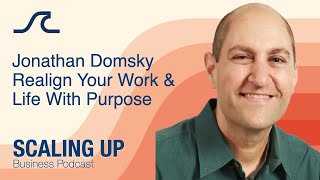
Jonathan Domsky left Kidorable, the company he co-founded, in 2020 to become a full-time coach. He works with clients to align their lives around core values using daily meditation, a framework of ease, meaning, and happiness, and practical tests to uncover hidden beliefs holding them back.
Questions this video answers
January 31, 2020.
untangledcoaching.com.
1994.
Over 3,000 books.
Chapters
Foreign.
Oh, it's funny how we don't really leave our personal life at home when we go to work and we don't leave our work life home at, at work, we go back home again. It's always us in the middle of all of it and all of the things that we deal with. So, so you go to work on your business, you put in tools and frameworks, then there's also you to deal with. And that is a lot of what we're talking about today. Hey everybody, my name is Bill Gallagher, Scaly coach, host of the Scaling Up Business podcast. We bring our show to you every week with something to do with growing your business and the leadership challenges along the way. So all of the things of course with people, strategy, execution and cash, but also you, the person in the mirror, the person between your ears who's dealing with and set up a business in life the way that you've set it up. So that's the easiest place to work on. It's certainly the subject of our conversation today. So these shows and more, hundreds of them now@scalingcoach.com so you'll find all that scalingcoach.com or wherever you're getting this right now is if you're on YouTube, if you're on Apple podcasts, if you're on Stitcher, if you're on Facebook, LinkedIn Live, like whatever it is, that's where we can get it. But if you want to find all the regular shows, go to scalycoach.com all right, I want to introduce now Jonathan Domsky. So Jonathan has been around an organization that I've been around for 23 years now, EO y e organization and as a younger person with maybe more hair, Jonathan started a company, Kiddorable, and he grew that business and now he's a full time coach and he really has evolved and become a coach over time. He's going to share the story not only of why he became a coach and what it is that he cares about, how he works, but he'll give some examples of some of the company's, the people that he's worked with in those stories. So, Jonathan, welcome to the show.
There's nowhere else I'd rather be here than with you, Bill. It's a pleasure to be here.
Well, thanks for joining us and so many of our mutual friends have talked about your coaching and we've spoken a little bit about it before, but I, but I'm looking forward to sharing some of the examples. I think they're really great. What we did as preparing for the show here. So what, why don't you start us off with like how did you become an entrepreneur? How did you start the Kidorable company? What did you learn about yourself in the process that led you to this place?
Yeah, I was very much an accidental entrepreneur when I was growing up. I had no experience with business. 100% of my parents friends were professionals. I was a junior in college before I knew that there were a million things to do in the world and that being a doctor and lawyer were only two of them. But the week that I graduated from college in 1994, I was on a plane with a one way ticket to China. Bill I was expecting to have an adventure and I did. I was expecting to perfect my Chinese. That happened too. I was not expecting that three weeks in I would meet the woman who's now my wife and that we'd be engaged seven months later. But that's what happened. I spent a year and a half in China and when I came back to Chicago, when she came to the US for the first time, we were used to spending all of our time together like 23 and a half plus hours a day. And we wanted to keep doing it, we liked it, we wanted to be able to go back to China. And it seemed like it'd be really hard to do that if we both had nine to five jobs and two weeks of vacation a year. So we decided that we needed to become entrepreneurs. I'm a learner. I've read over 3,000 books. I would talk to anyone who had anything to teach me, who was willing to talk to me. And we, we started this business together simply so that we could spend time together. My, my wife's background is she's an artist. She's a graduate of the China Academy of Fine Arts, China's foremost art institution. She started designing some products and I joined EO as soon as I was eligible. And EO taught me how to be an entrepreneur. And if you had asked me say 15 years ago, am I passionate about Cadorable, this business that I co founded when I was 24 years old, I would have told you yes. If you had asked me, does selling fun, practical, unique children's accessories make my heart sing? I'd have to say no, not really. I mean EO had taught me how to become an entrepreneur. I'd learned how to become an efficient administrator, an aspiring leader, all that stuff that we learned from scaling up and Vernon, all that stuff to run our businesses. But the highlight of my week was the 10 or so hours that I would spend in meetings. I love meetings. It's a little bit unusual, but I can be for hours with staff. Sometimes I'd see a look of desperation on their faces and adjourn early. But for me, meetings are where problems are solved. It's where I help people accomplish their goals. It's where they come in, just frustrated, confused. They leave with clarity and direction, inspired to do great work. And after a couple decades, you know, the business was pretty highly optimized. I was working from home a couple hours a day a of hours, couple into the office once a week for, you know, for a day of face to face meetings. And then it was a single day. January 31, 2020, right before anyone knew what Covid was. And it was a Friday afternoon like any other. I lived three and a half blocks from Lake Michigan. I took a walk up to the lake, up to Northwestern University campus to clear my head, process the week. It's a walk I've taken hundreds of times. But this day, as soon as the water came into view, I felt like the ground started to shift beneath my feet. It felt like I was riding an avalanche. And I just realized in that instant, I can't keep devoting my work life to things that don't light me up. So I was literally shaken. I was a little unsteady on my feet. I needed to sit down for a few minutes. But when I came to my senses, I just took a long walk, cleared my head, came back, talked to my wife. She'd been on her own parallel journey the last few years, wanting to take more. And we came up with a plan right there for her to take over as president and for me to exit the company and become a full time coach. And Bill, it is the best decision I've ever made in my life. There is such a vast gulf between doing what you're merely really good at and really enjoy versus what you were born for.
Hang on a second for. Because that's a. Just a curious. I don't know what it. Do you have any idea what it was on that walk that had you have that inside at that moment? Do you have any notion of what the stimulus was or what you saw that where that thought came from?
Sure. Well, it's impossible to create an avalanche, but you can, you can create the context. You could create the circumstances that make an avalanche more likely to happen. I have always loved learning. I've always been great at teaching. The world's always needed entrepreneurs who have clarity on who they are and where they're going and how to get there. And maybe six years ago, at an EO retreat, I actually, you know, presented to my EO forum and said, you know, maybe I should become a coach. This is, you know, something I think I'd be good at. It's something that I think I'd really enjoy. And everyone was supportive. And I had this magical thinking idea that I would just put it out into the world, and then all of a sudden, clients would magically knock on my door. But I didn't actually take any action beyond that, beyond that forum meeting. And nobody, nobody knocked on my door, Bill. So another four years passed, and why was it that day and not six months earlier, not six months later? I can't tell you that, but I can tell you I was ready to take action. You know, I believe that life is a curriculum perfectly designed for us to work out our purpose. And all we need to do is just look at what's building.
It was building there. And then just in that walk, something came to you. But you didn't see a bird move in some particular way.
And it wasn't anything that happened, happened that day or that week. It was really a Friday afternoon like any other. But it had been something that had been building for a while. I've been looking for something else, some other way to express my entrepreneurial energies. And it was that moment when it all clicked and came together.
Came together. Interesting. So you were talking about then moving into something that you love, right? You decided this, you made that change, and you began to do the work of being. So talk about that.
So I knew that I would be a great coach. This is, again, work that I was born for. But I didn't know anything about the business of coaching. So I reached out to my four mates, I think, fellow friend of yours as well, Mike Maddock. And I said, mike, how do I do this? How do I start? How do I start a coaching business? If people knock on my door, I know I could do a great job, but no one's knocking. And Mike helped me, you know, with my positioning. And I spent that first month just alone in my office looking through my bookshelf, looking through all of my notes from all these learning programs that I've done, and just deciding what kind of coach do I want to be. And like I shared a minute ago, life is a curriculum perfectly designed for us to work out our purpose. So I said, well, you know, I. I need to start just taking action. And I'm a big believer in painting a picture, making a vision. Of where you want to go in life. That's a great way to get there faster. And early on, I made this declaration to myself. I said, I declare the possibility that this is the kind of coach that I want to be. I declare the possibility that I radiate a palpable wisdom, compassion, and all embracing acceptance to people just the way they are so they feel safe enough to approach me, engage, and do the work that I untangle, the clutter obscuring their best, most authentic self, so they see a clear path to become who they most want to be. That's the kind of coach I wanted to become. It was not the kind of coach that I was at that moment. So I had some work to do. That's a curriculum perfectly designed to work, to work out my purpose. You know, I knew that I could be compassionate, for example, for people who I know and I love and, you know, who I've spent 20 years with, but not strangers, not, you know, new people who I'd be working with. So how do I do that? How do I become more compassionate? So I did what I do. I. I read a dozen books. I talked to some compassionate people that I know, and I wound up finding this Buddhist compassion meditation. Every morning before I open my eyes, I. I meditate. I get in a relaxed, receptive state, and I think of everybody I'm going to see that day. I did it for you this morning, Bill. And I'll breathe in Bill Gallagher. And I'll breathe out love, compassion, and acceptance. If I know that you're dealing with something, if I know you're resentful, it's opposite. I'll breathe out loving acceptance. If I know that you're anxious, I'll breathe out its opposite. Calm presence. My heart's grown three sizes since I started doing this, Bill. It's. It's. It's amazing. Just by breathing out compassion towards everyone I meet in the day makes that happen naturally. I knew if I wanted to. If I wanted to radiate a palpable wisdom, I couldn't just have my bag of tricks. I couldn't just have all these hundreds of tools and frames and stuff that I've collected over the years, I needed a comprehensive coaching framework. A way that someone could bring a problem, a challenge, something that they're frustrated with to me, and I could put it in a framework that immediately makes sense and that I could help them live the kind of lives that they want. And again, I read a dozen books, and I looked at all my notes, and I thought about everything that I've done over the last 20 years. And I realized there's three measures of success in living your life. All the things that we try to achieve, like growing our businesses and with family and all that, that's all great, but at the end of the day, there's really three measures of success in living your life. The first is, is life easier now than it used to be? You know, life has its ups and downs. Reversal of fortune, loss of loved ones, poor health. That's inevitable. But are you better at navigating life's ups and downs now than you were a year ago? The second measure of our success in living our lives is are you in a path that fills you with more meaning now than you were a year ago in all aspects of your life? And then lastly, are you happier now than when you were a year ago? Are you happier now than when you were 5 years old? And tragically, for most of us, the answer is no. We've had 50 years, you and me, Bill, figuring out what makes us happy. We should be pretty darn good at it by now. But no one teaches us how to do this stuff in school. No one teaches us how to do it in the.
You probably know, the rosebud moment, right? In Citizen Kane on the deathbed. And I think that when you talk about, was I happier at 5? I think there's a kind of a childhood happiness that we could think of. I can think of a particular place. I could think of the warm asphalt on the driveway that extended into my grandmother's backyard, and laying there in my swim shorts with the water flowing around me on a sunny day in Los Angeles, and I think of a moment like that Rosebud, right? Like, it's that house. It's. It's the grandparents that were all accepting and all loving.
Right.
Like, there is a piece of bliss there. Right. But unlike maybe Citizen Kane, I realize that that isn't lost to me, but that is always with me.
Yeah. You know, it's a beautiful image, and we all have access to that. The problem for most of us, though, is we don't know who we are. You know, we go through life accumulating stuff, trying to accomplish things without ever taking the time to ask, like, why are we doing this stuff in the first place?
Does it make me happy? Right.
Yeah. And there's just some simple, very easy tools and practices that to do that, you know, there's basically five reasons why entrepreneurs who are working so hard don't have the life and business that they're looking for. Most people think it's. And the reason why people, you know, go to, you know, Rockefeller Habits workshops and listen to podcasts like this one is, you know, most people think, you know, if I only have one takeaway that I could improve my life or business that'll be more worthwhile. I just need to learn another tool. I need to learn another, you know, more stuff. I'll just figure something out to grow my business. And that kind of knowledge is essential. I mean, it's impossible to be successful if you don't have expertise in whatever your field is. But what's more common is people don't know who they are. They don't know what their core values are. They don't know what their why is their purpose. And if you don't know what your core values are, and if you don't know what your purpose is, it's impossible to be fully aligned with them. So what does that look like at the end of the day? Sure, maybe we have conventional success, but you have to relax with a drink or two after work or maybe just plop down in front of the TV for three hours because it's a slog, it's a grind, it's not aligned with who you are. Work that is aligned with your purpose is naturally energizing, it's joyful, it's seemingly effortless. But if things seem hard, if we're just trying to get through our days, it's a symptom that we're out of alignment with who we are. So the first step is just, is going through the process, taking the time to learn, what are your core values? What's your purpose? End of the exercise. Check. Got my purpose. I even printed it out. I put it next to my computer. But if that's all it is, then it was just a warm bath of self knowledge and exploration. We all love the rubber ducky of awareness, but so what if you just do the exercise and put it to the side? It doesn't do any good. We need a process to become aligned with our core values and purpose in our businesses. For those who follow scaling up. At the beginning of each strategic quarterly meeting, we start by reciting our core values and our company purpose. And we ask, you know, are we in alignment? Is there anything we need to do as a, you know, quarterly goal to, you know, to improve our culture? It's the same exact process for, you know, for us as individuals. State your purpose, state your values one at a time and ask yourself, can I think of specific examples since the last time I Did this where I fully lived this value? What were times when I fell short? Is there. Did I have the opportunity to live this value, but I chose not to, or I didn't even realize it was there until it was too late? What do I want to keep doing what I want to do differently? And look at your calendar, look at your expenditures. How do you spend your time and money? Do they reflect commitment to this value, or do they reflect commitment to something else? And if we do that on a regular basis, that's how we become who we are meant to be.
Let's talk about some of the examples that you've got, some of the stories, the people that you've worked with. You first shared about Daniel. Yeah, tell us about Daniel.
Yeah, so Daniel is an entrepreneur who I've been working with for a couple years. He'd reached a certain level of success, but, you know, he was constantly searching, searching for new ways to improve the technical side of his business, new ways to, you know, to grow. And all that learning did help. You know, it helped him grow sales a little bit. It helped him improve the quality of his product, but it really resulted more in complexity and increased costs than an increase in profit. And he was, you know, he's working long hours. It just wasn't satisfying. He lost his passion for his business. He was burnt out. And he was one of these people who just had to sit in front of a gaming console for hours to relax after work because it was a slog. It was draining. He didn't know who he was anymore. He was rudderless. So I helped him identify his core values. I helped him identify his why, bringing him into alignment so that his purpose is driving his work, so that he was naturally motivated. If I could get metaphysical with you for a minute, Bill, you know, for any of, you know, for any of the listeners who have, you know, familiar at all with Buddhism or Eastern philosophy, you know, there's this concept of non attachment that, you know, we shouldn't be attached to things, desires, the enemy, all that sort of stuff. And that's an impossible goal. You know, maybe there's a. Maybe there's a monk somewhere who's able to get rid of all their desires. But I certainly never met anyone like that. Bill, do you play any sports?
I do a lot of outdoor sports, yeah.
Name one.
Surfing.
Surfing, sailing. Anything with the ball just makes for an easier example. I play no ball sports. All right, well, let's take surfing as an example. So if you surf, and this is a little bit outside my wheelhouse, so you know, forgive me if I get some of the vocabulary wrong, but if you search, if you surface and you don't care if you catch a wave, and if you don't care if you're able to stay up on the surfboard or not, it's kind of a dumb sport. Like, why would you do that if you didn't want to be successful at it? Desire makes life worth living. A game is only worth playing if we care about how we're doing and we want to improve. Now, where non attachment kicks in is, you know, as soon as you do fall, then, you know, it's over. You know, there's no, you know, there's nothing to be upset about. Just, you know, use the amazing power of your senses and your logical brain to gather feedback and improve for next time. But just be in the moment. Enjoy surfing, try as hard as you can and, you know, don't worry about too much about, you know, any individual results. Desire is what makes life worth living. But there's two kinds of desire. There's desire that's grasping, like, I want, I want more money, I want more power, I want more respect, I want more sex, I want more whatever it is, I want more stuff. And desire that's grasping, it brings out the worst in us. It's not satisfying. You know, your award for achieving whatever your goal is is that you enjoy it for 15 minutes. And if you've gone through a long slog to achieve that goal, really doesn't seem that worth. It does separates us from other people. It makes us look at other people as objects, either obstacles who are in our way or vehicles to get what we want. If they can't help us or hurt us, it makes us look at them as irrelevancies. In contrast, desire that flows from your purpose is it brings out the best in you. It connects you to everyone else. And all of that work, all of that effort, it's seemingly effortless. It's naturally energizing and joyous. And in Daniel's case, as soon as he connected to his purpose, he knew exactly what he was supposed to do. Life is a curriculum perfectly designed for us to learn to work out our purpose. He stopped doing all the other stuff, improving the technical things, all these things that, sure, they were important, but it didn't really drive the business. He did what was in his heart, and now he could work a full day. He's making tremendous progress with his business. And it all started with that natural energy and joy and meaning that comes from doing work. That is, that flows from our purpose. Does that make sense?
Yeah, I think so. And I think the surfing analogy is interesting. Like, business for me is a game to play, not for everyone, right? A lot of times it's. It's survival, proving something, fixing something. But if it's a grand game that we. We, like, take on freely now, it's a game with big stakes consequences like our. Our financial security, our house, things like that, like, our stress is all tied in with that whole thing. So it has big stakes. But if we're playful with it, like, it's interesting. All parts of it, like, oh, we're on an upswing. Oh, we're in a challenge now. We embrace all of it, and we have our emotional responses, but we set them aside. I think the same thing true with the surfing, it's like, okay, so you want to catch that perfect wave. You want to get tubed, you want to have that glassy day that you're out, just carving, connected, responding to the wave. But that's like a brief moment of the hours that you spend at surfing, right? There's other times when you're just bobbing around. There's times when there's too many people. There's times where you're not catching it right, you're just off. Or you get up and you fall all the time. Like, you're. Everything's just off, right? But there's something about, like, enjoying the whole thing, like, all aspects of it, like sitting out there, paddling out there, getting ready, like, embracing all the little parts of it. Same thing's true with, like. Like, do you like. Do you like catching fish? Or do you like fishing? Right? Like, if. If all you wanted was the fish, just go to the. The fishmonger, go to the store and get your fish, right?
Here's the. You know, here's the thing. And this was certainly true in Daniel's example. If you don't know why you're doing what you're doing, if you're not aligned with who you are, your core values and your purpose, you know, for the. You know, for the surfing example, you know, it's really frustrating if you don't catch a wave, if you're just falling all the time, and we give up or we do other things, or we do what's easy and we don't have that kind of sustainable success, you know, In Daniel's example, he had severe anxiety. It was really hard for him to develop new relationships. But once he was clear on why he was doing what he's doing, once it actually meant Something well, then he had the fortitude to develop, to step out of his shell and develop those relationships anyway, because it was who he was, it was what they. It was what he was born to do, is what he needed to do. And things that seemed impossible before, now that it seems so hard, and a lot of things that, you know, where he just had modest success before, all of a sudden, with all these new relationships, all this new energy, he was able to succeed. It's only after getting clarity and who he is and where he wanted to go that it made sense even to even decide which skills he needed to get there.
I noticed for me, when I figured out what my life purpose was, my work started to shift and went through several years of shifting and I suppose is continuing to shift and evolve the way that I worked. The kinds of things now, I still had the same strengths, I still had a lot of the same interests. I still had a lot of the same things I enjoyed. But the purpose combined it differently and shifted the whole emphasis into areas that I did not expect.
Right.
And the satisfaction went way up with. With the purpose in. But. But I also think it takes some time because before then, there's just relating to you, yourself and other people are relating to you as, like a stereotype or as, you know, some set of good and bad habits. Things that you can do for me or not. Like there's a difference. When the purpose is at play, it takes a while for people to notice and for you to notice. Oh, yeah, that's who I am.
Yeah. Well, so, you know, you said it takes a while for people to notice when you suddenly make a change. The people who know your. Who know you best say, bill, what's wrong? You're acting weird. Even. Even if it's a positive change. One of the great things about. Yeah. One of the great things about EO is that we only meet once a month. We only meet once a month. These are peers. These are people who don't need anything from us. They're just here to support us. It's the best place to experiment, to try new things and to get a little confidence so that when you do bring it to your office, when you do bring it home, you already have that validation that this is something that's something that's good, that could work. But, yeah, it's very easy to be discouraged, even if it's a very positive change.
Yeah. So for me, the challenge wasn't. And my coach and teacher at the time was a guy who's now head of learning at the Gallup organization. And he's like, you know, like, no, you could, you could, you could, you could work on this with anything that's fun for you. And I just was like, wait, my fun and the purpose are like at odds with each other? And that was the most mind blowing thing for me, the notion that my fun, my play and purpose could be intertwined with my work too. That all of those could, could be connected. That, that was like, odd. So I like took it as a challenge and I thought I was going to get shut down. But my first like work in this realm was to take kids flying. So I created a project to take flying because one of the most selfish things I did at the time was fly small airplanes, right? And so, and my purpose was making a difference, living a life of contribution. And so I began and I got other pilots to go and we took kids flying and I mostly organized and led it, but I also did so myself. And, and then over the course of it, we took a thousand kids up for flights and, and I was on the news hundreds of times and people started to relate to me differently, right? Like the guy's in fixing my copier and I walk in the door, he's like, he'd seen me on tv, he's like, ah, you're that guy, right? And now I just wasn't some CEO of a company. I was the guy who took kids flying, right? I had become for him a generous person.
You know, that story that you share about, you know, you have your purpose, but then what do you do with it and how do you align it with your personal life and your business and all this other stuff, there's a big misunderstanding about purpose. You know, for, for those of us who are fans of, of Simon Sinek, and I'm certainly one of them, you know, he tells about the golden circle that on the outside is your what? And Simon says, well, no one really cares about your what. You know, it's but one level. Then is your how you know, your core values unique. Selling propositions, stuff like that, that's, that's a little bit better. And then in the center is your why, the real reason why you do things. And that's what, you know, tracks everyone to, you know, creates long term customers and employees and all that sort of stuff. He tells a story, probably getting some of the details wrong, but about La Marzocco, it's a high end Italian coffee machine maker and apparently their why is something like to bring people together for great conversation. Now, it doesn't have anything to do with coffee. Now, if you. If your why is also like, I love bringing people together for great conversation, and your core values are aligned with theirs. Working for this company might be the best job that you ever had. But if you hate coffee, if you think coffee is just bitter and disgusting, don't work for a coffee company.
For you connect it to something.
Yeah, I mean, sweet, buttery goodness is where it's at. You love cake and cookies. I mean, work for a bakery. Your why and your how, your. Your purpose, your. Your core values, they point a finger in the direction of your purpose. But for a human being, your life is the what. Your life is what you're actually doing. The first step is to be really clear on your why and on your core values. But it could take some experimentation to find out, like, what is it that actually I should be doing? One of my favorite exercises to do with clients. You know, we started off by saying just, okay, like, I did the purpose exercise. Check, you know, cross that off my list. I don't have to look at my purpose anymore. That's just a waste of time. The first step is to figure out your purpose in core values. The second step is to walk your talk and be in alignment with it. The third, and this is really my favorite. How could it be more so? What are all of the manifestations of this? One of my clients? The third.
Say that again. What's the third?
The third step is to ask, how could it be more so? What are all the manifestations of my purpose? What are the manifestations of my core values in their fullest sense? One client that I work with, his why. Is to use his resources to create memorable experiences for the people he cares about. And, you know, he's a retired entrepreneur. He sold his, you know, good for him. Sold his business for a lot of money. This is his new thing. I mean, this has always been how he's shown up, you know, work at home with his family. But, I mean, he's. He's dedicating his life just to creating these amazing spaces, this amazing experiences for his different groups of friends. I went through this exercise, and I said, well, you know, looking at all the different aspects of your life, how could you create. How could you use your resources to create memorable experiences for the people that you care about? And in his philanthropy, he's on the board of a local hospital, and they, you know, help provide health care to, you know, people who are too rich for Medicaid, too poor to, you know, get insurance, to get their own insurance. It's very Worthy work. But he's always complaining about it. It's not a fun. It's not a fun board position. He's like, they want my money. And it's just not a really satisfying experience. But it's a worthy cause and he wanted to do it. And in going through this exercise, he thought, why am I on the board of this hospital? I should be doing Make a Wish. I'm about using my resources to create memorable experiences. It's in this healthcare space. It's a great, you know, it's a great cause. But why don't I direct my philanthropy towards creating memorable experiences for people? Now, I'm not saying Make a Wish is more important or more worthy than, you know, what he's doing now, but for him, for someone who's motivated by creating memorable experiences, it's such a better fit. And it's so. He's going to be so much more impactful because instead of dreading a board meeting, he's really looking forward to it, giving it his all. And we can do that in all aspects of our lives and businesses.
You know, I love that. And I think, like, the expression of purpose shows up. Like, my business purpose is really tied to my life purpose, but I notice there's an expression of purpose in any realm. So around my family, it shows up in another way. In any given situation, it shows up. And every now and then, there's something where it's really challenged and I have to, like, do a little work to think about what is my purpose in this moment, in this situation. I, you know, like, making a difference and contributing is. Is really important to me. And when my dad went through a decline, I didn't want to work on that because I was the kid and he was the dad. And I, like, some, like, it was really hard for me to, like, try and, like, fix him. Right. You probably can't fix people going through that kind of profound thing. But so I'm like, what? Like, I want to engage this, but how do I engage this consistent with my purpose? And what I came up with was providing leadership for our family. And my job with my dad was to love and accept it.
Yeah.
And that was the difference to make, right?
Yeah.
And even though he died tragically, you know, I know that he passed knowing I loved him.
Yeah, I love what you did. It was perfect. There. We have. We have the same. Why when we're at home, when we're at work, when we're everywhere else. But it has different applications that have different. Has different manifestations. And as Entrepreneurs. Our company wide may, you know, is probably going to be slightly different than our personal why, but you know, we make our companies in our own image and our. Whether you articulate it or not, your, your why radiates from you like body heat. Right? It's, you know, it's this, this is, this is who we are. I'll. A few weeks ago, I have a 13 year old son. A few weeks ago, he comes storming into the house. He had had a fight with his friends. Words were, you know, words were exchanged, beautiful afternoon ruined. And you know, I do what I do, I calm him down and you know, make him feel seen and heard and you know, help him decide how he wants to respond, help him come up with some language, all that sort of stuff. Half hour later he's all calmed down and you know, feeling really good and he says, thanks, that was really great. And I said like, thank me, thank you. I live for this stuff. This was the highlight of my day. Like, what part of untangling the clutter so that didn't you understand? I mean, this is who I am. I don't turn this off when I come to work. But the application of it is different. There's another concept which is also situational and changes over time, which is what's the size of your purpose? Now your purpose can't just be you. You know, even if it's, you know, the, the growing of your bank account, the perfection of your beauty, health, even your, your spiritual, you know, perfection that's inevitably a prison. You're never going to measure up to it. Your purpose needs to be bigger than yourself. But is it just you and your family? Is it just you and your company? Is it your community? Is it your country? Is it the entire world? These are things that, that change over time. Your purpose is the intersection of how you feel compelled to show up and contribute to the world. With the way that you feel the world should be and the needs of the world, the way you feel the world should be. Those change over time. So, you know, when you're in a family crisis, your purpose might shrink just to be, you know, for you and your dad or for, you know, leading your family through this, through that crisis. In other areas of your life, it may be more expansive.
Yeah, you know, I noticed that the purpose is not really personal. It's not really about you, your survival. It's something that you aspire to, that calls to you, that's that, that you feel deeply compelled to fulfill. And it, and whether it's around beauty or Truth or contribution or whatever. It's much, much bigger than you. It's, it's a kind of a universal thing that you hunger for.
Yeah. As humans, we just have this need to be of service, to contribute. And we're most happy. We find lives that are most meaningful when we're part of something that's bigger than ourselves.
So let's, let's tell another story. Talk to us about Phyllis, because I think that's a really interesting one about where something's at odds with something else in your life.
Yeah. So I'll tell you, there's five reasons why entrepreneurs who work so hard don't live the lives and have the businesses that they want. And the first is they don't know who they are. The second, they don't know their core values or purpose. The second is they don't know where they're going. They don't have a clear magnetic vision that pulls them towards. The third is they don't have the practical skills. That's what most people think that they need when they join EO and organizations like that. And then if they know who they are, if they know where they're going, if they know how to get there and they're still not making progress, then there's an obstacle, there's something in the way and obstacles are in front of us. Those are usually fairly straightforward to deal with. But the ones that are most interesting to me and the ones that trip the people up the most, frankly, are the ones that are between our years. You know, Phyllis is a serial entrepreneur. She had reached a certain level of success. She had about 15 employees and her business was driving her nuts. She was working 15, 16 hour days. She had created this prison where nothing could happen without her micro involvement. And when she came, when she came to me, she was looking for a traditional business coach. Someone who could tell her like this, like, what am I doing wrong? Like how do I scale my business? How do I, and how do I scale it so I'm not, you know, killing myself? So we, you know, I gave her the standard prescription. You know, we started with, you know, we started with daily huddles. We, you know, did quarterly change, planning meetings, all this basic stuff to help her improve her business. And it seemed to have good effect. In the first couple months that we worked together, she was making progress, but it always seemed like it was it forward, one step back, like all these things kept happening that were getting in her way. So that's a red flag for anyone who has a problem challenge that they've been working on sometimes for years, and they just can't seem to get it. Especially if all the people around you say, bill, why don't you just do the whatever? And you say, well, no, I mean, it's so much more complicated than that, Jonathan. Like, I couldn't possibly do that. That's a big red flag that the problem is not out there. The problem's in here. So I let her through this exercise called revealing your competing commitments. And we started by asking, what are you committed to? And in Phyllis's case, she was committed to scaling her business without her micro involvement. Like, okay, great. What are all the things that you do that sabotage that? What are all the actual behaviors that you engage in that are at cross purposes with your conscious commitment? And it wasn't hard to. To come up with a list. She didn't like it when someone, you know, chose a new color for, you know, or whatever, so she would just wind up doing it herself. It was just easier to do it herself than to depend on her team. She didn't pay a market wage, so she attracted all these people who frankly weren't, you know, they weren't good fits for her job. She worked all these crazy hours. She did all these things that were in the way of her scaling the business without her. And now no one chooses to do these things. She didn't want to do these things. And the next step in the exercise then is to ask, but someone who does do these things, what else might they be committed to? What is a hidden subconscious commitment that makes all those sabotaging behaviors seem perfectly reasonable? Our subconscious minds aren't, you know, they don't have. Our subconscious minds don't have words and logic and all that sort of stuff, but they make perfect sense. And in Phyllis's case, she realized that she was committed to not depending on anyone. Okay, makes perfect sense. If you're committed to not depending on anyone, then you don't depend on people. But we asked why someone who has that competing commitment to not depend on anyone, what might they believe? What's something that they might believe about the world that would fuel that competing commitment? That would make it perfectly reasonable? Because no one wakes up in the morning saying, I don't want to depend on anyone. I want to work a 16 hour day and, you know, be exhausted. So, but why do we. What's fueling that? What's the self protective, vulnerable thing in ourselves that we're trying to hide? And in Phyllis's case, she realized that she is committed to not depending on Anyone, because if she does, Phyllis believed that they would let her down, betray her and she'd feel awful about herself. Now when she was 8 years old that was a perfectly reasonable, accurate worldview. But not for a 50, not for a 50 year old successful entrepreneur. It was just, it, it was, it served her when she was, as a self protective mechanism when she was a child, but certainly not now. But subconsciously she had held onto that. And it's not enough just to know, oh like that's silly, that's my eight year old self. You know, it's, these things aren't logical or our conscious minds are like an ant riding the elephant of our subconscious. The ant cannot ride the elephant and drive it in a certain direction through force of will. I mean maybe for an instant, you know, maybe through superhuman effort for a week or a month, but in no way that's sustainable. The most that the ant could do is say like hey elephant, look over there and hope that the, you know, the big W turns its head so it could see something. So once we knew that, that she believed, she didn't want to believe it, she didn't think it made sense. But at a deep place she believed that if she depends on other people, they're going to betray her, let her down and she's going to feel awful about herself. We did a safe test to show that elephant whether it was true or not. And sometimes as soon as you shine a light on these hidden beliefs, it just evaporates. And as soon as the belief is gone, it no longer fuels a competing commitment. As soon as you're no longer feeling the competing commitment, all those self sabotaging behaviors, they effortlessly melt away because there's no reason to do them, there's no reason to engage in them. But in this case I said, you know, just ask someone to do, ask someone at work, ask your assistant to do something really easy. It doesn't matter if they fail. Ask your husband to take out the garbage, do something, depend on other people in a safe test so that if it blows up in your face it's not going to matter. She did it and it turned out okay. And then she took some, you know, slightly riskier, riskier tests and things started to really improve in her business until about a month later she had this horrible day. We had a 3pm coaching call and she hadn't had time to eat she breakfast, she hadn't had time to pee. She was just angry. She's like, ah, these little people, they can't do anything. You know, she was Talking about her staff, angry with them. I calmed her down. I told her to eat something, go pee. Ten minutes later, let's come back, let's talk. I said, phyllis, are you committed to scaling your business without your micro involvement or are you committed to not depending on anyone? And she said, I'm committed to scaling my business. Great. You know what you need to do. And we came up with eight action items. Fire the incompetence. Start a progressive write up system to have some accountability in the organization. Be more clear, train. Do all these things that you need to do in the next two weeks. She did all of them. She had never had a more satisfying.
Just underscore. That's like you come up with a plan, people then go do all of them. That's not normal people. That's, that's awesome.
We, it was the same stuff we've been talking about for four months. Yeah. This time it stuck because there was no, there was no longer any reason for her to sabotage herself.
Right.
The next two weeks were the most satisfying she'd ever had as an entrepreneur and completely walked away from her business. Something that would have been possible when we first started working together.
Yeah, yeah, yeah.
And it wasn't because she learned a new thing or because she learned a new skill or she learned how to do, you know, daily huddles. Although that was certainly a part of it to have that structure to support her while she was gone. It was because there was this thing inside of her that was sabotaging, causing her to sabotage herself. So she, she had one foot on the brake while she was pushing ahead. And as soon as we got rid of that belief, there was nothing to fuel the competing commitment and she was able to move towards her dream as an entrepreneur.
Let me underscore a couple things in what you shared there for the listeners. The first, I think the biggest one is the personal growth and development begins with self awareness. Right. Who am I? Like, you know, you want to change your universe, it's your universe alone.
Right?
My universe is not the same as your universe is not the same. We all occupy a place and point in time and that unique perspective is ours alone. And so you want to change yours, you have to look in the mirror. Who are you and how are you interacting with the universe? Right. There's a key to something. And the second thing I think that was really great is when you notice that your results, when you're feeling stuck or whatever, consider that the commitment in action is different often than the commitment you verbalize. I'm really Committed to this. And then you go have a piece of cake, right? Or whatever it is that you like, your indulgence, your bad habit. You're like, whatever it is. And when you stop and you bring that first bit, the self awareness to it, you're like, oh, and why am I always going for the cake? You're like, oh, because. Because I'm kind of resigned to this and I'm just going to go for comfort and I'm, you know, committed to feeling good and like, so I'll. I have something then that's at odds. But now that I'm self aware and I notice those two things, I could start to grapple with the conflict and change up the whole thing. The other thing then that you said that I think was really great is like, all of these patterns, they go back to our childhood. They go back to those moments of strategies that we worked at to survive and the relationship that we had with our mom, our dad, our siblings, a few teachers, and other people in our life. We carry over, like, reverberations of those relationship patterns into everything. Not just the people we date and our friends, but also the people that work with us, around us, fund us, etc. Like, all of those relationships repeat ourselves and. But when you notice it and distinguish it, like the competing commitment, you now have a choice to not be limited to that one color on your palette, but to have more colors to use, a greater range. Oh, I did that because of that when I was 8 and my mom did that and. But I'm not 8 anymore. I could do something else.
Let me build on that. It certainly all starts with awareness. And if you don't know who you are, if you don't know, you know, this stuff, that it's hard to do any of this work well, maybe you'll be conventionally successful, but your heart won't be in it and it won't feel right. There's a couple more components, though. Again, if we do this exercise and, like, nailed it, you know, have my. I have my purpose, I have my core values, I'm done. It doesn't do any good. We need to have a process. We need to. So many people who I work with, they'll have some sort of challenge. And the strategy is to work harder. You know, the strategy is to have discipline, and working hard and being disciplined is great, but it's. It's not a sustainable strategy, and it's impossible to do. It's possible to do over time so much better. And this is the whole reason why scaling up Works is to have a simple process that takes the burden off of the leader. Years ago I was, I had a marriage accountability call with a friend of mine. We would talk every, every other week for just, for 15 minutes to just check in, you know, how are we showing up in our marriages? And I spend a few months a year, each year in China. And because of the time difference, you know, I wasn't going to get up at 2, 3 in the morning to, you know, have this call. We weren't able to, we weren't able to meet, but we were staying at my in laws and my wife and I really hadn't connected lately. And I saw this thing on my calendar that I had a marriage accountability call that I was supposed to be thinking about my marriage. Now we never had the call because of the time difference, but it brought me into awareness and it told me, you know, I don't like how things are going right now. And I took a long walk and I cleared my head and I thought, like, how do I want to show up? And I came back and we reconnected and my friend and I never even had the meeting. But just having it on the calendar was enough to bring me into awareness. The more that we could have rituals, the more we could have routines, the more we could have just a little bit of structure in place. It takes all the burden off of us so that we don't need the next is even if we do have complete clarity over what we want to do, we still need the energy to take action. And the best way I know how to do that is to create a vision. But there's two kinds of visions. There's positive visions and there's negative visions. You said use the eating cake example. Let's say that you want to lose some weight. Now A negative vision would be, I don't like what I look like in the mirror. My clothes are too tight. So that's where we are right now. And we have a vision that I'm going to lose 20 pounds. So I diet and I exercise, I do all those things and the more progress I make, you know, my clothes aren't so tight anymore. And this creative tension that we built from the. With a gap between where we are right now and where we want to go. It's like a rubber band that pulls us forward. But the more progress we make on a negative vision, you know, my clothes aren't so tight anymore. There's no longer any motivation to keep going. So we stop doing all those good habits when we go back to where we started. And that's why you see people, you know, starting to make progress and then going back. In contrast, a positive vision is like a magnet, but the magnet. The more progress you make, the closer you get to your goal, the more motivating it is. Taking that same example of losing weight, if your goal in losing weight is that you want to look great and have lots of energy, well, then the more weight you lose again, you do all the same things you do with the negative vision, but the more progress you make, I'm starting to look pretty darn good, and I get to feel that better. Then you're just more motivated to keep going. And that's what's sustainable, is over time.
Yeah. So we're. We're getting at our time limit. So I want to underscore a few things. If you want to find out more and get in touch with Jonathan and learn about his work and all that kind of thing, we'll put the link up here. It's Untangled D Coaching. Untangled coaching dot com. That's his website. And we'll put that in the show notes as well. So if you're listening, you. You can find that. So we've talked about a whole bunch of things here that I think are really useful for folks to take away and embrace. Right. So we talked a lot about having a purpose and having a vision for the future, something that inspires you. And that if you don't have what you want, if you're not getting that, the answer is the person in front of the mirror between your ears. Right. It's not out there. It's in here. Um, and that when you have a positive vision for something that you can go and. And like, change the. Put a dent in the universe, like make something, build something that inspires you, but it will require, like, consistent behavior and, like, rituals and habits and regular rhythm of that kind of thing. And with that positive vision in mind, though, you can deal with your negative thinking or positive thinking. Do you have a way of thinking that makes you happy, or do you have a way of thinking that makes you unhappy? And you have the opportunity to. To shift that and all of those things kind of. Right. Relating to each other. I. I loved having you on the show and this whole conversation, it's. It's just been a super pleasure. So thanks for joining us.
It was fun. Bill, thanks for having me on.
Yeah. Reminder to our listeners, if you want to drop us a line or get in touch or send a suggestion or anything like that, you'll send it to info scalingcoach.com Infocalingcoach.com is our email where you can find us and then all these shows and more. You can find them all@scalingcoach.com at our website where we have all that stuff. If we can help you connect with a coach like Jonathan or anybody else, please let us know. We're out to connect as many people with the resources they need to scale up in whatever. You know, it's usually around your business, but you and your business are not far separated, right? You are two sides of the same coin. So big thanks to Vern Harnish, author and creator of the Scaling Up Framework and the Rockefeller Habits that brings us together. That underlies the work is one of our core tools at Scaling Coach and to Wanda Mitchell who produces our show and the folks over at Podfly Productions who get our show ready and out and all the stuff done with it. Albert Burge, ANA Kodina, Tim McGowan, all those folks, everybody, thank you for watching, for listening. We'll see you again next time. Keep scaling up. Thanks. Bye bye now.










