Maximizing Business Value with Justin Goodbread
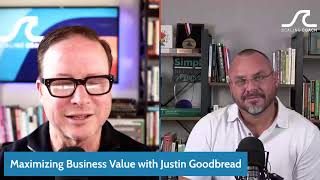
Justin Goodbread breaks down the eight value drivers that increase what your company is worth: planning, leadership, marketing, sales, people, operations, finance, and risk management. Owner dependence and customer concentration kill valuation. Founders who sell on an upswing and delegate before exit get the best deals.
Chapters
Foreign.
We're talking about increasing company value today. How do you get the value up? In practical, real terms, how do you get the value up? How do you set the stage for a great exit someday? So important for your peace of mind, for your legacy, for your financial future, your security, for your family. Getting company value up changes all kinds of things. And the fundamental things that you do to get that company value up are things that, like, maybe you know them at the surface, but what does it really take? We'll tell some stories today about increasing company value with our guest. Hey, everybody. I'm Bill Gallagher, scaling coach and host of this super fine Scaling up business podcast. Our show comes to you every week. We talk about all the things to get right with your strategy so you can get growing, how to dial in the team, attract and engage and retain the right people, execute flawlessly and optimize the cash flow to survive the journey and ultimately to get the value right. The subject of today's topic, 600 plus shows and more@scalingcoach.com or wherever you're getting this right now. You can go like, subscribe, turn on your notifications to get them every single week. And there's probably something as well in the back catalog. So you can go find all our other programs@scalingcoach.com or. Or I've got a special offer for you and absolutely free. No gimmicks, no bs, free coaching call. So time available. My assistant will book you for a short conversation with me where we'll dive into what your issues are and where you're at. I'll give you some free coaching. It's not a strategy session or some manipulation to some program. We got plenty of programs. You can ask for those if you want it. But I'll just give you some absolutely free advice. First one's free. Like your friendly neighborhood drug dealer, I'm here to help you grow your company. Always appropriate and reverent. That's me. All right, so I'm going to bring on our guest now. Our guest, Justin Goodbred. He's. He's a author of a couple of great books, your Baby's Ugly and the Ultimate Sale. Also, the host of the Justin Goodbridge show where he talks about financial strategies and growing your business profitably for ultimate company valuation. Justin, welcome to the show.
Hey, Bill. Glad to be here. I love the drug dealer analogy. That's awesome. You saw me over here chuckling as you said that.
First one's free, baby.
That's awesome, man. Glad you're here, brother.
Thanks for Having me, I'm here to corrupt the entrepreneurs of today.
That's awesome.
So we recently did 600 episodes. You're also pretty high up there. How have you managed to create and sustain a show for all that time?
I think it comes back to passion. I have to believe, especially here in your introduction, that you love what you do. You love impacting entrepreneurs. The same is true for me. You know, being an entrepreneur now for over 30 years, starting and selling seven companies from six to nine figures, it's just in us, right? We know, we know, and we want to bring people along and we want to help them, not make the same dumb mistakes that we've made. Right? I have to believe that's why you do your show. So for me, that's what the passion has been is being able to talk to the microphone, learning every day what business owners are facing, what entrepreneurs are facing, and then just trying to help them navigate this psychotic world that we live in these days, especially during the selection time, et cetera, as we're recording this, just trying to navigate this particular area. So that's what drives the Passion man so allows me to do almost 600 episodes like yourself.
We are recording this as the election is going on today. It'll be released in some weeks after a lot has come out. And we have no idea how all that's going to go yet. But here's the thing, right? Like, entrepreneurs are going to figure out how to survive and thrive no matter what happens in the world, right? There's a pandemic. Good. Pivot, pivot, pivot, pivot again. Find a way to stick around and, and move through it by creating value in the right. You do something that people need and want and, and, and you're rewarded with a business for that, right? Like do something valuable. Not trick people out of things, but, but create some actual value.
You know, that's what, that's what separates entrepreneurs, I think, from the others of the world. I had this, had this survey that I put on LinkedIn some time ago, and I think we have 10, 15, 20,000 people on LinkedIn. I don't even know who follows us there, but it was what makes a successful entrepreneur successful. That was the question. And I had a couple of basic answers. And what ended up being typed in more than anything else was the resilience and the able. The ability to pivot, right? We saw this during COVID Some of the entrepreneurs I saw that were ended up making millions literally during COVID were those that were able to pivot. I think of one Particular coaching client that I had back in the day, and this was a restaurant don't typically work in the restaurant business. In fact, today I spend most of my time dealing with the service industry, which is where my passion is. But this restaurant, you know, they were closed because of the necessity of the COVID virus and the closures and everything else. But what they had done because of their just in time inventory control and everything else they had in the place, they had overstocked by accident. Their, their stock room, so they had frozen meats and plates and everything you could think of that would need to run a restaurant. Little small rural town in Kansas. They pivoted and instead of opening the restaurant up, they actually started making takeout meals and delivering them to their, to their, the people in area. What that ended up doing is they ended up now becoming a supplier versus a restaurant. And because no one else was meeting that demand, they went around to other restaurants and purchased their plates and their silverware and their frozen food, and then developed an entire strategy, put some of their competition out of business, but yet ended up making more money, was able to feed their employees, was able to keep their community fed. All because an entrepreneur's mindset of pivoting during what ended up being a very devastating era for many business owners out there. So I think that's what makes us, regardless what's happening in the political world, the economic world, whatever it is, we have the tenacity to charge hell with the water pistols like what I say, you know, we see the goal, we know we're headed. You put a roadblock in front of us, we're going to go through it over and around underneath. We're going to get to our destination. But it's that same tenacity that, that ends up hurting us. Many times. We ended up being so bullheaded and so controlling that we ended up not focusing on the thing that matters most to us as business owners. So for me, Bill, this is devastating to me. You know, right now there's 32 million business owners in the United States roughly paying on which statistics you read. And out of those 32 million business owners, roughly about 80% of our net worth is our business. According to research from the Academies of Mergers and Acquisition Advisors, which is a big fancy company out there. But they're saying that roughly 80% of our net worth is our business. Well, out of. If 80% of our net worth is this highly liquid asset, most business owners don't focus on driving the value of that business. Yeah, we're tenacious and we're resilient. We'll charge hell with a water pistol. Throw Covid, throw an election, throw something at us. We're gonna get through it, but to our own detriment, because we don't take and look at our business is an asset that we should be grooming to make it transferable. And here's where it gets scary. What gets scary is, is that out of the roughly 11 million businesses that are going to try to sell in the next five years, that's the study of the roughly 11 million businesses are going to try to sell in the next five years, only 1 million of them will transact. In other words, they're going to actually move from the owner to whomever else buys it. The child, a competitor, a venture capital firm, whoever it is. Right out of that 1 million to transact, only 40,000 business owners, 4% will be happy with the price. So think about this. 11 million businesses are going to try to sell in the next five years, and only 40,000 business owners are going to be happy. That, to me, is the passion that I talking to the microphone, trying to raise this awareness for this tenacious group of people that want to ultimately charge you with a water pistol. That's sad to me, though, Bill.
You know, there's. There's a few things that I think in growing and enjoying the journey of growing your company that make a big difference. And one of the biggest, biggest ones is planning to sell. And I would say the vast majority of the people that I am in contact with that contact me, that I work with, are not planning to sell. They don't have any specific. They like, oh, maybe someday. Right. But there's no specific notion. Like, no, I just want to grow this thing. I want to run it, and I want to take it to the next level. And the problem with that, and I think it's one of the fundamental problems, because then what creates that. That compulsion to sell. Sell at some point is. Is one of two things. Either you run out of energy, like, emotionally, physically, you're too old now, right? And that's a really common inflection point. People hit 70 and now they want to sell. And. And that's one. Or it approaches, or they. They cross that line. So that's a big divider there. Like, they've been running the company. And then the other ones, they hit a crisis that they no longer have the stomach. You're really kind of screwed. Like, you could still sell the company potentially, but it's worth a lot less or worthless at that point.
Yeah, the way I think you've narrowed it down, the way I describe it is you're going to sell your business, you're going to. Well, let's say it this way, you're going to leave your business either you're going to die one day regardless, you're going to leave your business, it's not going to last forever. And you're going to leave your business either by desire or necessity, period. So, you know, we've been taught, for those of us who like to invest in real estate, we've been taught that location, location, location is what matters the most in real estate. We've heard, I've heard that since way back on the century. 21 guy that sold my mom and dad the house in the 80s. Location, location, location. When in business, it's all about timing, timing, timing. Always. The reality is, is that something is going to happen. Either a desire or necessity is going to push us in a position to where we want to exit our company. But the statistics say is that if 80% of our net worth is set up in our business and it's highly illiquid and it's not positioned properly, then what happens is because we don't think about that in game. And yes, we want to grow our businesses and we want to scale a business, we want to be profitable and all those things. And we'll talk to that. You end up building a business that's not transferable. And so whenever necessity comes, you now get pennies on the dollars or when desire comes, you find yourself, whenever you now don't have the desire to grow the business anymore, now having to do things which are so disruptive to what you've been doing the last 10, 15 years that you've now end up not making those radical changes that I need to make to position the company for sale. So for me, whenever you're looking at a business owner, where I shout from the mountaintops is get this. And it's a play on words. Play on words. So friends, if you're a business owner, it's going to sound funky, but I want you to hear me out. I have literally consulted thousands of business owners. Literally. I have seen many companies who are profitable but are not valuable. Many companies that are profitable but not valuable, I have yet to see. I've yet to see a company that is valuable, that's not profitable. Think about that plan works. So we as business owners, we focus on increasing our revenue. We want to scale to our mindset, especially those of us who watch social media or YouTube. We see people trying to tell us how to grow more revenue, how to grow more, more, more, more profit, more margin, more noi, whatever it is. The problem is they're looking at one side of the coin. The reality is there are two sides to a coin. The coin side that we should be focused on is let's grow the value of our company. What is your company worth today? What could it be worth if it was best in class? And what do you need to do to double the value of that company over the next three years? If you focus on value, profits are going to follow, revenue is going to follow, NOI is going to follow. And what you've done is you've positioned a company that now an investor or a child or key employee or whomever, strategic buyer, they're going to be looking at this company saying, oh my goodness, you have built this thing for me to actually pay you premium dollars for. And whenever you build it for the buyer, the ultimate client, as I call them in my books, the ultimate client, the person that pay you one day money for that company, when you build it for them, you're going to get everything you want, you're going to get the scaling you desire, you're going to get the revenue you desire, you're going to get the freedom that you desire as a business owner. All those things follow if you focus on value versus revenue. So Bill, I think we mess it up. I think we mess up because of ignorance, because of the media that we face today, because of get rich quick schemes in our generation today, all these various things and we focus on the wrong part of business and the statistics show it. It's crazy.
Yeah, you know, I think there's a lot of that pay me mentality like I'm just going to make some money, I'm going to bring in the paper and, and that I'm just going to hustle and grind and I'm going to. And there isn't a thought about like, let's create something of lasting value and let's design it to sell. Let's not plan to run this into the ground and into our retirement. Let's, let's build it, let's grow it, let's get out of it and let's move, let somebody else take it to the next level. Like let's move on with life and that kind of thing. And that makes for a whole. Changes the game entirely. Now let's. So let's share some of your stories. You gave a number of examples in preparation, we could talk about those or whatever Else comes to mind for you. I know you've got endless stories, but having client concentration, being focused on a particular product, not having your operations transferable. Take your pick. What are the Share one of the stories with us.
Yeah. So I'll start off with kind of my story so let you know where I'm coming from and we'll dive into whatever story when I want to go into. So I started my first business when I was 15 years old, sold it when I was 22. It was a grass cutting business, like so many entrepreneurs, right? Started doing stuff around the house and got my taste of business. And I sold my business for a sizable amount less than what it probably could have been sold for, but nonetheless sold it. Ended up selling three businesses before I realized that this game of business is about pursuing our passion. What I saw my own experience and what I see so many times with business owners is we are passionate until we get bored. Until we get bored. And then we start chasing shiny object and we do self. We self destruct in my own company. I can remember I was sitting in Chicago, William Booth School. I was taking an advanced certification and I had a client of mine, Bill, who lived in West Virginia. My client lives in West Virginia. We're on top of a mountaintop. You can almost see this in your mind's eye. It's a fall day. The mist of the Appalachians are kind of moving across the mountaintops. The leaves are golden, yellow. Sun's coming up. We're actually out there, look, fixing go deer hunting. And he looks at me in all sincerity, in his mid-50s, and he said, Justin, I'm broke now. He's 50 years old. He had been working for 30 years, second generation business owner. So he actually bought the business from his father, building just unbelievable business. I can't get too much in there. But he had millions of dollars worth of equipment sitting in his lot in his yard. You know, heavy equipment, various things. And he goes, justin, I'm broke. And I knew what he was saying, but I wanted him to fully unpack this pain that he was facing. I said, what do you mean you're broke? Look at that, look what's down there on your lot. He goes, no, if I sell that equipment, I got to pay recapture tax. And all I've got is, yeah, my house is paid for and I drive some fancy cars and I take these big fancy trips. But I can't support the lifestyle that I love. I can't save enough for my mid-50s. Now in order to bridge this gap, dude, I'm going to be working till I'm 80 in order to get enough money for me to bridge this gap. And I can remember sitting there and I said so and so, what do you want to do? And he said, I don't know, I'm tired. I spent 30 years of this game. I got millions of dollars but I can't make this happen. That same moment I'd already come to an epiphany of my own saying I can't build the business that I'm building right now unless I make radical changes. So Bill, I went back to Tennessee, I shut my own company down, relaunched the company, saying I'm going to start with a focus on value. And I took this client and he and I side by side did this journey together. We had other clients join us on this journey. For me, I took a company in the financial services industry, the most compliant ridden company, their industry there is. I mean it is hard to deal with that industry. And I took it from a startup position to an eight figure exit in 49 months following methodologies that we've been talking about. That client in West Virginia did the same thing. He took a step back and he said, you know what, I've got to do things different. So yes, he had a customer concentration issue. He would not be able to sell his company if he didn't diversify. I can remember way back I had this client of mine who is located in Virginia up there near D.C. area and they own a manufacturing company. They had one contract with the U.S. military, one contract with one branch of the U.S. military, the Marine Corps and the whole thing was to build sleeping bags. So they had one widget. Think about this concentration. One customer, one widget that was running a multi million dollar company. Nothing to sell. We totally, just like I did for my own company, we totally did for the client in West Virginia, we retooled the company and said, you what, we got to get away from this concentration issue. Another one that often happens that I've seen many times. You see it a lot in the professional services world like with dentists and chiropractors and doctors and various people that use their hands that have the knowledge level, maybe even the VC world where you have these, these investment people who have their knowledge level, they build their entire company around them and the business owner is at the epicenter of the business. I know people who run, who run landscape companies that they're at the epicenter. Everything has to go through them. Whenever you have these issues in your company, what ends up happening is as you built a business that provides good income, but it doesn't pay you ultimately what your company's worth. It's kind of like having a piece of rental property that you're collecting rents off of, and that rents are nice, but you can never sell the house. That's what happens for us business owners. So, yeah, we've got to take a step back and say, hey, the trajectory I'm on, am I able to continue to support my lifestyle with assets outside this company? If I can't save, sell it? And that's a hard question many people don't answer.
Let me challenge you a little bit. You don't have to change it. You could just run it. Like you run it at, right, like cash flow neutral. You're just barely making it. You do that until you get tired and then you step out. You could run it with concentration. We had one customer in a former company who was 60% of our revenue. And they knew that they were a big customer. They knew that they were probably our biggest customer, and they probably didn't know 60% that they were 60% of them. But anyway, we felt it keenly and we caved every time they squeezed us back. So we caved again and again. We often felt squeezed. We also had one primary factory for some years. So between our factory having the hold on all of our production and one of our customers having majority stuff, we were always in the middle. And it drove me effing crazy. And it wasn't until we got hit with a crisis, in this case the 2008 crisis, where it looked like the business was up, like we were going bust. And I pulled back and I'm like, no, we gotta change things. So after cutting costs and getting some room to breathe, we started to pivot. I started to get multiple factories. We went from a handful of stores to hundreds of other factory store partners. And we got ourselves out of that because I was tired of being squeezed. Like, if we're going to reinvent this business, I'm going to get myself out of it. We made other mistakes then in the next little phase, but that's a story for another day. But getting out of that concentration on. And you could. It doesn't have to be like, it could be one product, it could be a product group, it could be one or a few customers. It could be one factory, a few suppliers. No matter what it is, if you don't have any room to maneuver, if you don't have any choice, then you're kind of screwed. I certainly felt that. But you can support your family, raise your kids, get by, take some nice trips, you know, have a decent car like you can, you can have some nice things in life. You just won't necessarily have a retirement.
You won't have a retirement. I mean, statistically there's this thing called statistically you won't have a retirement. There's this thing called a wealth gap. And it's a calculation that I tell every business owner to calculate and that is this, what is your current net worth minus what net worth do you need in order to sustain your life and then subtract your business, your estimated business value out of it? Because if you're not building your business to sell, then you're not going to get that. And what happens is so many of us live through our business because our tax advisors tell us to and it helps us. And we pay for our cell phones and our cars and our trips and our kids and our everything out of our business that when we sit back and look at it, we don't realize how much money we're actually making. We know what our W2, our NOI says in our financial statement, but we normalize our lifestyle through our business. Bill, I've. I seldom see where a business owner has had the discipline of the decades to secure assets outside of their business, that is 401k retirement accounts, real estate, properties, whatever it may be that's going to provide them income. And so if you don't address this max, this major problem that, hey, I've got this business and it's affording me this dynamic lifestyle and if I don't build my business where it's going to sell, then you have one or two choices. Either build the assets out of your business where it can sustain your lifestyle and you better get a good financial planner and a tax advisor can help you through all that or either build the business. But if you just stay him, ha. Concentration risk will rock your world. Crisis are going to rock your world. Being lazy will rock your world. I had this statement this morning. I was talking to a very successful, very successful financial advisor who owns a business with literally almost 100 employees inside the business. And I said, hey, you find yourself stuck between a rock and a hard place. And he was dealing with some of these concerns that you and I have been talking about. I said, but your problem is, is that if you don't address the immediate pain, the long term pain doesn't go away. The long term pain is going to kick you in the teeth. Actually said something else in about six years from now in about seven years from now it's going to kick you. And unless you deal with the immediate pain you're delaying and that pain of the future is going to be devastating to you and your financial issue. And so we as business owners, the awareness that we're trying to raise is yes, you are successful in business, yes, you are making a good income, yes I get all that. Take a step back. What do you truly want? And Bill, now after 30 years of being a business owner and almost 15 coaching business owners, most of the time what I hear is Justin, I want freedom man. I want the ability to go on vacation without thinking about this business. I want the ability to fire a customer because I don't like them versus having to work with them. I want the ability to not be him hawed by my or hamstrung by my employees who basically they know if they quit I'm screwed. So I'm having to cater to them. I want to have the excitement that I've dreamt of as a business owner. And friends I can tell you if you find yourself saying those things then this is where by focusing on driving value you answer all those questions. You see there are eight carries of business and there are eight value drivers. And if you couple those eight areas of business, eight value drivers together then you can unlock all the frustrations you have. But it's work and it's hard. So for those of you like good bread, help me. Eight areas of business. Every business has these bill. Yours has them, mine has them, every company has them. You're planning where you headed, why are you going there. Leadership, how you working within your team members. Marketing, who you tell, how you tell your prospects about your service and product. Sales, how you converting them from lead to a client. People, your employees of your company. Operations, how it works. Finance, how the APA are accounts payable, accounts receivable, flow in and out. All those various things that come with CFO work and risk management eat areas of business. Every business has them. Whether you're a Solopreneur or large 500 company. But then each of those eight areas are affected by value drivers. One of the biggest value drivers that we as business owners and I could tell you night in fact I will tell you nightmare stories around this nightmare stories is one of the biggest value drivers is we are so tenacious as we were talking earlier and we're so daggum smart that we become our own worst enemies as a business owner because everything has to go through us. We end up being as I call it at the epicenter of our business. And we don't let go when reality is if we build the golden goose to where that company can operate and literally you can sit on the beach and have the business pay you a dividend. If you build that now, you have a highly transferable business that you don't want to sell, that you don't want to retire from. And you'll get unsolicited offers from people who are looking at this thing saying, I want what you built. Because no one builds the golden goose. It's easy to do if you understand the eight areas and the value drivers, one of them being owner dependence. So as I preach this from the stage, I talked to on the stage on a regular basis talking to business owners and as that there's this particular convention and there was a business owner who, who owned a multi state H Vac company. I call my peeps right blue collar people. I mean, the type of man, when you shake his hand, you feel the calluses on there. You know, if he gives you his word, he's going to stand behind it. I mean, my type of people, he comes up to me almost tears in his eyes. He said, good bread, I cannot breathe. So what do you mean you can't breathe? He goes, I, every day when I wake up, I know I'm gonna be fighting fires because my managers are incompetent. And he started just, just delineating the various things that so many of us heard. And I said, I called his aunt. I said, man, do you mind if I'm brutally honest with you for a second? He said, yes. You reap what you sow. Biblical principle. You reap what you sow. It happens. You're not gonna sow corn and get okra, dude. So what you've sown is decades of reaping that you're the epicenter. And if you want to have the freedom, if you want to have build value, if you want to have it to where this company is now a joy to operate, we got to get you out of the company. Which means we got to break every, we got to break a lot of stuff in order to get you out of the company. Bill, he went through a turmoil about six months vacillating, trying to fix it. He came back and he said, help. Two years later, he was out of the company. And then he's like, dude, I want.
To sell this company.
I don't want to sell it. I'm sitting here making dividend, man. I'm making bank and I'm not having to work, and I'm having fun. I'm able to walk in, and my team's like, get out of here. What are you doing? Because he was at. He recognized that the value driver being at the epicenter of your business was harming his ultimate desire, which was freedom. So for most business owners, it's freedom, man.
Well, I don't know how it lives for you, but I want to call out one other big thing right at that moment. And I tell people this all the time. Sell on the up. Don't try to sell top. Don't try to ride the whole thing out like, okay, it's going good now let's start selling it. Because, you know, it's only a matter of time before something stumbles, something happens, and you've got another problem and you got to bring it back up again or whatever. So if things are going good and you have a good future in front of you, that's actually a story. And people buy stories and they support their emotional decision about buying the story of your business with the facts of it. But the facts actually come later behind the story. It's an emotional decision like everything else. We see something, we like it, it feels good. So if you feel good about it, if things are going well, that's a time to start selling. Or we've all gone to or like, whatever. Right.
Well, you know, I'm sure you've experienced this. I know the listeners will experience this because I know the world we live in. We've all tried to go to the bank and borrow money, and they'll say no. And then when we don't need the money, they'll try to lend it to us. Why? Because they realize that, you know, that, I mean, it's just a crazy world. The same is true whenever you're going to sell the company. If you don't. If you don't have to sell the company, you actually are able to garner a premium for it. In my own world. So my story. So I'm building this company from the ground up. We're three years into it. I'm already best in class financial planner at that time. Top five. I was listed as five times in a row, top 100 financial advisor in the United States. Just having a blast, dude. Making bank, taking four months off a year. Everything I teach, I'm now living. And during COVID as we're helping clients deal with the PPP loans and Eidl loans and all these other crazy things we were dealing with at the time. My wife gets sick, Bill talking about you know, out of necessity, out of desire. My wife gets sick and we laid up in the hospital and honestly, she shouldn't be here. Today we had a miracle. She's healthy, thank God. But that time we're literally facing a life or just decision. And I'm in the hospital 16 weeks, she's laying up in the bed and this, this is grim. Sitting here as a dad of three, right? And I'm in my early 40s and I'm going, what's life about? I built this business and it's cranking out revenue and bank. And she makes a statement to me. She said, justin, what's another million dollars going to do for us? And it wasn't like a pounding of the chest. That's not who I am. It was a slap across the face. And I couldn't get that off my head. So I went to my coach, my scaling coach, and he said, so good bread. If you had unlimited time, unlimited resources, what would you do tomorrow that you're not doing today? That was his question, like, well, I don't have a limited time. I don't have unlimited resources, talents, whatever. But I would spend more time my family. Here I am thinking, my wife's going to die and I'm like, you know, I started thinking about like so many business owners out there. I spent decades burning the candle at both ends, missing kids events, trying to grow this business. And in that moment, I tell my coach, I'm like, I don't want to sell because I see what the business is doing. Business is phenomenal. We're growing 40% without me in the office. I'm making bank, I'm having time. He said, now you should sell. And I told him what I thought the company worth and he laughed. He said, dude, you're twice that right now. You built a machine and now that you don't have to sell, you'll be surprised at what it goes for. It went for a best in class figure. As I'm trying to internalize this, he makes this statement to me. Bill. He said, justin, you're an entrepreneur. Just imagine if you're in your mid-40s, early-50s, and you have time and money, what would you do different? Dude, that rocked my world. Bill, for me personally, you know, as the guy who coaches business owners who teach you how to build your business for sale. He said, justin, if you had time and money, what would you do different? He goes, I know you. You're going to do something that you're passionate about. So here I'm in this business and it's operating, I'm having fun. It's on a just trajectory that's out of this world. I get a best in class exit, by the way. I'm not alone. Most people who build companies for this, they get a best in class exit if they sell when they don't have to. And now you're now face back and you have resources and time and experience of 30 years to run a business, man. I'm having the time of my life, Bill. And so do so many other business owners I know who when they exit properly, they take care of their customers. Their customers, the thing they're concerned about. I don't want to hurt my customers or I don't want to hurt my team. When you exit properly. And now you put bank, you put money in your bank account, you have funds that you can rely on that you're not relying upon that job. Dude, I'm telling you, as a business owner, a business owner, you will find your passion and you'll be more motivated to charge hell with a water pistol to help those people that you truly desire to help, all while knowing you took care of your clients and your customers, your vendors, your employees, your community all simultaneously. Free friends. That's the dream. The business is an asset. It's not a legacy. Let me say it again, it's an asset. Your business is there to generate wealth. Statistically speaking, your kids don't want it. They've seen your stresses. Statistically speaking, your employees don't want it. So look at it as an asset like you would a stock or a piece of real estate. And know that it can create generational wealth for you and truly give you that freedom that you desired when you went into business to begin with. That's hard to say, Bill, but it's true.
Well, you said earlier that the business, you build a business around you, especially as a founder and even more so if you're like the doctor or dentist or CPA or something like that, you end up building this business practice around. You have support people and that kind of thing. My business is a lot like that today, but my old business wasn't. And it's not necessarily the technical things, right? Like, but you can't sell a business if you're central to the whole business. You can't step away from it. The value is greatly reduced because there's always this doubt about, well, if we pull Bill out of there, what is this thing going to come apart? And they very often do. So I had this and I already had planning, I had Leaders. I had dashboards, I had meeting rhythms, I had processes defined, I had operating systems. And, you know, I had all kinds of things in there. It still required me. And it wasn't until I saw something that it shifted it. And for me, the shift was. And I think for you probably have some similar stories to share. There's also a psychological shift that goes around. So you can have leaders who are accountable. You can have meetings, they can have KPIs, you can have dashboards and displays. You can do all these kinds of things. And you can still be central to business if you haven't changed the fundamental way that you interact with people. So for me, it happened. And when my wife and I looked at each other in 2009, early 2010, and we, I guess it was 2009, and we realized that we had made a promise to each other that when our kids are between 10 and 13, that we would take serious time off, we would take whole summers off, we would travel the world, we would live differently because those are magic years where they can remember it and they're still young enough that they don't hate you, right? That they are willing to do things with you. Like, there's a little window there in my mind anyway, 10, anyway, 10 to 13 arrives, we're like, oh, crap, we have to change things. We have to do some things differently. And yet that was also a time of crisis. So for me, I just, I was like, okay, I have all the systems, but I'm still got my hand in everything. I haven't passed the baton. So I just started asking people for about 10 months, what are you going to do when I'm not here next summer? What are you going to do when I'm not. How are you going to handle that when I'm not here to tell you what to do? And that, and variations in that question and keep remembering to train myself and them, train myself and them out of coming to me to solve every problem and every decision, like pushing that away took concerted effort for 10 months. And it took a real event, like, I'm going to Europe, right, with the kids. And. And in fact, I did, right? So we spent 10 months. I shifted the way they worked, the way I worked. We went to Italy. We ended up only being for a month. But going away for a whole month for, you know, a North American businessman is an extraordinary accomplishment. We can barely get away for a week, most of us, and we're not French or German or whatever, so it was a big deal. And I never went back to being the same kind of CEO. And I was able to exit that company eventually and that changed everything. But there's a psychological shift, so you got to put in the structures, you got to build the team around all those things you were talking about. But there's also something for you to do yourself with the way that you work with people.
Yeah, it's interesting the way that you approach that is the exact same thing that we teach our clients is you've got to take a month off. You've got to disconnect completely now, you know, because you've been through this. I know because I've been through this. That's painful to process. That first time you tell a client that whenever I'm talking to our coaching clients and I'll say, hey, look, next year or the Q2 of next year, you're going to take off the month of April. Yeah, like, what do you mean I'm going to take off? And all that fear comes in. It's like, what are you concerned about? And what that, what that exercise that you just outlined did for you is it shifted your gaze from internally in the company to externally is what it did. It put you in a framework. I'm putting words in your mouth, but I just, I know I've seen this too many times. It puts you to where the business wasn't your only baby as the business owner is for us. Our business is everything to us. We live it, we breathe it, we're up at night, we're writing thoughts out on the pad beside our bed or whatever it is. What that did for you is to say there may be an opportunity for me to take my family on a month long vacation. What would that be like is in there just one little ideation came into play. And then you, in your case, Bill, and mine in my case, and those business owners who are tenacious enough to do the hard work, that's what it took was hard work. The things that we don't want to deal with with those who are tenacious. I do the hard work. What that comes in is it says, oh my goodness, there is life outside of business. Oh my goodness, you mean that I can have list X now? You didn't say this, but I have to believe because of the preparation that you did over that year or so beforehand that your business did not suffer while you were gone that month. I'm assuming that your business did okay while you were gone.
Profit, cash, revenue, everything went up. People did their job, they were happy, they were free. I got a daily and Weekly update on my email and I have a little video clip of me dancing with an iPad in my hand on the. Or actually maybe I set it down on the boat, on our sailboat off the coast of Italy. So. So I'm off sailing for a week of out of that month with the family in Italy, around the little islands out of Naples, and there I am. And I'm like deliriously happy because I've got daily updates, my dashboard things are good. You can relax, Bill. And that's in a time of real growth for the company. Like it was truly. And look, it was great a business thing, but I also got a month with my family in Italy. Right. Like, that's like a magic thing that, like getting time with your family at that moment when they still want to be with you. It's amazing.
What's interesting and I didn't know your story, you and I didn't talk about that. So I appreciate you sharing that with me as a guest. But more importantly, friends, those of you who are listening, I want you to listen to the heart of Bill. Yeah, you hear him all the time. I know that. But from a coach, consultant guy who's been in those shoes, here's what's going on is in that moment and if you're willing to do the hard work, you can have this experience. It's so easy to say, it's hard to do, but if you set your mind to it. So, Bill, you decided means you cut away. You didn't have a choice. You said, I'm going to do this, I'm going to set it out. You and your wife made a decision and then you did the hard work to relinquish control. You had the systems, but you still had that control mechanism, almost that ego or lack of trust, some one of those things that was in play at that point that you now let your team, who wanted that, that authority, they wanted to be able to take it and go, they knew that they had it within them. So you now gave them the ability to run with that forward and out of that outcome. Not only did you have growth while you weren't there, not only did you see for the first time perhaps that your business didn't need you, you also improved the value. I don't even know the data points on, but I can tell you improve the value of your company because now you're able to prove to the buyer that, look, look what happened when I wasn't there. So now friends, as a business owner, if you're focusing on that value if you're focusing on trying to make that company where it is going to grow without you, just like Bill, you may be dancing on a sailboat or for me, mine was, I took my family on a trip, wasn't quite a month long, but as a trip, totally disconnected, Bill. And like you, I get teary eyed when I talk about it because I now have memories with my children and they're like dad, this is amazing. Now take it one step further. For those of you who build that golden goose, if you really do the hard work and you build the golden goose, what's going to happen, mark my words, on this date, whenever you hear this is somebody is going to pay attention. You've moved yourself from the average business owner because there's 30 million of them, 32 million of them out there right now to now, best in class to where now an investor looks at this thing and says, oh my goodness, Bill, your company can operate and grow without you. We now have a business that we can take and create even more efficiency, poor dollars behind, restructure some things and grow this thing. So therefore we're willing to pay you X number of dollars Then when it comes time for that that you're not dealing with perhaps the same earnout structure that you were dealing with prior to, you're not dealing with the same clawback or hold back provisions, the cash payouts higher, everything that you want as a business owner because of that one beta test is unlocked in your mind and ultimately now I have to believe because I know I'm experiencing this. Dude, I'm going for a month at a time right now, taking four months off. My son and I spent two weeks. My 60 year old. What Daddy would not want to spend two weeks with her 16 year old son at that pivotal moment, totally detox from the world. We spend it up in the Rocky Mountains elk hunting, had a blast, man. What daddy wouldn't want to do that with their child? Now I'm able to do that. So many other business owners like yourself can experience that because you made the hard decision and did the work well.
Let me tell you, let me fast forward, give you a peek of your future. So my kids are now adults, they're both entrepreneurial and we talk all the time about one has already started his family, the other one, hopefully she'll take her time. But we talk with them now about combined family trips. Okay, remember the trip we took? Do you guys want to do things like that together with your families years from now? And now a thing in place in our family Is the idea that we will come together as multiple extended family now and take trips together every year somewhere interesting, somewhere compelling. And even as adults now, we've already started to do that. We did our first one, I think the first one was in the pandemic or just before the pandemic hit. We went to Greece as a family with the adult kids and so on. And now we have to have extra rooms, a bigger boat, things like that.
But none of that would have come and none of the. So I have to believe, I have to believe because I know entrepreneurs. I know as business owners, whenever you launched into business, you saw a need, you saw a skill set and you had tenacity and resilience to say, I can make this work. I know that. But inside your head you're like, I also see that this business will afford wealth and freedom and time off and all these various things. And then you find yourself handcuffed because the business is scaling everything. And friends, what the message that I want you to hear today is, it doesn't have to be that way. You don't have to be a statistic, Bill. You just yourself and your own story illustrate the fact that by making decisions, doing the hard work now, you've changed your family dynamics, your kids are forever impacted because of some hard decisions you made. And I have to know because I.
Know business, the dollars, it's not just the money bank. It's the whole, it's the light, it's the life choices, the habits, the routines.
Absolutely. And you probably helped your customers, you probably helped your customers and your employees through this whole process because I know business, this, I know you put them in a position to where they're better than you. Stand in control, man.
Congratulations, Justin goodbread.com academy he's got an offer for try out his value growth academy right there. Justin goodbread.com Academy is the place to go. It's on screen. It'll be in your show notes as well. If you want to find it, go check it out, see what Justin's got. He's obviously got a wealth of experience and stories and a lot of passion for helping you build the value. And we love to bring people like that to you every day. That's my whole deal for the rest of my career, working life until I fully retire. So thanks again for watching for listening. If you want to know more, 600 plus episodes for our show. Like subscribe, turn on the notifications if you'd like to try that free coaching offer. One free call, first one's free. Remember your friendly neighborhood drug dealer. I'm your business drug dealer. So just send me a note in. My assistant will schedule it. Billcalingcoach.com it's pretty easy to remember my email. Big thanks and shout out to my friend and mentor Vern Harnish, who created the whole scaling up framework that we use as a cornerstone of our business. And to the folks at Storion Christel in the background today, Cameron, Seth and the team. Thanks again everyone for watching, for listening. Until next time, keep scaling it.










