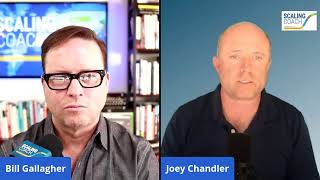
Joey Chandler teaches a two-question method to find your purpose, then shows how to build it into your business. He walks through real examples: an insurance couple who doubled their revenue, a shopping startup that transformed its culture by aligning systems with what people actually cared about.
Chapters
There we go. Coming in live. Facebook, YouTube, twitter, etc. We're live again for the second time today. Wow. Today when we get things done. If you're joining us live, that's awesome. Welcome. You can throw comments or questions here. Say hi to us as you like and we'll entertain what you can. Today we're talking about purpose, especially your life purpose, but also we're talking about your business purpose. But in particular that life purpose piece. You're digging. The royalty free music, the licensed music.
I love it, I love it. I love the, the, the production value of the. The of the show. It's awesome.
I would love to just play like everything except get my licensing cleared is hard so. Hi everyone and welcome again to the Scaling Up Business podcast. We're talking about life purpose, business purpose, the the why of your work today. A subject that's favorite of mine and really, really timely now as people are considering their life in this unusual and extraordinary time. We're talking with Joey Chandler. I'll introduce Joey in just a second. Joey, welcome to the show.
Thank you so much for having me. It's good to see you. It's been a while since we've talked. Yeah, yeah.
Joey and I met just after I figured out my life purpose years ago. So I'm Bill Gallagher, your friendly neighborhood scaling coach, host of the show. We bring a show like this to you every week. We've got over 230some shows so far and we've got shows on everything to do with business growth. So our show's all for business leaders trying to grow their businesses and so you'll find all those back that back catalog@scalingcoach.com from coaches, CEOs, business gurus, subject matter experts and everything to do with people, strategy, execution or cash. All of that world@scalingcoach.com all the old shows, the show notes on virtually any topic that you might want to consider, plus downloads of the tools, special offers, that kind of thing. Scalingcoach.com Also if you could use them out finding a coach for a particular area or scaling up in general right now, we can help you. We've got over 200 coaches in our world, plus subject matter experts like Joey here who work on particular areas and I'm happy to connect you to those to the appropriate person. We've never seen such demand as we have since the pandemic hit for coaching. So I'm really grateful for the chance to work with and help people. So my friend here today, Joey Chandler is a purpose coach, a specialist in that world. And he kind of came to that in a long way. I'll have him tell you his whole background. But he, he worked as a photographer, a videographer and he was doing these like life tribute videos when he saw something about purpose. He'll tell it better. Joey lives in Northern California with his family, wife and child and is an outdoor guy lover, you know, like all around groovy guy. So. And I'm going to let him focus more on that. Right. Well, there's not, you know, sometimes our folks, you're a coach and you work in this realm and that's how we first met. Years ago. I figured out my life purpose and Joey took a stab at coaching me for a minute. That was not easy to do.
Yeah. Those are back. We won't, we won't. We'll put those down as the learning category years.
I do whatever the hell I feel like doing. Right. And that's hard to code.
Yeah. And in all honesty, that's one reason why I love purpose. Because I think we're all over coached. We all. It's not a matter of not knowing the information. It's a matter of actually doing it. And I think the more that you get clear on who you are, then you can develop systems that are based on yourself rather than what other people tell you and you're just more likely to do it.
Yeah. Isn't that the truth? Like, you know, you call your mom up right now, she can tell you everything that's wrong with you in your life and it won't make a bit of difference for you. You won't take any action on it, but when you see it for yourself, everything changes. Yes.
Well, my, you know, I actually had this, I had a conversation with my sister today. She had this great line. She said there is nothing easier than figuring out what's wrong with other people.
It's so easy. It's. It's easier to work on yourself than it is to work on other people. Yeah.
Sorry. I had a little car going by here. Yeah. And that's why, that's actually why I love purpose. Because it forces you to look at yourself and then hopefully take action.
Yeah. Yeah. So I, So we're going to talk all about that. Why don't you give us a little bit of kind of your story arc, Tell us about the work you were doing in the video and what you saw about people and bring us, create that picture for us.
Yeah. Well, you know, like I've been involved in coaching and being a coach and Coachee for 20 plus years, leading seminars and workshops and, and when I look back at my life, I always involved coaching in whatever jobs I was, what I was doing. I was a snowboard coach in Japan. I let you know you. And I led courses for landmark, you know, all sorts of different things. But what really got me into purpose was a few years back and I think you actually participated in the very first of these videos where I did a video for my wife. We, I asked 30 or 40 or 50 people what they loved and appreciate about her and, and then I put that all together and I showed. We gave it to her for a birthday party and it was totally awesome. And we did. I ended up doing a few hundred of those videos for people. And somewhere along the way, probably after a hundred of them, I started to see that there was always a theme in the video. The person was about love or joy or happiness or excitement or something. And it wasn't like loud, it wasn't overt, but it was. Once I started to see it, it was always there. And then a few years back I started reading all the, you know, know your purpose, know your why, all those kind of books. And it dawned on me that that theme that I was seeing, that was that person's purpose. It's who they are, it's how they. And it impacts how they interact and act and act. And it is again, it's not intentional. And I know one person can see it but, and I could see it because one, I had that, you know, that long history of being in the coaching world, in the self development world. But also I spent, you know, literally years of my life seeing other people say something nice about each other. And when you put all those videos together, this, this essence shows up. And I did videos for people from 7 to 90 all over the world. So I can say with pretty, pretty good certainty that I could do a video, I could do a video for you get 30 or 40 or 50 people, all say what they love and appreciate about you and there would be a theme and that theme would be a reflection of your purpose. And when I saw that, I was like, that's really cool. And I spent the last four years basically developing a conversation where pulls that purpose from the background real life to the foreground and then started implementing systems. And now I help entrepreneurs, mostly solo, but also small teams, really craft their business in such a way that is reflection of their purpose and it also feeds it.
Interesting. So your. Well, yeah, talk to, talk to us about how you've. So are you still using the videos now to discover purpose Are you working directly with people on it?
Yeah. The videos were the evidence. And then I went and you know, I started grinding through a bunch of conversations and now it turns out it takes two questions to help someone figure out what's to the core. And, and I should also clarify what I mean by purpose. Our per. I say a per. We. We all have something at our core. Some something. It's a spirit, a soul and energy. You know, way the brains are wired. I don't know, there's maybe was there before we were born or after we, we were born again above my pay grade. But no matter what, we have something at our core. And our purpose, why we are here is to experience and to share that thing.
Thing.
And our ability to experience and share that thing is based on the systems that we have in our life. We have personal systems, professional systems, social political systems. And the more clarity and more conviction, the more consistency we have regarding our purpose and regarding those systems, the more effective, the more fulfilled we are. What.
What do you mean by when you say systems?
So like, so I'm about people being free. Like that's, that's my purpose and how I manage. I can manage my finances in a way where I have freedom around that or I can manage my, my finances in a way where I don't. How you, You're. I know you're a someone. You know, when you talk about scaling.
Right.
You're going to, you're going to put in systems that allow the company to scale.
Yeah.
And so you can start to ask are we scaling in a way that we are present to our purpose or are we scaling in a way that's not. And by checking in on that allows you to scale in a way that stays aligned with the company rather than you end up scaling, but you end up someplace where you don't want to be. Yeah.
Well, we always find in our work that the purpose is the motivator and the why of the work. And when it's articulated, when people really know what it is, they, they can connect back to it like you say, but they also get a different kind of engagement from the team. And people choose to be in or not be in the company very much related to that purpose. And they, they work at different. So tell a few stories. You. One of the stories you shared in, in preparing was about a couple who was working. One of them was insurance or. I forget what you said there, but talk about that.
Yeah. So this is a, this is a couple where the gentleman was basically running an insurance brokerage of Sorts. And it. He got offered a job that he couldn't turn down. It was. He had applied for a job a while back. He got offered this job and he was like, I need to take it. And he's like, to his wife, like, you, you know, here's the. Here's this business that I'm running.
You.
You get to do it. And. And so she called me and. And she's like, look, I'm totally lost. I. I don't. This is. There's this opportunity here, but I don't know what I'm do, you know, I don't know what I'm doing. And we said, okay. So we sat down and we figured out a cup. Two main things that really helped. One, we got present to her purpose, which was about people being happy. That was. That was.
Yeah.
And. And in that, you know, that started to get a little way. But her big question was, is like, her bigger. A bigger vision now. Her purpose is about people being happy. Her vision for the world was about elevating women out of poverty. A little bit of work to get clear on that. And like you said, the more clear you are on those things, the more effective you are at express, you know, expressing it and sharing it and really living it. So she got clear on that. She realized she was about people being happy. She was about this bigger picture. So then the question became, is this insurance play, is that a vehicle for her to help one create happiness for herself and help women get out of poverty? And it turns out it was. She had some questions to address. Like, it wasn't clear. And one of the things when you get clear on your purpose, when you really start to be able to say, this is who I am, you start to be able to stand up for what you need. I mean, there's so many people that know, like, I need this. But we don't stand up and tell our boss, like, hey, this is what I need to be successful. Or we tell our spouse or tell, you know, who tell ourselves, like, this is what I need to be successful. She went to the team saying, this is what I need. And within a few months, she actually, I don't wanna go through numbers, but she. She did an unprecedented amount of money that came in.
She made a million dollars, a bajillion.
It was something like. I think it was a bazillion, but. But the main part was, is that she. She had a framework. She could wake up every day and she's like, you know, I'm about people being happy. And we have some Tools to help people stay connected to that even when they aren't feeling happy or you know, are not present to their purpose. And then also having this bigger vision and then she could talk to people and it just made sense what she was doing.
Yeah, yeah, So I get that because they're connected with this underlying thing. Right. It was clear for her and then she had a way to relate to it because she didn't have background in that business and insurance. Right.
Well, you know, but here's the interesting part. When you, when person gets present to their purpose, they start to see how it's already shown up in your life because your purpose has already, it's been there for a long time. It's been impacting you in all sorts of ways. Turns out she had been exploring finances for a long time. She actually, you know, personal finances, how to take care of her family. But she had this, she wasn't like an expert in it, but she had been putting some intentional work. And so it wasn't like this massive, massive leap. But by connecting the dots, she had a foundation to move forward.
That's interesting. So years ago I had a couple of tech companies back in the 90s and we decided to shut those things down. And in the process of questioning my life and what I was all about, what I came up with was that purpose of my life was making a difference, being a contribution to people. Right. And up until that time the people were kind of irrelevant, often in my way and, and for sure that still shows up sometimes. Right. Very often people annoy me. They're in my way and that like self absorbed, self centered arrogance. Right. Like I didn't stop being that it would be nice. But so there's this desire to being a contribution, to being generous, to make a difference for people. And that's the thing I'm proud of and I feel good about. And yet at times I'm a petty jerk who's just trying to do my own thing. Lots of times. Not just. Right. Not just rarely, but frequently.
Well then yeah.
Or something like.
There's two really important aspects of that. One, your purpose is always about yourself and others.
Yeah.
Your, your ability to be a. Make a difference is one. Making a difference with yourself. Like saying, hey, this is what I need. Yeah, yeah, do that for so long. Then you have to, you know, you have to look out and how can I make a difference for other people?
For other people.
Yeah. And the other thing is, is that your purpose, you're always bumping up against limits. There's places where you are totally awesome. You can totally make a difference, and you're. You got no problems with that. And then there's places where you're that petty jerk, right? Like, you know, that's. And. And you're still your purpose. They're just. You're bumping up against limits. And I used to think that, you know, we. We got to get rid of all those negative thoughts, you know, those. You know, you and I are trained in how to get back to our, you know, past limiting beliefs and all of those things. And while I think those things are really important and you got to be aware of them, you're always going to be triggering them. Because if purposes means growth, you're always growing, you're always going to be bumping up against the limits. So then you start to say, like, okay, my voice, you know, mine is. My voices are, no one likes me. And I'm going to. I failed. And, you know, I have this I suck sort of thing. So those are there. I have to be aware of them. But spending time to, like, exhaust, you know, try to get rid of them all. Like, I don't do therapy.
That's.
That's the therapy realm.
Yeah.
Yeah.
I don't feel like there's any help of getting rid of them all. Like, they're just going to come and kind of let them come and go. So when I figured that out, my wife and I had three companies at the time. We shut down two, and I went to work with her business. I took over the CEO role in that company and ran it for a number of years through periods of growth and challenge, and the only thing that I could relate to and that I knew anything about. So jewelry, fashion, women in general were all a bewildering mystery to me and an uncomfortable kind of a domain. But making a difference was all I had. I'm like, okay, I'm going to go make a difference for this team, for this brand, for this company, for these people. I'm going to be a contribution here. I'm going to provide some leadership. I'm going to step up from this purpose, and that's it. And the moment that I saw that was when we were out in a department store and we came across one of our regular customers who we didn't know, but, you know, like a fan of the brand. And. And I saw the difference the product made for that person in their life, and I'm like, oh, I can relate to this. In an instant, I saw my purpose in a totally new category, and I knew that I Could. Could lead that business, you know, sometimes. Sometimes not so well, but. But I had a place to come from there.
Yeah, yeah, no, that's. That's how it is.
You.
You figure out your core now. Can I ask you a couple questions?
Yeah, yeah, sure.
I always. I. I don't. Well, you tell me, like, because I think I can help you clarify your purpose a little bit more.
So I've experimented with that. Yeah, let's play that game. But I've actually expressed it lots of different ways over the year. I keep coming back to that simple heart of it, but I have put it out at different ways because it got a little tired sometimes or whatever. I always. As long as I'm moved by it, it's good for me. Right. But go ahead. Yeah.
So here's the. And the reason for this is all the videos. This is what the videos would say.
Yeah.
So when you interact with people, how do you want them to feel?
Great.
Great.
Special.
Special.
Yeah. I want them to feel good about themselves and about the world.
Okay.
I want them to feel fun, like, you know, life could be fun.
Yeah. So you want them to feel great, good. There's something special about them.
Yeah.
One second.
I got.
I got a. And, and have fun. My. I was on my phone. So, as I said, our purpose has been with us for a long time, and it was there when we were young, so we would have interacted with it even if we didn't know what it was when we were a young person. When you feel great and you feel good and you feel special and you. You're having fun, how would you describe that feeling in language you would have used when you were 10, 11, or 12? When I.
Let me ask. Understand the question you're asking. How would I describe feeling great, Fun. Good.
When you're feeling that yourself, you're, like, experiencing yourself, and for whatever reason you're feeling that, how would you describe that feeling in language you would have used when you were young?
Cool. Cool.
Awesome. And when you feel cool, how.
How.
How do you describe that? How would you say that? As an. As a. Emotional, like.
Happy.
So I'll ask you, Billy, about people being happy. Yeah, yeah, yeah. You see the smile? Yeah, yeah, yeah. And if I interviewed 30 or 40 or 50 people. Well, let me ask you this. Is it happy or joy?
I don't know. I don't. Sometimes I use the word joy, but not as much.
It's happy. Yeah, yeah.
Happy, playful.
Yeah.
Those are things that come to mind, right?
Yeah. So you could say that all your Work is about helping people be happy.
Could maybe. Yeah.
I mean, you know, like, in different. And happiness means different things to different people, so you have to do it. But that's at the core of what you do, you know, in all, like, you know, all the. The jewelry that. The design, the contribution that you are to people, you want them to be happy and maybe even excited. What I found is that there's five main purpose words after having this conversation with a few thousand people. Love, joy, happiness, excitement, and freedom.
You know, another one that comes to mind as you talk about it, as I think about it and when I think about, like, I. I also often want people to feel powerful.
Yeah. Yeah. So for you, happiness is a couple things. It's making a difference for people that brings you happiness for you, right? Yeah, yeah. People feel. You want people to feel empowered. You want to feel empowered. You want them to feel empowered, capable.
Right? Like, yeah.
I'm guessing having a plan is part of happiness for you, having a structure.
Yeah, maybe.
Yeah. You know. You know, like. Yeah, I mean, you're. You help people grow their business. That, like, having a win or success, that's happiness for you, right?
100%. Yeah. Like, I finished today. I'm like. And I'll walk out and I'll go in and after a team session or a particular call or whatever, and I'll go, I'm a fucking badass.
God. I'm a fucking coach. Yeah. That's part of happiness for you is winning. It's like, yes, you know, success.
But there's a particular feeling of like, I can do that. Like, I'm. I'm good at this. Right. And I love it when other people have that right that I want myself. I want for other people too.
Yeah. So, like, mastery is an important part of happiness for you.
Yeah, maybe.
Yeah. So the idea here is that. And I just want to applaud you for. On the spot in front of thousands of people, you know, diving deep in this. The idea is that we figure out who we are at our core. We figure out what it means to us. Like, who I am is about people being free, and that means to me, is knowing who you are, making things happen, seeing the greatness in myself and other people, taking on challenges and getting paid for what I love to do. That to me is. Is freedom.
And.
And everybody can figure out their own. And what that does is. Allows you to find the things in your life that create your. Allow you to experience more your purpose. And then there's a really cool thing for business. If you're up for that? So it turns out the purpose of any company is going to be some combination of the purposes of the founders.
Yep.
So you wouldn't. You wouldn't create a business that wasn't a reflection of your purpose. I actually don't think you could, but I don't think you would do it. Never try to do it that way.
I find there are a few people. I don't end up still working with them. I worked with one recently, like, I worked with one recently, and they're just like, money. I just. It's just. I like, you know, I'd sell you anything. I'd tell you guns, I'd tell you whatever. You know, it's just money. I'll sell this, I'll sell that. You know, I don't really believe it.
I. I don't. I don't either.
It might not be about the product, but it's about something more than you realize.
Absolutely. And I even question, like, I think if we ask that person a little bit more, they say that they're about something and that selling brings them joy in some way. But what you can do is if you have, you know, two, three or four founders, we could do this exercise that we just did. We figure out their purpose, then we do a little bit of wordsmithing, and then you have the purpose of the company, then you figure out what each. Like. Like I said, I'm about freedom. So it's, you know, knowing who you are and greatness and. And getting paid for what you know, to do or love to do. If I was part of a founding team, those sorts of things would show up in the values of the company. And so what we do is we take the founders, they figure out the purpose and what a purpose means to them, put them together, and you now have the values of a company. And the cool part is you can do it in a lunchtime hour, you know, hour, hour and a half.
Yeah. So, okay, this is a good. Maybe we shouldn't talk about this in public. I found if you give people their purpose and values too fast. Right. Like, I and I. I was out at a CEO retreat for a week a couple years ago, and somebody's like, really? You could do purpose in 15 minutes? I'm like, yeah, I can do purpose, your life purpose, in 15 minutes. They', okay, do me. And so. So, you know, in front of everybody, we did it. But I think that when you get it that fast, you don't respect it. You don't. Even if it's. You that did it, versus me telling you what your purpose is. You don't feel like you did enough work to claim it, to own it.
Yeah, that's, Yeah, I would. So there's two things. So the problem is that we all have far more experience being who we think we should be rather than who we actually are. Yeah. So when you, when you do figure out your purpose and who you are, you have to understand that you have a lifetime of habits and routines and systems and structures and interactions with people that are based on who you thought you had to be. You know, you had to be, you know, you know, you know me, like, I'm always like, like, that's why I thought I had to be like, I'm always overcoming these things that nobody likes me sort of thing. So I, I, I have to watch my, you know, my, my zealousness. And I love that part about me, but I just have to watch it. And so when a person figures out who they are, if that's all you do, then yes, they're going to struggle. But what then there's to do is start to relate to them that way. So, like, I will when I, when I work with people, once we figure out that they're about happiness or love or joy or whatever it is they, that's all I relate to them. I don't give them extra coaching. I just say, hey, how can we bring more love to the situation? How can we bring more joy? And what that does is that starts to deepen their sense of who they already are. And my goal for coaching now is not to teach anybody anything, but to help them become more of themselves. And I say the more, the more that we are ourselves, the more likely we are to use all the knowledge that we have. Because there's a bazillion, you know, there's a million how to do things, but it's a question of how do we actually put into place. So if we can help people be ourselves, be themselves, then they're more likely to actually do that work.
So when I was becoming a coach, I was both working on the skills of being a coach and working on myself, applying those skills to myself, like taking my own medicine. Right. And as I began to have experiences along the way, I remember again and again thinking, I want everybody to feel like this. And, and I can remember moments like, there's a spot down the street and I can remember being on that spot and some car passing me by. And I remember that moment and I was running, you know, strong, and now I done, you Know some number of triathlons already. And I, and I knew that I looked good and that right, like I, I knew I, I like look good, my head's high, I have good form right now. I'm feeling great. And the car passes by and I could see the person noticing me and having some thought about the whole thing. And I'm like, yes, I want to be an example. I want everyone to have. You might not want to run a triathlon, but, but I want you to feel powerful in whatever you do. I want you to feel great about yourself. I want you to feel good when you look in the mirror. Not necessarily about your body, but about your whole being. Right. To be proud of who you are. And I remember having that notion. And then when I started to coach larger and larger groups, I remember standing in front of people and saying, I want everybody to have this feeling like you could have it all, you could have what you want in your life and it could go the way you wanted it to. And I just deeply moved by that kind of thing. And I'm still moved by that same notion today, which informs the coaching. And then that becomes the purpose of the business. The purpose of the business in my case is really, really easy because I founded it to do my work and that kind of thing. So it's very closely related. But our purpose is helping leaders build a better world. The funny thing is, not everybody that I start with realizes they're trying to make the world a better place. But they, they all discover that they are and come to connect to it. And it's not something that I got them to do, but that they were already doing in some way. They just kind of get in touch with it. And there are a few people who maybe aren't trying to do that. And then we don't end up working together.
No, I find that. Do you have this experience, like someone's like, I don't know if I'm about the, you know, changing the world or making a difference. And then you talk to them for about 30 seconds and that, you know, you just scratch the surface just a little bit. Then all of a sudden this huge vision comes out.
Yeah. Yeah.
You know, that's like. I think we, I, I think we all have bigger visions than we realize now. For some of us, our vision, our big visions, our day to day life doesn't reflect our big vision. And for some, like, and we need to work on, you know, doing the laundry and paying the bills and you know, taking care of the basics. And then for other people they're so stuck in the day to day that they need to have, they need to expand themselves and kind of embrace the bigger vision.
Yeah, I do find there's a struggle. Like a lot of people, they're like, yeah, I don't want to step up to a bigger game. I, you know, there's a little caution there about like how much they want to swing out and like some scarcity and boundary concerns, that kind of thing.
Yep.
Tell us the story of the, the, the, the partners who were working some kind of shopping company and they were figuring out their purpose and it was this combination of the two. Talk, talk about that because that illustrates what you're talking about. Yeah.
So this is pretty, you know, a startup. There were, there were two founders and two key execs essentially. So the founder, when I started working with him, he's like, I want all these four people in this particular conversation. Yeah, so we, we all, and I actually don't remember the purposes of all the individual founders, but I, I worked with them. You know, it takes, takes about 45 minutes. With this particular one, I did individual first and then we brought it all together and we were going back and forth. And they're a shopping company that basically allows people to sell and buy goods through Facebook and Instagram. And I'll be 100 honest, I don't exactly know everything about it, but their main client were Midwestern moms who were trying to shop and buy things. Like that was, that was their big client. And they, they, they went around and they're all sudden, they're like, oh, we're about ease and excitement. We want people to be, have it be easy and be excited when they, they shop or they buy and that. And, and they, it's not like they went out and rebranded everything that way, but in the months afterwards they just, you could just talk to them about like, are you bringing ease and excitement to this? And they use, they started to tweak their copy, they started to tweak how their processes work with just having that sense of who they are and what they wanted to create. And I think that's one of the real powerful things of putting your purpose in a, in a clear, simple, everyday language. Because then you can go to your systems how, you know, you know, if you're, they like, they can go through and say, is my client, is the onboarding process of my client? Is that, does that generate ease and excitement or is there something in the way? Can we tweak it? Because at the end of the day you want Your client to experience what you're about and you want. And you want to be able to experience it. This also applies. They had some internal, you know, startups. They got some internal issues and the idea of, like, how can we create ease and excitement internally led to different conversations.
That's interesting. So they're bringing that all over the place. So we normally ask, what difference does it make? Why does it matter? Right. Your business and the expression of that is unique. Where they set up, you know, touch their heart cord, there somewhere is the place that we're looking for the thing that they care about. And then distilling that down from a group, we do often end up with. With some like, beautiful expression. One that stands out for me is a client that I've talked about before and longtime client and, and become a friend and all that. And they're like, ah, you know, we just, we bought this business. We. This was really like a thing to make money and it seemed like it would work and we needed something and, and they, so they, they. I, I often. I usually send people off in pairs. So I'll. Because I'll work with usually like 6 to 10 people or something like that. So I'll send them off in pairs and they'll interview each other. And the listener, of course, is listening for something and can usually hear it first. But. And they go back and we pull those words together. What each one came up with that they actually care something about. We're listening for that emotional core, that motivating piece. And, and they, they. We put the things up on the wall and we moved words around it. We came up with in a matter of minutes. We keep the world working. And you know, it's like, fine. But they. When they saw the elegance of that, you could hear like a little shift in the room. They went. And like, there it is. That's it right there. Like that thing like, you know, and certainly my allowing myself to be proud of them help them to be proud of themselves as well. But that came out and it became like a thing. And they put it on T shirts and all that kind of thing.
The one, the one like the, the part where I would just push a little bit on there is like, what's the experience when someone has work, when they're working? You know, in that case, they're working and was this a staffing company or something?
Yeah.
So when someone has that sense of like getting a job and they, and they're in there working in that sense of contribution and taking care of themselves and their family, that experience, that's what, that's what they're creating. That love, that joy, that sense of excitement and being proud of who you are. That's what they're more than. That's what they're creating. How they do it is by helping people get jobs and work. Yeah. What I find is that most, most purpose statements, most are, are. Are a little more marketing and branding is than heartfelt and, and it's more intellectual than heart.
Yeah, I do. A lot of people try to get it. They try to start to take it to a marketing slogan and that one very close. But it was the idea of like I'm productive, useful, valuable. Right.
And that's, it's totally, I mean it's totally beautiful. It's just the question is, when you feel that experience, when you feel useful and valuable, what is that experience? And I would bet you dollars to donuts that those, those, the people that bought that business, they are something about people loving themselves. Like they did that already. They didn't buy that business by accident. That they, they, they may think they did, but there's, it's almost. They wouldn't have bought it. There's a million businesses they could have bought. They bought that one because it fulfills on their purpose in some way.
Putting people to work or something. Talk to us about what's happening this year. This is a unique year. Unique time, probably should be anytime that we consider our purpose. But a lot of people are starting to wonder what the hell. What.
Yeah.
About. Right. Yeah.
So this year has taught me a ton about purpose because, you know, I'm a wild. You can tell my hands, I move around. Oh, for the people on the podcast, I move my hands a lot and I get excited. I used to think that you're, you were your purpose or you weren't. It was kind of an on or off. And, and so I had all these systems in place and the way I coached was, you know, just how to be more your purpose. And you know, March, you know, whatever it was, January, February, March, Covid, social justice, fires, environment, you know, all that kind of stuff. It, it showed me that you can't be your purpose all the time and that you actually need systems and support to do it so out. And so it's been the most, you know, life altering educational experience of my lifetime is. And so what I started doing is I create. I help people create what I call their purpose ladder. And because I needed a metaphor that was simple that I knew I would use because I couldn't, you know, there's just we can't think about anything. It's just too much going on. And so we create what I, what I call the purpose ladder. And so at the very top of the ladder, you put, you put your purpose. At the very bottom of the ladder, you put some version of life sucks, you know, it's horrible. The very worst. Your very worst moment for me, it's being angry, you know, whatever that is for you. And then you put, um, I usually have four steps in between. So like for me it goes from anger to scattered to focused to con or excited, then confident than free. Those are like my steps. And then on the other side, because I realized I again, I used to think that you could go from the very worst up to the very best. Like, that was my. I was just being naive in that.
So that I realized you can't switch on off.
Yeah, exactly. It was, I was, I was, I was hopeful, you know, But I realized when you're, when you're in that very low estate, like, there's just not much you can do. So at the very low estate, I say you tell the truth. You, for me, it's telling the truth and being, you know, taking a breath and being honest. And that helps me get up one step. And so I have clients basically create an action plan. So what the means is, is that you can wake up no matter where you're at, whether you're fully present to your purpose or you're fully present to something fully. Far less you can find yourself on the ladder and say, okay, here's what I'm going to do. I'm going to take a step forward. And so what 20 all that 2020 taught me is that yes, you need your purpose, but you also need systems in place to allow you to support yourself. And that's why I think business is so important now for a business person to sit down and really figure out their purpose so they can put in place that their business not only reflects their purpose but also feeds it and empowers it.
Interesting. So, okay, gotta figure out how do we use that with, with our people. So hold that for one second. Before we come back, let me give some shout outs to some of the people that help us put our thing together. So big shout out to our show producer Lucy Summ, who schedules books, prepares everything and so on. Shout out to Lucy and then a couple of thank yous. But a reminder, if you are looking for information or a coach or some of the shows on other topics, that kind of thing, you should go find us@scalingcoach.com you'll find the 230+ episodes back there, plus any new ones that we've done since we talked about this here today. All of those things. Scalingcoach.com also a free copy of the Scaling up book. Want to copy the book for free? Just pay the shipping and handling. I'll send it to you for free. All that and more. Scalingcoach.com also if you want to got a question or that kind of thing, send us an email to info scaling coach.com I want to give big thanks to Vern Harnish. Vern Harnish is the author and creator of the Scaling Up Framework and the original Rockefeller Habits that we learned and applied in our past businesses. Our audio is edited by Albert Burge at Podfly Productions and our show notes are compiled and written by Ein Codina, then proofread by Tim McGowan. So let's go back to what do you think are the key things that people need to do to understand, to discover and anchor their purpose?
So to see, to understand it's to me it's asking those two questions. You know, how do you want people when you interact with people, how do you want them to feel? And how would you describe that as a language of a young person that is that will give you the core and then there's to do is to create. You actually then start to create your vision. What is it that you want to create? We all have, we all have goals. So what is your vision? You want to grow your business? You want to run a triathlon, you know, something you want to do? So you have your purpose and then you, then you have your vision. Then I what I suggest is you create what I call your purpose process. And you talked a little bit about this like empowering people is part of the way you make people happy and you empower them. And when a person looks at their purpose, they look at their their vision. Then they can start to you'll find that they have four or five or six steps that they take to help themselves and others experience more of their purpose. And then after that you start to build systems in place to support all of that. And then you take actions, you implement, you evaluate and celebrate. Those five steps will help you create a create a life and a business that reflects your purpose and fulfills on it.
So you'll find all those steps and more@joeychandler.net and in our show notes. You find them right there in the show notes wherever you get the show. If you're listening to it later in the audio and we'll post them up to the video and so on. And you can get in touch with Joey and read about his thing. Get his downloads and all that good stuff@joeychandler.net thank you Joey for joining us on the show talking about purpose today. Super awesome.
Thank you for having me. I love it. Really appreciate it. And props to all the episodes. Man, you do a great job.
Yes, we have fun with it. It's one of my favorite things to do. Talk to people, hear what they got to say, learn something.
Thanks again.
Talk to everyone again next time.










