Scaling For Success with Andrew Bartlow
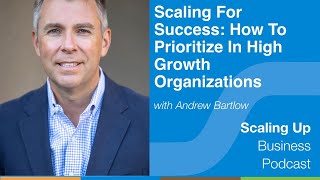
A recorded interview (podcast/video) hosted by Bill Gallagher with Andrew Bartlow about people priorities in high-growth organizations. The conversation covers setting company-level priorities and plans, limits of OKRs and best-practice lift-and-shift, importance of context over content, practical HR/talent-development lessons, and evolving hybrid/remote workplace choices after COVID.
Chapters
Foreign. Hey, hey, hey everyone. We're talking all about people side of setting priorities today. Balancing the needs of people in a changing time and helping to provide clarity around the decisions and the priorities people need to make. Hi again, everyone. My name is Bill Gal Gallagher, Scaling coach, host of the show. Every week, many times a week now, three times a week, we bring you a show on something to do with the world of scaling up. You'll find that whole back catalog of nearly 300 shows now@scalingcoach.com Stitcher, Spotify, SoundCloud, YouTube, iTunes, et cetera. Wherever you get your podcasts, we're there, I hope, and we've got something for you there. That whole back catalog as well as all the show notes, the, the links, the things that our guests talk about available@scalingcoach.com I'll catch my breath now. So we're talking today with Andrew Bartlow. Andrew is a co author of Scaling for Success about people priorities in high growth organizations. He leads series B consulting, consulting business focused on coaching and helping people get through high growth just like we do. And he's worked with lots of people in a range of things, coming from a talent development background. And so really speaking to that, the most vexing thing was getting people to do what you want them to do, work together well, all that kind of thing. So I'm excited. You know, he's, he's got a strong background, a great education. I'll let him say more about all of it. But I'm excited to welcome Andrew show. Welcome, Andrew.
Yeah, Bill. Hey. Really appreciate it. Glad to be here.
Thanks so much. So where are you physically, like where.
Are you now other than in my office with all my girls pictures behind me? I'm in the San Francisco Bay area, little town of Danville.
I can see the girls picture. How old are your kids?
Five and seven. Yeah, we have, we have unicorns, we have rainbows and we have rainbow unicorns.
Yes. With sparkles. I'm pretty sure.
All, all of the above. Yeah.
Oh my God. Thank God for that. So we're going to get into this idea around how to set priorities and how to focus time and attention on things when everything what feels like there's nothing you can cut out. This is something we deal with all the time we've been dealing with this week, last week, every week. Right. That battle in our mind of like, it's all important, it's all got to get done. And yet, of course, course, at the end of the day, it doesn't all. And you've Got some great stories to share. Before we get into that, share a little bit of your story. How do you get into this? Talk about your background and like that.
Sure, sure. Well, thanks. About 25 years of human resources experience inside some of the world's largest companies, Fortune 50 and then inside some startups with less than 50 people and then everything in between. I've worked all over the country, have had some global experience as well, had a great ride that culminated with an IPO and a great exit from a real estate tech company a few years ago. That gave me the flexibility to start to cross things off my bucket list including writing the book Scaling for Success and starting my consulting business where it's really been a lot of fun over the past few years, working with high growth organizations, PE backed, VC backed and mentoring HR leaders at these organizations and some of the business leaders as well. So trying to give back and help people stub their toe or burn their fingers a fewer times than I did along the way.
Now in getting ready for the show, you shared that used to be self conscious about saying that you worked on that sort of people, the HR side of things. Say more about that. That's it.
Yeah, yeah. Boy, we're revealing right away here, aren't we? Yeah. Even though I went through what, what's arguably the top graduate school in the world for, you know, this HR discipline, you know, I, I encountered a lot of people that didn't understand what HR was or what it could be. And you know, the first things that popped to mind were employee relations and payroll and benefits and boy, you're the HR guy. I bet everybody wants to talk to you or I bet nobody wants to talk to you. And so I found myself kind of shying away from it and telling people I was in management consulting because that's how the work was done at the world's best companies. For this discipline, it's really consulting senior leadership how to run your organization more effectively. And so I've always approached the work that way and frankly that's what I'm trying to do now in my consulting life, is trying to help more HR people think like management consultants think about business effectiveness.
Well, right, there's recruitment and retention and talent development are meaty, significant things that nobody would disparage in any way. And they take real effort, especially in constrained resource like people. And through all of that direct impact on leadership and, and yet we do often think about the more administrative aspect, which is also very critical, especially as you have a lot of people of HR payroll onboarding Et cetera, et cetera. Like the routinization, the operational aspect of it.
Yeah, yeah. You do find yourself getting caught up in the vernacular, in the language of business and the HR ambiguity. And ultimately I think you tell a much more concise and direct story if you say, hey, I'm helping people manage their organizations better. And so that's probably the crux of what I've done and what I'm trying to continue to do better.
So why this book? Talk to us about the book. How did you come to write this and what's your message here?
Sure. Well, again, bucket list. There are a lot of people I talk to that say they've got a book in them somewhere. I didn't know that, I really did, but I was trying to get my thoughts together around, hey, I'm launching this consulting business a few years ago. What is it that I can help people with? And started putting those thoughts together and it turned into 220 pages of narrative, of charts and diagrams and examples and templates and stories, particularly focused on high growth enterprises. I live out here in the San Francisco Bay area. It's the cradle of startup civilization. And there are a lot of companies that are seeing a lot of success, often in spite of themselves, often in spite of their interesting management techniques. And so I found that there's a lot of HR work going on that could be better focused, better targeted, a lot of management work that could be elevated. And so I wanted to be helpful. And so that's really where the book was aimed, is some of my lessons along the way and really planting a foot firmly in the practice of 25 years of experience and then the academic foundations of research. So my co Author is a PhD in Organizational Behavior and teaches management and entrepreneurship. So, you know, it's not just a couple of interesting stories as anecdotes, but it's really grounded in what, what really works.
Yeah, well, we, look, we all benefit from the stories, help us to create a mental picture and then from that we can tease the principles and see the application of the tools and frameworks and things like that. So let's tell us some of those stories. In getting ready for the store for the show, you had quite a few to share. So I think our listeners love to hear some of the, the things that you've had experience with in the last little bit. Maybe start with the high tech CEO that and you don't have to, you can name names, you can use it, whatever works for you in terms of.
Yeah, well, hey, I appreciate that. So, so I have, you know, probably three big takeaways that are represented in the book and that I talk about a lot and, and I'll, you know, share, share a few stories and anecdotes around them. And the first is have a plan. Bill, I think you led with this around. Things change so quickly in a startup environment. Resource constrained, not sure where your next nickel will come from or when you'll need funding and lots of product pivots along the way. In many cases there's this reticence to commit to a plan. What are the three or four, five things that are most important to us right now? And that's so interesting as organizations really try to drive down accountability at an individual level if the CEO founder is unwilling to share what the company top level goals are. So a big takeaway is have a plan. And a specific example there was working with a really well known late stage startup that was moving into performance management and goal setting and had reached a couple hundred employees at the time. And at that point the CEO, founder and executive management just can't know what every single person is working on on a daily basis. And so they're trying to ramp up the alignment, the awareness of what people are doing. And so they were rolling out okrs across the organization and were asking me to help them and I said, hey, stop presses. Let's start with committing to what's most important at an organizational level. So have that plan. Put the stake in the ground before you start driving something deeper into the organization because anything deeper just isn't going to work until you start at the top.
So I have a plan and how'd that go? Did they adopt it? Were they receptive to it? Did they struggle with it? With creating the overall plan? What was the effect of yeah, frankly.
All of the above. So once I brought that up, there was immediate acknowledgment that yep, that makes sense, we probably need to do it, but boy, we're really scared about not getting it right. Or what if we miss a target? Will everybody quit? Will our investors walk away from us if we say we're going to do something and we can't deliver through maybe no fault of our own? So there was acknowledgement, there was some fear and it was a bumpy implementation road. So we ended up spending probably too much time trying to nail down what are those few most important things for the organization and didn't get entirely away from trying to drive individual targets and goals. But we made progress from where they intended to start out and that benefited them ultimately. So it was a little bumpy. But hey, that's, that's life in the, in the startup scene, right? You test and you learn and you know, there's lots of, lots of pendulum swinging from complete anarchy to overcorrection into too much structure. And then by the time you think you found your equilibrium, the game has changed and you need to do it again.
Yeah. See I think what you point to is interesting and what I hear in this is like if it's a bottom up OKR process, then you've got all the parts pulling in slightly different directions. Maybe not profoundly different because they've been engaged in something towards, but slightly different interpretations of the end state and they're all kind of going off and then that creates tension and then you're trying to corral the whole thing. But if you'll just declare, we want to hit these targets, we think these are the major initiatives. Do you have any input on them? Now the CEO is declaring the major targets, or at least the CEO plus perhaps the senior team of five or six people is declaring a few major initiatives, a few targets. And now we have some idea. Now I can think for my department, what do I want to focus on? And it changes slightly. But now we all start to pull together towards that common view of the future. And even if it changes, we're working together better. Right?
Yeah. Clarity can drive alignment. I find that often people will lead with the stick or a carrot and maybe you should start out by pointing at the finish line.
That analogy, well said.
Just made it up, honestly, just made that up.
Focus on the target.
Yeah, like what race are we running? So let's start there. And you know, a lot of these high change environments, boy, if you, if you're working on quarterly OKRs at an individual level and what's your 70% target and what's your stretch goal? Heck, by the time you actually come up with anything that's reasonable, the quarter is already over. You got to do it again. And by the way, your organization has probably changed so that it's no longer relevant anymore. People forget that OKRs were popularized by Andy Grove back in 1970s Intel. And intel already had 10,000 plus employees at the time. So that was a stable, mature organization where people had clear jobs, clear accountabilities, they're pumping out widgets essentially and at most 50 person startups that are trying to use okrs. It's an entirely different landscape. Right. So start with the basics, get the basics right and that is, you know, commit to what your organization is trying to achieve and everything else gets a lot easier.
So we, we don't lead with OKRs. We talk about priorities and initiatives and we focus on that. The okrs can get a little wonky and can lead to too many priorities because these major objectives, but then underneath it is a jillion krs and so it can really get out of hand if you use it. So we do use it with some of our clients because they're used to it, they're committed to it, but we work to rein it in because it can sort of lead to this explosion of too many things.
Yeah, hey, this is my controversial but strongly held professional opinion that is somewhat counterculture out here around, you know, commit to company level, clear and aligned goals. If you're a large ish organization, maybe you do that at a function or department level. But once you get down to, you know, smaller units, you know, teams or individuals are trying to do it on a quarterly basis, it just loses its relevancy unless things are really, really stable. So yeah, I'm familiar with the Gazelle's framework and the one page strategic plan and boy, I've used that in business and with clients in the past. And the clarity that's involved at doing that at the top level of an organization, it's like a magic wand. It's really powerful.
That's great. It's also useful if you're in love with OKRs. To remember, have a look at intel today because it's not so good.
Yeah, well, hey, that bleeds into another one of the big lessons I talk about and that is there's no such thing as a best practice. Yeah. So context is more important than content. You can't just lift and shift somebody else's thing and say, oh yeah, intel did this and you know, look how successful they were. Google did this. Let's do what Google did. And those stories, you know, to your point, carry tremendous power and tremendous credibility where, you know, so and so famous investor manager, company did it. But boy, you really still have to use your critical thinking to figure out whether that will work for you or not.
I love what you're saying and I just want to reinforce it for our listeners. I remember years ago hearing much younger people come into my companies and start yammering at me about best practice. Best practice, best practice. And, and I'm like, according to who? Where'd you get the best practice from? You read it in some magazine, whatever, and Ink said it was cool. And so you decided it was best practice for what situation? When? Who knows? And where's the authority behind that. And maybe it was that moment in time, but is it still? And is that really. Do we want to be just like everybody else? I love that you just like cutting the legs off the best practice nonsense. It just reinforces a lot of unconsidered dogma that maybe isn't necessary.
Thanks. Thanks. I mean heck, there's nothing scarier than a Monday in startup land or you know, being the HR guy or gal. You come in on a Monday and your CEO founder has attended their YPO event or their investor conference or read, you know, they caught up on their reading and you know, you know, I've got this great idea, you know, let's go implement Holacracy on Tuesday. You know that, that's.
Yeah, that happened famously. Right?
Yeah, well that, that happened to me. That happened to me. I had a CEO founder who, who loved what Tony was doing at Zappos and said, you know, let, let's do this, you know, self directed team, you know, type of concept. And you know, I, I paused and thought about whether this was a hill I, I needed to die on or not. And I decided it was. Again, consider the context. So Zappos was largely dominated by call center employees under a single rooftop in Las Vegas. And they had a fantastic, well oiled machine around their call center which was great. And so that sort of self managed work team can work where you have a really large multi incumbent workforce and there's a lot of similarity. It you don't need as much structure and control. The workforce that we were in was smaller in overall aggregate employee size but a lot more complex. We had 1500 people in 95 different job titles, under 38 different rooftops, geographically spread again all over the country. If you move to a self managed work unit without layers, without hierarchy, without bosses and everybody's setting their own, their own goals, how the heck would we ever take that company public? How the heck would we ever scale? I pushed back pretty hard on that and it cost me some real political capital. We'll never know what would have happened had we implemented it. But there was a real success story at that company that ended up being worth a lot of money and going public.
Well, it's useful also to say that in the long view it hasn't exactly been a success at Zappos. Right. And, and there's a lot of magic at Zappos worth considering and drawing lessons from, but not everything that they did, you know, turned to gold. And of course Tony's own story is a personal tragedy of Being surrounded by people who don't challenge your point of view. Truly tragic. Right? So I think it's great for you talk a little bit more about this notion of context versus content because I think the context is truly decisive in so much. And this is something that leaders have a lot to say about actually creating context.
Yeah, well, the idea again of lifting and shifting, of best practicing, I'm putting up the air quotes for the listeners instead of the viewers. Something else might work in somebody's particular context. But consider the geographic dispersion, the scale, the complexity, the leadership, the culture, the business environment, the margin, the investor expectations, the personalities of the leaders. All of these things are factors that create your environment. And some of those you have control over, and some of those you just live in, and some of those you find out after you've already tripped over something. But you as a leader, an HR leader or a business leader can and should be considering that context before you implement any sort of significant management practice in your organization. So again, I just continue to steer people towards, think about what will work for your particular organization. You know it best. And regardless of what worked for somebody else, that doesn't mean that it will succeed or fail in your organization. So largely I encourage people to focus on the break on the basics. Get brilliant at the basics. You don't need to be mailing cactuses to people's homes to make them smile. To build a great culture, start with clarity. To have great culture, name what your few goals are. Ensure that your managers are having one on ones with their team. Pay people at a reasonable basis. Get those basics right. One of the things that I encourage people to do is you want to be novel potentially with your product or service. You don't need to be novel with the way that you operate as an organization. So like let's, let's explore that one more time. Like lots of visionary founders are out there creating a business, creating an offering, and they try to create everything novel inside their organization. You don't need to do that. You're actually increasing the risk of failure by trying to make everything a special snowflake. Make your product a novel success, make your service something new and different. But you don't need to recreate an applicant tracking system. You don't need to recreate internal communication and start a brand new process around how to manage people. We've got some things that have been proven out over the course of time at thousands of companies and lots of academic research.
Well, I hear in this, like the importance of being selectively novel. And innovative in key areas, but not everywhere, because it's. You'll break things, you'll exhaust yourself, you'll do work you don't have to do to try to reinvent every single thing. There's so much that we learned that is. Works across so many companies in different ways at different stages. But. But I think that's really useful. And that notion of the context for all things, I think is really useful. So, like, we arrive at a place with a particular past, a sequence of events, that kind of thing. Now we're at this particular position, but where we're headed, where we're facing, is all by intention, declaration, right? So we say we're going here versus there, and that changes the whole way we see everything. Right. Which creates the context of which the current circumstance lives in. And from that vantage point. So the declaration of where we're going and what we're up to and how we're going to operate, that all that language creates that context. And in that context, one team is going to be an A team, and one team is going to not be an A team. It's going to be BC or like that, Right. I had a team in one of my companies that, you know, you wouldn't look at those resumes and go, this is the A team. But in reality, it was palpable. It was like, you felt it day in and day out. This team is clicking together, this team has it, this team is operating in flow state on a regular basis. This team is just killing it. And then after that particular challenge, the team started to dissipate. People moved on to the next challenge, the next kind of thing. But they were awesome for a period of time, right? You think about the old Chicago Bulls back in the day, right? Like, there was a moment in time where it just, like it was working. It was magical.
Well, it helped. They had Michael and Scotty as well, right? Yeah, sure helped.
Michael and Scotty have done other things in their careers that haven't been the same as that moment where all, like, work for a while, right?
Yeah, yeah, fair. Well, you're. You're drawing on, you know, I think one of the most famous and most relevant writings on the topic. Marshall Goldsmith. You know, what got you here won't. Won't get you there. And that's another classic issue where you've had some success in building your business and you're at a certain size, scale and complexity, and you can start to get in your own way if you try to hold on to the past too much. And so I hear all the time like, hey, can you help me keep my culture? Can you help me prevent it from changing? So I go, hey, let's challenge that assumption first and foremost. And there's some core things that will be special and unique to you that you, that you want to keep, that you want to reinforce. But boy, if you're, if you're trying to operate things the way that you were when you were 25 and now you're at 250, let's pause and reassess. Like, there's some things that probably need to be different.
It's really, it's really interesting to see. I was working with a company just in the last week that has gone from a handful of people now in a short period of time to more than a few hundred around the world in multiple countries and time zones and languages and things like that. Lots needs to change. That old meeting that used to work when you were a couple dozen people is not the meeting that you should still be running to this day.
Yeah, yeah. I think about it in factors of five. It's, you know, call it 25, you know, 150 and then, you know, whatever. Five times that is 750. And that corresponds roughly to management layers, number of management layers in your organization. And so every time you add another layer, it's like the tin can game where things get interfered with, you don't hear the message as well, and people are further away from the final decision maker. Trust is not as strong, awareness is.
Not as strong, which is why people like Tony Hsieh and Zappos say maybe we should do something where we just liberate people. Right. The Holacracy thing, which there's a good intent there, unfortunately, it's jargon heavy and cumbersome kind of a system. But one of our past guests, Ron Lovett, outrageous empowerment, a different kind of thing about empowerment and coaching and decentralizing. They also have a lot of similar type people in their organization. Or you can read. We talk a lot about Bourzarch, who, you know, implemented a coaching kind of structure and kind of cut people loose to operate more autonomously, I think is interesting. Yeah, yeah, I've been on the same kind of topic. Right. A few times.
Yeah, you can try a bunch of different methods and frankly, a bunch of different methods will work at a bunch of different places. One of the challenges, though, is that whereas if you're in digital marketing, you try one form of advertising and your AB test proves out that, hey, this didn't work very well. This this other alternative works, works way better. You can, you can test and iterate forever. People though, people have memories, employees have experiences. And so you don't want to be testing and iterating with your employee experience.
This to me.
Yeah, yeah. So yeah, yeah. If you're going to test and learn, you want to do that in your low cost Facebook advertising, you don't want to be doing it with your core employee population.
Let's talk about this last year and where we're going now because I think people adapted, especially our listeners, they adapted in some way. They got to this place and now it's shifting again. And you know, some places are in waves of whatever and lockdowns and things like that. And yet just across the border there's vaccines and the case rates are dropping and things are different and things are opened up. We have some places where people want to meet in person. I've been doing more in person meetings all of a sudden now. And other places where they're afraid to do it. Places like it's shifting and the question is, where are we going? What does the new workplace look like? Talk a little bit about your experience over the last year and maybe some of the companies that you've been working with and where you see things going now.
Sure, sure. Well, we all see that it's continuing to evolve. We don't know what the answer is. There have been a couple of surveys and studies published recently. I really like the Lightspeed Ventures study. Luke Bassetta published this recently. 300 or so, mostly tech startups and what they're doing and how soon they expect to go back to the office, if at all, and what those percentages look like. Really interesting stuff. We should put that in the show. But I'm seeing companies bifurcate along two lines. One is we're going to make the choice for people and the other is we're going to let people make the choice. And ultimately I think that the answer will depend what that company's business context is, what their margins are, what the competition for labor is, you know what their type of business is. If you have Google like 90% plus margins, if you can hire anybody that you want to, you can be a lot more flexible. Right. You can have people work wherever and you can pay them San Francisco Bay Area rates in Idaho if you want to. If you're a PE backed organization in manufacturing and your margins are much tighter and you're trying to drive towards profitability, you probably don't want to pay barrier rates in Idaho, North Dakota, whatever. But you probably want to look for some labor arbitrage. So now that you can hire somebody anywhere to work, you know, to do the same job and do it potentially from a lower cost labor market, why wouldn't you take advantage of that? Why wouldn't you cut some of your office overhead? So some of these organizations, I think, are looking at this as an expanded talent pool where that will drive wages up. Other organizations are looking at this as a cost cutting opportunity where they can reduce their overhead of wages or office space. Again, expanded talent pool. So from the organizational perspective, they're going in two directions. Cost cutting versus, you know, increasing the pace of talent attraction.
Yeah, that's mostly what we see is this notion that we're not limited by hiring necessarily. Right. Whether it's in the Bay Area or wherever they happen to be located. We could hire some people across the country and work together well, because we've learned how to do that. But then that raises then the next issue of when do we come together? When do we see face to face?
Yeah. One of the best approaches to that that I've, that I've heard about recently, one of my clients has decided, they're based out of Texas. They've decided that they're going to get together once a month. The leadership team, physically in one location. They're spread out all over the place right now, but they're going to get together one week out of the month, not necessarily have meetings that entire week, but work under the same rooftop and the same office for, call it three days every month. And boy, that seems very reasonable, really sustainable. You can build relationship, you can have your meetings and you can still be working out of your home office and hit whatever other travel and family and personal and business commitments that you might have. Love that approach.
Mm, yeah. Interesting. Well, of course it'll. We'll see how things evolve and where we end up. One thing is, you can be sure is it won't look like it used to. Nothing ever really stays the same. I remember when you used to be greeted at the gate or greet your family at the, at the airplane at the airport gate. Right. And now you get. Somebody looks through your toiletries and you get scanned 12 ways to Sunday and you say goodbye to people at the curb and, and you don't see them. Right. That's not changing. And that's not likely to ever go back to the way that it was. Things you, you adapt to and we find to work in a new normal. I don't find wearing a mask to be that big a problem anymore. I'm now vaccinated. Now we can, like, go around without the mask on, but there'll be places and times where you have to. But that's less of an issue today than it was before. Like, before it was like, oh, in Asia they do that, but we don't walk around with masks on. Right? Yeah, yeah, it's fascinating, I think. So let's underscore a few things before we run out of time in our show. So you gotta have a plan. The plan's gonna change, but you've gotta have a plan. And it's far better to declare some big goals and priorities at the company level down. And that makes it much easier for everyone else to figure out what their part of it is, how to support it. And then the other thing that you said I think is interesting is that the context of things, the environment matters more. So what's gonna work in a big company at certain stage is not necessarily what's gonna work in your company, in your industry at this time. So think very carefully at that before you adapt the, like, whatever. And then along that same line, not every aspect of your business needs innovation. Like, pick the areas. You could have a little innovation. Right. We, we clearly know that Southwest is a different kind of airline. They do some of their operations differently. Right. But they, but there a lot of things that are, are still the same. Right, so they still have seats in airplanes.
Correct? Right.
Like, we're not trying to reinvent everything at every moment. And so picking your places where you're going to focus on innovation makes a big, big difference. So if you'd like more information about, about our guest business, go find them at Series B consulting dot com. Series B Consulting. We'll put that in the show notes. We'll put that right there in the crawl, just going across the screen beneath me right now so people can find out more, connect with, talk with you about your work and, and how it goes. I want to give big thanks to Lucy Summers in the background there queuing things up, getting the show ready, scheduled, produced, out the door, all of that. If our show was helpful to you, if you learned something, if you got some, please pass it along like it. Subscribe to it helps us subscribing. Get some in your box so you never miss one. We do a tip. We do a deep dive with a guru, an expert on something. We, we talk with CEOs about their leadership journey and our getting real shows. We do three a week like that. So all that and more@scalingcoach.com if you've got a question, follow up, something we can help you with, send us an email. The email address for the show is infocalingcoach.com info scalingcoach.com is the show. I want to give big thanks also to Vern Harnish, author and creator of the Scaling Up Framework, and to Podfly Productions. Alby Burge edits the show at Podfly Productions. The finished, not the live stream video version. If you want live stream video, go find us on YouTube or Facebook. And then if you want the audio versions, those go out in the same places, but they also go to itunes, Stitcher, et cetera. Our shownotes are written up by Ayan Kadina and proofread by Tim McGowan. Thanks again everyone. Thanks Andrew for joining us. We'll talk to you again next time. Thanks. See you later. Keep Scaling up. J.










