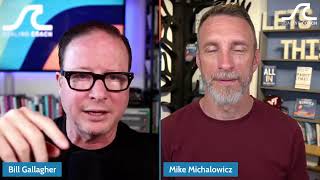
This is a YouTube video titled "The Money Habit with Mike Michalowicz" recorded in July 2025. It features a conversational interview between Bill Gallagher, a scaling coach and podcast host, and Mike Michalowicz, a serial author and entrepreneur. They discuss personal finance strategies, money management habits, and the psychological aspects of wealth building, including practical tips like subscription management, the six-account system for budgeting, and the importance of financial clarity and intentionality. The conversation also touches on personal stories related to money challenges and lessons learned over time.
Yeah. What if managing your money was as natural as bobbing your head to the beat?
You're good at improv.
What if there was a groove you could just follow and it actually worked? Instead of running you into the poor house, we're talking about putting your budget, your money on automix, right? Getting the groove going and riding it. Building wealth without all the anxiety about what comes next. Without spreadsheets and a lot of neuroses. Hey everybody, I'm Bill Gallagher, scaling coach, host of this super fine Scaling up business podcast. Our show comes to you weekly, I don't know, about 650 episodes now. Wherever you're getting this right now. So just turn on it all and follow us and all that kind of thing, you know what to do. But if you want more, go to scalingcoach.com that's my website and that also has things like some free tools and we do a monthly workshop that gets you started in the path of scaling up, starts to introduce some of the way you work and gets you a little, not one on one, but a few on one time with me. You'll definitely get some attention for me talking about you and your business. Scaling coach.com. all right, listen, I want to introduce my friend, returning guest serial author, entrepreneur, awesome all around guy, Mike Michalowicz. So Mike built and exited several multimillion dollar business before the age of 35 and he now runs, I don't know, a couple dozen ventures that spin out of and are related to the books that he writes. He's a best selling author of Profit First, Clockwork, a whole bunch of other books, over a million books sold. Mike McAllowitz, Profit First Cash Flow Method has been adopted by over a million business around the world, I think.
Yeah.
And Mike's been featured on MSNBC and loads of other places. Mike, welcome to the show.
Well, it's good to see you. And you didn't. You neglected to share that. We also went to a concert together. We saw the Eagles together and we were grooving out to take it easy.
You know, the concert that still is ringing with me is the U2 concert. That's.
Oh yeah. Oh yeah, I'm sorry. Eagles performed also at the Spear because we saw the Sphere. You're right. It was a U2 concert we saw together. Now it's like a total heel. That was amazing.
At our age with a little gray here and there, things start to blend.
Yeah, yeah. I did see when they started singing one, a little tear dripped down from you.
Well, when I went out to Lunch with my son earlier this week. And I'm like, hey, have you been in this place, Southie? Maybe we should go there. He's like, we've been there dozens of times. It's been there for 10 years. Yeah. And what's funny is, like, I remember being there with my wife many times, and I associate, like, going there with her on certain occasions. I. I really don't remember being with anyone else.
Not funny. Well, yeah. What were you doing? What else were you doing down there that would make you maybe not to remember so.
Well, good question. I've. I've said to my daughter, running joke now. Hey, have we. Have I taken you to this place called Acre? It's a great little restaurant. And she's like. It's like her fourth time dad. How am I getting so old? Like, it's really painful and embarrassing.
Yeah. Yeah.
All right. So what's the weirdest personal money ritual that you keep today? Something that might make your banker raise an eyebrow but saves your sanity. What's the oddest thing you do around money?
Yeah. And I'll tell you, this is a game changer. So I have a dedicated credit card that I've scrolled the word subscriptions on in marker, and all of my subscriptions, Netflix streaming. I have, like, an exercise thing called Hydro. All those things go on there. I used to think, oh, I spend probably a couple hundred a month. I spend over $600 a month on subscriptions when I put them all there. And it was a shock. So it helped me cut those things in half. And every month when that statement comes, it's super painful around subscriptions.
That's a. That's a really great idea. And I think to do I last. I don't know, recently, in the last couple months, we've done for a couple companies, some cash rescues. Like, let's. Let's do a deeper dive on your business. So we will anonymize. We'll take off the header data and change the names on some of their financials and their account list and their vendors and some of the credit card statements. And we throw all that stuff into your favorite neighborhood AI tool. And we're like, what are all the subscriptions we could cut? And where's all the. And how could we combine things? And where might we have duplicate things? And chat found all kinds of things like that. And in one case, it was like, hey, you are paying for Zoom, but you already pay for Google, and you could use the Google video meeting.
We did the literally the exact same thing. And we did the exact same outcome with Zoom to Google in our transition, and that's been bumpy because there's some. There's some ongoing commitments we had that Zoom was required. But we've been moving over, and, my gosh, we're starting to save the funds. It's a big deal.
Well, this company had many, many users on Zoom and Google already, so it was really adding up in this case. But we found all kinds of interesting combinations of things. And then I used to have a hack. I would tell our accelerator, we have about 2,000 companies in a program called Accelerator from EO organization that we do. And I used to tell folks in those things, you know, just periodically start canceling and reissuing your credit card. So take whatever your card is and just cancel. Don't do them all at once, because then you'll find yourself in a weird situation. But, like, do the one. Cancel it and ask. Tell them a card was hacked, stolen, whatever, and you need a new number. And then get a new card and then rotate through all that, and then all those subscriptions will have to come to you for a new number.
Yeah, so we're talking. It's like we're at church here. It's choir and preacher. Same thing. Just one caveat. Be careful. When you get a new number issued, sometimes they will transfer over subscriptions. So you have to take. Tell the credit card company, I don't want anything transferred over. I once tried a lame joke. Didn't work. I said, my card was stolen. They say, you have any more details? I said, well, it's stolen by me. And there's like, silence on the other side. I'm like, it's whatever. I lost it. I lost it.
I left it somewhere.
Yeah, I left it somewhere.
I'm about to cut it out.
Right. I left it in my pocket.
Yeah. So that's a. I mean, that doesn't work if your company's bigger. Um, and. And your things are more complex. But. But periodically doing that because you're right. All kinds of subscriptions and things. Like, I found various, like, website services, things that were part of our marketing. I'm like, we're not using that. We don't need that. You know?
Yeah, it's shocking. And this. Obviously, we're going to talk about personal finance, too. It translates all the personal finance, and maybe businesses have a couple more zeros at the end of it, but it's the exact same situation in most cases.
All right, so profit first. We've talked about before. We've talked about on the show, we've taught it every other year to the accelerator community. We get people started on it. You've got profit first professionals. But the ideas of that now may be more applied in a more personal way to your personal finance. Is the money habit.
Yes, exactly. So I got a call from a garage door service company. It's called A one Garage Door. And the owner says, hey, I did prop first. My business has been transformative. I want to know if you could do this for my employees. And I'm like, maybe. I said, but why? And this was interesting. He said, well, my employees have financial worries and they're coming to me and saying, I need some more money. You're not paying me enough. And he goes, they're great people. I want to pay more. I have paid them more. And the same person comes back and say, well, it's still not enough.
It's never enough.
There's never enough. No one break there. You don't break through the atmosphere here. At some point you have to. Financial independence is financial clarity. And then that becomes control. So I said, yeah. I said, that's really interesting. So he was like, I want to educate my team members on financial acuity. Could you do it? I said, yeah. How many folks you have thinking, like, you know, two or three or ten? Because, yes, it's 900. 900 employees. I'm like, what? Yeah. So we did a beta group of about 30 folks and then subsequently rolled it out to the team, the entire company. And it was really fascinating that without changing people's income, you can change their financial independence just through awareness. And it's not necessarily just cut your spending. That's not really the solution. It's an awareness so you can control and direct where you do spend and where you don't.
Yeah, being thoughtful, being conscious, being intentional. Let's talk about how the whole thing even starts. Let's talk about your meltdown moment. You sold a couple companies, you had a lot of money, and then what happened?
So, yeah, like, yeah, total idiocy. So self made millionaire in my early 30s. Think I think I'm hot. Hot tamale. I know everything. And I was just extremely ignorant, extremely arrogant, which is a deadly combination. As entrepreneur became an angel investor, I lose everything. And the transformative moment is I came home to my family and I'm fronting my wife and my three children, and I'm bawling to telling them we're going to lose our house. We lost it within the month. And I told him we have to cut everything back. And my Daughter. She goes, but, Daddy, can I can. I still go to horseback riding lessons. And to give context, was $20 for a group session. Every time I'm like, I'm sorry. No. And I'll never forget, she bolted out of the room. I hear the door slam. I'm crying. I'm ashamed. I get. She wants to run away. She's so afraid. Thing is, the door opens just as quickly as she closed it. Behind that door was where she kept her piggy bank. And she runs back and she's, daddy, Daddy, Daddy. She goes, we're okay. I'll pay our bills. And she gives me her piggyback. Still get emotional. And that moment became, in retrospect, not in the moment. Only years later do I realize that was a defining moment. I started to drink a lot back then. You know, we go out together. I don't drink anymore, really occasionally, but not really. And I said, I realize I know nothing about entrepreneurship. I think I do. I've been lucky, but I've been ignorant. I'm going to get really invested in understanding and mastering it. And when I figure something out, I'm going to teach it. Hence, first is one of the things I've taught. Secondly, I don't know anything about money management. Even though I'm a finance major in college and stuff, I'm going to figure out money for myself. So from that period forward, I had implemented a personal financial management system and a business management system, and it's. It's transformed my life.
Yeah, it's. It's a really remarkable thing. And you know that the kid thing, the family thing is so, like, personal and emotional, right? Like, I. For a year, every time you come up and you see that, right? One of my, like, big pivotal moments came when the. The bank wanted to take my house and they were threatening the business, and so they. They just thought they'd sort of dangle out there, well, we could take your house. And, and, and they didn't say it, but I immediately thought, I lose the house. Lori leaves me. I become a weekend dad. And that was like the most terrible. Now my kids are grown now. We survived that. We did it. I'm in that house today, so it has a happy ending. But that kind of thing, like, really gets to you. And then the idea of, like, intelligent, thoughtful, humble sort of stewardship or whatever is usually what's there for most of us. For me, I actually had for years. I don't have any more. A picture over on the side wall. I have little inspirational pictures, things like that. Of Ward Cleaver. And so there's this old show, Leave it to Beaver and Ward Cleaver was this old, like 50s style dad and he, like you, you just knew that he always had the family's finances well in hand. Because he was written that way.
Yeah, yeah. Because he was written that way. It's so funny. That's right. That's why. Yeah.
He always had the right thing in a calm fashion. Right.
My father, he's passed away. But growing up, my family's a single source. Income was my father. My mother started working again once we got into high school. But everything, you never talked about money at our house and everything always seemed fine. It's only funny since he passed, my mom and I have had some heart to heart conversations. Oh, there were some really tough periods. I don't remember any of it. I wonder, is that a good thing? Because my parents were protecting and shielding me from something that brought me fear. But also. Which is nice and good, but also I wasn't, I went in with this ignorance into money management. I thought if you make money, you make money, you keep it. Like it just grows and grows and grows. It's not the case.
Yeah, yeah. You find new ways to spend it. Right. I'm, I, you know, I think at any level, right, we, we, from time to time we heard about a billionaire who faces bankruptcy, right. Because they, they like that kind of money. Well, even 100 million starts to make you think that you're smarter than everyone else. Right.
There's no level of income where you escape terminal velocity. There's always that gravitational pull. So it's funny, like if you talk to the average American makes $50,000 a year, which. Right. So that's the average American and the average listener is making probably a lot more than that. And we're like, how do you live on 50,000? Because I can't live on my 150 or 250 or whatever our number is. I can barely get by on that. Well, it's all relative. Once you're making a different level of income, the spend goes up. It's called Parkinson's law. It's a behavioral wiring that as a resource expands in its availability, we expand it in our consumption of that resource. So even the billionaires, like, how do you get by on 250 a year or a million a year, whatever you make, how do you survive? I can't comprehend because I'm barely getting by at a billion a year.
I think that's the thing. It's like, well, okay, well, I Could live lots of places other than where I live. Where I live is remarkably expensive. Right. Like if I, if my. At this age. Right. My wife and I go out for dinner. We usually share one salad, one entree, two glasses of wine and one dessert.
Yeah, yeah.
One meal, but two glass of wine. Taxi tip is usually $150 to $180.
Yeah, yeah. Isn't that. It's unbelievable. It's unbelievable.
And this is not super like. So we have also the, like the Mich. We have a couple. We have a restaurant down the street with two Michelin stars. I took my wife and daughter there for a birthday. You know, that way more like 10 times as much expense. Right. So go live in, I don't know, pick a, pick a little less coastal place, a little less urban. It's going to be a different cost of living.
Yeah. And I would suspect human nature dictates that person that leaves the coast and goes interior. Us rural town still struggles financially because. Because our. Regardless of the circumstances around us, we will find a way. It's like water flows out. There's an interesting phenomena too. As I was interviewing people for this book, I said what do you need? Do you think you need to be financially sound forever? And everyone was kind of the next tier. So if I was making 50,000, I said if I make 75,000, I'm there, I'm good. If I was making 75, it's usually almost like a doubling. If I make 150, I'm good. And a lot of these people myself too. I would look at someone in the news like if I had that kind of money, I would never make so many mistakes. And the reality is, day one you won't make those mistakes because you've been wired to live within your current parameters. But day two or day three, I start getting concerned because now you have this expansion of inflow of cash. You're like, oh, what else could I do? Our spend will rapidly expand. So it's true. Someone that doesn't have the money in the moment won't spend ridiculously like someone that has a lot more money. But that is very short lived. Typically.
Yeah. You know, it's funny, I was on a panel of founders at some meeting, conference, whatever of founders of tech companies in 2000. I'm pretty sure it was 2000. Could have been early 2001. Right. So. Right. Just before everything went up and, and I was asked if. And I'd started the company with about a combined financing of maybe half a million. And somebody asked me what Would you have done differently? And they thought they were so brilliant with this question, what would you have done differently if you'd been funded with 5 million? And they wanted to hear some dramatic change in strategy. And I said, well, I would have done pretty much the same things, the same mistakes, but bigger and f turn with nicer reality.
The reality I talk with. You know, I work with micro enterprise when it comes to the entrepreneurial space. These are companies that generally do under a million dollars in revenue. And some of them say, I need to raise funds or want to raise funds and have no experience with it. So they hear about VCs, I'm like, forget it, just forget it. But. And the response is, a VC does not make a small $500,000 investment or 100,000. They'll make tens of millions. And the response from the small business owner is like, oh, I can take tens of millions. You can't. No, you can't. You shouldn't take any money, my friend. It's this perverted belief that because we're just scraping by today that we actually have it figured out with finances and more money. Well, now that's the delta we needed to have savings and prepare for our future and all that stuff. No, if you're barely scraping by, you've only proven you know how to barely scrape by. Irregardless, or regardless of how much income comes in.
Yeah, so take in money. Now you need to put it to work, which is what a VC wants you to do. They want that money making money not just sitting in your account, like it could sit in their account just as easy. So they've given you money, now they want you to put it to work. What are you going to put it to work on? If you don't know yet what to throttle, where to invest, good luck. It's just you're going to throw it at things and it's not going to work. Let's talk about this epiphany of six accounts. When did you like, have the insight? What is it that led you to that?
Okay, so with the money habit, that's the personal finance book I wrote. I've been living this, so I consider myself ground zero. I've been doing this for about 17 years now, and it's transformed our income just to set the stage. My wife and I used to have a parent child relationship when it came to money. I'm the money guy at the house, I pay the bills. My wife would come up and say, hey, Mike, can I get that lollipop, you know, or that item, that thing. And I say, no, no, no, we don't have enough money. So it's a very parent child relationship and combative. I'm the bad guy or the good guy and neither of us like to me in that role or her in that role. The system has put us on equal footing. In fact, she just pinged me today and said, oh, I have a question. Because this system becomes the parent, if you will, it's in control. What we do is we set up a technique. It's called a behavioral intercept. Basically, it's very difficult for any of us to change our behavior. I want to lose weight, I'm going to go on a diet. Good luck changing that. We have far more effective results by staying with our current path, but just having some kind of mechanism that channels our behavior to get the result we want. So don't change channel. So what we do is we look at what's our current routine. Well, for almost everyone, when it comes to personal finances, very few people balance checkbooks and we're told to still do that or equivalent. Very few people reconcile their accounts. Very few people have a formal budget. But what we all do is we log into our bank accounts and see how much money we have. So what we do is we skip accounts at your bank and it needs to be there because that's where you're naturally going. That's an intercept. The six accounts are as follows. One is income. That's your source of income. It's if there's one earner, that's that one person. If there's multiple earners, it's their net deposits. The next account is called needs. These are survivability needs, the core elements to survive. So I need food, I need water, I need shelter. Wants are the small luxuries. So I want food, but I want to go out and have a Michelin rated restaurant that is actually a want. You don't need that, I want that. So we need to allocate for that. And the ultimate is dreams. Dreams are the largest aspirations and it's all contextual. For some people a dream may be, I haven't gone on vacation in 20 years. I want that. For some people it's like I want a second home. You have to define what it is. Then we have what's called fixer future. Fixer future means a lot of people, sadly in America in particular have lots of debt. We can fix that. And we need to be in a program that's getting that debt gone, reducing it and ultimately eliminating it. Once our debt's eliminated. Then we focus on future planning, retirement, other elements of our future life. And then the last account is called Emergencies. The unexpected is the one thing you can always expect. That roof is going to, that roof is going to leak, someone's going to get sick, something's going to happen. So we're going to allocate for that. So that's the foundational six accounts.
Yeah, I, it's good to think about all of those things, right. And how they break out and to break them down into things. I probably you get into debates about is it a want or a dream, right?
A need or a want. You need a Mercedes. You know, I, I need, I need a car. Does it have to have a Mercedes logo on it? Yeah.
People will say on the regular, right? So I, I need the Mercedes because the job I have, I need to project a certain something. You live in Los Angeles, like, oh, people have a car well beyond their means in LA to put out some bs, right. On the other hand, you might have somebody who's really made it, who drives a Prius because he wants to send the message that he or she is environmentally responsible. Exactly like kind of thing. So you can send a message. I might argue I need the Michelin restaurant. Cause I need my wife to be happy for her anniversary.
I remember I, I met with as a guy we both know, I just don't want to say his name because I don't know if he would want me to publicly share his name. It's a company that does nearly a billion dollars in revenue and he's out, he's in Canada. I go out to visit with him, this is 10 years ago. And he's like, yeah, I'll pick you up at the airport. Like, oh, it's super kind of you. And expecting like a Lamborghini or something come up and there's like this beat up pickup truck comes and I'm looking and he parks right in front of me and I'm looking around and he's like yo. I'm like, that's you. He's like, yeah. I'm like, this is an interesting ride. Now this is like an old pickup truck. He's like, yeah. I goes, I love pickup trucks, man. There was no need for anything, but that was just his joy. So ironically, a beat up pickup truck was his only ride. Satisfied his need, but it was also his dream. And sometimes that happens. It's just, it's true authenticity.
Yeah, yeah. I, yeah, I think finding ways, right. So that goes to a little bit money and happiness. Right. We think money buys happiness. But in reality, you'd have a lot of money or a little money. You could be unhappy or happy. And they're not really related. Right. At all. Like people are live in slums and are happier than people with billions. It's where you come from. It's a choice. It's a way to live. It's a frame of reference. Right. There's different. Yeah. On the other hand, if I have a lot of money and I'm feeling down. Right. I can do some unhealthy things to.
But there's no question it gives you the freedom of choice. You can choose to do healthy things too. I mean, listen, there is a base level research identifies there's a certain level of income in the US standards, about 75,000 for a household where happiness increases at the exact same rate of income. So we are more happy the more money we make. There's also a misnomer about, you know, the miserable billionaire. Billionaires on average are more. Are happier per surveys than other earners. So more money gives you access to more opportunities. But how you manage that, of course, is the ultimate driver of happiness.
And you know, in. In after the 2008, 9 downturn. Right. Laurie and I, we thought we might not have a company, we might not have a house again. Yeah, yeah. And we faced all that. We looked at our life and we're like, but this is the moment because of the age of the kids. So we said we were going to do certain things. And so. And when we travel with the kids, family travel, extended family travel is what was important to us. That we had said before we had kids, and it was clearly still important. And we agreed and. But we're like, we don't know if we're gonna have money or. And we said, we said at that moment, we said, well, either we'll be backpacking through Europe with a couple of preteen kids, or we'll be in really great hotels. And who knows? But come next year, something will be. There'll be some kind of a trip and we'll be in Europe.
Yeah. Yeah. I love that. Yeah, you're right. You can spin it any way you want. It's interesting. It's also really happiness. What is happiness? It's. To me, it's the reflection on story and then the interpretation. I give it to it. And sometimes the reflection can be in the moment, seconds later, but over time, sometimes that maybe things I didn't feel were great in the moment. And reflection, like that was the greatest thing that Backpacking, when that snake came into my tent was amazing. You know, it is funny how we can digest it in different ways.
Let's talk about seasonality. Right through a year, we have seasons. Through phases of life, we have seasons. I'm in a second career now. A couple of our parents have passed. We've got some other parents who are getting close to passing. Our kids are now pretty much independent. I'm a grandfather now. I'm not paying for college now. I'm beginning to think about maybe working differently or less. I've already begun to shift my work even from where I started, you know, 13 years ago as a full time coach. Um, talk to me about seasonality and cycles and that kind of thing.
Yeah, you know, as I went through traditional personal financial research, learning, I love so many books out there that I've read and used and they've been very valuable. I did see a common thread that there was phases, chapters where, you know, and there's even a rhyme like your 20s and 30s are for learning. Your 40s and 50s are for earning. Your 60s and 70s are for burning. Your 80s and 90s are for returning. I'm like, oh, there's a script. But as I looked at it, I said, no. When my children were young kids, I want to go to Disney. I want to actually burn cash at that point because that's going to be a remarkable story where their appreciation for the innocence is going to be of such value. It's way better than a trip when they're in their 40s and I can go there. So we go through these quick cycles and to me it's like seasons. Within the major phases, there's seasonality. So the seasons are as follows. There's a recover season. Recover is where I'm laden with debt. Often there's a financial desperation of sorts, check to check living. And we seem to hack our way out of that. A lot of people that are discovering the money habit are coming in, in the recovery season. But then there is the activate season. That's where, yeah, I want to do that Disney trip or whatever it is where you actually are depleting funds with intentionality. You're spending more than you're saving. And that can happen in any phase age of your life. Then there is the so we activate fund. Oh, the fund season fund is where we're preparing for a future event, not necessarily retirement, a future event. We've been doing that for years. We're doing a big trip, big family trip and we've been funding for that. And then There's a balance. A balance is where I'm living large as I define that activate, but also preparing for future events and striking that delicate chord. Unlike seasons like you don't go from winter to spring to summer and fall, you can bounce around. You may start in recovery season and jump right to balance, and you may actually go back to recover because of an unexpected event and move to activate. But we do have to have clarity of what season we're in because that brings intentionality to, to how we use our money.
It's a really interesting reflection, I think. Like I, I look at my grandparents and, and my parents and how they lived with money and then I think about how I live with money and, and one of the things that comes immediately to mind with that was my grandfather who grew up during the Depression and for a period of time slept in a tent in the backyard because they took in the extended family, right? So they came together. You might consider that like a heartwarming story of community resilience, family self reliance. Like my grandfather took that as a scary lesson, like, I never want to be in that position. I'm never going to do that. And I. And he vowed, I don't know if it was conscious or not, but he vowed it later became very overt. I'm going to die a millionaire. Now this is interesting because my grandfather was like a bank manager, not a high level banker, right? He was just bank manager. And so he never made a lot of money. And in fact he had a couple of massive losses when he had too much concentration and risk and that kind of thing. But he was determined to die a millionaire. And he was unbelievably frugal. Like, like, yeah, yeah, yeah. That's the most. Good God, man, we can go to McDonald's. It's okay, you know, like that level of, of stuff. He's going to build a patio in the backyard. So we went to a place like a beach that was unposted or unmarked and we just took sand every day so we could make the patio. Because he wasn't going to buy the sand, right? We would go, I remember going with him. We'd fill the back of the Datsun B210 with buckets of sand and then we'd do a little bit and then we'd come back the next day and like, like, so he loved sailing, just like that was his thing. Now my dad's a sailor, I'm a sailor. Like sailing runs through us, right? But my grandfather, who did die a millionaire, wouldn't buy himself five to $7,000 sailboat. And he sort of begged and hoped for friends to take him sailing, which was never enough. And like, he denied himself the most basic pleasure instead of finding a way to do it. And I think there's a lot of that runs through us. We're so neurotic now. My dad, seeing his dad was like, foolish with money beyond belief. Like, just have it, spend it. We're gonna eat big today, right? He was a speaker and, like, I just got paid $40,000 for a gig and, like, you know, and we'd live well for a little while.
Yeah, yeah, yeah, yeah, yeah, yeah, yeah. That's the Easter famine.
I'm. It's fascinating to me, and I'm like, how do I. How do I progress beyond that? But I see the seasonality, like, give yourself the boat, like, go to you. That's what I like about our decision about going to Europe. One way or another, we're going to Europe. We might not put it on a. On a credit card. You know, it might be really on the cheap end of things.
But, you know, we have. The book is as we're recording, this isn't even out yet, but we have over a thousand people have deployed the system because we've been teaching it and we're. Hopefully it grows exponentially. But one of the common challenges is exactly, this is my past wiring is dictating how I manage money going forward. Usually that means I'm not going to change the system. I just. I was burned in the past, therefore, I'll never be burned again by living in that tent, figuratively, for the rest of my life. So you actually emotionally stay trapped there. So the technique we have is to get started with the money habit. Ask yourself, what is the one thing that most worries me or I wonder about the most? Every time I wake up, do I worry, can I pay the mortgage this month? Hopefully you it's not. And for most of us, hopefully it's not. But some people, that's it. Well, then we're going to do is we're going to set only one account, forget the six accounts, one account that says mortgage. And we're going to allocate the funds that are necessary to ensure the mortgage is covered. That will tell us what's left over for everything else. And at least that one worry will be satiated because you'll have absolute confidence. I wonder for your grandpa if we could have set up an account called the sailboat, and he allocates a portion of money to that so he can still have this frugality in the rest of his life, but he'll no longer will wonder, can someone else give me a sailboat for the day? He'll have the funds there. And it's undeniable to start with one account. I call it a clarity account on the thing you wonder or worry about most and have absolute confidence, I wonder for your grandpa if we could have set up an account called the sailboat. And he allocates a portion of money to that so he can still have this frugality in the rest of his life, but he'll no longer will wonder, can someone else give me a sailboat for the day? He'll have the funds there. And it's undeniable to start with one account. I call it a clarity account on the thing you wonder or worry about most and just watch, you know.
So for me at this point, but at this age and with the training and experience and things like that, I know that I have a range of fundamental concerns, but I can do them in a variety of budget levels, right? So like I belong to the sailing club. I think the monthly fee is like 60 bucks or something. It's not a huge amount. And then I pay for the boat. So if I want to go take friends on a really big boat, I can rent that boat. It's a thousand bucks on a weekend day or whatever, right? But I can take 12 friends or something, or I could watch the crew list and I could jump on somebody else's boat and go sailing for 100 bucks, right? So I could do it in a range of ways. I could go down. I remember early in my life and career I wanted to go sailing and I'm like, how do I sail? I can't afford a boat at this point and I don't know anybody in this town.
And.
And I was, my uncle or my dad or somebody told me, just go down to the yacht club and get a little three by five card and write, crew available. You know, eager, enthusiastic, will take any position, right? And. And very like immediately I got called by six or seven people. I did a sailing on a few of them. I ended up as a regular crew on one of the regular racing boats. And, you know, and I raced a couple seasons with that crew in different positions and like, great. Now I sailed for free. You know, I think at any level, in any way, there's a way to work it out. There's a way.
There's always a way to work it out. There's always a way to work it out.
But knowing what you need, Like, I need a certain amount of me time. I need a certain amount of play. I need to get outdoors. I need, like, I get anxious if I don't travel. I like. Right. So what am I going to do?
Yeah, yeah, we. Exactly. I think we need to know what our personality desires, but what's the root desire as opposed to the possession? What is the outcome? I need to own a sailboat for me to be out on the water. Well, that's not true, but we also. We often have the possession intercept us. Say I can't be on the water until I own a sailboat. But what you did is a great example of. You talked about the outcome you wanted. You just want to be out in the water, man. And one way to do it is by being in the crew. One way to do it is by owning a boat. But there's many paths to get there. I think people don't look at that enough.
Your work and structures are great, both with business and personal finance. They're applied to that particular thing. But there's a lot of symmetry here between some of the thinking and ideas that go in the mega popular atomic habits book. What are the regular focuses and small changes that we could make that would make a difference that would actually give us what we want.
Exactly. So the entire money habit system, even though it's simple, it's overwhelming. Profote that it's just as simple. It's overwhelming. And what James Teach, James Clear teaches in his book is start off with those micro. The atomic habit. The smallest change, the biggest change. Yeah. So I'll give you a little hack. I did this is prior to him writing his book. So I kind of stumbled across it. I wanted to exercise regularly and just. I didn't. I tried to use willpower and that surely didn't work. But what I did is I noticed I'd wake up in the morning, I go to the bathroom, make a cup of coffee, and then start scrolling through the news. So I said, that's my predictable pattern. So what we need to do with our money is. What's your predictable pattern? Well, once I identify, I go to the bathroom right after I wake up, I put my sneakers on the toilet seat. And so the only way I could use the toilet was by grab my sneakers and I intercepted my predictable pattern. Well, with the money habit, what I realized, most of us, we do bank balance accounting. We launch our bank account and if we have money, we spend it. If we don't, we panic. So I said, okay, that's the intercept that's the toilet seat. We need to put the sneakers on that. So that's the Clarity account or ultimately the 6 account. But intercept what you naturally do, and that's in alignment with atomic habits.
It's a really like thinking about who you want to be, what you want it to look like, and then starting to make little changes to adjust. I remember when I first applied, so for years I had good accounting, team controllers and CFO and things like that who managed me and managed my money because I need managing. One is watching in the background, she knows I need managing, and I forget what I'm doing. You know, I have a thought and I go to the phone and before I can even finish that thought, I'm distracted by something else and I'm looking at whatever and I'm. I'm like, lost, like a lot of people. So learning to manage myself with little cues like that, like put the, put the sneakers out or do the thing makes a massive difference. I, for me, it's like, okay, I have to put out the sneakers and they'll fill the water bottles and pump up the tires and do things like the, the night before. And then if they're there, hit me in the face, right? And with the business, right, There's a recurring thing on the 10th and the 25th, or, you know, you're sweep your accounts and you know what the percentages are now, and you're moving them in the first time around. You just put 1% aside, right? Yeah. And the business, like, you know, there's. You probably don't have a tax account for most of us personally because it's coming out already from either the business or W2. But. But you've got the needs, right? What is the mortgage? You're setting that aside first, and then you're learning to live with the rest and you're making small changes. So you eventually have money for the wants and dreams.
That's exactly right. But we actually start allocating for the wants and dreams from day one, along with it. So in the book I researched out, basically there's five income thresholds. So if you make nothing to 50,000, that's what I call tier one. 50,000 to 150,000 to tier two and so forth. And what I found is what the proper percentage allocations are for an optimized plan for each season. So if you're in recovery season, here's the percentages. But if you're in the fund season, here it is, and so forth. And so you allocate these percentages so the idea is you're tackling that mortgage, but you're also preparing for that dream, whatever it may be, and the short term luxuries you want. If you can't afford your mortgage and there'll be things, or you can't afford that dream beyond because of the money you're allocating. What that indicates is either you have too much house for your current income. Hard conversation, but truthful. And how are you going to address that? Or you have to compromise future dreams and have to do this now at a conscious level. Many people do that subconsciously. We buy the bigger house or that Mercedes because I live in a certain area and say, look, I'm driving the cool ride now. And we subconsciously are also saying, and I don't care about my future. Screw my future dreams. I got my sweet ride now. So what the money habit does is that all is happening. It's a subconscious now, you see, oh, I'm paying more for this car than I can afford and have the small luxuries going out and have those dreams. So am I consciously willing to compromise those things and. Or I'm going to run it up on the credit card. I'm going to keep doing it and I'm going to run up on a credit card and the money hat will show you you have a very quick trajectory to the cliff. And that is a horrible moment because you get right over that. And recovering from that bankruptcy is excruciating.
Knowing where you are and seeing it clearly is really empowering. Like makes a huge difference. Right? And, and, and so many people have done that where suddenly they realized, oh wait, I'm out of money. I've had it, you know, not in recent years, but in the past around business where there was a. I was more leveraged than I thought I was. And then I hit a hiccup. Like sales took a little hit, but now I have a major cash crunch and I'm panicked. Right? And then you have to make like difficult things. You sell things off, you cut dramatically, rapidly and it's painful. Right? Having a few months of warning.
Exactly. It's forcing that hard consideration or conversation before the problem happens, which is beautiful. It's still painful. But doing it in desperation results in desperate acts. And that's, that's a real problem. My I tell you about my wife. She texted me this morning, our anniversary is coming up this weekend and we're going, we're planning what to do. And she texted and said, hey, let's go to a fancy restaurant. I saw that we have an account called Dinner's out because we like to do it. She goes, hey, I saw how much funds are in there. She's like, let's go really fancy to celebrate this weekend. The beautiful thing is she didn't have to ask me. She's telling me where. Before we had the system, it was like, can we afford this? And then I had to play this weird role. And sometimes, admittedly, if I didn't want to go out to dinner, I justify saying, well, I don't know if we can really afford that now. It's all black and white and it's really been powerful for us.
You know, it's interesting how, like, you can get creative with it as long but having a plan and having a practice makes all the difference. Right? Like, so you couldn't. But. But trying to do the big deal thing when you don't have it there bites you again and again and then you wake up. How am I going to pay for that? Like, where did that come from for sure? Well, we've talked about a lot of good things here. If you want to know more. Mymoneyhabit.com that's where to go. We'll put that. There it is on screen. Mymoneyhabit.com and that's where to go to get started with the system. The book's not out yet as we're recording, but out soon. Do you know when?
Yeah, it's available now on bookshop, Amazon. Barnes and Nobles is carrying it ready on pre order so you can get it there and then my money habit. We have a ton of resources, including an AI model that will walk you through the entire system to make sure.
You'Re doing it right. Right. So awesome. Everything should be AI enabled. Make it sweet. Mymoneyhabit.com if you want to know more about that, go find Mike Michalowicz there. Mike, thanks for joining us. Shout out to everyone if you want to know more about our work in general in the broader sense of scaling up or get anything else or do a workshop with us, that kind of thing. Scalingcoach.com that's our website and big shout and thanks to Wanda and Anna who get our show ready, in and out, everybody, every week and keep it running smoothly. It takes more than me to get on here and talk and make it good and bring folks like Mike to you. A big thanks to my friend, our mutual friend and my mentor, Vern Harnish, who created this whole scaling up framework, without whom we wouldn't know each other. We wouldn't have done lots of things in our business. And to all of you, thanks for watching, for listening. Trying to do the big deal thing when you don't have it there, bites you again and again. And then until next time, keep scaling and you wake up. How am I going to pay for that? Like, where did that come from for sure. Well, we've talked about a lot of good things here. If you want to know more. Mymoneyhabit.com that's where to go. We'll put that there it is on screen. Mymoneyhabit.com and that's where to go to get started with the system. The book's not out yet as we're recording, but out soon. Do you know when?
Yeah, it's available now on Bookshop, Amazon. Barnes Nobles is carrying it ready on pre order so you can get it there and then my money habit. We have a ton of resources, including an AI model that will walk you through the entire system to make sure.
You'Re doing it right. So awesome. Everything should be AI enabled. Make it sweet. Mymoneyhabit.com if you want to know more about that, go find Mike Michalowicz there. Mike, thanks for joining us. Shout out to everyone if you want to know more about our work in general in the broader sense of scaling up or get anything else or do a workshop with us, that kind of thing. Scalingcoach.com that's our website and big shout and thanks to Wanda and Anna who get our show ready, in and out every every week and keep it running smoothly. It takes more than me to get on here and talk and make it good and bring folks like Mike to you. A big thanks to my friend, our mutual friend and my mentor, Vern Harnish, who created this whole scaling up framework without whom we wouldn't know each other, we wouldn't have done lots of things in our business. And to all of you, thanks for watching, for listening. Until next time, keep scaling.










