
Aspen Funds 2025 Economic Forecast
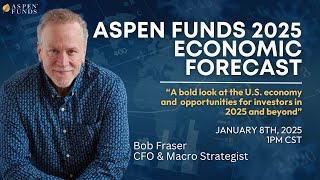
In a recorded January 9 2025 webinar, Aspen co‑founder, CFO and chief macro strategist Bob Fraser presents Aspen’s 2025 economic playbook to an investor audience. The discussion, moderated by Ben, walks through Aspen’s “mega‑trends” – major macro forces shaping the U.S. and global economy – and translates them into concrete asset‑class and sector opportunities. Fraser reviews the legacy of the Trump administration’s policy mix (tariffs, tax cuts, immigration stance, energy policy) and projects how these will affect inflation, the labor market, and the Treasury‑funding environment. He then examines the strength of the U.S. dollar, consumer spending, wealth‑effect dynamics, and the outlook for core inflation, emphasizing labor and energy as the hidden drivers. The webinar moves to sector‑specific outlooks: oil & natural gas (LNG opportunities, supply‑deficit risk, range‑bound pricing), industrial real‑estate (reshoring/nearshoring boom, cap‑rate stability), multifamily housing (short‑term distress, long‑term shortage), and private credit (preferred‑equity strategies). Fraser also touches on China’s economic collapse, de‑globalisation, and the limited role of crypto (only Bitcoin deemed investable). Throughout, he stresses Aspen’s disciplined, agile capital‑allocation approach, the importance of low‑leverage structures, and invites listeners to join Aspen’s Investor Club for early‑access deal flow. The session ends with a brief Q&A covering debt sustainability, interest‑rate expectations, and construction impacts.
Chapters
Hello, hello everybody! Welcome to today's webinar. So excited. To jump into today's topic, which is the 2025 economy and forecast. And we got a lot to cover today. We have an amazing turnout, so thank you all for joining live. I know a lot of you couldn't make it, so this is recorded. We'll share this as a recording later on. But before we dive into it, if you've been following us for any length of time, you know how important this is to how we operate at Aspen. We look at the big trends, what we call the mega trends, that we believe are going to be in play and be a key part of an investor's understanding of where to invest for the next several years. And so really excited to do this with Bob Fraser, one of our co-founders and our chief financial officer and really our chief macro strategist. He's been following the economy, been following trends for over several decades now and with pretty incredible accuracy over the past several decades. If you've been following us, you know this is really good content. This is probably our highest-rated content and what people ask for all the time. Bob Fraser is going to be presenting these very slides at multiple conferences this year. So you're going to really, really enjoy this. And again, this is our playbook for 2025. This is how Aspen is looking at the economy and looking at the opportunities, and we want to give it to you. And if you want to participate with us and what we're investing in this year, we invite you to join our investor club. Um, but you can take all of our research here and use it to your benefit however you like. We'd love if you want to join with us. So we'll have some throughout the presentation here, ways for you to join our investor club if you're not already in that. That gives you early access to our deal flow and insights and content that we put out throughout the year. So with that, let's get Bob Fraser to the stage here and start the presentation. Bob, all right.
Yeah, I'm pretty pumped about this. And, um, for those of you who have watched us for a while, you know, a lot of my— a lot of the presentation is similar to the previous one, always. That's because nothing, you know, really— I look at the big trends and a lot of things haven't changed. Well, this time a few things are changing, so, so it's kind of interesting. But yeah, we've been doing this how many years, Ben? And, uh, I mean, a lot, lot of years and with pretty good accuracy. But as Ben said, this is our playbook. So I literally spend this time for myself and for my company Aspen to figure out where we want to put our chips in this new year and where we want to look for the outsized opportunities. And so this is our playbook. This is how I'm going to place my capital this year. And we love to share our playbook with anyone who's interested. All right. So let's see if we can jump in here.
And just while you're pulling that up, um, we have a lot of people on the line here, so put in the comments where you're tuning in from. We'd love to see, uh, where everyone's coming from. And, uh, and also be thinking about questions as we go along. We will reserve a little bit of time at the end for some Q&A, um, so feel free to, um, uh, put those in the chat later on. All right, Bob, let's go.
All right, that's me. And again, for those that don't know me that well, you know, in 2001, I started a— I lost everything in a dot-com crash. And, you know, when the tide went in and the dot-com boom, every— all boats floated. And when the tide went out, no boats floated. It doesn't matter how good your dot-com was, in 2001, it went down. And so that was the turning point for me. It was a defining moment where I decided I had to understand what was going on in the economy. And since then, I read 2 to 3 hours a day and study and discuss with other people what's going to be happening. You know, and it was a lot of fun, by the way. We had our, we had, what's her name, the economist Ramon.
Oh, Dr. Belinda Roman.
Dr. Belinda Roman. And oh my God, that was so fun. And I found, I mean, we're just really in sync, you know, very much in sync. All right. Uh, so this is, as Ben said, this is part of our process. So we first look at macro trends. What are the big trends? What are the big, big things that are going on? Not the little waves. I can't tell you what the stock market is going to do tomorrow or this month, but, but I can, I can tell you some things that are very, very predictable. What's going to happen, the bigger, the bigger tides. And then we identify the best asset classes to invest in and the best structures and strategies. Then we place capital. And we invest in our own deals. So this is, this is, you know, this is for us. Every single Aspen partner invests material in every single Aspen deal. Here's our track record. So we've raised about $250 million from investors, $600 million assets under management, and we've returned $85 million in investor distributions since inception. So I don't know, how do you feel about that, Benny?
I like those numbers, especially the last one.
I know. And, you know, one of the things about our team is incredible breadth of experience. We started in distressed debt, but we've got a lot of development experience, a lot of experience in oil and gas, a lot of experience in hedge funds, venture capital, private equity, and real estate. So we're not the typical vertically integrated kind of operators. And we actually like that. We think having this kind of broad background gives us a lot of perspective. And I found a lot of mistakes being made in vertically integrated operations, right? If you're the multifamily guys and you've got your own property management company and your own construction company and your own, you know, underwriting company and everything, well then you've got to do multifamily deals to feed the engine, right? Feed the machine, whether or not there's good deals. And I find I want to be light, I want to be agile, and I want to look at what wherever the money should go is what I wanna pay attention to. So, all right, the Trump economy part 2, right? Back to the future. So it's interesting in 2017, I remember that distinctly. And I remember I should pull up my old slides, you know, and when he announced the tax cuts, I said, we are gonna see an economy get on fire. And if you remember, we had 10 years of the Obama administration, the great, the Great Recession that never quite ended. And here's a very, you know, business unfriendly president who just couldn't make it work. And then Trump comes in, you know, with all Trump's baggage, you know, he understands economics and he understands business. So let's dive in. So the backdrop, Trump economy, first and foremost, all right, is tariffs. So he's talking about massive tariffs. Those are, of course, taxes on goods coming into America. Well, those go straight to the coffers of the federal government. So it's a huge way to raise money. But obviously there's a downside. So he's talking about as high as 25% tariffs. And it's interesting because as soon as he announced these tariffs, Ben, there's already been changes. You've seen just— was it yesterday or the day before? You know, Trudeau, the Canadian Prime Minister, resigned. Mexico, they're already talking about detaining immigrants and slowing the immigration process and cooperating. So, well, he's, you know, my guess is he is using these tariffs to extract concessions relating primarily to border security and immigration. So US is by far the largest trading partner for Canada and Mexico. And they're pretty much going to do whatever Trump wants. So my guess is these tariffs are not going to remain, are not going to be material. But that's a guess. I mean, I am, I'm going to speculate here. So, but this is the assumption I'm working on.
Europe. It seems to be consistent with Trump's process of talking big and, you know, using the leverage that we have, but then also backing down.
Well, if you've read his book, and I haven't read his book, The Art of the Deal, it's about coming on strong. He's a master negotiator. Works, you know. I mean, he just rubs, rubs our, you know, rubs us the wrong way in so many ways. But, but, you know, you know, you gotta, you gotta— I think it can be effective. So, right, I mean, what's gonna happen? I think we have very weak foreign policy, and I think he's gonna come on strong. We'll see. Again, you know, I'm hoping for the best. I hope for every president and hope for the best for every one of my, my leaders. Europe. So Europe, the economies are absolutely comatose, and tariffs would be extremely damaging to them. So, you know, my guess is he will use this to extract concessions on energy imports from America. They have a real energy crisis in Europe. You know, as you know, they've gotten most of their energy from Russia, and that has been crushed. Those, those, the pipeline through Ukraine has now been shut off. The other pipelines are being shut off. They're importing from LNG, primarily from Dubai right now. And this is a huge opportunity for America. And I'm gonna talk about gas down the road, but America's, we have a huge amount of natural gas and a lot of it's just being flared and wasted. And unfortunately, you know, the previous administration actually tried to stop LNG and ridiculous stuff. And so anyhow, my guess is he's going to use concessions for— or use to extract concessions on energy, on peace in Ukraine, and more spending on defense. He wants them to carry their weight in NATO. All right. Now, China, I think, is different. I think he might really be aiming for real tariffs in China. And if I was Xi Jinping, I'd be terrified because China's economy is in full implosion mode right now. And, you know, I'm going to talk about that in a minute. And tariffs are going to really hurt. So, you know, it's a real issue. But tariffs, you know, here's the downside of tariffs in China. If China chooses to retaliate, which they might do, You know, which means they would, they would, they would put tariffs on, on stuff coming, coming into China. Well, it's not a big deal for most, for most Americans and most American companies, but look at this chart. Look at the processing. Look over to the right over here. You can see this, look at what they process. China processes 40% of the world's copper. 40% of the world's nickel, 65% of the world's cobalt, 60% of the world's lithium, and 85% of the world's rare earth minerals. Now, none of these are rare. There's copper all over the world. There's nickel all over the world. America is rich in almost all of these things, including rare earths. They're not actually rare. But the problem is China processes it. They've set up giant factories processing this stuff. So, so the mines in Indonesia or wherever, create concentrates, you know, so they'll mine, they'll concentrate the ore, then they'll ship it to China to process. And then China processes it. They have these giant smelters and they do it low cost. And the reason is they've just decided to be an industrial powerhouse and they've decided to do this. Well, here's what happens if they decide to, to, to squeeze us like we've squeezed them with, with chip exports and other things that we've done. I mean, they could create a huge problem, a huge supply chain problem like nobody's business. They could completely shut off. I mean, copper is huge. Nickel is humongous for EVs and iPhones and everything else. So all of these things. So the tariffs are a double-edged sword. And I'm not that afraid of all this. And the reason is I think Trump is quite smart. Related to economics and these things. So I think he's going to use it as a negotiating tool to get what he wants out of China. And so we'll, we'll see. It's a powder keg. It's a lot of risk, but, but China has a lot more to lose than America, as we'll talk about. Right. So I also—
how do you feel like this would impact inflation?
Yeah, it definitely could. So, so there is, there is a lot of unknowns and this could be inflationary. It depends on how, how hard he goes after this. So if it's simply, you know, to extract concessions from our trading partners, then obviously it's not going to be recessionary. If it's really a way to raise capital for the Treasury and he's very serious about pursuing these, it's going to be inflationary. But it's not as inflationary as putting, you know, as what Biden administration did, putting cash in people's checking accounts. Okay. It's just not that, you know, that is about it. That's like throwing gunpowder on an open flame, right? That's what that is. This is not that. This is much more, much less. It's much more, you know, there's a lot more upstream. Let me put it that way. Right. So what this will do is continue a major, major trend that we've been tracking for several years now. The reshoring and nearshoring trend, which I'm going to get into. So tariffs are going to— and this really is Trump's driving aim. He wants America to be a manufacturing power again. And believe it or not, America is a manufacturing power. And I can't remember if I included these slides, but, you know, we have seen manufacturing jobs actually increasing. And manufacturing jobs in America have been decreasing since the '50s. So as we just continue to outsource manufacturing, but we're going to become a manufacturing power again. All right. So tax cuts. So everybody's talking about tax cuts now. And I take a very different view of tax cuts. And, and I've been right, I'll say it, you know, but hey, I could be wrong, but I've been right. And I believe that tax cuts will strengthen the economy, they'll boost jobs, they'll boost equipment demand and boost consumer spending. I don't believe that tax cuts are primarily inflationary. And again, because they're mostly upstream, what tax cuts primarily do, especially corporate tax cuts, encourage people to invest. And tax cuts to the wealthy encourage people to invest. So I think there is some inflationary pressure, but it's not going to materially increase deficits and it's not going to materially increase inflation. Now, again, and part of that is speculation based on Trump's intelligence as an economics guy. So it depends, you know, it depends how, you know, how the tax cuts are structured and what they look like. But, you know, I've included here the Laffer curve and this is a famous curve and most economists believe we're on the the right side. I, I don't believe so. I believe we're right in the middle of this. And what happens is at some point increasing taxes does not increase revenues because you slow the economy so much, right? And at some point cutting taxes boosts the economy.
So, I mean, spend 2 more minutes on that because it's a little counterintuitive, right? If you think you're going to increase tax cuts, you're decreasing, um, the federal, uh, revenue source, you know, and in, they already have a deficit. So how does that not increase it?
Well, but if you look at, I mean, and, and, and I mean, back in the Reagan days, you know, he cut taxes and revenues massively increased. Um, so, and same, same with the, uh, same with the, with the Trump in 2017, the tax cuts that he did in 2017. He allowed companies to reshore their offshore earnings and, uh, and gave them a little bit of a tax holiday and the economy boomed. Well, booming economies, people pay more taxes, right?
Right.
Because you earn more money. So my rate may go down, but my tax bill went up because I made more money as a business, right? And so that's why the tax cuts are beneficial. So I'm definitely of that school. And again, you could disagree with me, that's fine. But, you know, honestly, tax cuts are, you know, are generally not inflationary in the most ways they're done. I don't, I can't, I don't have a single example in, in the last several decades where tax cuts have increased inflation. Um, so I don't, I don't believe they have. Uh, so I don't, I don't think they're inflationary and, and I don't think they'll materially increase deficits. Um, but again, it depends on the structure. So more to come as we see what, what is actually passed. Um, the other big, you know, uh, the big, you know, thing Trump's talking about is immigration and deportation, right? He wants to stop immigration and do a pretty massive deportation. And I actually, I'm actually really not in favor of that. I, I think we need workers in America, and I think immigration is a good thing if it's done right and if it's done safely. And I, I think we should have We should have a good immigration policy, and hopefully that's something they will fix.
But it seems like he's also posturing in this topic with coming in really strong. But, you know, the end result is not as extreme as he—
Right. And he's made comments like, well, we don't want the criminals to be here, but obviously people who are working hard. And so again, we don't know what is actually going to happen. Hopefully, if people are here and they want to work work hard and they want to get ahead. I'm all for it. I mean, look at the jobs that they're taking. Look at the unauthorized immigrants. This is a great, great little chart. You know, maids and cleaners. Okay. You know, anybody, anybody listening on this podcast want to become a maid or cleaner and worry about their job being taken? I'm not, you know, you know, so cooks, construction laborers, grounds and maintenance workers. You know, agricultural workers, janitors, building cleaners, carpenters. We need these people. They help reduce wages. There's— we have a job shortage in all of these areas. So I'm not super concerned about this. And I wish there wasn't so much energy on deportation. On the other hand, I believe in a strong border, and I think we should have a strong border because I'm very concerned. I mean, if we've Have you forgotten 9/11? You know, and, and do we want open borders where terrorists and criminals and gangs can come through and take advantage? So heck no. So I'm very, I'm very strong border and I'm very pro-immigration. Can you be both? Absolutely. And I think we should have pro-immigration. But anyhow, so I'm a little concerned about this and I'm hoping he is. It's a lot of rhetoric and not as not as deep, uh, you know, as, as he, as he thinks it, thinks it could be. Um, energy policy. So, um, you know, he made, he made the comment, drill baby drill, right? You know, we're going to start drilling. Well, the reality is, here's, this is from Exxon, this is a quote: we're not going to see anybody in, quote, drill baby drill mode, Liam Mallon, head of Exxon's upstream energy division, told the Energy Intelligence Forum in London. A radical change in production is unlikely because the vast majority, if not everybody, is focused on the economics of what they're doing. That's absolutely right. And so we, we did see in the '90s, we saw the drill baby drill, as we saw, you know, the energy explosion in America, in America where America became the world's top oil producer, and it was indiscriminate. And, uh, and then, uh, then we saw, you know, uh, in 2016 The Saudis had enough of that and crashed the oil market. And since then, oil drillers are very disciplined. You know, pretty much there, no one is in drill baby drill mode. And if they wanted to be, they can't get the funding to be. So the exciting thing for me, I mean, and I think strategically, I think, you know, gas, natural gas is a, is a, is a huge resource for America. We have incredible amounts of natural gas in, in America. And a lot of that gas, like the Permian Basin, the giant Permian Basin in Texas, Texas, almost all that gas is flared off because there is no offtake infrastructure. And it's horrible. Why can't we— why can't we create LNG? And one of the things Biden did, which just, just boils my blood, is he stopped the, the, the building of LNG terminals. Now, what LNG is, is liquefied natural gas, natural gas, where they cool it, they compress it, cool it down to -250-some degrees. So it's basically extremely cold and then you can ship it. And it's the cleanest of all fossil fuels. It has far less carbon than every other fossil fuel. The US is massively oversupplied. And here Europe is starving for natural gas.
They're—
are they our allies? Do we want to help our allies? We should be cranking up LNG as much as possible. Stop flaring and crank up LNG production and shipping it to Europe to help these guys.
You know, prices are 5 to 10 times higher in Europe than they are in the US.
I mean, it's not just a little bit. Yeah, it's like 3 to 4 generally. And what's more is it's in— It's hurting their economy where the businesses that require any energy cannot get cheap energy. Plus it's energy security. They're, you know, Russia is using gas and oil as this gun to Europe's head. So are these not our allies? Do we not want to help these people? And number two, help ourselves as well. So it was so stupid what, I mean, the previous administration is just completely It's dumb in my opinion. It's nonsensical. They're just using more, it was more religion. It was the carbon religion, but even that, it's not even true to the religion because if you really believe in decarbonization, natural gas is the best way to do that, to bridge there because it's the lowest carbon fuel. It generates 50% less carbon than oil because it's a very simple molecule. The natural gas molecule has 1 carbon atom and 4 hydrogen atoms, which is clean. So it's very, very good. Anyhow, so the energy policy, I believe, is going to boost our GDP, you know, quite a bit. And having an energy-friendly administration, I think, is going to be very good. Um, all right, Doge. So this was a great idea. I'm optimistic.
This, this is not, not the coin, right?
Not the coin. You know, Department of Government— what is it—
Expenditure Efficiency, I think.
Yeah. So, um, I'm hopeful. I mean, these are— I mean, if you look at what, what Musk has done, I mean, how many companies does he own, you know? And And he's completely revamped these things. You know, the guy is, the guy is a one of a kind. Can he do pretty brilliant things? Is it possible? Well, I think that's proven. So now the government's a very different deal, but he, you know, I'm, I'm gonna give him the, you know, benefit of the doubt. I think it's possible. I, I think, I think he's gonna have a lot more luck in reducing bureaucracy and regulation than reducing spending. And that's all good. I mean, bureaucracy and regulation, getting rid of some of those things, I think is a plus. But the reason I think I'm less optimistic about spending is that if you look over here at the budget, the mandatory spending, this is the mandatory spending, this outer circle here, you can see, and most of our spending is mandatory. It's Social Security, Medicare, Medicaid, income security programs, and other, you know, you can't touch it. You know, you can make the Social Security Administration, Medicare Administration more efficient, but you really can't touch the money going out. And then here's net interest. This is the inside one. And here's discretionary, non-defense is about $1 trillion, and defense spending is about $1 trillion. So this is the, this is the discretionary stuff. So I think it's very difficult, you know, but I'm going to give them the benefit of the doubt. And I think it can have a very positive impact. And we'll see. Right. All right. So let's— that's the Trump backdrop. Let's look at the consumer still powering the US economy. So this is, you know, how many, how many How many times have I showed this chart? You know, so this is consumer spending. And the reason this is always my first chart is because this is 70% of the US economy. So as long as this chart is looking good, the US economy is going to look good. That's why back, what, 3, 4 years ago when everybody was saying we're going into recession, I said we will not go into recession. And I nailed it. I was one of the only guys that I I can remember saying we were gonna, we were not gonna have a recession. And it was based on this chart. And here's what's happened. So this is the Obama years, you know, this, this is, this is consumer spending and it just goes up. Here's COVID here, you know, this, this little dip and post-COVID consumer spending has been on a rip and I keep waiting for this to turn, right? I keep waiting for it to turned south. Well, and now it's on rip, part 3. People are spending. Now, this seems incongruous, right? Because you hear about people, you know, the dollar store and Walmart saying, you know, people are under pressure and inflation is hurting people and people. And that's true. Those things are all true. Doesn't change the fact that overall consumer spending is on fire. And so the lower quartile, the way you can think about it, this is to break these consumers down to quartiles. The lower quartile of earners, the, you know, the poorer folks, they're struggling mightily.
Right.
And, but the, but the rest of the people, the middle class is doing quite well. And you've, you've seen, you've seen, you know, a lot of things happening. Great. Yeah. You know, but, but the job market is strong. Wages, wages are high, you know, wealth effect with other things. So this is still going on and it's still powering the US economy. Individuals are still sitting on record cash. This is household check deposits, checking accounts of households. So look what happened, you know, 2010, COVID here, boom, $4 trillion. In new capital sitting in checking accounts. So people are flush. People are flush, you know. Yeah, we wonder who those guys are, where are they, you know. But there's—
to your point, this— I think what so many people get sucked into is the headlines of, you know, that bottom quartile, because that they are really struggling, that they are being impacted the most. But at a whole— at an economic and GDP economy level, this is what the numbers show.
That's exactly right. That's exactly right. And it doesn't— you know, we don't want to be insensitive to the issues. There's a really— that's a lot of pain. But on the other hand, I, I'm not calling that— I'm calling the economy here. And, and, all right, it's consumer savings. So we saw consumer savings spike up. This is the COVID spike, and since then it's been at a much lower range.
So, you know, um, you know, it was a savings rate, so percent of income they're saving.
Yeah, so it's 5 5% versus it was, you know, higher than that before, but it's not too bad. So consumer savings has definitely been hurt by the inflation. Consumer debt. So this is the delinquency rate on single-family mortgages. You know, it's so funny when I say, yeah, we're in distressed debt. Everybody says, oh, that's got to be a good business. I'm like, no, it's a dead bit. You know, look at this defaults. So this is the 2008 crisis where we saw the defaults happening. And, you know, we're just— no, people are paying their, their consumer debt, their residential mortgages. This is household debt service as a percent of disposable income. This is how much money they pay of their disposable income. What percentage of their disposable income consumers are paying to maintain their debt? This is this one down here. Well, not that much. It's not that bad. And this is total financial obligations, not just debt. Again, it's pretty low. I mean, this is the COVID spike. People, people paid down their debt. So it's still— again, people are not under pressure. Why is this? Because a lot of people are, are, you know, the bulk of people's debt they're carrying is their mortgage debt, which is still locked in at these very low rates.
So, you know, I'll make one more comment here because I see a lot of people put out the credit card debt chart, right? And we've seen credit card debt spike. But you have to take it in the context of— and you'll show this in a minute, I believe— is real wages have increased. And so you want to look at as percentage of income. And we're seeing here as a percentage of income, their debt service—
and this includes the credit card debt.
So this is what I'm saying.
Yeah, this is where a lot of times people— you've got to know what to look at when you're listening to the headlines, because there's always another headline that's alarming, right? But how big is it and how important is it? So what I'm doing here is I look, I put everything in context, and then I figure out how important it is.
Right.
All right. The wealth effect. Now, the wealth effect is when people feel wealthy. And this is based on net worth. And so this is household net worth. And you see what happened here. So this is, again, you know, COVID boom, household net worth just skyrocketed. This is because housing prices jumped up. The stock market jumped up. The, you know, everything jumped. And this is real net worth. This one here is the— and so real net worth means adjusted for inflation, adjusted for inflation. And real net worth is up 30% since 2019. So people are feeling wealthy. This means their homes are— they're sitting on equity in their homes. Stock market has, has gone up. So the net worth of people has gone up. So again, again, I'm waiting for these charts all to turn, right? I keep— I pull these every quarter and I go keep waiting for something to turn and nothing has turned yet. You know, well, a few things. I'll show you a few things here. Real income. Again, this is, this is real median household income. So this is real means adjusted for inflation. So we saw, you know, Obama years sucked. As soon as, you know, as soon as we saw— well, this is the Great Financial Crisis, sorry. And then here's the Obama years, real household income rose. Here is— we saw it go down you know, some during COVID and it's still up 23% since 2012. So wages have been fairly strong, and even against inflation, so it's continued to beat inflation. US dollar, and I've been saying, I said 20 years ago, the US dollar is going to be the world's strongest currency for the next 20 years. I said it 10 years ago, it's going to be the strongest for the next 20 years. And I'll say it again, 2025, it's going to be the strongest currency for the next 20 years. And don't let anybody, you know, show you, you know, talk about the dollar circling the toilet bowl and BRICS and all that. It's, it's not going to happen. Here, here's the dollar. I mean, you know, it's— we have the only strong economy in the world right now. We have the strongest stock market in the world. We have high interest rates. Rates right now, which attracts capital. And the rest of the world economies are comatose, you know. You know, everybody says, well, what about the— you know, you know, everybody hates the dollar. Americans seem to like buy into this negative dollar scenario. I'm like, okay, well, which currency do you like better? Do you want to buy the loonie, you know, the, the Canadian dollar? You know, do you want to buy the Chinese yuan controlled by the Politburo? You know, you know, how much— how many of your billions are you going to put in there? Right. You know, the truth is America is the strongest destination. And there's no chance of this changing in the next 20 years. Not a chance. Economic growth has been strong. So the blue here is GDP growth. And we're seeing, you know, since COVID 3%, 2.5%, 4%. 1.5%, 3%. So these are really strong growth. And I put this against the Fed funds rate here. This is the red, is the Fed funds rate. Fed started raising rates. And it didn't change a thing. We've seen really strong growth. I'm predicting again, quite strong growth. We're gonna continue to see 2.5% to 3.5% GDP growth per year, very strong. And primarily because Trump is a pro-business president and is going to enact pro-business policies. And he's, he is, you know, unlike most of our politicians, you know, uh, oh, I believe, I believe we should require politicians to take Economics 101, you know, and because they're so idiotic in some of the policy decisions. Um, and Trump is actually quite intelligent in economics, so Oil. What about oil? Well, near-term range-bound. So I'm seeing right now here on the demand side, US demand is strong. But if you look in, you know, China's demand is weak, European demand is weak, and the rest of the world is kind of medium. So supply continues to be constrained. So there we have a supply issue, but we also have the demand is weak. So at this point, oil is going to be range-bound, which means buying opportunity because long-term— and I'm going to talk about oil a little more— long-term oil is in a massive supply-constrained, uh, problem. And so right now, because demand is weak, that's called a buying opportunity. So time to be accumulating oil assets. Here is crude prices recently, and here's the range. You know, you can see And I think we're gonna, we're gonna continue in this range more or less, you know, let's say between $60 and $90, $60 and $85, maybe. Jobs. So this is one of the things that has been changing. So the job market is, is still warm, but it's cooling. So job openings, for the first time, the unemployment level has actually risen above the job openings level. So we had a huge problem where you know, where the job openings, the blue line here, with more job openings than we had unemployed people. And it just says really a labor shortage. We see that finally the labor market is more or less in balance. Now, I'll say this, I'm a data guy, but I'm not sure I believe this data. I think the job market is still quite hot for, especially for certain jobs, right? For certain, you know, high-end, you know, white-collar jobs, etc. So we'll see. Um, but I don't think these jobs are going to be producing the kind of inflation that we have been seeing. We have been seeing. So, all right, so do you know—
I mean, it's hard to tell if this is more skilled labor versus, um, unskilled labor. I know, but what do you think is driving that kind of more normalization to an equilibrium here? Is that the, the unskilled labor has kind of caught up through the—
I think we've seen, yeah, we've seen the jobs being filled, right? The jobs have been— more and more jobs are being filled and fewer and fewer people are coming back into the job market. So I think it's just coming into equilibrium. I also think a lot of people— there's a lot of jobs that are disappearing, you know, from AI, right? And those kind of things, as always, right? There's always this disintermediation. Of job market by technology, you know, robotics and other things. So, um, I just, I just think it's, it's— I mean, everything normalizes, right? The best, the best, uh, solution for high prices is high prices, right? The best solution for low prices is low prices. So everything normalizes. And, uh, if, if you can't hire people, you find other solutions. And if, if If you— if people are very, very inexpensive, very cheap, well, then you hire more people. And so everything, everything normalizes. All right, so I, I never opine on the stock market. I'm not a, you know, I, you know, I just keep minimal, minimal wealth in the stock market. But I thought, I thought I'll do it. I thought I'll do it. And, um, so this is from JP Morgan, um, and, uh, and this is a, this is a study that I've done myself and pulled all the data and I love this, but I didn't do— this is from them. And so what this shows is the forward PE and subsequent 1-year returns for, for the S&P 500. And so what, so basically what it says is this, it's like when the stock market is based on the how highly valued it is determines the returns over the next 10 years, right? Or next 1 year. And you can see there's a pretty good trend right here, right? On the 5-year return.
That's 5 years, uh, following that, the date, right?
So if the forward PE is 11, 11x, you, you can be pretty— you can get pretty sure you're going to make 15 to 20% returns in the next 5 years because the stock market's cheap. When the stock market is really expensive, when it's out here, you know, 26x, So you can be pretty sure it's so highly valued, you're probably not going to make as high returns. Well, so the fact that you can see right here, pretty accurate. And where are we now? Well, the little red dot here, 20, 22x. So the market is a nosebleed. You know, it's hard to invest in the stock market right now for me. So looking at 5-year returns of maybe under 5%. Which would be pretty sucky. And we've had, of course, the last 2 years have been insanely good for the stock market. Well, that's almost a sure sign that the next won't be, right? You know, so everything equalizes. And unfortunately, you know, people tend to follow markets and time themselves wrong. But all right. Okay. 2 of the megatrends. Number 1, inflation, softer but still stubborn today and problematic tomorrow. So long-term, we're going to continue to have inflation issues. Um, today, I, I think we're not going to see a lot of inflation issues, but it is going to be stubborn. It's not going to go down like people think, but it's also not going to go up very high right now. Um, tomorrow, you know, a few years from now, we are going to see a very stubborn inflation problem. So here's core PCE and PCE. This is the number the Federal Reserve looks at. And we've actually seen it ticking up slightly, you know, core PCE 2.88%. They want to get it down here at the 2. It's not, not quite there. And here's inflation's two dirty secrets. And I've never seen any other economist talk about this, but I'm telling you, I don't get why, because to me, this is everything. To understand inflation, you have to understand the drivers of inflation. And there's two hidden ingredients in inflation: labor and energy. And labor is not part of the inflation indexes. And neither is energy, except in a teeny tiny way. But what can you do in the economy that doesn't involve labor or energy? Nothing. So they're the, they're the, they're the, they're the underlayment. Of everything. And I can show you, here is— there's the black line, here is the oil price, and here's this Consumer Price Index inflation, the yellow line. Do you notice the correlation?
Pretty tight here.
You know, oil prices rose, inflation rose. Oil prices cool, inflation cools. Hello. You know, and here, here it is laid against, uh, wages. CPI again The black line is wages. Do you notice anything? Hello, wages. Hello, wages. So this, this is, this is everything. And I'll say cooling for now. This is because of my oil prediction and because of my labor prediction, which is, which is cooling. Both of them are, are going to be in control. So inflation is cooling for now, but long-term is problematic due to energy and labor constraints, which I will talk about. And we have, we have issues. We're in— we have energy issues long-term, and we have, we have labor issues long-term. Trump policies may increase the inflation, um, and any economic recovery in China or Europe will bring inflationary pressure, primarily because they'll increase oil, oil prices. So as long as these are cool, I think we're fine. All right. Megatrend 2, and this is a brand new one. Era of higher rates, cheap dead ends. This is not good news. You know this, I don't like this one, but I got to call it. So this is the federal surplus or deficit. Do you notice anything?
Looks kind of one directional there recently.
And just the size of it is insane. I know. I mean, the deficits that has been, have been running. And, and here's what people don't think of it. It isn't just the deficit. So whatever, whatever we, whatever deficit we run means you're spending minus your tax revenues, you have a deficit. Well, we borrow for that. And, um, this is the Treasury market. This is how much we've been borrowing. Okay. And I put presidents in here. So the Bush administration, this is what we were borrowing, roughly the size of the Treasury market. This is gross Treasury issuance. This is how many Treasury bonds are being issued. And if you have a bigger deficit, you have to issue more bonds, more debt. And then during the Obama administration, while he decided to, you know, let's double our daily issuance of Treasuries. Trump increased it even more. And then Biden, this, this was insane what has happened here in the Treasury market. Well, what happens, that's a supply and demand problem. So, so this is the, this is the Treasury supply. Right? So who's buying all these bonds? That's the question. I've actually studied that. And it's not one outsized, outsized buyer. I don't have a chart for it, but, but we are seeing more and more supply. And what that means is when you have outside more supply and less demand or the same demand, and demand has been increasing, but not at the same rate, you'll see rates increase. So you'll see prices increase. So that's the backdrop. You know, and I said mandatory spending, it's very going to be very, very difficult to bring this down. Furthermore, we have, you know, the mandatory spending is a lot of, a lot of it Medicare and Social Security. But you look at the deficits, we are running deficits and it's only getting worse because of the aging of America. Right, right. So we're seeing, you know, all right. Jamie Dimon, who's JP Morgan's leader, says we might see interest rates spike. And these are the things he mentioned: the green economy, which is very way more expensive than anyone will admit, the remilitarization that is happening and needed, and the restructuring of global trade. Coming energy crisis, I'm gonna hit this real quick. So this is, you know, energy supply and demand. And this is supply with no investment is the green here of oil. You know, you can, you can see down here, this is investment in existing fields. And then this is the new, the new resources needed. So, and we are in a huge, we have a huge problem. There's not enough investment has not been made. In oil exploration. This is natural gas, very, very similar situation. And here's the problem. We normally spend about $3 trillion a year in oil and gas exploration. We're down to less than half that. There's not been enough money spent in oil and gas exploration. The problem is every oil field runs out of oil. Unless you're exploring, you're in trouble. And this is why I, I believe that we're going to have a major, major energy crisis sometime in the future, not in 2025, which is great news. So it's time to be buying. Uh, time to be buying. And this is the perfect Goldilocks buying opportunity for oil and gas. Um, People think— it's amazing to me how uninformed people are about green energy. You know, people think, oh, aren't we post-fossils? You know, yeah, we're 83% carbon today, right? And transportation, by the way, is 91% carbon. 91. Airplanes— when have you seen an electric airplane? You know, a ship— how about electric ships? You know, how about electric, you know, over-the-road trucking? How about electric trains? We're just not seeing these things. And the reason is there's not enough energy density, right? There's just not, um, in, in, uh, in, uh, lithium or anything. You know, oil has an enormous energy density. So that's—
go back to the, the whole rare earth minerals and all the other things that China controls supply of, that's another big challenge to accelerate the EV and battery production.
Yeah, I wish I was wrong. I wish we were further down the road, but windmills are not the answer. You know, they're not even net zero carbon. You know, people don't realize how much it costs in fossil fuels to make a wind turbine and to keep it running.
So now, like, quick introduction here, uh, because we are going to be doing a webinar here in a few weeks just on oil and gas predictions for 2025 and talking about where we're seeing opportunities. So be sure, if you're not on our list, to get on the list, and we'll be sending more information on that soon.
So JP Morgan is predicting a supply deficit in this year widening to 7 million barrels per day in 2030. So we'll see. All right, Megatrend 4, China-pocalypse. This, this is, this has been amazing to watch. 2023 was the year China's economy was supposed to come roaring back. Instead, we've seen, you know, you know, falling exports, deflation, a property bubble popping. Um, China cannot cut rates due to debt concerns and currency concerns. Uh, we've seen a crackdown on the private sector, um, an accelerating deglobalization. Which is China is just, they're gonna have the worst decade ever. According to the Wall Street Journal, we're seeing, you know, something like they've seen, you know, like our great financial crisis in 2008, theirs is greater. $18 trillion right now has been lost in China, in China's property. And there's been a huge debt bubble. 85% of these, these local financing vehicles has— is 80% of the debt is in these vehicles. A third of China's major cities are struggling just to pay the interest on the debts. And we're seeing as much as 90 million empty housing units, 90 million. That's That's more, that's almost over half of the entire housing units in the United States. 20 million unfinished units. Chinese people had 78% of their wealth tied up in residential property, hundreds of entertainment complexes, ghost cities, and abandoned roads and bridges. And the projects are all funded by these local financing vehicles. And they turned out to be ill-timed, ill-conceived, or both. Hello. When you get a centrally planned communist government deciding how to invest, right? It's the worst kind of thing. It only ends one way. It's, you know, Russia proved it. Cuba proves it. Venezuela proves it. China proves it. Centrally planned economies are just this very stupid idea. Why do we think a bureaucrat knows what to invest in? Right. Um, $400 to $800 billion at high risk of default. Um, Beijing could either pay for bailouts, which might create a bigger problem by encouraging unsound borrowing, or it could allow insolvent funding vehicles to go belly up, exposing Chinese banks to serious losses and potentially spurring a credit crunch that would further erode economic growth. So if that isn't bad enough, we've got this, this demographic collapse. What this shows, this is the population, total population of China. And we're seeing by the end of the century, China's population dropping by 50%, 50%. Insane. This is their working age population, the 25 to 64, right, right here, dropping by two-thirds, two-thirds of their workers disappearing. This— their economy is in shambles, and they are going to be a second-rate, third-rate power, um, in no time. Um, so anybody who's banking on China is, is, is placing the wrong bet. De-globalization. Suddenly in 2020, supply chains had to be risked, and now supply security is paramount. Add tariffs. So this is trade as a share of GDP, and you can see it peaked right around 2010, and it's been dropping. So trade is less, less, uh, less of a contributor to our, to our economy than it was in the past. And this, this is the chart that shows deglobalization. So it's, it's not entirely— it's not rapid, it's not brutal, but it's happening. So we are seeing the world deglobalize. The world is over-globalized. You know, as you said, they've underpriced, they've underpriced a risk of supply chains and these kind of things. What's more is China, China is seeing its, its days as a manufacturing titan are past. I mean, it is going to continue to be manufacturing titan, but this is China's wages. You know, this is, this is Mexico's wages.
Yeah.
So China's in trouble. Huge reshoring and nearshoring boom. This is one of our favorite megatrends that we just continue to, to, to play. Industrial real estate will be the first beneficiary, but this boom will affect every area of the economy. We're going to see secondary and tertiary markets, which is primarily where the industrial, the manufacturing boom will take place. Place continue to boom. We've seen a rapid urbanization of America. We're going to see a slowing of that, that trend and kind of a de-urbanization where we're going to see, you know, the— in this, it's, you know, second-tier and third-tier markets are going to continue to, to grow. Um, this is reshoring job announcements. You know, this is the amount of jobs announced in reshoring. This is construction This is many manufacturing facilities, percent of companies actively reshoring, you know, 90% reshoring trends. It's cheaper to manufacture in the United States for 32% of companies. It's actually cheaper to manufacture in the United States when counting for TCO, which means, you know, totally total cost of ownership. Logistics, quality control, inventory management, other risk factors. 46% when counting for TCO and 15% tariffs, right? So people don't realize how competitive America is when you add, you know, everything— quality, inventory, risk factors, you know, tariffs. Um, U.S. factory spending has nearly tripled since 2021. This is construction spending factories. Monumental growth in domestic manufacturing is underway. You know, I don't— you want to comment on this at all, Ben?
No, I mean, the, the trend's clear. I think Trump is only going to accelerate, um, what we've already been seeing. For your point, been happening for about a decade, and it's been a little bit of a slower, you know, deglobalization trend. But I think we're going to see that really accelerate over the next couple years. And yeah, I think $1 trillion spent last year or 2 years ago on that.
Yeah. And you're looking— these are lower-wage markets, a lot of these. They're business-friendly markets, as the South and the Rust Belt, you know, continues to be, to be big hotspots for, for growth spending. Construction starts in industrial are way down. So we've seen everybody going pencils down, not Aspen. We're busy, busy you know, looking at this commercial real estate opportunities. So we, we're seeing, you know, uh, commercial real estate— we just always have loved commercial real estate. Office is not an area that we're playing in. At some point somebody is going to be buying office and they're going to make a gob of money in it, you know, but I'm not going to be that guy.
Uh, yeah, not yet, not yet.
Um, you can see delinquency rates are steadily rising in in lodging and in multifamily, not in industrial. Industrial is by far the healthiest. So we are, we are seeing this. We're seeing, you know, we talked about this a year ago. The lenders are primarily extending things and extending terms. We're seeing delinquencies rising, but they continue to extend, extend terms. Meanwhile, we're seeing lots of dry powder, lots of money behind all this waiting prices drop, which means we're not going to see values drop much because there's a lot of people waiting in the wings for this distress, which we've not seen happen. Um, and cap rates are fairly stable, uh, trending down slowly but unlikely to drop to previous levels. Again, based on the 10-year, you know, we're seeing it rise. I, I think we do have some risk of cap rates staying where they are, rising slightly. They, you know, I think most people believe the trend is down And I say it's probably down to sideways, but it could go up. Number one opportunity in my book is industrial. It's extremely healthy, plays the reshoring trend. Deliveries are down, absorption is rising, and the market flipping in 2025 from surplus to shortage. And the cap rates are very stable and falling. So there's the cap— you want to comment on this?
Yeah, I think, you know, we have a lot of time here, we get some questions, but I think the trends you just described there exactly right. It's, you know, had a little bit of a delivery boom of new product being delivered the past few years, but that's very quickly being absorbed, and the construction has fallen off, you know, quite a bit in new starts. And, you know, if we see a pickup, even just the same trend of reshoring that we've already seen, there's going to be a huge need for more manufacturing, more distribution, warehousing in the next year or so. And most of the predictions are saying by the, you know, end of 2025, mid of 2025, we're going to actually flip over from surplus to shortage. And especially in the tertiary markets where it is a lot cheaper to get more blue-collar labor that's very reliable. And so we're We're actively playing that. From an investment standpoint, I think it compares way more favorably than other real estate asset classes because of the simplicity to build. You don't take as much risk on the construction and usually can get institutional quality tenants if you're building the right building. So a lot of reasons to like it.
I'll let you hit this one. Yeah.
So we've talked a lot about multifamily meltdown. Quote unquote, over the past year and a half. And, you know, things have started to, uh, you know, potentially hit a bottom. We've seen values come down 25-30% depending on who you ask. And, um, you know, a lot of what's happened so far, like the big apocalypse that people thought was going to happen with the maturity wall and, you know, all these loans that are, um, you know, not hitting their debt service coverage or their covenants and, you know, going to cause this huge domino effect We, we said that originally that it's, it's going to be, uh, more pockets, right, of, of distress. But because there's so much capital on the sideline waiting to jump back in, it's not going to be this, this massive reset in multifamily. Um, that said, it's still time to be cautious in multifamily. Um, I agree with you. I think that we're still, um, at risk for cap rate expansion, right, not, not compression. I think If the, the rates maintain, you know, the long-term rates maintain, you know, higher levels, that's going to continue to put pressure on cap rates. And right now we're seeing, you know, pretty much flat or negative rent growth depending on what market you're in. So, you know, my perspective is in the short term, um, it's going to be very choppy, right? We're going to continue to have, uh, deals going from distressed to foreclosure. We're already seeing a lot of that. Um, but long term, we still have a housing shortage. So there is strong demand. We actually saw that. Interestingly, we have a chart here if you want to go to the next chart. In 2024, uh, absorption actually exceeded, uh, the deliveries, which was a record, right? So it's, it's— there's still demand there, but the challenge is in the short term there's so many things going on, um, that you gotta, you gotta tread carefully. But I think if you have a long-term time horizon, I would say at least a 4 to 5 year time horizon, um, you're probably in a good position buying at a good basis with, with solid debt, um, at a low leverage point. You should be good. The way we like to play this— I'm gonna go to the next slide— is really from a, a credit perspective of going lower on the capital stack to where we can do your rate of return lower in the capital stack. Yes, and you reduce your risk to cap rate expansion, right? You, you have a lot of other rights as a lender, preferred equity investor. So that's the way we see it being really the best way to play because you can achieve pretty incredible rates as a preferred equity investor given the challenges that the lending and capital markets are seeing.
So, yeah. So, and the way we want to play this, like I said, is private debt. So we started a private credit fund. We love this fund. You can see this is the amount of— look at the blue is private credit versus bank loans. So private credit has really become a major, major lender in the space as the banks have just dragged their feet. And, um, so we, we have a private credit fund. This is the best way in our book to play multifamily, but I think it's a selective opportunity. And, you know, but a lot of the deals we're looking at that we've been underwriting recently, Ben, are not deals I would want to put a dollar of equity in, but I love putting in debt into these deals. Yep.
All right, well, we've made it through, and, uh, a little bit over time. We still have a lot of people on the line, so obviously, uh, people were interested in engaging. Um, yeah, let's take some questions. We still have a couple in here, so encourage you, if you have a few more minutes, we'll stick around for about 5-10 more minutes. Put those in the comments and we'll come to those. Um, can you scroll up, Sam? There's a couple that I saw was good. Uh, one I saw, we got a couple votes for for Bob as president and Bob as Fed chairman. So be sure to vote for him the next term.
Be sure to write me in.
Yeah, right, Jim. Okay, what are your feelings about the impact of the growing US national debt and interest payments? Barry, great question. Thanks for putting that in here. What do you think, Bob?
Yeah, I think the primary impact, again, a lot of people are talking about dollar crisis and all this. That's not going to happen. You know, there was a great study by Carmen Reinhart and Kenneth Rogoff, they're Harvard economists, who looked at high, high debt-to-GDP ratios and the number of the countries that defaulted. And countries don't default. The way we get rid of the debt is inflation. So even 6% inflation just wipes out debt. Inflation is a massive transfer of wealth from savers to borrowers. Well, who's the biggest borrower? The United States. And so that's the way it's going to be solved. But what it will have is higher interest rates. And that's, that's why I showed the chart. So I'm not, I don't believe there's a systemic issue, but it is a problem that we need to solve. We need to start to live within our budget or closer to it.
And unfortunately, up to this point, we haven't seen massive softness in the Treasury markets, but we have seen you know, a little bit. And if we continue to increase the deficit and increase percent of it as a percent of GDP, maybe demand, you know, is, is less for, for our bonds than it used to be. And the way you compensate that is higher interest rates. You got to, you know, pay more interest to attract, attract that capital. And so another reason why long-term rates might be higher. Yeah, yeah, yeah. All right, Shondor, great question. Hey Shondor, Elon talks very seriously about paying off national debt. How will this impact the economy if his influence with Trump makes this happen?
Well, you know, the problem is that bonds are the plumbing of the world. So what is China gonna buy, or every nation that runs a current account surplus, what are they gonna buy to backstop their currencies? So, you know, I don't know how he can be serious about that. Number one, we can't afford forward to. Number 2, you know, the world doesn't want that. I mean, the, you know, one man's debt, what we, you know, the government issues its debt, another man buys as an investment. And so debt is not evil. It's, it is every dollar of debt is someone else's asset, right? And savings. So it's not realistic.
What I do think, obviously, Trump and Elon are aligned on is they want incentivized growth with the tax cuts and manufacturing. And if we could increase our GDP, that increases our tax revenue, which can hopefully decrease the deficit. And over time, we kind of earn our way out of it. If we have some inflation, you know, that'll obviously benefit the federal government as well. But yeah, we don't, we don't have the, the ability to pay off the, the current deficit right now. Uh, Walker. Hey, Walker, great question. If cheap debt is ending— puts that in air quotes— uh, what will be, um, what does that mean? Will be normal or high? What are those rates? How will this impact ground-up construction? Well, you're asking the right guy because Bob has read the history of interest rates since— what was that, the 2,000 years of interest rates?
Yeah, since the, you know, So, and yeah, what is, what are high rates? People think rates are high because they're at 6%. Well, historically, you know, for the millennia, do you know what rates were? Around 6%. So it depends on, you know, of course it depends on what kind of debt you're talking about, right? All the, you know, what are, what rates you're talking about? There's 100 rates. But I think we're going to see rates where they are right about now. I think we're going to normalize in this area for for a while. Yeah, you know, we're seeing mortgage rates in the 7s. I hope that comes down. Um, I think it will. Um, commercial rates, you know, anywhere from, you know, we're seeing, you know, agency debt being what, you know, low 6s right now. Um, I, I think it'll ease a little bit from there, but it might not. I mean, again, it depends on the spending.
So yeah, how it impacts construction, I think, is a great question. You know, what we're seeing is we do a lot of construction deals and we see those, what ends up happening is we have a higher borrowing cost. Obviously, it reduces your margin. And what a lot of times happens is it just reduces the amount of construction that can happen, right? Because it's hard to form capital, it's expensive to form capital. I think if we have higher rates, it's going to force a lot of people out of building, you know, if they can't achieve the yield they need to achieve. Um, if inflation continues, I think it'll increase that potential total yield on cost you can generate from construction. Um, but higher interest rates are definitely going to keep construction slower, in my opinion. I don't know if you'd comment on that, Bob.
Agreed.
Yeah. Uh, Francois, hello, how are you? What is Bob's view on cryptos 5 to 10 years?
Yeah, that's great. And you know, I'm a computer scientist, so I actually study cryptos for fun. And you need to read my book, "Invest Like a Billionaire." I just finished it, it'll be coming out here this year. I talk about crypto, but there's only one crypto that I would actually, that's actually investible in my opinion. And that's Bitcoin. And because it does have a value as a currency and it is limited in its value, but it does have some and it has limited supply. So as long as it has any demand and this limited supply, it's going to go up. So, you know, I think it's a decent investment. I would not make it a core investment, but yeah, the other, the others are, you know, everything is problematic and for different reasons.
Yeah, got a couple other here. Chris Wilson, um, uh, you're saying, what's this one? Will extend and pretend fall apart in 2025?
Right. And this is, you know, especially you're talking about commercial lenders. I think you're going to see it fade out. I think it fades. I think more and more deals are being worked out. I mean, we've seen a lot of distressed deals that, you know, they're just, they're giving up. A lot of guys are, a lot of sponsors are writing checks every month, these deals, and they're just saying, I'm done. And they're The investors are taking wipes and a lot of deals are getting cleaned up.
Um, yeah, I think what's different than, than from '08— I mean, not to go too deep in the weeds, but there's, there's not a banking crisis right now. Banks are generally fairly healthy. And what we're seeing is it's, it's a lot more idiosyncratic with what's the lender's preference. Are they going to be aggressive and foreclose, or are they going to work with with the borrowers is I think the type of lender matters a lot. I think bridge lenders that are debt funds, you know, some of the big ones like Arbor, they're really struggling in their, um, the publicly traded security side of it, and the valuations have come way down. I think they're having to be a lot more aggressive. So I think the type of debt really matters, the type of lender you're working with. I think more regional lenders, agency lenders, are a lot more willing to be flexible. So a lot of that depends, and But again, there's a lot of cash on the sidelines. So if there is distress, most people are not going to see it because it's going to get picked up and scooped up before it ever hits the streets.
And but are lenders incentivized to extend? Of course they are. So, you know, they don't want to, you know, and but again, to your point, you know, it's never, is never systemic, meaning going to crash the system. It was never that. The only time a financial crisis becomes systemic is when they become banking crisis, and this is not even close to a banking crisis. So it's not, not systemic. I, I do think it's going to continue to extend, and I think it's just going to fade. Less and less extensions and more and more cleanup.
Yep. Chris— hey Chris, sounds like Aspen, we focus on commercial real estate and oil and gas in 2025. Are there other opportunities that you're focusing on? Um, yeah, those are the two biggies, and, uh, there's obviously multiple verticals and strategies we have in the commercial real estate side, and we are very bullish in oil and gas. You know, there are things down the road we're looking at, um, nothing that is well-formed enough right now to put in front of investors, but possibly distressed debt.
You know, we're looking at a pool there. I'm looking at private equity. I've been looking at some companies— I haven't told Ben this yet— but a company that was developing data centers, very cool model. So there's a— there's some things we might do down the road.
Even a bank we've talked about, right, which is something we're excited about down the road.
Yeah.
So, um, Cameron, last, last question here, we'll log off. Any comments on rent growth, stagnation, uh, decline projections across the next few years for residential and multifamily housing? Yeah, I mean, we kind of touched on it a little bit. Um, I think the surprise this year, at least for me, was seeing demand, um, actually was higher than supply in 2024. So the net absorption, um, was very, very strong. And I think that's driven by a few things. One, a housing market that's very, uh, expensive right now with mortgage rates and prices that's keeping a lot of people in multifamily, uh, as renters longer. And then I also think there's more household formation. I've seen some data that had very strong household formation last year, which creates new renters. Into the market. I think long term, you know, we're still of the belief that we have a housing shortage. I think in the short, short term it's going to be flat, and a lot of that's going to depend on the supply in the market. Um, in the Midwest here, we're in Kansas City. Uh, Bob's Colorado, but I'm Kansas City. Um, we actually had, I believe it was 4% rent growth in 2024 in Kansas City. Um, you know, meanwhile most of the Sunbelt markets had, uh, you know, it's, it's very regional.
I, I would not want to be— I would not want to be in Dallas right now, you know, some of these big metros. There's still way too many deliveries. A lot of the Florida cities, there's a lot of cities that I wouldn't touch with a 10-foot pole. Um, and then there's a lot of cities in the Rust Belt and Midwest that are, that are having very high rent growth.
So yeah, yeah, but I think 3, 4, 5 years from now, I think we'll see a tick up.
Absolutely.
There's a normalization. So again, time horizon really matters, and a good basis always matters, and really good debt always matters. So if you have those 3 things, I think you should be good. All right guys, hey, thank you so much. This was really good. Bob Fraser, thanks so much for putting this together. Hope you guys got a lot out of it. Um, again, if you saw in the chat that we have a link for Investor Club, if you're not already signed up for that, be sure to do that. You get kind of first access to deals that we launched. We have several things teeing up in the first half of the year here, um, so definitely be paying attention and, um, be sure to get on the inside if you're not already. So thanks so much, everyone.










