
Building Wealth Without Wall Street feat. Joey Mure
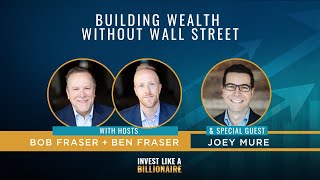
Joey Muir left a $300k mortgage job to teach alternative investing through Wealth Without Wall Street. He uses an Investor DNA framework to match people's personalities to ten passive-income strategies, from rentals to syndications, and emphasizes that community and relationships beat chasing random deals.
Chapters
Hello, future billionaires. Welcome back to the podcast. We've got a really fun episode for you today. Uh, we interviewed Joey Mehr of Wealth Without Wall Street, and if you've been in the alternative investing space for any length of time, you've probably seen these guys. Um, they have a great podcast, great education platform teaching people about alternative investing and investing approach that's outside of Wall Street, right? And that's our whole mantra here on this podcast. And so it was really fun to talk with him. And really understand, you know, what are the goals as an investor and how do you approach investing, right? We all know we can find deals on Facebook and from a friend or wherever, but how do you actually know if it's the right deal for you? And they've created this whole program called the Investor DNA to really help you understand if the deals you're investing in actually fit your goals and who you are. So Bob, did you enjoy the interview? I thought it was pretty fun.
It was awesome. I love the whole focus on accrediteds and this whole Investor DNA idea. Very interesting.
Yeah. So tune in. And if you are enjoying the show, we always appreciate you leaving a review and sharing it with a friend and appreciate you guys so much for listening. Enjoy. This is the Invest Like a Billionaire podcast where we uncover the alternative investments and strategies that billionaires use to grow wealth. The tools and tactics you'll learn from this podcast will make you a better investor and help you build legacy Wealth. Join us as we dive into the world of alternative investments, uncover strategies of the ultra-wealthy, discuss economics, and interview successful investors. Looking for passive investments done for you? With Aspen Funds, we help accredited investors that are looking for higher yields and diversification from the stock market. As a passive investor, we do all the work for you, making sure your money is working hard for you in alternative investments. In fact, our team invests alongside you in every deal so our interests are aligned. We focus on macro-driven alternative investments so your portfolio is best positioned for this economic environment. Get started and download your free economic report today. Hello everybody. Welcome back to another episode of Invest Like a Billionaire. Today we've got a really fun guest, Joey Muir. and we're super excited to have this conversation. Joey is one of the founders of Wealth Without Wall Street. And, you know, we love the kind of catchy names like Invest Like a Billionaire, Wealth Without Wall Street. That's a, it's a pretty cool name and definitely aligns with a lot of our thinking. So we're excited to bring him on. And what they've really done at Wealth Without Wall Street is create a community, a tribe of folks that are learning to invest better, to achieve kind of their lifestyle goals and financial freedom faster. And so Joey, thanks for coming on the show.
Oh man, it's an absolute pleasure to be with a like-minded tribe of people who are outside of Wall Street. I love it.
Yeah. So talk a little bit about, you know, I tried to do my best to describe what you guys do at Wealth Without Wall Street, and I've actually been following you guys for a little while, so I'm somewhat familiar and just really love the education you're doing because I think it, just makes a lot of these things that we talk about in our podcast, like alternative investing and, you know, these are tax strategies and other things, very accessible. You know, sometimes we can get a little too heady over here and, you know, get a little too big picture. But I think the way you guys break things down in very simple ways is really, really cool. So talk a little bit about what it is and how did you kind of start this? What was kind of the impetus to drive you to do this?
Yeah, well, our goal is to demystify alternatives in the sense that If you'd asked me 15 years ago what people invest in, and this was when I was in the mortgage business, I would've been like, well, people can buy real estate. And I mean, that's about all I knew, right? That was either the stock market or real estate. And I was stuck in this corporate kind of ladder growing as a professional. And thought, man, this is, I'm buying into this retirement idea when in actuality I was working 40, 50, 60 hours a week and getting further and further and further away from the people that I loved and cared for the most. I always point to this as a picture just because it's kind of ingrained in my head, but I remember being on vacation with my wife and I have 5 daughters, by the way. and being at the beach and saying, hey guys, you go ahead down to the beach. I just have to make one more phone call for this pre-approval or whatever it may have been. And I'll, I'll, I'll meet you down there. And 3 hours later, where do you think I was? I was walking down that boardwalk and my wife and kids are walking back into the condo or the, the house and saying, they're just shaking their heads and just, they're disappointment that Dad's on vacation with them, but he's not present. And it kind of started to click with me that, that the real objective was not more income. It was not more assets. It was cash flow that I didn't have to work for. I needed passive income that would allow me to then dictate what my calendar and my time looked like. And that's really where this whole idea of Wealth Without Wall Street came from. It's not that we just want to beat up on Wall Street. We want to beat up on the idea that Wall Street predicates, and that's that you give up your time and your money for the vast majority of your life and hope that there's enough left over to just live the last of your days.
Yeah, that makes so much sense. I mean, we've, we talk a lot about alternative investing, right? And a different approach to investing and so many people just assume, you know, I got to put money into a 401, maybe I get my employer match and I don't think about it. I'll look at it until I'm, you know, 62 and a half, and then hopefully I have enough to retire, right? That's kind of the traditional approach, but you feel disconnected. You don't feel like you have a handle on an ability to, you know, hit the goals you want to hit. You don't have any control over it, right? And you're just a slave to whatever that mutual fund that you're in is doing. And so, you know, taking a different approach and there's lots of different ways to do it, right? But there's taking a step outside of the traditional thought process and traditional kind of mechanisms that are kind of created here. So what was your path to that? What is it buying rentals? How'd you kind of get to that place where you could kind of have enough passive cash flow to leave?
I'll say this, I didn't, leave because of the passive income. I left in the hope that I could share with others what I was learning. And that may sound a little backwards to you, but I was, I had been introduced to this idea of infinite banking. And I know you and I have talked about the fact that you, that's something that you've done as well. But it was a new idea to me to put money into my access and my control. Like everything I had done before that was 401s, IRAs, 529 plans. All the traditional alphabet soup that exists. And it left me feeling broke, right? No access to capital. So if you came to me, Ben, and you said, man, I've got this great opportunity, this real estate deal that I'm raising capital for, I'd be like, man, this sounds great for somebody else. Like, it's not me. And simultaneously I had hundreds of thousands of dollars that I had put away that I couldn't use to get involved in things that maybe I would have wanted to be a part of. And so I started this idea of infinite banking, started putting large amounts of capital away in places where I could own and control it. And then it dawned on me like, man, this is a path to freedom. I didn't have exactly what the passive income ideas were going to be yet, but I had access to cash. And that's what really got me fired up. And I said, I'm going to leave this career I had built over 11 years. I'm making well over $300,000 a year and go and teach people this piece of it. And from that, it's amazing. Once you have capital in your possession, it's kind of like what I was telling you previously, Ben, it's almost like burning a hole in your wallet. Like, what do I do with it? Like, how can I get this at work? And so Russ, my business partner, and I started the Wealth Without Wall Street podcast to start interviewing passive income experts to say, what do we do with this capital that we have? And as we started to determine those things, not perfectly, by the way, we decided, well, these are some places we can start putting money at work. And we went from, we literally started tracking this in June of 2020 of $2,000, $2,500 between the two of us monthly passive income to now we, and we report this every single month, over $50,000 a month. And it was just because we got laser focused on, man, passive income is that true end result. And how can we be most efficient to put our capital to work to get there?
Yeah, that's so cool. So talk a little bit about this concept of an investor DNA. So we talked about this a little bit before, and I love this because we have a lot of listeners on our podcast and I would say generally they're going to be a little farther along in their journey. You know, they've, you know, maybe made some money, maybe they have sold a business or, you know, they've accumulated some wealth. But they're really struggling with how do I invest it, right? That's the bigger problem, right? Is financial freedom. I know we have folks that that is the goal and how do you accelerate that path to get the financial freedom. But talk a little bit about, you know, for investors that are just feel stuck, right? One, maybe they're worried about, you know, the economy and potential recession right now. And, you know, two, maybe they just don't know how to understand and do the due diligence on these types of deals. Like, what do you Talk about this concept of investor DNA and break that down.
Well, this is a great point that you're bringing up because so often I hear when people hear the name Wealth Without Wall Street, they say, so what do you invest in? It's like the immediate next question, right? If you don't invest in Wall Street, what would it— which is a natural question. I get it. I get it. But the bigger question isn't what's the investment. I always ask them, what sort of investor are you? And nobody, well, I shouldn't say nobody, very few people know how to answer that, right? And very few people have actually thought about what is the end goal for this investment? What do they think they look at? Well, what's the ROI, right? Because what has Wall Street taught us to do? Look at a prospectus and see what's the historical you know, return on this XYZ fund or whatever it may be. Oh, that one has a higher number. I guess I'll invest in that. That's literally what we've boiled down our investment, you know, brains to look at one number. And by the way, being in the banking industry, you probably can appreciate this, Ben, but interest rate is a distraction, right? It's what we've been told to look at, but What's more important? The terms, right? The overall comprehensive picture. There's a whole story to be told. It's not just the interest rate, which is just the same as for you as an investor. You should not just be investing because, oh, you know, Ben or Bob Fraser say this has a good interest or good return. It's which one of these investments is actually— am I aligned with? Right. And as you know, certain syndications have certain goals, right? Some of them have, hey, I'm on the hook for this money for maybe 2 or 3 years, but there's a big potential exit. Well, there's no cash flow with it, but there's a big exit. Well, if my main goal is financial freedom today, that's not a fit for me. No matter how big the end result is, I need cash flow today to obtain my my goal. So we actually created a profile, we call it the Investor DNA, that really mimics the DISC profile. Are you guys familiar with that?
I am, but for listeners that aren't, can you break it down for us real quick?
So the DISC profile is just D-I-S-C. And so just a really gross, like, you know, basic overview, a high D is somebody who likes to be in charge. They want to take take charge of things. They want to be kind of front and center, and they're, they're not gonna just kind of sit back and let things happen. And a high I is somebody who's very driven by people and social interaction and, um, they want to be the center of attention, you know, that, that sort of thing. A high S would be somebody who's very steady, loyal, loves to be behind the scenes, doesn't really want, um, conflict. Or, or anything like that. And then the high C, somebody's, uh, somewhat analytical. They're gonna think first and speak second. They're going to really kind of analyze things, um, down to the nth degree, but they want steadiness. They want kind of consistency. Those type of things are God-given traits that you, that you have that should, that do mold the way you look at the world. And they should mold the way you look at certain investments. And so what we've determined is that out of, there's a 10 passive income ideas matrix that we give to people with this Investor DNA profile that helps people say, well, what are the pros of short-term rentals? What are the cons of syndications? What are the, based on my DISC profile, and people can then use that to kind of filter down to say, these are the top 2 things I should really be focused on based on my goals, my objectives, how I actually see the world, and what are the things that I need to consider about this investment before getting involved in it.
Yeah, no, I love that. I think I heard this phrase the other day where most investors have kind of a sock drawer of investments. right? It's this kind of smattering and haphazard approach to investing where, oh, I heard, heard about this investment from my buddy over here, and I saw this one on a Facebook ad over here, and you know, I've heard about this one another way. And all of a sudden you kind of have this random assortment of deals that are just kind of stuff in your sock drawer. You don't really pay attention to 'em, but you thought it was a good idea at the time, but there was no strategy behind it, right? And to your point a minute ago, Okay, that could be a good deal. Absolutely. Like this, you know, we're big believers in development in certain asset classes and markets right now, but a development deal, it's very different than like our debt fund, right? Where it's just passive, boring monthly cash flow. But those are two very different things. And it could be the same investor that kind of has a balanced portfolio, but it could totally be two different investors, right? And you got to, you got to understand what are your goals? What are you trying to do? Are you trying to maximize tax savings? Are you trying to maximize cash flow? Are you trying to maximize growth? And are you thinking about this holistically as a portfolio, right? Not just a onesie-twosie, you know, here and there. And so taking a step back, I love that your first question is, well, what do I invest in? Right? Well, that's the second part of the question, right? First, you need to understand, you know, what is going to drive you? What's going to be your goals? So where do you kind of find like the biggest, misalignment with investors generally? Aside from just maybe being haphazard about their approach to investing, what do you generally find? Is it kind of a mismatch of growth versus income, time horizons, or where do you kind of find most investors get stuck?
I think it's a little bit of all what you just said, right? And I'll give you a story, like an example of one of our mastermind members. He came in and he was exactly what you just explain. He was the sock drawer investor. I love that. I'm going to start, I'm going to, is it okay if I steal that?
Hey, I stole from somebody else. So it's 100% uncopyrighted.
I mean, here's the thing. He's, he's a dentist. He's a very successful dentist, but he is that shiny object guy. Like, oh, I heard about this on this webinar that my friend invited me to. So I'm going to invest in it. And I heard about this and like he, he got involved in all these things. They're good. They're good things. But when he came to us, he said, my main objective is I, I love, you know, being an owner of a dental practice. I just don't want to be stuck in someone's mouth all day. Like, I love being outdoors. I'm, you know, like, if he's not in somebody's mouth, he's not getting paid. And he said, how can I, how can I break free of that? And so when we looked at what he was investing in, we were like, Well, none of, like half of these things have big time horizons or they have big exits, but no cash flow. And what was his need? His need right now over the next, you know, couple years when he wanted to be financially free was cash flow. And so what did he do? He took that sock drawer and he kind of evened it out and he said, now that I know where I'm headed, where, you know, what's my destination? I know how to pack. He starts putting in the right clothes for the destination. And, and what happened is over about an 18-month timeframe, he actually came back to us. He said, man, I'm June of this year, so 2023, I'll be financially free. So I've got, I've hired a couple of the dentists to take over the practice. I'm gonna still maintain ownership of it, but all these other passive income streams that I created. By getting really clear, have now gotten me to the point where my monthly expenses will be exceeded by that, and I can step away and I can start doing things. And he said, now my biggest challenge is I don't know what I'm gonna do with my time. It's like he had turned off that, that dream function of what would I do if I wasn't stuck in someone's mouth, you know, doing this dental work. And it's been really fun to, to work with him to say, And let's talk about your passions and what would you be doing with your time? So anyways, I don't know if that directly answered the question, but it is a mixture of all those things. Are they putting money in just because they got invited to it? They don't really consider the goal of the syndicator or of the fund that they're involved in. They haven't really created a portfolio idea, like you said, which is what I love about what you guys do. Is you're really creating a path for people to diversify within just your own umbrella of opportunities. So anyways, that's what I would say.
Yeah.
It sounds like you deal with a lot of non-accredited investors, which is a real unique challenge. How do you guide non-accrediteds and and maybe open up the infinite banking concept a little bit, you know, because there's a lot of folks that are saying, gosh, I so love all this, but I can't play. I can't play the game, you know? And it's very difficult as a non-accredited investor.
Yeah, I would agree with you. I think it's an unfortunate thing that there's not more opportunity that people can get involved in some of the other things because there's people that don't meet the accredited standard that are actually very savvy and they would benefit from that.
Right?
And so what our focus at What About Wall Street, we have two levels of masterminds for this reason. One is just for accredited investors. One is open to any investor. And what we've been trying to do is curate opportunities that would allow people to invest even as non-accredited. But the biggest opportunity we see for people that are not accredited is to create some form of a side hustle that they could eventually build with the end in mind that they can put an operator in place. For instance, I'll give you an example, building their own short-term rental empire, right? Buying short-term rentals and/or using rental arbitrage as like their to maybe their, their way to get started. And eventually they can actually, if they get those up and running, they can actually hire management companies now that exist to run those for them. And there's enough juice typically in that model, usually $800 per bedroom per month is what the models that we've, we've seen more, more often than not. If you can still, if you can get a management company in there, you may still be able to net $500 a month. Per bedroom. That's a really strong ROI for very, you know, typically not very much of an investment to begin with. We have a lot of people that do land investing. They go and they buy raw land, they flip it for retail prices, and they make the difference on owner-financed notes. So they realistically become the bank. And what they've done in that model is that it does take some nights and weekends to begin with, But eventually they can hire virtual assistants at virtually every step of that process to where they can exit their 9 to 5 and be working 10 hours a week to manage a business like that versus the 40, 50, 60 hours that they're doing in their W-2 and they own nothing. So those are two examples, but we've also curated a number of different syndicators within our mastermind that are open to working with non-accredited investors. And so that gives that person that needs to be completely passive an opportunity.
Yeah, very cool. So a lot of times if you're not accredited, you may have to be a little more active, but if you are able to, you know, work for, you know, have the end in mind, like you said, and for a couple of years, maybe I'm going to, I'm going to do this, you know, spend 10 hours a week. And that's pretty realistic to be able to do, you know, Airbnbs and other things on the side to, get to a point where your net worth, your income kind of exceeds those levels and then maybe transition to a passive portfolio. But to your point earlier, maybe that's not what they wanted. Maybe they want to stay active. Maybe they end up liking it. Maybe like being kind of in charge to your point and want to kind of own their own portfolio anyway. And so again, going back to kind of fitting the investor's goals.
100%. Yeah, I think the, the beautiful thing about this whole process is nobody is exactly the same. And, and so I, I kind of started to tell you my story. Well, my story isn't the path that everybody takes, but there's certain components of it that we've built into our process when people work with us that they, they can kind of take the fast track. 'Cause I meandered like this. You know, and tried to figure it out. And it took a, it took a lot longer. It took, you know, roughly 12 years. But we are seeing people doing it in 24 months or less, right? 36 months now. And that's because they now have the shortcut. They're borrowing my experience and our experience to say, how can I get there faster? And that's why we developed things like the Investor DNA, because I invested in the things that were not good for me. You know, I learned, oh, wait a minute, slap my hand. I should not buy a dropshipping company like 100unicorns.com. I'm just saying, just in case you're wondering, I bought one because I have 5 daughters and I thought, oh, this would be how I teach my daughters business. You know, they'll be interested in unicorns. So I'll buy this dropshipping business. And by the way, I suck at operating a dropshipping business. So it does no business. It makes no money. And I'm stuck with it. But I learned that and implemented that into the Investor DNA to say, let's rethink what's the end goal here.
So, well, it goes back to the shiny object syndrome, right? You have, you know, dropshipping, maybe it works for some people, but it seemed like it had its heyday probably 10 years ago. And then as the market is kind of, you know, normalized or become a, or competitive, it's more difficult to do it. And yeah, it's, it's hard. Wow. Well, the, the, those guys on YouTube ads keep saying it's the best thing, right? Since sliced bread. So, but it's, it's kind of interesting going back to kind of some of the earlier thoughts that you were sharing and what I, what I find in talking with investors is it's really a passive approach to their wealth, right? And the whole system of Wall Street and just stuffing money into a 401k, it doesn't give people the mindset or support the mindset to take control of their money and to take it by the reins, right? And make it work for you, right? And so, so many times people are working, like you're saying, 50, 60, 70, 80 hours a week trying to earn income, but they're not thinking or devoting as much brain space to, well, how do I make my wealth, my income work for me, right? And kind of come back in a positive way. And so I think a lot of the challenge, a lot of the reason for this kind of haphazard approach or kind of the shiny object approach is we've kind of been conditioned to just, you know, well, if someone says it's good, then it's good, but it's not taking it an active intentional, disciplined approach with how you're doing it. And we've worked with investors that are very, very disciplined in that. And it makes sense. And you can see the fruit of that because they're hitting their goals and they're very specific about what they want and what they're looking for and what they're trying to achieve. And it makes all the difference. Like you're saying, you can shortcut from a 12-year journey to a 2-year journey. I mean, that's a big— if time is your goal, right? If time is the ultimate reward, getting your time back, then that matters.
And I would, I would add this because you said something earlier that I was like, I need to come back to this and make sure I bust up on this. If you're getting an ad on Facebook about an alternative investment and that's your strategy to build your portfolio, you're in the wrong place. Okay. Just, I'm just telling you that this is not going to end well. But the people who are most confident are the people that have actually invested in themselves to become a better investor. And that's the part that I think Wall Street has done a ridiculously good job of marketing is they've tried to convince you that you can't do this on your own.
Yep. A hundred percent.
And that someone else needs to manage this for you. So you need to abdicate all of the responsibility, all the education, and just hand it over to somebody. And that is the biggest lie that anybody can live. I lived it. I was, I was that guy, right? So I can speak from experience. But once you start getting around other investors, and again, we created masterminds not because we, like, we pretend to be the experts, it's that we need to be surrounded by people who are experts and who are really good investors. Because when someone comes in and pitches you a deal, if you're surrounded by 50 other investors who can say, hey, this ranks a 6 out of 10 for me because of this, this, and this, I immediately just invested in myself. I immediately just borrowed that person's experience, their perspective. I mean, all those things make me just level up. As an investor. And it's not hard, but if you try to do it alone, it's impossible, right? You're going to just meander your way through. And so, yeah, I just want to encourage you, if that's somewhere you feel weak, right? I don't feel like I know what to invest in. I feel like I'm going to make mistakes, whatever. Then the issue isn't I just need to keep putting money in Wall Street because they know better than me. It's I need to take a step back and actually invest in myself And whether, I don't care where it is, but some mastermind, some group of investors that's more savvy than you, you gotta get in those rooms.
You know, Joey, you as a mortgage guy, right? How much time did you invest in developing your career, right? How many conferences did you go to? How many books did you read? How many networking events did you attend? You know, marketing programs did you sign up for? And the whole point is to become really, really good at selling mortgages, right? And most people, you know, are on the career track and they're investing enormous amounts of time and energy to do that. But then the fruit of that is presumably some financial independence. You start to get a little nut, a little bit of wealth accumulated, and then it's throw that over to someone else and entrust someone else with all the fruits of your labor. And if you've, like me, you've gone through crashes. I went through the dot-com crash where You know, Amazon lost 95% of its value. I mean, how do you recover from that? You know, so you're entrusting yourself to this incredibly volatile machine, all the fruits of your labor. And here's what I tell people, take a fraction of the energy that you put into developing your career and put it into managing your money. Learn how to manage your money and learning how to take control. So get a book on it, join a mastermind, you know, hang out with other investors and develop the ability to manage the fruits of your effort too. I find people that will devote, you know, 50, 60 hours a week to their career, devote zero to developing their money. And the truth is money is more powerful. Your career gets you started, but being a successful investor takes you much further. And you know, you start to get great opportunities. You can accumulate massive amounts of wealth. It's really a lot. It's a great career as you're pointing out.
100%. And I would add to it, one of the biggest components is you can educate yourself, right? On the black and white books, podcasts like this, you know, those are good things. But what I also find is the less encouraged or the least kind of focused on aspect of investing is relationships, right? The relationships, like the fact that Bob, you and I met at the Real Estate Guys Conference recently, those are relationships, right? When you have operators, operators are not investments, they are people. They are, you are, anytime you're putting your money in an investment in syndication, It is not about that asset. It is about that operator and what's their track record and what's their ability to produce on what they say they're going to do. Relationships are the biggest opportunity to grow as an investor, and it just doesn't come in a vacuum, right? You have to be around people who know people because that is where, you know, your true wealth will take off. And again, if you're looking at your mutual fund right now and you can't tell me the name of the people involved in that mutual fund, which you can't, I can go ahead and tell you there's no way. You might know the one fund manager name because it was on the prospectus at one point, but all the companies involved in it, I can tell you that's why you're the last one to be paid in the transaction and the one that's most susceptible to loss.
Right? So that's so true. You know, the, you know, I come from the venture capital world, right? I had a venture capitalized company and the venture capitalist said this, you know, the key to investing success as a venture capitalist, you bet on the jockey, not on the horse. And it was like that, that a guy that had the right chip set, they're going to bet on that guy. And even if he's got the stinkiest idea, he's going to adapt the idea. He's going to morph it. He's going to fight it out. He's going to win because that's what he does, right? Then you got another guy that could have the best idea, the best horse, so to speak, right? Looks, sounds so good, but he's just not the guy that can execute and he's not the guy that can make things happen, convince people to do stuff for him and investors and bankers and customers and vendors. You know, and so there, so it, it's really what you, what you said. And you know, when the key is relationship, it's, it's finding those guys that are, that are successful and jumping on with them. You know, it's definitely right. You know, definitely the right, the right way to go. Not just the latest sexiest idea.
Yeah, I think so much too about, you know, how do we shortcut the path, right? Because so many people, they, they don't want to go make the mistakes and So maybe they just never do it. Maybe they never educate themselves because they just don't think they can. And they're worried about taking the risks and the mistakes. But if you can shortcut, right? Education, reading the books, listening to the podcast, these are very, very important and, you know, invaluable tools, right? I mean, some of the wisdom that's been passed down in some of these books that you can read for $10 is worth millions and millions of dollars. But in addition to that, getting around people that are maybe a few steps ahead of you, right? And they've actually made a few of those mistakes. They have a few bumps and scars to prove it. You're going to learn so much by hearing the stories and seeing what they're doing. And it's going to really illuminate the path for you. And I think to your point, relationships are such a key part of this because, you know, really, I mean, I've only been doing this a couple of years, but it's, it's not uncommon and it's not weird anymore to talk about what are you investing in, right? Because it used to be so taboo to talk about finances and talk about these kinds of things. And it was, you have to kind of put on the show of what you're doing, but it's, you can have these discussions with people and then see what's going on and see what's working. So I love that. So as we're kind of wrapping up here, what's, what's kind of the best way for folks to kind of get more familiarized with Wealth Without Wall Street and some of these communities that you guys are dealing with, the masterminds and education, all that kind of stuff?
I'm happy to connect. We have a podcast, Wealth Without Wall Street Podcast. If you love podcasts, we love to have you come over and hang out with us for some time. The other thing, I'll just create a webpage, wealthwithoutwallstreet.com/investlikeabillionaire. And on there, there's a free quiz just to see where you're at in terms of your financial freedom journey. You can book a call with one of our coaches and just get to know ways that you could get plugged into one of our masterminds or walk through the process. And then lastly, if you do want to just apply strictly for one of our masterminds, we have a link there as well. If you're interested, the big key I'll just end on is, you know, there's always a cost to everything. And when it comes to this idea of financial freedom, or even for the people that have created their own level of independence, but they now have capital that they don't know what to do with. There's always a cost. It's either a cost in getting in the rooms and getting the access to the resources that are going to make you successful, or there's a cost in time that I didn't take action because I was scared, because I didn't know where to put it. I didn't, put it in the right place. And so I take a step backwards. Like there's always a cost. And yeah, just hopefully as you're investing like a billionaire, you're paying for access first because that's where you save the most money.
Awesome. Well, Joey, thanks so much for coming on and sharing your story and what you guys are doing. Love it. And like you said, it's fun to connect with people that are like-minded and on this journey together. So Thanks so much for coming on.
Yeah, it's a privilege. Thank you.










