
Economic Panel w/ Neal Bawa (Best Ever Conference) - Part 2
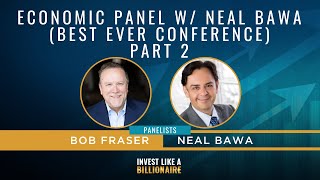
In this second part of the Invest Like a Billionaire podcast’s economic panel, host Mark is joined by real‑estate investors Bob Fraser and Neal Bawa to discuss the current state and near‑future outlook for commercial real‑estate development and investment. They compare industrial development versus build‑to‑rent (BTR) timing, explain why industrial ground‑up projects are now more attractive than buying existing assets, and predict that BTR land deals will become viable in 6‑9 months as large builders capitulate. The conversation moves into financing tactics, emphasizing the importance of regional and community banks, the disappearance of bridge lenders, and the potential resurgence of bridge debt when rates stabilize. They also explore seller‑carrybacks, mezzanine and distressed‑debt lending, and the strategic use of large cash deposits to negotiate better loan terms. Demographic trends are highlighted as a core driver of market selection, with a preference for high‑income, pro‑business states and a nuanced view of Midwest versus fast‑growing markets. The panel reviews a range of asset classes—assisted living, 55+ communities, mobile‑home parks, and accessory‑dwelling units (ADUs)—offering bullish or bearish stances based on occupancy trends, labor shortages, and scalability. Finally, they share their go‑to information sources (Wall Street Journal, investment‑bank research via ZeroHedge, Yardi Matrix, Flipboard) and discuss broader macro questions about capitalism’s resilience amid slowing global population growth. Throughout, the tone is conversational and advisory, with a mix of cautious optimism and pragmatic skepticism.
Chapters
Welcome back to the Invest Like a Billionaire podcast and happy Thanksgiving. This is part 2 of the economic panel from the Best Ever virtual conference that Bob Fraser participated in a little bit ago. And the conversation was with Neal Bawa and Ben Lapides. If you listened to last week's, you've heard some of the great conversation that they were having, talking about economic trends, what to expect going into 2023. What's important for investors to pay attention to, and this episode concludes that conversation. Lots of great insights. You definitely want to listen to this. And for those that are interested in going to the Best Ever conference next year, our good friends over there sent us a coupon for our listeners for 15% off tickets. This is a conference that we really love. We've been going to for several years and we'll be there next year. And if you have any interest, uh, we'd love to see you there. and hope you enjoy this episode. Thanks so much. This is the Invest Like a Billionaire podcast where we uncover the alternative investments and strategies that billionaires use to grow wealth. The tools and tactics you'll learn from this podcast will make you a better investor and help you build legacy wealth. Join us as we dive into the world of alternative investments uncover strategies of the ultra-wealthy, discuss economics, and interview successful investors.
Let's go back to the short-term rental comments. So with, with the home, home prices dropping, we have another question here. Homebuilder sentiment. In the single-family home market dropped to half of what it was 6 months ago. Is now a good time to be a developer in commercial real estate? And I would add, in addition to commercial real estate, BTR, build-to-rent. Is now a good time to be a developer in either commercial or build-to-rent?
And I'll jump, I'll jump in there as well. So absolutely. We've been aggressively in the industrial space and we prefer to buy existing assets. And they're very difficult to buy. The prices are very high. We're finding, we're actually doing an industrial build, a ground-up build, 350,000 square feet right now. We're looking, we're going to be doing a lot more. And the numbers are nuts. It's cheaper to build than to buy for sure. And so very good returns on building and industrial is easy. It's very short. Add to that that the supply chain constraints are kind of lifting and prices are coming down. It's a perfect time to be actually a developer, you know, especially in industrial, which is a shorter horizon.
So I'll agree with Bob Fraser on that. So my industrial assets that I'm building are doing phenomenally well. The vacancy is very low. I'm getting the rents that I want and cap rates are still very low in that particular market, even though I expect them to decompress. So great time to be building industrial. Now the question from a BTR perspective, is mixed. So while sentiment is down, and I know that market well, I have over $500 million invested into the BTR market from the development side. And I can tell you this, I'm still waiting for builders to capitulate. I'm still waiting for landowners to capitulate. When will that happen? I'm guessing it's Q1 or Q2 because I've started to start getting more phone calls from brokers saying, hey, there was this piece of land that you chose not to make an offer on. You know, I'm gonna talk with you about it. So my answer is wait for about 3 quarters. There's gonna be blood. There's gonna be blood in the streets for people that basically paid for land that's basically built-to-rent land, either for townhomes or single-family homes. We're not there yet. So I very carefully follow the big builders. So I read the D.R. Horton report, I read Lennar, I read Pulte Homes. They're screwed, all of them. But they're not at the point where they're doing fire sales of the land that they put contracts on. And I think that happens Q2, Q3 next year. And that's the trigger for the builders. 'Cause you know, Lennar doesn't really build anything. They just basically go and pay other people to build it for them. So the local builders that work as subcontractors for Lennar and everyone else. So those people are not hungry yet.
Why?
Pipeline. Development is a pipeline business. Right now, every builder in the US is busy because they're still developing whatever I paid them to develop last year. It takes a while to get to that point. So my feedback is the end of next year may be a good time to start going to builders. They'll be hungry. They would've paid on pieces of lands that they can't build on, and you can strike deals with them for to do build-to-rent. But I think it, it's, it's early days in that market. It takes a lot of time for that market to adjust.
So a couple of terminology for some questions I've seen coming in. I'm just gonna go ahead and answer these. I'm not familiar with industrial. What does that entail? Industrial is warehouses, like think Amazon, Walmart, major warehouses, as well as last mile small warehouses that bring you your stuff. So when you buy something on Amazon, it's stored somewhere before it gets to your house. Those buildings that store that stuff, that's industrial.
It can also, and manufacturing and manufacturing and manufacturing.
And it can include some other niche asset classes like data centers, just big, big vast spaces that just house data centers and other unique things like cold storage. But industrial is the general food group for business renting that does not have people coming to an office, manufacturing, storage, data centers, what have you. And what is the difference between traditional multifamily and build-to-rent? Multifamily is multiple units in one structure. Build-to-rent is typically referred to and tracks development of single-family units. So where you build it not for the purpose of selling the homes to a homeowner, but for the purpose specifically of renting that unit in that particular development. It's just a different grade of quality when you're constructing for build-to-rent versus selling to a homeowner. Okay, so one of the questions here I think is also getting answered, but I'd like to clarify. So Selda asks, is this a good time to get into land development where the buildable lots will be ready in 2 to 3 years? Neal, you're saying yes, but no. Yes, because it's almost, you're saying in about 6 to 9 months it will be a good time. I'm seeing the similar data. Coming from John Burns Consulting where land is becoming less desirable, but I haven't seen the shift in pricing yet being a developer ourselves. So I've got a question for you, Bob, saying that you would like to, or that you are looking to develop, and both of you think that this is a good time to develop. We have a peer in the storage group that is doing lots of development, just launching them like crazy. October, November, no problem. He's a merchant builder and he is taking on, I believe to be fairly sizable variable rate risk. As a merchant builder. So how do you finance this development, especially in 6 to 9 months? Maybe land prices come down faster if cap rates have only moved a point, but interest rates have moved substantially and you're taking on this development risk as well as lease-up risk where you do not have cash flow along the way. How do you finance these things safely? What is the best strategy for development? I'm asking this, I wouldn't have asked this, but I saw 7 questions come in about this at the same time.
There you go. You know, well, again, for our calculus in industrial build, I mean, we are literally completed 9 months after breaking ground. So, so interest rate is irrelevant, right? It doesn't matter what I could pay double-digit interest rates and it doesn't even hit, hit the, hit the bottom line. You know, I'm exaggerating, but you get the idea. The availability of capital is another matter, right? That we're seeing definitely, you know, on spec builds, we're seeing a lot of caution coming out of the lenders. Our, our model, we love local banks and regional banks, so they're underloved and we love them. So we go, we go maintain a large network of lenders and we have on our staff a banker, an ex-banker who speaks bank and smells and smells like a bank banker. And so we tend to, we, we love, we love regional finance financing and these banks, you, there's always a hungry bank out there and we get 'em all, do a big dog and pony. We get them to compete for our business and and we tend to get good deals.
Okay, well, my feedback's very similar. Love, love, love regional banks. And that's why you need to keep the size of the deal smaller. So you always have to understand your market. So let's say you're investing in New Braunfels, which is, you know, 30 miles from San Antonio. You need to know the answer to this question. If there were 3 banks based in San Antonio, what is the loan amount they're comfortable with? And size your loan to that amount. So do not build a project over that amount None of them will compete with you basically, and you'll simply lose all of the local banks. So I've had projects that I've walked away from that were pretty lucrative where I basically simply couldn't size the project to match the local banks because I'd never want to lose that segment. And all of my, you know, hits in this environment have been local banks. Here's one other tip which may not work for you, but there's possibly other people listening in here that it might work for. One of the things that I like to do is that as I'm raising money for value-add, you know, properties, often I'll raise funds way in advance. Right now I have millions of dollars sitting in the bank. My investors know I'm not gonna buy anything in this quarter. I'm not gonna buy anything in Q1, but I will buy something in Q2. And so they're giving me that money knowing that it'll get deployed. Guess what I'm doing? I'm keeping that money in a local bank and getting them to do my construction projects. Local banks love deposits. National banks don't particularly care, but local banks, if you put $10 million or $20 million into a local bank, they will give you incredible construction deals, absolutely crazy rates that may not even make sense to you. It's like, how do, how are they doing that? The answer is they're really sensitive to deposits because that allows them to grow their total lending. So if you have money that basically is simply parked in a bank that you can't really do anything else with, park it with them first, then go ask them for a loan. It makes a huge difference.
Awesome. Thank you both. Uh, all right. And just a reminder, if you have more questions as we're having this conversation, be sure to drop them in the Q&A. All right. So we, we've been talking about financing here a little bit and, uh, we, I, we covered this a little bit, but I just want to expand the scope beyond development. What are your thoughts on the continued use of bridge financing and the cost of the rate cap?
I think bridge is pretty, the bridge lenders have disappeared, right? Well, you know, pretty much. And so it's, you know, that's been the main way people are doing the higher leverage deals, you know, because they'll go up to 80% LTVs in some cases and they're gone. So we're going to see that, you know, really massively affect, you know, the availability, available capital massively affects the purchasing. But I, as I said, I think it's a bug looking for a windshield. All this, all the bridge debt financing that we had, and I've been sounding this alarm for 2 years. The bridge debt was, you know, it really is a bridge. And you know, if something is a bridge that doesn't go anywhere, it's not actually a bridge, right? It's a death, it's a swan dive, right? You gotta have something bridged to. And so I think bridge is a huge problem and I think it's going to be a huge, huge, huge problem as it just blows up if the rate caps are or the rates are higher and the debt service coverage is not there. There's no debt service coverage anymore, which on already marginal deals. So we're going to see a lot of things blow up. And the funny thing is, of course, who's going to benefit is the bridge guys who basically going to take back properties.
I think Bob, they're going to be rescued and I'll tell you why. Bridge comes back when interest rates start to drop. My model shows they'll start dropping in Q3 or Q4 of next year. So just as all of these bridge guys who've made crazy deals are hyperventilating, I think they'll start to see bridge again. Remember, bridge doesn't require interest rates to drop. It simply requires the going-forward prediction of rates to be that they will go down or stay stable and won't go up. The bridge market only is nonexistent as long as people don't know how high rates will go. The moment they know that there's a plateau and there's a chance that they'll go down, the bridge market reappears, though it's gonna be pretty expensive, but I'd rather take an expensive bridge loan than lose my property.
But, but you can't— you won't qualify for bridge because the higher interest rates, the properties will not cash flow anymore.
That's the problem.
And the debt service coverage ratio goes below or close to 1 and it's over at that point.
Yeah, yeah, yeah. So it really depends on how much you overpaid, right? So some of them will be able to squeeze by or put a little bit more of equity in. I've been talking with a friend of mine about creating a equity fund that basically finds those kinds of properties and comes in as lending to help them basically get their DSCR up. And I get first access to everything on the property. So basically I'm in a senior position to all of the equity. So it's risky, but it's definitely not as risky as all those investors in there.
And that's, you know, I'll reverse it. That's exactly right. I mean, the way you, the place you want to be in, in, in, in when the cycle downturns is the lending side. So, So distressed debt is an ideal place to be and we love that space. That's where we've cut our teeth at Aspen and we love the distressed debt space. And honestly, I, you know, we're looking at it starting a kind of mezz lending, right? Mezzanine lending with the same thing. So we get a, we get a lien on the property and hey, best case we get paid. There's no, no problem. Worst case we get paid, we keep the property, we keep the property back, you know? So yeah, vulture lending, you know, but we're nice guys. We're just, we're just, you know, going to deal the cards we've been dealt.
Yeah.
All right. So let's actually talk about some of these financing strategies. Seller financing. So I saw a post the other day that the only way to get deals done is to buy cash, loan assumptions, and seller financing. So if I can get a seller to the table to say, you know what, I'll give you 40% leverage because that is what I do not have leveraged on my side. And I will do it for you at a 3% interest rate, all I owe for 5 years. The value of that I would like you to put into additional basis. So if I'm going to be saving a million dollars a year in interest expense relative to what I could get with the market over a 5-year period, I would like you to take $5 million and add it to the basis. Or better yet, I'd like you to take the discounted cash flow value of that 5-year interest rate delta. Let's call it $3 million and add that to your basis. Is that smart? Is that wise? Can you pay more for lower interest rate seller financing?
I'd have to pencil it out, but depending on what that, you know, what it definitely could pencil, you know, these, you know, interest rates are a big deal. We're just, you know, after we shut, we said we're no longer going to do any more multifamily acquisition. Well, now we're doing one and it's a 3.49% assumable Fannie Mae loan with 9 years left. You know, it's like, Hey, hello. You know, you can't, we can't lose money on this deal. I mean, you know, so, so finance is a big deal and seller financing is, I would absolutely negotiate with somebody in a seller, seller carryback position to get them on a, you know, increased basis.
You know, it's got to pencil, but yeah, it's, it, I think it's an Excel question, but I, I'd say I want to have a way to exit them. So the, that's the only thing that I'll add to that. I don't want them to be there until the very end. If the market improves, I want to have a way to exit them.
Well, thank you for validating my current strategy. So I appreciate that was a bit of a selfish question. So let's chew around the edges of some of these outstanding questions that we have here, guys. And for those who are giving us a what's up and a thumbs up, much, much appreciated. Omar, hey, what's up? This session is way more beneficial than I expected. I learned more than I thought I would. Thank you, Mark. This is the type of content that we like to provide at Best Ever. We have nothing to sell. It's just a lot of fun to hang out with Neal and Bob. Hunter Thompson and John Chang on the screen, and I don't know that you get a better room than that. So here's another question we have from John. What type of accounts do you suggest investors save money in until ready to be used for real estate syndications and investments? If our cash is losing value to inflation in regular checking savings accounts, but we want our cash to be accessible when ready to invest.
Not a lot of choices. You know, bank accounts.
I will say that I personally see—
If you need liquidity, there's only really one place to keep it.
Yeah, yeah.
I'm gonna disagree with that one completely. So the answer is Comerica. Comerica has money market accounts. I get 3.6% today. Anyone can call, call Comerica. These are money market accounts. They're 30-day liquid and they do not put that money into stocks or bonds. What they do is, and I have tens of millions of dollars with them, and actually it's paying for that entire side project is being paid for with $3.6 million on you know, 50+ million. So it's an amazing product. And I think that you should look at it. They actually break it up into $249,000 chunks and put them at different banks. Why $249,000? Because $250,000 is FDIC insured. So they put them at different banks and they give you a list of all the banks that they're spreading this money out to. So check it out. Comerica Money Market, 3.6% as of last week. Hot. And it's going to go up to 4.1%, by the way. It's going to go up to 4.1% on December 6th. 'Cause the Fed's gonna raise by 50 basis points and Comerica's gonna raise it by 45 basis points with that last 10 bps obviously being their spread.
And Marcus is offering same-day liquidity at 3%, which is a Goldman Sachs bank. Barclays Capital has something similar, I think Capital One. So we are starting to see savings rates above 3%.
I see a question. So no, spelled Comerica, C-O-M-E-R-I-C-A. Colmerica, not Coal America.
Colmerica. All right, so we got one or two more here. We're just going to bang through them really fast. Um, why sell— another question for Mark— why sell when the rate is at its lowest? Uh, would you mean things are kind of crazy during a recession so you don't want to sell? This was during your presentation, Neil, so this was at the end of your presentation. You made a comment, why sell sell when the rate is at its lowest. You had said when things are kind of crazy during a recession, so you don't want to sell. I don't know if you recall that or not.
Well, during a recession, firstly, it's not a great time to sell. So I simply won't sell until there's bullish people in the marketplace. So I'll just hold. So my goal is do not sell any asset from now until June 2024. I build detailed models and I shared it within my presentation. And I change those models every month. By the way, one thing I'm not is I'm not looking to predict the marketplace. I'm looking to learn from it and change because one thing I know is I'm always wrong. But if I keep listening to the market every month and changing my model, then I have a good shot of being right at the end. So the short answer is I'm not looking to sell. So if I implied that, that was incorrect. I'm looking to hold every asset that I can until June 2024.
Awesome. Thank you for that, Neal. So let's hit one more topic while we're here. Demographics, at the end of the day, that's still a huge, huge issue. It doesn't matter if you're in a recession or not. If you're investing in commercial real estate, you need to be paying attention. So what are you guys looking for in the demographic data? You've alluded to some that core markets are a little bit scarier now than secondary markets, but what other demographic trends are kind of your guiding lights right now?
I mean, we're looking at, obviously we favor, you know, pro-business states, you know, let's, or red states if you will, obviously. And we're looking at demographics, we're looking at higher income demographics, which again can weather inflationary kind of storms better than the lower income demographics. Those are kind of our two driving factors. And we love the Midwest because of just great just seem to always great steady eddy economics.
A different, you know, feel for us. So I also like high-income markets. For example, I'd take New Braunfels, which is a small town over San Antonio, even though San Antonio is a much larger market because New Braunfels, $20,000 higher income on average. So I tend to, you know, it's easier to get rents and rent inflation there. But I am, extremely, massively, extraordinarily worried about demographics in the United States. World's dem— the world demographics are truly effed. But the US demographics, while being one of the strongest in the world, are still problematic. So, you know, population growth in the last 2 years has been 0.2%. It's kind of hard to keep long-term inflation up when your population growth is slowing. And that's why I'm afraid of the Midwest. I think the best deals are in the Midwest, and if you know what you're doing, you can make lots of money. But you know, for larger projects, especially new construction projects that I feel are riskier, I'm just very obsessed with going into markets with extraordinary population growth. I'm looking for 5 times to 10 times the US average, 5x to 10x the US average, because I'm really worried about what demographics do to real estate prices in the '26, '27, basically 3 or 4 years from now. When everyone realizes, oh shit, we don't need as much housing anymore because our, the country's demographics are so negative.
So once again, I'm going to ask a selfish question that has nothing to do with the topics that we're talking about today. And this is something that's 50 years out, but here's a question that I have for you, for you two gentlemen. Can capitalism survive as a primary structure for society if we do not have global population growth? If 50 years from now we have population decline, can capitalism survive? I'm kind, I'm just curious, a little waxing poetic here.
That's a big question. Yeah. I mean, I think it can serve, it can survive, but I think it gets very ugly, you know, and that's a good point, you know, because people will choose to, you know, they'll want, you know, guaranteed, you know, income, universal basic income and other kinds of things. You know, and the ones are going to be the most hurt are the smaller markets, export-based markets that are, that have been driven entirely by selling their local resources overseas. And, you know, literally these poor countries are going to go to a very, you know, kind of a pre-industrial economy. And then what happens to their, to their political structures? I mean, I think it's all, it's all, it's a free-for-all at that point. So I think it's, I think it's an unequal kinds of gain, right? Some, some nations like America, we're actually the, in the best position of all nations.
Yeah.
And then other nations are going to really hurt. So I think it's, I think you have to ask by nation. And so that question is uniquely for each nation.
Right. I have a slightly different answer. I mean, very, very similar thought process there, but I like to look at Japan. So obviously Japan, negative population growth for decades. And what the Japanese did was restructured their society, number one, to serve older people. And number two, they became an export society. So they basically started looking at fast growth nations such as India or, or, you know, or the, in, in the African area, I think they're very strong on Nigeria and basically became a service economy to these fast growing nations. So the, the US is extremely nimble. I find us that no other country in the world is as nimble from a capitalistic perspective than, than the US is. And we'll basically find fast growing economies. The entire world's population is not gonna slow down at the same time. The African continent, if they can stay away from wars, are actually going to have a phenomenal population growth over the next 50 to 100 years. So we can attach ourselves to them. The second part of it is technology's going to help. So one of the best ways in which you can actually thrive in an environment where population doesn't grow is if less people die. Life extension technologies are just starting and will have a phenomenal 30-year run. I fundamentally believe that for affluent people, you'll be able to extend their life by 25 to 30 years. When you do that, you overcome the effect of population loss because that person is now living another 30 years. Right. And in the past they would've simply died. So no services would be needed. No goods would need to be sold. Yeah.
But are they working?
Well, yeah. The question is, right. So, you know, how much, how much will they produce? GDP, right. You know, so they don't, they don't. So I think we need robotics to help. Right. So I think what'll happen is we'll have, we're very uneven kind of problems, you know, that we will create of, you know, where are all the people that we need to sell goods to? And then all of a sudden, well, we have these older people, but then Who's gonna provide the services? Well, now we need robotics and we need automation. So it's gonna be extremely bumpy, but I think what happens is technology tends to fill in the gap. So you ask technology the question of where are all the people? The answer is life extension. And they, the question is, well, who's gonna provide the actual services? Who's gonna make my hamburger? The answer is, you know, my, my family owns 115 Burger Kings and they're now installing their first completely automated Burger King where the burgers are made by machines. right? So that's a process and it doesn't happen until it becomes really, really expensive. But have you noticed labor costs are going crazy? So that's when automation really starts to happen and, and, you know, take effect. And I think automated driving over the next 15 or 20 years is also going to put about 10, 15 million people outta work. And I think they can be put to work doing other things.
You know, I'll take one more stab at this. So he, so Neil brought up Japan. Japan is actually a case in point, Neil. I mean, Ben. So So think about this. Here's a, here's a nation that has declining working age population, and yet the democracy is still, still in play. And here's the primary thing they've done. They've taken their technology, their expertise in business and management, and they're there, but they have no workforce. Their labor force is decreasing. What are they doing? They're relocating their plants, for example, to the South. So they're using US labor, US parts and materials, et cetera, But their corporation and their leadership, and that's where the future, where a lot of these countries are going to have to go. You'll see, you know, maybe we'll see Africa becoming industrialized by, you know, US leadership and companies and, you know, European, Japanese leadership starting plants to utilize this workforce, this labor force that doesn't exist in their home countries. So it survives.
Okay. Some good.
It survives.
That's some good Socratic conversation. So we actually have a question that came out of this conversation. So as a passive investor, what periodicals should I be reading to keep my finger on the pulse of the real estate market? What do you read? What do you subscribe to? And that, no, Neil, I know you kind of answered this a little bit, but you kind of put up a QR code to find out, but maybe just hit the highlights.
Well, yeah, I think that QR code will help you, you know, look at sort of what I'm reading. But I think the one thing that I like to do, which is really easy to do, is I go into Flipboard and every time I read a real estate article that I like, I do not forget the one important thing. I thumb it up. So what happens over time is that as I like articles of different kinds, real estate demographics, you know, multifamily cap rates, self-storage, things like that, I keep thumbing them up. And over time, Flipboard for free does the job of basically bringing the more and more articles in. So that's kind of a cheating tip for you. I've been doing that thumbing up for 3 or 4 years now. More than 50% of all content that comes into Flipboard every day for me is somehow real estate related. So I think that's key. The other one that I'd like to propose for people that are multifamily folks is Yardi Matrix. I think that I have to give them, you know, kudos. Their monthly newsletter, which comes into my email, and their quarterly webinars are absolutely phenomenal in terms of understanding what's happening in the space. So if there's one that you should sign up for, for the multifamily space, it's Yardi Matrix.
And I'd say my number one is Wall Street Journal. Read it cover to cover every day. Never miss. And my second would be the big, the smartest analysts out there in the planet are the big investment banks. The Goldman Sachs, the Morgan Stanleys, JP Morgan. These guys, they are really, really, really smart. And I follow all their stuff. The best way to get their stuff for free is ZeroHedge. So best stuff ever.
Awesome.
Yep. Yeah, I agree on that. I actually have a friend that forwards me all of the Goldman Sachs write-ups. He's got it set up on auto, so it comes into his mailbox and then comes into my mailbox a few seconds later. Amazing stuff, right? These guys are like way beyond our capabilities.
So we have another question that's coming in here. We did not touch on assisted living. Housing and pharmaceutical assets. You guys have opinions on those?
Again, I mean, I think it's so assisted living, it's very, it's very, been very COVID affected. And I think a lot of people are choosing not to go into these facilities. I had actually an elderly parent and we couldn't visit them. And, you know, it was horrible. And so I think we might see a whole change in consumer choices. That are not favorable. And so we do not know what a normalized world looks like in assisted living. And I'm 100% out and would recommend anyone to stay clear.
Yeah, I've been very bearish on assisted living before COVID and for different reasons, because I love the fact that in multifamily we all hyperventilate when occupancy falls from 96 to 95. Oh my God, the sky is falling. I mean, their occupancy hasn't hit 90 for the last 6 or 7 years. I mean, and that had nothing to do with COVID I mean, it's, people are converting 5-bedroom homes into assisted living.
That's right.
So they're basically, there's a supply side issue on the assisted living side that we haven't seen on the multifamily side, right? So there's a real problem there. Please go look at the occupancy rates for assisted living for the last 6 or 7 years. It's a real problem. And then of course, this COVID thing is a double whammy. I mean, there's a bunch of people that do not want to go live in those places. And I think even though I don't think it makes any logical sense, I think COVID's really gone at this point in time, but mentally they've been affected and I, God knows when they're gonna snap back to saying it doesn't matter.
And add the labor shortage. These things are having really have trouble staffing. You know, it's a bug looking for a windshield. Stay out.
I did see a follow-up question though that's very, very interesting. And that's from Lena. She said, what about 55 plus? I love 55 plus. Because assisted living is a hotel inside a hospital. Well, 55+ is neither a hotel or a hospital. So I think 55+ adult, especially in affluent markets, is something to really, really look at. They were very expensive. They were selling for ridiculous prices, you know, in 2021. So I just stayed away. But I think that once the market corrects and you see something reasonable, I think that 55+ in affluent markets be A-, A- kind of assets. I think that's amazing because you get all of the benefits on the assisted living side. You get older tenants that stay for a longer time, but you're not really dealing with all the legal and the legislation to, you know, feed them and make sure that they get drugs. None of that's happening with 55+. Even though people say 55+, but do you know that the average tenant in a 55+ community is almost 70 years old? So you get all the benefits, you get none of the downsides.
Let's just round out the asset classes here. Mobile homes and accessory dwelling units in places like Los Angeles. Thoughts on those?
I like mobile homes. I just don't invest in them because they're so time intensive and they don't scale well. That's a challenge with mobile homes. They don't scale well. But I think for somebody that's starting out, it's certainly something to look at. Keep in mind that mobile homes tend to have delinquency problems during recessions, so you may not want to buy one until the end of a recession. But you'll get really good prices at the end of a recession because there would've been 6 or 9 months of delinquency already affecting their net operating income, therefore affecting their prices. So maybe at the end of the upcoming recession would be a great time to buy a mobile home park. I just find that it doesn't scale well.
There's mobile homes and there's mobile home parks. They're very different. Very different. So mobile home parks, I actually think there's a huge shortage and I think it's a great time to be a mobile home park developer. If possible, if possible, going outside of, you know, incorporated cities, et cetera. I'm seeing a lot of stuff that's kind of short-term rental-ish and glamping and other things that create huge, huge demand. Kind of the new millennial, you know, kind of hip things and, you know, they're just tearing it up. So I'd be very bullish on developing anyone who wanted to develop and would love to deploy capital in that area. And what was your other, what was the other one?
Accessory dwelling units, secondary structures on residential properties.
I don't know how you invest in that.
I, I think it's, yeah, I, good for an individual investor, right?
If you've got an, you can do that.
I mean, it's exactly what, what is the business model for someone to actually build a company on that? I don't know, but I think ADUs are really great if you live in California and you have one of those older properties with lots of land, plop as many as you want. I, I think that you can make lots of money. I'm just unclear on the business model.
For an individual investor who has an Airbnb or something, heck yeah.
Right.
That makes a lot of sense.
There are folks who are getting the entitlements on behalf of homeowners and then taking a part of the ownership of the ADU at scale. Hundreds.
I think it's painful. It's painful.
Welcome to America. There's always a way to make a buck, man. There's, and there's always somebody to help you do it.
Well, gentlemen, Neal, Bob, we're going to end it there. I want to thank you both so much for giving us so much of your time and your attention and your wisdom this morning. Your attention to the markets and your ability to synthesize this data is unparalleled to those who hang out in our mid-market commercial real estate space. So I thank you both for being here. Thank you for having Socratic Conversations. Thank you.
Come on!










