
Finding Opportunities in Residential Real Estate - feat. Kathy Fettke
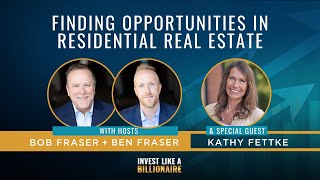
Kathy Fettke breaks down the 2022 residential market after the Fed's rate hikes squeezed liquidity and inflated home prices. Single-family rentals still work because of 30-year fixed rates and tax advantages like bonus depreciation. Dallas, Central Florida, and Cincinnati offer the best opportunities due to undersupply and migration.
Chapters
We've got a fun show for you today. We interviewed Kathy Fetke, who you've probably seen her name around if you've been involved in real estate at all in the past, you know, 10 or 15 years. Her and her husband Rich have been kind of around for probably many decades and really focused on the single-family rental market. She runs one of the top real estate podcasts. It's, I think it's a top 10 podcast called The Real Wealth Show. She's also a co-host of a BiggerPockets podcast. So Kathy has a lot of knowledge. She's kind of, you know, got her fingers in a lot of different places and feels, you know, the pulse on the real estate market. So in this episode, we talk a lot about the multifamily market, some of the concern that she has seen from some of the deals she's been seeing recently and potential challenges coming down the pike in multifamily, why they are shifting to single-family rentals and kind of the kind of growth story behind there. And then lots of other tangential topics that are really fun and really relevant. And Bob, what did you get out of the interview?
You got to listen to this one. It's great insights on migrations, on trajectory of the housing market, multifamily. So must, must listen.
Awesome. And as always, we appreciate your support of the podcast by leaving us a review on iTunes or whatever platform you listen on and enjoy the show. This is the Invest Like a Billionaire podcast, where we uncover the alternative investments and strategies that billionaires use to grow wealth. The tools and tactics you'll learn from this podcast will make you a better investor and help you build legacy wealth. Join us as we dive into the world of alternative investments, uncover strategies of the ultra-wealthy, discuss economics, and and interview successful investors. Welcome back to the Invest Like a Billionaire podcast. I am your co-host Ben Fraser, joined by fellow co-host Bob Fraser. And today we have a really fun guest. You've probably seen her because she's pretty famous in the real estate world. It's Kathy Fettke. How are you?
Wonderful. So good to see you guys.
Yes. So for those that are maybe not as familiar with Kathy, she is a best-selling author with her husband on Retire Rich with Rentals. She runs some pretty awesome podcasts, including a small media firm you may have heard of, BiggerPockets, and it's called the On the Market Podcast, where she does a lot of kind of headline news going on in the real estate world and kind of tracking a lot of the kind of big picture things and trends going on. So we thought, what better time to bring Kathy on than now as a lot of things are happening in the market, right? So we want to bring her on, get her thoughts and come a little bit of a throwback to Bob and Kathy were on a panel earlier this year. That was—
Don't bring that up.
Don't.
I have to. I have to, because you got to give credit where credit is due. And Kathy and her partner on the panel who we also had on the podcast, John Chang, were voted as the winners of the debate. We were robbed. Yeah.
Yeah. I had John Chang on my team.
I know.
That's not fair.
Data master. I just let him talk and I wore a pink dress.
Kind of eye-catching.
So Kathy, that was a lot of fun. What do you, what are you seeing in the market right now? So you're obviously tracking this on a near daily basis and things that you're seeing. You've had a lot of experience in rentals and kind of residential market, especially both single-family and multifamily. You know, what are the kind of bigger things you're seeing going on right now in kind of summer of 2022?
Well, so much is predictable and so much is unpredictable. But really, there's a lot that's happening right now that was pretty much in the cards, you know, 6 months ago. And when we did our debate, you know, this was the topic, like, is there going to be more sales volume this year than last year? And we were both kind of just given the topics we had to argue, but I got on the side of there will be less. So we'll see. We'll see. The year's not over yet. But it was predicted because The Federal Reserve is charged with keeping inflation under control, and they kind of lost sight on that, right? Inflation got completely out of control. So if you had $100,000 in the bank, you're going to lose $10,000 this year. That's pretty serious. And that's why it's so important what you guys are doing and what we're doing is to make sure people aren't sitting on cash because if, You're losing it, or equity in your— Yeah, it's just, if it's sitting there, inflation's eating it up. So that's really overall the situation right now is we're in a high inflationary market. It is not as—
Which is the best friend of real estate generally, right?
So it's good to be in hard assets in times like this when really what the Fed did, and it's kind of, some of us just scratch our head and go like, Well, how could you not see this coming? 'Cause I did, and I don't have access to all the data that you have. You know, they brought 50, it was like 40 or 50% of the currency circulating over the last 2 years was new, and that was created by the Federal Reserve. So if you are playing a Monopoly game and, you know, everybody gets their bank, all the bank money's passed out to all the players on the table, and there's a certain amount of assets on that table, And all of a sudden the banker brings in another box of fake money and that spreads around, but the same number of assets are on the board. Well, everybody has more money to bid it up. So it's, it's obvious that when you flood the market with more currency, that that's going to drive values up, especially and mainly in assets that where there's a limited supply, right? And that people really need. If there was far too much housing out there. It wouldn't matter how much money was put into the market.
And the feeding frenzy gets even worse when everyone knows that real estate does well in inflation. As soon as inflation pops its head up, everybody says, I got to get in real estate, and you got to get in real estate, well, at any price. And so it, so it goes up. But we're also seeing a lot of pressure in the markets, right? We're seeing deals go down. We're seeing, you know, some deals falling out. And, you know, I don't know if we're seeing in the multifamily space too too much pricing pressure right now, but we are seeing deals falling out of, you know, they're not closing. And we're definitely seeing prices softening in the, in the, uh, you know, single-family market. Um, but again, it's not severe, it's just more softness. Um, so what— give us some color on that.
Well, it was fully predicted. So it's, it's almost like if you were taken off guard by what's happening in the market right now, then you're kind of like Austin Powers when that big roller was coming after him, like across the warehouse, and he's freaking out. It's like, we had warning, uh, we, we knew. You and I talked about this on a stage in front of thousands of people, that the Fed messed up. They put too much money into the, into the, you know, um, money supply, and that drove prices up. How they didn't see that, I don't know. But they have to pull that money back out, and they pull the money back out by raising interest rates. And I've said this before, they pull that money back out Through bankruptcies, through foreclosures. That's, that's how you get money back outta the market. I hate to say it, it's just how it is. So when, when asset values went up, and you're right, add to the fact that every headline was saying, oh my gosh, real estate's one of the best hedges against inflation. Add to it Trump tax, you know, the, the Trump tax benefits that expire this year. So not only, you know, could you get ahead of inflation, but you didn't have to pay taxes. So of course anyone who understood— Wait a minute.
What Trump tax benefits expire this year?
The bonus depreciation. Okay. Yeah, it is like just a massive tax benefit for buying, you know, certain assets. Talk to your CPA, but that expires this year. So in the last 2, 3, 4 years, you know, you were just basically not paying income tax if you bought certain assets, and that's going away. So all this stimulus, you know, was coming into real estate that didn't need the stimulus. The Fed was also buying mortgage-backed securities to keep rates low until March of this year. They're still doing it, but until March they started to taper it, which means when they buy the mortgage-backed securities, that keeps rates low. Why would you do that when, you know, when there's all— we don't need lower— we didn't need low rates. Housing was already out of control, 20% price growth in some places, 50% with rents rent's going up that much. So, uh, you know, if it were my job to control inflation, I would have done it a little differently. But here we are. And, and it was all, again, very predicted. Starting in the early part of 2022, the Fed came out and said, we're going to raise rates 7 times this year. And, and Wall Street responds immediately. As soon as Jerome Powell, or whoever's in charge of the Fed at the time, uh, says anything, the market reacts quickly, like, oh boy, okay, we're going to do this or this. We're going to get in inflationary assets because we know there's inflation. Uh, we're going, you know, like food, gas, like you're doing. These are things you do in an inflationary market when there's not enough of the thing that people need. Uh, so anyway, it was predicted rates started to go up in March. They're going to continue until inflation is under control. Powell has been saying this. And that is going to— the attempt is to slow down the economy and slow down the price growth. So when you see headlines saying, oh my gosh, price growth, well, that's the plan, right? You can't have prices go up 20, 30, 40% every year. It's unsustainable. So don't be surprised by it. That's what it's— it's a plan. It's a bad plan.
You're throwing the Fed under the bus.
And I am, I am.
Fair enough. But this is not a Fed-only problem. Problem, right? This is created by actual, you know, systemic shortage in the market. So there is underlying demand at its, at its root, and that's in, you know, most classes of real estate. You know, I'll say, you know, certainly industrial, single-family, multifamily, especially storage. Um, and so there's huge demand underlying. So it's very different than, you know, you know, my view at least is not a bubble. We're not in a bubble. I, I think we're seeing, you know, the Fed exacerbated problem but it's on top of a fundamental, you know, rise. So do you see, you know, a lot of damage happening here or do you see prices softening? Do you see just, you know, growth slowing?
There will be damage. It depends on which asset class that you're in and how you underwrote your deals. So, you know, when we went through the housing crash of 2008, 2009, there were parts of the country that did amazing. We helped thousands of investors sell in bubble markets at the peak and take all of that money and 1031 exchange it into Dallas that was just at the beginning of its growth in 2005.
Smart.
So that's kind of been our thing is riding these markets, you know, finding out where it's peaked, getting your money out and going where it hasn't taken off yet. So, and that was in the—
So where, where, yeah, where, where's the peak? Where do you want to get out and where do you want to get in?
Well, you could see, you know, anytime there's lots of teachers out there teaching a certain thing and a lot of newbies jumping in and trying that thing, there's probably going to be a bloodbath.
It's over.
Yeah, you know, sure. There were gurus every— I don't know about you guys, but there were gurus all over my YouTube feed trying to get me to buy crypto. And these are people who'd maybe been in it for a few months and made a bunch of money, right? Because it was doing great. And Obviously we know they got, they got clobbered. Then, you know, we also see a ton of multifamily gurus out there teaching it. People who maybe even just started or haven't ever been through a downturn. And I was kind of watching and I know you guys—
A lot of people started in the space, in the syndication space, multifamily. It seemed to me like that, but I'm not that familiar.
Oh yeah, no, absolutely. There were groups with people, thousands of people in the room teaching syndication with people who'd never bought Anything, you know, and I understand. I mean, it's great to learn and I'm sure there's a percentage, maybe 1 or 2% of those groups that did amazing. But, but what we were seeing, and I think you had the, the same experience, is these deals would come to me and I'd be like, uh, this is extremely aggressive underwriting. No, you know, we're not, we're not going to leverage something to 80, 85%. I know someone at the same event that we were at in Denver that took a one cap in Houston on a value add. You know, I mean, that type of thing. So there's going to be, you know, there's going to be harm out there, but that's how it, that's how people learn, right? You know, people go through, they get tested and that's how you learn. New home sales. We have new home subdivisions new homes always get hurt first when interest rates go up because they're more expensive. And just like you said, with the supply chain issues, it's been just brutal trying to get anything built and the costs have doubled, but the prices haven't. The prices have gone up a lot, but not as much as the costs. And now interest rates. So new home builders definitely having a hard time. But then you've got other industries like I think we talked about where we're starting a single-family rental fund because we, we see certain areas that are really booming and we think they're going to do great because of the desperate need for housing.
Yeah, it's interesting. I mean, we talk about this a lot on the show, but, you know, a lot of these asset classes are cyclical, right? And multifamily, as we've been talking to folks on that, has had a great run for the past decade plus.
I mean, incredible record-breaking run in the last 18 months.
Yeah, especially the last kind of 18 months, 2 years. But what I'm seeing kind of on my end of things where I'm, you know, in all these kind of capital raising groups and these kind of syndication groups and to your point on some of these gurus that are teaching you how to syndicate, you know, how to buy multifamily with zero money down and with none of your own money and all this kind of stuff, when that kind of catches on and it's, you know, it's, it seems like everyone and their mom is doing a syndication, right? And that becomes very popularized. It can create these kind of you know, bubble-esque, you know, characteristics in the market. And for us, what's been interesting is, you know, we track a lot of the macro trends going on from the supply and demand fundamentals in these asset classes. And, you know, we're seeing continued demand growth for residential housing, you know, and you're talking about, you know, new homes. And with the price increase that we've seen in single-family homes and the interest rate increases that we've seen, this year has driven affordability, you know, way, way, way up. And so it's, it's down, down. So the cost of these homes has gone up a lot. So the mortgage payments, I think, have increased almost 50% in one year. And that's going to be driving a lot of demand back into, you know, rentals, multifamily. So you're seeing on one side there's kind of this strong fundamental support for rent growth. And generally residential housing has trended very, very tightly with inflation. So you have very positive, you know, dynamics going on there. But then you look at, you know, really the cap rate environment. What are you paying for that growth and what are you— what does your financing structure look like? And what we're seeing on a lot of deals is not necessarily that the rent growth is unrealistic where Some cases it is, right? Where all these people coming in the past 2 years, all they've seen is 5, 10, 15% rent growth annual numbers. And that's definitely not sustainable long term. But you know, our, our opinion at least is that we're going to see, you know, probably mid to high single digits for the next couple years as we have this big shortage and it's a fundamental shortage. But then you have the cap rates and, and you know, all this money that's searching for yield. And you have all this kind of these, these newbies that are coming and willing to take, you know, the very tail end of the capital stack of, you know, they're behind bridge debt, they're behind pref equity and they're levered up. You know, we've seen some deals levered up to 90 plus, 90% when you take into account the pref equity or the mezzanine debt that, that's on the cap. Yeah.
That's a bug looking for a windshield. Yeah.
That's, that's a scary place to be when a lot of these, a lot of these deals only work on bridge debt. We have to lever 80%.
Interest only payments for 3 years. Acquire or refinance in 3 years and who knows what, in what interest rate environment and what cap rate environment, you know, with minimal debt service coverage. This is, this should give every, everybody, you know, who's a banker willies, right? This is scary, scary stuff. And they're doing that and then sticking pref equity on top. And then you're investing the, the, the tail end of that thing. And while, boy, if everything is a rocket ship, you're going to make a lot of money. And if it's something less than that, you're going to get creamed. So it's just really irresponsible in my book.
Yeah, there's, there's people who probably did deals like that and got out this year.
And there are the smart ones.
Well, lucky, you know, some were just lucky and, and now they're going to kind of see that, you know, luck runs out sometimes. So, and you got to come back to the basics. We're seeing retrading. A lot of retrading happening by the millions. I mean, multifamily being repriced $15 million less. And so you can imagine there goes the pref equity. So it's going to be a bloodbath, unfortunately. And that again, that's how people learn. I've been through it. I've done deals I shouldn't have done. Like I said, new home building is hard right now, but we got, we finished 2 of them. One is fine. And the other one is just, it's struggling along because interest rates have really affected sales. So it, again, it just depends on the asset class you're in. But I do think that we're looking at some great opportunity just in our single-family fund. We're starting to be able to negotiate again, be able to get deals and not junk, you know, up until recently there wasn't much left. You know, people were paying A-class for C-class, it seems like, you know, so No, it's—
I'd love to hear more on the kind of new home construction side of things, you know, because we're here in the Midwest, we're in Kansas City, and Midwest generally is not as volatile both on the upside or the downside. So it's a little more, you know, kind of steady eddy growth. And I actually just purchased a new home that's being built and hopefully 2 weeks here I'll be done. And I just got the appraisal back and it actually came back higher than our contract price, which is kind of surprising to me. Based on what I've been hearing in the market of maybe there is some kind of softening of prices and other things. But, you know, talk about what you're seeing because, you know, it seems like it's a lot of it's kind of market specific right now. Are you kind of seeing this as a, you know, trend more on the coast that's going to be kind of coming more to the Midwest, or what are you kind of seeing in your experience on the new home construction right now?
Well, yeah, the one that we are sort of struggling with is vacation area. So we we already see with our Airbnb that our short-term rentals, that they've slowed down a bit. There are apparently just more people using short-term rentals, using Airbnb, but there's also way more short-term rentals out there. That's another thing that the gurus have been doing is teaching how to, you know, rent Airbnbs and then, I mean, rent homes and put them on the Airbnb market, no money down type thing. So there were a lot of those gurus. So now a lot of short-term rentals out there. Making lots of competition. So that, that'll be interesting to see how that goes. But on the single-family side, the reason we're choosing that right now, I definitely think in 6 months we're going to be doing multifamily as the prices come down. We haven't seen prices come down in housing in, in good strong markets. Okay, that's the thing. You're in Kansas City. That is a strong, strong market. And, you know, We are in Dallas. We've got that. Our first one is going to be in Dallas and the second in Central Florida. These areas have not seen declines yet. There's so much demand and so little inventory.
Kind of the, kind of the Sunbelt and the Midwest you like. And the market's still, you know, we're seeing the volume slow, but the prices are not, are not coming down.
Yeah. When you see the headlines, it looks terrifying because headlines are meant to terrify you. You have to read that. You actually have to read the article. But they'll say, you know, sales plummeting, you know, in housing. And that's true. That's true. The sales have come to a halt, but that doesn't mean prices have, because what you, what you've got to look at is people who own homes today, they're not like multifamily investors. Multifamily loans, commercial loans are dangerous sometimes. Like right now, I've got a lot of people that are having to put more money into their project because interest rate lowered the, you know, the— oh, I should know these terms better, but they're having to do rate locks and—
Right. Interest rate caps.
Yeah. Interest rate caps, all these things. And one of my friends is they're having to pay $40,000 more a month on their— so these are, these are things that are happening in multifamily. This doesn't happen on a 30-year fixed rate mortgage on a single family. And that's where people get confused. You have over the last, oh my gosh, 15 years, you've had people, and more like 14, buying property at low prices, getting into low interest rates, sitting on trillions of dollars of equity, massive, the record amounts of equity in homes today, and low, like record low payments because these payments were 2, 3%. It's double. It would cost them double. Triple if they left their current house and tried to rent. So it makes no sense, no sense at all for anyone to say that there's gonna be a housing crash because homeowners are in the best position of anyone. They are sitting on low payments with a massive amount of equity, and the job market is robust. Mm-hmm. There were 450,000 jobs created every month this year. The, the average over the last 10 years before, before COVID was 195,000. Massive amount of jobs. So the homeowner is not in trouble and we're not going to see a housing crash with homeowners.
I mean, there's obviously going to be an uptick like there always is because there's divorce and the typical trade-up market is going to be hampered too because so, you know, I'm sitting in my home, I got, I got some equity because I've been sitting in it and I got a 3.25% interest rate fixed for 30 years.
Me too.
Me too. Like I'm not going to go somewhere else. I'm not refinancing.
Yeah.
I'm not selling.
I'm going to sit on that. Well, that, and what that does is removes inventory, right? It just removes inventory from the market.
Inventory's not needed and builders are having a hard time building it and they can't build it affordably until these, I mean, a lot of prices have come down for commodities, but now it's cement, you know, on our project. And you were asking what's wrong with our project. We can't get cement. You know, like what, how do you build a house without concrete? You know, on the foundation. It's like, So crazy times. We couldn't get garage doors. Bob Fraser. You know, build a house on sand. I don't know. But it's been a very, very challenging time to bring on new inventory. So yeah, people sitting on 3.25% interest rates like I am, I don't care how much equity I have, I'm not going anywhere. So it is the issue. The crisis is not a housing market collapse. It's renters. Renters are in a horrible position, or people who don't own homes, because now it's like you said, twice as expensive to own a home, but then they go rent and that's awful too. So there's bidding wars on, on multifamily, just trying to get an apartment. That's, that's the issue. And new, new development is so desperately needed. I, I think if there was one thing that the government could do, I'm, I'm I'm all about free market economics, but if the federal government wanted to help, they would help builders, you know, help builders get new supply on. Don't make it so hard for us to build.
You know, it's, it's, it's a cross, you know, it's just where it's primary regulators, right? I mean, everything is overregulated. It's impossible to get things approved or very difficult and expensive and risky, you know, but that's right. I totally agree. And I actually have— there's a chart that I've, that I've used for years that shows here's the typical new construction, the permits being pulled. Right. It's— and it's got this normal range. And ever since the great financial crisis, it fell off the cliff and it's never recovered since. So we're sitting on about 15 years of an underbuilt market. And so there's just a dearth of inventory because construction all but stopped. Multifamily started to tick up, but not single-family. And only recently has it— is it just touching the 40-year normal range. And so, so we're seeing a huge shortage and it's not going to be fixed. You can't fix it overnight. It's just, it's going to take years of, of, of building to, to, to see this normalized. And, you know, meanwhile, the population continues to grow, but the housing doesn't.
That's, that's exactly it. And this all comes at a time this short supply and lack of new building, and the new builds that are being built are twice the price, just, and the builder's still losing money, right? And this all comes at a time when we have the largest generation starting families, wanting, you know, forming households. The age 28 to 34 of millennials is the biggest group. When you look at the, the chart, it's like a bubble of millennials, and they're all trying to find a place.
They want to buy a house.
They want to rent a house, buy a house, rent an apartment. They want not to live with mom and dad as they're forming a family. So it's, it's a very, it's everything came together at the wrong time. I just went out surfing this morning and the waves were crazy and nobody could catch a ride because they were coming from all these different directions. And that's what we're in right now. And the economy is like Oh my gosh, all these people want to buy. There's nothing to sell. And, you know, so no, I don't see a housing crash. That's why we're investing in single-family. I just think it's a great place to be right now.
And why new construction versus existing?
Oh, we're doing both. We're doing both. Yeah. I mean, new construction because I know that we can negotiate with builders right now. I am one. And you're like, you got, you got loans to pay. You got to sell stuff. So I think now's a good time to negotiate on new and it's just easier to manage in a fund when they're new. But we're also buying and renovating and making them like new. So we'll do both.
Yeah, we're obviously huge believers in the single-family, just, you know, market from an investor standpoint. We think that there's a lot of fundamentals supporting that. What do you, what are you seeing as far as yields go on the single-family rental market? Because that's, It's kind of gone in phases where there used to be, I would say there was kind of a bubble in single family a while ago. Obviously we saw the '08 crash and then kind of the rental side where it's kind of done-for-you rentals, other things, and the yields just aren't super compelling. But as we're having now, to your point, a very strong demand for rentals and seeing people bidding for getting into a rental and bidding higher than what the sticker price was, what are you kind of expecting yields to be maybe on a levered basis on kind of single family? What are you guys kind of projecting right now?
Oh, the cap rates are awful. I mean, you would laugh 'cause it comes in, it's a fourth.
In and out.
Fourth to fifth of what you did on your oil deal, right? But you won't let me in it. The reason people like me want to buy single family, and we've been helping people buy single family or 1 to 4 units for 20 years, that's been our business in growth markets, is that there are some benefits where you can lock in 30-year fixed rate loans and you can get up to 10 of those. So that's just good, you know, to be able to lock in those rates, especially if you're in growth markets. And then you get an enormous amount of tax benefits on top.
So what do you mean you get up to 10 of those? What does that mean?
That means that Fannie or Freddie will— you can get 10 conventional loans backed by the government at 30-year fixed rate, which are the lowest rates. Uh, they'll, they'll allow you to have up to 10 loans. And so per person, if both are working, and if one person is not working and they're married, that person can kind of be the overseer of the portfolio and they take massive deductions to the point where we've helped Thousands of people pay no income tax. I know there's a whole thing of people might hate me for saying that, but that's, hey, I'm sure your, your oil deal got lots of great tax breaks too.
Exactly.
Yeah.
I don't know anyone who's going to, who says, I want to pay more taxes, but yeah, you're out there, you know, well, the people who want the money coming to them want us to pay more. There you go. So it's more of a favorable financing is a big reason and tax benefits. Yeah. That's for sure. And of course the appreciation. Appreciation.
Yeah.
Yeah, you got appreciation, you got someone paying off your loan for you, you're getting cash flow and we're getting about 8%. So to answer your question, so it's not an 8 cap in the areas that we're in. Yeah. Dallas, outside of Dallas, Central Florida.
That's probably with leverage, right?
So it's not, that's not a leveraged—
we're in the fund, we're doing it, but we're getting, believe it or not, a 5.25% on the fund. So I would say investors are getting probably closer to 6%. So it would be lower for, you know, if you're individually buying it.
But as you said, so it's, you know, not super exciting, but when you add the tax benefits and you add appreciation, you know, it's, it's loan paydown.
The loan paydown.
You're positioning yourself for some long-term appreciation that we're all kind of believers in talking about all the dynamics going on. Talk about markets because you made a comment earlier in the conversation here about, you know, rotating from, you know, a market that, you know, before the crash and then into kind of a more growth market. And one thing you said, you rotated, you know, 10 years ago into Dallas, but you mentioned Dallas as a market that you really like. So you're still seeing continued growth there, obviously. But talk about some other markets that you're kind of seeing as, as kind of really going to benefit from these shortages in long-term appreciation?
Yeah, really any market that has not had a lot of construction, new construction is probably going to be well off. Like we've been investing in Cincinnati, Ohio for years, helping lots of investors buy there because the cash flow is high. Never an appreciation market. We never expected that, but it has been. It was like Cincinnati properties went up like 20%, you know, I mean, that's insane. So that's because Cincinnati wasn't on the radar for a bunch of national builders. They weren't like, yeah, let's go build a bunch over there. But there's growth. You've still got this massive amount of millennials looking for a place to live, and many of them want to live near mom and dad because they have babies. So these, these Midwest areas are actually going to probably do pretty well over the next few years. Um, we still love Florida, parts of Georgia, the Carolinas, because you've got all those East Coasters fed up, you know, just fed up with the tax situation or ready to retire. You have businesses moving from New York City, financial industries, stock, you know, traders. I mean, they're moving to Florida.
Money from California, right?
Yeah.
So yeah, you haven't mentioned California, which is, you know, and I've seen, I'm sure you have too, over time to time, all these articles predicting the demise of California, the demise of New York, but there always seems to be people moving there. And You know, but you know what, what really is happening? Is there a lot of net migration out of the coast? And, you know, it seems like the housing markets are, I know, are fairly soft. I know in San Francisco, I think I've seen some stats as soft, but what are you seeing really in, you know, the coastal markets?
Yeah, it's, uh, that's, I would say that there's definitely more people leaving than coming in, but I'm, I'm guessing the people leaving are retiring, you know, and, and realize they can take their nest egg and go somewhere else and and live on that because, you know, maybe they needed to bolster up their retirement by selling their house. So we're seeing a lot of that. We're seeing people who just got priced out and realized they could go other places, they could work remotely and didn't have to live in downtown San Francisco or LA, that both are just becoming more dangerous and dirtier than ever. So, you know, you definitely see people leaving, but I talk to people all the time who want to move here, so people with money want to move to California because they can live where they want. Uh, people who, you know, just are fed up and, and maybe don't have to work anymore, can just go anywhere, they're leaving. Uh, but I, I was a little concerned because I helped my daughter. I didn't, she did it all herself, but she got married and had a baby and I was like, please live near grandma. I need to see this baby. So I helped her find a house just over the hill. It's like 30 minutes from me. And definitely she paid too much for this house. So it was just ridiculous. It probably was worth $800,000 and she paid $1,000,001, right?
That's just what's going on.
That's my mom, the real estate guru.
Yeah.
But you know what, it's 30 minutes out of a real estate guru. Like I, you know, you want a babysitter? This is, it's going to pay off.
That's an expensive babysitter.
But she got it with those low interest rates, right? Right before the rates went up.
So that's hard to argue, you know, her payment's less than rent.
It's less than rent and she's got a 4-bedroom. So I was kind of freaking out just recently. And by the way, there were 3 homes on the market in that price range when she bought, and there were hundreds of people at the open house. I worked my magic and we got the, you know, we got the deal. but it was 3 houses. So I thought, oh my gosh, what's happening now? Is there massive inventory? Did she pay too much? Did she lose $300,000? Am I a bad mom? You know, all these, all these things. So I look up, guess what? There's nothing in her price range right now. There's nothing, right? There's a few at like 1.4, 1.7.
Wow.
Yeah. So it, I don't know where all this inventory is people are talking about. I don't know where it is. I'm not seeing it.
Yeah.
Yeah.
We're, we're definitely not seeing it either. I think again, it's, it's the, the trade-up people that don't wanna give up their, their good mortgage rates right now. It's keeping people in and they're willing to just accept what they have or, or wait longer, you know?
Absolutely. 'Cause you know, rates are gonna come down. Right. That's, that's something I would love to address.
Yeah.
Because there's this concern that rates are gonna go up forever.
Yeah.
The market's actually predicting, I can't see what I see the latest, but you can see from the markets what investors are predicting when the first rate cuts will be. And I don't remember when it was, but I believe it was, uh, early next year, I think. Yeah, it was early, it was Q1 of next year, which is nuts. They just are going to finish raising in order to cut rates.
I mean, yeah, no, the Fed is creating, like I said, these, these waters that are like, whoa. But, um, I'd much rather surf on, you know, smooth waves, but here we are. It's just, again, important to understand the fundamentals that so many people don't see. 'Cause when you're, when you're thinking rates are gonna go to 9 or 10 or 12% or whatever people are freaking out about, then you have to assume that every country in the world is gonna have the best economy they've ever had. And, and that they're just gonna have to keep raising rates to slow it down. If you look at the charts, it's just not true. The Fed fund rate has not been able to get over 2.5%. 3% in decades. Well, maybe not decades, but look at the charts, pull up the Fed fund rate and you'll see when you get to 2.5, 3%, it all starts to wobble and they reverse it. There's no going back to 18% like there was in the '80s. And the, the main reason for that is the US loves to spend money, and so does every country in the, in the world. Now, uh, we are at 30, over $30 trillion in debt. You can't have that much debt and then raise short-term interest rates and have the country default on its debt. It's not going to happen. So you're, you've got the world addicted to free, easy money. Let's just print it. Now we have more. Obviously, when you do that, that creates inflation. Oh no, now we have to lower the rates. But then, so here they are like, oh, we got to lower, we got to raise rates to slow down the economy. It's going to happen. And then they're going to have to reverse course. So it's very rate-sensitive world that we're in.
Yeah, it's going to be tough. I mean, and in our analysis on the inflation, kind of inflationary impulse, and we're seeing high energy prices probably being sustained. I mean, a lot of the big banks are predicting $140 oil, Goldman Sachs for instance. Um, we're talking to other oil analysts, uh, having just done an oil offering We're seeing sustained prices and it's because it's, it's not so funny. It's not that dissimilar from housing market. It's been underbuilt for 7 years. Literally, the investment in oil and gas development is, is less than half what it was 7 years ago. And so the problem is you've got— it doesn't matter what the price of oil is, there's not more oil to be had. And because it takes, it takes years to develop these in this infrastructure. And so that's going to create a higher inflationary impulse because energy, oil especially, is the mother of all commodities, right? Everything takes oil. Your wheat takes oil, your windmills take oil, your steel takes oil, everything takes oil. And, and so I'm not—
not today though, but Joe Biden said we don't need oil.
I know.
Yeah, he's a little—
he's a lot ahead of himself, you know, and You know, but that's the thing.
Like, of course we know that oil is dirty and that nobody, you know, we'd, we'd love to have other ways of creating energy and power, but we don't have it. And sustainable energy is—
doesn't— it's not enough right now.
On the chart, it's like this much. So I don't know.
So, so it's, it's a political narrative and kind of ideological narrative that has actually created shortages.
Yes.
And, and it's a false narrative. It's a flawed narrative. And it's created shortages that is going to keep inflation high. And that's going to make it very difficult for the Fed to raise rates. So, you know, now, you know, can the Fed keep rates below the rate of inflation? Well, they are today, and I think they're going to have to be. And, and so that is, that is a buy hard assets market when you see this inversion between, between interest rates and inflation. So it just bodes well for all things hard assets, especially real estate. Um, but I, I, I think they're going to have to lower rates, but I don't think— I think they're gonna have a bear of a time. I think we're in a different environment than we were 10 years ago with 2% inflation. I just don't— I don't think we're going to see 2% inflation, um, you know, in anytime soon.
Well, they'll find a new way to gauge it, I imagine. If you look at the problem with the spreadsheet, yeah, um, and with modern monetary theory, and that is what has been adopted by most central bankers. And by the way, Central bankers are just bankers. They're just banks and they've been given an enormous amount of power, uh, which is unwarranted, but it is what it is. And, and so, you know, uh, it's—
yeah, well, it's interesting. If the, the impetus behind MMT that I've seen, you know, is, is more politicians, because this is really good news for politicians. And for the, for those listeners that don't know what the heck MMT is, it's Modern Monetary Theory, and this is the idea that you can create money, kind of, and give it away to people and pain-free. And it really is a political impulse. In fact, the main book that I got, I can't remember the name, Stephanie Kelton, I think. And it's a political narrative basically of why, hey, we found the genie. You can get free stuff and give it away to everybody and solve all the problems. And there is some truth to it, but it also has limits, right?
And so it's just obvious, you know, if you're not producing something, you're, you're, you know, what are you doing? Your country's not going to probably, you know, have a great GDP or have very much output if nobody's producing. They're just receiving fake money. It just doesn't work that way. You got to produce things. You know, if you've got a garden, you got to go out there and work on it and grow some zucchinis. So it just, uh, bottom line is modern monetary theory does support politicians, because politicians can give away free education and all these things and, and healthcare, which of course, you know, people need healthcare. But what that— what I'm saying is that they're going to continue to print money to fix the problem. They're going to print money to pay the interest on the debt. They're going to print money to, you know, everything, everything and anything, and that will continue to increase inflation. So I'm, I'm with you, like Sure, the cap rates on the houses that we're buying, it's okay. And I could never sell something saying it's going to be worth more later because we don't know. But I have a really good feeling it's going to be worth more, you know?
Right.
To argue against it, you have to argue against inflation and that's pretty hard to argue against. Yeah, I think inflation is going to go to negative or zero. I was like, right, really?
No.
Kathy, it has been so fun to have you on the show. Really great thoughts. And what's the best way for folks to kind of get get a hold of you and hear more about things you guys are doing and helping investors kind of navigate some of the tumultuous times we're going through?
Well, realwealth.com has lots of free webinars and resources, and that's how we help people buy single-family homes. And then if you wanted, if you're interested in our fund, so realwealth.com, and then The Real Wealth Show is my podcast.
Awesome. Thank you so much. It was really fun. We definitely got to have you back on down the road.
Awesome to have you. Yeah.
Appreciate it.
Great insights.
So fun to see you guys.
All right, everyone.
We hope you enjoyed that podcast. It was a lot of topics, a lot of good insights, and we got a lot out of it. Hopefully you did as well. And again, if you enjoy this podcast, please subscribe to the show so you don't miss any podcast episodes that are coming down. And if you are interested in learning about some of the investment offerings that we provide through our private equity firm, Aspen Funds, please go to AspenFunds.us and click on the Offerings tab. And the Invest tab at the top, and you can join our Investor Club list to get notified of future deals. Thanks for listening.










