
How to know when enough is enough, a 1:1 with John Maxwell
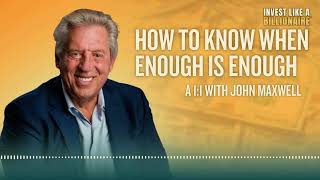
John Maxwell and Bob Fraser discuss identifying a comfortable living threshold, then directing excess wealth to charitable impact. Maxwell emphasizes that leadership qualities like trust and character matter when choosing wealth managers, and warns against quitting once you're comfortable. He advocates treating philanthropy with the same rigor as investing to achieve lasting returns.
Chapters
What story is your money telling about you and about your legacy? Today on the Invest Like a Billionaire podcast, I'm handing the mic to Bob Fraser and we're bringing you something really exciting. And I think it's going to be impactful. Bob recently had a conversation with a friend of the Aspen community, John Maxwell. He spoke at our Invest Like a Billionaire Summit that we recently had. And John is a New York Times bestselling author. He's a legendary leadership coach. He's trained leaders around the world, Fortune 500 CEOs, heads of state, entrepreneurs, and his primary message has always been about leadership. But how many times have you heard John Maxwell talk about money and investing? Well, this is what this podcast is all about. Stay tuned.
Well, John, thank you for joining me today.
Oh my gosh, Bob, it's so good to be with you again. And I always look forward when I can do something like this with a good friend. And you help a lot of people, including me. So let's help some other people today. What do you say?
There you go. Well, you've coached thousands of top CEOs and executives with leadership principles, obviously. What leadership principles translate to being a good financial steward of your wealth?
Well, I think first of all, understanding that leadership is influence, nothing more, nothing less. When I started training leaders, I wanted to understand that it wasn't title, that it wasn't position, that it was really the ability to influence people. So when you ask how does that translate over to finances of life, you know, Bob, we all have a story to tell. Every person that's going to watch this and be with us, we all have a story to tell. And I've just recently been challenging people to tell their story with their money and challenging people now to pick a number. You know, in other words, what's your number that you need to live very comfortably on? I'm not wanting anybody to have a Spartan life, but there's a number. And the reason I tell people to pick a number is because if we don't, we become greedy. Human nature is to want more. I don't know how much it is, but it's never enough. And so the moment you pick a number, you begin to satisfy the soul. And then the question is, what are you gonna do with the number above that number? Mm. And this is life-changing to me. And I, again, you have to understand, I'm new at this, I'm working at it myself. Margaret and I picked a number, so we have a number. And what that means to us is the fact, this is what we live on. Everything else above what we live on, we made a decision that half of it would go to charitable causes. And you can do that when you pick a number. See, if I don't pick a number, what happens is the next time I get some more money, it's kind of like, well, I could invest it over here. My gosh, I could go buy that. And so now I'm back into this game of more stuff. And I just say, when you pick a number, you don't get distracted and it frees you up now to tell a great story. I mean, just think about it. I guess I could tell a selfish story and say I picked a number and everything I got above that number I just spent on me. So I could have a John story, I suppose, But what would happen if I said all of a sudden, I'm gonna give this to causes I believe in and to a mission that I can live out? All of a sudden, I'm gonna write an incredible story with my life that has great influence and impact because that number could be pretty sizable after we pick our number. And so when I think of leadership as influence, nothing more, nothing less, that's what it really is. Well, what do we do? We have our time influences things, our dollars influence things. And so, because you're really concentrating on people in the financial side of their life. I just think picking a number is just very important for me, for you, for everybody.
That is so good. Then everything else we do can help others. I love the way you put it in the foreword of the book. You said financial success isn't about wealth, it's about the freedom to impact others.
Totally. And we can only impact others if we give it away. Yeah, there's a world of difference between success and significance. I want everybody that's watching you and listening to you, Bob, I want them to be very successful. I want you to be successful. But success usually is pretty much about me. Mm-hmm. And what I've accomplished. I mean, it's kind of like the Maxwell story. The story I'm talking about has to be bigger than me.
Mm-hmm.
One is too small of a number to achieve greatness. It just is. It's wonderful what one person can do, but every person that's watching, listening understands that it's through partnerships and it's through coming together that we multiply and compound. Everything in life. I mean, if I'm going to climb Mount Everest, I'm going to have to have a team. Now, if I'm going to just go take a hill, I can go get my shorts and gym shoes on, and I can go up and spend a couple hours and take the hill. But the big stuff, you got to have other people with you. So I have to get away from success, which is about me, and start living a life of significance, which is with others and for others.
Wow.
And the most beautiful stories that will always be about others. Because I know a lot, and you do too, Bob, I know a lot of very unfulfilled, unhappy, successful people.
Boy, isn't that the truth?
Oh, they're loaded. They got money, they got everything. Hey, if stuff would make them happy, they'd all be happy. They're not happy because stuff can't make you happy. Stuff's not supposed to make you and I happy. So here we are. But I have never ever met one person that lived a life of significance, that was unhappy or unfulfilled. And why? Because we are born, we are created to care for others and make a difference in other people's lives. We are not born for ourselves. We are born to be our brother's keeper. So I tell people, go make a whole bunch of money, just don't spend it all on you. Pick your number and then pass it on and be a significant person. Does that make sense?
It's so good. It seems like there is a lot of crossover between good leadership and financial success because good leadership creates value and value creation is the foundation of wealth building.
Totally. In fact, you know, when we're talking about charitable giving, there are questions I ask myself before I give, because I mean, there are so many wonderful causes. I mean, there are so many needs out there. So I ask myself a few questions. And the first question I ask myself, when you talk about leadership and stewardship and how it works, The first question I ask myself before I give to a cause is about leadership. I ask, do they have a good leader? Mm. Character and competence. If the leader doesn't have good character, what am I going to give to that person? They're going to take that money and waste it anyway. And if they don't have competence, why would I give them money? Because they're not going to be able to maximize the dollar. So I'm just not going to do it.
That makes total sense.
Yeah.
You know, it seems to me too, one of the focuses of our book is on selecting private wealth managers. The first thing is, you want to make sure they have good leadership, good character.
Yeah, I never thought of it that way, but that's very true. Thank you for that insight. Yes, that makes all the sense in the world. And again, what's the foundation of leadership? Trust. What's the foundation of stewardship? Trust. And when I say everything rises and falls on leadership, what causes leadership to rise? Two things: good leadership skills and good values. And you can't substitute one for the other. You can't say, we know they got great leadership skills, but I think he probably, he's a crook. I don't trust him. Well, hello. But I wanna flip it. I also know people that are very trustworthy, but they can't lead. They can't lead. So I tell people, don't make them your leader, make them your friend. You know, go out to lunch with them, have a good conversation, but don't go follow them. They're incompetent. But when you put good leadership skills and good values together, hey, it works the same way in finances. You want people that are competent stewardship-wise with skills, But you also want them to have good values. They gotta be better on the inside than they are on the outside. Yeah.
So many people don't integrate. Investing is not their primary focus, and wealth building is kind of secondary to their broader mission and calling. One of my questions is, how do you integrate it? And I'm coming back to your comment on significance. It's making the reason for your investment is to increase the significance.
No question. In fact, I find it very interesting. On our own personal financial portfolio, we really work hard on trying to make sure that we get the best return for our money. But when it comes to giving, I think we're quite careless. I think we throw money on the wall and, you know, that's a good friend of mine. I wanna help him out a little bit. And we really don't go through the proper stewardship of stewardship and ask ourselves, why wouldn't we care for an eternal return as much as we care for a return right now in our own life. And I think that's a big miss with a lot of people. And when I call them out on that, often they'll say, you know, you're exactly right. Obviously, we want to get the best personal return. There's nothing wrong with that. Nothing at all. But I think we also, when it comes to giving, we have to be good stewards of our giving. And we've got to make sure that we're going to give the kind of return there that is going to be eternal. No question about it. Yeah.
You know, and while we're there, you know, I'm going to go ahead and just give a shout out to Equip. And I'm actually a— I'm a huge, huge fan of the John Maxwell organization. And you talk about good stewardship. I mean, the return you're getting and the impact you're making across nations. And my favorite is the iLead program where you're taking values and you're inculcating these in millions and millions of children. And the impact is real, it's tangible. So I'm just so excited about that.
I am too, because you know what happens if you can put good values in children, You save a generation. Yeah. How do you change your country? I tell you how you change it.
No question. Start with the kindergartners.
Because here's what happens when kids learn good values, they can live good values. And when they live good values, everything appreciates. And by the way, thanks. You are a— you're not only a fan, and I got a lot of fans. You got— you're a supporter, buddy. You step up big time. Thank you very much. It means the world to me. Really does.
Well, and it's good stewardship. I mean, I feel like every dollar that I give is really being used well. And you guys have done an amazing job.
Of that.
And back to your earlier point you made about picking your number, you know, the goal of the book, Invest Like a Billionaire, is to help people become next-level investors. And because the difference is enormous, I point out in the book that the value of compounding your investment is greater than the value of a career or even a successful business over time. And so if you have a number, right, then everything above that can go to impact and making the world a better place and doing whatever is telling your story, as you say.
Bob, what I love about your Invest Like a Billionaire book is this: successful people get to that top 10% plateau. They get there. I mean, 90% of the people basically are, quote, under them. And if you get to the top 10% in your career, you can live a very comfortable life. I mean, you're in leadership, you've got influence, you probably really don't have need of anything at that 10% level. But the tendency is for people to stop there. And what I love about your Invest Like a Billionaire, you stretch the minds and say, wait a minute, the next 9% above that, going from 90 up to 99, get up to that top one, the next 9% compounds 6 to 1 to the first 90%. And this is the big miss because people say, well, you know, I'm comfortable, I don't need to work here. Well, of course you don't need to work anywhere, but you're missing the picture. All the influence and all the good you could do in culture and society is on that back end.
It is.
But you got to stay in the game. In fact, I have a saying sometimes I use, and that is, when you can afford to quit, you can't afford to quit. Wow. Because when you can afford to quit is about the time you're starting to compound that money and that influence. And what I tell people is, if you quit on that 10% level, if you quit there, you'll never have any idea of the loss of potential that you just gave up because you don't know, you didn't go there. So you don't get a readout on that. But here's what I know. If you had influence and money on the first 90%, which you do, that next 9%, that's where you tell the beautiful story that we talked about. And it compounds. It's almost embarrassing. I'm 78. I wish when I was 60, somebody would've helped me with this. Wow.
Isn't that something?
I stayed in the game and I'm still in the game. But I mean, and 60 is not like a young kid. My brother was this very successful business guy. When he became 40 years old, we were visiting out in San Diego where I lived at that time. And he said, Johnny, he said, I think I'm going to just retire. I got everything I need. And I said, no, that's a horrible thing to say and do. Now's the time to put the pedal to the metal. And he spent really the rest of his life telling and writing beautiful stories of giving and charity and significance in his life with hundreds and hundreds of thousands of people's lives being changed. So what I love about your book and about the way you think is that you really do understand, Bob, that when you get to that 90%, that's when harvest time just gets ridiculous. And you never know if you stop, but if you don't stop, you become incredibly amazed and unbelievably grateful because you've never lived in a time like you're about to live in when you start compounding all that money, all that influence, never.
It feels like that to me. I, at this stage in my life, and I'm 64, I'm just a youngster, you know, here.
And you're a kid.
But I am more excited about the next phase of my life, about multiplying everything that I've been given in order to make the biggest difference I can make for the most people.
You know what I want you to do? Because your book is out now, right? Or it's coming out.
It's September 2nd.
So what I want to do is I want to buy 100 copies of your book. But I want you to give them to people that you want to invest in. Basically give them to young people. Give them to kids that aren't— hey, they're not even a millionaire yet, but get that kind of teaching in there. And I want to send you a check because I want to invest in the book because I know the book and I know what you've said in the book, and I want more people to get it and put that gift in their hands and let them blossom.
That's the thing about investing is time is your friend, right? The sooner you get started, the more impact you have, the better it is, you know?
No question.
And especially if you do what you're saying, you pick your number as a young person, pick your number and then just live on that, grow and give the rest.
Absolutely. But I think you need to pick two numbers. I think you need to pick on it. This is my standard of living number and this is gonna be my net worth number.
Hmm.
And they do two different things for different people. 'Cause I picked a net worth number. Oh my gosh. 15 years ago, I suppose. So my net worth has stayed the same for quite a period of time. Because I give all the rest of it away. Wow. And so it's just, it works. It really works. I mean, and by the way, my number is a good number. I have a good life. I'm not trying to strain people. I'm just saying, pick it up.
And the rest doesn't get invested. It just goes to charity.
Oh yeah. Yeah. That's why we do it. So yeah, I could have a bigger net worth, but I just think my friend Ron Blue said, do your giving while you're living. So you're knowing where it's going. Doesn't that work?
That's great.
And Margaret and I have a lot of joy in seeing our money work. You know, I mean, just like you build your personal portfolio, you have a lot of joy in watching that money work for you. Well, we have a lot of joy in being able to give to these causes and saying, look what's happened with that money that we've invested. Look at the return we're getting. And we get to see it. Too many people, they wait until they're ready to die and then try to figure it out. And they miss an incredible journey of our life of seeing that money help people.
You know, I find the older I've gotten, I get more focused on the giving than the earning. You know, early in my career, it was just building, building, building. But today it's more, I think, a lot more about how do I make the greatest impact and figure out how to earn more, but to give it away. Do you think that's a natural thing with age, or what's your perspective on that?
No, I think it's a natural thing with a person that has a heart for generosity. I think greedy people are greedier their whole life. I just think greedy people get more greedy as they get older. Wow. You know what I'm saying? And I tell people all the time, oh, I mean, I know people, they've been climbing the ladder their whole life. And I said, what happens when you get to the top of the ladder and find out that it's leaning against the wrong building? That's why I know that if we make those decisions when we're younger, the return is great. My father, who lived to be 98, I can remember when he was about 91, we were talking one day in his office and he said, John, isn't it wonderful that the older you get, the more you love people? And I said, Dad, I said, that's true of you, but that isn't true of a lot of people. I said, the older some people get, the crankier they get. They become a dog.
That's true.
What happens is how we spend our youth and our bent and our perspective of life, what happens is you get older, it just gets more exaggerated. Age exaggerates. So if I have lived a giving, generous, abundant life, as I get older, guess what? It exaggerates. And so my father loved people. Loved people when he was 35, well, he really loves people at 85. But if you don't like people at 35, that love switch doesn't just turn on automatically. You just don't like them very much at 85 either. So I think that perspective is, you know, how we view things is how we do things. So I've become kind of, you know, outside of sharing my faith with a person, if I could help them with anything, I would, I think I would help them with their perspective because If my perspective is one of generosity and abundance, I'm going to have that. But if my perspective is scarcity and holding tight to what I have, what I tell people is your perspective is your real world. It's your real world. It's not a false world. It's not a fake world. It's not a wrong world. It's just a real world. And I think that the quicker people can understand that and get what I call a life stance, a life perspective about how to be generous and how to have good values and how to truly be bigger on the inside than on the outside. I think there comes a time where, man, that life gets to be compounded and it begins to be an incredible influence in a positive way to a lot of other people without any doubt.
That's so good, John. You've shared some amazing nuggets here. Last question for you. You know, Invest Like a Billionaire is being published by Maxwell Leadership, which I'm just super honored to be partnered with your organization.
We're so happy about that.
And so let me ask, why did you decide to take on this project and why do you believe this message of wise wealth building is so timely important today?
Well, we have a publishing company and we're honored to publish you, but we don't publish you first of all because the book you've written, we publish you because the person you are. I learned a long time ago, you bet on the person and then everything else they do comes out okay, but you bet on the person. So hey, if you're a speaker but you're a good person, we'll bet on you and it'll come. If you're a writer, we'll bet on you, but you got it, you bet on the person. And so when we met you and had some time with you and asked the questions you asked, we sat there and we said, Bob's a good person. And you're right, your motives are right, and you're doing the right thing for the right reason. And so now we said, okay, what kind of book you got? Well, the kind of book you have is a book that is practical, and it's a book that's biblical, and it's a book that truly stretches people. Would I read a book I want to be stretched. When I read a book, I want a mountain to climb. I want something to do that I haven't yet done. I want to see something yet I haven't yet seen. And so Invest Like a Billionaire is a blueprint to do the right thing with the materialism that you're going to have in your life. We're very proud, and it's an honor. It's truly an honor to partner with you because there are going to be a lot of people helped. And again, I really want to invest in 100 books myself just because there are people that need to get that. And I'm very excited about young people picking it up because my life was changed because my father put us on a reading program from the 7th grade on, and we were paid our allowance by the books that we read. And so by the time I got out of high school, I was so much further ahead than my peers, not because I was smarter, but because I was reading good stuff all the time.
Isn't that the truth? You know, today for $30, you can get the most world- world-changing, life-changing concepts, the secrets of the world. And it's just amazing the rich time we live in. Well, John, this has been amazing. I absolutely love the things you've shared. I think they're timeless and incredibly important. And I just hope people take this all to heart. And thank you so much for being here with us and for giving your wisdom. And you're just so generous with yourself. And I so appreciate you.
Well, you are too. You're salt and light. You make things better. Make things brighter.
Back at you.
Hey, keep shaking the salt and turning on the light, man. Wow.
So grateful to John Maxwell for joining us in this conversation and even bought 100 copies of the Invest Like a Billionaire book. If you want to buy a copy or multiple copies of the book, please head to thebillionairebook.com to get your copy now. Pre-order will be released in early September. Hey, get in touch if you're on YouTube or Spotify. Let us know in the comments, what do you think of John's idea of picking a number? How much do you need to feel comfortable? What do you want to do with the rest? This is a great exercise to cap that desire for more, more, more and write the best story that you can with your money and with your life. Well, that's it for this week. Thanks for listening. We'll be back next week with more deep dives into the portfolios of passive investors like yourself. See you there.










