
How to Vet Private Placement Deals with Ben Fraser and David Phelps
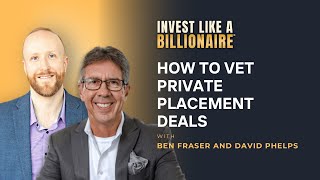
In this panel, moderator Ellis interviews two private‑placement experts—Ben Fraser, CIO of Aspen Funds, and Dr. David Phelps, founder of Freedom Founders—to teach limited partners how to source and vet alternative‑real‑asset deals. The conversation begins with each guest’s personal journey into private‑placement investing, highlighting the shift from operator‑focused work to passive LP roles. Both stress that high‑quality deals are found through strong networks and relationships, not random referrals. They outline a three‑stage diligence framework: (1) sponsor evaluation (track record, full‑cycle experience, co‑investment, fee structure), (2) market and asset analysis (demographics, supply‑demand fundamentals, capital stack), and (3) deal‑specific review (PPM sources & uses, waterfall structure, sensitivity analysis on inflation and cap‑rate, and red‑flag indicators such as rescue funds or lack of transparency). The panel discusses first‑look criteria, the importance of alignment of interests, and practical tools like background checks and sensitivity models. Real‑world anecdotes illustrate a successful self‑storage equity investment and a failed joint‑venture in gas exploration, underscoring the need to stay within one’s expertise. Final advice emphasizes joining educated communities (e.g., Freedom Founders), being patient, accumulating “reps” by reviewing multiple deals, and setting personal investment rules. The discussion also promotes the “Invest Like a Billionaire” book as a concrete guide for private‑placement vetting.
Chapters
Hey, welcome everyone to this panel with two amazing guests, and we want to provide an opportunity. You know, the, the important thing if you're going to be investing in alternative investments, whether you're new to this or you're an experienced investor in this, you know that a key part of investing in private placement deals is one, is finding good quality deals, and is vetting good quality deals. And so I have two, uh, experts when it comes to private placement passive investing, one of course being, uh, one of the host of this event, Ben Fraser from Aspen Funds, and the founder of Freedom, uh, Freedom Founders, Dr. David Phelps. Want to welcome both of you to this panel. How you guys doing?
Doing well, thanks.
Doing well, excited.
Uh, well, listen, I want to jump in. David, let's start with you. Guys already know a little bit about, about Ben. Will you talk to us about how you first got involved in private placement investing, uh, and just how much you've done over the years so folks can kind of get an idea of your background?
Certainly. Well, this is my 45th year. Yeah, I'm that old. I just dated myself, didn't I? 1980 was actually my first private placement. Now, I'm going to be clear. I started with private equity in direct investments. So we're going to move forward very quickly here into what I do today, which is why we're here talking as, as your co-hosts, co-contributors. But I started out with equity in real estate because I read books when I was in college and realized that I needed to know something about how money works. I was going to do something in a profession in dentistry. I could make the money, but how could I learn how to be an investor? That was on my mind. I know, crazy, you know, as a kid, but I always wanted to learn how money works. I had to make it, but how does it work? So I started buying rental properties when I was very young. Actually, before I became a dentist, I was in real estate. So I was never a flipper. I was never a syndicator. I did direct investment and I also got involved in lending and performing notes. So the private credit side, But again, direct investments, mobile home park on the side, some commercial buildings on the side, I would say. But I moved into what we're talking about today in terms of private placement into collaborating or investing through other people, operators, because I didn't want to be the operator anymore for a couple of reasons. As you go through life, you start to value your time much more. When you're young, you can try to do all things because you have more time than money. But as you start to move up in your stature, I would say, then your time becomes more important, but you have typically more capital to invest. So how am I going to do that? I got to find other people. We're talking about how you do that, but other people through whom I can invest that capital, still get the returns and the benefits of private placements. So that's my fast forward for you.
Let me just follow up to that question is, you know, what drew you to alternative investments or private placements over the stock market? 'Cause I mean, some regard the stock market's passive too. I mean, you can invest in the S&P 500 and don't do any work. So why real estate in general, but private placement, you know, overall?
Yeah, well, it's a great question. And when I was back in college reading books about, you know, how money works and, you know, how to be an investor, certainly there were books about the stock market, mutual funds were coming out back then. And so I was interested, I read about it, but I also got some books about real estate. When I compared and contrasted the two, What I like, and I didn't really understand that point, but what I liked was the tangible aspect of the collateral in investing in private placements, in this case, in collateral-backed investments versus the stock market where people get into maybe being traders or even long-term investors in the S&P. I get that. I get that. And maybe there's a place for some of that, not against it. But what really drew me to private placements and in private investments was the fact that I felt like I had more control, right? It's tangible. I can understand it. I can understand a house and I could understand where I could put the value into it. I could have discernment over what that was gonna be, if I would buy it, how I'd rent it, how I'd do value add, how I might exit it someday. When do I— I got to make all those choices. It comes with responsibility and time, but I like to have that level of control that I never felt like you get in the stock market.
Yeah.
Ben, quickly summarize too, you know, I want to— I want folks to hear a little bit from you because maybe, yeah, they don't know your journey into the world of alts because you kind of come actually from a more traditional background. Can you just give folks a, you know, a glimpse into your world, into private placement investing?
Yeah, sure. So, you know, I started out my career in kind of traditional corporate finance, worked for some boutique, uh, you know, publicly traded asset management companies, and then moved into commercial commercial lending for, you know, a good chunk of my early career where I did a lot of underwriting, a lot of analysis, um, and also some lending before kind of moving into the private placement world on the equity side. And what was interesting to me when I was in banking, you know, one of the, the cool things I got to do was look at the most successful borrowers of our bank or multiple banks and see their personal financial statements. That was a requirement of our underwriting, was we had to review that and see the financial wherewithal of these borrowers. And the thing that was interesting to me as kind of a young up-and-coming, you know, finance guy was seeing this very high correlation to the higher the net worth, usually the more real estate they owned and the more direct ownership or, you know, running a business as an entrepreneur or a partner of a business that they had. So it was businesses, and it was real estate. And, you know, that's, you know, the two big verticals within private alternatives. And so it kind of got me excited about it to see this and truly understand it. And then, you know, really about 8 or so years ago, jumped full-time into the world of private alternatives. And, um, you know, the rest is kind of history at this point. Now, now I'm running, you know, for Aspen Funds, our acquisitions and our asset management. And so, you know, now, you know, for the purpose of this panel where we're talking about how do you find good deals. You know, that's what I'm doing on a day-to-day basis is using those analysis underwriting skills that I've developed to help find the best opportunities. Because we'll talk about this probably a little bit, but one of the, one of the challenges for a lot of investors in private alternatives is return dispersion. And what I mean by that is the, the potential outcomes that you can have investing in private alternatives is way wider than what you'd expect and what you actually see in public investments. So, you know, the difference you kind of mentioned earlier, Ellis, the difference between, you know, the best operators and the worst operators in the public markets is maybe a few percentage points. But the difference between the best operators and the worst operators in private alternatives is, you know, high double digits on the high end to losing your money. And, and that's a very common thing. So that's the importance here. A lot of people overlook, you know, the reason why it's so important to get familiar with diligence and vetting. But that's the real why, why we're talking today. Right.
Well, I'm excited for both of you guys because you're both on a day-to-day basis doing different things. I mean, Ben, you're the chief investment officer of an alternative investment company. David, I don't know if folks know a whole lot about Freedom Founders, so feel free to kind of give us a summary where you're more of maybe sitting in a consultant role or you're an LP yourself in a lot of deals. So you're not necessarily you know, you're definitely not the chief investment officer of an alternative company. You're kind of looking at deals. So I want to give the advantage to you in this question, but definitely ask Ben, too, on the individual side, how you're looking for deals. I mean, where are the best private placement deals typically coming from in your world, David, for you and your, your community?
Yeah, because I am not an operator, I'm not a sponsor, I'm not a GP. I have a great appreciation for for Ben and what he does, because I know how much goes into that. So yes, I'm more of an educator, a connector in Freedom Founders. And so we very much have developed the protocols that we use in at least on the front end, doing some filtering of who we believe would be potentially good operators, sponsors that we'd introduce our clients to. We are big about education, though. I don't guide, don't point. I don't tell people, go invest here. So I would, to answer your question, where do you find, where do we find best place to find? I believe it's in a network, it's in relationships. And people say, well, what do you mean? What's that about? Well, that's where this kind of investing does take a little bit of work. Not work in actually finding the properties, finding the deals, managing the deals. I'm not talking about that kind of work, but relationships have been the biggest inflection point in my life, bar none. Even outside of investing, it's just people I know. And I had to work to do that. I work to do that today. I mean, that's how we met because I don't sit in a silo and do a little day trading on my computer. I gotta be out in the world and you either go to conferences or you're part of different communities or sponsors who have events. You go and you meet people, you meet people who are sponsors, you meet people who are invested with sponsors. That's the first place to start is see who's out there, who's who, see from the outside, you know, how people, show up. That's, that's the very outside of the envelope. And I know we're going to dig in deeper than that, but that's where I would start is relationships to give you the access points to, as Ben said, you know, the benefit here is an inefficient marketplace. Inefficient. People go, well, why do you want inefficiency? I want inefficiency because that's where the opportunity and the greater return dispersion comes from is the inefficiency in the market. I can't do that on Wall Street. At least I don't know how. But here I have the opportunity to do that by putting myself out there and creating relationships with other people.
David, I want to follow up on that though, because as someone who speaks with a lot of high net worth individuals, maybe post-exit founders, guys who've come into cash, they're saying, hey, I got this deal that my brother-in-law sent me. This is a good relationship, or my friend from college this is a relationship I've known for a while. But as you and I both know, those deals typically are the worst deals in their portfolio in, in the long run. So would you maybe just expand a little bit on what you mean by relationships, how you're building those relationships? We'll get into what a good deal and bad deal looks like, but I just want to clarify like that statement.
Yeah, you know, very good point, very good point. We all have friends that tell us, uh, here's the greatest deal I've ever seen, and yet it comes back to the blind leading the blind, you No bad intentions, right? Everybody wants to share something, thinks it's great. But what is your brother-in-law? What is your trusted friend that you've done business with in other respects? What do they know about this particular thing? What I tell people is to become a more sophisticated investor as an LP, a limited partner, want to be more passive, you got to have enough reps. What do you mean by reps? You've got to look at enough deals. You've got to look at enough, you know, and how do you do that? Well, you've got to be around, you know, people who can show you deals and over time through education and talking to other people who have more, maybe more sophistication, you start to learn what are you, what am I looking for? I know we're gonna get into that, this discussion. What am I actually looking for as I go down my checklist? Is this potentially something I might invest in or do I just toss it out? So yeah, relationships are important, but the right relationships. I want a brother-in-law who actually, you know, has some depth in investing and could tell me, I've been doing this for 15 years and here's my track record. Okay, now maybe I'm listening, right?
Yeah, yeah, yeah.
Specialized brother-in-law is what we're saying. Nothing against brother-in-laws. I have a great one. Yeah, I know.
Exactly.
Ben, back to you, because what I appreciate about Aspen, being part of the Aspen team, is, you know, in some ways we are capital allocators as well, right? We've, we've grown our business to be across multiple verticals and not just one. We started or specialized in one. But now over 4 or 5. From your perspective, how are you finding maybe great opportunities, different verticals? Can you talk about that, you know, uh, from, from the Aspen model or from, from your perspective?
Yeah, I mean, you know, one of our core verticals is private credit, and that is investing in other, in other deals, other operators' deals. And we have to do all the same things that we would do if someone was evaluating us as the operator of the deal, right, as an LP. From an LP perspective, you know, I think David hit the nail on the head. And I, and I think it, it doesn't have to be, uh, so much more than that of really getting out, meeting people that are already doing this, and finding the networks like David's group, Freedom Founders. You know, big, big shout out for, um, you know, any dentists out there that want to become financially free, make sure you reach out to David. That is to me the end-all be-all, because what you can do from that is one, you get around other people that are already a few steps ahead of you. So they've already kind of made some of the same mistakes that you would likely make if you didn't have a network around you. You can bounce ideas off of other people, right? Hey, am I crazy for thinking this is an interesting idea or an interesting deal? Right? You get— there's power in getting feedback and and, you know, getting that feedback loop going from other people that are more experienced. And then the other big benefit of that is people that have invested with those sponsors before, you can hear about their experiences, right? Because, you know, the number of times that we hear LPs talk about investing with a sponsor that, you know, they were, you know, really nice looking brochure, seemed like a great deal. And, you know, very communicative, very helpful upfront. And then once the money was sent, the wire was sent, it's like a black box. Now they can't get a hold of anybody at the company. They aren't getting timely reports, if reports at all. They don't really have a good sense of is this, you know, deal on track or off track. And that's a really not fun place to be as an LP, right? Because there's— there is lack of transparency, you know, at a high level in this industry. So you have to find those operators that are going to be transparent. You can get those kind of, I'll call them little hacks, right, of finding the right relationships with people that are going to be good to work with, that will give the good communication, that will give the transparent reporting, that will be responsive after the check is received. And, you know, as an LP, you're at a distinct disadvantage on the front end because you don't know what the—
you don't know any— yeah, you don't know any of that, unfortunately.
You don't know how it's going to be 5 years down the road, right? That you're taking a risk of a jump of trust to, to hope that they're gonna, you know, do that. And so being able to talk with other people that are already a few steps ahead of maybe invested with those sponsors, I think, could be very, very beneficial and helpful. And, you know, I have a whole host of things I would say are some, you know, red flags and green flags that we can get into a little bit for, for operators. But for finding them, I think that's, you know, You can't beat that, you know, going to the conferences. And I love what David said, getting the reps in. The reps is so important because what I found too, and David, you probably, you know, might have a similar experience, especially those kind of post-exit founders that have a big liquidity event that just want to go all in on alternatives and they just invest it all at once. And generally, I mean, I'm trying to think through all the times I've talked with folks that have done this. Most of the time the first investments that they make are usually the ones they regret the most down the road because, you know, it's— you learn so much as you go and as you wait, as you have patience and you have discipline in how you're allocating and how much you're putting in every deal and the things you learn from just seeing the deals and doing this over a long period of time really builds an incredible base of knowledge. Yeah.
Yeah. When, when you go from a, an exit from equity, a business that you have been running, the operator, well, you know what that's about. And I think we're all driven about ROI. Well, yeah, ROI's important. Am I getting a good ROI in my business equity? Now I've harvested that equity, I'm gonna put it somewhere else. Well, I gotta drive that for ROI too, and I better get going to get it, get it working. And that's where the big mistake comes from is too fast going into a place where you don't know and you've gotta gain a little bit of knowledge. And have the reps and the resources to do that deeper dive.
That's such a good— like, that's— it's a really great way of describing it. Like, especially if you're coming out of an exit, you probably have just been pushing so hard for so long. And the ability to kind of step back and be patient and do due diligence is like almost a completely different mindset. Right. And so I've never really thought about like that of just understanding that mentality and the two different mentality it takes. That's a really, really great— because like when you're in a business or owning a business, I mean, you get paid to make decisions quickly, right? I mean, we all know that, right? And so in this case, it's like, it's a little bit different. I think that's a really good point, David.
It's very difficult to— for us, for us, I say we're talking to— it's difficult for us to do, to hold back and be patient.
So I'm big into first impressions. You know, I think first impressions are a big deal. I want to know when a deal comes across your desk, this is a question for both of you guys. What are the first things that you look for?
Well, I'll jump in. I'm going to look first for, you know, execution. I'm looking at the operator. So what do I know? What can I learn about their track record? Have they gone full cycle, you know, in the current model, whether it's private credit, private equity, the actual asset classes, self-storage or multifamily? What is it, the model? How long have they been in it and they've gone full cycle? Because what we're very aware of across the board is that we're going through a cyclical change right now. And there are people who have done well or above average in returns, many people in the last number of years. And we're hitting a time in the market where those that were not as experienced perhaps in building their capital stack and operations are showing up now. And so I want to know someone who's been through a full cycle and knows what to look for in those operations. Because I'm as an LP, I'm relying on them to have some sense of where my money, where my money's going. And are we just, we just investing in something because they're good capital raisers and they got to put it somewhere? So are they going into marginal deals that are just keeping their fingers crossed that interest rates are going to come down or what's the game? So execution is first one. Second one for me would be alignment, alignment of the GP sponsor with me, the LP, you know, how much skin in the game do they have? Actual, actual hard money into the deal. I mean, I'd like to see 5%, you know, maybe, maybe more in some cases, but something there. I want to look at the, the splits. So say there's preferred return, the— what's the waterfall splits out after that? You know, are they— are there— is there alignment? I want to make sure that we're working together and there's not disinterest going on here where I'm being put aside and it's all about what the sponsor is doing. And I'd say the third one, the key would be the actual property or it could be the assets if it's in a fund. But what's the value play there? What's the proposition? What are we— what are the assumptions that we're looking at in particularly in rent growth or interest rates changing, you know, cap rate exits? What are the assumptions? And I have to be able to have enough wisdom or know people who can look at those, go, Well, are we pushing the, pushing the needle a bit hard here to, to come up with these IRRs that are being promised, or, or should I tamp them down myself and decide now, is this still something I want to do based on that good operator? But I think they're pushing the needle too far, so I may still invest, but I'm not going to go for their 20% IRR. I might be happy with 12% maybe in this case.
Ben, I'll pass the same question to you.
Yeah, you know, I'll take the question from, from my perspective, which is, again, I'm getting requests, you know, every time or every day, I would say, from sponsors looking for us to invest in their deals as preferred equity. And so it's a very similar approach, I would say, for an LP looking to invest in a GP because we're looking at very much the same things. You know, I kind of break it into 3 different stages of the diligence. And the first to me is sponsor. The second is market, and the third is the property or the underlying assets to what David said. And so for me, the sponsor always comes first and I want to look at the track record and dig into it, right? How long have they been doing this? You know, have they gone full cycle? Are they doing similar types of deals in similar geographies as what this deal is? Right. Do they, do they have the market knowledge, the market expertise, any competitive advantage that they have for operating this asset, you know, relative to somebody else. And then I totally agree with alignment. I think that this is something that cannot be emphasized enough, is alignment of incentives and alignment of risks. And to me, one of the biggest ways to just have a simple, you know, hack of looking at what's the most important number on that, and that is co-investment to me. What amount of the equity is the sponsor bringing to the table and investing alongside the other equity at the same terms. Right. Because if they're putting their own skin in the game, their own cash, and I look at— I want to look at equity after acquisition fee.
Right.
Because this is, this is something that can be a little bit misleading. We're like, oh yeah, we're investing into the deal, but we're only investing half of our acquisition fee, which is a fee that we earned on the deal. So it's not it's not true, you know, cash in, right? Where it's not going to hurt as much if they lose that. And the bigger the number, the better to me, because I want the sponsors to feel the pain if the deal's not going, you know, according to plan. I want their, their capital at risk just as much as my capital. And they're going to act differently if they have capital to lose than if they don't. And I've seen this happen over and over and over again in even the past couple of years as the cycle's kind of corrected a little bit where the sponsors that did not have skin in the game, they have less incentive to stay in the deal when it gets hard, right? Because it's not, it's not fun operating a struggling asset. So if you have no incentives to stay in, why don't I just hand the keys back? Right. And I've seen that happen a few times. And then, yeah, looking at the fees, I think this is where the reps really matter because, you know, that's one of the first sections I go to. The first two sections in a PPM I go to or in a deck are sources and uses. I want to see what is the purpose or what are they— what are they going to be doing with the money? All right. This is for a purchase, but how much is going to be CapEx? Are they replacing capital? Are they replacing another preferred equity investor? They're replacing other equity investors. They're, you know, buyouts. I mean, there's a lot of things I've seen that get thrown into a sources and uses table. This is required in a PPM. So you— they have to tell you what the funds are going to be used for. Really, really helpful. I've seen some preferred equity funds recently that are— I call them rescue, rescue funds for their own deals, right? And these sponsors are raising money. When we looked at recently, half of the money that was coming in and this new fund they're raising was paying back GP loans on the deals that they're— the assets are secured by. That to me is a pretty massive, at least a yellow flag if not a red flag, that the the GP is taking not only putting money, not putting money in, but taking a significant amount of money off the table on that. So that's really important. And then, you know, the market's really important. Is this a market they want to be in? Is this a growing market? Are the demographics favorable? Are the supply and demand fundamentals favorable for that type of asset I'm looking at? And then the deal in particular, does the business plan make sense? Right. Does Does it make sense that the strategy they're trying to do, do the assumptions that they're using to achieve that business plan seem reasonable? And do they have the staff, the experience, and the resources to achieve that business plan as it's, as it's stated? So those are all the things that I'm looking at when I'm, I'm just running through a deal real quick.
Really good. I just want to recap some of the things you both similar said. I mean, clearly alignment is important for both of you. So alignment from the sponsor, meaning they're co-investing, their fees are, you know, are within, you know, market. Uh, Ben, I thought your point of sources and uses, understanding kind of where money is going to, is really, really key. And then, yeah, that, you know, you— the— you can, you can explain the business plan, right? Like, it doesn't— uh, not everything has to go right for it, for them to execute, uh, perfectly. So I think that's really good. I want to move on, David. I'd love to just get some real life lessons from you, right? I mean, I think, I think this is important for someone who's been doing this for 45 years.
You want to see my scar tissue?
Yeah. Well, yeah.
Yeah.
Can you pull up your shirt a little bit and show us? I don't want to start there. Let's start a little more positive. How about one of the best deals that you've ever been a part of and what made it so successful?
I haven't really hit any home runs, but let me speak from the fundamental of, of a really good deal. Number one, most of my allocations where I'm in life right now, I like to be longer term. I'm a longer term player and typically that's going to be in equity syndications. I love private credit too, by the way. There's a place for that. But when the market's right and the, the opportunity's right, I like to put my money into an asset that's going to run for some time, which means I get some kind of distributions, preferred returns, and then there's a back end play there. I just like, like that respect, like capital gain treatment. And so I love that. So I would say my, some of my best investments, or maybe the best investment that is, you know, still running right now, some 5 years down the road, is a asset class. It doesn't matter, but I'll just say it was self-storage. But you can do this with any asset class where the operator and the opportunity is right and it's well managed. Obviously the operator does a really good job there. They're good communicators. They have the track record. I trust them explicitly and implicitly because of the time I spent with them. But just regular distributions, increasing distributions over time. And I believe, you know, the valuation just based on numbers, NOI and cap rates, that the gain is there when it's time to be harvested. I'm happy with distributions. I just see that the gain keeps going. There'll be a time to exit. There's a time to harvest. But I like long term. I do keep short term money working as well. But man, I'm a put it in there and let it run for a long time. And if I can find those operators and those opportunities, that's kind of my home run, if you will.
Yeah, sounds like an asset that is able— it's an asset. It covers its liabilities, it covers its expenses. It's paying you cash flow as you essentially— it's paying you to grow in value is what I hear you saying is a great asset.
Okay.
So if you're willing, kind of pull your shirt up a little bit, show us the battle scars. How about on the other spectrum. I think this is helpful, right? You don't have to tell us who it was, but, but what is the worst deal that you've experienced? And really what I'm looking for is what did you learn from that that helped you vet future opportunities?
My worst deal or deals, uh, and there's, you know, certainly a good handful where I got outside my lane of knowledge. Um, I got into, uh, some 20 years ago, but We were all in, in, uh, in joint ventures in gas exploration. And, and, uh, back to the, the friends, the relationship, uh, somebody, and it was not bad faith. I mean, he believed in what he had too, but his exuberance, uh, talked me into putting significant amounts of money at that time into some joint ventures that, uh, basically imploded for lots of reasons. Not his fault. Not his fault. Don't, don't blame him at all. I think he believe what, what was there. I didn't understand the model. I didn't do the, the depth. I just believed because I wanted to believe, uh, that this is gonna be a big turn. Uh, I've done the same thing a couple of times, you know, beat me over the head twice, right? Um, in, in, in some tech ventures, not real estate, but tech ventures. So once again, I went outside my lane of my expertise, trusted someone else. Again, not bad intentions, no one, no one deceiving or no, no, no fraud anywhere. It's just, out of my lane of exposure, probably should have put it in my allocation, which would be more speculative. I, I, and I didn't. So speculation's okay if you're, if you're willing to lose the money, which I did. So I think allocations are important. So I think the lesson for me was stay in a lane of expertise that I have because I don't know how to evaluate gas exploration joint ventures and I don't know how to evaluate tech. Just not my area. So stay—
and that's really interesting. Yeah, that's really interesting that you may have a percentage of your allocation bucket that is in more of a speculative—
yeah, relatively small, right?
A couple percentage points maybe of your portfolio. Yeah, really, really interesting. Okay, that's really good. I want to, um, Ben, I want to move on to due diligence. Okay, and I think, you know, you're really good at this. Um, I don't think anyone— I think the point is when we talk about due diligence, I folks can kind of get overwhelmed, right? The point here is not to overwhelm people because no one's going to go likely for a $100,000 investment. Most cases do the due diligence that we do on sponsors and deals for our private credit fund. But I do think we can— most folks should be doing back of the napkin math on a deal, right? Of like, what are the fundamentals? What makes sense? And so could you give us a, you know, a 3-minute outline of kind of what folks should be looking for if they're going to do back of napkin math on a on a, let's just say, a real estate investment?
Yeah, no, I think it's a great question. And this is a big struggle for a lot of LPs because in a lot of, a lot of times if you're writing a $50,000 or $100,000 check, you're not bringing a lot to the table. So it's hard to ask for a lot. And, you know, I think there's this natural tension of, you know, what can I ask for? What can I not ask for? And I've had You know, I've had some LPs that we've built good relationships with and they're like, hey, is this, is this normal to ask for a sponsor or is this too much? Am I crossing lines here? And so I get there's like a natural tension, right? Because the diligence that we're going to go do on an operator, one, no LP has the time to go do it nor expertise or probably the leverage to be able to ask for things we can ask for. Right? I can go get personal financial statements and I go pull background checks and you know, I'm going and reviewing the track records in depth. And, and those are the things that we can do. But from an LP perspective, I think, one, it's really important to read the PPM, right? And this is something that a lot of LPs, I think, skip because it feels daunting, right? Because it's a 100-plus page legal document. That's a lot of jargon. There's a lot of boilerplate, a lot of stuff that, you know, is just compounded of, you know, PPOs over time. It just gets kind of clunky with a lot, a lot of things. So there's certain things that I would focus on when you are reviewing a PPM, but you, you need to read that to understand. Again, do you know the business plan? Can you explain it very, very quickly and easily? And does it make sense? Do you understand where the funds are going? And the other side of that, which I had to mention earlier, but is another big, big piece of this, is How are they funding the, the, the, the uses of funds, right? The sources side of it. And that's usually some form of bank debt, some form of equity. And sometimes there's other capital in there. You got to understand the capital stack. Is there mezzanine debt? Is there preferred equity? Are there different share classes that have different types of rights? Is there joint venture equity in a deal that you're investing alongside? And do you understand, you know, the rights that they may potentially have? These are things that I think are really important to understand where are you in the lineup of who gets paid if the deal doesn't work out? And generally what most people are investing in, if you're investing in equity, you're the last to get paid. So you have to understand who gets paid in front of me. I really want to understand that. I think it's— I think it's okay and good to ask for background checks, right? It's very simple to run a background check. There's a lot of services out there you can do it. You don't need a whole lot of information to run it. And I, I've been surprised over and over and over again, um, when I even just tell people we're on a background check and then I ask the question, is there anything that I should, uh, I, I might be surprised to see that you want to let me know ahead of time?
The question in itself is actually so good. Like, you can save the money on the background check if you just ask the question, right?
That's what I've learned, 100%. And every time there's that, well, yes, there was one time when I was, you know, 20 years old.
Or if they say, go run it. This is the one lesson I learned early in my career. If they Well, go run it and come back and let's, let's talk about it. Just move on, you know, like, just don't even— don't, don't waste time or the money.
Yeah. And sometimes there's things that come up and it's easily explainable, and sometimes, you know, you'll be surprised. And I think the, the challenge in our world— and David, you probably see this more than anybody— but a lot of times there's really good promoters really good marketers and really good operators, and sometimes they can be both, but very few times can they be both, right? And so there's this challenge of the ones that are the really good marketers or the really good promoters that are out and everywhere, they're top of mind, everyone, everyone knows who they are. That doesn't necessarily mean they are the best operators. And that's a challenge, right? Because again, going to getting reps, getting referrals, finding the good operators, It's not always as easy as just the ones that are on social media all the time. And so that can, that can help, you know, be a first pass. And then, you know, I think just testing, testing assumptions. You don't have to be a math expert. You don't have to be an expert in underwriting. But when I'm looking at a deal, I want to see, you know, sensitivity analysis, which is basically run the same model with with, with more conservative assumptions and less conservative assumptions. And I want to see what, what range of outcomes happen when you do that, right? Because, you know, depending on how leveraged the deal is, those, those, those assumptions can significantly impact, uh, the rate of return. I say the two most important assumptions are the inflation rate assumption and the cap rate assumption. And on any asset class, inflation rate and cap rate. And so ask for sensitivities on those, and they should be able to provide that. And then the last thing I would do in due diligence, not just the deal, but is get the track record. And again, ask— asking simple questions, but that are strategic questions can be very helpful. Say, I'm assuming you're not leaving anything off this track record, right? Or just, just, I want to confirm this is your entire track record because Again, they're out— you're hoping they're operating in good faith and that they're not leaving off things that they don't— they don't want people to see. And then, you know, always ask about a bad deal. Tell me about a deal that didn't go according to plan and what did you do, right? Because if they've been around long enough, they— a good operator, even a good operator, will have had a deal that was— that struggled, right? And the good operators can turn something bad into something that works out okay. And how they handle it, how they communicate about it. Are they— are they forthright with investors? Are they telling them what's going on? Are they, you know, proactively trying to solve the problem? Like, it tells you a lot about an operator. And so those are the things that I would say for diligence.
Really good. I'll summarize. I wrote down several things. PPM— make sure you read that, understand what's in there, especially the sources and uses. Understanding the capital stack, meaning You know, what is the debt? How much? Where are you at in the capital stack? What priority are you to get paid back? I think that's such an important question. Background check on the sponsor. Sensitivity analysis is so key. You're just saying like, here's what I always tell our investors when they ask me about the pro forma. I say the one thing I can guarantee you in this deal is that what you're looking at on paper is not going to— what's going to happen. Meaning like we can never guess on a 5 to 10 year investment investment, what the IRR is going to be, right? And so you need to understand what the variables are in the, in the, in the investment— inflation and cap rate analysis and track record. Guys, I want to wrap up here. Final advice from each of you. Um, David, I'll let you go as our guest first. What, what is the single most important piece of advice that you would give someone at this summit who is beginning to vet passive investment deals?
It goes back to what we really talked about at the front end of our conversation today, and that would be to surround yourself with people who have experience in this realm, in private placement investing, in this case as an LP, being that we're talking to LPs here today. I want to— so I want to do that. So I need to be around people that, that have been doing this, and I want to be around sponsors who, like Aspen and we're doing here today, are educating at a very high level. That's where I want to start. And then my discernment, my sophistication can, can grow from there. Back to the point of, of having a lot of money on hand. Be patient as you dole it out. If you're sitting on capital that needs to be deployed, be patient in this market and use time and as your, as your measuring stick before you just put it all out there too quickly.
David, will you also share, before I let Ben go and kind of wrap us up, what, uh, where folks can go learn about your organization? I mean, clearly we want to promote great communities where our investors and, and listeners can go and, and do exactly what we're talking about— network. So share a little bit where folks can go and learn about your organization.
Yeah, certainly. Uh, the main primary website is freedomfounders.com. Uh, I do have a podcast, Freedom Founders Podcast. People want to just listen to some discussions I have with different people, different aspects. So those would be the two main places people would go.
Awesome. Thank you so much, and we're so grateful for you being here today. Ben, uh, final question as well. Just single piece of advice you'd give to anyone here today who's, you know, starting in, in this journey of passive investing, uh, and how to vet.
Yeah, go, go join Freedom Founders.
That's one way, and I'm happy to talk to people.
Thank you. Yeah, I mean, I think I'd be a little tongue-in-cheek, but I'm really serious, right? Getting in communities, 100% agree with David. It's, it's the most important thing. There's a lot of other great masterminds, communities you can join, join with, you know, and join a couple. And there's, there's some that are, you know, uh, I'd say smaller, more high level, you know, more, uh, you know that have more education that are a little more expensive. There's some that are just low barrier to entry, just join an online community, right? There's a lot of information out there and just getting around, you'll be surprised at how much you can learn by osmosis, just being, being around these communities. And, uh, you know, 100% agree again with David on, on patience. And, um, you know, especially for someone that has a liquidity event, you, you can you can, you can go as slow as you want and it's probably going to feel if you're an entrepreneur like you're going way too slow. But I've talked with some LPs that they set a cadence, they set kind of some, some, some ground rules of I'm only going to invest the minimum investment in any deal I see. I'm going to wait till I invest with a sponsor again until, you know, I feel confident, you know, that they are performing what they said on the last deal I'm doing. So they'll wait 12 months. Right? So they're just, they're just kind of basic rules that you kind of create internally, what feels right and what probably feels a little bit maybe slow. But you, again, you learn so much the more you do that you, they actually really benefit you to, to see what, what works, what doesn't work for you. And then the last thing I would say is, is kind of the other side of it is if you're sitting on the sidelines and you're, you're worried, right, about losing money, you're worried about this is seems too much for me to learn. It's just, just get started. Just, you know, dip a toe in. You don't have to go all in, you know, but there's some amazing reasons why you want to get involved in these types of investments. And, uh, you know, just start the process, start the journey. And education is the first step, and the most important thing you can do is self-educate. But just start dipping toes in and just start getting comfortable and start getting those reps in. And you can't do that just on the sidelines. And so I think just an encouragement for people that you can do this. You're smart. You can go figure this out. It's not rocket science. There's just, you learn a lot as you go and you have to get started to get the journey going. Yeah. Awesome.
And so if you're, uh, thank you guys so much. This was so incredible. If you're on this, uh, and you're like, man, I wish there was like, this was written down. I wish I had a blueprint. That's literally why we, uh, are doing this event to promote this book, the Invest Like a Billionaire book. Uh, and so we literally have, um, a whole section on how to vet private placement deals, including what to look for in a PPM, understanding waterfalls, deal sponsors, etc. So there is a guide. And so when you grab your copy of the Invest Like a Billionaire book, that is, that is part of this book. So excited to be able to let you guys know that. And you already know where to go, where to go get that. David, Ben, thank you so much. We're going to continue with the day. I appreciate your— I appreciate you being here.
My pleasure. Thank you.
Thank you.










